
Presentation Anxiety at 50+: Why Confidence Drops and What Rebuilds It
Quick Answer
Presentation anxiety at 50+ is rarely the same anxiety a younger presenter has. The body has more years of accumulated meeting memory — wins, losses, near-misses, the colleague who challenged you in 2014 — and the nervous system reads each high-stakes meeting through that longer lens. The fix is not the breathing exercise from a junior training course. It is a combination of nervous-system work that addresses the accumulated load, structural preparation that gives the senior brain something concrete to anchor on, and the deliberate rebuilding of pre-meeting routines that have quietly fallen away.
On this page
Annette had run divisional reviews for the European arm of a reinsurance group for eleven years. She was the one who had stayed calm in 2018 when the chair walked out mid-presentation; she was the one her own director sent in when a board paper needed a senior face on it. In March, three weeks before the half-year strategic review, she sat at her desk on a Tuesday morning and felt her hand shake while opening the financials. Nothing on the agenda was unusual. She was 53, three years from the role she had been working towards her entire career. And the anxiety she had not felt since her late twenties had walked back into her body without warning.
What Annette experienced is not unusual. Presentation anxiety in the 50+ stage of senior leadership is one of the least-discussed patterns in executive coaching, partly because the people experiencing it are reluctant to name it. By this stage of a career, the cultural script says you should be past it. The room expects calm. The colleagues expect calm. You expect calm of yourself. When the body produces something else, the first response is often to hide it — which extends the problem rather than addressing it.
The pattern has accelerated in the last three years. Several mid-career senior professionals I work with describe the same arc: a long stretch of confident presenting through their thirties and forties, then a sharp return of anxiety in their early fifties — sometimes triggered by a new role, sometimes by a difficult board, sometimes by nothing identifiable at all. The body is doing something the cognitive story has not caught up with.
If your presentation anxiety has returned in your 50s
It is not a sign that the years of confident presenting were a fluke. The accumulated meeting load, the nervous system shifts of the perimenopausal and post-menopausal years, the rising stakes of senior roles — all of it lands on a body whose recovery margins are different from twenty years ago. The work that addresses this is different from the work that addressed your first board presentation.
Why presentation anxiety often arrives — or returns — at 50+
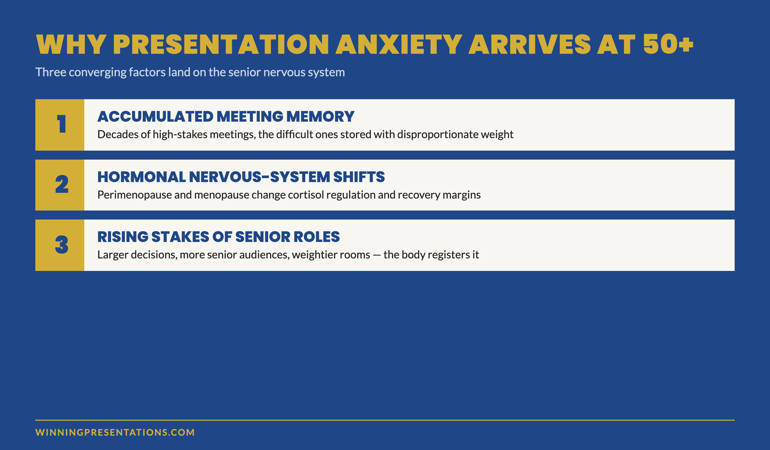
The body that walks into a high-stakes meeting at 53 is not the body that walked into the same kind of meeting at 33. Three things have changed simultaneously, and the combination — not any single factor — produces the pattern.
The first change is accumulated meeting memory. By 50, a senior professional has been in the room for hundreds, sometimes thousands of high-stakes meetings. Most of those went well. A handful did not. The brain stores the difficult ones with disproportionate weight — the chair who interrupted in 2014, the board member who flagged a number you had wrong in 2017, the moment in 2020 you cannot remember without your stomach tightening. None of these meetings ended your career. All of them left a trace. By midlife, the trace is dense enough that the nervous system uses it as a baseline, not an exception.
The second change is hormonal. Perimenopause and menopause shift the body’s stress response in ways that the medical literature is only recently catching up with. Cortisol regulation changes. Sleep architecture changes. The body’s tolerance for sustained activation drops. None of this means the senior leader has become less capable. It means the same meeting load that the body absorbed at 35 produces a different physiological response at 53. The recovery margins are smaller. The same trigger lands harder.
The third change is the rising stakes of senior roles. The presentations themselves are higher-consequence than they used to be. A divisional review at 53 affects more people than a project update at 33 did. The decisions are larger, the audience is more senior, the room has more weight in it. Even when the senior leader does not consciously register this — and most do not — the body does. The activation level the body settles to in the moments before walking in is correctly higher, because the stakes correctly are higher. What used to be a moderate physiological response is now a high one.
None of these is a deficit. All three are accurate physiological responses to actual changes in life and career. The work is not to suppress the response. The work is to give the nervous system something that addresses the actual load — not the load a junior presenter would face.
The three patterns mid-career anxiety takes
Senior professionals describe the anxiety in one of three patterns. Most have one dominant pattern; some shift between them depending on the meeting. Identifying which pattern is in play matters because the recovery work for each is different.
Pattern 1 — The “this used to be easy” pattern
The anxiety surprises you because the meeting type is one you have run hundreds of times. Quarterly reviews. Divisional updates. Pipeline presentations. The format is familiar, the audience is familiar, the material is familiar. And yet the pre-meeting feeling is now what it used to be at the start of your career. The cognitive story is “I should be past this,” which adds a layer of self-judgement on top of the physiological response.
This pattern is most common in senior professionals whose role has not changed recently. The body has shifted underneath the work. The work has not shifted to compensate. The recovery practice for this pattern is centred on rebuilding pre-meeting routines that have quietly fallen away — the morning walk, the printed-deck review, the silence in the car park before going in.
Pattern 2 — The “new role, old body” pattern
You moved into a more senior role in the last 18 months. The presentations are higher-stakes, the audience is more senior, and the body is responding to the larger load — but you are pattern-matching the new role against the routines that worked at the previous level. The old routines were calibrated for a smaller meeting. They are not calibrated for the new one.
This pattern is most common in senior professionals promoted into divisional or executive committee roles in their early fifties. The recovery practice is structural: rebuild the pre-meeting routine specifically for the higher-stakes context, not by intensifying what worked before but by adding components — the longer wind-down the night before, the deliberate physical exercise in the morning, the half hour of silence before the meeting starts.
Pattern 3 — The “physiological background” pattern
The anxiety is not specific to the meeting. The body has shifted into a higher-baseline activation state across many areas of life — sleep is lighter, recovery from a difficult day takes longer, the morning starts at a tension level that used to belong to the afternoon. The presentation anxiety is one expression of a broader nervous-system shift, often associated with perimenopausal or menopausal transitions but also with the cumulative load of a long executive career.
This pattern is most common in senior professionals between 48 and 56. The recovery practice for this pattern is the broadest — it is not specifically about presentations. It is about giving the nervous system the kind of recovery that the body now needs, which is more than it needed at 35.
The 6-week rebuild — what works at this stage of career
The single biggest mistake senior professionals make with mid-career presentation anxiety is borrowing the techniques that worked when they were younger. Power posing in the bathroom mirror, repeating affirmations, shallow box breathing, visualising the audience naked — these are the techniques of junior training programmes, and they were borderline useful for a 28-year-old. For a 53-year-old senior leader with twenty years of meeting memory and a different physiology, they are not the right tools.
What works at this stage is a 6-week rebuild that addresses the actual factors driving the anxiety. The components are not glamorous. They are calibrated for a senior nervous system carrying a senior load.
Week 1–2: Sleep architecture and physical baseline
The first two weeks are not about presentations at all. They are about giving the body a baseline that can absorb the meeting load. The work: tighten the sleep window to a consistent eight-and-a-half hours, remove caffeine after 11am, walk for 45 minutes a day at a pace that is brisk but not gym-intensity, and stop reading email after 8pm. None of this is specific to presentation anxiety. All of it changes the baseline activation level the body brings into a meeting.
Two weeks of this baseline produces a measurable shift in what the body feels like the morning of a high-stakes meeting. The shift is subtle but it is real. Without it, every other piece of the rebuild is being installed on top of an over-activated baseline.
Week 3–4: Pre-meeting structural preparation
Weeks three and four address the cognitive load. Senior professionals at this stage often skip preparation that they consider beneath them — they have run quarterly reviews for fifteen years, why would they need to prepare? The body knows the answer. The familiar meeting still has variability in it; the body is still scanning for the unexpected; the absence of fresh structural preparation leaves the senior brain without a recent anchor to return to under pressure.
The work for these two weeks: print the deck the night before every high-stakes meeting, walk through it once aloud in the morning, name the three points where you most expect challenge, and write the one-sentence response to each. This is not over-preparation. It is the structural anchor that the body uses to settle in the moments before walking in. The more senior the role, the more this matters — because the body has more to settle.
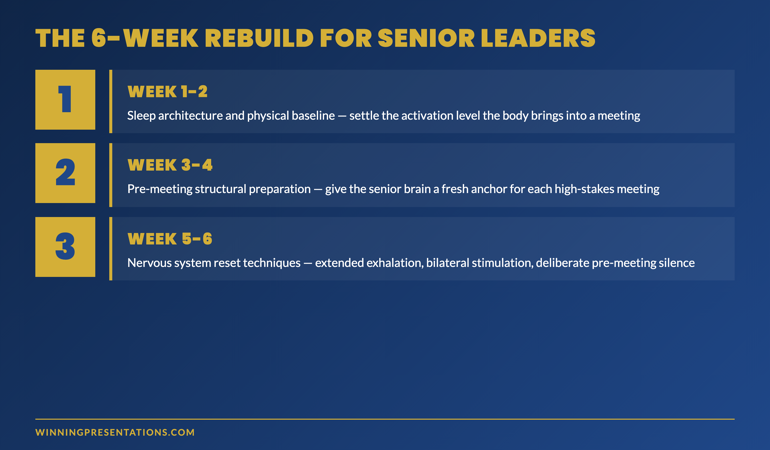
Week 5–6: Nervous system reset techniques
The last two weeks add the techniques that work directly on the nervous system at the level senior professionals need. These are not box breathing or counting backwards from ten. They are slower-onset techniques that produce sustained shifts: extended exhalation breathing (six seconds in, eight seconds out, twelve cycles), bilateral stimulation while walking, and a deliberate 20-minute pre-meeting silence with no input — no phone, no email, no music. The senior nervous system responds to depth more than intensity.
By the end of week six, most senior professionals report a meaningful shift — not the absence of activation, but a return to the baseline they used to know. The body has not gone back to 35. It has settled into the version of itself that 53 actually is.
For the deeper nervous-system work senior leaders need
Conquer Your Fear of Public Speaking — clinical hypnotherapy programme
- Recorded clinical hypnotherapy sessions designed for senior professionals carrying years of accumulated meeting memory
- Works on the embodied response that surface techniques do not reach — the body’s pre-meeting baseline rather than the in-the-moment symptom
- Listen at home before the high-stakes meeting cycle — most senior participants notice a shift inside the first two weeks
- Built on five years of recovery work after my own presentation anxiety in financial services
Conquer Your Fear of Public Speaking — £39, instant access, lifetime use.
Get Conquer Your Fear of Public Speaking →
For senior professionals whose presentation anxiety has returned despite years of confident presenting.
What does not work (and is sometimes still recommended)
A number of techniques persist in mainstream presentation training that do not serve senior professionals well at this stage of career. They are sometimes recommended by well-meaning HR teams, sometimes by general public-speaking coaches, sometimes by colleagues who used them at junior level and have not updated their advice. Knowing what to leave alone is part of the work.
Power posing. The original research has not held up well to replication. For a 28-year-old going into their first board presentation, two minutes of arms-overhead in the bathroom mirror produces a small placebo effect. For a 53-year-old senior leader, it produces nothing useful and can introduce a layer of self-consciousness that makes the next ten minutes worse.
Speaking of preparation routines that need updating with stage of career, my colleague Lara, who runs internal communications at a UK bank, told me she had been using the same five-minute pre-meeting routine since her late twenties and had not noticed how thin it had become for the kind of meeting she now ran. Conquer Your Fear of Public Speaking rebuilds the routine for the senior load — the same insight she described from the inside.
Beta blockers as the primary tool. Many senior professionals reach for propranolol because it works for the acute symptoms — the heart rate stays down, the hand stops shaking. The risk is using the medication as a workaround that prevents the underlying nervous-system rebuild. For occasional acute meetings, beta blockers are reasonable. As the daily strategy for a senior leader presenting weekly, they leave the broader pattern unaddressed and the body does not get the chance to rebuild its own settling capacity.
Visualisation of the audience naked, or any of the other 1980s public-speaking tropes. These work weakly even at junior level. At senior level, they introduce a frame that is incongruent with the audience the body is actually responding to. The body knows the audience is the executive committee. Asking it to imagine otherwise produces dissonance, not calm.
Affirmations and mantras. Repeating “I am calm, I am confident” produces measurable cognitive friction in someone whose body is signalling otherwise. The brain notes the contradiction. The signal that the practice was meant to settle is amplified by the contradiction itself. This is well-documented in the cognitive-behavioural literature and yet still appears in presentation training programmes aimed at senior leaders.
For the physical symptoms in the moment — shaking, racing heart, dry mouth
Calm Under Pressure covers rapid-response techniques for the physical symptoms of presentation anxiety. Methods you can use in the room, in the moment, without anyone noticing — the in-the-meeting layer that complements the longer rebuild work. £19.99, instant access.
Rapid-response techniques for shaking hands, racing heart, trembling voice — designed for senior leaders.
Frequently asked questions
Why has my presentation anxiety come back when I have been confident for twenty years?
Three factors usually combine: accumulated meeting memory whose weight has been growing for years, hormonal nervous-system shifts in the perimenopausal and menopausal years, and the higher stakes of senior-level meetings. None of these means the years of confident presenting were a fluke — they mean the body’s load and capacity have shifted, and the routine that used to absorb the load is now too thin. Rebuilding the routine for the current stage of career is what closes the gap.
Should I tell my colleagues or my manager that I am experiencing this?
Most senior professionals choose not to, and that is a reasonable choice in most environments. The exception is when the anxiety is interfering with attendance or performance to a degree that is becoming visible. In that case, naming it briefly to one trusted person — a peer or a manager who has shown discretion — usually reduces the load rather than increasing it. The fear of being seen tends to be larger than the consequence of being seen.
Is hormone replacement therapy relevant to presentation anxiety in this stage?
For some senior professionals, yes. Where the anxiety is part of a broader perimenopausal or menopausal pattern — sleep disruption, mood shifts, baseline activation rise — addressing the hormonal shift can change the nervous-system baseline that the presentation anxiety is sitting on top of. This is a conversation for a menopause specialist or experienced GP, not a presentation coach. But if you have not had the conversation, it is often worth having before assuming the anxiety is purely psychological.
How long does the 6-week rebuild take to produce a noticeable shift?
Most senior professionals notice a baseline shift in week three — the morning of a high-stakes meeting feels meaningfully different from how it felt at the start. The full rebuild produces a sustainable change by week six. After that, the work becomes maintenance — the components are no longer interventions, they are the new routine. The rebuild does not need to be repeated unless something larger shifts in life or role.
Is clinical hypnotherapy genuinely useful for senior professionals or is it more of a wellness intervention?
Clinical hypnotherapy works on the embodied response that conscious techniques do not reach. For senior professionals carrying decades of accumulated meeting memory, it addresses the specific layer that surface techniques cannot — the body’s pre-meeting baseline rather than the in-the-moment symptom. It is not a replacement for the structural rebuild. It is the component that addresses the part of the pattern the rebuild alone does not reach.
The Winning Edge — weekly newsletter for senior presenters
One framework, one micro-story, one slide pattern — every Thursday morning, ten minutes’ read. For senior professionals who want my best material before it appears anywhere else.
Not ready for the full programme? Start here: download the free Executive Presentation Checklist — a one-page reference for the structural questions every executive deck must answer before the meeting.
For more on the deeper nervous-system work, see what happens in a clinical hypnotherapy session for public speaking.
Mary Beth Hazeldine — Owner & Managing Director, Winning Presentations Ltd. After 24 years in corporate banking at JPMorgan Chase, PwC, Royal Bank of Scotland and Commerzbank, and five years recovering from her own presentation anxiety, she works with senior professionals across financial services, healthcare, and technology on the embodied side of high-stakes presenting.