

When AI Makes You Faster But the Anxiety Doesn’t Fade: Why Confidence Lags Capability
Quick Answer
Confidence lags capability because confidence is built on felt-mastery — the embodied sense that you wrote the material, walked through the data, and earned the recommendation. AI shortens the time to a polished draft but does not produce felt-mastery. The fix is not less AI. It is a deliberate practice that rebuilds felt-mastery after the AI has done the drafting work — three short walk-throughs, a counter-argument rehearsal, and a deliberate roughness pass that puts your voice back into the deck.
On this page
Niamh had been a director of risk in an insurance group for fourteen years. She had presented to the executive committee dozens of times without anxiety. In February she introduced an AI workflow into her quarterly committee deck — Copilot for the data extraction, ChatGPT for the structure. The deck took 90 minutes instead of seven hours. She walked into the meeting and felt, for the first time in years, the cold-stomach feeling she had not had since her first board presentation.
Niamh’s AI workflow had not failed. The deck was good — possibly better than her previous quarterly. What had failed was her felt-sense of having earned it. She had written 11% of the words. The recommendation slide had been her decision but not her drafting. When the chair asked her to walk the committee through the third data point, her stomach dropped — and the body remembered the feeling from years ago even though her capability had grown, not shrunk.
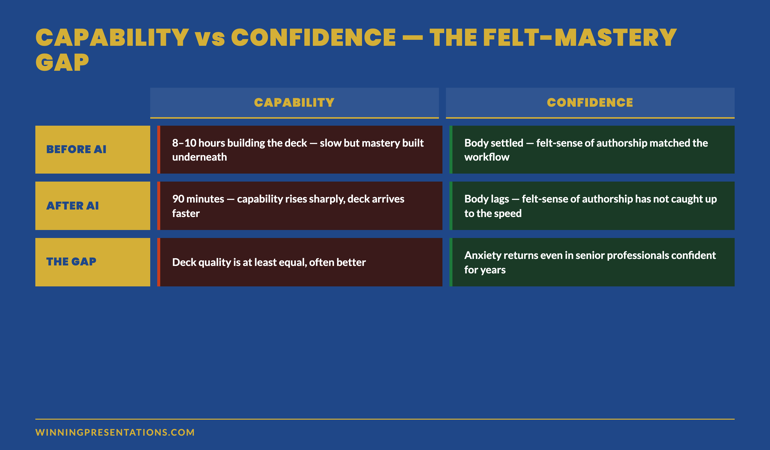
The pattern Niamh experienced is now common across senior leadership. Generative AI cuts the time to a polished deck. The body’s measurement of mastery — built over decades on the felt experience of writing, revising, struggling — does not move at the same speed as the toolset. Capability runs ahead. Confidence lags. The gap shows up as anxiety, even in senior professionals who have not felt it in years.
If presentation anxiety has returned with your AI workflow
It is not because you are doing AI wrong. It is because the body’s mastery measurement runs slower than the toolset. The gap is real, the anxiety is real, and the practice that closes both is well-rehearsed.
Why confidence lags capability — the felt-mastery gap
Confidence in front of a senior audience is not built on the quality of the deck. It is built on the felt-sense that you can answer any question on any slide because you wrote the slide, struggled with the analysis behind it, and chose every number deliberately. That felt-sense is what the body uses to settle the nervous system before a high-stakes meeting.
The traditional path to that felt-sense is slow. Writing a quarterly committee deck used to take eight to ten hours. Most of those hours were not productive in the strict sense — they were re-reading source material, rewriting the recommendation three times, walking the corridor of the office and arguing with yourself about whether the second option deserved more weight. The deck got built. The mastery got built underneath it.
AI shortens the deck to 90 minutes. The deck is built faster — sometimes better. The mastery underneath is not. The body, which uses time-on-task as one of its inputs to the calm-or-anxious calculation, registers something is missing. It is right. The hours of struggle that produced the body’s confidence are no longer in the workflow.
This is not an argument against AI. The time saving is real and substantial. It is an argument for replacing the lost mastery-building hours with a deliberate, condensed practice that rebuilds felt-mastery without rebuilding the deck. Twenty years ago, this practice was not necessary because the workflow itself produced it. In an AI-augmented workflow, the practice has to be added back deliberately.
The three patterns that produce post-AI anxiety
Senior professionals who experience this anxiety report it in three patterns. Most have one dominant pattern; some have a mix. The pattern matters because the recovery practice is different for each.
Pattern 1 — The “I didn’t earn this” feeling
The deck is good. The recommendation is sound. But you cannot shake the sense that you are presenting work you did not fully do. The anxiety lands hardest in the moments before walking into the room. It is mostly cognitive — a story the mind is telling about authorship.
This pattern is most common in senior professionals who have been promoted on the strength of detailed individual work and are still calibrating their identity around delegated and AI-assisted output. The recovery practice for this pattern is the walk-through — three short rehearsals of the deck without the slides, in your own words, until you have re-authored the material in your own voice.
Pattern 2 — The “what if they ask about that figure” feeling
The anxiety surges when you imagine a board member asking about a specific number — and you cannot remember which file Copilot pulled it from. It is mostly anticipatory — fear of the question you will not be able to answer in real time.
This pattern is more common in functions where source provenance matters at meeting time — risk, finance, audit, regulatory affairs. The recovery practice is the source-walk: open every file Copilot referenced and read the original passage that produced each number, in the file’s native context. Twenty minutes restores the source map. The body settles when the map is back.
Pattern 3 — The “this looks too polished” feeling
The anxiety is about the deck itself looking machine-drafted — even if no specific phrase reads obviously AI. It is mostly aesthetic — fear that the audience will register a tonal evenness that says “no human wrote this.” The fear is specific to the moment the deck appears on the screen.
This pattern is more common in senior professionals presenting to peer audiences (other senior leaders) rather than reporting up. The recovery practice is the deliberate-roughness pass: rewrite three to five bullets in slightly less polished language, add one specific anecdote or hand-drawn detail, leave one chart with the slightly off-axis labels Copilot produced. The polish drops a notch. The deck reads as authored.
The practice that closes the gap in 45 minutes
The recovery practice has four moves. Together they take 45 minutes — substantially less than the hours of struggle the AI removed, but enough to rebuild felt-mastery before the meeting. The order matters: the first move addresses authorship, the second evidence, the third response readiness, the fourth tone.
Move 1 — Three walk-throughs (15 minutes)
Print the deck. Stand up. Walk to the back of the room. Talk through the deck out loud, in your own words, without reading the slides. Do this three times. The first walk-through will be halting. The second will surface the slides where you do not yet have your own language. The third will sound like you.
The walk-through is the single highest-leverage practice for closing the felt-mastery gap. Speaking the material in your own words re-authors it in the body. The deck stops feeling like AI’s output and starts feeling like yours.
Move 2 — The source-walk (15 minutes)
Open every source file Copilot or ChatGPT referenced. Read the original passage that produced each number on the deck. Note the page or table reference next to each number on your printed copy. The exercise is not about catching errors (those should have been caught at the editorial stage). It is about restoring the source map in your memory.
If a senior audience asks “where does that come from,” the body’s calm response depends on whether you can name the source instantly. Twenty minutes of source-walk produces that calm without rebuilding the deck.
Move 3 — The counter-argument rehearsal (10 minutes)
Write down the three sharpest objections the audience could raise — the ones an experienced critic would lead with, not the polite ones. Write a two-sentence response to each. Read each pair aloud. Adjust until the response feels true rather than scripted.
This move addresses Pattern 2 anxiety directly. It also produces a side benefit: when an objection arrives in the meeting, the body recognises it from the rehearsal and stays calm. The practice that built into the work in the old workflow needs to be done deliberately in the AI-augmented one.
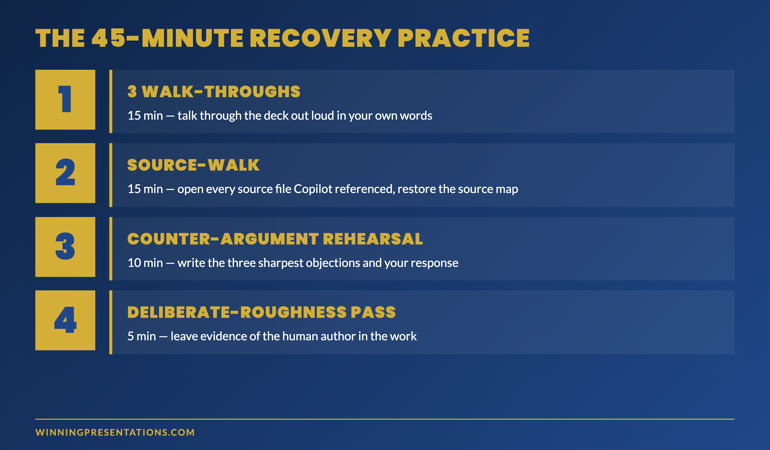
Move 4 — The deliberate-roughness pass (5 minutes)
Open the deck one more time. Rewrite three bullets in slightly less polished language. Add one specific human detail to the recommendation slide — a date, a name, a sentence in your normal speaking voice. Leave one of Copilot’s slightly imperfect chart labels alone if it is structurally accurate. The point is not to make the deck worse. The point is to leave evidence of the human author in the work.
Senior audiences register the absence of this evidence. The deliberate-roughness pass adds it back without compromising the structural quality.
When the anxiety is the story the body keeps telling
Conquer Your Fear of Public Speaking — clinical hypnotherapy programme
- Six recorded clinical hypnotherapy sessions designed for senior professionals with returning presentation anxiety
- Addresses the embodied response, not just the cognitive story — works on the body’s pre-meeting nervous system
- Listen at home before the high-stakes meeting cycle — most participants notice a shift inside two weeks
- Built on five years of recovery work after my own presentation anxiety in financial services
Conquer Your Fear of Public Speaking — £39, instant access, lifetime use.
Get Conquer Your Fear of Public Speaking →
For senior professionals whose anxiety has returned despite years of confident presenting.
When the anxiety is older than the AI workflow
The patterns above describe new anxiety triggered by an AI workflow change. Some senior professionals have presentation anxiety that predates AI by years or decades. The 45-minute practice helps at the margin, but the underlying work is broader.
Three indicators that the anxiety is older than the workflow:
- The anxiety appears before any meeting, regardless of whether AI was used to draft
- The physical symptoms — racing heart, shaking hands, dry mouth — feel familiar from before AI tools existed in your workflow
- The anxiety persists even after a meeting has gone well — the body does not register the success
If two or more of these are present, the work to do is different. The 45-minute practice closes the felt-mastery gap; it does not address the underlying nervous system pattern that drives chronic presentation anxiety. For that, the rapid-response techniques in Calm Under Pressure and the deeper hypnotherapy work in Conquer Your Fear of Public Speaking are designed to work on the embodied response itself rather than the cognitive story around it.
For senior professionals managing both — chronic anxiety plus AI-introduced anxiety — start with the embodied work. The cognitive pattern reduces faster once the body has settled.
For the physical symptoms — racing heart, shaking, dry mouth
Calm Under Pressure covers the rapid-response techniques for the physical symptoms of presentation anxiety — methods you can use in the room, in the moment, without anyone noticing. £19.99, instant access.
Rapid-response techniques for shaking hands, racing heart, trembling voice.
Frequently asked questions
Should I stop using AI to draft my decks if it is making me anxious?
For most senior professionals, no. The time saving is substantial and the structural quality of AI-assisted decks tends to be at least as good as hand-drafted. The fix is not to remove the tool. It is to add the 45-minute felt-mastery practice that the old workflow produced organically. The practice replaces the lost mastery-building time without giving up the AI productivity gain.
Will the gap close on its own once I have done more AI-assisted decks?
Partially. The novelty of the workflow does fade with repetition, and that takes some edge off the cognitive pattern. But the felt-mastery component does not auto-correct without deliberate practice. Senior professionals who skip the 45-minute practice and just do more AI-assisted decks tend to report the anxiety lingering longer — sometimes for months — rather than closing.
Is this just regular presentation nerves dressed up in AI language?
The physiology is identical. The trigger is new. Senior professionals who had not experienced presentation anxiety for years are experiencing it again specifically in AI-augmented workflows, and the recovery practices that worked for ordinary first-time-presenter nerves do not address the felt-mastery gap directly. The combination — old physiology, new trigger — is what makes a targeted practice necessary.
How quickly does the practice close the gap?
For most senior professionals, the first run of the 45-minute practice produces a noticeable reduction in pre-meeting anxiety. By the third or fourth deck, the practice can often be compressed — two walk-throughs instead of three, ten minutes of source-walk instead of fifteen. Once the body has rebuilt the felt-mastery measurement around AI-assisted decks, the practice becomes maintenance rather than restoration.
The Winning Edge — weekly newsletter for senior presenters
One framework, one micro-story, one slide pattern — every Thursday morning, ten minutes’ read. For senior professionals who want my best material before it appears anywhere else.
Not ready for the full programme? Start here: download the free Executive Presentation Checklist — a one-page reference for the structural questions every executive deck must answer before the meeting.
For more on AI-specific anxiety patterns, see speaking anxiety before AI-drafted presentations.
Mary Beth Hazeldine — Owner & Managing Director, Winning Presentations Ltd. After 24 years in corporate banking and five years recovering from her own presentation anxiety, she works with senior professionals across financial services, healthcare, and technology on the embodied side of high-stakes presenting.