

Partnership Proposal Presentation: The 4-Slide Structure That Gets Board Approval in One Meeting
Partnership Proposal Presentation: The 4-Slide Structure That Gets Board Approval in One Meeting
Lena spent six weeks preparing a partnership proposal for a logistics company’s board. She had 28 slides. Competitive analysis. Market sizing. Risk matrices. Implementation timelines stretching to 2028.
The board chair stopped her on slide 9. “Lena, what do you actually want us to decide today?”
She had buried the partnership ask behind 8 slides of context. The meeting ended with “let’s reconvene.” Three months later, a competitor closed the deal she’d been building for a year.
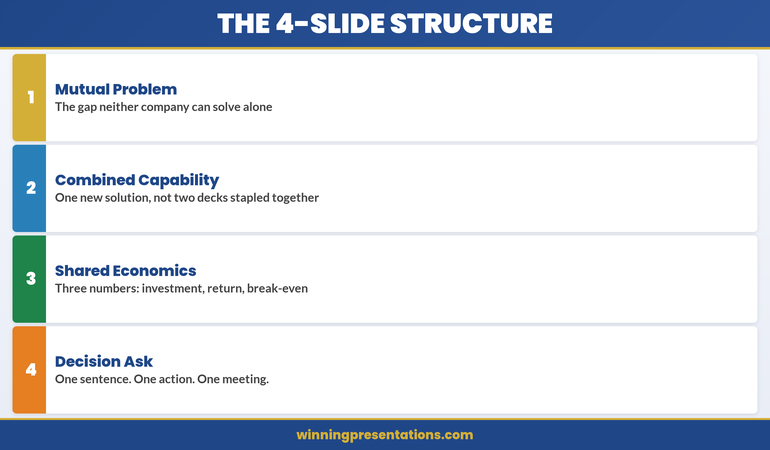
Quick Answer: A partnership proposal presentation that wins in one meeting follows a 4-slide structure: mutual problem, combined capability, shared economics, and a single decision ask. Most partnership pitches fail because they present two companies’ capabilities instead of one shared outcome. The structure below eliminates the “let’s reconvene” response by making the decision inevitable before slide 5.
Partnership proposal structure
Can you articulate these three elements clearly: the shared problem, the combined capability, and the single decision you’re seeking?
→ Explore the Executive Slide System for decision-first templates → View templates
What you’ll find in this article:
- Why most partnership presentations get “let’s reconvene”
- The 4-slide structure that closes in one meeting
- Slide 1: The mutual problem neither company can solve alone
- Slide 2: Combined capability (not two capability decks stapled together)
- Slide 3: Shared economics that make the decision obvious
- Slide 4: The decision ask
- Frequently Asked Questions
I once watched a partnership proposal die in the most instructive way possible.
Two pharmaceutical companies — one with distribution, one with IP — were trying to bring a diagnostic product to market. The presenting team built a 34-slide deck. Slides 1–12 covered Company A’s capabilities. Slides 13–24 covered Company B’s capabilities. Slides 25–30 covered “synergies.” Slides 31–34 covered implementation.
The problem? The board saw two capability presentations stapled together. There was no shared problem. No combined economic model. No single decision they could say yes to.
The chair said: “This looks like two companies that want something from each other. Show me what the customer gets that they can’t get today.”
That feedback changed how I think about every partnership proposal. The structure isn’t two companies presenting side by side. It’s one new entity presenting a solution that didn’t exist before.
When I rebuilt the deck around that principle — mutual problem, combined capability, shared economics, single ask — the same board approved it in 40 minutes. Same companies. Same product. Different structure.
Why Most Partnership Proposals Get the “Let’s Reconvene” Response
Partnership presentations fail for a different reason than other executive pitches. They don’t fail because the idea is weak. They fail because the structure creates confusion about who benefits and what the decision actually is.
Most partnership decks follow this pattern: “Here’s what we do. Here’s what they do. Together, we’ll do more.” That sounds logical. It’s also the fastest route to deferral.
Boards and executive committees approve decisions, not concepts. When a partnership proposal presents two sets of capabilities, the audience has to do the synthesis work themselves. They have to imagine the combined offering. They have to calculate the shared economics. They have to figure out what they’re actually being asked to approve.
Most won’t. They’ll say “interesting — let’s schedule a follow-up” and move to the next agenda item.
The fix isn’t more slides or better data. It’s a structural change that moves the audience from “two companies presenting” to “one solution requesting approval.” That’s the difference between a 6-month partnership courtship and a 40-minute decision. A strong decision slide is the foundation of every partnership deck that gets approved in a single session.
The 4-Slide Structure That Closes a Partnership in One Meeting
This structure works because it mirrors how executive committees actually make decisions about partnerships. They don’t evaluate each company separately. They evaluate the proposition.
Slide 1: The Mutual Problem — What market gap or customer pain exists that neither company can address alone?
Slide 2: The Combined Capability — What does the partnership create that’s new? Not “Company A does X, Company B does Y.” Rather: “Together, we deliver Z, which doesn’t exist today.”
Slide 3: The Shared Economics — Revenue model, cost structure, and year-one projections. One model, not two.
Slide 4: The Decision Ask — What exactly do you need approved today? Scope, timeline, and the single next step.
Everything else — competitive analysis, risk assessments, implementation details — goes in the appendix. Available if asked. Never presented unprompted.
⭐ Maven Flagship — Executive Buy-In
Turn reluctant stakeholders into active advocates
The Executive Buy-In Presentation System is a self-paced programme with 7 modules. Enrol with this month’s cohort, work through at your own pace — optional live Q&A calls are fully recorded.
£499, lifetime access to materials.
Slide 1: The Mutual Problem Neither Company Can Solve Alone
This is the most important slide in the deck. It sets the entire frame for the decision.
Most partnership proposals skip this slide entirely or replace it with “market opportunity.” That’s a mistake. Market opportunity tells the audience the prize is worth winning. The mutual problem tells them why they can’t win it alone.
The structure is simple. One sentence for the customer pain. One sentence for why Company A can’t solve it alone. One sentence for why Company B can’t solve it alone. One sentence for what happens if neither company acts.
For the pharma partnership I mentioned, the mutual problem slide read: “Oncology practices need point-of-care diagnostics that integrate with existing lab workflows. We have the diagnostic IP but no distribution infrastructure. They have distribution in 4,200 oncologypractices but no proprietary diagnostic products. Without a partnership, the market defaults to the incumbent — and neither company captures the £340M opportunity.”
That slide did more work than the other 33 combined. It told the board exactly why this partnership mattered and what was at stake. Effective stakeholder mapping before the meeting ensures you know exactly whose concerns to address in this opening frame.
Slide 2: Combined Capability (Not Two Capability Decks Stapled Together)
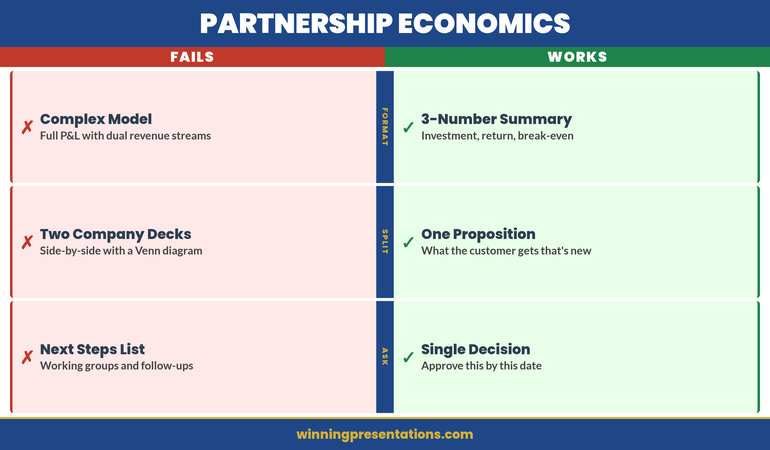
This is where most partnership presentations go wrong. They present Company A’s strengths on the left and Company B’s strengths on the right, with a Venn diagram in the middle showing “overlap.”
Boards don’t invest in Venn diagrams. They invest in solutions.
Slide 2 should describe the new thing the partnership creates. Not what each company brings. What the customer receives that doesn’t exist today.
Instead of: “Company A: 15 years of diagnostic IP. Company B: 4,200-site distribution network.”
Write: “Together: point-of-care oncology diagnostics delivered to 4,200 practices within 18 months — a product-distribution combination no single competitor can replicate.”
The shift is from inputs (what each company contributes) to outputs (what the partnership delivers). Inputs interest internal teams. Outputs interest boards. Every approval I’ve seen land in one meeting made this shift explicitly on slide 2.
Slide 3: Shared Economics That Make the Decision Obvious
Partnership economics are inherently more complex than single-company financials. Two revenue streams, two cost structures, shared investment, and split returns. Most presenters try to show all of this.
Don’t. Show the combined model only.
The board needs three numbers: total investment required, projected year-one return, and break-even timeline. Everything else is appendix material.
The format that works: a single-page financial summary with three rows. Row one: “Joint investment — £X.” Row two: “Year-one projected revenue — £Y.” Row three: “Break-even — Z months.”
Below that, one sentence on how revenue splits. Not a detailed financial model. Just: “Revenue split: 60/40 in favour of distribution partner, reviewed annually.”
Executives approve partnerships faster when the economics are simple enough to explain to their own boards in one sentence. If your economics slide needs a 10-minute walkthrough, it’s too complex for a decision meeting. Understanding how executives evaluate proposals — especially in contexts like vendor selection decisions — reveals why simplicity always wins.
Partnership Proposal Templates Ready to Use
Pre-built slide templates for partnership proposals and strategic recommendations, structured around the mutual problem, combined capability, shared economics, and decision ask.
Explore the Executive Slide System →
Used in cross-border partnership presentations at financial institutions and consulting firms.
Slide 4: The Decision Ask — One Sentence, One Action
The decision slide is where partnership proposals either close or stall. Most presenters end with “next steps” — a list of follow-up actions, working groups to form, and timelines to agree.
That’s not a decision. That’s a project plan. And boards don’t approve project plans in decision meetings.
The decision slide needs one sentence: “We are asking for approval to [specific action] by [specific date], with an initial investment of [specific amount].”
For the pharma partnership: “We are asking for board approval to execute the distribution partnership agreement with [Company B], with a joint investment of £2.1M and first product delivery targeted for Q3 2026.”
One sentence. One decision. One meeting.
If the board has questions — and they will — the appendix handles those. But the decision frame is set. They’re not evaluating a concept. They’re saying yes or no to a specific ask.
What Belongs in the Appendix (And What Doesn’t)
The 4-slide structure works because it’s lean. But that doesn’t mean you ignore the details. You just put them where they belong: ready for questions, never presented unprompted.
Appendix material for a partnership proposal includes competitive landscape analysis, detailed implementation timeline, full financial model with sensitivity analysis, legal and governance structure, and risk assessment with mitigation strategies.
What doesn’t belong in the appendix? Anything that changes the decision. If there’s a deal-breaking risk or a regulatory hurdle, that goes on slide 3 as a caveat, not hidden in appendix slide 14.
The rule I follow: if hiding it would embarrass you, it’s not appendix material. Put it on the main slide. Everything else can wait for questions.
Managing Presentation Confidence in Partnership Pitches
The 4-slide structure removes ambiguity from the room — but only if you’re able to deliver it with clarity. Presentation confidence matters in high-stakes partnership meetings. I’ve written about how to manage presentation anxiety using evidence-based approaches.
Is This Right for You?
✓ This is for you if:
- You’re presenting a partnership, joint venture, or strategic alliance proposal to a board or executive committee
- Your partnership discussions have stalled in “let’s keep talking” without a clear decision
- You want a slide structure that moves from concept to approval in a single meeting
✗ This is NOT for you if:
- You’re creating a general company overview or capability deck (not a partnership-specific pitch)
- You need a legal partnership agreement rather than a presentation structure
- The partnership has already been approved and you need implementation planning
Frequently Asked Questions
How do I handle partnership presentations when the other company wants their own slides in the deck?
This is the most common partnership presentation mistake. The answer is to build one unified deck together, not staple two decks side by side. Propose the 4-slide structure as the joint approach and offer to draft it. The company that controls the narrative controls the decision frame. If they insist on separate sections, add their content as appendix material and keep the core 4 slides focused on the combined proposition.
What if the board wants more financial detail than 3 numbers?
They will. That’s what the appendix is for. Present the 3-number summary on slide 3, then say: “The full financial model is in the appendix — happy to walk through any line item.” This lets the board control the depth. In my experience, most boards ask about one or two specific assumptions, not the full model. The 3-number summary gives them the decision frame; the appendix gives them the assurance.
Does this structure work for internal partnerships between departments, not just external ones?
Absolutely — and internal partnerships often need this structure even more. Cross-departmental initiatives frequently die because the proposal reads like two departments justifying their own budgets. The mutual problem slide is particularly powerful internally: “Neither Engineering nor Marketing can solve the customer onboarding bottleneck alone. Together, we can reduce time-to-value from 45 days to 12.” Same structure, same decision clarity.
📬 The Winning Edge — Weekly Presentation Intelligence
Join executives who receive one actionable presentation insight every week. Proposal structures, slide frameworks, and decision-making psychology — directly applicable to your next partnership pitch.
🆓 Want to start free? Download the Executive Presentation Checklist first.
Read next: The 48-Hour Window After Every Q&A: Why Most Presentations Win the Room but Lose the Decision
Your next partnership proposal doesn’t need 28 slides. It needs 4. Download the Executive Slide System before your next joint meeting and build the proposal that gets approved in one session.
About the Author
Mary Beth Hazeldine is Owner & Managing Director of Winning Presentations. With 24 years of corporate banking experience at JPMorgan Chase, PwC, Royal Bank of Scotland, and Commerzbank, she advises executives across financial services, healthcare, technology, and government on structuring presentations for high-stakes funding rounds and approvals.