

The Comparison Trap: Why Watching Great Speakers Makes Your Anxiety Worse (Not Better)
Quick Answer
Watching skilled speakers when you’re already anxious doesn’t motivate—it triggers comparison and reinforces the belief that you’re not good enough. Your nervous system reads it as evidence you can’t measure up, not inspiration to improve. Breaking the pattern requires understanding what anxiety actually does to your brain, then rewiring how you relate to your own speaking challenges.
Does This Sound Like You?
- You watch a polished TED talk and feel worse about your own presentation skills
- You study “great speakers” hoping to feel more confident—but feel more anxious instead
- You compare every moment of your delivery to speakers who have years of practice (but you only notice their polish, not their process)
- The more “speaker content” you consume, the more self-doubt creeps in
- You spiral into “I could never do that” thinking before major presentations
Jump to Section
- The CFO Who Couldn’t Breathe During Board Announcements
- How the Comparison Trap Hijacks Your Nervous System
- You’re Watching Highlight Reels, Not Real Practice
- The Faulty Logic of Anxiety-Driven Learning
- What Actually Reduces Speaking Anxiety (It’s Not Speaker Videos)
- Reframing: From Comparison to Nervous System Regulation
He’d started watching YouTube videos of confident CFOs presenting. Financial analysts at Ted talks. Executives delivering flawless earnings calls. The more he watched, the worse the anxiety got. He wasn’t learning confidence. He was collecting evidence that he didn’t measure up. He didn’t need better financial analysis. He needed his body to feel safe in that boardroom.
Stop Measuring Yourself Against Speaker Highlight Reels
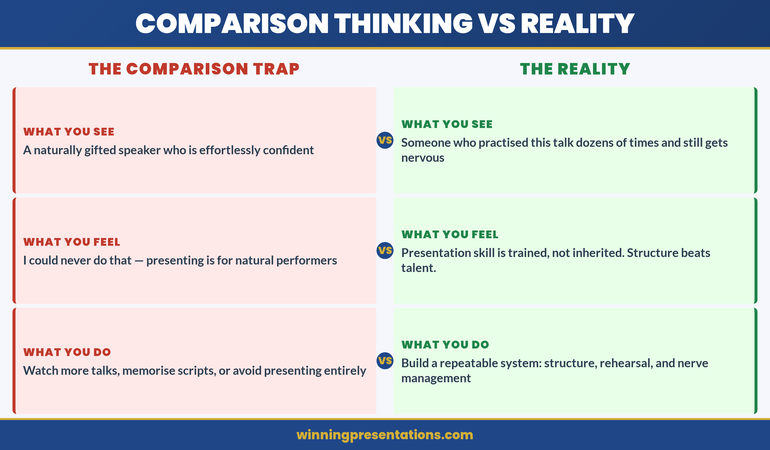
The primary problem with using other speakers’ performances as your learning benchmark is that you’re comparing your full, unfiltered reality—including anxiety, self-doubt, and visible struggle—to someone else’s highlight reel.
What you see: A polished delivery, perfect pacing, no visible nerves.
What you don’t see:
- Their first 50 presentations (where they were terrible)
- The speaking situations where they failed and learned
- How they actually feel in their body during presentations
- The years of practice hidden behind 18 minutes of TED talk
- Their current anxiety triggers and vulnerabilities
When your nervous system is already primed for threat (which it is when you’re presentation-anxious), watching someone else’s polished performance reads as evidence that you’re deficient. Your brain doesn’t think, “That looks learnable.” It thinks, “I could never do that.”
The pattern that keeps you stuck: Watch skilled speaker → Feel inadequate → Try harder → Rehearse obsessively → Anxiety increases anyway → Watch more speakers to feel better → Repeat.
The Conquer Speaking Fear programme (£39) breaks this cycle by teaching you how your nervous system actually works during presentations—using clinical hypnotherapy and NLP techniques to regulate anxiety at the source, rather than trying to out-skill your fear.
You’re Watching Highlight Reels, Not Real Practice
Here’s what gets hidden when you study great speakers: their learning curve. The neurobiologist who delivers a brilliant TED talk has probably given that talk a thousand times. The executive coach who looks totally composed has probably felt exactly as anxious as you do.
But you don’t see that journey. You only see the highlight.
This creates a dangerous assumption in your brain: They’re naturally good at this. I’m naturally anxious. We’re different.
That difference isn’t skill. It’s practice. It’s repetition. It’s nervous system regulation they learned (usually by trial and error, not by watching other people).
When you’re already battling presentation anxiety, consuming more “great speaker” content doesn’t close the gap. It widens it. Because every polished performance feels like evidence that the gap is wider than you thought.
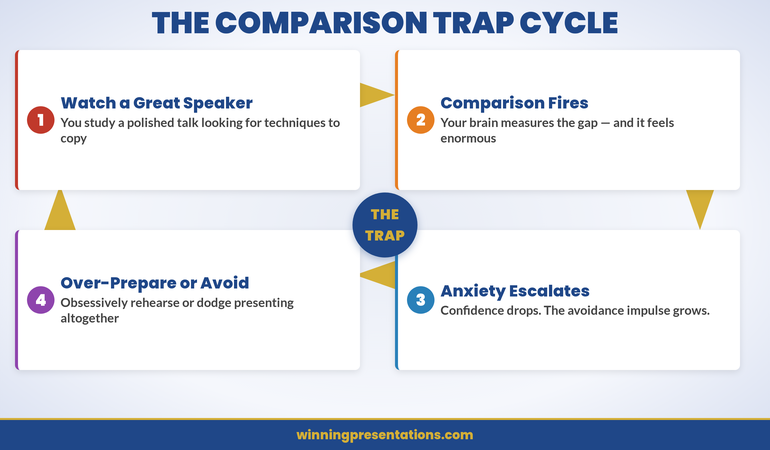
How the Comparison Trap Hijacks Your Nervous System
Your nervous system has a job: keep you safe. When you’re presentation-anxious, it’s already in a heightened state of alert. Your body is primed to notice threat.
Then you watch a skilled speaker deliver flawlessly. In that moment, your nervous system interprets the signal as: That’s the standard you need to meet. You’re not meeting it. You are unsafe/failing.
This isn’t a logic problem. It’s a nervous system problem. The more speakers you watch, the more evidence your system collects that you don’t measure up.
The comparison trap doesn’t just affect your confidence. It actually heightens physiological anxiety: increased heart rate, shallow breathing, cortisol release. It’s not just negative thinking. Your body is responding to what feels like a threat assessment.
This is why “just practice more” or “study great speakers” advice often backfires. You’re adding pressure on top of an already dysregulated nervous system.
The Faulty Logic of Anxiety-Driven Learning
Anxiety has a particular way of “teaching” you. It shows you problems, not solutions. When you’re anxious about presentations, your brain highlights:
- Everything that could go wrong
- Every way you might fail
- Every person watching who might judge you
- Every flaw in your delivery compared to “better” speakers
Then you try to solve this by consuming more speaker content—thinking you’ll find the “right” way to do it. But you’re not learning the right way. You’re reinforcing the belief that there’s a standard you’re failing to meet.
This is learning through threat, not learning through mastery. And it doesn’t stick. It just creates more anxiety.
What actually works is learning how to regulate your nervous system first, then practicing presentation skills from a calmer, more resourced state. That’s when learning actually happens. That’s when confidence builds—not from watching someone else do it perfectly, but from your own body learning that you can manage the situation.
Feeling the comparison spiral right now? This is exactly what Conquer Speaking Fear addresses: how to interrupt the anxiety pattern before it becomes your default response.
What Actually Reduces Speaking Anxiety (It’s Not Speaker Videos)
The research on anxiety reduction is clear: exposure to threat (like watching skilled speakers when you’re anxious) doesn’t reduce fear. What reduces fear is regulated exposure to manageable challenge, combined with nervous system techniques that help your body learn the situation is safe.
That’s the gap most presentation advice misses. You don’t need:
- More tips on body language
- More examples of “perfect” presentations
- More pressure to match someone else’s standard
You need your nervous system to feel safe while you practice. You need techniques that actually work at the physiological level. You need to build confidence through your own success, not through comparison to others.
Reframing: From Comparison to Nervous System Regulation
The shift from “I need to watch better speakers to learn” to “I need to regulate my nervous system to perform” changes everything.
Instead of:
- Watching great speakers → feeling worse
- Rehearsing obsessively → staying anxious
- Comparing yourself → spiralling into self-doubt
You’d be:
- Learning how your body responds under pressure
- Practising techniques that actually calm your nervous system
- Building confidence through managing your anxiety, not copying someone else’s skill
- Developing a genuine sense of readiness, not just borrowed confidence from studying others
Stop Rehearsing What They’re Thinking About You
Here’s what happens in the comparison trap: you’re not just watching speakers. You’re imagining what the audience will think of you compared to them. You’re rehearsing judgment in your head.
This creates a secondary anxiety layer. Now you’re anxious about the presentation and anxious about being judged as “not good enough.”
That’s where nervous system regulation techniques become essential. Not to pump yourself up with false confidence. But to actually interrupt the fear response at the source.
The Conquer Speaking Fear programme uses evidence-based techniques from clinical hypnotherapy and NLP to help your nervous system feel safe during presentations—not just think positive thoughts about them.
Is This Right For You?
This approach is for you if:
- You’ve studied great speakers and it hasn’t reduced your anxiety (it may have increased it)
- You’re rehearsing presentations obsessively but still feel nervous before delivering
- Comparison is part of your anxiety pattern—you measure yourself against others
- You want to feel genuinely confident, not just “get through” presentations
- You’re ready to work on the nervous system level, not just the skills level
From Speaking Terror to Teaching Others
That CFO who couldn’t breathe in the boardroom? He didn’t stop being anxious by watching more successful financial leaders or studying presentation techniques. He stopped by learning how his nervous system actually worked during high-pressure situations. Once he understood that, he could regulate it.
Within 18 months, he went from dreading board announcements to volunteering to lead quarterly presentations to the full board. He didn’t become naturally good at presenting. He learned to manage his nervous system well enough that anxiety stopped controlling his performance.
Three years later, he’s mentoring other finance leaders through their presentation anxiety. Not because he became a “natural presenter.” But because he learned the one thing most presentation advice skips: how to work with your nervous system instead of against it.
The Conquer Speaking Fear programme (£39) condenses that learning curve into a structured programme using clinical hypnotherapy and NLP to create lasting change. You get the nervous system techniques that actually work. Not tips. Not tricks. Tools that work at the physiological level.
📊 Want to improve your slides?
Preparation reduces anxiety. The Executive Slide System (£39) includes confident-presenter templates designed to minimise preparation stress.
People Also Ask
Does watching great speakers actually help with presentation anxiety?
For some people, watching skilled speakers can be motivating. But if you’re already anxious about presenting, it often increases comparison and self-doubt. The key difference is your nervous system state when you watch. If you’re primed for threat, you’ll interpret polished performances as evidence you’re not good enough. Nervous system regulation should come first; learning through observation should come later.
How long does it take to get over presentation anxiety?
It depends on your approach. If you’re trying to “think positive” or “rehearse more,” it often takes months or years—and can actually worsen anxiety. If you’re working directly with nervous system regulation techniques, most people notice significant shifts within 2-4 weeks. The foundation changes quickly; building full confidence takes longer, but you’re working from a much more resourced place.
Can I stop being anxious about presentations if I’m naturally an anxious person?
Yes. “Naturally anxious” usually means your nervous system is sensitised to threat more readily than others’—not that you’re broken or incapable. With the right nervous system tools, you can learn to regulate that sensitivity in specific situations (like presentations). You don’t become a different person. You become someone whose anxiety no longer controls their performance.
FAQ
Should I completely stop watching other speakers?
Not necessarily. The issue isn’t watching speakers; it’s when you watch them and why. If you’re watching them to learn a specific technique and you’re in a calm, resourced state, that can be valuable. If you’re watching them because you’re anxious and hoping to feel better, that usually backfires. Focus first on nervous system regulation. Then, from a calmer place, you can observe and learn without the comparison trap activating.
Is presentation anxiety the same as general anxiety disorder?
Not exactly. Presentation anxiety is specific to the performance situation. You might be calm in most areas of life but dysregulated when presenting. This specificity is actually an advantage—you can work directly with the nervous system triggers in that context. If you have generalised anxiety, presentation anxiety might be one manifestation of that larger pattern, and you’d want support for both.
If I fix my nervous system, will I need less practice?
No, but your practice will be more effective. Right now, if you’re anxious, you might be rehearsing obsessively and still not feeling confident—because anxiety is hijacking your learning. Once your nervous system is regulated, your practice time creates actual skill development and real confidence. You’ll likely need smarter practice, not necessarily more practice.
Ready to Stop the Comparison Cycle?
Join The Winning Edge newsletter for weekly strategies on nervous system regulation, presentation confidence, and the counter-intuitive approaches that actually reduce anxiety.
🆓 Free resource: Get the Checklist — a free guide to strengthen your presentation preparation.
Download your free Executive Presentation Checklist – the exact preparation system that reduces anxiety at each stage of your presentation process.
Next: Plan B: Handling Unexpected Questions in Senior Presentations
Deep Dive: Breaking the Audience Judgment Anxiety Loop: What Actually Happens in Your Nervous System
Related: Why Presentation Perfectionism Fuels Your Anxiety (Not Excellence)
Advanced: Glossophobia in C-Suite Contexts: When Fear of Speaking Threatens Leadership Credibility
About the Author
Mary Beth Hazeldine is a presentation coach and nervous system specialist working with senior leaders and executives. She’s trained over 3,000 professionals to move from presentation anxiety to genuine confidence—by working at the nervous system level, not just the skills level. She’s the creator of the Conquer Speaking Fear programme and the Executive Slide System.