

Risk Committee Q&A: The 5 Questions That Silence Even the Most Prepared Executives
I once watched a VP of Operations present a £3 million risk mitigation plan to her company’s risk committee. She had 47 metrics on her dashboard. She knew every number. But when the Chief Risk Officer asked, “What’s the one thing in your plan you’re least confident about?” she froze.
She couldn’t answer because she’d prepared for every question except the ones about her own uncertainty. The risk committee wasn’t testing her confidence. They were testing whether she understood the limits of her own knowledge. She failed that test in seven seconds of silence.
The vote to approve her plan got deferred. Not because her mitigation approach was weak. But because her Q&A revealed that she hadn’t mapped her own blind spots — and a risk committee’s job is precisely to find blind spots before they become losses.
Risk committee Q&A is a distinct discipline. The questions are sharper, the scepticism is structural, and the threshold for credibility is higher. This isn’t steering committee Q&A or board update Q&A. Risk committees exist to challenge assumptions and surface exposure. Your preparation must reflect that.
This article gives you the exact taxonomy of risk committee questions and the preparation framework that turns hostile Q&A into a credibility moment.
Preparing for a risk committee in the next 30 days?
Most executives prepare for capability questions. Risk committees test something different: whether you understand your own blind spots. The Executive Q&A Handling System includes a Question Map framework specifically structured for risk, audit, and governance committee Q&A.
Why Risk Committee Q&A Exposes Blind Spots Other Committees Miss
Most executives prepare for executive Q&A the same way regardless of the audience. They prepare for capability questions, financial impact questions, timeline questions. Standard executive fare. This approach will fail in front of a risk committee.
Risk committees operate from a different agenda entirely. While a steering committee is asking “will this work?” and “what does it cost?”, a risk committee is asking “what could go wrong that we haven’t considered?” and “how do you know that?” The psychology is adversarial by design. Risk committee members are professional sceptics. Their job depends on finding the gaps in your thinking.
The gap that most presenters miss is the distinction between demonstrating competence and demonstrating risk awareness. You can walk into a risk committee meeting thoroughly prepared to defend your strategy, but if you haven’t prepared for questions about what you don’t know, the committee will expose that gap within the first four minutes of Q&A. And once credibility is damaged, no amount of capability data recovers it.
Risk committees are also heterogeneous in their expertise. Your audience typically includes an internal Chief Risk Officer (highly technical, familiar with risk frameworks and ISO standards), an external risk or compliance specialist (often with a regulatory lens), and business leaders who sit on the committee for governance rather than technical depth. This means your Q&A must navigate different levels of sophistication simultaneously — you can’t assume the group shares the same risk literacy.
The questions that expose blind spots fall into five categories. Each category tests a different kind of credibility: your understanding of exposure, your confidence in your assumptions, your awareness of gaps, your execution track record, and your alignment with the board’s risk appetite. Most executives prepare for one or two of these. Risk committees test all five.
The Five Question Types That Dominate Risk Committee Q&A
Understanding the taxonomy of risk committee questions is half the preparation battle. Once you know what type of question is coming, you can prepare a scenario-specific answer rather than hoping for a question you’ve rehearsed.
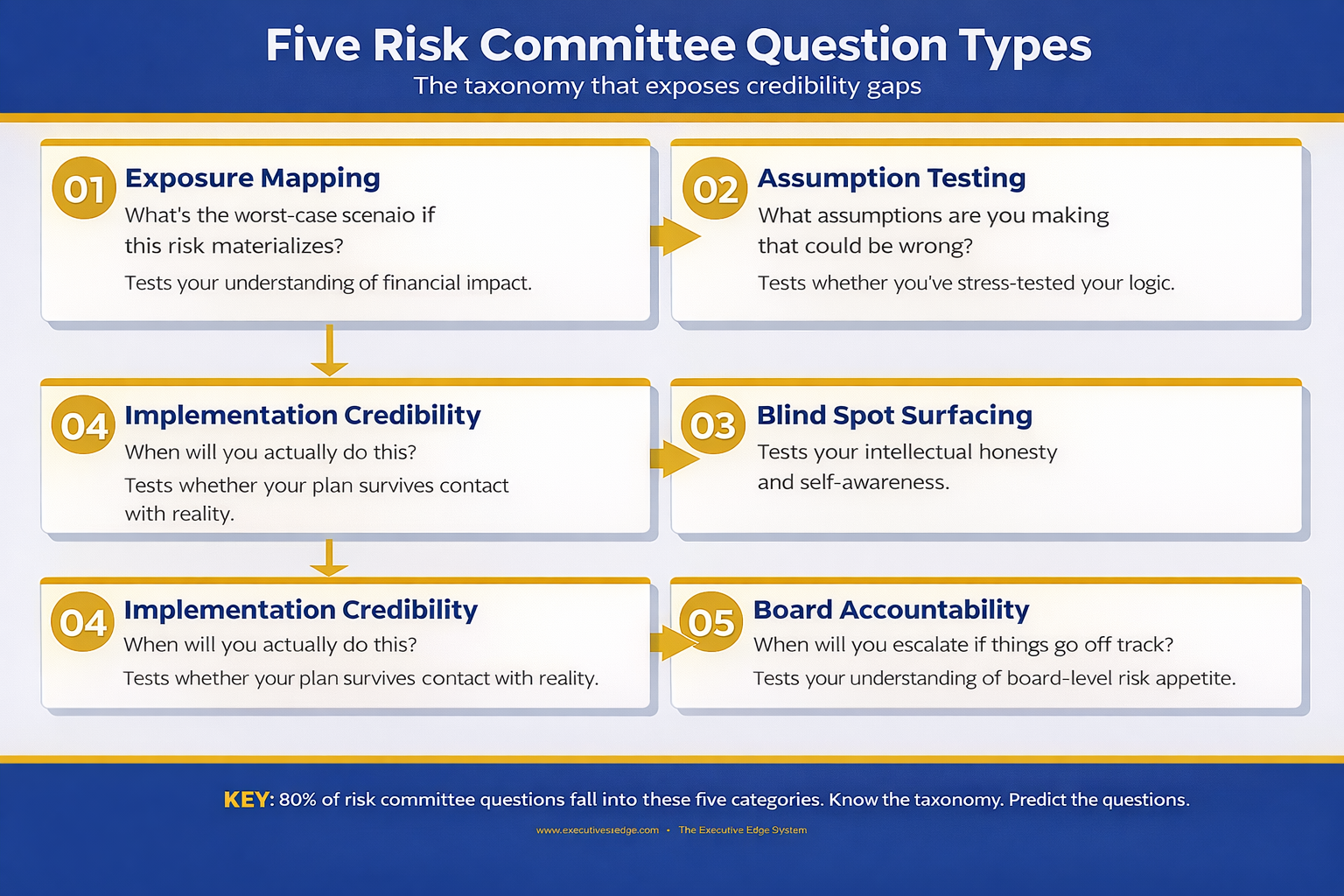
The five types are:
- Exposure Mapping Questions: “What’s the worst-case scenario?” “What asset or revenue stream is at greatest risk?” “How do you quantify the exposure?” These test whether you actually understand the financial or operational consequence if things go wrong.
- Assumption Testing Questions: “What assumptions are you making that could be wrong?” “How sensitive is your plan to market changes?” “What happens if [variable] changes?” These test the robustness of your logic, not just the competence of your execution.
- Blind Spot Surfacing Questions: “What haven’t you considered?” “What’s the thing you’re least confident about?” “What would change your view of this risk?” These are the most dangerous because they presume you’ve already missed something, and they’re often right.
- Implementation Credibility Questions: “How will you actually do this?” “Who owns the accountability?” “What’s your track record in similar initiatives?” These test whether your plan will survive contact with reality, not just whether the plan itself is theoretically sound.
- Board Accountability Questions: “What does the board need to do to support this?” “When will you escalate if things go off track?” “What metrics matter to the board’s risk appetite?” These test whether you understand what success looks like from the board’s perspective, not just from yours.
Notice that only one of these question types is about your capabilities or what you’ve done. The other four are about exposure, assumptions, gaps, and board-level thinking. This is why standard Q&A preparation fails in front of risk committees. You’re preparing for the wrong category.
Exposure Mapping Questions: The Ones About What Could Fail
Risk committees begin with exposure. They want to understand the size and nature of what’s at risk if something goes wrong. Exposure Mapping questions are rarely hostile — they’re genuinely trying to understand the scale of the problem. But they will expose you if you haven’t thought about the worst case.
The most common Exposure Mapping question is some variation of: “What’s the worst-case scenario if this risk materialises?” A good answer names the specific asset, revenue stream, or capability at risk, quantifies the financial or operational impact if it fails, and explains why you’re confident in that quantification.
The trap most executives fall into is either overestimating the worst case (which signals panic or lack of confidence) or underestimating it (which signals you haven’t thought about it properly). A risk committee will test your quantification by asking where it comes from — historical precedent, industry benchmarks, internal models. If you can’t source your number, they won’t trust it.
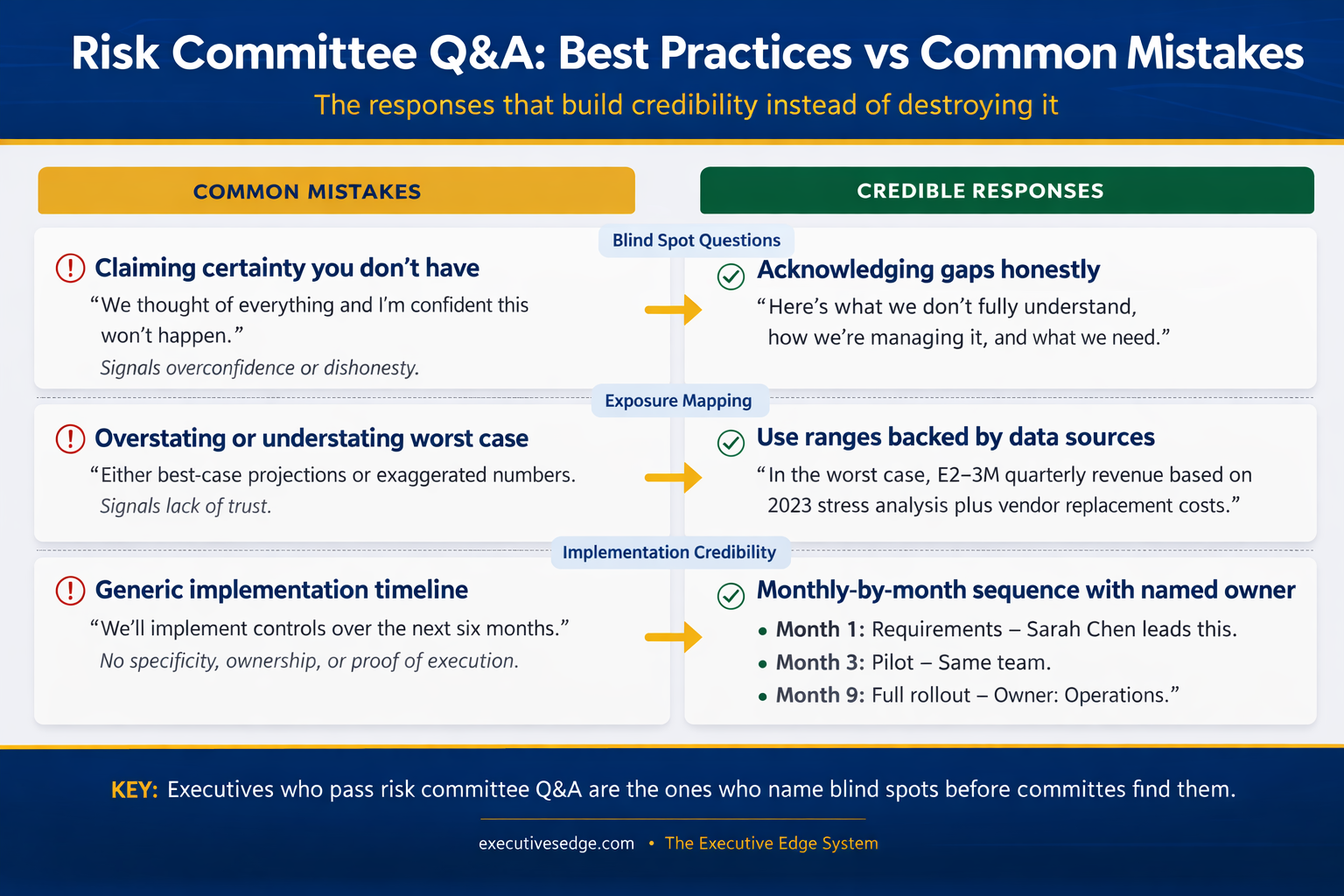
A stronger approach is to present a range rather than a point estimate. “In the worst case — a failure of System A combined with a loss of our primary vendor — we’d expect £2–3 million of impact to quarterly revenue. That’s based on our 2023 outage analysis plus vendor replacement costs from our procurement team.” This signals both rigorous thinking and realistic uncertainty.
Exposure Mapping questions also frequently probe the cascade effect: “If that fails, what else fails with it?” The executives who survive this line of questioning are the ones who’ve already mapped their dependencies. You need to know not just your primary risk, but what happens when that risk triggers others.
Prepare this section of your Q&A by listing the three to five assets or processes you’re most dependent on, estimating the financial impact if each fails, and mapping the cascade effect if they fail simultaneously. Have this analysis written down before you walk into the room.
The Question Prediction System Risk Committees Actually Test For
The Executive Q&A Handling System (£39, instant access) gives you the exact preparation framework risk committees are designed to defeat:
When you understand the five question types that risk committees use, you can prepare scenario-specific answers that demonstrate both competence and risk awareness. The executives who pass risk committee Q&A are the ones who know their blind spots before the committee finds them.
- The five question taxonomies that risk committees use to test credibility — Exposure Mapping, Assumption Testing, Blind Spot Surfacing, Implementation Credibility, and Board Accountability
- The Question Map framework for predicting the 12–15 questions your specific risk committee will ask, based on your presentation content
- The exact scenarios and responses for each question type with real-world examples from high-stakes risk presentations
- 51 AI prompts to generate your Q&A answers in 30 minutes, including challenge-response pairs for hostile questions
Get the Executive Q&A Handling System → £39
Built from 25 years of risk presentations across banking, insurance, and regulated industries — including risk committee scrutiny at JPMorgan Chase, RBS, and PwC.
Assumption Testing: Challenging Your Risk Logic
Every plan rests on assumptions. A market will behave a certain way. A vendor will deliver on time. Your team will execute as planned. Risk committees exist to stress-test those assumptions. Assumption Testing questions probe what could be wrong with your logic, not your execution.
The question usually sounds like: “What assumptions are you making that could turn out to be wrong?” This is often asked conversationally, which makes it more dangerous. You might hear, “We’re assuming the risk framework you’ve proposed would actually reduce exposure, but what if the market doesn’t cooperate?” The committee is not attacking your plan. They’re testing whether you’ve already challenged it.
Credibility in Assumption Testing questions comes from acknowledging your assumptions explicitly before the committee finds them. The strongest answer to “what assumptions are you making?” is to name three key assumptions yourself, explain what happens if each assumption breaks, and describe how you’d know if the assumption was at risk of breaking.
For example: “We’re assuming the control framework we’re implementing will be mature and effective within 180 days. That’s based on benchmarks from similar implementations in our industry. But if our team capacity turns out to be less than projected, that timeline could stretch to 12 months. We’ve built in a checkpoint at day 90 where we’ll assess maturity against a standard control maturity model and escalate if we’re below target.” This shows you’ve thought about failure modes and have monitoring in place.
The committees that challenge assumptions most fiercely are the ones with external members. An external risk advisor has seen multiple companies implement similar plans. They often ask: “In your experience, what’s the most common reason this type of plan doesn’t work as expected?” They’re giving you permission to name failure modes. Take it.
Prepare for Assumption Testing by listing the three to five key assumptions in your presentation, stress-testing each one mentally, and preparing a brief “here’s what could break and here’s how we’d know” response for each. This section of your preparation can be as simple as three sentences per assumption.
Blind Spot Questions: Finding What You Haven’t Considered
Blind Spot questions are the most dangerous because they presume a gap in your thinking — and often they’re right. A risk committee member will say something like: “What haven’t you considered?” or “What’s the thing you’re least confident about in this plan?” These questions feel adversarial because they assume you’ve already missed something.
Most executives respond defensively to Blind Spot questions. They over-explain, they defensively assert they’ve thought of everything, or they freeze. The credible response is to name your blind spots first. This shifts the psychology from “the committee found something I missed” to “I’ve already identified the exposure and I’m managing it responsibly.”
The strongest Blind Spot answer names one or two genuine gaps in your knowledge, explains why they’re gaps (insufficient data, external dependencies you can’t control, operational variables you can’t fully predict), describes what you’d need to close the gap, and acknowledges the risk of proceeding without full certainty.
For example: “The biggest gap in our analysis is vendor stability. We’re dependent on [Vendor] for a critical integration, and we don’t have complete visibility into their financial health or technology roadmap. We’ve asked for it in our ongoing contract review, but we may not get full transparency. If that vendor fails, we have a 60-day recovery plan, but that’s our exposure.” This answer shows mature risk thinking. You’re not claiming certainty you don’t have. You’re acknowledging the exposure and showing a mitigation path.
Blind spot preparation is counterintuitive because it requires intellectual honesty. Sit down with your presentation and ask yourself: “What part of this plan am I least certain about? What would I need to be more confident? And if I can’t get that certainty, what’s my backup?” Write those down before the meeting. When the committee asks, you’ll have an answer that signals maturity rather than defensiveness.
Some of the most effective Blind Spot answers include a statement like: “I’d welcome the committee’s perspective on what I might be missing. In our testing, we focused on [X]. Are there areas you’d recommend we pressure-test further?” This invites the committee’s expertise and shifts from defensive to collaborative.
If you’re preparing for risk committee Q&A in the next 30 days, the Executive Q&A Handling System (£39) gives you the question prediction framework and scenario-specific answers for all five question types.
Implementation Credibility: Will You Actually Execute?
Risk committees have seen many plans fail not because the strategy was wrong, but because execution fell apart. Implementation Credibility questions test whether your plan will survive contact with reality. They typically sound like: “How will you actually do this?” or “Who’s accountable if this doesn’t work?”
The questions that probe implementation most effectively are deceptively simple: “Walk me through the first 90 days.” “Who owns this if something goes wrong?” “What’s your track record on similar initiatives?” These are not asking about your strategy. They’re asking whether you have a realistic plan, clear accountability, and a history of follow-through.
A strong Implementation Credibility answer includes three elements: a specific sequence (not a generic timeline), named accountability (not a committee or a department, but a person), and a proof point (you’ve done something similar before and it worked). If you can’t provide all three, the committee will doubt your execution.
For example, rather than “we’ll implement controls over the next six months,” you’d say: “Sarah Chen, who led the control implementation at our Asia division, is leading this. Month one is requirements definition and stakeholder alignment. Month two is test environment setup. Month three is pilot in our non-critical process. We did a similar implementation in 2023 that came in on schedule and 8% under budget. Sarah’s here if you want to ask about her execution approach.”
Notice that this answer includes a named person, a month-by-month sequence, and a historical precedent. It’s not theoretical. It’s concrete. Risk committees trust concrete. They distrust abstract.
Preparation for Implementation Credibility requires you to own the plan at a level of specificity most executives avoid. You need to know not just the timeline, but who does what in month one. You need a case study of a similar implementation that succeeded. And you need to be able to name the person who failed the last similar initiative and explain what’s different this time (if there was a failure).
Common Questions About Risk Committee Q&A Preparation
How do you prepare for questions you can’t predict?
You can predict roughly 80% of risk committee questions using a Question Map framework. You list your presentation’s claims (e.g., “This control framework will reduce exposure by 40%”), then ask: what would challenge that claim? What data supports it? What assumptions could be wrong? What would the committee need to trust it? This process usually surfaces 12–15 likely questions across the five categories. The final 20% are wildcards, but they’re usually just variations on the predictable questions.
What’s the worst answer you can give to a risk committee question?
Claiming certainty you don’t have. Saying “we’ve thought of everything” or “we’re confident this won’t happen” signals that you’ve either misunderstood risk or you’re not being honest. Risk committees respect leaders who acknowledge edge cases and unknowns. They distrust leaders who claim omniscience. The credible answer is always “here’s what we know, here’s what we don’t know, and here’s how we’re managing the gap.”
Should you ever push back against a risk committee question?
Rarely, and only if the question is based on faulty data or a misunderstanding of your presentation. If you do push back, do it respectfully and with a data source. “That’s a fair question. We actually modelled that scenario — it’s on slide 14. The exposure in that case would be closer to £1.2 million rather than £2 million because we have a secondary control. Would you like to walk through that scenario?” This corrects the record without making the committee feel attacked.
Is This Right for You?
✓ This is for you if:
- You’re presenting to a risk committee, audit committee, or governance forum in the next 60 days
- You’ve had risk committee feedback that you need to “think bigger about exposure” or “understand your blind spots better”
- You’re introducing a new risk framework, control environment, or governance change and expect the committee to challenge your assumptions
- You want a tested question prediction framework you can apply to any risk presentation, not just this one
✗ This is NOT for you if:
- You’re presenting to a standard steering committee or operational review (those use different question types)
- You need bespoke risk consulting rather than a Q&A preparation system
- Your risk committee is entirely internal to your function and doesn’t include external or audit expertise
The 72-Hour Preparation Framework for Risk Committee Q&A
Risk committee Q&A is more preparation-intensive than standard executive Q&A because the questions are deeper and the scepticism is structural. The 72-hour framework breaks the preparation into three stages.
Stage One: Question Mapping (24 hours before)
Print out your presentation. For each major slide, ask yourself: what question would a risk committee ask about this? What assumptions does this claim rest on? What would a sceptic challenge? Write down 2–3 likely questions per slide. You’ll usually get to 15–20 likely questions across the presentation. Categorise them by question type (Exposure Mapping, Assumption Testing, etc.). This gives you the 80% of questions you can actually predict.
Stage Two: Answer Preparation (16 hours before)
For each of the 15–20 questions, write a one-paragraph answer. Not a talking point. An actual answer you’d give if asked. The discipline of writing forces you to think at a granular level. As you write, you’ll often discover gaps in your thinking. Good. Better to find them in your office than in the Q&A.
For each answer, ask: Does this answer the question directly? Does it include a data point or proof point? Does it acknowledge uncertainty where it exists? Can I deliver this in 60 seconds? If the answer to any of those is no, rewrite.
Stage Three: Scenario Rehearsal (4 hours before)
Practise the hostile questions. Not the friendly ones. Have someone read you the three most uncomfortable questions on your list and respond without notes. You’ll stumble. That’s good. Better to stumble in rehearsal. After each response, ask: Did I sound credible? Did I show I’d thought about this? Would a risk committee trust me? If not, rewrite the answer and rehearse again.
Focus rehearsal on questions about blind spots and implementation credibility. Those are the two categories where executives most often fail.
Stop Getting Blindsided by Risk Committee Questions
The Executive Q&A Handling System (£39, instant access) gives you the preparation framework that turns hostile risk committee Q&A into a credibility moment:
The moment a risk committee member asks “What haven’t you considered?” and you freeze, you’ve lost credibility. The executives who thrive in risk committee Q&A are the ones who know their blind spots before the committee finds them. The Executive Q&A Handling System teaches the exact preparation framework.
- The Question Map framework for predicting 80% of risk committee questions before you walk in the room
- The five question type taxonomy with scenario-specific answers for each category
- Real-world examples of hostile questions and the credible responses that turn them into trust moments
Get the Executive Q&A Handling System → £39
Taught to risk, compliance, and operations leaders across banking, insurance, healthcare, and regulated sectors.
What Risk Committees Actually Decide Based on Your Q&A
It’s worth understanding what a risk committee is actually evaluating during Q&A, because it’s not what most executives think. They’re not deciding whether to approve your plan. That decision usually happens in the room before Q&A begins, based on the presentation itself. Q&A is a credibility test.
The risk committee is answering four questions during your Q&A: Do you understand the size of the exposure if things go wrong? Do you understand your own assumptions and what could break them? Do you know what you don’t know? And can you actually execute this, or will it fall apart? If they believe the answer to those four questions is yes, you pass. If they have doubts on any of them, the decision gets deferred.
Deferral in risk committee meetings is the operational equivalent of rejection. It means “come back when you’ve thought about this more.” Some executives have sat through three or four deferral cycles on a single initiative. The ones who break the cycle are the ones who realise their Q&A wasn’t demonstrating competence — it was exposing gaps.
Risk committee Q&A often overlaps with board-level preparation — if your session includes board directors, the board Q&A preparation guide covers the director-specific dynamics in detail.
One other thing risk committees decide: trust. An executive who names their blind spots, acknowledges uncertainty, and shows they’ve already challenged their own plan is trusted more than an executive who claims the plan is airtight. Risk committees have institutional memory of plans that failed because the executive was overconfident. They’d rather hear “here’s what could go wrong” than “we’ve thought of everything.”
This is why the 72-hour preparation framework is essential. It’s not about memorising answers. It’s about demonstrating that you’ve already done the challenging work of examining your own plan critically. The committee is asking whether you deserve to be trusted with risk management responsibility. Your Q&A answers that question.
Frequently Asked Questions
What’s the difference between risk committee Q&A and steering committee Q&A?
Steering committees ask “will this work and what does it cost?” Risk committees ask “what could go wrong and what don’t you know?” Risk committees are structurally sceptical because their job is to find exposure. Steering committees are evaluative. This means your Q&A preparation must shift from demonstrating capability to demonstrating risk awareness. The frameworks are completely different.
How honest should you be about gaps and uncertainties in front of a risk committee?
Extremely honest. Risk committees trust executives who acknowledge uncertainty more than those who claim omniscience. The credible answer to a question about a gap is “here’s what we don’t fully understand, here’s what we need to understand, and here’s how we’re managing the risk while we get that understanding.” This signals mature risk thinking. Claiming you’ve thought of everything signals the opposite.
What happens if a risk committee question is based on a misunderstanding of your data?
Clarify respectfully with a data source. Don’t make the committee feel stupid. Instead, say something like “That’s a fair interpretation of the metric. We actually modelled that scenario — here’s what the data shows.” You’re correcting the record without creating tension. If the committee is sceptical, it’s usually because you weren’t clear enough in the presentation, not because they’re unreasonable.
Can you over-prepare for risk committee Q&A?
Yes, if you memorise answers and sound robotic. No, if you prepare scenario-specific responses and practise delivering them conversationally. The goal is to show you’ve thought through your risks, not to recite prepared statements. Risk committees recognise the difference immediately.
The Winning Edge — Executive Presentation Insights
Weekly strategies for executives who present at risk committees, boards, and high-stakes governance forums. No filler. No theory. Practical frameworks for presentations where credibility is currency.
Subscribe Free →
Also published today:
- Track A: The Pre-Decision Conversation: Getting Executive Approval Before You Present — If you’re presenting to risk committees and need stakeholder alignment beforehand, this is your setup strategy.
- Track B: Why Your Voice Gets Higher Under Pressure (And the Fix That Works) — If nervous system activation is affecting your Q&A delivery, this addresses the physical symptoms behind the performance gap.
Your risk committee meeting has a date on the calendar. The committees that ask hostile questions are usually the ones with external or audit members — people who don’t have a stake in your plan succeeding. They’re structurally sceptical because that’s their job.
The only way to change that dynamic is to come in already sceptical of your own plan. Walk into the room having already named your blind spots, stress-tested your assumptions, understood your execution risks, and acknowledged what you don’t know. When the committee asks about gaps, you’ll have answers ready. When they challenge your logic, you’ll respond with confidence because you’ve already challenged it yourself.
Start with the Question Map. Print your presentation, write down 15–20 likely questions, categorise them by the five question types, and prepare one-paragraph answers for each. Use the Executive Q&A Handling System (£39) to structure the preparation in the 72 hours before you present.
For further reading on high-stakes Q&A strategy, see Board Meeting Q&A: Questions Directors Actually Ask, The Q&A Preparation Checklist: The Pre-Meeting Audit Every Executive Needs, and Predict Your Presentation Questions: The Question Map That Works.
About the Author
Mary Beth Hazeldine is the Owner & Managing Director of Winning Presentations. With 25 years of corporate banking experience at JPMorgan Chase, PwC, Royal Bank of Scotland, and Commerzbank, she has delivered high-stakes presentations in boardrooms across three continents.
A qualified clinical hypnotherapist and NLP practitioner, Mary Beth combines executive communication expertise with evidence-based techniques for managing presentation anxiety. She advises executives across financial services, healthcare, technology, and government on structuring presentations for high-stakes funding rounds and approvals.