Tag: risk committee presentation

29 Apr 2026
Businesswoman presents financial dashboards to a diverse team in a modern conference room around a long table.

Risk Committee Presentation: How to Brief the Board When Every Metric Demands Attention

Quick answer: A risk committee presentation should open with three to five headline risks ranked by severity and likelihood, move into a clear summary of risk appetite versus current exposure, and close with specific decisions the committee needs to make. The board does not need an encyclopaedic tour of every risk on your register. They need a prioritised view that enables governance-level decisions within a focused meeting window.

Adriana Vasquez had been Chief Risk Officer at a mid-cap pharmaceutical company for three years, and she had never once left a risk committee meeting feeling that the board had fully grasped the risk landscape she had presented. It was not for lack of effort. Her quarterly packs ran to 45 pages. Every risk category was represented. Every heat map was colour-coded. Every trend line was annotated.

The problem crystallised during a January committee meeting when the non-executive chair interrupted her on slide 14 to ask a question she had already answered on slide 3. Two other directors were scrolling their iPads, clearly reading ahead. The committee approved her recommendations in eleven minutes after a 40-minute presentation — not because they agreed with her analysis, but because they were fatigued by it.

That evening, Adriana sat in her office and wrote a single question on a Post-it note: “What does this committee actually need from me?” The answer was uncomfortable. They did not need a comprehensive tour of 87 risks across nine categories. They needed her professional judgement on which five risks required their attention, what had changed since last quarter, and what decisions she needed from them. Everything else was reference material.

Her next committee pack was eight pages. The chair described it as the most useful risk report he had received in four years of governance. What changed was not the quality of her analysis. It was the structure of her communication.

If you want a structured approach to board-level risk presentations, the Executive Slide System provides templates and frameworks designed for governance scenarios where clarity and prioritisation matter most.

Explore the Executive Slide System →

Why Risk Committee Presentations Overwhelm Instead of Inform

The fundamental problem with most committee-level risk briefings is volume masquerading as thoroughness. Risk officers compile exhaustive registers, categorise every conceivable threat, and present the lot — because leaving something out feels professionally dangerous. If a risk materialises that was not in the pack, the CRO looks negligent. So the instinct is to include everything, rank nothing, and let the committee decide what matters.

This instinct is understandable but counterproductive. A committee that receives 50 risks with equal visual weight cannot exercise meaningful governance over any of them. Their job is to challenge your judgement on the risks you have elevated, test your appetite recommendations, and approve or redirect your mitigation strategies. When you present everything, you are implicitly asking the committee to do your prioritisation work for you.

This pattern is structurally identical to the challenge that surfaces in audit committee presentations, where the temptation is to walk through every finding rather than leading with the governance implications. In both contexts, the committee loses confidence not because the analysis is weak, but because the communication forces them to work too hard to extract what matters.

There is also a psychological dimension. Non-executive directors carry personal liability for governance failures. When presented with 45 pages of undifferentiated risk data, their cognitive response is defensive scanning — looking for the item that might personally expose them, rather than engaging with the strategic picture. A well-structured governance risk briefing reduces this anxiety by making the presenter’s professional judgement visible and explicit.

Build Board-Ready Risk Slides in Under an Hour

The Executive Slide System includes 26 templates, 93 AI prompts, and 16 scenario playbooks — covering governance presentations, committee briefings, and high-stakes executive scenarios. Stop building risk committee packs from scratch every quarter.

£39 — instant access. Designed for executives who present at board and committee level.

Get the Executive Slide System →

A Prioritisation Framework That Cuts Through Noise

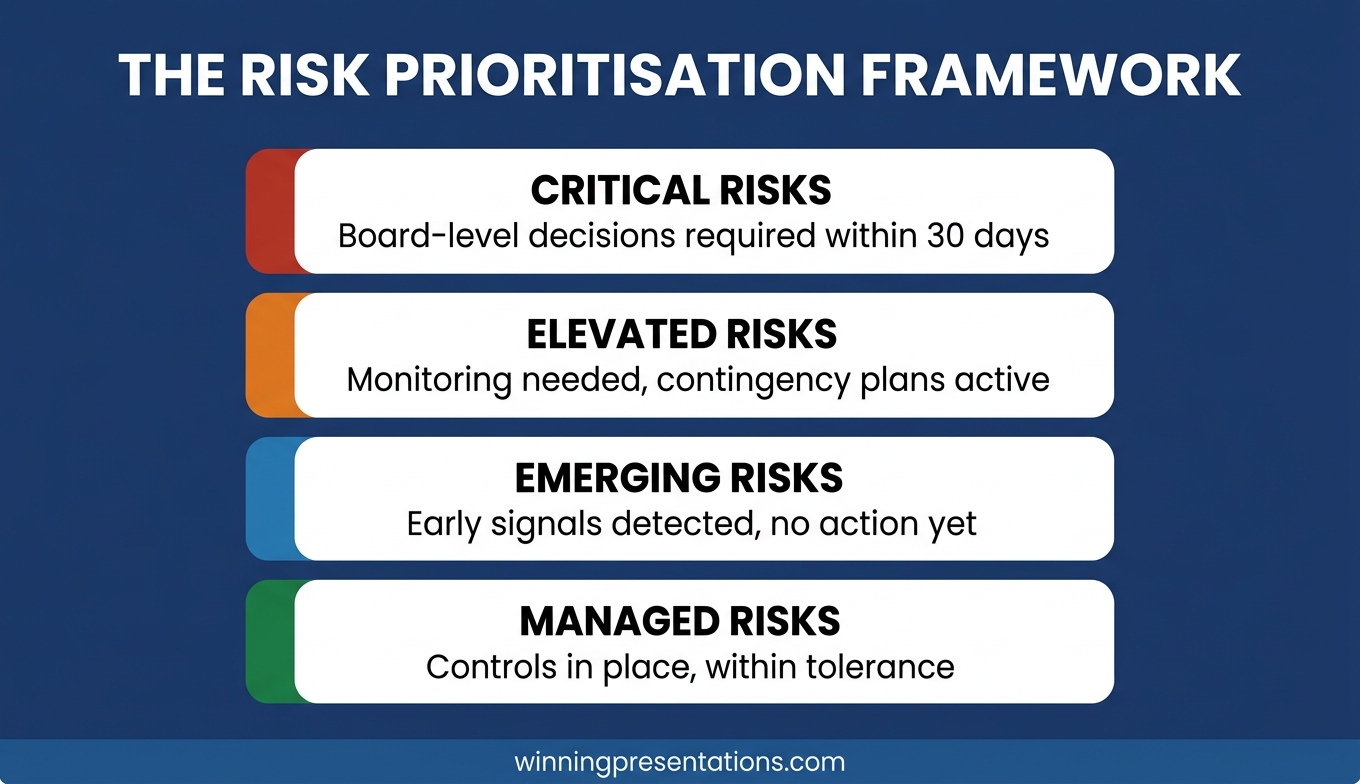
Effective risk committee communication starts with a decision about what to elevate. Before you open PowerPoint, apply a three-filter test to your risk register:

Filter 1: Movement. Which risks have changed in severity, likelihood, or velocity since the last committee meeting? A risk that was amber three months ago and is now red demands committee attention. A risk that has been amber for six consecutive quarters does not — unless you are recommending a change to the mitigation strategy. Static risks belong in the appendix, not the main deck.

Filter 2: Decision required. Does this risk require a committee decision? If you are asking for approval of a new mitigation approach, an adjustment to risk appetite, or additional resource allocation, the risk belongs in the core presentation. If the committee simply needs to note it, a summary table is sufficient.

Filter 3: Emerging or interconnected. Has a new risk emerged that the committee has not previously considered? Or have existing risks begun to interact in ways that change the aggregate exposure? Interconnected risks — for example, a supply chain disruption compounding a cyber vulnerability — are where the most dangerous blind spots develop, and they are precisely the risks that a flat register fails to surface.

Apply these three filters honestly, and your 87-item register typically produces five to eight risks that warrant committee-level discussion. That is the right number. It is few enough to enable genuine deliberation and many enough to demonstrate that your risk function has breadth of vision.

How many risks should you present to a risk committee? Between five and eight elevated risks in the core presentation, with the full register available as an appendix. This gives the committee enough material for substantive governance without overwhelming the meeting’s limited time.

Three-filter prioritisation framework for risk committee presentations showing movement filter, decision-required filter, and emerging risk filter with example applications

Structuring Your Risk Committee Slides for Clarity

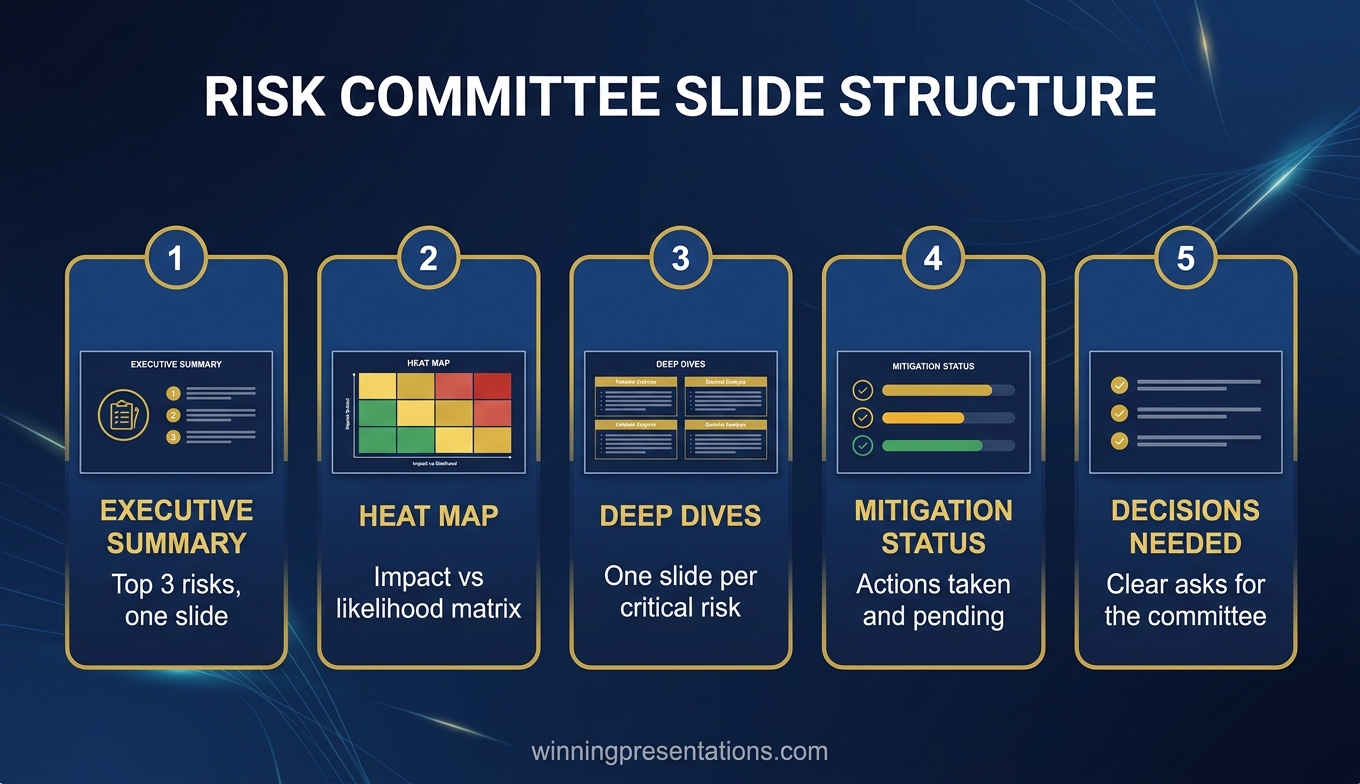
Once you have identified the risks that warrant committee attention, the slide structure needs to serve a specific purpose: enabling the committee to challenge, question, and decide — not just absorb. Each elevated risk should follow a consistent four-part format across a single slide or a slide pair:

Risk description — two sentences maximum. What the risk is and what it would affect if it materialised. Avoid technical jargon; write for non-executive directors who may not share your domain expertise.

Movement and context — what has changed since the last reporting period and why. This is the most important element. A risk rated as “high” means very little in isolation. A risk that has moved from “medium” to “high” because a key supplier failed a security audit tells a governance story that the committee can engage with.

Current mitigation — what controls are in place, whether they are performing as expected, and any gaps. Be honest about gaps. A committee that discovers unreported mitigation failures after an incident will lose trust in the entire risk function, not just the individual report.

Decision or action required — what the committee is being asked to do. Approve a revised appetite? Allocate budget? Note a new emerging risk? If no decision is required, say so explicitly: “For noting — no committee action requested.” This prevents the meeting from stalling on risks that need acknowledgement rather than deliberation.

This structure works because it mirrors the governance mindset. Directors think in terms of “what is it, what has changed, what are we doing about it, and what do you need from us.” When your slides follow that sequence, the committee engages at the right level without translating your material into their own framework. The same principle applies when structuring any ESG board presentation where non-financial data must be made governance-ready.

If structuring governance-level slides feels time-consuming, the Executive Slide System includes templates designed for committee briefings and board-level reporting scenarios.

Presenting Risk Data Without Drowning the Room

Risk professionals love heat maps. Boards tolerate them. The standard five-by-five likelihood-versus-impact matrix has become so ubiquitous in governance reporting that many directors have stopped actually reading it — they glance at the cluster of dots in the top-right corner and move on. If your entire risk narrative depends on a heat map, you are relying on a tool that has lost much of its communicative power through overuse.

More effective approaches include:

Movement arrows. Instead of plotting risks on a static matrix, show the direction and speed of change. A simple table with risk name, previous rating, current rating, and a directional arrow communicates more governance-relevant information than a crowded heat map.

Risk appetite overlay. What is a risk appetite statement? It is the board-approved level of risk the organisation is willing to accept in pursuit of its strategic objectives. Show where current exposure sits relative to stated appetite. This is the single most governance-relevant data point you can present — it answers “are we within the boundaries we set for ourselves?” If exposure exceeds appetite in any category, that becomes an automatic agenda item.

Scenario narratives. For your two or three most significant risks, replace data visualisation with a brief scenario: “If this risk materialises, the impact would be [specific consequence]. Our current mitigation reduces the likelihood to [level], but residual exposure remains because [specific gap].” Narrative scenarios engage directors more effectively than abstract probability ratings because they create a concrete mental model of what the risk means in practice.

The goal is not to eliminate data from your presentation — data is essential for credibility. The goal is to make every data point answer a governance question rather than simply demonstrating analytical effort.

Comparison of risk data presentation methods showing traditional heat map versus movement arrows and risk appetite overlay with governance-level annotations

Governance Slides That Communicate, Not Just Report

The Executive Slide System gives you 16 scenario playbooks and 93 AI prompts to structure committee presentations that drive decisions instead of passive nodding. Templates for risk reporting, board briefings, and governance scenarios.

£39 — instant access.

Get the Executive Slide System →

Handling Challenge Questions from Non-Executive Directors

Risk committee meetings are adversarial by design. Non-executive directors are discharging their governance obligations by testing the quality of your analysis and the adequacy of your mitigations. The quality of your answers determines how much credibility your risk function retains between reporting periods.

The most common challenge questions fall into predictable categories:

“What are you not telling us?” This is the question behind every other question. The best response is structural: explain your escalation criteria transparently. “Any risk above [threshold] is automatically elevated to this committee. Risks below that threshold are managed within the executive risk committee and reported in the appendix.” When the committee understands your filtering logic, they trust the output.

“How do we compare to our peers?” Peer risk data is rarely public, but you can reference sector-level trends and regulatory themes. “The FCA’s latest supervisory statement highlights operational resilience as a sector-wide concern, which aligns with our elevation of that risk this quarter” demonstrates awareness without inventing comparative data.

“Is our risk appetite still appropriate?” This is a governance question, not a technical one. Your role is to present evidence — has the operating environment changed in ways that make the current appetite too aggressive or too conservative? Prepare a brief assessment of appetite adequacy for each elevated risk, but resist answering the question definitively on the committee’s behalf.

The approach to handling these questions is closely related to the discipline of structured board presentation follow-up — where the quality of your post-meeting actions determines whether the committee’s confidence grows or erodes over successive reporting cycles.

Your Pre-Meeting Preparation Protocol

The quality of a board-level risk briefing is determined before the meeting, not during it. A disciplined preparation protocol separates presenters who inform from presenters who influence.

Two weeks before: Finalise your risk register review. Apply the three-filter test to identify elevated risks. Brief the committee chair informally on your headline risks — no chair wants to be surprised in a formal meeting, and this pre-brief allows them to shape the agenda around your most significant items.

One week before: Circulate the committee pack with a one-page executive summary listing elevated risks, key changes since last quarter, and decisions sought. This page is the most important in your pack. Many directors will read only this page before the meeting — make it comprehensive enough to stand alone.

Two days before: Prepare for challenge questions. For each elevated risk, identify the three hardest questions a non-executive director could ask and draft structured responses. Pay particular attention to questions about mitigation effectiveness, residual risk levels, and appetite adequacy. How should you prepare for a risk committee meeting? Write out your three most difficult answers in full — the act of writing forces clarity that mental rehearsal alone cannot achieve.

Day of the meeting: Review the previous meeting’s minutes and action items. Nothing undermines credibility faster than being unable to report progress on assigned actions. If something is overdue, address it proactively in your opening remarks rather than waiting for a director to raise it.

This protocol takes discipline, but it transforms the committee meeting from a reporting obligation into a strategic conversation — and that is the environment where the best governance decisions are made.

Frequently Asked Questions

How long should a risk committee presentation be?

Aim for 8 to 12 slides in the core presentation, with the full risk register available as an appendix. Most committee meetings allocate 60 to 90 minutes, and your presentation should consume no more than a third of that time — the rest is for discussion, challenge, and decision-making. If your slides take longer than 25 minutes to present, move supporting analysis to the appendix.

Should you use a heat map in a risk committee presentation?

Heat maps remain a useful visual shorthand, but they should not be the centrepiece of your presentation. Their limitation is showing position without movement or context. If you use one, supplement it with a movement summary showing which risks have changed position since last quarter and why. Better still, use the heat map as an appendix reference and lead with the elevated risks and their governance implications. The committee will engage more deeply with narrative context than with colour-coded dots.

What is the difference between a risk committee and an audit committee presentation?

A risk committee focuses on forward-looking risk exposure, appetite, and mitigation strategy — what might happen and how prepared the organisation is. An audit committee focuses on backward-looking assurance — whether controls are operating effectively and compliance obligations are being met. The key structural difference is that a risk committee expects professional judgement about future exposure, while an audit committee expects factual findings about past performance. Tailor your language and evidence accordingly.

Join The Winning Edge

Free weekly newsletter for executives who present at board and committee level. Practical frameworks, governance communication strategies, and slide structure guidance — delivered every Thursday.

Subscribe Free →

Not ready for the full system? Start here instead: download the free Executive Presentation Checklist — a quick-reference guide for structuring any high-stakes board or committee presentation.

Read next: If you are preparing financial presentations alongside your risk reporting, see Annual Budget Presentation: How to Present Your Numbers with Confidence for a complementary framework on presenting financial data to senior leadership.

Mary Beth Hazeldine is the Owner & Managing Director of Winning Presentations. With 24 years of corporate banking experience at JPMorgan Chase, PwC, Royal Bank of Scotland, and Commerzbank, she advises executives across financial services, healthcare, technology, and government on structuring presentations for high-stakes scenarios.

15 Mar 2026
Female executive presenting risk assessment to a serious risk committee in a modern boardroom, showing risk matrix slide on screen, navy and gold corporate aesthetic

Risk Committee Q&A: The 5 Questions That Silence Even the Most Prepared Executives

I once watched a VP of Operations present a £3 million risk mitigation plan to her company’s risk committee. She had 47 metrics on her dashboard. She knew every number. But when the Chief Risk Officer asked, “What’s the one thing in your plan you’re least confident about?” she froze.

She couldn’t answer because she’d prepared for every question except the ones about her own uncertainty. The risk committee wasn’t testing her confidence. They were testing whether she understood the limits of her own knowledge. She failed that test in seven seconds of silence.

The vote to approve her plan got deferred. Not because her mitigation approach was weak. But because her Q&A revealed that she hadn’t mapped her own blind spots — and a risk committee’s job is precisely to find blind spots before they become losses.

Risk committee Q&A is a distinct discipline. The questions are sharper, the scepticism is structural, and the threshold for credibility is higher. This isn’t steering committee Q&A or board update Q&A. Risk committees exist to challenge assumptions and surface exposure. Your preparation must reflect that.

This article gives you the exact taxonomy of risk committee questions and the preparation framework that turns hostile Q&A into a credibility moment.

Preparing for a risk committee in the next 30 days?

Most executives prepare for capability questions. Risk committees test something different: whether you understand your own blind spots. The Executive Q&A Handling System includes a Question Map framework specifically structured for risk, audit, and governance committee Q&A.

Why Risk Committee Q&A Exposes Blind Spots Other Committees Miss

Most executives prepare for executive Q&A the same way regardless of the audience. They prepare for capability questions, financial impact questions, timeline questions. Standard executive fare. This approach will fail in front of a risk committee.

Risk committees operate from a different agenda entirely. While a steering committee is asking “will this work?” and “what does it cost?”, a risk committee is asking “what could go wrong that we haven’t considered?” and “how do you know that?” The psychology is adversarial by design. Risk committee members are professional sceptics. Their job depends on finding the gaps in your thinking.

The gap that most presenters miss is the distinction between demonstrating competence and demonstrating risk awareness. You can walk into a risk committee meeting thoroughly prepared to defend your strategy, but if you haven’t prepared for questions about what you don’t know, the committee will expose that gap within the first four minutes of Q&A. And once credibility is damaged, no amount of capability data recovers it.

Risk committees are also heterogeneous in their expertise. Your audience typically includes an internal Chief Risk Officer (highly technical, familiar with risk frameworks and ISO standards), an external risk or compliance specialist (often with a regulatory lens), and business leaders who sit on the committee for governance rather than technical depth. This means your Q&A must navigate different levels of sophistication simultaneously — you can’t assume the group shares the same risk literacy.

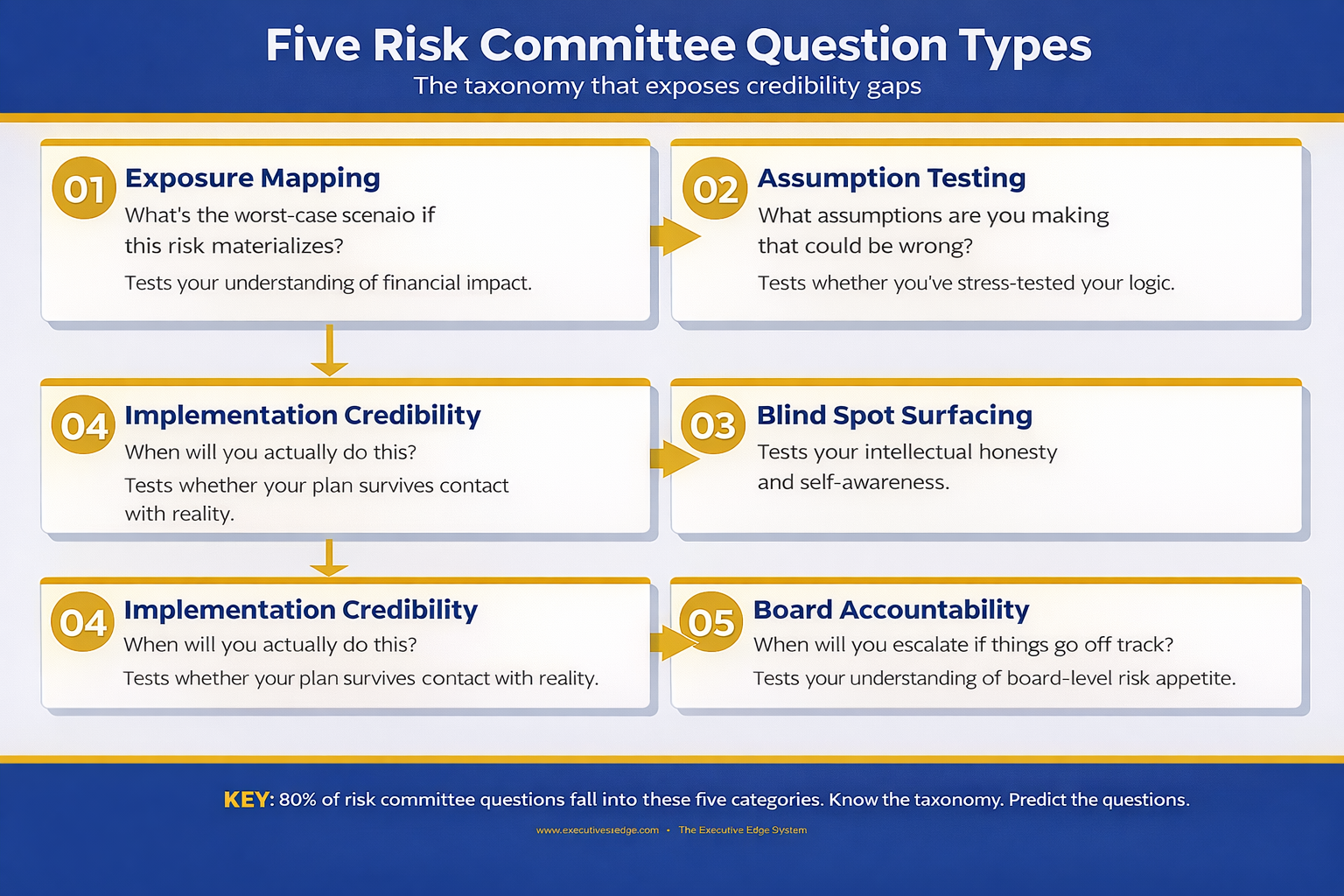
The questions that expose blind spots fall into five categories. Each category tests a different kind of credibility: your understanding of exposure, your confidence in your assumptions, your awareness of gaps, your execution track record, and your alignment with the board’s risk appetite. Most executives prepare for one or two of these. Risk committees test all five.

The Five Question Types That Dominate Risk Committee Q&A

Understanding the taxonomy of risk committee questions is half the preparation battle. Once you know what type of question is coming, you can prepare a scenario-specific answer rather than hoping for a question you’ve rehearsed.

The five types are:

  • Exposure Mapping Questions: “What’s the worst-case scenario?” “What asset or revenue stream is at greatest risk?” “How do you quantify the exposure?” These test whether you actually understand the financial or operational consequence if things go wrong.
  • Assumption Testing Questions: “What assumptions are you making that could be wrong?” “How sensitive is your plan to market changes?” “What happens if [variable] changes?” These test the robustness of your logic, not just the competence of your execution.
  • Blind Spot Surfacing Questions: “What haven’t you considered?” “What’s the thing you’re least confident about?” “What would change your view of this risk?” These are the most dangerous because they presume you’ve already missed something, and they’re often right.
  • Implementation Credibility Questions: “How will you actually do this?” “Who owns the accountability?” “What’s your track record in similar initiatives?” These test whether your plan will survive contact with reality, not just whether the plan itself is theoretically sound.
  • Board Accountability Questions: “What does the board need to do to support this?” “When will you escalate if things go off track?” “What metrics matter to the board’s risk appetite?” These test whether you understand what success looks like from the board’s perspective, not just from yours.

Notice that only one of these question types is about your capabilities or what you’ve done. The other four are about exposure, assumptions, gaps, and board-level thinking. This is why standard Q&A preparation fails in front of risk committees. You’re preparing for the wrong category.

Five risk committee question types: Exposure Mapping, Assumption Testing, Blind Spot Surfacing, Implementation Credibility, Board Accountability with example questions and credibility tests for each

Exposure Mapping Questions: The Ones About What Could Fail

Risk committees begin with exposure. They want to understand the size and nature of what’s at risk if something goes wrong. Exposure Mapping questions are rarely hostile — they’re genuinely trying to understand the scale of the problem. But they will expose you if you haven’t thought about the worst case.

The most common Exposure Mapping question is some variation of: “What’s the worst-case scenario if this risk materialises?” A good answer names the specific asset, revenue stream, or capability at risk, quantifies the financial or operational impact if it fails, and explains why you’re confident in that quantification.

The trap most executives fall into is either overestimating the worst case (which signals panic or lack of confidence) or underestimating it (which signals you haven’t thought about it properly). A risk committee will test your quantification by asking where it comes from — historical precedent, industry benchmarks, internal models. If you can’t source your number, they won’t trust it.

A stronger approach is to present a range rather than a point estimate. “In the worst case — a failure of System A combined with a loss of our primary vendor — we’d expect £2–3 million of impact to quarterly revenue. That’s based on our 2023 outage analysis plus vendor replacement costs from our procurement team.” This signals both rigorous thinking and realistic uncertainty.

Exposure Mapping questions also frequently probe the cascade effect: “If that fails, what else fails with it?” The executives who survive this line of questioning are the ones who’ve already mapped their dependencies. You need to know not just your primary risk, but what happens when that risk triggers others.

Prepare this section of your Q&A by listing the three to five assets or processes you’re most dependent on, estimating the financial impact if each fails, and mapping the cascade effect if they fail simultaneously. Have this analysis written down before you walk into the room.

The Question Prediction System Risk Committees Actually Test For

The Executive Q&A Handling System (£39, instant access) gives you the exact preparation framework risk committees are designed to defeat:

When you understand the five question types that risk committees use, you can prepare scenario-specific answers that demonstrate both competence and risk awareness. The executives who pass risk committee Q&A are the ones who know their blind spots before the committee finds them.

  • The five question taxonomies that risk committees use to test credibility — Exposure Mapping, Assumption Testing, Blind Spot Surfacing, Implementation Credibility, and Board Accountability
  • The Question Map framework for predicting the 12–15 questions your specific risk committee will ask, based on your presentation content
  • The exact scenarios and responses for each question type with real-world examples from high-stakes risk presentations
  • 51 AI prompts to generate your Q&A answers in 30 minutes, including challenge-response pairs for hostile questions

Get the Executive Q&A Handling System → £39

Built from 25 years of risk presentations across banking, insurance, and regulated industries — including risk committee scrutiny at JPMorgan Chase, RBS, and PwC.

Assumption Testing: Challenging Your Risk Logic

Every plan rests on assumptions. A market will behave a certain way. A vendor will deliver on time. Your team will execute as planned. Risk committees exist to stress-test those assumptions. Assumption Testing questions probe what could be wrong with your logic, not your execution.

The question usually sounds like: “What assumptions are you making that could turn out to be wrong?” This is often asked conversationally, which makes it more dangerous. You might hear, “We’re assuming the risk framework you’ve proposed would actually reduce exposure, but what if the market doesn’t cooperate?” The committee is not attacking your plan. They’re testing whether you’ve already challenged it.

Credibility in Assumption Testing questions comes from acknowledging your assumptions explicitly before the committee finds them. The strongest answer to “what assumptions are you making?” is to name three key assumptions yourself, explain what happens if each assumption breaks, and describe how you’d know if the assumption was at risk of breaking.

For example: “We’re assuming the control framework we’re implementing will be mature and effective within 180 days. That’s based on benchmarks from similar implementations in our industry. But if our team capacity turns out to be less than projected, that timeline could stretch to 12 months. We’ve built in a checkpoint at day 90 where we’ll assess maturity against a standard control maturity model and escalate if we’re below target.” This shows you’ve thought about failure modes and have monitoring in place.

The committees that challenge assumptions most fiercely are the ones with external members. An external risk advisor has seen multiple companies implement similar plans. They often ask: “In your experience, what’s the most common reason this type of plan doesn’t work as expected?” They’re giving you permission to name failure modes. Take it.

Prepare for Assumption Testing by listing the three to five key assumptions in your presentation, stress-testing each one mentally, and preparing a brief “here’s what could break and here’s how we’d know” response for each. This section of your preparation can be as simple as three sentences per assumption.

Blind Spot Questions: Finding What You Haven’t Considered

Blind Spot questions are the most dangerous because they presume a gap in your thinking — and often they’re right. A risk committee member will say something like: “What haven’t you considered?” or “What’s the thing you’re least confident about in this plan?” These questions feel adversarial because they assume you’ve already missed something.

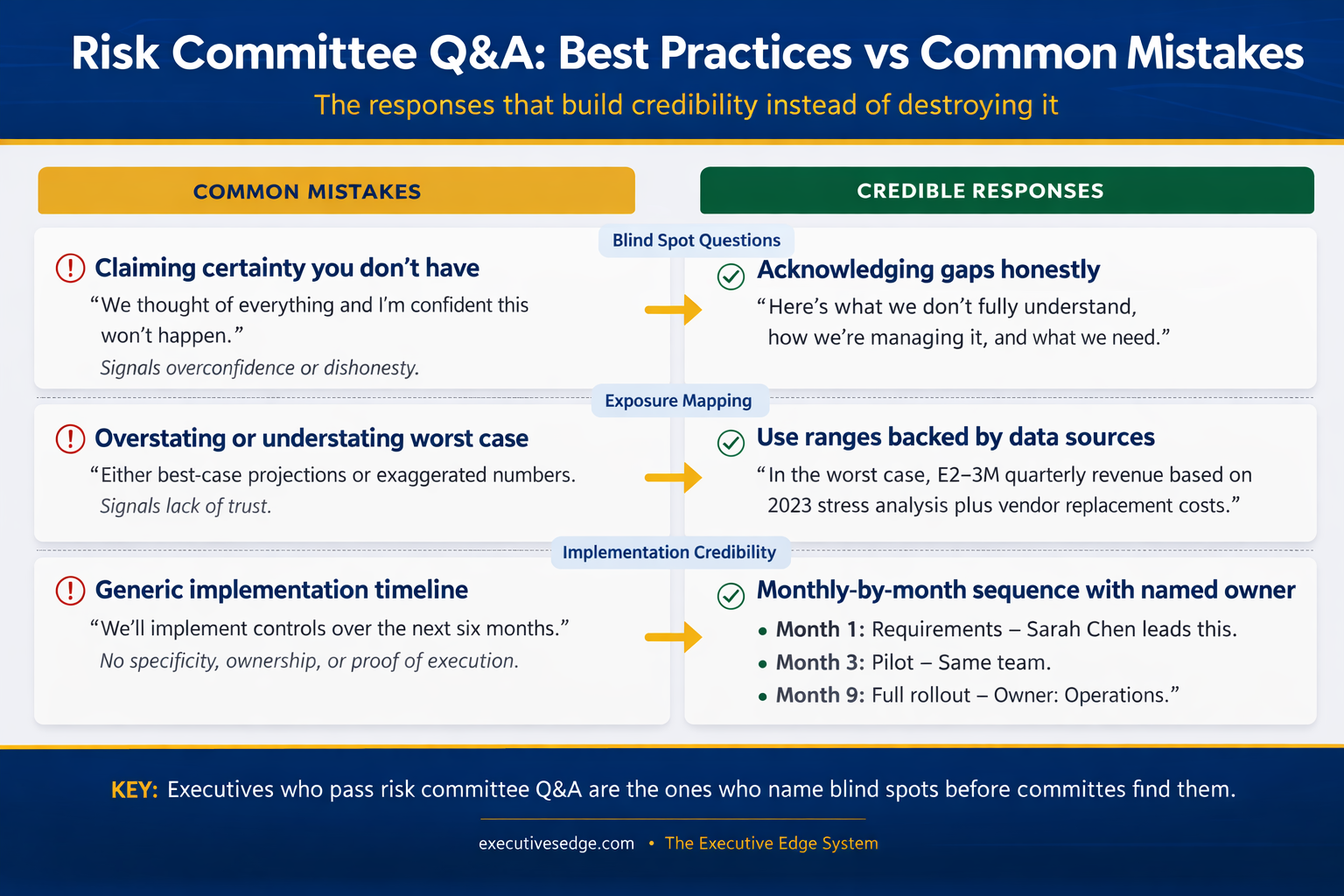
Most executives respond defensively to Blind Spot questions. They over-explain, they defensively assert they’ve thought of everything, or they freeze. The credible response is to name your blind spots first. This shifts the psychology from “the committee found something I missed” to “I’ve already identified the exposure and I’m managing it responsibly.”

The strongest Blind Spot answer names one or two genuine gaps in your knowledge, explains why they’re gaps (insufficient data, external dependencies you can’t control, operational variables you can’t fully predict), describes what you’d need to close the gap, and acknowledges the risk of proceeding without full certainty.

For example: “The biggest gap in our analysis is vendor stability. We’re dependent on [Vendor] for a critical integration, and we don’t have complete visibility into their financial health or technology roadmap. We’ve asked for it in our ongoing contract review, but we may not get full transparency. If that vendor fails, we have a 60-day recovery plan, but that’s our exposure.” This answer shows mature risk thinking. You’re not claiming certainty you don’t have. You’re acknowledging the exposure and showing a mitigation path.

Blind spot preparation is counterintuitive because it requires intellectual honesty. Sit down with your presentation and ask yourself: “What part of this plan am I least certain about? What would I need to be more confident? And if I can’t get that certainty, what’s my backup?” Write those down before the meeting. When the committee asks, you’ll have an answer that signals maturity rather than defensiveness.

Some of the most effective Blind Spot answers include a statement like: “I’d welcome the committee’s perspective on what I might be missing. In our testing, we focused on [X]. Are there areas you’d recommend we pressure-test further?” This invites the committee’s expertise and shifts from defensive to collaborative.

If you’re preparing for risk committee Q&A in the next 30 days, the Executive Q&A Handling System (£39) gives you the question prediction framework and scenario-specific answers for all five question types.

Implementation Credibility: Will You Actually Execute?

Risk committees have seen many plans fail not because the strategy was wrong, but because execution fell apart. Implementation Credibility questions test whether your plan will survive contact with reality. They typically sound like: “How will you actually do this?” or “Who’s accountable if this doesn’t work?”

The questions that probe implementation most effectively are deceptively simple: “Walk me through the first 90 days.” “Who owns this if something goes wrong?” “What’s your track record on similar initiatives?” These are not asking about your strategy. They’re asking whether you have a realistic plan, clear accountability, and a history of follow-through.

A strong Implementation Credibility answer includes three elements: a specific sequence (not a generic timeline), named accountability (not a committee or a department, but a person), and a proof point (you’ve done something similar before and it worked). If you can’t provide all three, the committee will doubt your execution.

For example, rather than “we’ll implement controls over the next six months,” you’d say: “Sarah Chen, who led the control implementation at our Asia division, is leading this. Month one is requirements definition and stakeholder alignment. Month two is test environment setup. Month three is pilot in our non-critical process. We did a similar implementation in 2023 that came in on schedule and 8% under budget. Sarah’s here if you want to ask about her execution approach.”

Notice that this answer includes a named person, a month-by-month sequence, and a historical precedent. It’s not theoretical. It’s concrete. Risk committees trust concrete. They distrust abstract.

Preparation for Implementation Credibility requires you to own the plan at a level of specificity most executives avoid. You need to know not just the timeline, but who does what in month one. You need a case study of a similar implementation that succeeded. And you need to be able to name the person who failed the last similar initiative and explain what’s different this time (if there was a failure).

Common Questions About Risk Committee Q&A Preparation

How do you prepare for questions you can’t predict?
You can predict roughly 80% of risk committee questions using a Question Map framework. You list your presentation’s claims (e.g., “This control framework will reduce exposure by 40%”), then ask: what would challenge that claim? What data supports it? What assumptions could be wrong? What would the committee need to trust it? This process usually surfaces 12–15 likely questions across the five categories. The final 20% are wildcards, but they’re usually just variations on the predictable questions.

What’s the worst answer you can give to a risk committee question?
Claiming certainty you don’t have. Saying “we’ve thought of everything” or “we’re confident this won’t happen” signals that you’ve either misunderstood risk or you’re not being honest. Risk committees respect leaders who acknowledge edge cases and unknowns. They distrust leaders who claim omniscience. The credible answer is always “here’s what we know, here’s what we don’t know, and here’s how we’re managing the gap.”

Should you ever push back against a risk committee question?
Rarely, and only if the question is based on faulty data or a misunderstanding of your presentation. If you do push back, do it respectfully and with a data source. “That’s a fair question. We actually modelled that scenario — it’s on slide 14. The exposure in that case would be closer to £1.2 million rather than £2 million because we have a secondary control. Would you like to walk through that scenario?” This corrects the record without making the committee feel attacked.

Risk committee Q&A credibility framework showing best practices versus common mistakes across five question types with specific language examples

Is This Right for You?

This is for you if:

  • You’re presenting to a risk committee, audit committee, or governance forum in the next 60 days
  • You’ve had risk committee feedback that you need to “think bigger about exposure” or “understand your blind spots better”
  • You’re introducing a new risk framework, control environment, or governance change and expect the committee to challenge your assumptions
  • You want a tested question prediction framework you can apply to any risk presentation, not just this one

This is NOT for you if:

  • You’re presenting to a standard steering committee or operational review (those use different question types)
  • You need bespoke risk consulting rather than a Q&A preparation system
  • Your risk committee is entirely internal to your function and doesn’t include external or audit expertise

The 72-Hour Preparation Framework for Risk Committee Q&A

Risk committee Q&A is more preparation-intensive than standard executive Q&A because the questions are deeper and the scepticism is structural. The 72-hour framework breaks the preparation into three stages.

Stage One: Question Mapping (24 hours before)

Print out your presentation. For each major slide, ask yourself: what question would a risk committee ask about this? What assumptions does this claim rest on? What would a sceptic challenge? Write down 2–3 likely questions per slide. You’ll usually get to 15–20 likely questions across the presentation. Categorise them by question type (Exposure Mapping, Assumption Testing, etc.). This gives you the 80% of questions you can actually predict.

Stage Two: Answer Preparation (16 hours before)

For each of the 15–20 questions, write a one-paragraph answer. Not a talking point. An actual answer you’d give if asked. The discipline of writing forces you to think at a granular level. As you write, you’ll often discover gaps in your thinking. Good. Better to find them in your office than in the Q&A.

For each answer, ask: Does this answer the question directly? Does it include a data point or proof point? Does it acknowledge uncertainty where it exists? Can I deliver this in 60 seconds? If the answer to any of those is no, rewrite.

Stage Three: Scenario Rehearsal (4 hours before)

Practise the hostile questions. Not the friendly ones. Have someone read you the three most uncomfortable questions on your list and respond without notes. You’ll stumble. That’s good. Better to stumble in rehearsal. After each response, ask: Did I sound credible? Did I show I’d thought about this? Would a risk committee trust me? If not, rewrite the answer and rehearse again.

Focus rehearsal on questions about blind spots and implementation credibility. Those are the two categories where executives most often fail.

Stop Getting Blindsided by Risk Committee Questions

The Executive Q&A Handling System (£39, instant access) gives you the preparation framework that turns hostile risk committee Q&A into a credibility moment:

The moment a risk committee member asks “What haven’t you considered?” and you freeze, you’ve lost credibility. The executives who thrive in risk committee Q&A are the ones who know their blind spots before the committee finds them. The Executive Q&A Handling System teaches the exact preparation framework.

  • The Question Map framework for predicting 80% of risk committee questions before you walk in the room
  • The five question type taxonomy with scenario-specific answers for each category
  • Real-world examples of hostile questions and the credible responses that turn them into trust moments

Get the Executive Q&A Handling System → £39

Taught to risk, compliance, and operations leaders across banking, insurance, healthcare, and regulated sectors.

What Risk Committees Actually Decide Based on Your Q&A

It’s worth understanding what a risk committee is actually evaluating during Q&A, because it’s not what most executives think. They’re not deciding whether to approve your plan. That decision usually happens in the room before Q&A begins, based on the presentation itself. Q&A is a credibility test.

The risk committee is answering four questions during your Q&A: Do you understand the size of the exposure if things go wrong? Do you understand your own assumptions and what could break them? Do you know what you don’t know? And can you actually execute this, or will it fall apart? If they believe the answer to those four questions is yes, you pass. If they have doubts on any of them, the decision gets deferred.

Deferral in risk committee meetings is the operational equivalent of rejection. It means “come back when you’ve thought about this more.” Some executives have sat through three or four deferral cycles on a single initiative. The ones who break the cycle are the ones who realise their Q&A wasn’t demonstrating competence — it was exposing gaps.

Risk committee Q&A often overlaps with board-level preparation — if your session includes board directors, the board Q&A preparation guide covers the director-specific dynamics in detail.

One other thing risk committees decide: trust. An executive who names their blind spots, acknowledges uncertainty, and shows they’ve already challenged their own plan is trusted more than an executive who claims the plan is airtight. Risk committees have institutional memory of plans that failed because the executive was overconfident. They’d rather hear “here’s what could go wrong” than “we’ve thought of everything.”

This is why the 72-hour preparation framework is essential. It’s not about memorising answers. It’s about demonstrating that you’ve already done the challenging work of examining your own plan critically. The committee is asking whether you deserve to be trusted with risk management responsibility. Your Q&A answers that question.

Frequently Asked Questions

What’s the difference between risk committee Q&A and steering committee Q&A?

Steering committees ask “will this work and what does it cost?” Risk committees ask “what could go wrong and what don’t you know?” Risk committees are structurally sceptical because their job is to find exposure. Steering committees are evaluative. This means your Q&A preparation must shift from demonstrating capability to demonstrating risk awareness. The frameworks are completely different.

How honest should you be about gaps and uncertainties in front of a risk committee?

Extremely honest. Risk committees trust executives who acknowledge uncertainty more than those who claim omniscience. The credible answer to a question about a gap is “here’s what we don’t fully understand, here’s what we need to understand, and here’s how we’re managing the risk while we get that understanding.” This signals mature risk thinking. Claiming you’ve thought of everything signals the opposite.

What happens if a risk committee question is based on a misunderstanding of your data?

Clarify respectfully with a data source. Don’t make the committee feel stupid. Instead, say something like “That’s a fair interpretation of the metric. We actually modelled that scenario — here’s what the data shows.” You’re correcting the record without creating tension. If the committee is sceptical, it’s usually because you weren’t clear enough in the presentation, not because they’re unreasonable.

Can you over-prepare for risk committee Q&A?

Yes, if you memorise answers and sound robotic. No, if you prepare scenario-specific responses and practise delivering them conversationally. The goal is to show you’ve thought through your risks, not to recite prepared statements. Risk committees recognise the difference immediately.

The Winning Edge — Executive Presentation Insights

Weekly strategies for executives who present at risk committees, boards, and high-stakes governance forums. No filler. No theory. Practical frameworks for presentations where credibility is currency.
Subscribe Free →

Also published today:

Your risk committee meeting has a date on the calendar. The committees that ask hostile questions are usually the ones with external or audit members — people who don’t have a stake in your plan succeeding. They’re structurally sceptical because that’s their job.

The only way to change that dynamic is to come in already sceptical of your own plan. Walk into the room having already named your blind spots, stress-tested your assumptions, understood your execution risks, and acknowledged what you don’t know. When the committee asks about gaps, you’ll have answers ready. When they challenge your logic, you’ll respond with confidence because you’ve already challenged it yourself.

Start with the Question Map. Print your presentation, write down 15–20 likely questions, categorise them by the five question types, and prepare one-paragraph answers for each. Use the Executive Q&A Handling System (£39) to structure the preparation in the 72 hours before you present.

For further reading on high-stakes Q&A strategy, see Board Meeting Q&A: Questions Directors Actually Ask, The Q&A Preparation Checklist: The Pre-Meeting Audit Every Executive Needs, and Predict Your Presentation Questions: The Question Map That Works.

About the Author

Mary Beth Hazeldine is the Owner & Managing Director of Winning Presentations. With 25 years of corporate banking experience at JPMorgan Chase, PwC, Royal Bank of Scotland, and Commerzbank, she has delivered high-stakes presentations in boardrooms across three continents.

A qualified clinical hypnotherapist and NLP practitioner, Mary Beth combines executive communication expertise with evidence-based techniques for managing presentation anxiety. She advises executives across financial services, healthcare, technology, and government on structuring presentations for high-stakes funding rounds and approvals.

Book a discovery call | View services