

Why ‘Just Be Yourself’ Is the Worst Presentation Advice Ever Given
I have heard this advice given in every variation imaginable. “Just relax and be yourself.” “Be authentic — they’ll respond to that.” “Don’t overthink it, just be natural.” It is delivered by coaches, managers, colleagues, and well-meaning friends. It is almost completely useless.
Here is the problem. The person asking for help with their presentation anxiety is anxious because, in that specific context, they don’t know how to be themselves. The presentation setting activates a version of them they don’t recognise — the one with the dry mouth and the racing thoughts and the sudden inability to remember what they were about to say. Telling them to “just be yourself” in that state is like telling someone who is lost to “just know where you are.”
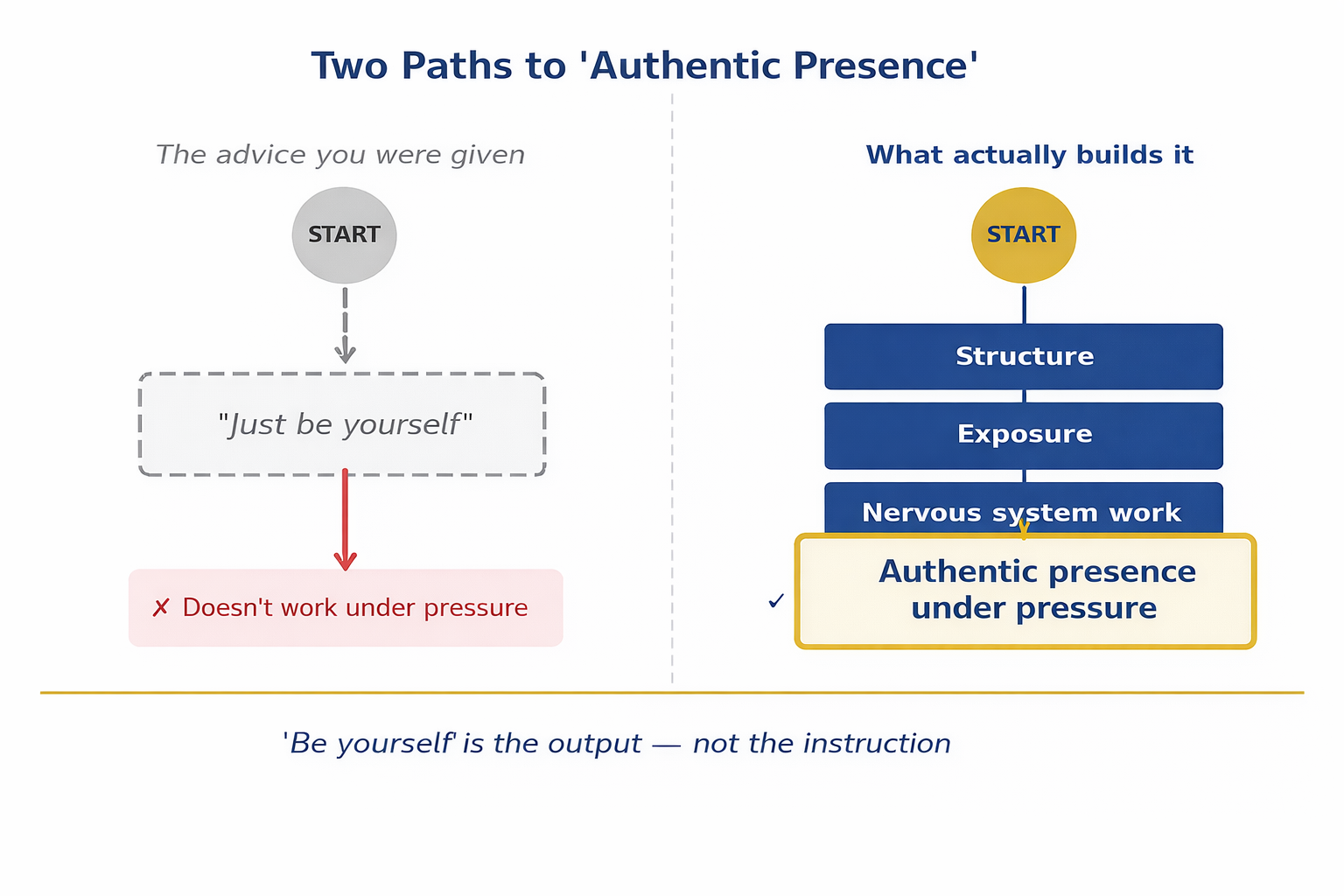
The advice is not wrong because authenticity doesn’t matter. It matters enormously. It’s wrong because it mistakes the destination for the route.
Quick answer: “Just be yourself” fails as presentation advice because it assumes you already have access to a confident, composed version of yourself in a high-pressure context — and for many people, you don’t yet. Authenticity in presentations isn’t a starting position; it’s a result of having a reliable structure, having prepared the right way, and having repeated the experience enough times for the nervous system to stop treating it as a threat. The route to authentic presenting runs through skill, not sentiment.
🧠 Struggling with presentation anxiety despite trying every tip you’ve been given? Conquer Speaking Fear (£39) addresses the root cause — not the symptoms — with a four-step approach built on clinical hypnotherapy and NLP.
Jump to:
I spent 24 years in corporate banking before I became a presentation coach and clinical hypnotherapist. In my banking career I gave many presentations that went well and several that didn’t — and I received “just be yourself” advice before most of them. I know what it feels like to walk into a room where the stakes are high, where the audience is senior, and where your nervous system is telling you that you are not safe.
In that state, “yourself” is not a useful concept. “Yourself” is simultaneously the person who knows this material better than anyone in the room, and the person whose heart rate has just doubled and who has forgotten how to breathe properly. Telling that person to “be themselves” doesn’t help them access the first version — it just leaves them alone with the second.
What actually builds presenting confidence is not more permission to be authentic. It’s removing the obstacles that prevent authenticity from being accessible. That’s a different problem with a different solution.
 Why ‘Be Yourself’ Fails in High-Pressure Contexts
The advice “just be yourself” contains a hidden assumption: that the self you normally inhabit is readily available in high-stakes situations. For most people, it isn’t — and this isn’t a character flaw, it’s a neurological response.
When your nervous system perceives threat — and many brains are wired to classify a large audience, an important meeting, or a high-stakes pitch as a threat — it triggers physiological responses designed to help you survive, not to help you present well. Elevated heart rate. Shallow breathing. Reduced access to higher-order thinking. A narrowed attentional focus. These responses are not evidence that you’re not good enough. They’re evidence that your brain is doing exactly what evolution designed it to do.
The problem is that “be yourself” offers no pathway through this response. It doesn’t tell you how to work with your nervous system rather than against it. It doesn’t provide structure that reduces the cognitive load of an unfamiliar or threatening situation. It doesn’t address the root pattern that makes presenting feel dangerous in the first place.
What’s more, the advice can actually increase anxiety. When someone tries to “be themselves” and still feels anxious, the natural conclusion is that there’s something wrong with them — that even their authentic self isn’t good enough for this situation. The advice doesn’t just fail to help; it creates a new layer of self-criticism on top of the existing anxiety. The research on why even confident presenters still get nervous confirms this: the problem isn’t authenticity, it’s the model people hold about what anxiety means.
🧠 The Approach That Actually Works When ‘Just Be Yourself’ Hasn’t
Conquer Speaking Fear addresses presentation anxiety at the level where it actually lives — the nervous system pattern that activates in high-pressure contexts — not the surface symptoms that generic advice tries to manage:
- The four-step framework for retraining the nervous system response that makes presenting feel threatening
- Clinical hypnotherapy and NLP techniques applied specifically to presentation anxiety
- The pre-presentation physical routine that creates genuine calm rather than performed confidence
- Evidence-building practices that change how your brain classifies the presenting situation over time
- The distinction between managing anxiety (which keeps the pattern in place) and resolving it
Get Conquer Speaking Fear → £39
Built from clinical hypnotherapy, NLP practice, and 24 years of high-stakes presenting at JPMorgan Chase, PwC, and RBS. Used by executives who’ve tried every other approach.
What Authenticity in Presenting Actually Is
Authentic presenting is not performing naturalness. It’s not trying to replicate how you feel in a low-stakes conversation and importing it into a high-stakes one. Authenticity in the context of presentations means that your words, delivery, and presence are congruent — that there isn’t a visible gap between what you’re saying and how you appear to be experiencing saying it.
That congruence is available to most people in some contexts and not in others. In a conversation with a trusted colleague about a subject you know well, it’s probably effortless. In a room with senior stakeholders, cameras, or an audience that includes people who can affect your career, it’s not — because your nervous system has added a layer of self-monitoring and threat assessment that didn’t exist in the smaller conversation.
Removing that layer is not a matter of trying harder to be authentic. It’s a matter of reducing what your nervous system needs to monitor. Structure does part of that work — when you know exactly where your presentation is going, you’re not simultaneously navigating and performing. Preparation does another part — when you’ve rehearsed the opening enough times, it stops requiring conscious attention and frees up cognitive resource for presence. And nervous system work — the kind that changes the underlying response pattern — does the part that structure and preparation alone can’t reach.
The result is what people experience as authenticity: the sense that the presenter is genuinely present, not performing presence. But that result is downstream of a specific set of inputs. It doesn’t arrive just because someone gave you permission.
Why Structure Comes Before Authenticity
This is the idea that most presentation advice gets backwards. The conventional model says: first be yourself, then communicate your content confidently. The actual sequence is: first build a reliable structure, then reduce the cognitive load of delivering it, then the self that was always there becomes accessible.
Structure reduces threat. When you walk into a presentation knowing exactly what your first sentence is, what your three main points are, and what you’re going to say in your closing — the brain has far less to manage. The threat response that generates the symptoms most presenters try to hide has less reason to activate. Not because you’ve suppressed it, but because the situation is now more predictable.
This is why some of the best presenter frameworks begin with slide structure rather than mindset. Building presentation confidence starts with giving yourself a reliable architecture to stand inside — not with trying to think your way into a more relaxed emotional state.
It’s also why the “just be yourself” advice works for experienced presenters and fails for anxious ones. Experienced presenters have already developed structure and reduced the cognitive load through repetition. Their brain genuinely has less to monitor in the presenting situation. When someone tells them to “be themselves,” they have reliable access to that self because the threat response has already been downgraded. They’re not natural because they’re naturally relaxed. They’re relaxed because they’ve done the work that structure and repetition require.
🚫 If Generic Advice Hasn’t Worked, the Route Is Different — Not Longer
Most presentation anxiety programmes manage symptoms. Conquer Speaking Fear (£39) addresses the nervous system pattern underneath — the one that ‘just be yourself’ never reaches.
Get Conquer Speaking Fear → £39
Built on clinical hypnotherapy and NLP — for executives who’ve already tried practice, positive thinking, and being told to relax.
What Actually Builds Genuine Presenting Confidence
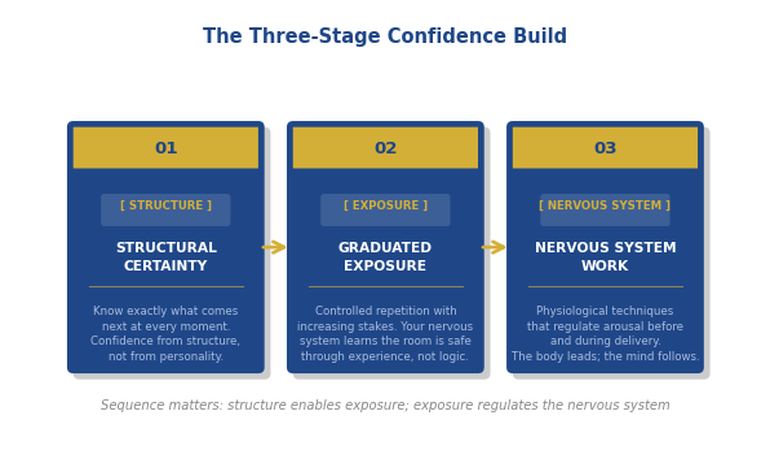
The route to confident, authentic presenting has three components. They work in sequence, not simultaneously.
The first is structural certainty. Know exactly where your presentation starts, what it covers, and how it ends. This isn’t about scripting every word — it’s about having a reliable architecture that your brain trusts. When the structure is solid, the self-monitoring that activates in ambiguous situations has less to do.
The second is graduated exposure. Presenting in low-stakes contexts — team meetings, small groups, recorded practice — builds the evidence base that your nervous system needs to downgrade the threat assessment of the presenting situation. Each successful experience registers as data: I presented and the outcome was acceptable. Over time, the brain reclassifies presenting from threat to familiar challenge. This is the mechanism behind why experienced presenters appear naturally confident. It’s not that they were born different — it’s that they’ve created a different data set.
The third, and the one that matters most when the first two haven’t been enough, is addressing the underlying pattern directly. Clinical hypnotherapy and NLP work at the level of the nervous system response itself — not by convincing you to think differently about presenting, but by changing the subconscious association between the presenting context and the threat signal. This is the component that ‘just be yourself’ and most generic presentation advice never reaches.
When all three are in place, authenticity stops being something you have to try to produce. It becomes, as it should always have been, the natural state of a person who is not being overwhelmed by anxiety. Looking confident when presenting is not a performance you layer over anxiety — it’s what emerges when the anxiety has been genuinely addressed.
The Nervous System Problem the Advice Ignores
Presentation anxiety isn’t a mindset problem. It’s a nervous system response that was calibrated in situations where social threat was genuinely dangerous — where being judged by the group could result in exclusion — and which now activates in professional presenting contexts even though the actual consequences are rarely catastrophic.
Telling someone with this response to “be themselves” is asking them to perform naturalness while a part of their brain is running a threat protocol. The physiological symptoms — the racing heart, the shallow breathing, the dry mouth, the trembling hands — are not the result of insufficient authenticity. They’re the result of an overactive threat response in a context where threat has been overestimated.
The work that changes this isn’t in the advice given before presentations. It’s in the pattern-interruption that happens underneath the conscious, rational mind — through techniques that access the subconscious associations between presenting and danger that maintain the response. That work is specific, it takes a particular set of tools, and it is available. But “just be yourself” isn’t it.
Also published today: The Investor Relations Update Format That Prevents Awkward Questions — the four-part slide structure for IR updates that keeps executives in control of the narrative.
Recognise that pattern in yourself? Conquer Speaking Fear addresses the nervous system response that ‘just be yourself’ never reaches — with a four-step clinical approach built on hypnotherapy and NLP.
Common Questions About Presentation Advice and Authenticity
Is ‘be yourself’ ever good advice for presenting?
Yes — for people who already have a confident, accessible version of themselves in presenting contexts. For them, the advice is a useful reminder not to over-perform or adopt a stylised ‘presenter voice.’ But for anyone whose nervous system still treats presenting as a threat, “be yourself” describes a destination they can’t reach from where they currently are. It’s good advice for the wrong people, given at the wrong stage.
What’s the difference between authentic presenting and faking confidence?
Faking confidence means performing a state you don’t have access to — and audiences can usually detect the gap, even if they can’t name it. Authentic presenting means the external and internal are congruent: you don’t appear more composed than you feel because you’ve done the work to reduce the gap. The goal isn’t to act calm while feeling panicked. The goal is to reach a state where calm is genuinely available. That’s a different project from ‘just be yourself,’ but it’s an achievable one.
Why do confident colleagues seem to naturally ‘be themselves’ in presentations?
Because their nervous system has already downgraded the threat assessment for presenting — usually through repetition, through a history of acceptable outcomes, or occasionally through a fundamentally different anxiety profile. They’re not naturally more authentic. They’re operating in a context their brain has reclassified as safe, so they have access to the full range of who they are. The route to that state is available to most people, but it runs through the work, not through the advice.
Is This Right For You?
✅ This is for you if:
- You’ve received ‘just be yourself’ advice and found it doesn’t help — or makes things worse
- You present competently but never feel genuinely present or relaxed in front of an audience
- You want to understand why standard presentation tips don’t address what you’re actually experiencing
❌ This is NOT for you if:
- You already feel calm and confident when presenting and are looking for delivery technique improvements
- You want a quick list of tips to apply before tomorrow’s presentation (that’s a different article)
🏛️ Built by a Clinical Hypnotherapist Who Spent 24 Years Presenting in High-Stakes Corporate Environments
Conquer Speaking Fear wasn’t built from academic theory about presentation confidence. It was built from the inside — by someone who experienced severe presentation anxiety in a professional context where generic advice consistently failed, and who spent years developing a clinical approach to what that experience actually required:
- The four-step nervous system retraining framework — not symptom management, root cause resolution
- Clinical hypnotherapy techniques for changing the subconscious associations that maintain the anxiety response
- NLP approaches for interrupting the thought patterns that escalate anticipatory anxiety in the days before a presentation
- The pre-presentation physical routine that creates genuine calm — not performed composure
- Evidence-building practices that change the data your nervous system holds about presenting over time
Get Conquer Speaking Fear → £39
From a qualified clinical hypnotherapist and NLP practitioner with 24 years of corporate presenting experience at JPMorgan Chase, PwC, Royal Bank of Scotland, and Commerzbank.
📊 Want the slides too?
Preparation reduces anxiety. The Executive Slide System (£39) includes confident-presenter templates designed to reduce preparation stress — because knowing your structure is solid before you walk in genuinely changes how your nervous system responds to the situation.
Related reading: Why Confident Presenters Still Get Nervous Before Every Talk — why the goal isn’t to eliminate nerves and what to do with them instead.
Frequently Asked Questions
How do I get comfortable presenting without having to ‘perform’ confidence I don’t feel?
The route is to stop trying to perform confidence and instead do the work that makes genuine confidence available. That means building a reliable structure so your brain has less to manage in the presenting context, using graduated exposure to give your nervous system new evidence, and — if those two haven’t been enough — working directly on the underlying anxiety pattern through approaches like clinical hypnotherapy or NLP. Performed confidence is exhausting and detectable. Genuine confidence is the result of the brain no longer classifying the presenting situation as a significant threat.
Is presentation anxiety something you can actually resolve, or is it just something you manage forever?
For most people, it’s resolvable — not just manageable. The distinction matters because ‘managing’ anxiety keeps the underlying pattern in place and requires ongoing effort. Resolving it means changing the nervous system response that generates the anxiety in the first place, so that presenting becomes a familiar challenge rather than an activating threat. That resolution isn’t guaranteed, and it requires specific approaches rather than generic tips. But the clinical tools exist, and for the majority of people who haven’t tried them, they produce significantly different outcomes than anything that’s been attempted before.
Why does the advice to ‘just relax’ also not work for presentation anxiety?
Because “just relax” is a request to consciously override a subconscious response — and the conscious mind doesn’t have access to the systems that generate the anxiety symptoms. You can’t decide your way out of an elevated heart rate in the same way you can decide to answer a question differently. The symptoms are produced by the autonomic nervous system responding to a perceived threat signal. The work that changes those symptoms has to operate at the level where that signal originates, not at the level of conscious intention.
What’s the difference between introversion and presentation anxiety?
Introversion is a preference for lower-stimulation environments and a tendency to recharge through solitude rather than social interaction. Presentation anxiety is a fear response to a perceived threat in a social performance context. They often co-occur, but they’re not the same thing and they don’t have the same solution. Many introverts present extremely well because they’ve addressed the anxiety component — introversion doesn’t cause anxiety, it just means the social aspects of presenting require more recovery time afterwards. The work of building presenting confidence is available to introverts as much as to anyone else.
The Winning Edge — weekly insight on presentation confidence, anxiety, and executive communication. Subscribe free →
Want everything in one place? The Complete Presenter Bundle (£99) includes Conquer Speaking Fear, the Executive Slide System, the Executive Q&A Handling System, and four additional products.
Free resource: Executive Presentation Checklist — the pre-presentation checklist for structure, content, and delivery, free to download.
About the Author
Mary Beth Hazeldine is the Owner & Managing Director of Winning Presentations. With 24 years of corporate banking experience at JPMorgan Chase, PwC, Royal Bank of Scotland, and Commerzbank, she has delivered high-stakes presentations in boardrooms across three continents.
A qualified clinical hypnotherapist and NLP practitioner, Mary Beth combines executive communication expertise with evidence-based techniques for managing presentation anxiety. She has trained thousands of executives and supported high-stakes funding rounds and approvals.