

I Had to Present 200 Redundancies. Here’s What I Learned About Trust.
The CFO handed me the deck at 4pm. “Present this tomorrow. 200 roles. Be clear but compassionate.”
I looked at the slides. Twelve pages of financial rationale. Charts showing declining margins. A timeline of “workforce optimisation.” Not a single word about the humans whose lives were about to change.
That night, I rebuilt the entire presentation. Because I’d seen what happens when cost reduction presentations focus on the numbers instead of the trust. I’d watched leaders lose their teams’ respect in 15 minutes — respect that took years to build and would never fully return.
The presentation the next morning wasn’t easy. But six months later, the remaining team was still engaged, still productive, and still willing to go the extra mile. That almost never happens after restructuring announcements.
Here’s what I learned about presenting cost cuts without destroying the trust you’ll need to rebuild.
In this article:
Quick answer: Cost reduction presentations destroy trust when they lead with financial justification and treat people as line items. To preserve trust: acknowledge the human impact first, explain the business reality second, be specific about what’s happening and when, answer the questions people are actually thinking, and commit to specific next steps. The sequence matters as much as the content.
Why Trust Dies in Cost Reduction Presentations
I’ve watched dozens of cost reduction presentations over 24 years in banking and consulting. The ones that destroy trust share the same pattern:
They lead with the business case.
“Market conditions have changed. Our margins are compressed. We need to reduce operating costs by 15%.”
The moment you start with numbers, you’ve lost them. Because everyone in that room is doing the same mental calculation: “Am I a cost? Am I being reduced?”
They’re not hearing your carefully constructed rationale. They’re scanning for threat signals. Their nervous systems have already shifted into fight-or-flight. And everything you say after that opening gets filtered through fear.
The trust equation shifts instantly.
Before the presentation, your team believed you cared about them as people. The moment you lead with financial justification, they recategorise you. You’re no longer “leader who has my back.” You’re “person who sees me as a number.”
That recategorisation takes seconds. Reversing it takes years — if it’s even possible.
For more on delivering difficult news, see my guide on how to present bad news to executives.
The 5-Part Framework That Preserves Credibility
After that 200-person restructuring presentation, I codified what worked into a framework I’ve used — and taught — ever since.
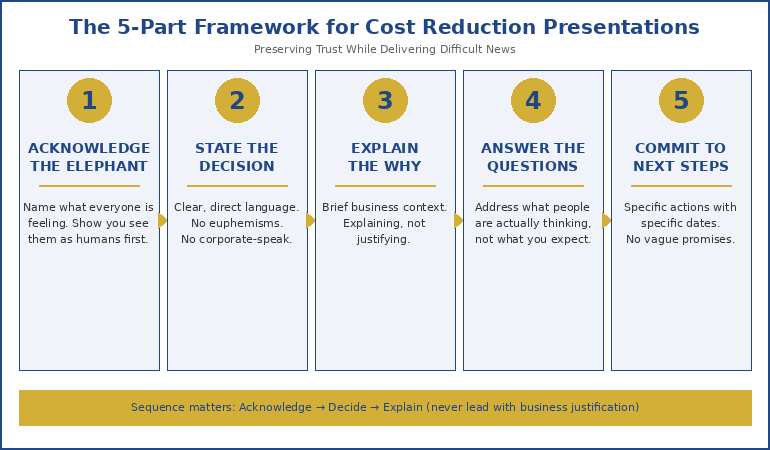
Part 1: Acknowledge the Elephant (First 60 Seconds)
Before anything else, name what everyone is feeling.
“I know why you’re here. I know what you’re expecting to hear. And I know that whatever I say in the next few minutes is going to affect how you feel about this company, about this team, and about me. I’m not going to pretend this is easy news.”
This does something crucial: it signals that you see them as humans, not audience members to be managed. It also prevents the mental drift that happens when people are anxious — they’ll actually hear what you say next.
Part 2: State the Decision Clearly (No Euphemisms)
“We are reducing our workforce by 200 positions. This affects the following departments…”
Don’t say “workforce optimisation.” Don’t say “right-sizing.” Don’t say “strategic realignment of human capital.”
Euphemisms don’t soften the blow. They signal that you’re either ashamed of the decision or think your audience is too stupid to understand plain language. Neither builds trust.
Part 3: Explain the Why (But Not First)
Now — and only now — explain the business context. But keep it brief and honest.
“Here’s why this is happening: our revenue dropped 23% this year. We explored every alternative — hiring freezes, salary reductions, project deferrals. This was the option that gives us the best chance of protecting the remaining roles long-term.”
Notice what’s different: you’re not justifying. You’re explaining. The tone is “here’s the reality” not “here’s why you should be okay with this.”
Part 4: Answer the Unasked Questions
Everyone in that room has the same questions. Answer them before they have to ask:
- “Is my role affected?” — Be specific about who knows what and when.
- “When will I find out?” — Give exact timelines.
- “What support is available?” — Be concrete about severance, outplacement, references.
- “What happens to my projects?” — Show you’ve thought about continuity.
- “Can I trust what you’re telling me?” — Address this directly: “I’m telling you everything I know right now.”
Part 5: Commit to Specific Next Steps
“By end of day Friday, every affected person will have a one-on-one with their manager. By next Wednesday, HR will have individual packages prepared. I will send a written summary of everything I’ve said today within two hours.”
Specificity signals competence. Vague promises (“we’ll support everyone through this”) signal that you haven’t actually planned what happens next.
📊 Difficult Conversations Require Clear Structure
Cost reduction presentations fail when leaders improvise. The Executive Slide System gives you proven frameworks for structuring sensitive communications — including templates for restructuring announcements that preserve trust while delivering clarity.
- 10 executive slide templates (including difficult news formats)
- Recommended-first structures that work for sensitive topics
- Opening and closing frameworks that set the right tone
Get the Executive Slide System → £39
Built from 24 years in corporate banking and consulting. Designed for restructuring, cost reduction, and high-stakes stakeholder meetings.
What Never to Say (And What to Say Instead)
Some phrases seem professional but actually destroy trust. Here’s what to avoid:
❌ “This was a difficult decision.”
Everyone knows it was difficult. Saying it sounds like you’re asking for sympathy — which should be flowing the other direction.
✓ Instead: “I wish I had better news.”
❌ “We’re all in this together.”
If you’re not losing your job, you’re not in this together. This phrase infuriates people.
✓ Instead: “I know this affects some of you more than others.”
❌ “This is an opportunity for the company to emerge stronger.”
True, perhaps. But saying it in a redundancy announcement makes you sound like you’re celebrating.
✓ Instead: Save this for three months later, when you’ve earned the right to look forward.
❌ “HR will handle the details.”
This makes you look like you’re delegating the hard part. Even if HR does handle details, you need to own the communication.
✓ Instead: “I’ll be working with HR to ensure everyone gets individual support. Here’s exactly what that looks like…”
The Executive Slide System includes specific language frameworks for sensitive presentations — phrases that land and phrases to avoid.
The Slide Structure That Works
If you must use slides (and sometimes you must, for documentation or remote teams), here’s the structure that maintains trust:
Slide 1: The Decision
One sentence. No charts. No logos. Just the news.
“We are reducing our workforce by [X] positions, effective [date].”
Slide 2: Who Is Affected
Departments, locations, roles. Be specific. Don’t make people guess.
Slide 3: The Timeline
When people will be notified. When last day is. When support begins.
Slide 4: Support Available
Severance terms. Outplacement services. Reference policies. Healthcare continuation.
Slide 5: What Happens Next
Specific actions with specific dates. Who to contact. When the next communication will happen.
Slide 6 (Optional): Business Context
If you include this, keep it to one slide. This is not the time for a 20-slide market analysis.
Notice what’s missing: no “journey” language, no vision statements, no “exciting future” positioning. Those come later, if ever.
For more on presentation structure, see my guide on executive presentation structure.
🎯 Structure Sensitive Presentations With Confidence
The difference between a cost reduction presentation that preserves trust and one that destroys it often comes down to structure. Get it wrong, and you lose your team’s respect permanently. Get it right, and you maintain the credibility needed to rebuild.
Get the Executive Slide System → £39
Designed for restructuring announcements, difficult conversations, and crisis communications.
What Happens After the Presentation
The presentation is just the beginning. Trust is built or destroyed in what comes next.
Within 2 hours: Send a written summary of exactly what you said. No softening, no additions. This creates a record and shows consistency.
Within 24 hours: Every affected person should have had an individual conversation. Not an email — a conversation.
Within 1 week: Check in with your remaining team. Not to sell them on the future — to listen to their concerns. The people who stay are watching how you treat the people who leave.
Within 1 month: Acknowledge the transition openly. “We’re a smaller team now. Here’s how we’re adapting. Here’s what I need from you.”
The biggest mistake leaders make post-announcement: acting like it never happened. Your team remembers. Pretending it’s “business as usual” insults their intelligence and damages whatever trust remains.
For more on this topic, see my article on restructuring announcement presentations.
Presenting Cost Cuts Without Losing Your Team
Here’s what it comes down to:
Your team will remember how you made them feel during the hardest moments. Not your financial rationale. Not your market analysis. Not your carefully worded euphemisms.
They’ll remember whether you looked them in the eye. Whether you spoke plainly. Whether you answered their real questions. Whether you followed through on what you promised.
The Executive Slide System gives you the structural frameworks. But the trust comes from how you deliver them.
That 200-person presentation? It wasn’t my finest hour. But the team that remained trusted me enough to rebuild. And that trust started with acknowledging that I was about to deliver news that would change lives — before I said anything else.
📋 Ready to Structure High-Stakes Presentations?
Whether you’re presenting cost reductions, restructuring announcements, or any difficult news — structure determines whether you preserve trust or destroy it. The Executive Slide System gives you proven templates for sensitive executive communications.
- 10 executive-ready slide templates
- Difficult news presentation frameworks
- Opening scripts that acknowledge reality
- 30-day email support if you get stuck
Get the Executive Slide System → £39
Built from 24 years in corporate banking and consulting + 15 years training senior executives.
Frequently Asked Questions
Should I rehearse a cost reduction presentation?
Yes, but not for polish — for emotional preparation. Rehearse so you can deliver the difficult parts without hesitating, stumbling, or showing discomfort that makes you seem uncertain about the decision. Your team needs to see that you’ve fully processed this, even if they haven’t.
What if I don’t agree with the cost cuts?
This is one of the hardest leadership moments. You have three options: advocate privately until the decision changes, present the decision as your own (which it becomes the moment you deliver it), or resign before delivering news you can’t stand behind. What you cannot do is subtly distance yourself from the decision during the presentation — your team will sense it, and it destroys trust in both you and the organisation.
Should I take questions during the presentation?
Yes, but manage the format. Say: “I’ll answer questions after I’ve covered everything. That way, some of your questions might already be addressed.” This prevents derailment while still showing openness. Have a clear time limit for Q&A and commit to following up on anything you can’t answer immediately.
What if someone gets emotional during the presentation?
Acknowledge it. “I understand this is difficult to hear.” Then pause. Give them space. Don’t rush past it. The worst thing you can do is pretend it’s not happening or quickly move to the next slide. Human reactions deserve human responses.
📧 Weekly insights: Subscribe to The Winning Edge →
📋 Free resource: Download the Executive Presentation Checklist →
Related: Difficult presentations affect your nervous system long after they’re over. If you’re still carrying the weight of past presentations, see Why Your Nervous System Remembers That Awful Presentation From 2019.
About the Author
Mary Beth Hazeldine is the Owner & Managing Director of Winning Presentations. With 24 years in corporate banking and consulting — including roles at JPMorgan Chase, PwC, Royal Bank of Scotland, and Commerzbank — she has delivered and supported high-stakes presentations in boardrooms across three continents, including restructuring announcements affecting thousands of employees.
A qualified clinical hypnotherapist and NLP practitioner, Mary Beth combines executive communication expertise with evidence-based techniques for navigating difficult conversations. She has trained thousands of executives on presenting with clarity, credibility, and composure under pressure.