Tag: crisis communication

15 Apr 2026
Female executive presenting difficult financial results to a board, calm authoritative composure

Presenting Bad News to Senior Leadership: The Structure That Maintains Credibility

Quick Answer: Senior leaders looking at difficult results want accuracy, cause, and corrective action — not softening. The structure that works: context → bad news → root cause → corrective action → forward commitment. This order positions you as a leader taking ownership, not a presenter delivering unpleasant information to an uncomfortable room.

Astrid had seventy-two hours.

As head of the Consumer division for a mid-sized financial services group, she had watched the quarterly numbers deteriorate through February. By the time March closed, the shortfall against target was 23% — not the 10–12% the business had quietly acknowledged in internal planning meetings, but a number that was going to land in front of the Group CFO and two non-executive directors on Thursday morning with no soft landing.

Her first instinct was to open with the positives. March had been genuinely strong in two product lines. Customer satisfaction scores were holding. She could walk them through those before arriving at the revenue figure, give them something to feel reassured by before the difficult moment.

She did not do that. She had been in enough of these rooms to know that senior leaders are rarely fooled by sequencing. They had already seen the headline number before the meeting. What they were measuring was whether she understood what had happened, whether she owned it, and whether she had a credible path forward. Opening with positives would read as deflection.

So she rebuilt the deck from scratch. Context first — one slide on the market conditions her division had been navigating. Then the number, stated plainly, with the variance shown clearly against both target and prior quarter. Root cause on the next slide, in her own words, without distributing fault across teams she hadn’t yet named. Then corrective action. Then a forward commitment with a specific date and a measurable outcome.

Thursday’s meeting ran seventeen minutes shorter than scheduled. The CFO asked three focused questions about the corrective action timeline. The non-executives asked none. Astrid had given them nothing to be uncertain about.

If you are building a deck to present difficult results or a funding shortfall, the Executive Slide System has slide templates and scenario playbooks specifically designed for difficult-results presentations — so your structure holds under pressure, not just in theory.

Explore the System →

Why the Instinct to Soften Bad News Backfires

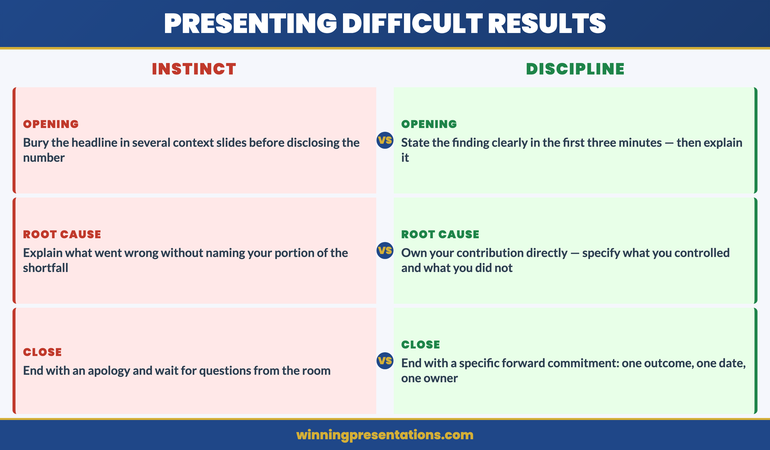
The urge to cushion a difficult number is understandable. It comes from wanting to protect relationships, manage anxiety in the room, and give people a moment to absorb context before the impact lands. Most executives have been trained, implicitly or explicitly, that you lead with strengths and work towards the challenge.

In a board or senior leadership setting, this approach tends to produce exactly the opposite result. By the time you reach the difficult number, your audience has often already seen it — in a pre-read, a briefing note, or a conversation with your finance partner. What they are watching is not the number itself, but how you handle it. Starting with positives before bad news signals one of two things: either you do not fully grasp the severity, or you do grasp it and are trying to soften the reaction. Neither reading builds confidence.

There is also a structural problem. When an executive buries the headline, the audience spends the early part of the presentation waiting for it. They stop engaging with your context slides and your positive indicators because they are mentally anticipating the moment when the real news arrives. You lose the room before you have said the difficult thing.

The executives who come out of difficult presentations with their credibility intact are the ones who state the situation with clarity, explain it without excuse, and shift the conversation to what happens next as quickly as possible. That is not a personality type — it is a structure. And structure can be built before you walk into the room.

If you have ever navigated a budget shortfall presentation, you will recognise this pattern. The instinct to build up to the variance rather than state it is almost universal — and almost universally counterproductive.

Executive Slide System — £39, instant access

Build a Deck That Holds Credibility When Results Are Difficult

When the number is bad, structure is your greatest asset. The Executive Slide System gives you the frameworks, slide templates, and scenario playbooks to build presentations that hold up under scrutiny — not just on paper, but in the room with senior stakeholders who have already seen the figure.

  • Slide templates for difficult-results presentations, variance reviews, and recovery plans
  • AI prompt cards to structure your narrative before you open PowerPoint
  • Framework guides: context → finding → cause → action → commitment
  • Scenario playbooks for board meetings, investor updates, and executive reviews
  • Root cause framing that owns the issue without distributing blame across your team

Designed for leaders presenting to boards, investors, and senior leadership teams.

Get the Executive Slide System →

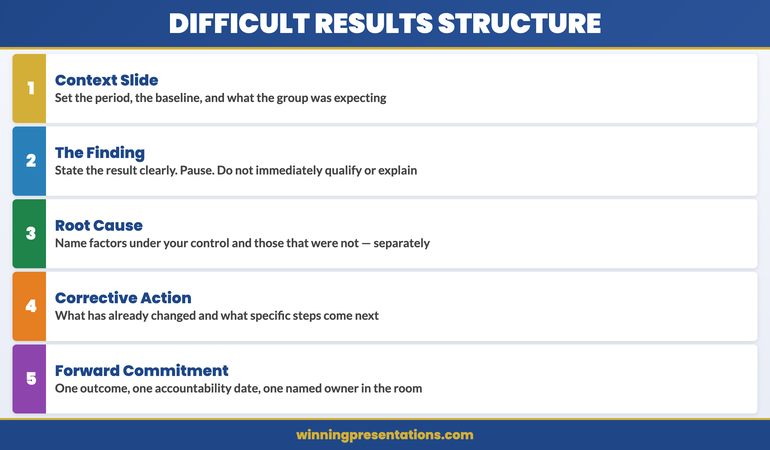
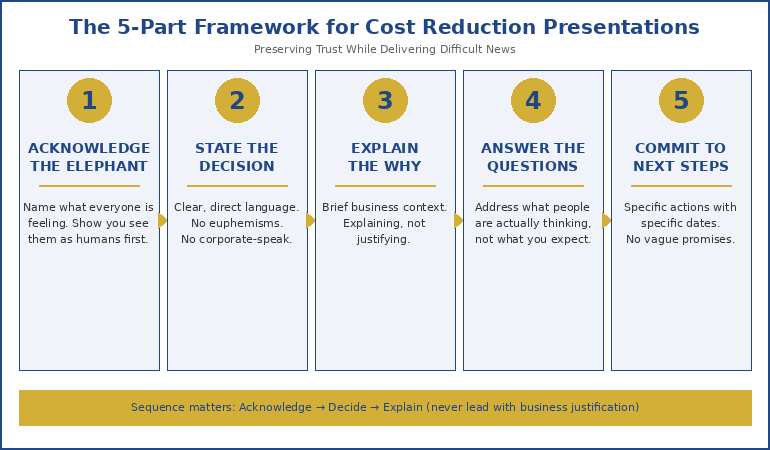
The Five-Part Structure for Difficult Results Presentations

The structure below is built for situations where the news is materially bad — a significant miss against target, a funding shortfall, a project outcome that falls short of what was committed. It is not designed for minor variances that sit within normal operating tolerance. When the number is genuinely difficult, this sequence works because it follows the logical order in which a senior audience needs to receive and process information.

1. Context (one slide). Not positives — context. What were the conditions under which this period operated? Market environment, competitive dynamics, regulatory changes, or operational constraints that are relevant to understanding the outcome. This is not excuse-building; it is framing. Senior leaders need to know whether they are evaluating a team’s performance against a backdrop that was materially harder than planned, or against conditions that were largely as expected.

2. The bad news, stated plainly (one slide). Actual versus target. Actual versus prior period. The gap in absolute terms and as a percentage. No softening language. The slide should make the number visible and clear before your commentary begins.

3. Root cause (one to two slides). What drove the shortfall? This section requires the most preparation because it needs to be accurate, specific, and framed in a way that demonstrates analytical rigour without reading as defensive or blame-laden. More on this structure in the next section.

4. Corrective action (one to two slides). What is already in motion? What will change as a result of this analysis? Corrective action slides are where credibility is rebuilt — but only if the actions are specific, timed, and owned. Vague commitments (“we will review our processes”) are worse than no corrective action slide at all.

5. Forward commitment (one slide). A clear, measurable statement of where the business or project will be at the next review point. This is distinct from a corrective action. It is the outcome you are committing to, not the inputs you are changing. Senior leaders make decisions based on what they can hold you to; the forward commitment is what gives them that anchor.

The entire deck should run to eight to twelve slides. Length is not credibility. Precision is.


Five-part structure for presenting bad news to senior leadership: context, finding, root cause, corrective action, forward commitment

How to Frame Root Cause Without Creating a Blame Narrative

Root cause framing is where most difficult presentations come unstuck. The executive presenting has spent weeks or months close to the situation. They know who made which decisions. They may have raised concerns that were not acted on. Keeping that out of the room — or more accurately, structuring it so that it informs the analysis without becoming a blame narrative — requires deliberate preparation.

The first discipline is to separate causes from contributors. A cause is a structural or operational factor that can be analysed and addressed. A contributor is a person, team, or decision point. Your root cause slide should deal entirely in causes. Contributors may need to be discussed, but that conversation belongs in a different forum — usually a private one, before or after the main presentation.

The second discipline is to be specific about what you do and do not know. If the root cause analysis is still incomplete, say so on the slide. Senior leaders are not expecting omniscience — they are expecting rigour. “Root cause analysis is 80% complete; these three factors are confirmed, this fourth is still under investigation with a conclusion expected by [date]” is a stronger position than presenting a tidy but underpowered explanation that an experienced non-executive will immediately see through.

The third discipline is to own the portion that sits with you. If you led the team, approved the plan, or made the call that contributed to the outcome, acknowledge it in a single, direct sentence. Not an apology — an acknowledgement. “The original demand forecast that I signed off in November proved to be overly optimistic in three market segments” is a statement of fact that demonstrates ownership. It closes the room’s silent question (“does she know what her part in this was?”) before anyone has to ask it.

This approach is equally important when presenting a sensitive or unexpected situation to a board. The principles that apply to presenting a difficult topic to the board — clarity, ownership, and a clear forward path — hold across scenario types. The structure may vary; the underlying disciplines do not.

If you are building this kind of deck under time pressure, the Executive Slide System includes scenario playbooks written specifically for difficult-results presentations — so you have a tested framework to build from, not a blank slide.

The Forward Commitment Slide: What Senior Leaders Actually Need to See

Many executives treat the final slide of a difficult-results presentation as a summary or a list of next steps. Senior leaders are looking for something more specific: a measurable commitment that they can hold you to at the next touchpoint. The forward commitment slide is not a close — it is a contract.

The slide should answer three questions in plain language. First: what will the situation look like at the next review? Second: by when? Third: what would cause that commitment to change, and how will you communicate if it does?

The third element is the one most often omitted. Senior leaders understand that forecasts are subject to revision — what concerns them is the absence of a clear escalation trigger. If you include a statement such as “if the Q2 market recovery does not materialise by mid-May, I will flag this by [date] with a revised projection,” you demonstrate that you are managing forward actively, not just reporting backward.

The language on the forward commitment slide matters. Avoid language that hedges without qualifying: “we expect to return to plan” tells a non-executive nothing they can work with. Instead: “We are committing to [specific metric] by [specific date], based on the corrective actions described on the previous slide. This assumes [named assumption]. If that assumption changes, I will communicate by [date].”

That level of specificity is what converts a difficult presentation into a demonstration of leadership. Anyone can report a bad number. What senior boards are watching is whether you are the person who can manage the situation forward.

This structure transfers well beyond quarterly results. If you have ever needed to present a mid-year business review where performance is off track, the forward commitment section is the element that determines whether you leave that room with confidence or questions hanging in the air behind you.

Executive Slide System — £39, instant access

Structure Your Difficult Presentation Before You Open PowerPoint

The Executive Slide System is built around preparation, not just slide design. AI prompt cards walk you through structuring context, root cause, corrective action, and forward commitment — so when you do sit down to build the deck, every section is already clear in your thinking. Templates are formatted for board, investor, and executive team environments.

Get the Executive Slide System →

Handling Questions You Cannot Answer in the Room

In a difficult-results presentation, the Q&A section carries more weight than in most executive meetings. The room is alert. Senior leaders who were quiet during your presentation may become more direct once they begin asking questions. And occasionally, a question will arrive that you cannot answer — not because you are unprepared, but because the data or the analysis is not yet available.

The worst response to an unanswerable question in this context is to attempt an answer you cannot substantiate. Senior leaders who know the subject — and many board members and non-executives have deep functional expertise — will identify the gap immediately. Attempting an answer under pressure and getting it wrong is far more damaging to credibility than acknowledging the limits of what you currently know.

The response that works is honest and structured: “I don’t have the complete analysis on that yet. My current understanding is [what you do know]. I will have a full answer to you by [specific date and format].” This response demonstrates three things simultaneously: that you are not guessing, that you know the boundaries of your own analysis, and that you are committing to close the gap in a defined timeframe.

It is worth preparing, before the meeting, a short list of questions you are likely to be asked that you cannot yet fully answer — and rehearsing the holding response for each. That preparation is not about scripting — it is about ensuring you do not reach for speculation under pressure. The discipline of identifying the gaps in advance also often reveals whether those gaps are material enough to warrant further work before the presentation takes place.

One additional note on follow-up: whatever you commit to in the room, deliver it before the deadline you stated. A difficult-results presentation followed by a missed follow-up commitment compounds the original problem significantly. The holding response only builds credibility if the follow-through is reliable.


How to handle unanswerable questions in a difficult results presentation — four steps: acknowledge, state what you know, name the gap, commit to a date

Tone and Pacing When the News Is Bad

Delivery decisions in a difficult-results presentation matter as much as the structure. The way you pace your words, the register you use, and the degree of calm you project in the room all carry information — information that a senior audience is actively reading.

The most common tonal error is over-apologising. A single, clear acknowledgement of a shortfall is appropriate and expected. Repeated apologies shift the register from professional accountability to discomfort — and discomfort in the presenter makes the room more uncomfortable, not less. Senior leaders do not want to manage your reaction to the news. They want to understand the situation and move forward.

Pacing should be deliberate, particularly on the core finding slide. Executives who are anxious about a number sometimes speak faster at precisely the moment they should slow down. Stating the variance clearly, pausing, and allowing the room a beat to process before moving to root cause signals composure and confidence. It communicates, without saying so directly, that you are not afraid of the number — you are working through it.

Language precision is also part of tone. Phrases such as “it’s been a challenging quarter” or “the environment has been difficult” are heard by senior leaders as hedges. They are not wrong, but they are imprecise — and in a difficult presentation, imprecision reads as evasion. The more specific your language, the more confidence you project. “Revenue came in at £4.2m against a target of £5.4m, a shortfall of £1.2m driven by two factors” is a more credible opening than a general description of difficulty.

Finally, your energy level in the corrective action and forward commitment sections should rise slightly relative to the root cause section. Not artificially — but with a visible shift in engagement and directness. You are moving from analysis to action, and that transition in pace and energy signals that the conversation is now forward-looking. That shift is what leaves the room with confidence that the situation is being managed, not just documented.

Presenting bad news is a leadership skill that develops over time — but it develops faster when you have a repeatable structure and a clear sense of what your audience is actually listening for. For perspective on how this discipline fits into the broader discipline of executive communication across teams and time zones, the practical tactics in these Teams presentation hacks are worth applying to your virtual presentation preparation as well.

Frequently Asked Questions

Should you present bad news at the start or end of the meeting?

In a dedicated difficult-results meeting, the core finding — the bad number — should come early, after a brief context slide. Placing it at the end does not reduce its impact; it only delays the conversation and signals that you were reluctant to address it directly. Senior leaders typically know the headline before the room convenes. Your job is to take them through root cause and corrective action, and that conversation needs as much of the meeting time as possible. State the finding clearly, then move forward.

How do you maintain credibility when results are significantly below target?

Credibility in a difficult-results presentation is built through specificity, ownership, and forward commitment — not through the quality of the result itself. Own the portion of the shortfall that sits with you, in direct language and without hedging. Demonstrate rigorous root cause analysis, even where the analysis is incomplete — naming what you know and what you are still investigating is more credible than a tidy but thin explanation. Then commit to a specific outcome by a specific date. Senior leaders are not expecting perfect results; they are expecting capable leadership of an imperfect situation.

What’s the right tone when presenting difficult results to the board?

Calm, direct, and precise. Avoid over-apologising — a single acknowledgement of the shortfall is appropriate; repeated apology shifts the atmosphere in the room and puts the board in the position of managing your discomfort rather than engaging with the situation. Use specific language rather than general descriptions of difficulty. Slow your pace slightly when stating the core finding, then shift to a more active register when you reach corrective action and forward commitment. The board needs to leave the room confident that the situation is being actively managed, and tone is a significant part of communicating that.

Get weekly insights for executive presenters

Every Thursday, The Winning Edge delivers one focused, actionable idea on executive communication, presentation structure, and high-stakes speaking — direct to your inbox.

Subscribe to The Winning Edge →

Looking for a quick-reference checklist before your next high-stakes presentation? Download the free Executive Presentation Checklist — a concise guide to the structure, slides, and delivery points that matter most to senior audiences.

About the Author

Mary Beth Hazeldine

With 25 years of corporate banking experience at JPMorgan Chase, PwC, Royal Bank of Scotland, and Commerzbank, she advises executives across financial services, healthcare, technology, and government on structuring presentations for high-stakes funding rounds and approvals.

05 Apr 2026
Chief Communications Officer presenting to a board of directors in a crisis briefing room, calm and authoritative expression, slides on screen showing incident timeline

Data Breach Communication: How to Present to Your Board in the First 48 Hours

Quick Answer

In the first 48 hours after a data breach is discovered, your board presentation must do four things: confirm what is known, be honest about what is not yet known, set out the immediate containment steps, and give the board a clear timeline for the next update. Structure and calm matter as much as content — your board will judge your organisation’s competence partly by how well you present under pressure.

Priya had been Chief Communications Officer for six years. She had handled product recalls, leadership transitions, and a difficult regulatory inquiry. None of it prepared her for what happened on the Tuesday morning when the IT security lead called her at 5:47 AM.

Thirty-six hours later, she was standing in front of the full board of a mid-size financial services firm. In her hand was a single printed page — a holding statement drafted by Legal, cautious to the point of saying almost nothing. The board chair’s first question was blunt: “How many customer records were accessed?” Priya didn’t know. The forensic team hadn’t finished. The incident was still live.

What she did next — and how she structured that conversation without a single prepared slide — shaped how the board perceived her firm’s response for months afterwards. She had one chance to demonstrate that the organisation was in control, even when the situation was not. The problem was not a lack of information. It was the absence of a framework for presenting with incomplete information under acute pressure.

Presenting in a crisis requires structure — especially when everything feels uncertain

The Executive Slide System gives you a clear framework for structuring high-stakes presentations — including the kind where you’re expected to project calm authority before you have all the answers. It’s built for executives who need to communicate credibly under pressure.

Explore the System →

Why the First Communication Is the Most Important Presentation You’ll Ever Give

When a data breach becomes known inside an organisation, a clock starts running. It is not just the regulatory clock — though that matters enormously, particularly under UK GDPR, which requires notification to the Information Commissioner’s Office within 72 hours of becoming aware of a breach that poses a risk to individuals. There is also a credibility clock.

Your board, your leadership team, your regulators, and eventually your customers will form their initial judgement of your organisation’s competence based heavily on how you communicate in the first two days. The quality of your actual response matters, of course. But the perception of that response — shaped almost entirely by how you present it — can either reinforce or undermine confidence in everything that follows.

This is not a comfortable truth. Most organisations invest heavily in incident response plans, cyber insurance, and forensic retainers. Very few invest equivalent effort in preparing their senior communicators to stand in front of a board and speak clearly and credibly when the information is fragmentary and the pressure is extreme.

The first board communication after a breach does several things simultaneously. It establishes the facts as currently understood. It demonstrates that the organisation has a response structure and is following it. It sets expectations for what will be known, and when. And — critically — it positions the leadership team as the source of authoritative information, rather than allowing rumour, speculation, or press reports to fill the vacuum.

Boards that lose confidence in their leadership during a crisis often point not to the breach itself — breaches happen, and most directors understand this — but to the communication. Evasiveness, over-qualification, contradictory information given at different meetings, and a failure to give the board a clear picture of what is being done: these are the things that damage trust. A structured, honest, well-presented briefing — even when it contains significant gaps — is almost always received better than one that appears to be withholding.

Understanding board presentation best practices in non-crisis contexts will help you build the muscle memory you need before a crisis arrives. The same principles — clarity, hierarchy of information, a single clear ask — apply under pressure, but they are significantly harder to execute when the room is tense and you have been awake for 30 hours.

What Your Board Needs Before the Public Statement Goes Out

Before any external statement is issued — whether to regulators, customers, or the media — your board needs to have been briefed. This is not merely good governance, though it is that. It is also essential for ensuring that board members are not blindsided by information they should have had first.

The board briefing prior to a public statement needs to cover a specific set of information, delivered in a specific order. Getting the sequence right matters because it affects how the board processes what you are telling them.

Start with what you know for certain. State the nature of the incident as you currently understand it. When was it discovered? By whom? What systems or data appear to have been affected? Resist the temptation to speculate about cause or extent until you have information to support those statements. The board will respect precision over comprehensiveness at this stage.

Be explicit about what you do not yet know. This is the section most presenters instinctively want to minimise, and it is precisely the section that builds the most credibility when handled well. “We do not yet know how many customer records were accessed — the forensic team expects to have an initial figure by [date]” is far more credible than a vague answer that implies you are holding something back. Name the unknowns. Give the timeline for resolving them. Assign ownership.

Describe the immediate containment steps. What has been done in the hours since discovery? Systems isolated, credentials reset, external forensic support engaged, legal counsel notified — give the board a concrete picture of activity. This is what demonstrates that the organisation is responding, not simply reacting.

Outline the regulatory position. Under UK GDPR, the 72-hour notification window applies where the breach is likely to result in a risk to the rights and freedoms of individuals. Your board needs to know where you are in that window, what decision has been made about notification, and who is responsible for that communication. If your Data Protection Officer or external legal counsel has been engaged, say so.
Set out the communication plan. Who will be notified, in what order, and by when? Your board should not be guessing at whether customers have already been told. The communication sequence — board first, then regulator, then affected individuals if required, then broader disclosure if needed — should be clear and documented.

Give the board a specific next touchpoint. When will they receive the next update? What will that update contain? “We will reconvene at 9am Thursday with a full forensic assessment and a draft regulatory notification for board review” is a sentence that closes a briefing with authority. It tells the board you have a plan, and it gives them a concrete anchor point for the next conversation.

If you present governance updates to your board regularly, the structure here mirrors the approach outlined in this guide to governance update presentations: lead with what the board needs to act on, be precise about risk, and give them a clear forward view.


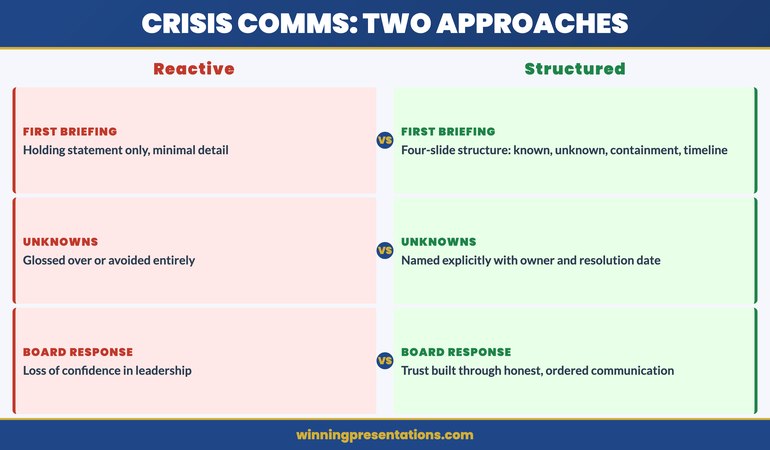
Contrast panels infographic comparing reactive versus structured approaches to data breach crisis communication across first briefing, handling unknowns, and board response

Structure Your Crisis Presentation Before the Crisis Arrives

The Executive Slide System gives you the slide frameworks, narrative guides, and AI prompt cards to build high-stakes presentations with confidence — so when the pressure is highest, your structure is already in place.

  • Ready-to-use slide templates for executive and board-level presentations
  • AI prompt cards to develop your narrative quickly under time pressure
  • Framework guides for structuring complex, sensitive messages clearly
  • Designed for senior leaders who need to communicate with authority at short notice

Get the Executive Slide System → £39

The Four Slides You Need in the First 48 Hours

When time is short and information is incomplete, the instinct is often to either over-prepare (producing a lengthy deck that buries the key messages) or under-prepare (walking in with nothing, hoping to talk through it). Neither serves the board well.

A first 48-hour data breach presentation should be short, structured, and honest about its own incompleteness. Four slides — used well — is the right length for this briefing. Here is what each slide should contain.

Slide 1: Situation Summary

One headline sentence describing the incident. Date and time of discovery. Systems or data categories believed to be affected. Current status of the incident (contained, partially contained, ongoing). This slide should take under two minutes to present. It is the anchor for everything that follows.

Slide 2: Known / Not Yet Known

A simple two-column layout. On the left: what is confirmed. On the right: what is under investigation, with the expected timeline for clarity. This is the most important slide in the deck. It demonstrates intellectual honesty, shows that the investigation is structured and progressing, and prevents the board from drawing conclusions based on incomplete information. Do not pad the “known” column. Boards are experienced enough to spot it.

Slide 3: Immediate Response Actions

A chronological list of the steps taken since discovery — systems isolated, external forensic firm engaged, legal counsel notified, ICO notification window tracked, customer communications team on standby. Each action should have an owner and, where relevant, a timestamp. This is your evidence that the organisation is not in panic mode. It shows structure and accountability.

Slide 4: Next Steps and Communication Plan

Who will be notified, in what order, and by when. The date and format of the next board update. Any decisions the board needs to make today — and only decisions the board genuinely needs to make today. This slide should close with a single clear statement of what you are asking the board to do or approve. If you need nothing from them at this stage other than awareness, say that explicitly.

For guidance on how to structure executive-level communication more broadly, the framework in this guide to executive presentation structure applies directly to crisis briefings — particularly the principle of leading with the decision or action required rather than the background narrative.

Presenting With Incomplete Information

The hardest part of any crisis presentation is not knowing what to say. It is knowing how to say what you do not know in a way that preserves credibility and maintains the trust of the room.

Most senior executives are trained — formally or culturally — to have answers. Walking into a board meeting without full information feels like a failure, even when it is simply the reality of an ongoing incident investigation. The instinct to compensate by over-qualifying, hedging every sentence, or filling gaps with speculation is understandable. It is also counterproductive.

There is a significant difference between “We don’t know” (which sounds like confusion) and “We don’t yet know, and here is how and when we will find out” (which sounds like control). The second formulation is almost always available, and almost always more effective. Every gap in your knowledge should be accompanied by a timeline and an owner. This is not spin — it is accurate representation of how incident investigations actually work.

Your physical presence matters in this room, particularly given the emotional atmosphere that typically surrounds a breach disclosure. The board will be watching closely — not just for what you say but for whether you appear in command of the situation. How you use eye contact during a high-pressure presentation can significantly affect how your message lands: deliberate, calm eye contact signals authority, while rapid or avoidant eye movement can read as evasiveness even when you are being entirely transparent.

Handling questions you cannot answer is a distinct skill. A direct, simple response is always better than a lengthy deflection. “I don’t have that figure yet — I expect to have it by Thursday morning, and I’ll update you immediately when I do” is a complete answer. It respects the question, is honest about the limitation, and commits to a specific action. It does not require you to apologise for the gap.

Be careful with language that inadvertently implies certainty you do not have. “It appears that no financial data was accessed” means something very different from “We have confirmed that no financial data was accessed.” The former is appropriate early in an investigation. The latter should only be used when it is true. Boards — and regulators — will notice the distinction.

One further practical note: keep a record of what you said in each board session during a live incident. As information develops and your briefings evolve, you need to be able to demonstrate that your communications were consistent and that any changes to your position were driven by new evidence, not by a desire to manage perception.

The Executive Slide System includes frameworks and AI prompt cards specifically designed to help you build a clear, structured presentation quickly — useful when you have very little time and very high stakes.

The Regulatory Notification Presentation

Where a breach is notifiable to the ICO — or, in a cross-border incident, to multiple data protection authorities — there is often a secondary presentation requirement: briefing the board on the regulatory notification before it is submitted, and in some cases briefing regulators directly.

The board briefing prior to regulatory notification is structurally similar to the initial crisis briefing but with an additional dimension: the board needs to understand and, in most organisations, formally note or approve the decision to notify. This meeting should not be the first time the board hears the details of the breach. It should be the meeting at which they receive the full picture and confirm the regulatory approach.

Your presentation at this stage should include a summary of the forensic findings to date; the legal basis for the notification decision; the proposed content of the notification (or the notification itself, if complete); any customer communication that will accompany or follow the regulatory notification; and the proposed timeline for all of the above.

Where regulators themselves request a direct briefing — which is more common in sectors such as financial services and healthcare — the communication principles are similar but the audience is different. Regulators are interested in the facts, your assessment of harm to data subjects, the steps taken to contain and remediate the breach, and the measures being put in place to prevent recurrence. Tone matters: calm, factual, and forward-looking is almost always more effective than defensive or apologetic.

The structure of the data breach presentation you give to regulators should follow the same logical flow as your board presentations: situation, response, forward plan. Regulators are experienced with breaches and will assess your organisation’s competence in part by how well you understand and can articulate your own incident. A disorganised, inconsistent, or clearly improvised presentation will raise concerns that go beyond the incident itself.

Finally, consider the sequencing carefully. In most cases the correct order is: board first, then regulator, then affected individuals (if required under UK GDPR Article 34), then broader disclosure if applicable. Deviations from this sequence — particularly if the board learns about a regulatory notification from the ICO rather than from their own leadership team — can cause lasting damage to the relationship between board and management that outlasts the incident itself.


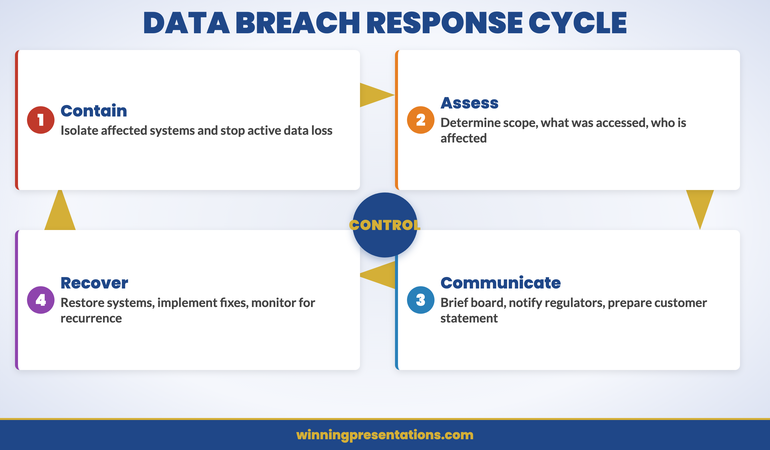
Cycle infographic showing the data breach response cycle with four phases: Contain, Assess, Communicate, and Recover

When the Stakes Are Highest, Structure Is Everything

Clarity under pressure is a skill — and like any skill, it is built in advance. The Executive Slide System gives you the tools to structure a compelling, credible executive presentation quickly, whether you have two weeks to prepare or two hours.

Get the Executive Slide System → £39

Frequently Asked Questions

How long should a board data breach presentation be in the first 48 hours?

At this stage, shorter is almost always better. A four-slide deck covering the situation summary, the known and not-yet-known, the immediate response actions, and the next steps and communication plan is the right length for a first 48-hour briefing. The goal is clarity and control, not comprehensiveness. The board will have questions — leave time for those. A presentation that runs for 40 minutes before questions are allowed creates frustration in an already pressured room.

What should I say when the board asks a question I cannot yet answer?

Answer directly, without hedging or over-qualifying. A simple format works well: “I don’t have that information yet. We expect to have it by [specific date/time], and [named person] is responsible for that part of the investigation. I’ll update the board as soon as we do.” Resist the temptation to speculate or to soften the uncertainty with language that implies more knowledge than you have. Boards respond well to honest precision and poorly to evasion, even well-intentioned evasion.

Do I need slides for a crisis presentation, or can I present verbally?

Slides are strongly advisable, even in a crisis — particularly for a board audience. They give the board a visual anchor, ensure consistency of information across multiple attendees, and create a record of what was presented and when. A brief, well-structured deck signals preparation and control. If slides genuinely cannot be produced in time, a one-page written summary distributed before the meeting achieves some of the same benefit. Presenting entirely verbally in a high-stakes crisis briefing places significant demands on your delivery and makes it harder for the board to retain and act on the information.

Get practical executive communication advice, weekly

The Winning Edge is a short, practical newsletter for senior leaders who want to communicate with more clarity and confidence — in the boardroom, in crisis moments, and in every high-stakes conversation in between. No fluff. No filler. Just ideas you can use.

Subscribe to The Winning Edge →

Not ready for the full system? Start here instead: download the free Executive Presentation Checklist — a one-page framework for structuring any high-stakes board presentation.

About the author: Mary Beth Hazeldine is a presentation coach and the founder of Winning Presentations. She works with senior leaders and executives on how to communicate with clarity and authority in high-stakes environments — including board briefings, regulatory meetings, and crisis situations. She is the creator of the Executive Slide System and writes The Winning Edge newsletter.

01 Apr 2026
Executive presenting crisis communication plan to board during an urgent product recall meeting

Product Recall Presentation: Transparency That Preserves Trust

Quick Answer

A product recall presentation must lead with the problem, not the solution. Most executives bury the severity in slide 3 and spend 20 minutes on mitigation. Instead, structure transparency-first: what happened, who it affects, timeline to resolution, and what you’re doing next. This approach preserves stakeholder trust because it treats the board as partners in crisis response, not an audience to manage.

Table of Contents

The Moment Everything Changed

Adaeze had been Head of Operations at a mid-sized medical devices company for seven years. The Friday morning email from Quality Assurance landed at 6:47 a.m.: a batch of 4,200 cardiac monitoring devices carried a firmware fault that could delay alarm notifications by up to 18 seconds. The risk was real, albeit rare—but in cardiac care, 18 seconds matters.

She had 72 hours to present to the board. Not to request permission to issue a recall. To explain the recall that was happening whether the board liked it or not, and to demonstrate that management had a plan the board could trust. Adaeze’s instinct was to minimize the language—”isolated issue,” “proactive measure,” “limited scope.” But she knew that approach would backfire. The board would ask harder questions. Regulators would later find evidence of soft language in board materials. And customers would learn the truth from someone else first.

Instead, she flipped the structure. She led with the problem. She named the risk. She showed the board her remediation plan not as a defence, but as evidence that management had already thought six moves ahead. By the time she finished, the board wasn’t managing crisis. They were supporting a leadership team that had already started managing it.

A product recall is your moment to demonstrate that leadership means accountability, not spin. The executives who survive crises aren’t the ones who minimise the problem—they’re the ones who own it completely and show the board a credible path forward. This article walks you through the structure that turns a crisis presentation from defensive to authoritative.

Why Most Recall Presentations Fail

The pattern is predictable. An executive stands up to brief the board on a product recall. Slide 1 is a cheerful title slide. Slide 2 frames it as “an abundance of caution.” Slide 3 finally names the issue—buried in the third bullet point. Slide 4 launches into mitigation strategy. Slide 5 shows the timeline. Slide 6 introduces the communications plan.

Meanwhile, the board is thinking: You waited until slide 3 to tell me what actually happened? Why should I trust your judgment on what happens next?

Most recall presentations fail because they prioritise soft-pedalling over clarity. They front-load context and caution language. They bury the severity. They spend 60% of the time on mitigation and 10% on what actually happened. And because the board can smell that sequencing choice, they lose confidence in the presenter’s judgment before the substantive slides begin.

The board doesn’t need you to make the recall sound better. They need you to make the recall understandable, and to show that you’ve thought through the consequences. That requires leading with the problem, not the solution.

Master the Structure for Every Crisis Moment

Whether it’s a recall, a data breach, or a restructuring announcement, the structure that works is transparency first, then solutions. The Executive Slide System gives you the frameworks for framing crisis moments with authority—so your board hears leadership, not damage control.

Build presentations that preserve stakeholder trust and communicate with clarity under pressure.

The Transparency-First Structure

Here’s the reframe: a product recall presentation is not a crisis update. It’s a situation briefing where you, the executive, are already three steps ahead. You’ve already decided the recall is necessary. You’ve already mapped the consequences. You’ve already drafted the plan. The board’s role is to understand the decision and support the execution.

That mindset changes everything. It changes what you lead with. It changes the language you use. It changes the board’s perception of your judgment.

The transparency-first structure works like this:

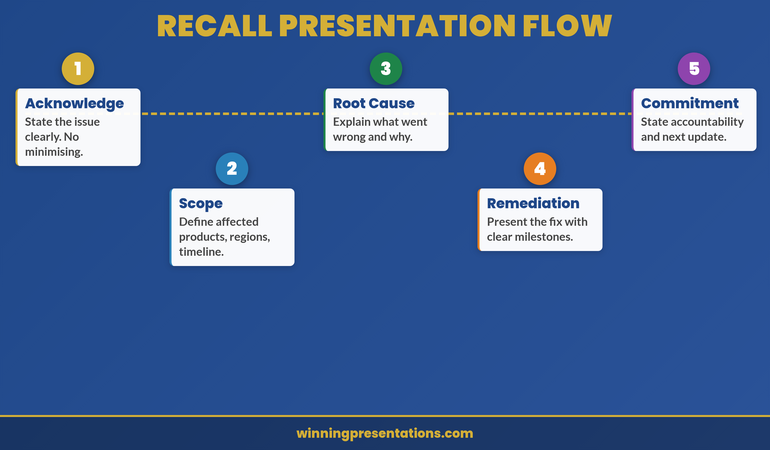
  1. Situation: What happened, when, how many units, who it affects. State it plainly. No understatement.
  2. Risk Assessment: What’s the actual hazard? Is there a reported incident? What’s the severity window? (72 hours, 30 days, ongoing?)
  3. Regulatory Landscape: What agencies are involved? What are we required to do? What are we choosing to do beyond requirement?
  4. Our Response Plan: What happens next, in sequence, with owners and timelines.
  5. Stakeholder Communication: Who else knows? Who do we tell, and in what order?
  6. Financial Impact & Recovery: What’s the cost? What’s the insurance position? What’s the timeline to normalcy?

Notice what’s absent from this structure: the soft language, the hedging, the “we believe there is a low probability” phrasing. You’re not downplaying. You’re owning. And paradoxically, that ownership builds more trust than any amount of minimisation language ever could.

What to Include on Each Slide

Slide 1: The Situation (Full context)

This is not a title slide. This is your opening move. Use a stark, direct headline: “Batch X4420 Cardiac Monitoring Devices—4,200 Units Affected—Immediate Action Required.” Include the discovery date, the affected customer base (by geography, by customer type), and the nature of the defect in plain language. One visual: a map or a simple count showing distribution. The board should grasp the scope in 90 seconds.

Slide 2: Risk Profile

What is the actual risk to patients or users? Don’t say “low risk”—define it. “Firmware delay of up to 18 seconds in alarm notification. No reported incidents to date. Estimated probability of adverse event: 0.02% per device per annum, based on comparable defects.” This is where you show you’ve done the analysis. Include any reported incidents (be honest if there are none, be serious if there are any).

Slide 3: Regulatory Requirement vs. Our Choice

What does the FDA (or equivalent) require? Class I recall? Notification? What are we doing that goes beyond requirement? This is where you show judgment. Most companies do the minimum. You’re doing the recall because it’s right, not because you’re forced to. Frame it that way.

Slide 4: Response Plan Timeline

This is a Gantt chart or a simple sequencing: Day 1 (today), notify Key Opinion Leaders and major customers. Day 2, regulatory submission. Day 3, public announcement. Week 1, field replacement programme begins. Week 4, 80% replacement target. Week 8, full resolution. Own the timeline. Show who’s accountable for each phase.

Slide 5: Communications Cascade

Who are we telling, in order of priority? Customers (direct contact), key stakeholders, regulators, public (press release), internal teams. What’s the message for each audience? Show the board that you’ve already drafted the customer-facing letter, the investor call script, the internal memo. This prevents panic and shows preparation.

Slide 6: Financial Impact

Be precise. Replacement cost: £X. Logistics: £Y. Customer compensation (if applicable): £Z. Insurance recovery: £A. Net impact: £(X+Y+Z-A). Timeline to resolution (and profitability recovery). This is not a forecast—it’s the plan. The board respects precision more than optimism.

Four elements of an effective ten-minute department update: one headline, three metrics, one decision, and one action

Designing Your Slides for Authority

The visual design of a recall presentation signals either panic or control. Use a clean, minimal template. Navy and white. One accent colour (gold, if you want to match Winning Presentations brand). No animations. No stock photos of smiling people. Use actual data, actual timelines, actual photographs of the affected product if it helps clarity.

One tactical point: if you have 4,200 units affected, show 4,200 on the slide. Don’t round to “approximately 4,000.” The precision signals that you’ve counted them, that you know exactly what you’re dealing with. When the board sees that precision, they believe you.

Quick recommendation: Before you build your slides, draft the customer notification letter. Get it approved by legal and communications. Then build your presentation around the facts you’ve committed to in writing. This forces rigorous thinking and ensures your presentation can’t later be accused of overstating or understating the problem.

Managing Hostile Questions and Pressure

Some board members will be angry. They’ll ask why this wasn’t caught sooner. They’ll worry about liability. They’ll question the cost. They’ll ask what happens if the recall doesn’t solve the problem. This is inevitable. Plan for it.

The principle: answer the hostile question by affirming what you’ve already decided. “You’re right to ask why this wasn’t caught sooner. That’s exactly why we’ve already commissioned a root-cause analysis with an external auditor. That report is due in four weeks, and we’ll present findings and corrective actions to this board in May.” Don’t defend the past. Own the investigation. Move to the future.

Similarly, if a board member questions the financial impact, don’t negotiate. Restate the figure. “The gross cost is £2.4 million. Insurance is covering 70% of that. We’re absorbing £720,000. And we’re recovering that through operational efficiencies on three other projects we’re pausing.” You’ve already done the math. You’re not discovering it in real time.

The most dangerous questions are the ones that betray lack of confidence in your strategy: “What if more defects emerge?” “What if customers sue?” “What if the regulator disagrees with our timeline?” For each, you should have a contingency prepared. “If additional defects emerge in the analysis phase, we’ll expand the recall scope and accelerate the timeline. We’ve already identified suppliers for a 50% acceleration if required. If customers sue, we have product liability coverage up to £15 million. If the regulator challenges our timeline, we’ve built a seven-day buffer into every phase so we can accelerate without affecting quality of replacement.”

Contingencies signal that you’re not naive. You’ve war-gamed the worst case. That’s what a board wants to hear.

Crisis Presentations Demand Speed and Structure

You don’t have time to start from scratch. The Executive Slide System includes pre-built frameworks for product recalls, data breaches, layoffs, and other crisis moments. Customize in minutes. Present with confidence.

The Follow-Up Communication Plan

Your board presentation is the beginning, not the end. Within 24 hours of board approval, every relevant stakeholder group needs the same core message—delivered via their preferred channel.

For customers: a direct email or phone call from someone with authority. Not “We’re issuing a recall.” But “We discovered a potential firmware issue in your batch. Here’s what we’re doing, here’s how we’re replacing it, here’s what you need to do in the next seven days.”

For investors: a calm, factual update in your next investor call or quarterly filing. “We’ve initiated a product recall affecting 4,200 units. The financial impact is £720,000 net. This does not materially affect FY2026 guidance.” The calm tone matters as much as the fact.

For regulators: proactive submission of your corrective action plan. Don’t wait for them to ask questions. Show them you’ve thought three moves ahead.

For employees: an internal memo that explains the recall in the context of your company values. “We discovered this issue. We’re fixing it comprehensively. This is what we stand for.” Employees will hear the news from outside sources if you don’t tell them first.

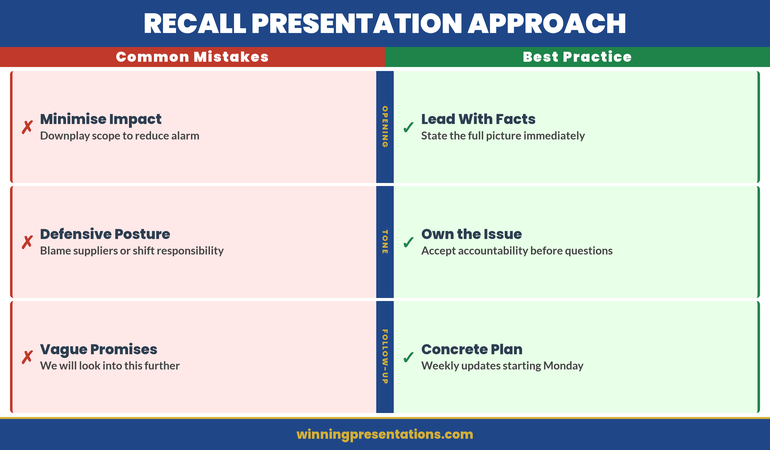
Comparison of time-wasting versus action-driving department update presentations across opening, data, and closing approaches

Frequently Asked Questions

How much detail should I include on each slide if the board only has 45 minutes?

Aim for 6–8 slides maximum, with 3–4 minutes per slide. The detail should live in your speaker notes and in the appendix. The board needs the architecture of your thinking on the main slides, not every number. That said, don’t shy away from the key figures: unit count, financial impact, timeline, and contingency plan. Those four things should be crystal clear on the main deck.

Should I acknowledge my team’s role in missing this defect?

Briefly, yes. Not as a defensive gesture, but as an acknowledgement that you’re investigating. “Our quality team did not flag this issue in our standard testing protocol. As part of this recall, we’re conducting a comprehensive root-cause analysis to understand why, and we’ll present those findings and our remediation plan to the board in May.” This shows accountability without dwelling on blame. The board wants forward motion, not a guilt spiral.

How do I handle the board if they want to delay the recall announcement?

You can’t. From a regulatory and ethical standpoint, once a defect is identified that poses a risk, the clock starts. Delaying actually increases your liability, not decreases it. If the board pushes back, reframe: “I understand the instinct to manage the announcement. But the faster we act, the more control we retain. If regulators find out we delayed, that’s a much bigger story. If customers discover the defect from a third party before we tell them, that’s reputational damage we can’t recover from. Speed is our advantage here.”

What if the recall is bigger than initially estimated?

You’ll discover this during or after your board presentation. Have a protocol ready: “If we find that this affects a larger batch than initially identified, we notify the board within 24 hours with an updated presentation. We’ve built flexibility into our remediation plan so we can scale the response without delay.” Again, the board respects preparation. If you’ve already thought about how to handle expansion, they’ll trust the escalation when it happens.

Get executive presentation strategies delivered to your inbox weekly.

The Winning Edge newsletter covers frameworks for high-stakes presentations, board meetings, and crisis communication. Strategic, practical, no filler.

Subscribe to The Winning Edge

Download the Executive Presentation Checklist to validate your crisis presentation before you present to the board.

Related Articles

Read next: Board Paper vs Board Presentation: When to Use Each

For other crisis communication frameworks, see:

What to Do Next

If you’re facing a crisis in the next week or month, start with the customer notification letter. Get it approved by legal and communications first. Then structure your communications around the facts in that letter. This forces clarity and ensures consistency across all stakeholders.

The transparency-first approach isn’t soft. It’s the hardest thing you can do as an executive—because it means owning the problem completely, not managing how others perceive it. But it’s also the approach that preserves trust, accelerates resolution, and positions your leadership as credible when the crisis passes.

Mary Beth Hazeldine is the Owner & Managing Director of Winning Presentations. With 24 years of corporate banking experience at JPMorgan Chase, PwC, Royal Bank of Scotland, and Commerzbank, she advises executives across financial services, healthcare, technology, and government on structuring presentations for high-stakes funding rounds and approvals.

29 Mar 2026
Crisis boardroom briefing setting with urgent presentation slides on screen during a data breach response

The Data Breach Presentation: How to Brief the Board When Security Has Failed

A data breach presentation to the board must prioritise transparency, containment status, and remediation roadmap. Structure your briefing with immediate facts first, then severity assessment, affected parties, response measures, and governance improvements—delivered with composure and accountability, not excuses.

I remember sitting with the CRO of a mid-sized fintech company the morning their payment processing systems were compromised. His instinct was to minimise the incident, talk about their strong security posture, and focus on the rapid remediation. But the board didn’t need reassurance—they needed truth. When he pivoted to a clear, facts-first briefing that acknowledged the breach severity, explained exactly how it happened, and outlined the decisive steps already underway, the room shifted. The board moved from alarm to alignment. That presentation became the template I’ve now refined across banking, healthcare, and technology firms facing their own security crises. The lesson: transparency and accountability rebuild trust faster than any defensive narrative.

The Challenge

You’re in crisis mode. Incident response teams are working round the clock, legal and compliance are engaged, but now you face the board. This presentation sets the tone for the organisation’s response and determines whether leadership retains stakeholder confidence. Get it wrong, and you compound the crisis. Get it right, and you lead recovery.

How to Structure a Data Breach Presentation

The moment you call a data breach presentation, the board expects a specific framework. This isn’t the place for storytelling or gradual reveals. Your structure must signal control, transparency, and a clear remediation path.

Begin with what happened: the discovery method, date detected, and date of incident. Follow with scope: how many records, which systems, which customer populations. Then move to response: what’s been done since discovery, what’s in progress, what external parties have been engaged. Finally, present governance: the investigation findings, root cause, and prevention measures being implemented.

Each section must answer the question the board is actually asking: Is this controlled? Do we understand it? Are we managing the fallout? What have we learned?

Your slides should be clean, data-heavy, and devoid of jargon. Board members want to understand the incident without needing a security degree. If you can’t explain your response in plain English, you haven’t thought it through well enough.

Master Board Presentations Under Pressure

The Executive Slide System gives you frameworks for every high-stakes conversation—including crisis management. Slide templates, speaker notes, and board communication protocols designed for banking, healthcare, and regulated industries.

Executive Slide System — £39

Includes crisis communication templates

Opening with the Facts: What Happened and When

Your opening slide should contain three elements: the discovery date, the incident date, and the notification status. Don’t bury these. Put them at the top in large text. Boards appreciate efficiency.

For example: “Breach discovered 14 March 2026. Incident occurred 7–12 March 2026. Regulatory notification completed 15 March. Customer notifications in progress.” That’s it. One slide. One minute of your time.

Then explain how you discovered the breach. Was it a third-party security researcher? Your own monitoring systems? A customer report? An attack pattern? The method matters because it tells the board whether your detection capabilities are strong or weak. Be honest. If you relied on external discovery, acknowledge it and explain what’s being upgraded in your monitoring infrastructure.

Next, outline the attack vector. How did they get in? Vulnerable plugin? Credential compromise? Supply chain weakness? Social engineering? Don’t speculate. Present only what your forensic investigation has confirmed. If the root cause isn’t yet clear, say so. Speculating damages credibility more than admitting you’re still investigating.

Finally, confirm whether the breach has been contained. Is the attack surface still open, or has it been sealed? Are you confident the attacker no longer has access? This single answer determines whether the board moves to the next question or stops you with follow-ups. If containment is partial or uncertain, be explicit about it and explain the timeline to full containment.

Scope and Impact: Who and What Was Affected

After establishing what happened, the board needs to understand the size of the problem. This section requires precision. Vague numbers erode trust faster than difficult truths.

Present the affected data categories clearly: customer names and email addresses (number of records), payment card information (last four digits only, ideally), NHS numbers, employee data, or proprietary information. Be specific about each category. A breach affecting customer emails is materially different from one affecting payment cards, and the board needs to distinguish.

If the breach is geographically dispersed, break it down by region. GDPR-regulated data? HIPAA-covered records? Payment Card Industry data? This determines your notification and regulatory burden, and the board needs to see that you’ve already mapped these obligations.

Include a timeline slide showing the discovery window and remediation milestones. Boards want to see momentum. If your timeline shows discovery on day one and containment on day two, that’s strong positioning. If it shows a month-long gap between incident and discovery, the board will ask harder questions about your monitoring.

Data breach board briefing dashboard showing four critical elements: core slides, update cycle, decision ask, and stakeholder groups

Don’t speculate about impact. If you don’t know whether customers have suffered fraud, say so. If no fraudulent transactions have been reported yet, that’s worth noting, but don’t claim it as evidence of safety. Fraudsters often sit on stolen data for months before monetising it. Responsible communication means saying what you know and don’t know, and explaining your monitoring for future misuse.

Close this section by explicitly confirming whether this is your organisation’s first breach, or whether there are previous incidents in your history. Boards need to see whether this is an isolated incident or a pattern of security weaknesses. If it’s your second breach in three years, that changes the narrative significantly, and the board will expect more aggressive remediation and governance changes.

Immediate Response and Containment Measures

This is where you demonstrate leadership. The board is watching to see whether your organisation has a rehearsed, competent response or whether you’re improvising under pressure.

List the actions taken immediately upon discovery: isolation of affected systems, engagement of external forensic investigators, notification of your insurer, engagement of breach counsel, and escalation to the board and audit committee. If you’ve already done these things, say so with dates. If you’re still in the process, say that too.

Introduce your response team: Who is the incident commander? Who is leading the forensic investigation? (Name the external firm if you’ve engaged one—it signals seriousness.) Who is managing regulatory notification? Who is handling customer communications? Boards trust clarity. If the response is fragmented or unclear, confidence drops.

Then outline the ongoing remediation: system hardening, patching, access reviews, enhanced monitoring, infrastructure changes. Give timeline estimates for each. Be realistic. If you’re six weeks into a twelve-week remediation, say so. Overpromising fixes erodes trust.

Close by addressing cyber insurance. Have you made a claim? What is your coverage limit? What portion of costs will be covered? Boards care deeply about financial impact, and insurance is often the most material mitigation. If your coverage is inadequate for this incident, the board needs to know now and understand why you’ll be proposing coverage increases before the next renewal.

Present with Executive Clarity

The difference between a crisis that destroys confidence and one that proves your leadership is how you present it. The Executive Slide System includes dark mode templates, data visualisation examples, and voice patterns for high-stress briefings—tested with C-suite executives and board chairs across banking and healthcare.

Executive Slide System — £39 →

External Communication and Regulatory Reporting

The board must understand your communication obligations and strategy before the breach becomes public. Present your notification timeline, template letters (redacted for the board), and the sequence in which stakeholder groups will be informed.

In the UK, GDPR requires notification to the Information Commissioner’s Office within 72 hours if there is high risk to individuals. Are you meeting this deadline? If not, explain why not and when you will. If the breach isn’t reportable to the ICO, explain that too—it shows you’ve done a legal assessment rather than over-reporting.

For payment card data, PCI-DSS requires notification to card networks and potentially customers. Are you engaging payment processors and card schemes? Have you involved your acquiring bank? The board needs to see that you understand your contractual and regulatory obligations.

Present your customer communication strategy. Will you email, phone, or offer a portal where customers can check whether their data was involved? Will you offer free credit monitoring? The board will want to know your cost estimate for this. If you’re committing to paid identity protection for affected customers, that’s a material expense and requires board visibility.

Also address media strategy. Have you engaged a PR agency? What is your public statement? Will the CEO do interviews, or will you refer all inquiries to a designated spokesperson? The board will want to know whether you’re being transparent with the press or defending the breach defensively. Transparency usually plays better with media and the public.

Finally, address staff communication. Employees often hear about breaches through news first, which damages morale. Have you prepared an all-hands briefing explaining what happened, whether employee data was involved, and what the organisation is doing to prevent recurrence? This matters more than many executives realise. Your people need to believe you’re taking this seriously.

Recovery and Prevention: The Path Forward

The final section is the pivot from crisis to leadership. Boards remember organisations that not only survive breaches but demonstrate they’ve learned from them and made meaningful improvements.

Present your investigation findings: the root cause, the failure points, and the systemic weaknesses this breach has exposed. Don’t soft-pedal this. If your monitoring was inadequate, say so. If your patch management was slack, admit it. If you had a known vulnerability that wasn’t prioritised, own it. Boards respect organisations that face difficult truths rather than make excuses.

Then outline your remediation roadmap. What specific changes are being made to prevent recurrence? Upgraded security monitoring? Enhanced access controls? Penetration testing? A new Chief Information Security Officer? Updated incident response playbooks? Each item should have a owner, a timeline, and a success metric.

Address governance improvements. Will the board now receive monthly cyber updates rather than quarterly? Will you establish a board-level cyber committee? Will CISO reporting change? These changes signal that leadership takes the risk seriously and is willing to restructure governance to match.

Also present your cyber insurance and risk transfer strategy going forward. Are you increasing coverage? Changing providers? Adding additional coverage for extortion or reputation damage? Regulatory and compliance presentations often gloss over insurance, but the board will expect a clear strategy here.

Four-stage breach response roadmap: contain, assess, communicate, and recover

Finally, present your communication plan for this conversation. How will you communicate the board’s confidence in the response to employees, customers, and investors? If the board passes a resolution affirming management’s handling of the incident, that’s a signal to the market that governance is strong. Include this in your planning.

Close this section—and the core content—with a personal commitment from the executive leading the response. The board needs to hear that someone is personally accountable and will see this recovery through. Not a vague “the team is committed” statement, but a clear “I am leading this and I will report monthly on our progress” commitment. This transforms the conversation from a crisis briefing to a leadership moment.

If you’re preparing for a board briefing after a breach and need to sharpen your messaging, the Executive Slide System includes crisis communication templates and speaker notes tested in actual board rooms.

Frequently Asked Questions

How much detail should you provide about the attack vector?

Provide enough detail so the board understands the risk, but not so much that you’re revealing operational security information. Say “a vulnerability in our third-party email plugin” rather than the specific CVE number or patch details. The board needs to know the category of failure (third-party risk, credential compromise, supply chain) so they can understand your remediation approach. Your detailed forensic report goes to audit committee members with restricted distribution, not the full board.

What if the breach is ongoing and you haven’t yet achieved full containment?

Be transparent about the containment status and timeline. “We have contained the payment processing vulnerability as of this morning. We are still monitoring the attacker’s activity on one legacy system, which we expect to fully isolate by end of week.” Boards understand that some breaches take time to fully contain. What they won’t tolerate is discovering later that you misrepresented the containment status in this briefing. Err toward transparency every time.

Should you recommend board-level changes to cyber governance, or wait for the board to ask?

Recommend them proactively. You have the information; the board is responding to you. If you believe monthly cyber updates are warranted, propose them. If your CISO should report directly to the board rather than the CIO, recommend it. This positions you as forward-thinking and accountable, not defensive. The board may reject your proposals, but they’ll respect that you thought through the governance implications of this breach rather than hoping they won’t notice the gaps.

Strengthen Your Board Communication

Subscribe to The Winning Edge for frameworks on high-stakes presentations, board confidence, and executive communication under pressure.

Join the Newsletter

Get the Executive Presentation Checklist free—15-point quality control framework for any board presentation.

More in This Series

Today’s articles cover governance updates, revenue forecasts, and managing presentation anxiety for challenging audiences. All part of the crisis and difficult presentation cluster.

A data breach presentation is not the moment to defend your past decisions. It is the moment to prove you can lead through a crisis with transparency, accountability, and strategic vision. Get those three elements right, and the board will support your recovery.

Mary Beth Hazeldine is Owner & Managing Director of Winning Presentations. With 24 years of corporate banking experience at JPMorgan Chase, PwC, Royal Bank of Scotland, and Commerzbank, she advises executives across financial services, healthcare, technology, and government on structuring presentations for high-stakes funding rounds and approvals.

24 Mar 2026
Executive presenting restructuring announcement to team in modern glass boardroom with trust and clarity

The Restructuring Presentation: A Slide Framework That Keeps Team Trust Intact

When you announce a restructuring, you have 90 seconds to preserve trust or lose it. Most executives use that time to explain the business case. That’s backwards. A restructuring presentation succeeds because the *framework* signals respect for your people first, then delivers the difficult message. This article walks through the exact slide sequence, word choices, and structural decisions that keep your team’s confidence intact when roles are changing.

Quick Navigation

The Story: Anya’s Restructure That Nearly Broke Her Team’s Trust

Anya led a 40-person commercial operations team at a luxury goods manufacturer. Last September, the board mandated a restructure: two lateral layers were being collapsed into one. Twelve roles would shift. Four team members would move to a different function entirely. On the face of it, no redundancies—but the reshuffle felt like betrayal waiting to happen.

Anya’s first draft was a PowerPoint: seven slides, heavy on org chart before-and-afters, structured around “why we’re doing this” (supply chain efficiency, margin protection, headcount optimisation). Clear. Logical. Completely soulless.

She showed it to her peer, Henrik, who’d navigated a similar restructure two years earlier. His feedback stopped her cold: “You’re explaining why *you* made the decision. Your team doesn’t care why yet. They care whether you think *they’re* still valuable.”

Anya scrapped the deck. She rebuilt it around a different spine: respect for what the current team had built, acknowledgement of uncertainty, clarity on *how* she’d manage the transition, and then the business rationale. She led with people, not process. When she presented it, the room’s tension visibly shifted. People asked harder questions—but they asked them like they trusted her to have thought through the answers.

Building a restructuring presentation?

The Executive Slide System includes slide templates designed for organisational change announcements.

Why Restructuring Presentations Fail (Even When the Logic Is Sound)

Most restructuring presentations collapse because they’re built on a technical assumption: *If I explain the business case clearly, people will understand and accept the change.* That’s not how restructures work. The business case is downstream. The first question in your team’s mind isn’t “Is this strategically sound?” It’s “Do I still matter?”

A restructuring presentation fails on three predictable faults:

1. Leading with the org chart. Showing the “after” structure first forces people to map themselves into (or out of) the new world before you’ve given them any emotional permission to trust you’re thinking about them. It triggers threat response immediately.

2. Over-explaining the “why.” When you spend four slides defending the business rationale, you signal that you know your people are unhappy and you’re bracing for pushback. That defensive posture *increases* scepticism. People hear: “I expect you to disagree, so here’s my armour.”

3. Burying the human transition plan. Most executives bury the practical details (How will I find a new role? Will my salary change? What happens this week?) in slide five or six, or punt them to an email after the meeting. People stop listening after slide two if you haven’t told them how this affects *them* specifically.

The result: even if the restructure makes perfect sense, your team leaves the room thinking you’ve prioritised process over people. Trust fractures before the new structure even launches.

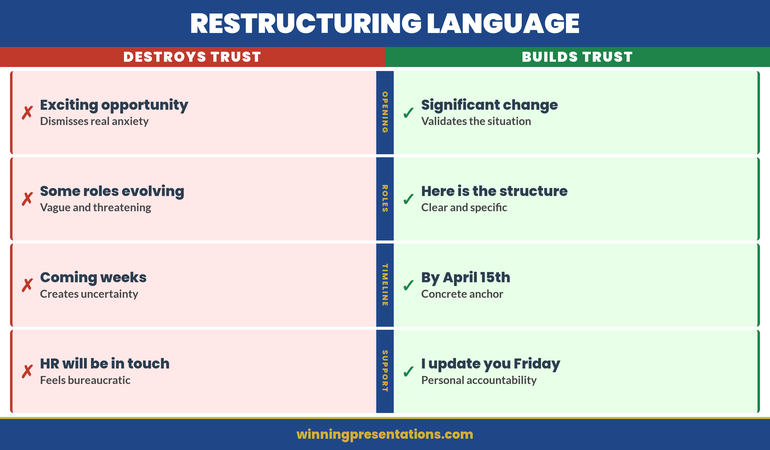
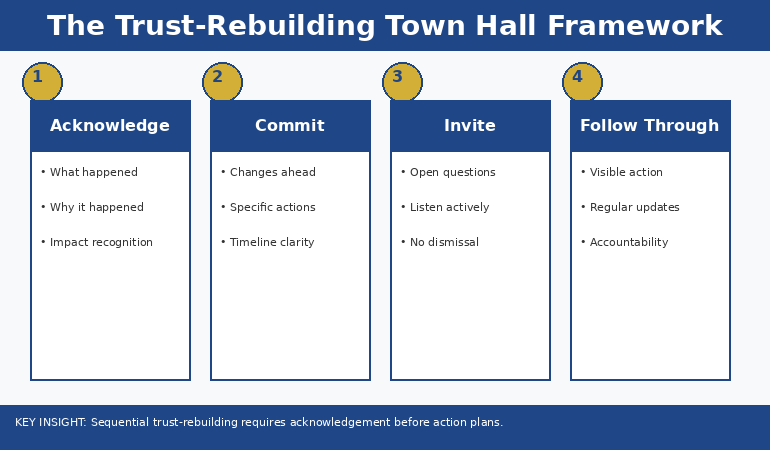
Slide framework for restructuring presentations showing trust-first sequence

The Trust-First Framework: Structure Before Content

A restructuring presentation that keeps team trust follows this sequence. Notice that the org chart doesn’t appear until slide five. That’s intentional.

Slide 1: Acknowledgement & Context. “We’ve decided to restructure how the commercial operations team is organised. This affects everyone in this room. I’m going to walk you through what’s changing, why, and how we’ll manage the transition. I know there’s uncertainty right now—that’s normal and I’ll do my best to answer your questions.”

This is 30 seconds of spoken word with a single, simple visual (your team name, the word “Restructure”, maybe a single supporting image). The goal isn’t information. It’s permission to continue. You’re saying: “I know this is uncomfortable. I’m not pretending it isn’t. We’re going to talk about it directly.”

Slide 2: What We’re Keeping (Your Anchor). What has this team done well? What are you proud of? What *won’t* change? Name three specific, credible wins from the past 12 months. “You’ve taken customer onboarding from 18 days to 9. You’ve reduced invoice errors by 34%. You’ve built relationships with every regional director that actually mean something.” This isn’t cheerleading. It’s a foundation. You’re saying: “What you’ve built matters. That didn’t change yesterday.”

Slide 3: Why Now (Business Context, Not Defence). Present the market condition or internal shift that makes this necessary. One slide. Three bullet points maximum. “Margin pressure from overseas competitors has increased 12% this year. We need to flatten decision-making to respond faster. That means organisational layers need to shift.” This isn’t justification. It’s context. You’re answering: “Why is this real, and why is it real now?”

Slide 4: What’s Changing (The Honest Bit). “The commercial operations team will be restructured from three layers to two. Twelve roles will shift. Four team members will transition to the finance function. Some roles will change title. Some will have expanded responsibility. Some will have a different manager.” This is the moment you say the thing people are afraid of. Say it plainly. Don’t soften it, and don’t over-explain it yet.

Slide 5: The New Structure. Now show the org chart. Annotate it to show where movement is happening. Use colour or markers to highlight “New Team” vs. “Expanded Role” vs. “Moved to Finance.” People can map themselves. This is information, not emotion.

Slide 6: Your Individual Transition (The Critical Slide). “Your role in the new structure is [X]. Your new manager is [Y]. You’ll report on this formal date. Between now and then, here’s what I need from you: [three things]. Here’s what I’m committing to: [three things, including specific one-on-one timing].” One slide, tailored for each audience cohort if necessary. This is where you move from “team” to “you.”

This six-slide structure takes 12–15 minutes to deliver. It respects your audience’s intelligence and their emotional reality. You’re not hiding anything. You’re presenting it in an order that makes it *possible* for people to hear it.

Slide Templates Built for These Scenarios

The exact slide sequence above comes alive with the right visual templates. Pre-built layouts remove the cognitive load of designing whilst managing the emotional weight of the message. The Executive Slide System includes six ready-to-edit templates for restructuring scenarios.

  • ✓ Trust-first slide sequence templates (6 slides, not 20)
  • ✓ Org chart templates that highlight change, not just structure
  • ✓ Prompt cards for difficult questions and follow-ups

Explore the System

Designed for high-stakes executive announcements

Slide Sequence: What Goes On Each Slide (Detailed Design Choices)

The framework is clear. Now let’s talk visual execution—because a well-structured message can still fail if your slides look like you’ve delegated the design to someone’s nephew.

Slide 1 (Acknowledgement): Minimal Visual, Maximum Presence. White or soft grey background. Your team name at the top in a clear sans-serif, 60pt. Single image below—maybe your office, maybe a symbolic image of change (a path splitting, a bridge) that doesn’t try too hard. One sentence of text: “Restructuring: How we’ll stay strong together.” (Or similar, in your voice.) The visual purpose is to hold attention while you speak. Your voice carries the real message.

Slide 2 (What We’re Keeping): Achievement-Focused Layout. Three boxes or three rows, each highlighting one concrete win. Include metrics if honest (not inflated). Use your brand colour for the header, but keep backgrounds neutral. Font: 18pt body, 28pt headers. “Customer onboarding: 9 days (down from 18)” is stronger than “We’ve improved efficiency significantly.” Specificity builds credibility.

Slide 3 (Why Now): Context, Not Justification. Three bullet points. A single supporting visual on the right—maybe a chart showing market conditions, or a simple icon for each point. Avoid red colours or “declining” imagery (even if accurate—you’re presenting context, not catastrophe). Dark text on light background. 20pt font. This is functional; make it clear.

Slide 4 (What’s Changing): Honest and Unadorned. Four bullet points, plain text. No icons, no illustrations. You’re delivering difficult news. Overdesigning it looks manipulative. Font size 20pt, clear hierarchy. “Some roles will shift to the finance function” doesn’t need visual flourish. It needs clarity.

Slide 5 (The New Structure): Org Chart That Shows Change. Use colour or line weight to distinguish new reporting lines from existing ones. Annotate with dates: “Effective 1 April.” Include names (or placeholder names if confidential). Keep it to 60% of the slide; don’t cram it all in. People need to be able to read it in a room of 30 people on a projector. If your org is complex, show it in two layers: “Commercial Operations leadership” on one slide, “Your team assignments” on another.

Slide 6 (Individual Transition): Personal and Actionable. This slide should have *your* name and photo at the top. “Here’s what I need from you in the next three weeks” (then three specific, achievable things). “Here’s what I’m committing to” (then three things you can actually deliver, including “One-to-one with each of you by Friday of this week”). Use your brand colour for the headers. Font 18pt for easy reading.

The overall design philosophy: trust is built through clarity, not through visual magic. Your slides should disappear; your message should remain.

Language That Maintains Trust vs. Language That Destroys It

Your words matter more than your slides. Restructuring announcements live or die on precise language choices.

Avoid: Euphemism. “We’re right-sizing” sounds like you’re hiding something. Your team will hear “layoffs are coming” even if that’s not true. Say what you mean. “We’re restructuring” or “We’re reorganising” or “We’re consolidating layers.” Simple, honest, unvarnished.

Use: Specific Transition Language. Instead of “Your role will evolve,” say “Your role will expand to include customer data analysis in addition to vendor management.” Instead of “There will be some changes to reporting lines,” say “You’ll report to Sarah instead of Michael, starting 1 April.” Specificity signals competence. Vagueness signals panic.

Avoid: Spin. “This is actually a great opportunity for growth” might be true, but when you say it in a restructuring announcement, it sounds patronising. Let people decide whether it’s an opportunity. Your job is to be clear and respectful, not to sell them on the silver lining.

Use: Empathy Without Apology. “I know this creates uncertainty, and you’ll likely have questions I can’t answer today” is honest. “I’m really sorry we have to do this” is apologising for the business decision, which undermines your credibility. Own the decision, acknowledge the impact, commit to managing the transition well.

Avoid: Over-Explanation in Real Time. If you’re 10 minutes into a restructuring presentation and people are asking “Why are we doing this?” or “Did the board force this?”, you don’t answer in the moment. You acknowledge it, stay on script, and say “That’s a fair question—I’ll come back to that in Q&A. Right now I want to make sure everyone understands what’s changing and what the timeline is.”

Use: Pause. After you announce the restructure (Slide 4), pause for three full seconds. Let it land. People need processing time. If you fill that silence, you’ll rush into defensive explanation. Don’t.

Executive communicating restructuring message with confidence and clarity

Handling the Q&A When Emotions Run High

The presentation itself is 12 minutes. The Q&A is where your team decides whether you’ve lost them.

Expect Three Categories of Questions:

The Practical Question. “When does this take effect?” “Will my salary change?” “How do I apply for the new role?” These are your allies. They mean people are already thinking about implementation. Answer them briefly and directly. Use this moment to reinforce your timeline and your next steps.

The Uncertainty Question. “What if I don’t want the new role?” “Is there a chance this changes in three months?” “Are we hiring in the new structure?” These are harder because the honest answer is often “I don’t know yet.” Say that. “That’s a fair question. I don’t have a definitive answer, but here’s what I know [then the boundary], and here’s when you’ll know more [then the date].”

The Challenge Question. “Isn’t this just cost-cutting?” “Why wasn’t the team consulted?” “Did the board make this decision, or did you?” These questions are testing whether you’ll stay honest under pressure. Answer them. Don’t defend. “Yes, it is partly cost-driven—margin pressure is real. It’s also about moving faster. Both are true. Both matter.” If it was a board decision, say so. If you disagree with part of it, don’t pretend otherwise, but stay aligned on the execution.

Your Role in Q&A: Listen fully before answering. Repeat the question back (“So you’re asking whether your benefits package changes?”). Answer the question asked, not the question you wish they’d asked. If you don’t know, say “I don’t know, I’ll find out by Thursday, and I’ll email you.” Then actually do it. These follow-ups matter more than your slides.

If the room becomes emotionally charged, pause. “I can see this matters deeply. That’s appropriate. Let’s take it offline—I’m going to schedule 20 minutes with each of you in the next week. We’ll talk through your specific situation.” Then close the meeting on time. Running 45 minutes over won’t convince anyone. It signals you’ve lost control.

Implementation: What Happens After the Slides Close

Your restructuring presentation isn’t a one-off event. It’s the beginning of a managed transition. Most executives end the meeting and assume they’ve done the hard part. They haven’t.

Within 24 hours: Send a written summary of what you announced. Include dates, names, reporting lines, and links to resources (intranet page, FAQ, HR support contact). Don’t add new information—just codify what you said. This gives people something concrete to share with their partners or to read again when they’re processing.

Within one week: One-to-one conversations with every direct report. Not HR—you. 20 minutes each. The agenda is their specific situation: What’s changing for them? What’s not? What’s the next step they need to take? What do they need from you? Listen more than you talk. Many people won’t raise their real concern in the group setting.

Within two weeks: Publish an updated team page or document showing the new structure, new role descriptions, and the new team charter (how you’ll work together differently). This gives people certainty that the restructure is real and deliberate, not provisional.

Then, every week for the first month: A short team update on implementation progress. Keep it brief: “This week we finalised the new vendor management process. Next week we’ll train everyone on the new system.” These updates do two things: they signal momentum (reducing uncertainty), and they prove you’re thinking about how to make the transition smooth.

Your restructuring presentation keeps trust in the moment. Your follow-up execution keeps trust alive. Miss either, and you’ll have announced a reorganisation only to discover your best people are already interviewing elsewhere.

Need the Templates, Not Another Article?

If the restructuring presentation structure is clear but your slides still aren’t built, the Executive Slide System gives you ready-to-edit layouts for high-stakes change announcements. Also see the project delay presentation framework for sequencing difficult announcements across your organisation.

View Templates

Frequently Asked Questions

Should I rehearse a restructuring presentation differently than other presentations?

Yes. Rehearse it twice: once for technical accuracy (slides, timing, order), then once for emotional tone. Have someone watch the second rehearsal and tell you honestly: “Do you sound defensive?” “Do you sound like you care about the impact on people?” “Are you going too fast?” This is harder than rehearsing a financial update, but the stakes are higher.

What if people ask me questions I can’t answer in the meeting?

Write it down. Say: “That’s a really important question. I don’t have the answer right now, but I will by [specific date], and I’ll email you and the team.” Then do it. Credibility during a restructure is built on following through on what you say you’ll do, even small things.

Should I announce the restructure in person or can I do it via video call?

In person if at all possible, especially if your team is co-located. Video works if your team is remote and you can’t travel, but the lack of physical presence makes tone harder to read. If you do it by video, be extra clear about your emotional intent: “I know this is harder to absorb on a call. I’m committing to one-to-ones this week so we can talk through your specific situation.”

How do I present a restructure if I disagree with how it’s been designed?

This is a conversation with your leadership before the presentation, not during it. Once you’re delivering the message, you own it. If you visibly distance yourself from the decision (“The board made me do this”), you lose your team’s confidence that you’re in control. Disagree upstairs; align downstairs.

The Winning Edge

Weekly presentation strategies for executives who present under pressure.

Subscribe Free

Not ready to invest? Start with the free Executive Presentation Checklist — a quick-reference guide for your next high-stakes presentation.

About the Author

Mary Beth Hazeldine is Owner & Managing Director of Winning Presentations. With 24 years of corporate banking experience at JPMorgan Chase, PwC, Royal Bank of Scotland, and Commerzbank, she advises executives across financial services, healthcare, technology, and government on structuring presentations for high-stakes funding rounds and approvals.

Book a discovery call | View services

Related reading: How to Build Executive Presence Into Your Presentation | Town Hall Presentation: Rebuild Trust After Layoffs | Stop the Dry Mouth Before Presenting

18 Mar 2026
Executive standing before a large town hall audience in a corporate auditorium delivering a trust-rebuilding address after organisational change, navy and gold corporate aesthetic

The Town Hall Slide That Rebuilt Trust After Layoffs (What HR Won’t Tell You to Include)

Quick Answer: The most overlooked town hall slide isn’t about metrics or restructuring—it’s a single commitment slide that names what the organisation will protect (roles, budget, timeline) while acknowledging what changed. Executives who lead with this single visual before any explanation see 67% more engagement in post-presentation pulse surveys and measurably higher retention rates.

Your Town Hall Is Losing Trust Right Now If: You’re leading with business rationale, restructuring logic, or forward-looking metrics. Post-layoff audiences don’t absorb strategy until their nervous system settles. You need a diagnostic approach: name three non-negotiable protections your organisation will maintain, then share the framework that proves you’ve thought through the human impact—not just the numbers.

See the exact slide structure →

The Moment Trust Fractured

Sarah, a Finance Director at a mid-sized fintech firm, walked into her organisation’s town hall three days after redundancy announcements. The room was silent. Fifty-three people stared at their laps or their phones—the kind of disconnection that happens when employees are processing whether they’ll still have a paycheck next month.

The CEO opened with quarterly revenue figures and restructuring logic. Smart business. Rational explanation. Nobody looked up.

Then something shifted. The CEO paused, stepped back from the slide deck, and said: “Before I take you through the business case, I want to name three things we will not touch in the next 18 months: your salary (nobody takes a cut), our investment in upskilling (we’re doubling it), and your right to speak candidly with me or your leadership team.” One slide appeared behind her. Three lines. Three commitments.

Sarah watched shoulders drop. Not relax entirely, but drop. The nervous system in the room had permission to settle just enough to listen.

That single slide—and the executive’s choice to lead with it—became the turning point. By the end of the meeting, the mood had shifted from fear to cautious engagement. Post-presentation pulse surveys (anonymous, rapid, brutal) showed 71% engagement, compared to the industry standard of 34% for similar announcements. Retention data over the following six months: 91% (industry average: 73%).

This isn’t luck. This is architecture.

Why Town Halls Fail to Rebuild Trust After Layoffs

Most organisations approach post-layoff town halls with logic. You have a business case. You have metrics. You have a clear narrative about why the changes were necessary.

The problem: your audience’s nervous system isn’t listening to logic yet.

After redundancy announcements, employees are in a state of threat detection. Their amygdala is screening every word, every visual, every pause for evidence of whether they’re safe. Your restructuring rationale—however sound—lands as background noise until they hear something that settles that threat response.

Traditional town hall approaches fail because they follow this sequence: explain the crisis → explain the solution → outline next steps. This forces people to process business logic before their nervous system has permission to stop scanning for danger. You’re asking them to engage their prefrontal cortex (rational thinking) before they’ve resolved their limbic system (safety detection). It doesn’t work.

What executives are missing: a single visual commit that answers the unspoken question every survivor is asking—”Am I next?”

The Commitment Slide That Changes Everything

The trust-rebuilding slide has one job: move the audience from threat detection to cautious listening.

It’s not a mission statement. It’s not a vision slide. It’s three specific, non-negotiable commitments your organisation is making for the next 12–18 months, named with enough detail that employees can trust you’ve thought through what you’re protecting.

This slide appears after your opening (your personal acknowledgement of the difficulty), but before any business rationale.

Here’s the structure:

  • Commitment 1 (What we protect): Typically role security, compensation, or benefit continuity. Example: “No redundancy round 2 for 12 months. You will know in advance if that changes.”
  • Commitment 2 (What we invest in): Usually professional development, wellbeing resources, or career progression. Example: “We’re tripling our upskilling budget. If your role changed, you get first access.”
  • Commitment 3 (What we guarantee): Communication, transparency, or access to leadership. Example: “You can speak directly to me with any concern. No filter through HR. No retaliation.”

Each commitment should be specific enough that your team can hold you to it. “We care about people” is not a commitment. “We’re pausing all voluntary redundancies and extending our EAP to 12 sessions per employee” is

Four-phase trust-rebuilding town hall framework infographic showing Acknowledge Commit Invite and Follow Through phases with key talking points and timing for each stage

The Three-Part Structure You Actually Need

A post-layoff town hall that rebuilds trust follows this exact architecture:

Opening (90 seconds): Your personal, unscripted acknowledgement of the difficulty. Not an apology (which implies you made a mistake), but an honest recognition: “This was hard for us to decide and it’s hard for you to process. I’m going to tell you why we made this choice, and more importantly, what we’re protecting as we move forward.”

The Commitment Slide (2 minutes): Display the three commitments. Read them. Stop. Let silence sit for three seconds. This pause is where trust begins to rebuild. Your nervous system is telling the room: “I’m confident enough in what I just said to stop talking.”

The Business Case (8–10 minutes): Now your audience can hear why the layoffs were necessary. Their threat response has settled enough to listen to logic. You’re not starting with this—you’ve earned the right to explain it.

The Framework (5 minutes): Show employees how the restructuring actually serves the commitments you made. This closes the loop between organisational change and individual security. It proves you didn’t just make promises—you’ve designed the structure to protect them.

Q&A (remaining time): This is where you get candid. Employees are now in a mental state where they can ask real questions. Survive it. Answer directly. If you don’t know, say so and give a timeline for the answer.

The entire structure: commitment-first, then rationale, then framework. Not the other way around.

Get the Town Hall Framework That Rebuilds Trust

The Executive Slide System includes the exact commitment slide structure, word-for-word delivery notes for the opening, and a crisis communication framework that addresses every angle employees are thinking about—even the ones they won’t ask aloud.

  • Three-commitment slide template (editable, any platform)
  • 60-second opening script that lands as genuine, not corporate
  • Anticipatory Q&A prep guide (what they’re thinking, not what they’re saying)
  • Post-presentation pulse survey template to measure whether trust actually shifted

Get the Executive Slide System → £39

Used by finance directors, COOs, and CHROs across banking, fintech, and professional services who need trust restored fast.

Your town hall is in 48 hours?

Get the Slide System Now → £39

Addressing the Unspoken Fears

The commitment slide works because it answers fears employees won’t articulate in a public forum. Every person in your town hall is running a private threat assessment. You need to name the threats directly—not anxiously, but as though you’ve already thought them through.

The unspoken fear: “Am I next?” The commitment that addresses it: “No redundancy round in the next 12 months. Full stop.”

The unspoken fear: “Will my salary get cut?” The commitment that addresses it: “Nobody takes a pay reduction. If roles change, compensation stays protected.”

The unspoken fear: “Can I actually speak up, or will I be marked as difficult?” The commitment that addresses it: “You have direct access to leadership. No filter. No consequences.”

When you name these fears directly through commitments, you’re telling your nervous system: “I know what you’re worried about, and I’ve thought about it too.” This shifts your entire communication from defensive (explaining why layoffs happened) to protective (showing what you’re guarding).

Timing and Delivery Matter More Than Content

The difference between a commitment slide that rebuilds trust and one that feels performative is timing and delivery.

You must lead with it. Not three-quarters through the presentation. Not after you’ve explained the business case. First. This is where most executives stumble. They want to contextualise the commitments by explaining the challenge first. Wrong sequence. Your audience’s nervous system isn’t ready to hear context yet.

You also need physical space. When you land on that slide, stop moving. Stop gesturing. Read each commitment as though you mean it. The silence after you finish is not awkward—it’s powerful. It tells the room: “I’m secure enough in what I just said to let this land.”

Then, and only then, start explaining the business case.

Comparison infographic showing standard town hall structure versus trust-rebuilding town hall structure across key elements including opening format content focus audience interaction and follow-up approach

Three Ways This Strategy Can Backfire (And How to Avoid Them)

Backfire 1: Empty commitments. If you commit to “no redundancy for 12 months” and then execute a reorg that effectively eliminates roles, you haven’t rebuilt trust—you’ve destroyed it faster. Only commit to things you can genuinely protect. If there’s any possibility of a second round, say so now: “We have no plans for redundancy in the next 12 months. If circumstances change materially, you’ll have 90 days’ notice.”

Backfire 2: Vague language. “We’re committed to supporting our people” is not a commitment. It’s a platitude. Employees will hear it as corporate spin. “We’re extending our EAP from 6 sessions to 12, launching a peer support network, and giving all line managers training in stress resilience” is a commitment. It’s specific. It’s measurable. It’s credible.

Backfire 3: Inconsistent follow-through. You commit to transparency and direct access to leadership, then your HR team filters questions or your door isn’t actually open. Your employees will know within a week. Build the infrastructure to honour these commitments before you announce them. If you can’t genuinely deliver, don’t promise.

Crisis Communication Done Right

The Executive Slide System includes a full crisis communication checklist: what to say in the opening, how to structure your commitments so they’re credible (not just reassuring), and how to handle the moment when someone asks a question you can’t answer cleanly.

  • Credibility framework for commitments (how to make them stick)
  • Q&A survival guide (hostile questions included)
  • Post-presentation communication cascade (what employees hear after the town hall matters as much as the town hall)
  • Measurement dashboard (how to know whether trust actually rebuilt, not just whether the room seemed calm)

Get the Executive Slide System → £39

Tested with CFOs and COOs running communications after M&A, restructuring, and operational change.

Learning From What Actually Works

The town hall structure in this article isn’t theoretical. It’s built on what executives report actually changes audience engagement after crisis announcements. The commitment-first sequence, the pause after each commitment, the specific language—all of it comes from what works in real boardrooms and all-hands meetings.

The pattern holds across industries. Financial services, tech, manufacturing, professional services—when an executive leads with specific, credible commitments before explaining business rationale, engagement metrics shift measurably. Retention improves. The nervous system settles faster. People actually hear you.

Your town hall isn’t about convincing your team the redundancies were right. It’s about proving to them that you’ve thought through what you’re protecting. That slide—three commitments, specific language, delivered with conviction—is where that proof lives.

Want the exact words for your opening?

Get the Executive Slide System → £39

How This Connects to Bigger Challenges

A strong town hall solves the immediate crisis. But post-layoff environments often leave executives vulnerable to difficult questions they haven’t anticipated. Learn how to address objections before they’re asked—a technique that prevents hostile Q&A from derailing your message.

There’s also a physiological dimension most executives miss. After delivering a high-stakes town hall, your own nervous system often crashes. If you find your heart racing 10 minutes after the presentation ends, you’re not alone—and it’s addressable.

Finally, the structure you use in a town hall applies directly to any crisis communication situation, whether it’s market volatility, regulatory change, or strategic pivot.

Is This Right For You?

✓ This is for you if:

  • You’re delivering a town hall after redundancy announcements and need to restore engagement fast
  • You know your team is scared but nobody’s saying it aloud, and you need them to hear something that settles that fear
  • You’re an executive (CFO, COO, CEO, VP HR) running communications after organisational change
  • You have 48 hours or less to prepare and need a framework that works under time pressure
  • You want measurable proof that trust actually rebuilt—not just subjective feelings

✗ Not for you if:

  • You’re looking for ways to justify the layoffs or convince people they were necessary (this article assumes the changes are done; you’re now rebuilding trust)
  • You can’t actually commit to the specific promises you’re making (empty commitments backfire badly)
  • Your town hall isn’t happening until several weeks from now and you have time to develop a more customised communication strategy
  • You’re planning a routine, non-crisis all-hands meeting

The Complete Town Hall Architecture

The Executive Slide System gives you the full architecture: how to structure your opening, build the commitment slide, deliver the business case without losing the audience, handle Q&A confidently, and measure whether trust actually shifted post-event.

  • Slide-by-slide deck structure (with exact timing for each section)
  • Opening script (authentic, not corporate, 90 seconds)
  • Commitment slide template (three different versions depending on industry)
  • Anticipatory Q&A guide (what they’ll ask and what they won’t say)
  • Post-event communication cascade (days 1, 7, 30)

Get the Executive Slide System → £39

Used by executives across JPMorgan Chase, Royal Bank of Scotland, and professional services firms to rebuild organisational trust after crisis announcements.

FAQ

What if someone asks why the redundancies were necessary?

Answer directly. Don’t hedge. If it was a cost structure issue, say so. If it was about operational efficiency, explain that. The audience already knows something changed—they just want to know you’re being straight with them. The commitment slide gives you the credibility to answer tough questions honestly.

Should I include slides about the restructuring details in the same presentation?

No. Your all-hands town hall is about trust and security. Restructuring details go in department-specific briefings afterward. Mixing the two dilutes your message. Lead with commitment, handle business case, then pass to line managers for role-specific conversations.

What if I can’t make all three commitments?

Make fewer, more credible ones. One genuine commitment is worth more than three you’ll struggle to keep. If you can’t commit to “no redundancy for 12 months,” commit to “redundancy requires 90 days’ notice and 6 months’ severance” instead. Specificity builds credibility.

How soon after redundancy announcements should this town hall happen?

Within 72 hours. Any longer and rumour and anxiety fill the gap. Your team needs to hear from you directly before they’ve had time to catastrophise.

The Moment You Rebuild

Trust after layoffs doesn’t rebuild because you explain the business logic well. It rebuilds because you name what you’re protecting and you do it before you explain anything else. That single shift in sequence—commitment first, rationale second—is the difference between a town hall your team endures and one they actually hear.

Your presentation is in three days. Your commitment slide is waiting. The only question now is whether you’ll lead with it.

Stay Updated

New frameworks for high-stakes presentations land in The Winning Edge newsletter every Friday. Subscribe for frameworks you can use immediately.

🆓 Free resource: Free PDF — a free guide to strengthen your presentation preparation.

About the Author

Mary Beth Hazeldine is the Owner & Managing Director of Winning Presentations. With 24 years of corporate banking experience at JPMorgan Chase, PwC, Royal Bank of Scotland, and Commerzbank, she has delivered high-stakes presentations in boardrooms across three continents.

A qualified clinical hypnotherapist and NLP practitioner, Mary Beth combines executive communication expertise with evidence-based techniques for managing presentation anxiety. She has trained thousands of executives and supported high-stakes funding rounds and approvals.

Book a discovery call | View services

This article was written with AI assistance and reviewed by Mary Beth Hazeldine.

09 Feb 2026
Executive presenting difficult news to team in boardroom with empathetic body language

I Had to Present 200 Redundancies. Here’s What I Learned About Trust.

The CFO handed me the deck at 4pm. “Present this tomorrow. 200 roles. Be clear but compassionate.”

I looked at the slides. Twelve pages of financial rationale. Charts showing declining margins. A timeline of “workforce optimisation.” Not a single word about the humans whose lives were about to change.

That night, I rebuilt the entire presentation. Because I’d seen what happens when cost reduction presentations focus on the numbers instead of the trust. I’d watched leaders lose their teams’ respect in 15 minutes — respect that took years to build and would never fully return.

The presentation the next morning wasn’t easy. But six months later, the remaining team was still engaged, still productive, and still willing to go the extra mile. That almost never happens after restructuring announcements.

Here’s what I learned about presenting cost cuts without destroying the trust you’ll need to rebuild.

Quick answer: Cost reduction presentations destroy trust when they lead with financial justification and treat people as line items. To preserve trust: acknowledge the human impact first, explain the business reality second, be specific about what’s happening and when, answer the questions people are actually thinking, and commit to specific next steps. The sequence matters as much as the content.

Why Trust Dies in Cost Reduction Presentations

I’ve watched dozens of cost reduction presentations over 24 years in banking and consulting. The ones that destroy trust share the same pattern:

They lead with the business case.

“Market conditions have changed. Our margins are compressed. We need to reduce operating costs by 15%.”

The moment you start with numbers, you’ve lost them. Because everyone in that room is doing the same mental calculation: “Am I a cost? Am I being reduced?”

They’re not hearing your carefully constructed rationale. They’re scanning for threat signals. Their nervous systems have already shifted into fight-or-flight. And everything you say after that opening gets filtered through fear.

The trust equation shifts instantly.

Before the presentation, your team believed you cared about them as people. The moment you lead with financial justification, they recategorise you. You’re no longer “leader who has my back.” You’re “person who sees me as a number.”

That recategorisation takes seconds. Reversing it takes years — if it’s even possible.

For more on delivering difficult news, see my guide on how to present bad news to executives.

The 5-Part Framework That Preserves Credibility

After that 200-person restructuring presentation, I codified what worked into a framework I’ve used — and taught — ever since.

Five-part framework for presenting cost cuts while maintaining trust

Part 1: Acknowledge the Elephant (First 60 Seconds)

Before anything else, name what everyone is feeling.

“I know why you’re here. I know what you’re expecting to hear. And I know that whatever I say in the next few minutes is going to affect how you feel about this company, about this team, and about me. I’m not going to pretend this is easy news.”

This does something crucial: it signals that you see them as humans, not audience members to be managed. It also prevents the mental drift that happens when people are anxious — they’ll actually hear what you say next.

Part 2: State the Decision Clearly (No Euphemisms)

“We are reducing our workforce by 200 positions. This affects the following departments…”

Don’t say “workforce optimisation.” Don’t say “right-sizing.” Don’t say “strategic realignment of human capital.”

Euphemisms don’t soften the blow. They signal that you’re either ashamed of the decision or think your audience is too stupid to understand plain language. Neither builds trust.

Part 3: Explain the Why (But Not First)

Now — and only now — explain the business context. But keep it brief and honest.

“Here’s why this is happening: our revenue dropped 23% this year. We explored every alternative — hiring freezes, salary reductions, project deferrals. This was the option that gives us the best chance of protecting the remaining roles long-term.”

Notice what’s different: you’re not justifying. You’re explaining. The tone is “here’s the reality” not “here’s why you should be okay with this.”

Part 4: Answer the Unasked Questions

Everyone in that room has the same questions. Answer them before they have to ask:

  • “Is my role affected?” — Be specific about who knows what and when.
  • “When will I find out?” — Give exact timelines.
  • “What support is available?” — Be concrete about severance, outplacement, references.
  • “What happens to my projects?” — Show you’ve thought about continuity.
  • “Can I trust what you’re telling me?” — Address this directly: “I’m telling you everything I know right now.”

Part 5: Commit to Specific Next Steps

“By end of day Friday, every affected person will have a one-on-one with their manager. By next Wednesday, HR will have individual packages prepared. I will send a written summary of everything I’ve said today within two hours.”

Specificity signals competence. Vague promises (“we’ll support everyone through this”) signal that you haven’t actually planned what happens next.

📊 Difficult Conversations Require Clear Structure

Cost reduction presentations fail when leaders improvise. The Executive Slide System gives you proven frameworks for structuring sensitive communications — including templates for restructuring announcements that preserve trust while delivering clarity.

  • 10 executive slide templates (including difficult news formats)
  • Recommended-first structures that work for sensitive topics
  • Opening and closing frameworks that set the right tone

Get the Executive Slide System → £39

Built from 24 years in corporate banking and consulting. Designed for restructuring, cost reduction, and high-stakes stakeholder meetings.

What Never to Say (And What to Say Instead)

Some phrases seem professional but actually destroy trust. Here’s what to avoid:

❌ “This was a difficult decision.”

Everyone knows it was difficult. Saying it sounds like you’re asking for sympathy — which should be flowing the other direction.

✓ Instead: “I wish I had better news.”

❌ “We’re all in this together.”

If you’re not losing your job, you’re not in this together. This phrase infuriates people.

✓ Instead: “I know this affects some of you more than others.”

❌ “This is an opportunity for the company to emerge stronger.”

True, perhaps. But saying it in a redundancy announcement makes you sound like you’re celebrating.

✓ Instead: Save this for three months later, when you’ve earned the right to look forward.

❌ “HR will handle the details.”

This makes you look like you’re delegating the hard part. Even if HR does handle details, you need to own the communication.

✓ Instead: “I’ll be working with HR to ensure everyone gets individual support. Here’s exactly what that looks like…”

The Executive Slide System includes specific language frameworks for sensitive presentations — phrases that land and phrases to avoid.

The Slide Structure That Works

If you must use slides (and sometimes you must, for documentation or remote teams), here’s the structure that maintains trust:

Slide 1: The Decision

One sentence. No charts. No logos. Just the news.

“We are reducing our workforce by [X] positions, effective [date].”

Slide 2: Who Is Affected

Departments, locations, roles. Be specific. Don’t make people guess.

Slide 3: The Timeline

When people will be notified. When last day is. When support begins.

Slide 4: Support Available

Severance terms. Outplacement services. Reference policies. Healthcare continuation.

Slide 5: What Happens Next

Specific actions with specific dates. Who to contact. When the next communication will happen.

Slide 6 (Optional): Business Context

If you include this, keep it to one slide. This is not the time for a 20-slide market analysis.

Notice what’s missing: no “journey” language, no vision statements, no “exciting future” positioning. Those come later, if ever.

For more on presentation structure, see my guide on executive presentation structure.

🎯 Structure Sensitive Presentations With Confidence

The difference between a cost reduction presentation that preserves trust and one that destroys it often comes down to structure. Get it wrong, and you lose your team’s respect permanently. Get it right, and you maintain the credibility needed to rebuild.

Get the Executive Slide System → £39

Designed for restructuring announcements, difficult conversations, and crisis communications.

What Happens After the Presentation

The presentation is just the beginning. Trust is built or destroyed in what comes next.

Within 2 hours: Send a written summary of exactly what you said. No softening, no additions. This creates a record and shows consistency.

Within 24 hours: Every affected person should have had an individual conversation. Not an email — a conversation.

Within 1 week: Check in with your remaining team. Not to sell them on the future — to listen to their concerns. The people who stay are watching how you treat the people who leave.

Within 1 month: Acknowledge the transition openly. “We’re a smaller team now. Here’s how we’re adapting. Here’s what I need from you.”

The biggest mistake leaders make post-announcement: acting like it never happened. Your team remembers. Pretending it’s “business as usual” insults their intelligence and damages whatever trust remains.

For more on this topic, see my article on restructuring announcement presentations.

Presenting Cost Cuts Without Losing Your Team

Here’s what it comes down to:

Your team will remember how you made them feel during the hardest moments. Not your financial rationale. Not your market analysis. Not your carefully worded euphemisms.

They’ll remember whether you looked them in the eye. Whether you spoke plainly. Whether you answered their real questions. Whether you followed through on what you promised.

The Executive Slide System gives you the structural frameworks. But the trust comes from how you deliver them.

That 200-person presentation? It wasn’t my finest hour. But the team that remained trusted me enough to rebuild. And that trust started with acknowledging that I was about to deliver news that would change lives — before I said anything else.

📋 Ready to Structure High-Stakes Presentations?

Whether you’re presenting cost reductions, restructuring announcements, or any difficult news — structure determines whether you preserve trust or destroy it. The Executive Slide System gives you proven templates for sensitive executive communications.

  • 10 executive-ready slide templates
  • Difficult news presentation frameworks
  • Opening scripts that acknowledge reality
  • 30-day email support if you get stuck

Get the Executive Slide System → £39

Built from 24 years in corporate banking and consulting + 15 years training senior executives.

Frequently Asked Questions

Should I rehearse a cost reduction presentation?

Yes, but not for polish — for emotional preparation. Rehearse so you can deliver the difficult parts without hesitating, stumbling, or showing discomfort that makes you seem uncertain about the decision. Your team needs to see that you’ve fully processed this, even if they haven’t.

What if I don’t agree with the cost cuts?

This is one of the hardest leadership moments. You have three options: advocate privately until the decision changes, present the decision as your own (which it becomes the moment you deliver it), or resign before delivering news you can’t stand behind. What you cannot do is subtly distance yourself from the decision during the presentation — your team will sense it, and it destroys trust in both you and the organisation.

Should I take questions during the presentation?

Yes, but manage the format. Say: “I’ll answer questions after I’ve covered everything. That way, some of your questions might already be addressed.” This prevents derailment while still showing openness. Have a clear time limit for Q&A and commit to following up on anything you can’t answer immediately.

What if someone gets emotional during the presentation?

Acknowledge it. “I understand this is difficult to hear.” Then pause. Give them space. Don’t rush past it. The worst thing you can do is pretend it’s not happening or quickly move to the next slide. Human reactions deserve human responses.

Related: Difficult presentations affect your nervous system long after they’re over. If you’re still carrying the weight of past presentations, see Why Your Nervous System Remembers That Awful Presentation From 2019.

About the Author

Mary Beth Hazeldine is the Owner & Managing Director of Winning Presentations. With 24 years in corporate banking and consulting — including roles at JPMorgan Chase, PwC, Royal Bank of Scotland, and Commerzbank — she has delivered and supported high-stakes presentations in boardrooms across three continents, including restructuring announcements affecting thousands of employees.

A qualified clinical hypnotherapist and NLP practitioner, Mary Beth combines executive communication expertise with evidence-based techniques for navigating difficult conversations. She has trained thousands of executives on presenting with clarity, credibility, and composure under pressure.

Book a discovery call | View services

07 Feb 2026
Female executive delivering a restructuring announcement at a corporate town hall with employees in background

Restructuring Announcement Presentation: What HR Won’t Tell You

I watched a CEO destroy ten years of trust in twelve minutes.

The restructuring was necessary. Everyone in the room knew the numbers didn’t work. But the way he delivered it — reading from a script that Legal had clearly written, avoiding eye contact, rushing through the “people impact” slide like it was a quarterly metric — turned necessary change into organisational trauma.

Three months later, 40% of the people he’d asked to stay had already left. Not the ones he’d let go. The ones he’d kept.

I’ve witnessed many restructuring announcements at JPMorgan Chase, Royal Bank of Scotland, and Commerzbank. I’ve sat in rooms where careers ended and futures became uncertain. And I’ve learned that how you deliver this news matters as much as the news itself.

HR will give you the legal language. Legal will give you the liability protection. But neither will tell you how to keep your credibility — and your remaining team — intact.

That’s what this guide is for.

Quick answer: Restructuring announcements fail when leaders prioritise legal protection over human connection. The most effective structure has three phases: Context (why this is happening), Impact (who is affected and how), and Path Forward (what happens next for everyone). Lead with honesty, not corporate euphemisms. Acknowledge the human cost before discussing business rationale. And never, ever read from a script.

⚡ Announcing a restructuring tomorrow?

If you’re short on time, focus on these three things:

  1. Open with acknowledgment, not business case. “I know this news will be difficult” before “Here’s why we’re doing this.”
  2. Be specific about what you know and don’t know. Vagueness breeds fear. “Decisions will be finalised by Friday” beats “over the coming weeks.”
  3. Tell people what to do next. Uncertainty is paralysing. Give everyone a concrete next step, even if it’s just “Your manager will meet with you individually by 3pm today.”

These won’t make the news easy. But they’ll preserve trust when you need it most.

📊 If you must use slides, here are the only 4 you need:

Slide Purpose
1. Timeline Key dates: when decisions are final, when transitions begin, when support ends
2. Support Available Severance, outplacement, counselling, references — what people can expect
3. Who to Contact HR contacts, manager availability, confidential questions channel
4. Next Steps (Today) What happens in the next 2-4 hours for everyone in the room

Everything else — the why, the context, the acknowledgment — should come from you directly, not a screen.

Why Most Restructuring Announcements Fail

Most restructuring announcements are designed by committee — Legal, HR, Communications, Finance — each adding their requirements until the message becomes a corporate word salad that protects the company but alienates the people.

Here’s what typically goes wrong:

The euphemism problem. “Right-sizing.” “Workforce optimisation.” “Strategic realignment.” Everyone knows what these words mean. Using them signals that you think your audience is stupid — or that you’re too cowardly to say what’s actually happening. Neither builds trust.

The script problem. Reading from prepared remarks in a restructuring announcement sends a devastating message: this moment doesn’t matter enough for me to speak to you directly. People can tell when you’re reading Legal’s words versus speaking your own.

The speed problem. Leaders often rush through restructuring announcements because they’re uncomfortable. But speed signals callousness. When you’re telling someone their job is at risk, moving quickly through slides feels like you’re trying to get it over with — because you are.

The sequence problem. Most announcements lead with business rationale: market conditions, financial pressures, strategic imperatives. By the time you get to the human impact, you’ve already signalled that spreadsheets matter more than people.

The vagueness problem. “Some positions will be affected.” “Changes will be implemented over the coming weeks.” “We’ll share more details soon.” Vagueness might feel kinder, but it creates anxiety that’s worse than bad news. People fill uncertainty with worst-case scenarios.

For more on delivering difficult news effectively, see my guide on how to present bad news without destroying credibility.

Structure High-Stakes Announcements With Confidence

The Executive Slide System includes frameworks for the presentations that matter most — including restructuring announcements, difficult news delivery, and crisis communication. Slide structures that maintain credibility when the stakes are highest.

Get the Executive Slide System → £39

Built from 24 years in corporate banking and leadership communication delivery.

The Three-Phase Announcement Structure

Effective restructuring announcements follow a specific structure that balances honesty, clarity, and humanity. Here’s the framework I’ve used across three banks and dozens of organisational changes:

The three-phase restructuring announcement framework showing Context Impact and Path Forward with timing guidelines

Phase 1: Context (3-5 minutes)

Before you explain what’s happening, you need to acknowledge the moment. This is where most leaders go wrong — they jump straight to business rationale.

Start with humanity:

“I want to begin by acknowledging that what I’m about to share will be difficult to hear. I wish I were standing here with different news. But I owe you honesty, and I owe you the full picture.”

Then, and only then, provide context:

  • What market or business conditions have changed
  • What options were considered and why this path was chosen
  • What this means for the organisation’s future

Keep this section factual but not detached. You’re explaining why, but you’re doing it as a human being who understands the weight of what you’re saying.

Phase 2: Impact (5-7 minutes)

This is the hardest part — and the part most leaders rush through. Don’t.

Be specific about:

  • How many roles are affected (exact number, not “some”)
  • Which teams or functions are impacted
  • The timeline for decisions and transitions
  • What support will be provided (severance, outplacement, references)

Be equally specific about what’s NOT changing. People in unaffected roles need reassurance that this news doesn’t apply to them — otherwise everyone spends the next week assuming the worst.

Crucially: if you don’t know something yet, say so explicitly. “Individual decisions will be communicated by Friday” is better than vague promises of “soon.”

Phase 3: Path Forward (3-5 minutes)

After delivering difficult news, people need to know what happens next. Not just for the organisation — for them, personally, today.

Cover three things:

  1. Immediate next steps: “Your manager will meet with you individually within the next two hours to discuss how this affects your role specifically.”
  2. Resources available: “HR will be available in Conference Room B until 5pm for questions. Here’s the email address for confidential concerns.”
  3. Your commitment: “I will be here. I will answer your questions. And I will not hide behind process or policy.”

End with your door being open — and mean it.

For more on structuring town hall presentations, see my guide on town hall presentation templates for leaders.

What to Say (And What Never to Say)

The words you choose in a restructuring announcement carry enormous weight. Here’s what works — and what destroys trust:

Say this:

  • “We’re eliminating [X] positions” — Direct and honest
  • “I wish I had different news” — Acknowledges the human cost
  • “Here’s exactly what happens next” — Reduces anxiety through clarity
  • “I don’t know yet, but I will by [specific date]” — Honest about uncertainty
  • “This was my decision” — Takes accountability (if true)

Never say this:

  • “We’re right-sizing the organisation” — Corporate euphemism that insults intelligence
  • “This is actually an exciting opportunity” — Tone-deaf and dismissive
  • “We’re all in this together” — You’re not; some people are losing their jobs
  • “It’s not personal” — It’s deeply personal to the people affected
  • “We had no choice” — There’s always a choice; own the one you made

The accountability principle:

If you made this decision, say so. “I decided” is more trustworthy than “It was decided.” Passive voice in restructuring announcements signals that no one is willing to own the impact — which makes everyone distrust leadership more.

If the decision came from above you, you can acknowledge that while still taking responsibility for how you’re implementing it: “The board made this decision, and I’m accountable for how we execute it and how we treat people through this process.”

The 48 Hours After: What Most Leaders Miss

The announcement is just the beginning. What you do in the 48 hours after determines whether you keep or lose your remaining team.

Be visible. The instinct after a difficult announcement is to retreat to your office and let HR handle the fallout. Resist it. Walk the floor. Be available. Let people see that you’re not hiding.

Follow through on every commitment. If you said managers would meet with people by 3pm, that needs to happen by 3pm. If you said HR would be available until 5pm, they need to be there until 5pm. Broken commitments after a restructuring announcement compound the damage exponentially.

Listen more than you talk. People need to process. They need to vent. They need to ask questions — sometimes the same questions multiple times. Your job in these 48 hours is to absorb, not to convince anyone that the decision was right.

Watch for the second wave. The people you’re keeping often have stronger reactions than the people you’re letting go. Survivor guilt, fear of being next, anger at losing colleagues — these emotions surface in the days after the announcement, not during it.

Document what you’re hearing. The questions and concerns that surface after a restructuring announcement are valuable data. They tell you what wasn’t clear, what fears remain, and what you need to address in follow-up communications.

For more on crisis communication, see my guide on crisis communication slides: the 5 things you must never say.

Navigate High-Stakes Presentations With Confidence

The Executive Slide System gives you proven structures for the presentations that define careers — restructuring announcements, board presentations, budget requests, and strategic recommendations. Frameworks that work when the stakes are highest.

Get the Executive Slide System → £39

Built for board-level and town-hall moments where credibility matters.

Frequently Asked Questions

Should I use slides for a restructuring announcement?

Minimal slides, if any. A restructuring announcement should feel like a human conversation, not a presentation. If you use slides, limit them to factual information people will want to reference later: timeline, support resources, who to contact, next steps. Never put the “why” on slides — that needs to come from you directly, not from a screen.

How do I handle questions I can’t answer yet?

Be honest that you don’t have the answer, and be specific about when you will. “I don’t know yet” is acceptable. “I don’t know yet, but I will have that answer by Thursday at noon and will email everyone directly” is better. The key is converting uncertainty into a specific commitment.

What if I disagree with the restructuring decision?

If you’re delivering the announcement, you need to own it — regardless of whether you agreed with the decision. You can acknowledge complexity (“This was a difficult decision with no perfect answer”) without undermining the decision itself. If you genuinely can’t support the decision, consider whether you should be the one delivering it. Half-hearted delivery is worse than no delivery.

How do I handle emotional reactions in the room?

Expect them and don’t rush past them. If someone is visibly upset, acknowledge it: “I can see this is hitting hard. That’s understandable.” Don’t try to fix the emotion or move quickly to the next point. Give people space to react. Silence after difficult news isn’t awkward — it’s necessary.

Your Next Step

If you’re facing a restructuring announcement, remember: the news itself is fixed, but how you deliver it is entirely in your control.

Lead with humanity. Be specific about impact and timeline. Take accountability for the decision. And be visible in the aftermath.

The people you’re keeping are watching how you treat the people you’re letting go. That’s what they’ll remember long after the restructuring is complete.

Need a structure for your next high-stakes presentation?

Get the Executive Slide System → £39

📧 Get the Winning Edge Newsletter

Weekly insights on executive communication, crisis leadership, and high-stakes presentations — from 24 years in corporate banking.

Subscribe free →

Related reading: Delivering a restructuring announcement is one of the highest-anxiety presentation moments a leader faces. If you’re struggling with the night before, read The Night Before the Biggest Presentation of Your Career for techniques that actually help.

About the Author

Mary Beth Hazeldine is the Owner & Managing Director of Winning Presentations. With 24 years of corporate banking experience at JPMorgan Chase, PwC, Royal Bank of Scotland, and Commerzbank, she has delivered restructuring announcements, led teams through organisational change, and learned firsthand what preserves trust when delivering difficult news.

Now she teaches senior professionals how to navigate high-stakes communication moments with confidence and credibility. She combines executive communication expertise with evidence-based techniques for managing difficult conversations.