

Fourteen slides in, I forgot what country I was presenting about.
Quick answer: Losing your train of thought during a presentation isn’t a memory problem — it’s a cognitive overload problem. Your working memory can hold roughly four pieces of information at once, and presentation anxiety floods it with threat signals that push out your content. The fix isn’t memorising harder. It’s reducing the load on your working memory before you present, and having a 3-second recovery protocol for when it happens anyway. Both are learnable skills, not personality traits.
Jump to:
I was presenting a cross-border integration plan to forty people at Commerzbank. The London and Frankfurt teams. Senior management on both sides. I’d rehearsed. I knew the material cold. Then someone shifted in their chair during slide fourteen, and my brain decided that shift meant disapproval.
Mid-sentence, everything emptied. I couldn’t remember what I’d just said, what came next, or why I was standing there. The silence lasted maybe four seconds. It felt like a year.
I looked down at my slide title — “Regulatory Timeline: Phase 2” — and said: “So, the critical milestone here is the March deadline.” I was back. Nobody in that room knew I’d just experienced a total cognitive wipeout. That four-second gap taught me more about presentation recovery than five years of preparation ever had.
If you want a structured approach to managing presentation nerves: Explore Conquer Your Fear of Public Speaking →
A neuroscience-based programme for professionals who want to present with genuine confidence.
Why It Happens (It’s Not Your Memory)
The standard advice for losing your train of thought is “prepare better” or “practise more.” This is wrong — and understanding why it’s wrong is the first step to fixing it permanently.
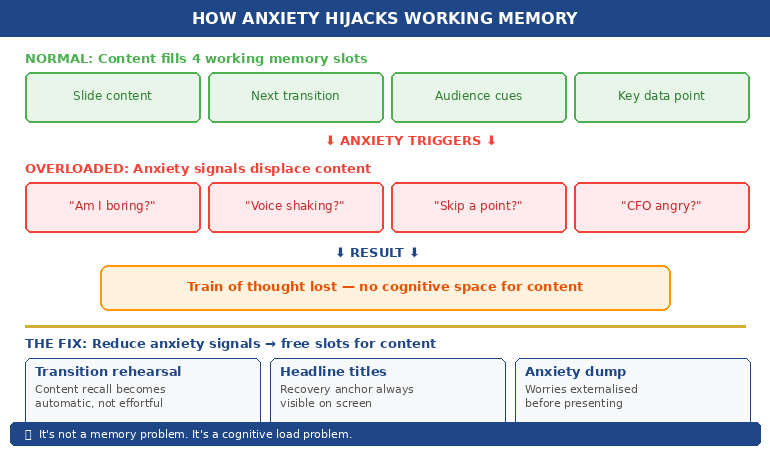
Your working memory — the part of your brain that holds what you’re saying right now, what you’re about to say next, and how your audience is responding — has a capacity of roughly four items. In a normal conversation, that’s plenty. But during a presentation, your working memory is also processing: “Are they bored? Was that the right word? Is my voice shaking? Did I skip a section? Is the CFO checking his phone?”
Each of those threat-monitoring thoughts takes up a slot. When all four slots are occupied by anxiety signals, there’s literally no cognitive space left for your content. Your train of thought doesn’t derail because you forgot. It derails because your brain prioritised danger detection over information delivery.
This is why it happens more to experienced professionals, not less. As a qualified clinical hypnotherapist, I’ve seen this pattern repeatedly with senior executives: the more senior you become, the higher the stakes feel, and the more working memory gets hijacked by threat monitoring. The VP presenting a quarterly update to peers loses their place more often than the graduate presenting their first project summary — because the VP’s brain calculates the cost of failure as higher.
The fight-or-flight response is the mechanism behind this. When your amygdala detects threat (even social threat like judgement), it diverts resources away from your prefrontal cortex — the part of your brain responsible for sequential thinking, language production, and working memory. Your brain is literally choosing survival over eloquence.
PAA: Why do I keep losing my train of thought when presenting?
Presentation anxiety triggers your threat-detection system, which floods your working memory with danger signals. Since working memory can only hold about four items at once, anxiety pushes out your content. This is a neurological response, not a preparation failure. Reducing the cognitive load before you present — through slide-title anchoring, transition rehearsal, and pre-presentation anxiety protocols — prevents the overload before it starts.
The System That Stops the Cognitive Hijack
Conquer Speaking Fear gives you the neurological reset protocols, pre-presentation anxiety tools, and in-the-moment recovery techniques that keep your working memory clear — so your content stays accessible when the pressure is highest.
Get Conquer Speaking Fear → £39
Built from clinical hypnotherapy training + 24 years presenting in high-stakes corporate environments at JPMorgan Chase, PwC, RBS, and Commerzbank.
The 3-Second Mid-Sentence Recovery
You’re mid-sentence and the thread vanishes. Here’s the protocol — three seconds, three steps. Practise it once and it becomes automatic.
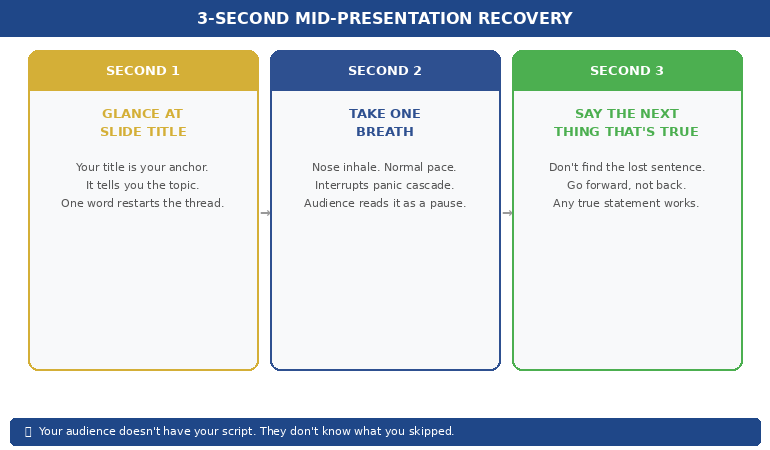
Second 1: Glance at your slide title. Not the content. Not the data. The title. Your slide title is your anchor — it tells you exactly what this section is about. If your title says “Q3 Revenue by Region,” you immediately know the topic. That single piece of information is enough to restart your working memory because it gives your brain a category to pull from, not a specific sentence to recall.
Second 2: Take one breath. Not a dramatic pause. Not a deep meditation breath. One normal inhale through your nose. This does two things: it interrupts the panic cascade (your amygdala responds to controlled breathing as a safety signal), and it gives your prefrontal cortex one second to re-engage. Your audience reads this as a thoughtful pause, not a breakdown.
Second 3: Say the next thing that’s true. Don’t try to find the exact sentence you lost. Say whatever is true about the topic on your slide. “The key number here is…” or “What this means for us is…” or “The critical point on this slide is…” You’re not going back to where you were. You’re going forward from where you are. Your audience doesn’t have your script. They don’t know what you skipped.
This is fundamentally different from the advice in our article on what to do when your mind goes blank, which covers total blank-outs. Losing your train of thought is a partial failure — you know the topic, you’ve lost the thread. The recovery is faster because you have more to work with. You just need to restart the sequence, not rebuild it from nothing.
🧠 Want the full recovery toolkit — including the pre-presentation protocols that prevent this?
Conquer Speaking Fear includes the neurological reset, anxiety-reduction sequences, and in-the-moment recovery techniques used in high-stakes boardrooms.
The Prevention System (Before You Present)
Recovery is essential. Prevention is better. Here are the three techniques that reduce the probability of losing your train of thought from “every presentation” to “rarely.”
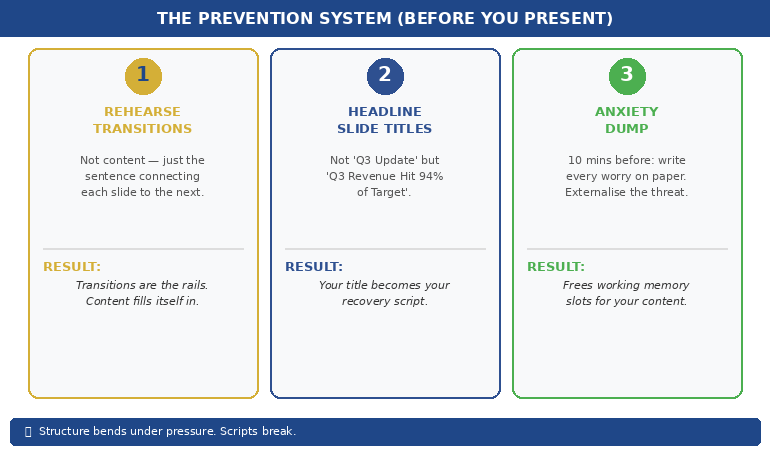
1. Rehearse transitions, not content. Most people rehearse what they’ll say on each slide. This fills working memory with content recall — exactly the kind of load that gets displaced by anxiety. Instead, rehearse only the transitions: the single sentence that connects one slide to the next. “So that’s the revenue picture — now let’s look at what’s driving it.” When you know your transitions, you can lose the middle of any slide and still get to the next one. The transitions are the rails. The content fills itself in.
2. Write headline-complete slide titles. Generic titles like “Q3 Update” or “Market Analysis” give your brain nothing to work with during a blank. Headline titles like “Q3 Revenue Recovered to 94% of Target” or “Market Share Grew Despite Price Increase” tell you exactly what to say even if you’ve forgotten everything else. Your slide title becomes your recovery script. If you lose your thread, the title is sitting right there — and it contains the point you need to make.
3. Pre-presentation anxiety dump. Ten minutes before you present, write down every worry on a piece of paper. “They’ll think I’m underprepared.” “The CFO will ask about the variance.” “I’ll stumble on the technical section.” This isn’t journaling — it’s a cognitive offload. Research on expressive writing shows that externalising anxious thoughts frees working memory capacity. You’re literally clearing slots for your content by moving the worry out of your head and onto paper.
The professionals who over-explain during presentations are often doing so because they sense themselves losing the thread and compensate by adding more words. The prevention system stops the root cause — working memory overload — rather than treating the symptom.
PAA: How do I stop forgetting what to say during a presentation?
Rehearse your transitions between slides (not the content on each slide), write headline-complete slide titles that double as recovery scripts, and do a 10-minute anxiety dump before presenting. These three techniques reduce working memory load so your content stays accessible even when nerves are high. The goal isn’t perfect recall — it’s having a structure that keeps you moving forward regardless of what you forget.
The Prevention + Recovery System for High-Stakes Presenters
Conquer Speaking Fear gives you the complete anxiety management system — pre-presentation protocols that keep your working memory clear, in-the-moment recovery techniques, and the cognitive restructuring tools that break the anxiety cycle permanently.
Get Conquer Speaking Fear → £39
Used in board meetings, steering committees, and investor presentations. Built from clinical hypnotherapy training + 24 years in corporate banking.
What to Do in the Worst Case (Total Blank)
Sometimes the 3-second recovery isn’t enough. You glance at the slide title and nothing comes. Your brain is fully offline. Here’s the escalation protocol.
Ask the room a question. “Before I continue — what’s your biggest concern about this timeline?” or “Quick check: does this match what you’re seeing in your region?” This does three things at once: it buys you 20–30 seconds while someone responds, it shifts the cognitive load to someone else temporarily, and it often triggers your own memory because hearing someone else’s perspective reactivates the neural pathway your content lives on.
Advance to the next slide. If you’re completely stuck on slide nine, move to slide ten. A new slide gives your brain a new anchor point — new title, new visual, new topic. The content on the previous slide can be addressed later (“Let me circle back to the implementation timeline”). Your audience doesn’t know you skipped forward. They assume you’re being efficient.
Narrate what you see. If everything has gone and you can’t move forward, describe what’s literally on the screen. “This chart shows our revenue trajectory over the past four quarters.” This is not insightful commentary — it’s a restart mechanism. The act of verbalising what you see re-engages your prefrontal cortex and typically breaks the freeze within 5–10 seconds. The first sentence is the hardest. Once you’re talking again, the thread comes back.
🧠 These recovery protocols are just one part of the system.
Conquer Speaking Fear includes the complete anxiety management toolkit — from pre-presentation reset to mid-presentation recovery to long-term confidence rewiring.
The Patterns That Make It Worse
Certain presentation habits dramatically increase the probability of losing your train of thought. Recognise any of these:
Scripting word-for-word. If you memorise a script, your brain is running a recall task — pulling exact words in exact order from long-term memory. This is an extraordinarily fragile process under stress. One missed word and the entire sequence collapses, because each word depends on the previous one. Professionals who present from structure (knowing their points, not their sentences) almost never lose their thread — because any sentence that makes the point is a correct sentence.
Avoiding eye contact. When you avoid eye contact, you lose the social feedback that keeps your brain anchored. Eye contact with one friendly face activates your social-engagement nervous system (the ventral vagal pathway), which actively suppresses the fight-or-flight response. One face, four seconds, per section. That’s enough to keep your threat-detection system quiet and your working memory clear.
Presenting too much information. Cognitive overload doesn’t start mid-presentation. It starts in the preparation phase. If you’re trying to cover twenty points in fifteen minutes, your brain is running a constant prioritisation algorithm that consumes working memory even before anxiety enters the picture. Fewer points means less cognitive load means more working memory available for delivery.
PAA: Can anxiety cause you to lose your train of thought?
Yes — this is the primary cause for most professionals. Anxiety activates your amygdala, which diverts cognitive resources away from your prefrontal cortex (responsible for working memory, sequential thinking, and language production). The result is that your content gets displaced by threat signals. This is a neurological mechanism, not a character flaw, and it’s more common in experienced professionals because higher seniority means higher perceived stakes.
Frequently Asked Questions
Is losing my train of thought a sign of poor preparation?
Almost never. The professionals who lose their thread most frequently are typically the best-prepared — because over-preparation creates rigidity, and rigidity collapses under anxiety. The fix is structural preparation (transitions + headline titles) rather than content memorisation. Structure bends under pressure; scripts break.
Should I use notes or a teleprompter to prevent this?
Notes as a safety net are fine. Notes as a script are dangerous. If you’re reading from notes, your brain is running two tasks simultaneously — reading and presenting — which doubles the cognitive load. A single card with your five transition sentences is more useful than three pages of scripted content. If you must use notes, write only your slide transitions and one key data point per section.
Does this get worse with age or seniority?
Yes, for most people — but not because of cognitive decline. It gets worse because seniority increases the perceived stakes. A director presenting to the board calculates higher personal consequences than an analyst presenting to their team, which triggers a stronger fight-or-flight response and greater working memory displacement. The techniques in this article work specifically because they address the anxiety mechanism, not the memory mechanism.
What if I lose my train of thought during a Q&A, not the presentation itself?
Q&A derailments are actually easier to recover from because the format is already conversational. Use the bridge technique: “That’s a good question — let me think about the best way to answer that.” This buys you 3–5 seconds and signals thoughtfulness, not confusion. Then answer whatever part of the question you do remember. If you’ve genuinely forgotten the question, ask them to repeat it — this is completely normal and nobody judges it.
📬 The Winning Edge Newsletter
Weekly strategies for speaking confidence, executive presence, and career-critical presentation moments. No fluff.
🎯 Free: Executive Presentation Checklist
The pre-presentation checklist that includes the working memory protection protocol, slide-title anchoring system, and transition rehearsal framework — everything in this article, condensed into a printable one-pager.
📊 Optional: Want the slides too?
Preparation reduces anxiety. The includes headline-complete slide templates designed to minimise working memory load — so you always have an anchor point to recover from.
Related: Losing your train of thought is magnified when you’re presenting under time pressure with no preparation. If you’ve been thrown into a last minute presentation, the 5-slide emergency framework gives you a structure that’s impossible to lose your place in — because each slide has exactly one job.
Losing your train of thought isn’t a preparation failure. It’s a working memory problem with a neurological solution. Glance at the title. Breathe. Say the next thing that’s true. And before you present, rehearse your transitions, write headline titles, and dump the anxiety on paper.
🎯 Present with the confidence that comes from knowing you can recover from anything.
About the Author
Mary Beth Hazeldine is the Owner & Managing Director of Winning Presentations. A qualified clinical hypnotherapist and NLP practitioner who spent five years battling presentation terror before learning to overcome it, she now helps executives speak with confidence in high-stakes environments.
With 24 years of corporate banking experience at JPMorgan Chase, PwC, Royal Bank of Scotland, and Commerzbank, Mary Beth combines neurological understanding of presentation anxiety with practical frameworks tested in real boardrooms — not classrooms.