

Quick Answer
A Monday morning presentation produces a recognisable pattern in many senior leaders: Sunday afternoon contracts, Sunday evening becomes pre-meeting prep no matter how much was finished on Friday, and the actual weekend stops existing. The pattern is not a sign of weak preparation. It is the predictable result of an unfinished mental loop the body cannot close until the meeting itself is done. The reframe that works is structural, not motivational. Two specific shifts in how the Friday and Sunday hours are organised tend to give senior leaders their weekend back without reducing meeting quality.
On this page
Ines was the head of corporate finance at a mid-cap industrial group based in Amsterdam. She told me, in our first session, that she had not had a real weekend in roughly three years. Not because she worked through it. Because every Sunday afternoon contracted into pre-meeting preparation for whichever Monday morning meeting was on the calendar — the operating committee, the board sub-committee, the investor briefing, the divisional pipeline review. By 4pm on Sunday, no matter what she had planned for the day, she was at her desk reading the deck again. By 7pm, she was rehearsing the answers to the questions she most expected. By 10pm she was unable to sleep. Saturday had become a buffer day for things she could not do during the week. Sunday had become the night before. The weekend itself was gone.
What Ines was experiencing has a recognisable shape. Most senior leaders who present regularly to executive audiences encounter some version of the Sunday dread pattern, and many of them have lived with it long enough that they no longer treat it as a problem with a fix. They treat it as the cost of seniority. It is not. It is a specific and addressable structural problem in how the Friday-to-Monday window is organised, and the reframe that addresses it is small enough that most senior leaders can implement it without coaching.
The pattern is also worth taking seriously because of what it does to the meeting itself. A Monday morning presentation delivered after a Sunday evening of accumulated dread is a different meeting from one delivered after a real weekend. The voice is fractionally tighter. The pre-meeting nervous-system state is more activated. The first ten minutes of the meeting are spent settling into a baseline that should already have been settled. The presenter performs well — they always do — but the cost is higher than the meeting requires.
If Sunday afternoon has been quietly contracting for years
The fix is not motivational and it is not “stop worrying”. It is a small structural shift in how the Friday close is organised that gives the body permission to release the meeting until Monday morning. The senior leaders who use it tend to recover most of their Sunday within a few weeks.
The Sunday dread pattern — what it actually is
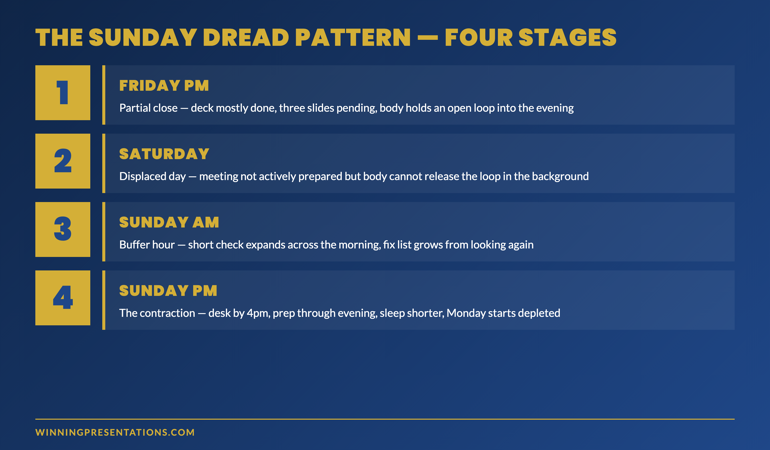
The pattern has a recognisable timing, and naming it precisely helps because the felt experience is often blurry — leaders describe “having a difficult Sunday” without separating the components.
Friday afternoon — the partial close. The leader finishes the working week with the deck in a “mostly done” state. Not finished. Not at a stopping point that the body can recognise as complete. There are three slides that need a second look, two numbers that need to be checked with a colleague who has gone home, and a paragraph in the executive summary that has not landed. The leader closes the laptop with the meeting still active in their working memory. The Friday evening starts with the loop already half-open.
Saturday — the displaced day. Saturday is usually the day the leader genuinely tries to be off. Errands, family time, the things that the working week has displaced. The Monday meeting is not actively being prepared. It is also not being released. The body is holding the loop in a low-activation state — present enough to interfere with sleep that night but not active enough to feel like work. By Saturday evening, most leaders describe a sense that “tomorrow I should look at the deck again”, which is the Sunday dread arriving early.
Sunday morning — the buffer hour. Most senior leaders’ Sunday begins with a planned buffer hour around 9am or 10am. Coffee, a short look at the deck “just to check”. The hour expands. By 11am the leader has noticed three things they want to fix. By midday the buffer has consumed the morning. The rest of the day will be a series of these expansions — never long enough to count as proper work, never short enough to leave a real Sunday afternoon intact.
Sunday afternoon — the contraction. By 3pm or 4pm the leader is at the desk in earnest. The plan is “an hour or two to be ready”. The body knows the meeting is in fewer than 18 hours. The combination of late-day cortisol, accumulated meeting weight, and the genuine remaining work produces an active prep state that runs through the evening. Sleep is shorter and lighter than usual. The Monday morning starts from a depleted baseline.
Why the body cannot close the loop until Monday
The reason the pattern is so persistent is that it is not a willpower problem. It is a structural one. The body cannot release a high-stakes meeting until either the meeting has happened or the preparation has been brought to a state the body recognises as complete. The Friday close described above does not give the body that signal. The deck is “mostly done” by the leader’s standards but is “open” by the body’s standards. The body is correct to keep the loop active, because the leader has implicitly told it the work is unfinished.
This is the part most “stop worrying” advice gets wrong. The Sunday dread is not anxiety to be calmed. It is the predictable consequence of an unclosed working loop. The fix is to close the loop, not to override its signals.
The challenge is that “closed” for the body’s purposes is more demanding than “closed” for the leader’s intellectual purposes. The leader knows the deck is 95% complete on Friday afternoon. The body knows it is 95%, which means there is 5% of pending work that the working memory has to keep available. By Saturday morning, the 5% has expanded — the leader has had ideas in the shower, noticed a number on a Bloomberg headline that affects the framing, remembered a question a colleague asked on Wednesday. The body’s 5% becomes the leader’s actual Sunday afternoon by the time the week starts again.
The Friday close — the structural shift that protects Sunday
The single move that most reliably reclaims the weekend is the structural Friday close. It is small enough to fit into 90 minutes on Friday afternoon, and it changes what the body holds across the next 60 hours.
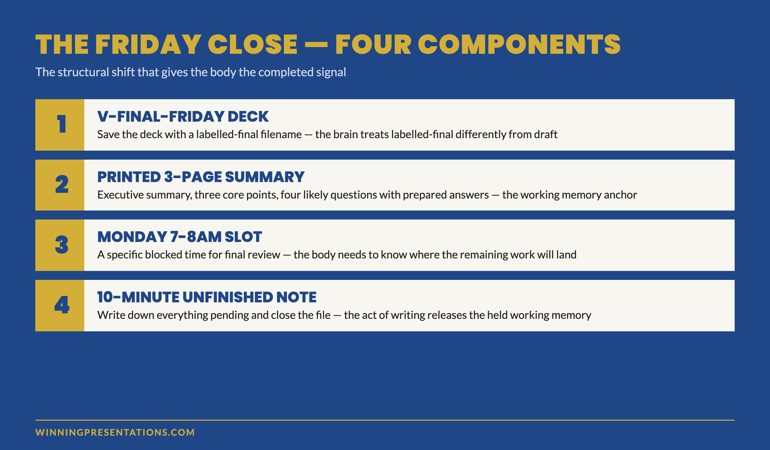
The Friday close has four components. They are not glamorous. They are calibrated to give the body the “completed” signal it needs.
Component 1 — A finished version of the deck saved as v-final-friday. Not a “draft”. Not “v3-pending”. A version saved with a name the body reads as final. This is small and matters. The mental loop is partially closed by the act of declaring a version complete, even if the leader knows they will probably touch it again on Monday morning. The brain treats a labelled-final version differently from a labelled-draft one.
Component 2 — A printed three-page summary of the substance, not the slides. Print the executive summary, the three core points the audience will leave with, and the four most likely questions with the prepared answer to each. This is the document the body uses as the anchor across the weekend. The deck itself can stay closed. The summary is the working memory the body needs to release.
Component 3 — A specific Monday morning slot for final review. Block 7am to 8am on Monday for the final review. Put it in the calendar. The body needs to know there is a specific time at which the remaining work will happen. Without this, the body fills the gap on its own — using Sunday afternoon — because it has no other instruction.
Component 4 — A 10-minute “what is unfinished” note, written and then closed. Spend ten minutes writing down everything that is not yet resolved — the two numbers to check, the paragraph that has not landed, the slide ordering question. Save the note alongside the deck. The act of writing it is the part that releases the working memory. The body holds working items more tightly than written ones because written ones are no longer at risk of being forgotten. This is the smallest of the four components and often the most powerful.
For senior leaders whose Sunday dread is also producing physical symptoms — chest tightness, disrupted sleep, racing heart on Sunday evening — the lighter-touch in-the-moment techniques in Calm Under Pressure work alongside the structural reframe and address the physiological component specifically.
The Sunday reframe — what to put in the gap
The Friday close on its own is half of the work. The other half is what happens to Sunday once the contraction is no longer pulling the day toward the desk. Most senior leaders, given an unexpectedly free Sunday afternoon, do not know what to do with it. The first three or four weekends after implementing the Friday close are often more disorienting than they sound. The body is used to the contraction. The absence of the contraction feels like something is missing.
The most useful Sunday reframe is to put deliberate non-work activity into the 3pm to 6pm window — the slot the contraction used to occupy. This is not “rest”. The body does not move from active dread to passive rest cleanly. It moves from active dread to active engagement in something else. A long walk that requires attention to navigation. A meal cooked from scratch with multiple components. A non-fiction book that demands actual concentration. The activity needs to occupy enough working memory that the Monday meeting cannot reclaim the slot.
By the third or fourth weekend, the body has learned the new pattern. The Sunday afternoon settles into something that is actually rest. The Monday morning starts from a different baseline. The first ten minutes of the meeting do not need to be spent stabilising; the leader walks in already at the activation level the meeting requires, not above it. The meeting itself is fractionally better — the voice is steadier, the pace is more deliberate, the pre-meeting nervousness is in the ordinary range rather than the cumulative range.
Get a structured weekend-protective routine — Conquer Your Fear of Public Speaking, £39
A structured programme covering the pre-meeting and recovery routines that protect the weekend before a Monday morning presentation. Designed for senior leaders who present regularly at executive level and want a consistent approach that does not consume Sunday afternoon.
- The Friday close routine and Monday morning prep slot, step by step
- Voice and pace calibration to enter the meeting from a settled baseline
- Recovery practices for after the Monday meeting that prevent compounding into the next week
- Designed for executives presenting to boards, exec committees, and senior stakeholders
Get Conquer Your Fear of Public Speaking →
£39, instant access. Designed for senior professionals presenting to executive audiences.
What stops working over time without the structural close
The cost of running the Sunday dread pattern across years is rarely measured in productivity. It shows up in three quieter places.
Sleep architecture across the working week. The Sunday night that runs short on sleep is the start of a week that has less recovery margin built into it. By Wednesday the leader is operating on a sleep deficit that they had no chance of recovering from on a Sunday that was already eaten. By the time the next Monday meeting arrives, the body is starting from a slightly worse position than the previous Monday. The pattern compounds across months in ways that the leader notices at year boundaries — “I am more tired than I used to be” — without identifying the structural source.
Anticipatory dread spreading earlier. The Sunday dread does not stay on Sunday. Across years, it tends to creep into Saturday evening, then into Saturday afternoon, then into Friday evening. The leader who started with one bad Sunday a month finds, three years in, that the dread is operating on a four-day cycle around any high-stakes Monday. The structural close addresses this because it stops the loop from being open across the weekend at all. Without the close, the leader’s only options are to extend the management of the dread (more anxious days) or to accept it as a permanent feature of their week.
The meeting itself. A leader who has slept seven hours after a real Sunday delivers a different meeting from a leader who has slept five and a half hours after Sunday afternoon prep. The audience cannot point to the difference, but the difference is there — in the steadiness of the voice during the first ten minutes, in the willingness to take a hard question without rushing, in the post-meeting clarity that determines what the leader does next. The structural close is a meeting-quality intervention as much as it is a weekend intervention.
Frequently asked questions
Will the Friday close make my Monday meeting worse because I prepared less?
No. The Friday close does not reduce preparation; it relocates an hour of it from Sunday afternoon to Monday morning. The total preparation time is similar. The state of the body during the Monday morning hour is significantly better than the state during Sunday afternoon. The actual meeting tends to be measurably steadier, not weaker.
What if my Monday meeting is at 9am and I cannot block 7am to 8am?
The earliest realistic Monday slot still works. The principle is that the body needs to know there is a specific dedicated slot for final review. A 30-minute block at 8am works almost as well as the 7am to 8am one. The component that matters is the existence of the labelled slot, not the specific time. Without the slot, Sunday afternoon expands to fill the gap.
Why does writing down what is unfinished release the working memory?
The brain holds open items more tightly than recorded ones because open items are at risk of being forgotten. Writing them down — even with no plan to look at the note again — registers as completion of the recording task and lets the working memory stand down. This is sometimes referred to as the “Zeigarnik effect”, and the practical implication is that the act of writing the unfinished list is itself the release, not a precursor to it.
Does this work if I have multiple Monday meetings, not just one?
The structural close still works; the Monday morning slot needs to be longer to accommodate review of multiple decks. A 90-minute block from 6:30am to 8am is the practical equivalent of the single-meeting version. The Friday close itself stays the same — the printed three-page summary becomes a separate page per meeting, and the unfinished-items note is per meeting.
For a related companion piece on the broader timeline of how presentation confidence develops, see How Long Does It Take to Build Presentation Confidence?
The Winning Edge — weekly, free
Each Thursday: one structural framework, one micro-story from senior coaching, one practical move you can use in this week’s meetings. Built for senior professionals who present at executive level.
Not ready for the full system? Start here instead: download the free Executive Presentation Checklist — a one-page pre-meeting routine the senior leaders I work with use the morning of a board presentation.
About the author
Mary Beth Hazeldine is the Owner & Managing Director of Winning Presentations Ltd, founded in 1990. With 24 years of corporate banking experience at JPMorgan Chase, PwC, Royal Bank of Scotland, and Commerzbank, she advises executives across financial services, healthcare, technology, and government on structuring presentations for high-stakes funding rounds, board approvals, and senior reviews.