

Quick Answer
Poor microphone technique is one of the fastest ways to lose an audience before you have said anything worth hearing. The three types of microphone used in executive presentations — handheld, lapel, and podium — each require different habits. Get the technique right and the microphone disappears from the room’s awareness. Get it wrong and it becomes the only thing anyone notices. This is a mechanical skill, not a talent. It takes twenty minutes to learn and applies immediately.
In This Article
- Why microphone technique matters more than most executives realise
- Handheld microphone: the positioning errors that destroy clarity
- Lapel microphone: placement, clothing and movement rules
- Podium microphone: how to work it without being trapped by it
- When anxiety meets a microphone: managing amplified nerves
- The soundcheck protocol most speakers skip
- Frequently asked questions
I watched a divisional director lose the room in the first forty-five seconds of a company-wide address. He had prepared well. The content was clear. The slide structure was sound. But he walked to the front holding the handheld microphone at chin level and turned his head away from it every time he looked at his slides. The words reached the front rows and evaporated. The back third of the room heard a sequence of half-sentences and ambient noise.
The people in those back rows did not know why they could not follow him. They simply stopped trying. They checked their phones, leaned to whisper to colleagues, and disconnected from a presentation that deserved better. The director did not recover, not because the content failed, but because the physical credibility gap opened in the first minute became the frame through which everything else was read.
Microphone technique is one of those skills that is invisible when done correctly and catastrophic when done badly. Most executives are never taught it. It is assumed that someone who can present to a boardroom can also handle an amplification system. The assumption is wrong, and the consequences are measurable in audience engagement from the first sentence.
Presenting to a large audience and managing your nerves at the same time?
Conquer Speaking Fear is a 30-day programme using nervous system regulation techniques from clinical hypnotherapy. Designed for executives who have tried other approaches and still struggle with the physical and psychological experience of high-stakes presenting.
Why Microphone Technique Matters More Than Most Executives Realise
In a small meeting room, voice projection is managed by the speaker. In a larger venue — a conference hall, a company-wide townhall, an awards ceremony, an industry event — amplification takes over that function. The microphone becomes the primary instrument of your voice, and if you do not know how to use it, you have handed control of your first impression to a piece of equipment you have not practised with.
The problem is compounded because microphone issues are almost always invisible to the speaker. When you turn your head and your voice drops out of the microphone’s pickup range, you feel nothing different. You have no signal that fifty per cent of the room just missed your opening statement. The feedback loop that would normally alert you — a restless audience, a confused expression, a question that reveals they did not follow — is delayed by several minutes, by which time the connection has already been severed.
The deeper issue is what poor amplification signals to an experienced audience. Senior professionals who attend many large presentations have a calibrated sense of what confident, prepared speakers look like on stage. Fumbling with a microphone, holding it inconsistently, or having feedback spikes from a lapel badly clipped suggests either inexperience with large formats or poor preparation. Neither is the impression you want to create in the first sixty seconds.
The solution is not complex. It requires understanding the three microphone types, the specific error patterns of each, and a pre-presentation soundcheck protocol that takes under five minutes. None of this is performance coaching. It is mechanical knowledge that anyone can apply immediately.
Handheld Microphone: The Positioning Errors That Destroy Clarity
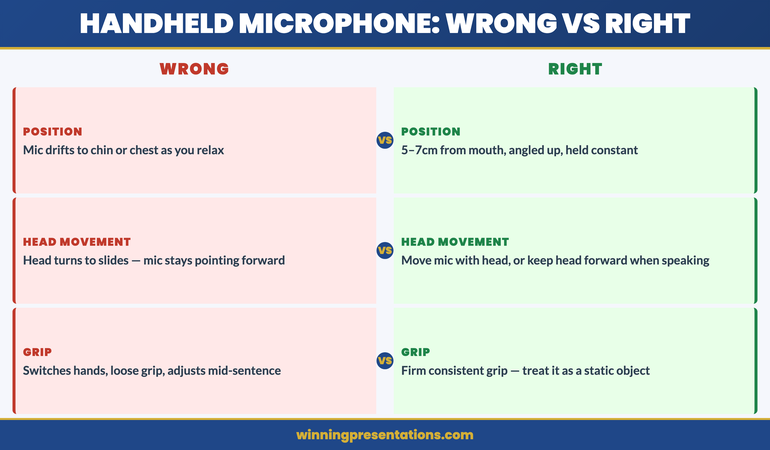
The handheld microphone is the most common in corporate presentations and the one most frequently misused. The fundamental rule is consistent distance: the microphone should be held approximately five to seven centimetres from your mouth, angled slightly upward, and maintained at that distance regardless of what your head does.
The most common error is letting the microphone drift downward as the presentation progresses. Speakers start with correct positioning and, as they relax into their content or begin referencing slides, the hand holding the microphone drops toward chin level, then toward the chest. At this point the microphone is capturing significantly less of the voice and more of the room’s ambient noise. The audience hears a reduction in clarity and volume that feels like disengagement, even if the speaker is fully present.
The second error is head-turning. When speakers turn to reference slides or look across the room, they often rotate their head while keeping the microphone stationary. The microphone stays pointing at where the voice was rather than following where it is. The fix is to move the microphone with your head, or to train yourself to keep your head forward when speaking and only glance at slides briefly rather than addressing them.
The third error is inconsistent grip. Nervous speakers often transfer the microphone between hands, hold it loosely, or grip it tightly and then adjust mid-sentence. Each adjustment creates a brief movement that disrupts pickup distance. Hold the microphone with a firm, consistent grip — treating it as a static object, not a prop — from the moment you take it to the moment you hand it back.
A practical test before any presentation with a handheld microphone: stand in front of a mirror, hold the microphone at the correct distance, and then do what you plan to do on stage — turn your head, gesture, reference notes. Watch what happens to the microphone position. The errors that appear in a mirror will also appear on stage.
Lapel Microphone: Placement, Clothing and Movement Rules
The lapel microphone, also called a lavalier, clips to clothing near the collar and provides hands-free amplification. It is common at conferences and company-wide events where the speaker needs freedom of movement. The three variables that determine whether it works are placement, clothing choice, and movement habits.
Placement is the most frequently mismanaged element. The clip should sit approximately fifteen to twenty centimetres below the chin, close to the centreline of the chest. Too low and the pickup weakens significantly; too high and the microphone is visible in camera shots and more susceptible to clothing noise. The exact placement depends on the sensitivity of the specific device, which is why a soundcheck matters — the technician will advise on positioning for that particular room and system.
Clothing creates the most unpredictable problems. Fabrics that rustle — certain synthetics, stiff cotton, structured jackets with internal lining — generate constant friction noise that the lapel microphone amplifies. This is not volume that the speaker can hear, but it is clearly audible to the audience and to anyone watching a recording. If you are presenting at a large event and wearing a lapel microphone, test your outfit with movement before you go on. Run your hand across the lapel area and listen for any fabric sound. Jackets with lapels are generally better than soft knitwear, which can move against the clip and generate intermittent noise.
Movement habits matter because turning your head sharply to one side — particularly if wearing a collar microphone near the jawline — can bring the jaw or shoulder into proximity with the pickup capsule, causing brief distortion. The fix is to turn from the body rather than leading with the chin: rotate your whole torso to address different parts of the room rather than swinging your head while your shoulders stay square.
Podium Microphone: How to Work It Without Being Trapped by It
The podium microphone is fixed in position, which creates a specific constraint that many speakers handle badly: they become physically anchored to the podium. They stand directly behind it, keep their movement minimal, and lose the stage presence that comes from occupying space freely. The microphone that was supposed to amplify their authority ends up containing it.
The key to working a podium microphone without being trapped by it is understanding its pickup angle. Most podium microphones have a cardioid pattern that captures a cone of sound roughly thirty to forty-five degrees wide directly in front of the capsule. You do not need to lean into the microphone. You need to speak across it from a consistent distance — typically twenty to thirty centimetres — and maintain that relationship even when you move your weight, gesture, or shift your stance.
The error most speakers make is leaning forward when they want to emphasise a point. The instinct is to move toward the audience when you want to make something land. But leaning into a podium microphone creates a volume spike that is jarring for the audience and uncomfortable in a large hall. Emphasis is better delivered through vocal variation — a slower pace, a deliberate pause, a lower register — rather than through physical proximity to the pickup.
If you want the freedom to move away from the podium briefly, discuss this with the AV team before the session. Many podium setups can be paired with a lapel backup that allows you to step out from behind the stand for a section of the presentation and then return. Planning this in advance is far more effective than improvising it on stage.
Understanding how to use eye contact effectively in executive presentations becomes significantly more powerful when your microphone technique is already handled — you can direct full attention to the room rather than managing the equipment at the same time.
Conquer Speaking Fear
Microphone technique handles the mechanics. Conquer Speaking Fear — £39, instant access — addresses the anxiety that makes the mechanics harder to manage in the moment. A 30-day programme built from clinical hypnotherapy techniques for executives who need a systematic approach to high-stakes presenting.
- Nervous system regulation techniques from clinical hypnotherapy
- 30-day structured programme for lasting anxiety reduction
- In-the-moment techniques for the day of a high-stakes presentation
- Designed for executives who have tried other approaches
The anxiety management system built from clinical hypnotherapy, not just presentation tips.
When Anxiety Meets a Microphone: Managing Amplified Nerves
For speakers who experience presentation anxiety, a microphone adds a specific layer of difficulty. The physical symptoms of anxiety — a slight tremor in the voice, an increase in breathing rate, a dry mouth — become more apparent under amplification. Sounds that would be imperceptible to an audience of twenty become audible to an audience of two hundred. This knowledge itself increases the anxiety, which worsens the physical symptoms, which increases the awareness of the microphone. It is a reliable loop that catches many capable executives off guard the first time they present at scale.
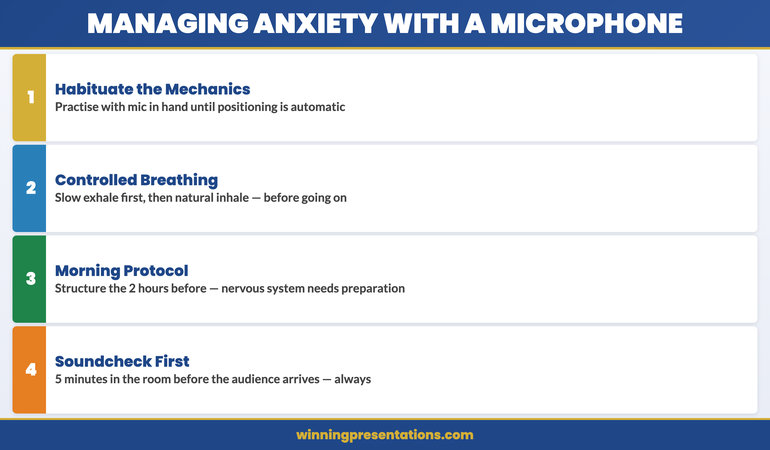
The most effective counter is preparation that is specific to the amplified format, not just to presenting in general. Practise with a microphone, or at least with your hand held in the position a microphone would occupy, so that the physical habit of holding it becomes automatic. Automatic behaviours are not disrupted by anxiety in the same way that novel behaviours are. When the mechanics of microphone use are fully habitual, they no longer compete with the cognitive and physical demands of managing nerves.
Breathing is more important under amplification than in smaller formats. The microphone will pick up an audible breath if it is sharp or gasped. Practise deliberate, controlled breathing before you go on stage: slow exhale, then a natural inhale, not the other way around. This is the breathing pattern associated with the parasympathetic nervous system rather than the stress response, and it reduces the visible and audible signs of anxiety more effectively than deep inhalation does.
The morning before a large presentation is also a significant factor. What you do in the two hours before you go on stage has a measurable effect on how well your nervous system manages the amplified format. A structured morning presentation protocol specifically for high-stakes events gives the nervous system the conditions to perform, rather than asking it to recover from a disordered start to the day.
If anxiety in large-format presentations is a consistent pattern for you rather than an occasional occurrence, that is not a microphone technique problem. The technique helps, but the root cause requires a different kind of work. Conquer Speaking Fear is designed specifically for executives dealing with persistent presentation anxiety — a 30-day programme built from clinical hypnotherapy, not generic confidence advice.
The Soundcheck Protocol Most Speakers Skip
Most speakers arrive at a large event, accept the microphone from an AV technician, and walk to the stage. This skips the single most effective preparation available to them: a working soundcheck in the actual space, at the actual volume level, before the audience arrives.
A soundcheck takes four minutes. What it gives you is worth far more. First, you get to hear your own voice as the audience will hear it — amplified, in that specific room, at that specific volume. For most people this is a surprising experience: the voice sounds different, often deeper and more resonant, and getting comfortable with that difference before you are in front of five hundred people means you are not distracted by it when it matters.
Second, the soundcheck is where you discover problems. The lapel clip that causes friction against your jacket. The podium microphone positioned too far to the left of centre. The feedback frequency that kicks in when you turn toward the screen. These are all fixable before the presentation and difficult to manage during it.
Third, the soundcheck is where you establish rapport with the AV team. These are the people who control your volume, your slide progression, and the lighting. Treating them as professionals who are invested in your success — which they are — rather than as technicians to be given brief instructions creates a collaborative dynamic that consistently produces better outcomes on the day.
Request a soundcheck as a formal part of your arrival process for any event that uses amplification. If the organisers say there is no time, arrive thirty minutes earlier than they suggest and ask the AV team directly. Almost always, they will make time. They want the audio to work as much as you do.
The same principle of deliberate physical preparation applies to movement and stage positioning: professionals who walk the stage before the audience arrives always look more comfortable when the audience is there.
Frequently Asked Questions
What should you do if the microphone cuts out mid-presentation?
Pause briefly, signal to the AV team with a clear look or a raised hand, and project your voice naturally until the system is restored. Do not apologise repeatedly or call attention to the technical problem beyond acknowledging it once. Audiences are forgiving of equipment failures that are managed calmly and unforgettable when a speaker appears thrown by them. The ability to project without amplification for thirty seconds, if necessary, is worth practising specifically: speak from the diaphragm, not the throat, and maintain the same pace and authority your amplified voice would carry.
Is it acceptable to hold a handheld microphone with two hands?
Not typically. Two-handed microphone holding limits gesture, signals physical tension, and looks uncertain on stage. The exception is if the venue is very large and the microphone is heavy — some broadcast-quality handheld microphones have significant weight, and a two-handed hold can be appropriate for extended periods. In most corporate presentation contexts, one hand with a firm, relaxed grip is correct. The other hand should be free to gesture naturally or rest at your side.
How do you handle a microphone when you want to pause dramatically?
A deliberate pause is one of the most powerful tools in executive presenting, and the microphone changes how you manage it. If you lower the microphone during a pause, you signal that you are about to speak again when you raise it — which can reduce the impact of the silence. Keeping the microphone in position during a pause maintains the tension of the silence rather than breaking it. The audience reads the raised microphone and the silence simultaneously, which creates a more powerful expectation of what comes next.
The Winning Edge — A Newsletter for Executives Who Present
Every Thursday: one practical technique for structuring, presenting, or defending a high-stakes proposal. Designed for executives who need to communicate with authority, not just confidence.
Conquer Speaking Fear
The 30-day programme for executives dealing with persistent presentation anxiety — built from clinical hypnotherapy techniques that address the nervous system root cause, not just the surface symptoms. £39, instant access.
The anxiety management system built from clinical hypnotherapy, not just presentation tips.
When you are ready to address the Q&A session that follows a large-format presentation, the same discipline applies: preparation and habit formation reduce the unpredictability. See the companion article on handling Q&A in team settings for a structured approach to managing questions under pressure.
About the Author
Mary Beth Hazeldine is the Owner and Managing Director of Winning Presentations. With 25 years of corporate banking experience at JPMorgan Chase, PwC, Royal Bank of Scotland, and Commerzbank, she advises executives across financial services, healthcare, technology, and government on structuring presentations for high-stakes funding rounds and approvals.