

Quick Answer: A virtual board meeting presentation succeeds or fails in the first thirty seconds, before the deck appears. Lift the camera to eye level, keep your face filling the upper third of the frame, light from the front, and open with the decision being asked for — not the agenda. Remote directors decide whether to lean in or check email by slide three.
JUMP TO:
Astrid joined the call from her home study seven minutes before her first virtual board meeting as the new chief operating officer. The lighting was a single overhead bulb behind her head. The laptop sat on a desk with the camera angled up at her chin. She knew what she wanted to say. She had rehearsed it twice. What she had not done was look at herself on screen first.
The chair opened the meeting and turned to her. She started speaking. Three of the seven non-executive directors were in their cars. Two had cameras off. The chair, who could see her, gave her a slight wince. She kept going. Eight minutes in, the chair interrupted gently and asked if she could “share the deck and walk us through the headlines.” She had been there for two minutes of meaningful airtime before the conversation moved past her presence entirely.
The decision she needed — approval to consolidate two regional warehouses — got deferred to a sub-committee. Not because the proposal was weak. Because the room could not anchor to her. Three days later we rebuilt how she shows up on a virtual board meeting presentation. The next attempt, six weeks later, she had the room from the first sentence.
If your next board call is on screen, not in the room
The Executive Slide System includes scenario playbooks for virtual board, investment committee and remote stakeholder presentations — the structural templates designed for audiences you cannot read in the room.
Why a virtual board meeting is not just an in-person meeting on Zoom
Most executives who present well in the boardroom struggle on screen because they apply the wrong rulebook. In person, you have the room itself. Body language across a table. The pause where someone leans forward. Side conversations that signal which directors are converging. The implicit pressure to make a decision rather than carry it forward to the next agenda.
On a virtual board meeting presentation, those signals are gone. What you have instead is a flat grid of faces, some with cameras off, several multitasking, and a chair who is now responsible for both content management and engagement detection. The friction to disengage is one swipe to email. The friction to defer a decision is one sentence: “let’s take this offline and come back next month.”
The virtual format penalises certain habits ruthlessly. Long preamble before the ask. Reading bullet points off slides. A passive opening (“thanks for the time today, I’ll walk you through where we are with the warehouse review”). Each of these works in the room because physical presence holds attention. None of them work through a 15-inch screen.
The format also rewards habits that experienced in-person presenters underuse. Naming the decision in the first sentence. Speaking in 90-second segments rather than seven-minute blocks. Asking specific directors specific questions by name. Leaving deliberate silence for response. Treating the camera as an executive who is already deciding whether you have the seniority for the decision you are asking for.
The camera angle that signals authority
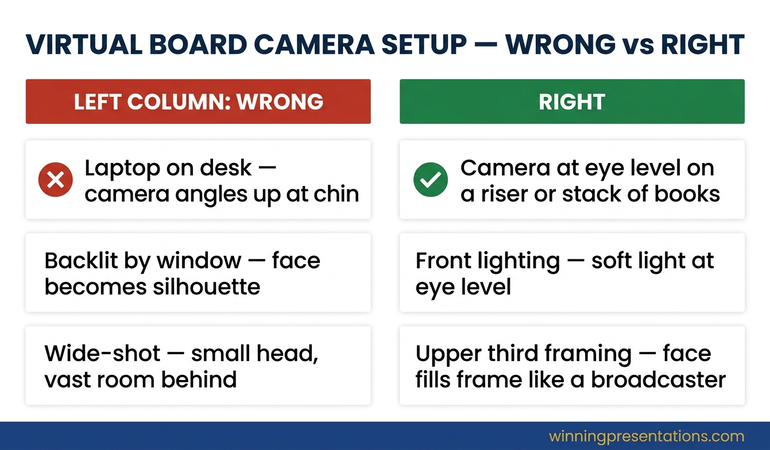
The single highest-leverage change is the camera angle. A laptop on a desk, with the camera looking up at your chin, makes you look smaller, less senior, and physically lower than the people you are presenting to. Even directors who consciously dismiss this read it unconsciously. You are speaking up at them. The room sees a junior posture before they hear the proposal.
The fix is mechanical. Raise the laptop until the camera lens is at eye level or fractionally above. Use a stack of books. Buy a £40 laptop riser. The investment is one evening and the change is permanent.
Three other framing rules carry almost as much weight:
- Fill the upper third of the frame with your face. Not your whole body. Not a tiny head with a vast room behind. Close enough that your eyes are clearly visible, far enough that the top of your head is not cropped. This is the framing all senior broadcasters use.
- Light from the front, not from behind. A window behind you turns your face into a silhouette. Move the desk so the window is in front of you, or place a single soft light at eye level pointing at your face.
- Look at the camera lens, not the faces on screen. Counterintuitive but critical. Your audience reads eye contact through the lens. If you are looking at their faces in the grid, every director on the call experiences you looking somewhere over their shoulder.
None of this is presentation theatre. It is the minimum bar for being treated as the senior person in a room you cannot physically enter. The directors making the decision should not be working hard to take you seriously.
THE EXECUTIVE SLIDE SYSTEM — £39
Stop building decks that work in the room and fail on the call
The Executive Slide System is 26 presentation templates, 93 AI prompts, 16 scenario playbooks, a master checklist and a framework reference. The virtual board scenario playbook is built for short attention spans, no body-language feedback and decision-stage audiences. £39, instant access.
Get the Executive Slide System →
Designed for executives presenting to remote boards, investment committees and distributed leadership teams.
The first thirty seconds: what to say before the deck loads
The deck is not the presentation. The first thirty seconds, before any slide is shared, decides whether the directors lean in or settle into half-attention. Most virtual board presentations waste this window on housekeeping: thanking people for joining, recapping where they are in the agenda, asking if everyone can see and hear them.
A structure that wins those thirty seconds:
- Sentence one — the decision. “I’m bringing the consolidation of the Manchester and Birmingham warehouses for board approval today.”
- Sentence two — the size. “It’s a £4.6m capital decision with an 18-month payback and a 3-year operational saving of £2.1m per year.”
- Sentence three — what you need from this meeting. “I’m asking for either approval, or the specific information that would let me bring back a revised proposal next month.”
- Sentence four — the structure. “I’ll spend twelve minutes on the case, three on risks and mitigations, and leave the remaining time for discussion.”
This sequence does the work the room used to do. It anchors the conversation, frames the decision, sets expectations for time, and signals that you are running the meeting rather than walking through your homework. Now the deck appears, and every slide is read against the question already in the directors’ minds.
For the closely related dynamic of when the chair invites you to speak before the deck loads at all, the camera-on, camera-off virtual presentation guide covers how to handle the asymmetry when half the directors have video off.
Deck structure for remote directors
An in-person board deck can run 25 slides. A virtual board meeting presentation should run 12 to 15. Each slide must work as a self-contained answer to a single question, because half the audience will only re-engage at the slide currently on screen.
The structural rules that hold up under remote conditions:
One question per slide, posed in the title. Title slides should be questions or decisions, not topics. “Why are we consolidating now?” beats “Consolidation timing rationale.” Titles do most of the work for the disengaged director who looks back at the screen halfway through your section.
The virtual presentation energy framework expands on how question-led titles maintain attention across longer remote sessions.
The minimum viable headline answer at the top. Below the title question, a single sentence answers it. The slide content underneath is supporting evidence. A director who only reads the top of each slide should still understand the decision.
No more than three numbers per financial slide. In person, you can talk a board through a complex P&L view. On screen, more than three numbers competes with the supporting commentary. Pick the three that anchor the decision and put the rest in an appendix the chair can navigate to if asked.
Decision slide before risks slide. Show what you are asking for first. Then show what you have done about the risks. Reverse this order in person if you want, but on screen the directors who tune out for a section need to land on the decision slide more often than the risks slide.
Appendix that the chair can use. Pre-load the appendix with the three or four likely questions and label them clearly in the navigation: “A1 — sensitivity analysis”, “A2 — alternative options considered”, “A3 — implementation timeline.” When a question comes, you jump straight there. No fumbling through fifty backup slides while the room watches you scroll.
Holding attention when you cannot read the room
The hardest skill in any virtual board meeting presentation is detecting when you are losing the room — and reacting before the chair has to. In person, body language carries this. On screen, you have to engineer the feedback into the structure.
Three techniques that work:
Named questions, not open ones. “Any thoughts?” produces silence on a virtual call. “Henrik — does the consolidation timing work for the German market entry you mentioned last month?” produces an immediate response. Naming a director by name and tying the question to something they have specifically engaged with creates a small obligation to respond. Use this every four to five minutes.
Deliberate silence after a question. The instinct on a virtual call is to fill silence. Resist it. After a named question, count six seconds before saying anything else. The chair will jump in. A director will jump in. The silence does the work.
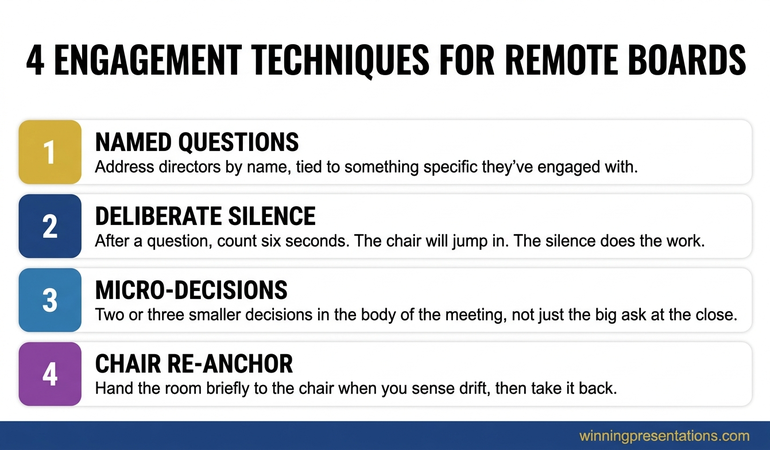
Micro-decisions throughout. Rather than presenting for twenty minutes and then asking for the big decision, structure two or three smaller decisions into the body of the presentation. “Before I move on, can I get a sense from the room — does the £4.6m envelope feel like the right scale, or do you want to see a phased option?” These micro-decisions keep the directors in the meeting rather than spectating from the side.
The chair re-anchor. If you sense the room drifting, hand the room briefly to the chair. “Charles, before I get into the risks section — anything you’d like to surface from the audit committee discussion last week?” This breaks your monologue, brings a different voice on screen, and gives directors permission to re-engage when you take the floor back.
If you also need to handle directors joining from different time zones with conflicting context, the cross-cultural virtual presentation guide covers how to adjust pacing and reference points for global boards.
Closing for a decision through a screen
The most common mistake on a virtual board meeting presentation is to finish the content and then leave the close to the chair. The chair will summarise, ask if there are further questions, and almost certainly say “let’s take a few days to consider this and come back at next month’s meeting.” That is not the chair being cautious. That is the natural outcome when no-one in the room actively shapes the close.
Your close should propose a specific decision path. Three versions, in order of strength:
The direct ask. “I’d like to ask the board for approval today, on the conditions we’ve discussed.” Use this when the room has clearly converged through the discussion. Watch the screen for nods and the chair’s body language. If you see them, ask.
The conditional ask. “Subject to the audit committee confirming the integration risk profile within two weeks, I’d like to ask for approval today contingent on that confirmation.” This is the workhorse close for cautious boards. It gets a substantive yes today rather than a vague maybe next month.
For the related dynamic of when the conditional close needs to handle a finance committee specifically, the partner article on remote pitch deck delivery covers how to structure the remote close in front of investors.
The structured deferral. “If the board wants to defer, can we agree the two specific questions I should answer in writing within the next ten days, and target a decision at the next meeting rather than carrying this for two cycles?” This is what you ask for when the discussion has surfaced legitimate gaps. Never leave the meeting without a date and the specific deliverables.
Astrid used the conditional ask at her second attempt. Approval contingent on the audit committee signing off on the integration timeline. The audit committee signed off six days later. The decision was confirmed before the next board meeting, not at it.
FOR THE NEXT VIRTUAL BOARD MEETING ON YOUR CALENDAR
The complete scenario library for remote executive audiences
The Executive Slide System gives you 26 templates, 93 AI prompts and 16 scenario playbooks — including the virtual board playbook with question-led title structure, decision-first slide order and the appendix navigation pattern referenced above. £39, instant access, no subscription.
Frequently Asked Questions
How long should a virtual board meeting presentation be?
Half the length of an in-person equivalent. If your in-person version is forty minutes, the virtual version is twenty. Use the saved time for structured discussion, not more content. Remote attention does not stretch to forty minutes of one voice.
What if half the directors keep their cameras off?
Treat them as present and engaged. Address questions to them by name as if you can see them. The chair sets the cultural norm on cameras — that is not your fight to pick. What you can control is whether camera-off directors feel addressed, which keeps them mentally in the room.
Should I send the deck before the meeting?
Yes — with the cover note framing the decision being asked for, the meeting structure and the time you are requesting. Many virtual boards now expect to read the deck in advance so the meeting itself is discussion. Plan for that pattern. Do not present the deck slide-by-slide if directors have already read it. Walk to the headlines and the decision.
How do I handle technical issues mid-presentation?
Acknowledge briefly, do not apologise excessively, and have a backup plan. If your screen share fails, talk to the deck verbally for sixty seconds while you reconnect — the directors have it in front of them. If your audio fails, drop into the chat with one sentence: “Audio dropped, reconnecting in 30 seconds.” Composure under technical failure is itself a credibility signal.
Presentation playbooks, delivered Thursdays
The Winning Edge newsletter covers the structures real executives use for high-stakes meetings — remote, hybrid and in person. One issue per week, typically read in four minutes.
Not ready for the full system? Start here instead: download the free Executive Presentation Checklist — a one-page structural review to run over any deck before a board call.
Partner post: Once you have the camera and structure right, the close on a remote investor pitch follows different rules. The remote pitch deck delivery guide covers that scenario.
Your next step: Before your next virtual board meeting presentation, sit at your desk in the same setup the directors will see. Open your camera. Look at yourself for thirty seconds. If anything in that frame is below the bar — angle, framing, light, background — fix it before you fix the deck.
About the Author
Mary Beth Hazeldine is Owner & Managing Director of Winning Presentations Ltd. With 24 years of corporate banking experience at JPMorgan Chase, PwC, Royal Bank of Scotland, and Commerzbank, she advises executives across financial services, healthcare, technology, and government on structuring presentations for high-stakes funding rounds and approvals.