

QUICK ANSWER
TED Talk advice was built for an audience that came to be moved. The boardroom is an audience that came to make a decision. Five techniques that earn standing ovations on stage — the personal story opening, the one big idea, the strategic pause, the call to wonder, and the rule of three — quietly kill credibility in front of senior approvers. The audience and stakes are different. The rules flip.
JUMP TO
Why the rules flip ·
1. The personal story opening ·
2. The one big idea ·
3. The strategic pause ·
4. The call to wonder ·
5. The rule of three ·
What to use instead ·
FAQ
Rafaela had been preparing the regulatory submission for nine weeks. She had taken a public speaking masterclass in the run-up. The course was excellent — built on TED Talk principles, taught by a former TED curator, recommended by everyone she had asked. She walked into the regulator’s hearing on a Tuesday morning genuinely confident.
The first comment from the panel chair came eight minutes in. “Could you tell us in one sentence what you are asking us to allow?” The second comment came two minutes later. “We do not need the story.” By the time Rafaela got to the recommendation slide twenty-six minutes in, two of the four panellists were checking their email and the third was preparing the question that effectively closed the hearing: “Why have you taken this long to tell us what you want?”
The advice she had absorbed was not bad advice. It was advice for a different room. The boardroom — and rooms that read the same way: regulators, credit committees, executive sponsors, investment panels — runs on the opposite logic to the TED stage. Five specific techniques that work brilliantly in one context actively undermine credibility in the other.
Need slide structures built for senior audiences, not TED audiences?
If your slides are still inheriting their structure from public speaking training, the Executive Slide System is the templates side — built around the patterns senior approvers actually respond to.
Why the rules flip
A TED Talk audience came to be moved. They sat down knowing they were going to be told one big idea and that the speaker had eighteen minutes to do it. They wanted to be surprised. They wanted to be made to feel something. They were ready to applaud and to share the talk later.
A boardroom audience came to make a decision — usually within the first fifteen minutes. They are not waiting for an idea. They are waiting to find out what is being asked of them and how solid the case is. They are reading the speaker the way a senior partner reads a junior associate: are you going to be useful to me, can I rely on the structure of your reasoning, will I be able to defend approving this if I am asked to defend it later?
That difference flips the rules. The techniques that signal warmth, intellectual range, and showmanship in front of a TED audience signal something quite different in front of a senior decision audience. They signal that you are performing rather than presenting. The room registers the performance, decides you have come to be admired rather than to make a case, and downgrades the case accordingly.
Technique 1: The personal story opening
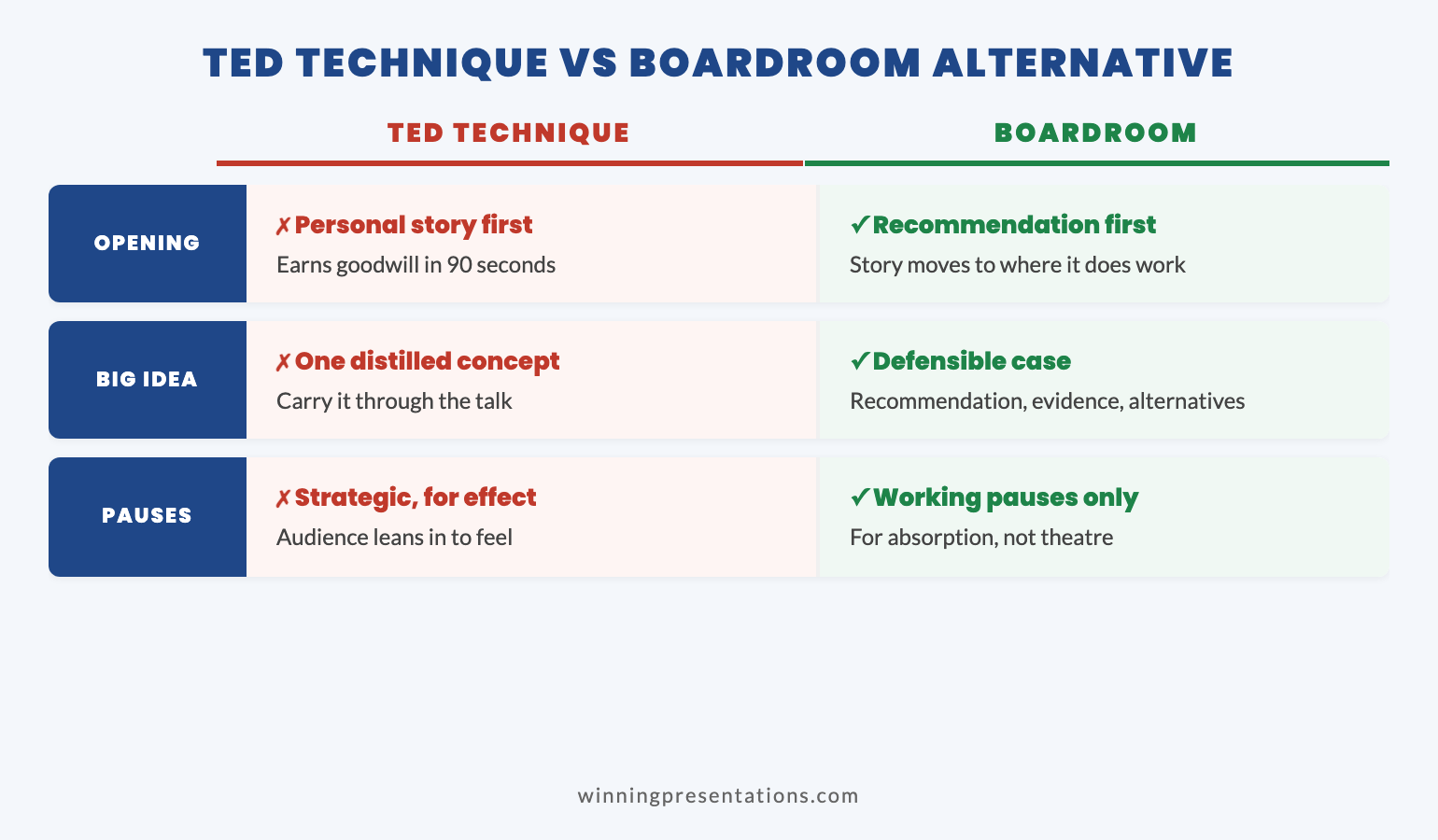
On a TED stage, opening with a personal anecdote is canonical. The story humanises the speaker, earns goodwill in the first ninety seconds, and gives the audience an emotional anchor for everything that follows. There is excellent research on why this works. There is no question that it works.
In the boardroom it earns a different reaction. The chair is watching the clock. They have allotted you, say, twenty minutes. You are spending the first three of those minutes telling them about something that happened to you on a tube platform in 2018. The chair’s mental clock is ticking down on a question they need answered: “what is this person asking me to approve?” Three minutes in, they have not heard it. Five minutes in, the room has started to read the speaker as someone who does not understand that the meeting is not about them.
The fix is not “no stories.” It is “the story comes after the recommendation.” Senior approvers are perfectly happy to spend ninety seconds on a relevant micro-anecdote — once they know what is being asked of them and why. The order matters more than the content. Story-then-recommendation is a TED structure. Recommendation-then-evidence-then-story-where-it-helps is an executive structure.
Technique 2: The one big idea
TED’s signature instruction to speakers is that every talk must have one big idea. Distil. Compress. Anchor. The audience leaves with a single concept they can carry into the rest of their week. This is, again, excellent advice for the format. It is also why TED Talks tend to be structurally simple — one idea, three movements, a clean close.
Senior decision audiences are not interested in a single idea. They are interested in a defensible case. A case has at least three components: what you are recommending, why this rather than the alternatives, and what it costs or risks. None of these can be reduced to a single big idea without misrepresenting the proposal. The presenter who walks into a board with one big idea and tries to land it across thirty minutes is either oversimplifying the proposition or under-presenting the case — usually both.
What works at senior level is the opposite shape. A clearly stated recommendation, then the case for it laid out in load-bearing order, then the alternative that was considered and rejected, then the implications. The structure is not a single ascending arc. It is a structured argument with named components — closer to a senior counsel’s submission than to a TED Talk. Think of it as a case rather than as an idea.
Technique 3: The strategic pause
Trained TED speakers use the pause as a tool. They land a key sentence. They wait. The silence becomes a vehicle for the idea. The audience leans in. The ovation, when it comes, is partly because of the pause as much as because of the words.
The same pause in a boardroom feels manipulative. The committee chair reads it as a deliberate piece of stagecraft. The room knows when it is being asked to feel something. In contexts where the audience came to make a decision, that recognition lands as: “this person is performing for us, not presenting to us.” The pause has signalled the wrong thing about the speaker.
Pauses still belong in senior presentations — but they are functional, not theatrical. The pause to let the audience absorb a number on a slide. The pause after a difficult question to organise the answer. The pause to allow the chair to interject. None of these is “for effect.” All of them are working pauses, and they read very differently from a stage pause.
Technique 4: The call to wonder
TED rhetoric leans heavily on the call to wonder. “Imagine a world where…” “What if we could…” “How would your life change if…” These openings invite the audience to suspend disbelief and enter a hypothetical, and they work because TED audiences came to be opened up. They wanted the question.
Boardrooms do not want the question. They want the answer. The “imagine if” framing in front of a senior approver reads as either softness (“you are asking me to make a real decision based on a hypothetical?”) or as an evasion of the actual ask. The first time I watched a senior partner at a global insurer interrupt a presenter to say, “I do not need to imagine. Tell me what you are recommending and what the cost is” — I realised that the call to wonder lives on the wrong side of the audience line.
What replaces it is something close to the opposite: a clear statement of where things currently stand, what the speaker is recommending, and what changes if the recommendation is approved. The room does not need to be invited to dream. It needs to be told what is being decided.
EXECUTIVE SLIDE SYSTEM
Slide structures that read like a case, not a keynote
The Executive Slide System gives you the templates and frameworks senior approvers respond to — recommendation-first openings, load-bearing case structures, and slides that survive being read on their own. Built for boardroom and senior approval audiences, not for the TED stage.
- 26 templates covering executive scenarios
- 93 AI prompts for fast structural drafting
- 16 scenario playbooks for high-stakes meetings
- Master Checklist + Framework Reference
- Instant access on purchase
Executive Slide System — £39, instant access. Designed for senior professionals presenting to boards, committees, and executive sponsors.
Designed for executive scenarios — not stage performance.
Technique 5: The rule of three
The rule of three is everywhere in trained public speaking. Three points. Three pillars. Three reasons. Three takeaways. The reason is rhetorical: triplets feel complete, are easy to remember, and have a satisfying rhythm. The pattern is so ingrained that most public speaking trainers will tell you to fit any structure into a triplet “for the audience.”
The rule of three becomes a problem in senior presentations when it forces the case into a shape that does not fit it. A capital expenditure proposal might naturally have four load-bearing components: the strategic rationale, the financial case, the risk treatment, and the implementation plan. Compressing those four into three for the sake of rhetoric leaves one of them under-presented — usually risk treatment, which is then exactly what the committee asks about and finds you have not prepared in detail.
The senior structure does not impose a triplet. It imposes load-bearing logic. Sometimes that is two components. Sometimes it is six. The number is whatever the case actually requires. Senior approvers do not notice the absence of a triplet. They do notice when a case has been forced into one and an obvious component has gone missing. The board approval presentation framework walks through the structure that lets the case dictate its own shape.
What to use instead
Most of the techniques that earn applause on the TED stage have a senior-context counterpart that earns approval. The substitution is not large. It is targeted.
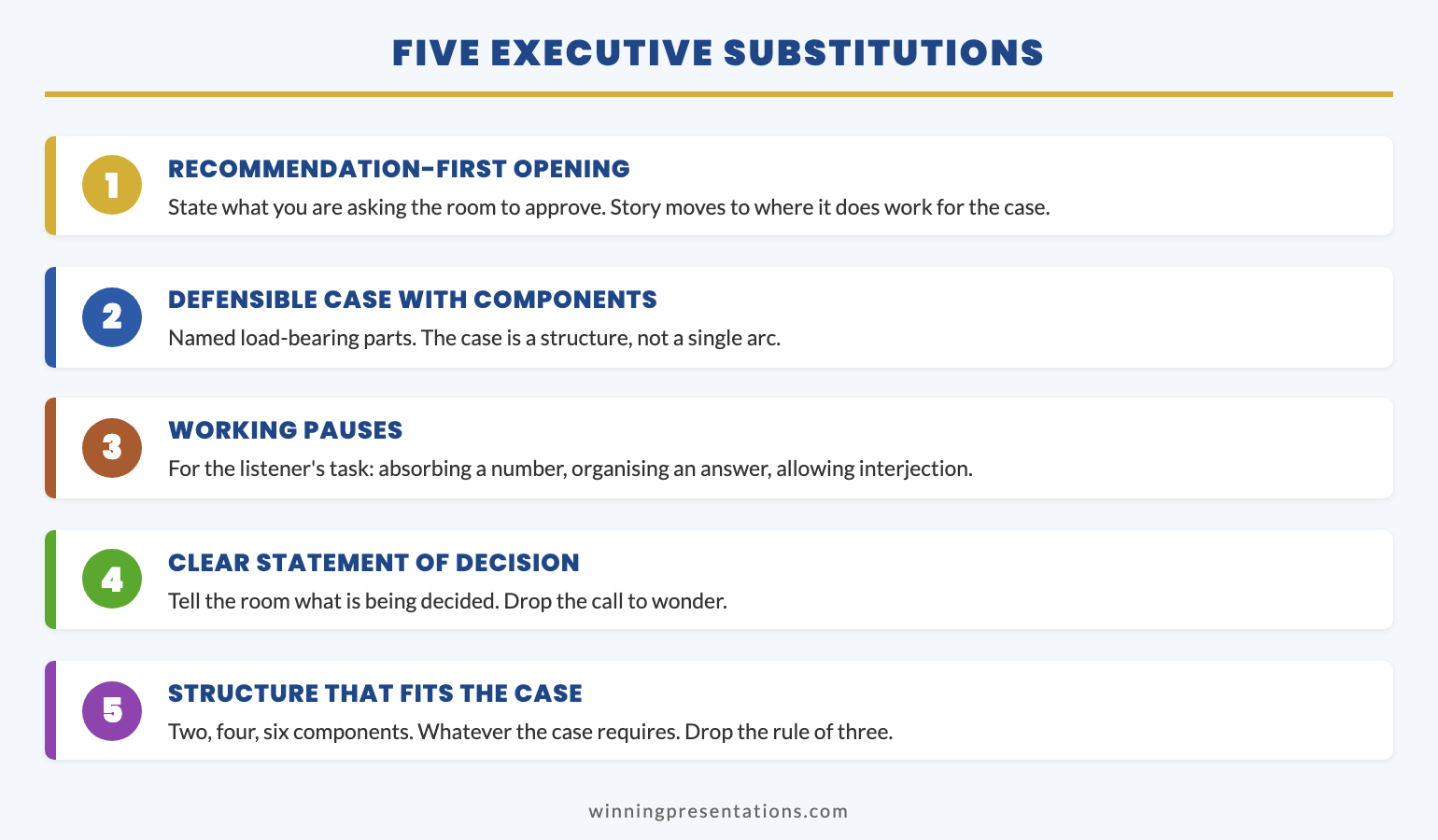
The personal story opening is replaced by a recommendation-first opening, with the story moving to wherever in the talk it does the most work for the case. The “one big idea” is replaced by a defensible case with named components. The strategic pause is replaced by working pauses tied to the listener’s task. The call to wonder is replaced by a clear statement of what is being decided. The rule of three is replaced by load-bearing structure that fits the case.
What links all five substitutions is a shift from speaker-centred craft to listener-centred utility. TED craft is, fundamentally, about the speaker’s experience of giving the talk. Senior craft is, fundamentally, about the listener’s experience of using the talk to make a decision. Both are valid disciplines. Only one of them is what the boardroom came for.
For senior professionals who have absorbed a lot of TED-style training and are now noticing it does not transfer cleanly, the path is rarely to undo it all. The voice work, the breath work, the basic stage composure all transfer. What changes is the structural canon — the ordering choices, the openings, the pauses, the framing of the ask. Executive presentation skills is the broader picture inside which these substitutions sit.
Why the canon needs translating
The TED canon is one of the most influential bodies of public speaking advice ever produced. It is also one of the most context-specific. Built for an audience that wants to be moved, designed around eighteen-minute slots, optimised for shareability after the talk — almost every property of the format is at odds with the boardroom. The senior professional who walks in with a TED-trained instinct is not undertrained. They are trained for the wrong room.
The fix is to recognise the canon for what it is and to learn the senior-context translation of each technique. Once the translation is made, the underlying skill set transfers cleanly. The substitutions are specific. The rooms are different. The instinct is the same.
EXECUTIVE SLIDE SYSTEM
Templates designed for senior approval, not stage applause
Recommendation-first openings, load-bearing case structures, scannable slides, and scenario playbooks for the meetings where senior decisions are made. £39, instant access — with the Executive Slide System you stop translating TED structures into senior-context structures one slide at a time.
Designed for senior professionals presenting decisions to boards and committees.
Frequently asked questions
Are TED Talks really bad training for executives?
They are not bad training in general. They are training for a specific audience — an audience that came to be moved — and many of the techniques are tightly optimised for that audience. Some of the techniques transfer cleanly to other contexts (voice work, basic stage composure, structuring sentences for clarity). Others actively reduce credibility in front of senior decision audiences. The five techniques in this article are the most common cases where the canon misfires.
Should I avoid personal stories in board presentations completely?
No. Personal stories are useful at senior level — just not as openers. The order matters: state the recommendation, lay out the case, and use a story where it does specific work for the case (illustrating a risk, anchoring a market insight, making a customer experience tangible). The instinct to put the story at the start is what causes the problem, because senior listeners are waiting to know what is being asked of them.
Why does the rule of three fail in senior contexts?
The rule of three is a rhetorical pattern, not a structural one. It works when the natural shape of the case happens to fit three components. When the case has two or four or five load-bearing components, forcing it into three either over-compresses or pads. Senior approvers do not consciously look for triplets, but they notice immediately when an obvious component has been left out for the sake of rhetoric. Cost cases get squeezed. Risk treatments get squeezed. The committee asks about the squeezed component and the case wobbles.
How long does it take to retrain from TED-style speaking to executive presenting?
The structural retraining is fast — usually a small number of presentations, with conscious attention to the substitutions. The instinctive retraining is slower. Most senior professionals find that the temptation to open with a story or to use a strategic pause for effect surfaces under pressure, which is exactly when senior audiences read it most clearly as performance. Practice in low-stakes senior settings (internal steering committees, working groups with senior attendees) is where the new instinct gets installed.
The Winning Edge
A weekly newsletter for senior professionals who present at board level. One specific structural idea per issue, drawn from real boardroom and committee work. No filler.
Not ready for the full system? Start here instead: download the free Executive Presentation Checklist — the pre-flight checks that catch the structural mistakes most senior professionals make in the last 24 hours before a high-stakes meeting.
If this article landed for you, Public speaking for executives vs everyone is the natural next read. It walks through the broader distinction between general public speaking and senior-level public speaking and where the disciplines diverge.
Next step: open the deck for your next senior presentation and check the first three slides. Where does the recommendation appear? If it is not on slide one or two, the deck is still inheriting a TED structure. That is usually the most consequential single fix.
Mary Beth Hazeldine is the Owner & Managing Director of Winning Presentations. With 24 years of corporate banking experience at JPMorgan Chase, PwC, Royal Bank of Scotland, and Commerzbank, she advises senior professionals across financial services, healthcare, technology, and government on structuring presentations for high-stakes funding rounds and approvals. She speaks German and works extensively with the German-speaking financial markets.