

Quick answer: A kickoff that electrified the room in January often falls flat when you re-run its energy in July, because the room is in a different state. A January room is assembled, rested, and expectant — it wants direction, ambition, the shape of the year. A post-summer room is scattered and returning — half of it has been on leave, priorities have drifted, and it needs to be re-gathered before it can be inspired. Match the wrong energy to the room and a strong deck meets polite silence. The fix is the Re-Entry Read: diagnose the room’s state (assembled-and-moving versus scattered-and-returning), pick the matching energy (direction-setting versus re-orientation), then rebuild your opening for it — a returning room needs “here is where we were, here is what changed, here is the one thing now” before it can hear a vision. Test it with the cold-open test: hand your first three slides to a colleague who has been on leave for two weeks and ask what the meeting is about. If they cannot tell you, a returning room cannot either.
JUMP TO:
In 2017 I sat at the back of a divisional kickoff on the second Tuesday of July. The managing director running it was good — genuinely good — and she had every reason to be confident, because the same deck had brought the room to its feet at the January offsite six months earlier. Same structure, same bold opening on the year’s ambition, same crescendo on what the division could become. In January it had landed like a starting gun. This time she opened on the vision slide, and the room just… sat there. Polite, attentive in the way people are attentive when they are being courteous rather than moved, two of her direct reports quietly checking phones beneath the table. She closed to a small round of applause that everyone in the room recognised as the obligatory kind. Afterwards she found me by the coffee and asked, genuinely baffled, what had gone wrong — because nothing had. The deck was the same deck. The room was not the same room.
(This article was created with AI assistance; all stories and insights are based on 35 years of real client work.)
What had changed was the state of the people in the chairs. In January the division had been together for months, moving on a shared set of priorities, and they walked into the offsite rested and expectant, ready to be pointed at something big. By the second week of July, a third of the leadership team had been on leave in the previous fortnight, the priorities set in January had quietly mutated under two quarters of real events, and the people who had been in the office had spent six weeks heads-down rather than looking up. The managing director presented to the room she remembered from January. The room in front of her needed something different first — not a bigger vision, but a re-gathering. This is the most common mistake I see in the second-half presentation calendar, and it has nothing to do with skill: experienced presenters re-run the energy that worked last time, and the energy is right for a room that no longer exists.
Before you rebuild a kickoff, it helps to see the small number of structures these meetings actually run on.
The free 7 Presentation Frameworks Quick Reference Card lays the core structures — including the re-orientation and direction-setting shapes behind any kickoff — on a single page you can hold beside your outline while you decide which one the room in front of you needs. It is the fastest way to check you are building the right shape, not just polishing the one that worked in January. Free download, no email gate.
Why the same deck lands differently in July
The instinct to reuse a kickoff that worked is sound — you proved the structure, the timings, the build — and it is also the trap. A presentation is not a fixed object that produces a fixed effect; it is a thing that happens between you and a particular room on a particular day, and the room is half of the equation. A January room and a July room differ on three axes that decide how your opening lands. The first is attention: a rested room arrives with spare capacity and gives you the benefit of the doubt; a returning room arrives with a backlog in its head and grants you about ninety seconds before it triages you against the inbox. The second is shared context: in January everyone holds the same recent picture of where things stand, so you can build on it; after summer that shared picture has frayed, and what you assume the room knows, a meaningful slice of it has half-forgotten or never heard.
The third axis is what the room actually wants from you, and it is the one presenters miss most. A fresh-year room wants altitude — the ambition, the direction, the sense that this year means something. A returning room does not want altitude first; it wants to be re-anchored. It wants to know what it missed, what changed while it was away, and what the one thing is that it should care about now, before it has any appetite for a horizon. Open a returning room on the horizon and you are answering a question it has not yet asked, while leaving unanswered the question it walked in with. That is the precise mechanism behind the polite, flat reception: not boredom, not a weak deck, but a mismatch between the energy you brought and the state the room was in. The content can be excellent and the match still wrong.
None of this means a July kickoff should be smaller or less ambitious in the end. It means the ambition has to be earned in a different order. The mechanics of opening a kickoff change depending on whether you are starting cold or restarting warm, and a second-half kickoff is almost always a restart. The room has history with the work, that history has gone hazy, and your first job is to bring it back into focus — not to act as though no time has passed. Skip the re-gathering and the vision lands on a room that is not yet in a position to receive it, which is exactly what I watched happen on that July Tuesday.
The Re-Entry Read: three components
The Re-Entry Read is a three-step diagnosis you run before you build a single kickoff slide. It does not change how good your content is; it changes what order and energy that content arrives in, so the same material lands rather than slides off. It has three components, and each one answers a question the room is silently holding.
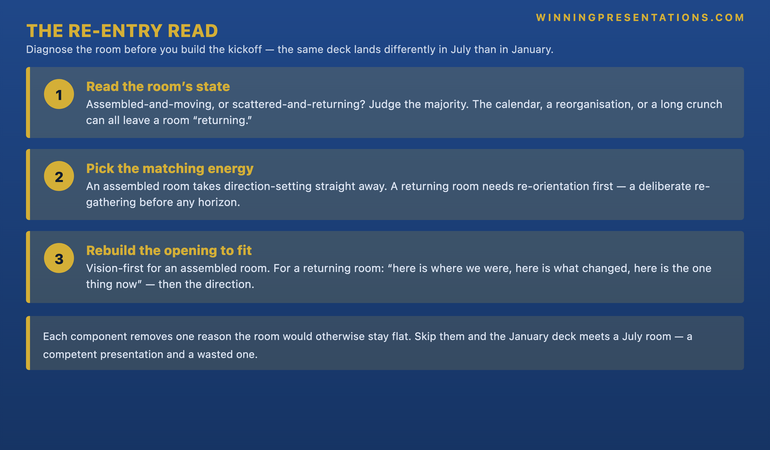
Component one: read the room’s state. Ask one question honestly — has this group been assembled and moving together, or scattered and returning? It is rarely all one or the other, so judge the majority. A team that has been in the building, on a shared set of priorities, with no major break, is assembled-and-moving. A team coming off a summer in which leave was staggered, priorities drifted, and attention fragmented is scattered-and-returning. The calendar is a strong signal but not the only one: a reorganisation, a leadership change, or a long project crunch can leave a room “returning” in September just as surely as a fortnight on a beach. Component two: pick the matching energy. An assembled room can take direction-setting energy straight away — vision, ambition, the shape of the period ahead — because it already holds the context that makes a vision meaningful. A returning room needs re-orientation energy first: a deliberate re-gathering that rebuilds shared context before any horizon is raised. Component three: rebuild the opening to fit. This is where the diagnosis becomes a deck. For an assembled room, vision-first works. For a returning room, the opening runs “here is where we were, here is what changed while you were out, here is the one thing that matters now” — and only then, on that re-established ground, the direction for the months ahead.
What makes the three components work together is that each removes a specific reason the room would otherwise stay flat. Reading the state stops you presenting to a remembered room. Picking the energy stops you answering a question the room has not asked. Rebuilding the opening stops the vision arriving before the room can hold it. Run all three and a returning room is re-gathered into a state where it can actually receive ambition; skip them and you get the January deck meeting a July room, which is a competent presentation and a wasted one. The diagnosis takes about ten minutes. The rebuild is mostly reordering and a couple of new slides, not a new deck.
Build the re-orientation opening — and the kickoff deck behind it — without starting from a blank slide.
The Executive Slide System gives senior presenters the templates and structures for exactly this kind of meeting — kickoffs, all-hands, and half-year resets — so you spend your time deciding what the room needs, not wrestling layout. It is built to turn a clear intent into a board-grade deck fast, which is what you want when a July kickoff has to be re-shaped on a tight runway.
- 26 executive templates and 16 scenario playbooks covering kickoff, all-hands, and review formats
- 93 AI prompts to draft the “what changed while you were out” re-anchor slide from your own notes
- 7 checklists to pressure-test the opening before the room does
- Instant access, lifetime use — £39
The cold-open test
The Re-Entry Read needs a test that tells you, before the meeting, whether you have actually built a re-orientation opening or whether you only think you have. The cold-open test is mechanical and takes five minutes. Take your first three slides — just the opening — and give them to a colleague who has been on leave for the last fortnight, or failing that, anyone who has been nowhere near the work for a few weeks. Ask them one question after they read: what is this meeting about, and what does it want me to care about? If they can answer cleanly, your opening re-establishes context on its own, and a returning room will follow it. If they squint, or they can describe the topic but not why it matters now, or they ask you a clarifying question to get oriented — then your opening assumes a context the room no longer has, and a returning room will feel exactly that gap in the first ninety seconds.
The test works because it simulates the real condition of a post-summer room: people who were away from the work and are meeting your slides cold, in sequence, without the running context you have been living inside for months. You cannot feel that gap yourself, because you have the context — you wrote the deck. The colleague who has been out supplies the missing perspective. It is the same reason a writer cannot proofread their own work as well as a stranger can: you read what you meant, not what is on the page. Run the cold-open test and you read what the returning room will actually receive, not what you intended to convey.
The test also tells you what is missing, not merely that something is. If your reader grasps the topic but not the stakes, your opening has context but no re-anchor to why-now — add the “here is what changed” beat. If they grasp neither, you have opened on the horizon with no ground beneath it — you need the “here is where we were” beat before anything else. If they get all of it but find it flat, your diagnosis may be wrong and the room is actually assembled, in which case you can move the vision forward with confidence. The first slide a senior leader puts up carries more diagnostic weight than any other, because it is where the energy mismatch either shows or disappears. The cold-open test puts a fresh pair of eyes on that slide before the whole room does.
When the kickoff has to do more than re-gather — when it has to win the room to a direction senior people can resist — the persuasion is its own discipline.
The Executive Buy-In Presentation System is the self-paced programme behind securing genuine agreement from a senior audience — seven modules on reading the room, framing the case, and structuring the ask so a group of decision-makers commits rather than merely nods. It enrols in monthly cohorts with optional, fully recorded Q&A sessions you can watch back at your own pace, and lifetime access to the materials. £499.
What re-orientation energy actually looks like
Re-orientation energy is easy to misread as “lower energy,” and that is not it. A re-orientation opening can be warm, brisk, and confident — it is not a dirge. What distinguishes it is the order of operations: it spends its first few minutes rebuilding the room’s shared picture before it reaches for the horizon. In 2019 I worked with a country head running a September kickoff after a summer that had scattered his leadership across three continents and two reorganisations. His first instinct was the usual barnstormer. We rebuilt it. He opened not with the year’s ambition but with ninety seconds of “here is exactly where we ended June, here are the two things that changed over the summer that you may have missed, and here is the single priority that now sits above the others.” Only then did he raise the direction for the rest of the year. The room, which had walked in fragmented, visibly re-gathered in those first minutes — you could see shoulders turn toward the front — and by the time he reached the ambition, it landed on a room that was finally in one place to receive it.
The components of a re-orientation opening are concrete. First, a where-we-were beat: a single slide that re-establishes the last shared picture, stated as fact, not nostalgia. Second, a what-changed beat: the two or three developments over the quieter weeks that the room needs in order to be current — not a status dump, just the deltas that matter. Third, a one-thing-now beat: the single priority that should rise above the rest as the room re-engages, named plainly. These three beats do in two or three minutes what a returning room cannot do for itself: they rebuild the common ground that an assembled room already stands on. Once that ground is rebuilt, everything you wanted to say about the months ahead becomes audible, because the room is now standing somewhere it can hear you from.
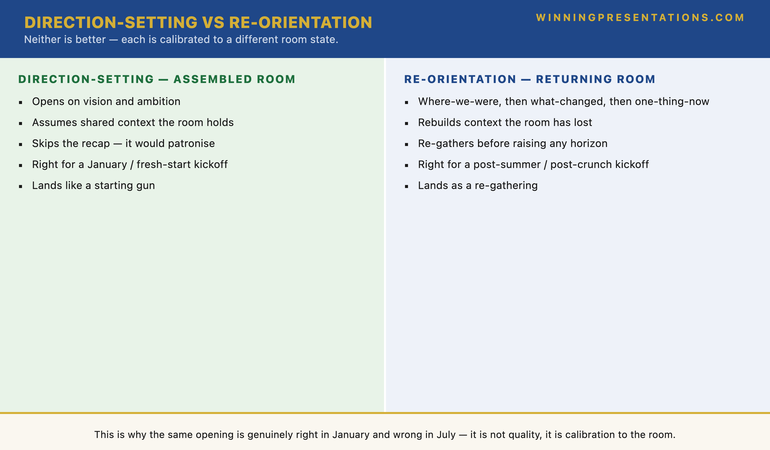
The contrast with direction-setting energy is instructive. A direction-setting opening for an assembled room can skip straight to the horizon precisely because the ground is already shared — the where-we-were and what-changed beats would be redundant, even slightly patronising, to a room that has been living the work without a break. This is why the same opening genuinely is right in January and wrong in July: it is not that one is better, it is that each is calibrated to a different room state. Get the calibration right and you stop fighting your own audience. The way you frame a quarter’s plan should shift with where in the year it sits and what the room has just been through, for the same reason a good opening does.
Stop re-running the deck that worked last quarter and watching it die this one.
The Executive Slide System works directly on the failure behind a flat kickoff: a deck built for a remembered room rather than the one in front of you. It gives you the re-orientation and direction-setting structures as ready templates, so re-shaping a kickoff for a returning room is an afternoon of judgement, not a weekend of rebuilding from scratch.
- Scenario playbooks for the openings most likely to misfire — kickoffs, all-hands, half-year resets
- The where-we-were and what-changed slide patterns, ready to drop your own content into
- Checklists that catch an energy mismatch before the room does, not after
- Instant access, lifetime use — £39
Reading the calendar, not just the room
The Re-Entry Read works on a single meeting, but the smarter move is to read the whole second-half calendar before it arrives, because the room’s state is partly predictable from the dates. There are stretches of the year when a presenting audience is reliably assembled — the weeks after a fresh start, the run into a year-end push — and stretches when it is reliably returning: the first fortnight back after a summer in which leave was staggered, the awkward window between Christmas and the new-year reset, the period after a long delivery crunch when everyone has had their head down. If you know your important presentations for the half, you can mark which ones land in a “returning” window and plan the energy in advance rather than discovering the mismatch live.
This is also a scheduling lever, not just a content one. Some presentations can move, and a few high-stakes ones are worth moving out of a returning window into an assembled one. A kickoff that depends on the room arriving ready for ambition is better placed a fortnight after everyone is genuinely back than on the first Tuesday when half the leadership is still mentally on the beach — if you have the latitude to choose. When you do not have that latitude — the date is fixed, the meeting must happen in the returning window — the Re-Entry Read is how you adapt the meeting to the date instead of pretending the date does not matter. The error is to treat the calendar as neutral, to assume a July room and a January room are interchangeable audiences who will respond identically to identical material. They are not, and the presenters who plan their second half around that fact spend far less energy fighting flat rooms.
One caution keeps this from becoming superstition. The calendar is a strong prior, not a law — it tells you what is likely, and the room in front of you is the final authority. A team that worked straight through the summer on a crisis will be assembled in August; a team blindsided by a reorganisation in June will be returning in a way no holiday explains. Use the dates to form your first guess about the room’s state, then confirm it against what you actually know about the group. The point of reading the calendar is not to replace the read of the room but to start it earlier, so you walk into the second half with your energy already matched to the audiences you are going to face.
One thing to do before your next kickoff
Before you build the next kickoff that lands in a returning window, do one concrete thing. Write your opening — just the first three slides — then hand them to a colleague who has been out of the work for at least a fortnight and ask them a single question: “Reading only these, what is this meeting about and what does it want you to care about now?” Time their answer. If they can tell you cleanly in under thirty seconds, your opening re-orients on its own and you can build the rest with confidence. If they hesitate, ask a clarifying question, or describe the topic without the stakes, you have your diagnosis: add the where-we-were and what-changed beats before the horizon, and run the test again. Do this before you design anything else, because the opening decides whether the room is in a state to hear the rest — and a returning room that is not re-gathered first will sit politely through the best vision you have ever written.
Frequently asked questions
Doesn’t a re-orientation opening just waste the first few minutes recapping things people already know?
It only feels like a recap if the room is assembled, which is exactly why the Re-Entry Read starts with diagnosing the room’s state. For a returning room, the where-we-were and what-changed beats are not a recap of things everyone holds — they are a rebuild of shared context that a meaningful slice of the room has lost over the quieter weeks. The cost of skipping them is not saved time; it is a vision delivered to a room that cannot yet receive it, which wastes the whole meeting rather than three minutes of it. If your cold-open test shows the room already has the context, then yes, cut the beats and go straight to the horizon. The discipline is to match the opening to the room, not to always add or always cut.
What is the most common mistake senior presenters make with a post-summer kickoff?
Re-running the energy of a kickoff that worked earlier in the year without re-reading the room. It is the experienced presenters who are most exposed to this, because they have a proven deck and the confidence to reuse it — and reuse is precisely the trap. The January deck was calibrated to a rested, assembled room; the July room is scattered and returning, and the same opening that landed like a starting gun in winter meets polite silence in summer. The fix is not a better deck or more charisma; it is a ten-minute diagnosis of the room’s state and a re-ordered opening. The mistake is treating the audience as a constant when it is the most variable part of the whole equation.
How do I tell whether my room is “assembled” or “returning” if it is genuinely a mix?
It almost always is a mix, so judge the majority and the people who matter most to the outcome. Ask who in the room actually drives what happens after the meeting, and read their state rather than the average. If the people whose engagement you need have been away or heads-down, treat the room as returning even if a few have been present throughout — you lose little by re-anchoring a room that is mostly assembled, but you lose the meeting by failing to re-anchor one that is mostly returning. When in genuine doubt, default to a brief re-orientation: a thirty-second where-we-were beat costs an assembled room almost nothing and rescues a returning one. The asymmetry of the risk should decide it.
Does this apply to virtual and hybrid kickoffs, or only to in-person ones?
It applies more sharply to virtual and hybrid kickoffs, because a remote returning room is even harder to re-gather. In a room you can see shoulders turn toward the front when the re-orientation lands; on a call you are presenting to muted squares and a backlog of email one click away, so the re-anchor has to be cleaner and the “one thing now” sharper to cut through. The components are the same — where-we-were, what-changed, one-thing-now — but the discipline of leading with them rather than the horizon matters more when you cannot feel the room responding. If anything, a post-summer virtual kickoff is the single hardest energy match in the second-half calendar, and the one most worth running the cold-open test on.
The Winning Edge — weekly newsletter
The Winning Edge is a weekly (Thursday) newsletter for senior professionals who present to teams, boards, and committees. One short email a week on the structural moves that separate the meetings that land from the ones that meet polite silence. Subscribe to The Winning Edge →
For the full set of skills behind a kickoff that re-gathers a room and points it somewhere — slides, storytelling, confidence, and delivery — the seven-product Complete Presenter bundle brings them together as a single resource — £99 for everything, lifetime access.
About the author
Mary Beth Hazeldine is Owner & Managing Director of Winning Presentations Ltd. With 24 years of corporate banking experience at JPMorgan Chase, PwC, Royal Bank of Scotland, and Commerzbank, she advises senior professionals across financial services, insurance, consulting, and technology on the structural moves that turn a strong presentation into a meeting that actually moves a room.