
Tag: stage fright

20 Mar 2026
Split corporate scene showing confident executive at podium on one side and anxious professional in meeting room on other side representing stage fright versus social anxiety

Stage Fright vs Social Anxiety: Different Causes, Different Fixes (Why This Matters for Your Recovery)

Quick Answer: Stage fright is situational fear tied to public performance itself. Social anxiety is pervasive fear of judgment that bleeds into all social contexts. They require different diagnostic approaches and different recovery strategies. Misidentifying which one you have is why many executives feel stuck—applying the wrong fix to the wrong problem.

Diagnosis Matters More Than You Think

Thousands of executives spend months or years working on confidence-building tips when their real issue is nervous system regulation. Or they focus on breathing techniques when their problem is an identity-based anxiety spiral. The Conquer Speaking Fear programme uses clinical hypnotherapy and nervous system science—not generic presentation tips—to address the actual root cause of your anxiety.

Learn how nervous system regulation differs from confidence coaching →

The Audience Judgement Loop (11 Years)
An executive spent 11 years trapped in a thought loop: “They’re judging me. I’m not ready. I’ll embarrass myself.” He’d rehearse presentations obsessively, avoid eye contact, speak in a monotone—all the classic presentation anxiety patterns. Then he took a confidence-building course. More techniques. More rules. More ways to feel like he was doing it wrong. Nothing stuck. Six months later, nothing had changed. But when he finally reframed his problem, everything shifted. It wasn’t stage fright at all—it was social anxiety wearing a presentation mask. His real fear wasn’t the performance moment itself. It was the belief that people were evaluating his character, his intelligence, his worth. One reframing technique broke the 11-year cycle. But only after he correctly identified what he was actually fighting.

Stage Fright: The Performance Response

Stage fright is situational. It’s specific to the moment you’re in front of people to perform. The moment ends, the fear largely ends with it. An executive with stage fright might feel completely calm in a one-on-one conversation with the same person they’re nervous about presenting to. They feel fine in small team meetings but anxious at the quarterly town hall. They rehearse obsessively because they believe preparation will reduce the performance risk.

Stage fright is fundamentally a threat response. Your nervous system recognises a real, temporary situation where judgment is possible and reacts accordingly. Heart rate rises. Adrenaline flows. Your body is preparing to either perform at high stakes or escape the situation. This is not a broken response—it’s an ancient survival mechanism that happens to activate in modern performance contexts.

The physical symptoms are unmistakable: trembling hands, a dry mouth, butterflies in the stomach, a tight chest, racing thoughts. These symptoms typically spike 15 minutes before performance and subside within 10 minutes of finishing. An executive with pure stage fright might feel completely confident 30 minutes after a presentation ends.

Social Anxiety: The Identity Problem

Social anxiety is pervasive. It’s not about the specific performance moment—it’s about the belief that people are judging your character. An executive with social anxiety doesn’t feel calm in one-on-one conversations with colleagues they worry about. They don’t relax after the presentation ends because the anxiety isn’t tied to the performance—it’s tied to the interaction itself.

Social anxiety is fundamentally about evaluation of self. The fear isn’t “Will I mess up my words?” It’s “Do they think I’m competent?” or “Are they judging my character?” This creates a loop where the person interprets neutral social cues as criticism, avoids interactions that trigger anxiety, and then feels ashamed for avoiding them. The anxiety spreads across contexts—presentations, meetings, networking, even emails.

The physical symptoms of social anxiety are similar to stage fright on the surface, but the duration and trigger patterns differ completely. Someone with social anxiety might feel anxious hours before a presentation, during it, and for hours or days after—replaying every word, every moment, looking for evidence they were judged. The anxiety doesn’t turn off when the situation ends because the situation was never what the anxiety was really about.
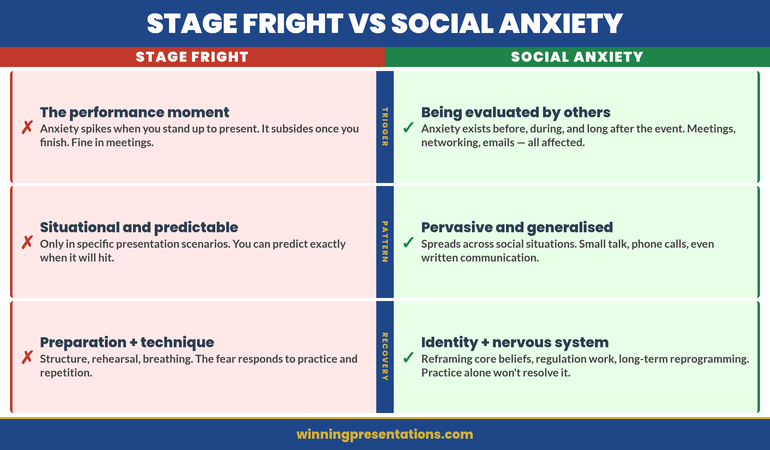
Comparison infographic showing stage fright versus social anxiety across four dimensions: trigger, pattern, core fear, and recovery path with cross and check icons

The Diagnostic Framework: How to Tell the Difference

Here’s the clearest diagnostic tool. Imagine this scenario: You’re delivering a major presentation to your board. Afterwards, someone you respect pulls you aside and says, “That was great. Really clear.” How do you respond?

Stage fright response: “Thank you. I was so nervous. My hands were shaking.” Relief. The moment is over. By tomorrow, the anxiety has dissolved.

Social anxiety response: “Really? But I was rambling in the second section. I could tell they weren’t engaged. I probably sounded unprepared.” Doubt. Rumination. The anxiety shifts into self-criticism and evidence-gathering about your competence or likeability.

Stage fright is about the moment. Social anxiety is about your interpretation of what the moment says about you as a person. This distinction is critical because it changes everything about recovery.

Aspect Stage Fright Social Anxiety
Trigger Specific performance moment; high-stakes audience present Belief about judgment or social evaluation; present even in low-stakes social situations
Duration Minutes to an hour before and during; subsides quickly after Hours or days before; rumination after; context-independent
Core Fear “I will make a mistake or forget my words” “They are judging my character or competence”
Avoidance Pattern Avoids presentations; seeks small audiences or written formats Avoids social situations broadly; withdraws from colleagues; struggles in group settings
What Helps Preparation, practice, nervous system regulation in the moment Identity work, reframing beliefs about judgment, nervous system regulation + cognitive shifts

Why Your Recovery Path Depends on Which One You Have

This is where most executives get stuck. If you have stage fright and you spend your time building confidence and self-esteem, you’re missing the real problem: your nervous system is reacting to genuine stakes. You don’t need to think differently about yourself. You need your body to regulate more effectively in the moment.

If you have social anxiety and you spend your time practising presentation techniques and rehearsing, you’re treating a symptom, not a cause. You can memorise your whole deck word-for-word and still feel like a fraud in the moment because the anxiety isn’t about your preparation—it’s about whether people are judging you. More preparation actually feeds the anxiety because it’s rooted in the belief that you have to be perfect to deserve positive judgment.

Stage fright recovery focuses on nervous system regulation: breathing techniques that actually work, body awareness in high-stress moments, strategic visualisation tied to your actual nervous system state, and graduated exposure to the feared situation (presenting to larger audiences, higher stakes).

Social anxiety recovery focuses on reframing: examining the belief that judgment is dangerous, creating evidence that contradicts your anxiety narrative, building tolerance for being evaluated without needing to control the outcome, and regulating the nervous system as part of a larger identity shift.

Which one resonates? Get the specific framework.

Get Conquer Speaking Fear → £39

The Nervous System Component

Both conditions involve nervous system dysregulation, but in different patterns. Understanding this is essential because the fix depends on the pattern.

In stage fright, your nervous system is in a sympathetic (fight/flight) state during the performance. Your body has mobilised resources for threat response. This is actually functional—it’s giving you energy and alertness. The problem is that this activation feels terrible and makes it harder to access your executive function (clear thinking, smooth speech, memory access). The solution is to downregulate without losing the activation. You want calm focus, not panic or shutdown.

In social anxiety, your nervous system is in a dysregulated state before, during, and after social interaction because your mind is interpreting social evaluation as a threat to your identity. You might feel activated (anxiety, racing thoughts) or shut down (numbness, dissociation, inability to speak). The underlying problem is that your threat-detection system is misfiring—it’s treating social judgment as equivalent to physical danger. Breathing techniques help in the moment, but the real recovery happens when you rebuild the belief that judgment is survivable.

This is why clinical hypnotherapy and nervous system regulation techniques work so effectively for both conditions — they bypass the thinking mind (where social anxiety feeds itself with rumination) and work directly with the body’s threat response system. You’re not trying to think your way out of the problem. You’re teaching your nervous system a different pattern. Conquer Speaking Fear (£39) uses exactly this approach — clinical hypnotherapy techniques designed for executives, not generic relaxation exercises.
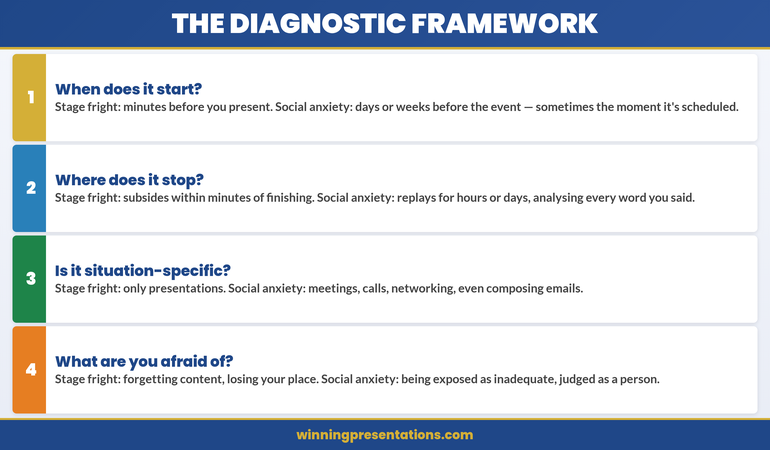
Four-step diagnostic framework infographic with questions to identify whether you have stage fright or social anxiety: when does it start, where does it stop, is it situation-specific, what are you afraid of

The Right Diagnosis Changes Everything

You can’t fix the wrong problem with the right techniques. Thousands of executives have spent years in generic confidence-building programmes, toastmasters clubs, and presentation-skills courses without lasting improvement. Why? Because they were never addressing the root nervous system pattern driving their anxiety. Conquer Speaking Fear uses clinical hypnotherapy and nervous system science—not presentation tips—to rewire how your body responds to high-stakes social situations. Different tools for stage fright. Different tools for social anxiety. Same outcome: calm, confident performance.

  • 30-day programme using clinical hypnotherapy techniques
  • Nervous system regulation specific to your anxiety pattern
  • Built for high-stakes executives and funding-round presentations

Get Conquer Speaking Fear → £39
Used by executives preparing for board presentations, funding pitches, and high-stakes approvals.

The Identity Loop: Why Social Anxiety Feels Inescapable

When an executive has social anxiety, they often don’t realise it—they think everyone experiences what they’re experiencing. In reality, their nervous system is caught in a loop where social situations activate the same threat response as physical danger. This creates a predictable pattern:

  1. Before a social/performance situation: Anticipatory anxiety (hours or days ahead)
  2. During: Heightened vigilance for signs of negative judgment
  3. After: Rumination and replaying of the interaction, looking for evidence they were judged poorly
  4. Conclusion: Self-blame and withdrawal, which temporarily reduces anxiety but reinforces the belief that judgment is dangerous
  5. Next situation: Baseline anxiety increases because avoidance has “confirmed” that the threat is real

This loop is why social anxiety often looks like a character flaw from the inside. It feels like you’re not confident enough, not prepared enough, not smart enough. It’s actually a nervous system pattern that’s running automatically, outside your conscious control. The more you try to think your way out of it, the worse it gets.

Stage fright doesn’t have this loop. You’re nervous in the moment. You perform. The anxiety stops. You don’t ruminate about it for days because your nervous system recognises the threat has passed. You might think about ways to improve your performance next time, but you’re not questioning your worth or competence based on the audience’s reaction.

Ready to break your pattern, whichever one it is?

Get Conquer Speaking Fear → £39

What Actually Changes in Recovery

For stage fright, what changes is your body’s response in the moment. Your heart rate might still rise—that’s fine. But you’re able to stay present, think clearly, and access your expertise despite the activation. You’re not fighting the anxiety. You’re regulating it enough to function at your best.

For social anxiety, what changes is the belief underneath the anxiety. You begin to understand that judgment is inevitable, survivable, and not a referendum on your worth. You build evidence that contradicts your anxiety narrative. You develop tolerance for being evaluated without needing to control the outcome or escape the situation. The nervous system follows the mind when the mind stops fighting the reality of social evaluation.

Both paths require specific techniques tied to your actual problem. Both lead to executives who can present to board rooms, lead all-hands meetings, and navigate high-stakes funding conversations without the anxiety controlling their performance.

Three Quick Questions to Clarify Your Pattern

  1. Do you feel anxious only in performance moments, or do you feel anxious about social evaluation in general? (Stage fright vs. social anxiety)
  2. Does your anxiety end when the presentation ends, or does it continue in rumination afterwards? (Stage fright vs. social anxiety)
  3. Are you avoiding presentations specifically, or are you withdrawing from social situations broadly? (Stage fright vs. social anxiety)

If your answers cluster toward performance-specific, moment-based anxiety, you likely have stage fright. If they cluster toward evaluation-based, pervasive anxiety, you likely have social anxiety. Many executives experience both, but one is usually dominant and driving the avoidance pattern.

Your Nervous System Doesn’t Care About Presentation Technique

Neither does recovery. The Conquer Speaking Fear programme bypasses the thinking mind and works directly with your nervous system using clinical hypnotherapy. You’ll learn the exact regulation techniques used by executives preparing for board presentations, funding rounds, and high-stakes approvals. Not generic confidence tips. Specific nervous system science. Different approach for different anxiety patterns. Same result.

  • Clinical hypnotherapy-based nervous system training
  • 30-day structured programme
  • Built for executives in high-stakes environments

Get Conquer Speaking Fear → £39
Thousands of executives have replaced anxiety with calm focus using these techniques.

The Real Cost of Misdiagnosis

An executive with social anxiety who spends a year perfecting their presentation skills without addressing the underlying belief about judgment will still feel like a fraud. An executive with stage fright who spends time in therapy exploring their childhood attachment style might feel better understood but no less anxious in the boardroom. The mismatch between the problem and the solution is why so many executives feel stuck after months or years of trying to fix themselves.

The diagnostic clarity matters more than you think. It’s not just about naming your problem correctly — it’s about directing your energy toward the actual fix. Your time is valuable. Your attention is limited. Applying the right solution to the right problem is how you move from stuck to free in weeks instead of years. Conquer Speaking Fear (£39) addresses both patterns with clinical hypnotherapy techniques matched to your specific nervous system response.

People Also Ask: Is stage fright the same as performance anxiety?

Stage fright is a form of performance anxiety, but they’re not identical. Performance anxiety is the broader category — it can apply to athletes, musicians, test-takers, and presenters. Stage fright is specifically the anxiety response triggered by presenting or speaking in front of an audience. The distinction matters because performance anxiety in other domains (sports, music) has different recovery paths than presentation-specific stage fright, which is tied to social evaluation in professional contexts.

People Also Ask: Can social anxiety develop later in life?

Yes. Many executives develop social anxiety in their 30s or 40s, often triggered by a promotion, a public failure, or increased visibility. The pattern can appear suddenly — you were fine presenting for years, and then a single bad experience rewired your threat response. This late-onset pattern is common in high-achieving professionals because their careers have placed them in increasingly high-stakes social situations. The nervous system reaches a tipping point.

People Also Ask: Should I see a therapist or use a self-guided programme?

It depends on severity. If your anxiety is significantly impairing your work (you’re avoiding meetings, turning down promotions, or experiencing physical symptoms daily), start with a qualified professional. If your anxiety is present but manageable — you can still present but it’s painful, or you ruminate after but can function — a structured programme like Conquer Speaking Fear can provide the specific nervous system techniques you need without the time commitment of weekly therapy.

Frequently Asked Questions

Can I have both stage fright and social anxiety at the same time?

Yes. Many executives have both. However, one is usually dominant and drives the avoidance pattern. Your recovery strategy should target the dominant pattern first. Often, when you address the dominant pattern with the right nervous system techniques, the secondary pattern naturally improves because you’ve rebuilt your confidence in social situations more broadly.

If I have stage fright, will breathing exercises actually help?

Breathing exercises help if they’re taught correctly and practised in advance. Most people learn a breathing technique once and then try to use it in a high-stress moment for the first time—which doesn’t work because your nervous system doesn’t recognise it as a safety signal. The techniques in Conquer Speaking Fear are designed to build nervous system recognition through repetition so they work when you need them.

How long does recovery actually take?

For stage fright, noticeable improvements often emerge within 2-3 weeks with consistent nervous system regulation practice. For social anxiety, the initial shift happens around the 3-week mark, with deeper integration and belief change building over 6-8 weeks. The Conquer Speaking Fear programme is structured as a 30-day intensive, which aligns with how nervous systems actually rewire.

Will I ever feel completely calm before a high-stakes presentation?

Possibly, but that’s not the goal. The goal is calm focus—where your nervous system is activated enough to perform at your best, but not so dysregulated that anxiety is controlling the experience. Most executives report that they still feel some activation before high-stakes situations, but it feels like energy rather than fear. The activation is working for them instead of against them.

Want the slides too?

Preparation reduces anxiety. The Executive Slide System (£39) includes confident-presenter templates designed to minimise preparation stress.

Stop Fighting the Wrong Problem

You’ve identified it. Now fix it. Conquer Speaking Fear uses clinical hypnotherapy and nervous system science to address the actual root of your anxiety—not generic confidence-building tips. Whether your issue is situational stage fright or pervasive social anxiety, this programme provides the specific framework and techniques for your pattern. Built for executives. Proven across thousands of high-stakes presentations.

  • Correct diagnosis leads to correct recovery path
  • 30-day programme with clinical hypnotherapy techniques
  • Nervous system regulation that actually works in real moments

Get Conquer Speaking Fear → £39
From board presentations to funding rounds: thousands of executives trust this approach.

Is This Right For You?

Conquer Speaking Fear is designed for executives who’ve tried the standard solutions—presentation skills courses, toastmasters, confidence-building workshops—and found that the anxiety either didn’t shift or came roaring back the moment stakes got real. It’s for anyone who recognises that their problem isn’t technique. It’s nervous system regulation and belief change. It’s for professionals in high-stakes environments: funding pitches, board presentations, all-hands meetings, investor calls, quarterly reviews where you’re being evaluated.

If your anxiety has started limiting your career opportunities, if you’re withdrawing from visibility, or if you’re spending hours ruminating after presentations, this programme will be valuable. The clinical hypnotherapy component accesses the parts of your nervous system that presentation skills training never touches.

Free resource: Download the Executive Presentation Checklist — a free PDF guide to preparing high-stakes presentations without the anxiety spiral.

About the Author

Mary Beth Hazeldine is the Owner & Managing Director of Winning Presentations. With 24 years of corporate banking experience at JPMorgan Chase, PwC, Royal Bank of Scotland, and Commerzbank, she has delivered high-stakes presentations in boardrooms across three continents.

A qualified clinical hypnotherapist and NLP practitioner, Mary Beth combines executive communication expertise with evidence-based techniques for managing presentation anxiety. She has trained thousands of executives and supported high-stakes funding rounds and approvals.

Book a discovery call | View services

12 Feb 2026
Professional reflecting on past presentation experience with contemplative expression

Presentation PTSD Is Real: Signs You’re Still Carrying an Old Failure

It was seven years ago. I still remember exactly what I was wearing.

The room had 40 people. I was presenting quarterly results to the leadership team. Slide 12 — a chart I’d built myself — had an error. The CFO spotted it immediately. “These numbers don’t add up,” he said. Not quietly. Not kindly.

For the next three minutes, I stood there while he picked apart my work in front of everyone. My face burned. My voice disappeared. I wanted the floor to open and swallow me whole.

That presentation ended my confidence for years. Every time I stood up to speak after that, I wasn’t in the current room — I was back in that room, waiting for someone to find the error, waiting for the humiliation to start again.

If you’ve had a presentation experience that still affects how you feel about speaking — even years later — you’re not being dramatic. Your nervous system is doing exactly what it’s designed to do. It’s trying to protect you from a threat it still believes is real.

I’m writing about this now because presentation anxiety is increasingly recognised as a genuine psychological response, not a character flaw. Recent understanding of how trauma affects the nervous system explains why “just get over it” doesn’t work — and what actually does.

Quick answer: Presentation trauma occurs when a difficult speaking experience becomes encoded in your nervous system as a threat. Signs include physical reactions (racing heart, sweating, nausea) that seem disproportionate to the current situation, avoidance behaviours, intrusive memories of past failures, and anticipatory anxiety that starts days before a presentation. Recovery involves recognising the pattern, working with your nervous system rather than against it, and gradually rebuilding positive associations with speaking. Some people notice shifts relatively quickly; deeper patterns can take longer. The key is that recovery is possible — your nervous system learned this response, and it can learn something new.

⏰ Presenting in the next 48 hours?

Three things to do right now to calm your nervous system:

  1. Tonight: Use a guided nervous system reset before bed (18–20 min)
  2. Tomorrow morning: Avoid caffeine; do 5 minutes of slow breathing
  3. Minutes before: Use a 90-second physical reset in the corridor

If you’d rather work from a structured system, the Conquer Speaking Fear programme includes guided audio for each of those three moments.

Note: This article discusses presentation-related anxiety and trauma responses. While these experiences are common and the techniques here help many people, persistent or severe symptoms may benefit from support with a qualified mental health professional. The term “PTSD” is used colloquially here to describe trauma-like responses to presentation experiences — clinical PTSD is a specific diagnosis that requires professional assessment.

As a certified hypnotherapist who now works with executives on presentation anxiety, I’ve heard hundreds of these stories. The details differ — a forgotten line, a hostile question, a technology failure, a panic attack — but the pattern is remarkably consistent.

Something happened. It felt terrible. And now, years later, it still controls how you feel about presenting.

The good news: this isn’t permanent. Your nervous system learned this fear response, and it can unlearn it. But first, you need to understand what’s actually happening.

Signs You’re Carrying Presentation Trauma

Presentation trauma doesn’t always announce itself obviously. Sometimes it shows up as “I just don’t like presenting” or “I’m not a natural speaker.” But there are specific signs that suggest you’re carrying something from the past:

1. Your Body Reacts Before Your Mind Does

You get an email about an upcoming presentation. Before you’ve even processed what it says, your heart rate increases. Your stomach tightens. Your palms get clammy.

This instant physical response — before conscious thought — is a hallmark of trauma. Your nervous system has flagged “presentation” as a threat and is activating your fight-or-flight response automatically.

2. The Fear Seems Disproportionate

You’re presenting to three friendly colleagues about a topic you know well. Objectively, the stakes are low. But your body is reacting like you’re about to face a firing squad.

When the fear response doesn’t match the actual situation, it’s often because your nervous system is responding to a past threat, not the current one.

3. You Have Intrusive Memories

When you think about presenting, your mind automatically goes to that time it went wrong. You can see it clearly — the faces, the room, the moment everything fell apart. These memories arrive unbidden and feel uncomfortably vivid.

4. You Avoid at All Costs

You’ve turned down opportunities, delegated important moments to others, or restructured your career to minimise presenting. The avoidance has become a pattern that shapes your professional life.

5. Anticipatory Anxiety Starts Days (or Weeks) Early

A presentation is scheduled for next Thursday. By Sunday, you’re already feeling anxious. By Wednesday night, you can’t sleep. The dread builds exponentially as the date approaches.

6. You Experience Shame, Not Just Fear

There’s a difference between “I’m afraid of presenting” and “I’m ashamed of how I present.” Trauma often carries shame — a feeling that you are fundamentally flawed, not just that the situation is scary.

🎯 Release Presentation Trauma With Guided Nervous System Work

Conquer Speaking Fear — £39, instant access — uses hypnotherapy and NLP techniques specifically designed to work with your nervous system, not against it. The programme includes three audio tools for different moments:

  • Full Guided Session (18-20 min): Deep nervous system reprogramming — use the night before
  • 90-Second Reset Audio: Quick calm-down for the corridor or bathroom — minutes before
  • Printable Pocket Card: 4-step physical reset — in the moment when you need it

Get Conquer Speaking Fear → £39

Instant download. Created by a certified hypnotherapist who spent five years terrified of presenting — and found a way out.

Why Your Nervous System Won’t “Just Let It Go”

If you’ve ever been told to “just relax” or “it’s not a big deal,” you know how unhelpful that advice is. Here’s why your nervous system doesn’t respond to logic:

The Amygdala Doesn’t Have a Calendar

Your amygdala — the brain’s threat-detection centre — processes experiences without timestamps. A humiliating presentation from 2018 feels just as threatening as one happening right now, because to your amygdala, there’s no difference between “this happened” and “this is happening.”

Emotional Memories Are Stored Differently

Traumatic experiences aren’t filed away like regular memories. They’re stored in a fragmented, sensory way — which is why a particular room layout, a certain type of projector, or even a specific smell can trigger the whole response pattern.

Your Body Keeps the Score

The fear isn’t just in your mind — it’s encoded in your body. Your posture, your breathing pattern, your muscle tension all hold the memory. This is why cognitive approaches (“think positive thoughts”) often fail. The body remembers what the mind tries to forget.

Avoidance Reinforces the Fear

Every time you avoid presenting, your nervous system gets confirmation: “See? That was dangerous. Good thing we escaped.” The avoidance provides temporary relief but strengthens the fear response long-term.

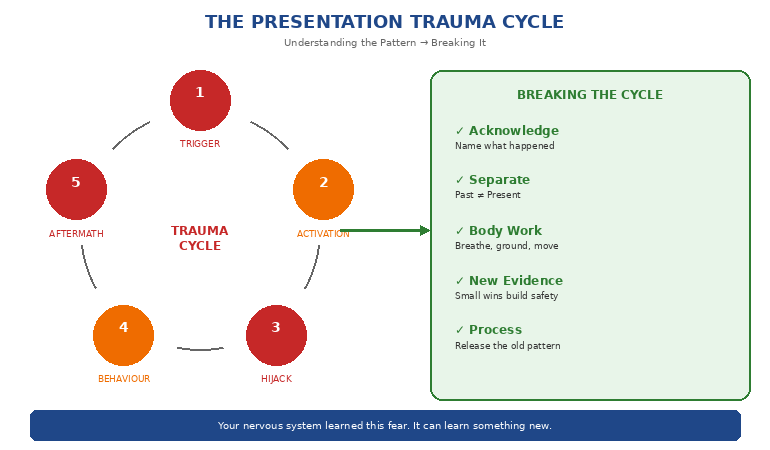
The Trauma Response Cycle

Understanding the cycle helps you interrupt it:

Stage 1: Trigger
Something reminds your nervous system of the original threat — a calendar invite, a request to present, even someone mentioning “presentation” in conversation.

Stage 2: Activation
Your fight-or-flight system activates. Heart rate increases, stress hormones release, blood flows away from your prefrontal cortex (thinking brain) toward your survival systems.

Stage 3: Hijack
Your rational mind goes offline. You can’t think clearly, can’t access your preparation, can’t remember that you’re actually safe. The past has hijacked the present.

Stage 4: Behaviour
You either fight (get defensive, speak too fast, overcompensate), flight (avoid, delegate, call in sick), or freeze (mind goes blank, voice disappears, body locks up).

Stage 5: Aftermath
Regardless of how the presentation actually went, you feel depleted, ashamed, and more convinced than ever that presenting is dangerous. The cycle reinforces itself.


Presentation trauma cycle showing trigger, response, and recovery pathway

Breaking the cycle means working with your body, not just your mind — the Conquer Speaking Fear programme (£39) is built around that principle, with guided audio that interrupts this exact pattern.

How to Release the Pattern

Recovery from presentation trauma isn’t about forcing yourself to present more (exposure therapy without proper support often makes things worse). It’s about working with your nervous system to create new associations.

Step 1: Acknowledge What Happened

Stop minimising. “It wasn’t that bad” or “I should be over it by now” keeps you stuck. Something happened that affected you. That’s real. Your response makes sense given what you experienced.

I spent years pretending my CFO moment didn’t bother me. Recovery only started when I admitted: that was humiliating, it hurt, and it changed how I felt about presenting.

Step 2: Separate Past from Present

When you notice the fear response activating, practice naming it: “This is my nervous system responding to 2018, not to today.” You’re not trying to make the feeling go away — you’re creating space between the trigger and your response.

Step 3: Work With Your Body

Because the trauma is stored in your body, body-based techniques are often more effective than cognitive ones:

  • Slow exhales: Longer exhales than inhales can help activate your parasympathetic nervous system
  • Grounding: Feel your feet on the floor, your weight in the chair — anchor yourself in the present moment
  • Movement: Shake out your hands, roll your shoulders — discharge the physical activation
  • Posture reset: Stand tall, open your chest — your body’s position affects your emotional state

Step 4: Create New Experiences

Your nervous system needs evidence that presenting can be safe. This doesn’t mean forcing yourself into high-stakes situations. It means starting small:

  • Speaking up in a meeting with one comment
  • Presenting to one trusted colleague
  • Recording yourself and watching without judgment
  • Gradually increasing the challenge as your nervous system adapts

Step 5: Process the Original Experience

Sometimes the old memory needs direct attention. Techniques like guided visualisation, timeline therapy, or working with a therapist can help you process what happened so it no longer controls your present.

This is where hypnotherapy-based approaches can be particularly effective — they work directly with the subconscious patterns that keep the trauma response active.

🧠 Nervous System Reprogramming for Presentation Trauma

Conquer Speaking Fear (£39, instant access) was created specifically for professionals carrying presentation trauma. The guided hypnotherapy session helps your nervous system release the old pattern and build new, calmer associations with speaking.

  • Work with your subconscious, not against it
  • Release the physical holding patterns
  • Build genuine confidence (not just “fake it”)
  • Three audio formats for different situations

Get Conquer Speaking Fear → £39

Instant download. Developed from hypnotherapy techniques that helped me release my own presentation trauma after five years of suffering.

Rebuilding Confidence After a Bad Experience

Once you’ve started releasing the trauma pattern, you can begin rebuilding genuine confidence:

Reframe the Original Story

The story you tell yourself about what happened matters. “I failed and everyone saw” is different from “I had a difficult experience and I survived it.”

My CFO story? I eventually reframed it: “I made an error, someone called it out publicly, and I handled a difficult moment without falling apart completely. I went back to work the next day. I kept presenting. I survived.”

Collect Counter-Evidence

Your brain has been selectively remembering the bad experience. Start noticing the neutral and positive ones. After each presentation — even a small one — note what went okay. Build a file of evidence that presenting doesn’t always mean disaster.

Prepare Differently

Trauma often creates over-preparation (spending 20 hours on a 10-minute presentation) or under-preparation (avoiding thinking about it until the last minute). Neither works.

Effective preparation for trauma recovery means: know your content well enough to feel secure, but accept that perfection isn’t the goal. Your safety doesn’t depend on getting everything right.

Build Physical Anchors

Create associations between specific physical actions and calm states. When you’re relaxed, practice a subtle gesture (touching your thumb to your finger, for example). Over time, this gesture can help trigger the calm state — giving you a tool you can use in the moment.

This anchoring technique is part of what makes nervous system-based approaches so effective for presentation anxiety.

What Recovery Actually Looks Like

Recovery from presentation trauma isn’t linear, and it doesn’t mean you’ll never feel nervous again. Here’s what realistic progress looks like:

Week 1-2: You start noticing the pattern — recognising when your nervous system is responding to the past rather than the present.

Week 3-4: The anticipatory anxiety begins to shorten. Instead of dreading a presentation for two weeks, you might dread it for a few days.

Month 2-3: You have a presentation that goes “okay” and notice it. The negative bias starts shifting.

Month 3-6: The physical symptoms become less intense. Your heart still races, but it doesn’t feel life-threatening. You can think while nervous.

Ongoing: Presenting becomes uncomfortable rather than terrifying. You can do it without it ruining your week. Eventually, some presentations feel almost… fine.

This timeline varies. Some people see significant shifts in weeks; others take longer. The key is that progress is possible — your nervous system can learn new patterns.

🎓 25 Years Coaching Senior Professionals Through Speaking Fear

Conquer Your Fear of Public Speaking is built from 16 years coaching senior professionals across financial services, consulting, healthcare, and technology — alongside 25 years of corporate banking experience. Every technique — the nervous system regulation work, the trauma-informed preparation rituals, the in-the-moment recovery scripts — comes from real client work with executives who came to speaking with histories that needed careful, not generic, approaches.

Designed for senior professionals whose speaking fear has roots in past experience, not just nerves — and who need approaches that respect that history.

Get Conquer Your Fear of Public Speaking → £39

Instant download — lifetime access to every framework and technique.

Frequently Asked Questions

Is “presentation PTSD” a real diagnosis?

The term is used colloquially to describe trauma-like responses to presentation experiences. Clinical PTSD is a specific diagnosis with defined criteria that requires professional assessment. However, the nervous system responses described in this article — hypervigilance, avoidance, intrusive memories, disproportionate fear responses — are real and well-documented, even if they don’t meet the clinical threshold for PTSD. Your experience is valid regardless of diagnostic labels.

How long does it take to recover from presentation trauma?

This varies significantly based on the severity of the original experience, how long ago it happened, and what support you have. Some people notice shifts within a few weeks; deeper patterns may take several months of consistent work. There’s no universal timeline — everyone’s nervous system responds differently. If you’re not seeing progress after sustained effort, consider working with a therapist who specialises in anxiety or trauma responses. The key is that recovery is possible — your nervous system learned this response, and it can learn a new one.

Should I force myself to present more to get over it?

Exposure without proper support can actually reinforce the trauma. Simply forcing yourself through more presentations while activated often strengthens the fear response. The goal is to present while regulated — which requires first developing tools to work with your nervous system. Gradual, supported exposure works; white-knuckling through high-stakes presentations usually doesn’t.

Can I fully recover, or will I always be anxious about presenting?

Most people don’t become completely anxiety-free — some presentation nerves are normal and even useful. What changes is the intensity and the control. Instead of anxiety hijacking your ability to think and speak, it becomes manageable background noise. Many people who’ve done this work eventually describe presenting as “uncomfortable but doable” rather than “terrifying and avoided at all costs.”

📬 PS: Weekly techniques for managing presentation anxiety and building genuine confidence. Subscribe to The Winning Edge — practical strategies from a hypnotherapist who’s been there.

Related: If presentation trauma is holding you back from career moments like requesting resources or budget, read The Headcount Request That Got Yes When Everyone Said No for a presentation structure that builds confidence through preparation.

That presentation from years ago — the one you still think about — doesn’t have to control your future.

Your nervous system is doing what it was designed to do: protect you from perceived threats. But the threat isn’t real anymore. The room is different. The audience is different. You are different.

Recovery is possible. Your nervous system learned to fear presenting, and it can learn something new.

It starts with acknowledging what happened, understanding why your body responds the way it does, and working with your nervous system rather than against it.

The past doesn’t have to own your present. You can let it go.

About the Author

Mary Beth Hazeldine is the Owner & Managing Director of Winning Presentations. With 25 years in corporate banking at JPMorgan Chase, PwC, Royal Bank of Scotland, and Commerzbank, she experienced presentation trauma firsthand — including five years of debilitating fear before finding techniques that actually worked.

Now a certified hypnotherapist and NLP practitioner, Mary Beth specialises in helping professionals release presentation anxiety at the nervous system level. She combines executive communication expertise with evidence-based approaches to fear and trauma recovery.

Book a discovery call | View services

10 Feb 2026
Professional taking a calming breath before high-stakes presentation, moment of composure

The Fight or Flight Hack I Learned From Hypnotherapy (It Works in 90 Seconds)

My heart was pounding so hard I could hear it in my ears.

I was standing outside a boardroom at JPMorgan, about to present a restructuring proposal to twelve senior executives. I’d done this a hundred times. I knew the content cold. But my body didn’t care about my experience. It had decided I was about to be eaten by a predator.

My hands were shaking. My mouth was dry. My brain was screaming at me to run — literally run — out of the building and never come back.

That was the day I realised something had to change. Not my preparation. Not my slides. Not my “mindset.” Something deeper. Something neurological.

I spent the next three years training as a clinical hypnotherapist, specifically to understand why intelligent, experienced professionals lose control of their bodies before presentations — and what actually works to stop it.

Here’s what I learned.

Quick answer: Presentation panic is an amygdala hijack — your brain’s threat detection system firing when there’s no actual threat. You can’t think your way out of it because the amygdala bypasses your rational brain. But you can interrupt it with a 90-second nervous system reset: ground your feet, slow your exhale, activate a physical anchor, and engage your peripheral vision. This shifts you from sympathetic (fight/flight) to parasympathetic (calm/focused) dominance before you enter the room.

For five years, I had a secret. I was a senior banking executive who delivered high-stakes presentations regularly — and I was terrified every single time.

Not nervous. Not “a bit anxious.” Terrified. The kind of fear where your vision narrows, your thoughts scatter, and your body feels like it belongs to someone else.

I tried everything the corporate world suggests: more preparation, more practice, more positive thinking. I visualised success. I told myself I was “excited, not nervous.” I did power poses in the bathroom.

None of it worked. Because none of it addressed the actual problem.

The problem wasn’t psychological. It was physiological. My nervous system was hijacking my body, and no amount of positive thinking could override 200,000 years of human evolution.

When I trained as a hypnotherapist, I finally understood why — and more importantly, what to do about it. (If you want the full story of how I overcame my fear of public speaking, I’ve written about that separately.)

Why Your Body Betrays You (The Neuroscience)

Here’s what’s actually happening when you feel presentation panic:

Your amygdala — the brain’s threat detection centre — has identified a potential danger: you’re about to be evaluated by a group of people. For our ancestors, group rejection meant death. Being cast out of the tribe was a survival threat.

Your amygdala doesn’t know the difference between a boardroom and a savannah. It just knows: evaluation by group = potential rejection = danger.

So it does what it’s designed to do: trigger the sympathetic nervous system. Flood your body with adrenaline and cortisol. Prepare you to fight or run.

This is the amygdala hijack. And here’s the crucial part: it happens before your rational brain gets involved.

The threat signal reaches your amygdala faster than it reaches your prefrontal cortex — the thinking brain. By the time you’re consciously aware of the fear, your body is already in full fight-or-flight mode. (This “low road” threat response was first described by neuroscientist Joseph LeDoux in his research on fear processing.)

This is why you can’t think your way out of it. By the time you’re thinking, the hijack has already happened.

You need to interrupt the nervous system directly.

The 90-Second Nervous System Reset

This technique works because it targets the vagus nerve — the main communication line between your body and your parasympathetic nervous system (the “rest and digest” system that calms you down).

Do this 2-3 minutes before you need to present:

Step 1: Ground (15 seconds)

Stand with both feet flat on the floor, hip-width apart. Press your feet down firmly — feel the floor pushing back up against you.

This isn’t metaphorical “grounding.” It’s neurological. Pressure receptors in your feet send signals to your brain that say “stable, safe, solid ground.” This interrupts the “run away” signal.

Mentally scan from the soles of your feet up through your ankles. Notice the connection to the earth. Your body is supported.

Step 2: Breathe (30 seconds)

Here’s the key most people get wrong: it’s not about breathing deeply. It’s about breathing out slowly.

Your exhale activates the parasympathetic nervous system. Your inhale activates the sympathetic (stress) system. Most anxious breathing is short inhale, short exhale — which keeps you stuck in stress mode.

The 4-7-8 pattern:

  • Inhale through your nose for 4 counts
  • Hold for 7 counts
  • Exhale slowly through your mouth for 8 counts

The extended exhale is what shifts your nervous system. Do this 3-4 times.

⚡ Presenting in the next 24 hours? Do this now (2 minutes):

  • Run the 90-second reset once (Ground → Breathe → Anchor → Peripheral)
  • Write the first sentence you’ll say when you start — just 9 words
  • Fire your anchor the moment you stand up tomorrow

If you want the guided audio version + the full calm protocol for tonight and tomorrow morning:

🎧 Emergency Relief: Guided Audio You Can Use Tonight

Conquer Speaking Fear includes a guided audio walkthrough of the 90-second reset — so you can practise with my voice in your ears instead of trying to remember each step. Use it tonight, use it tomorrow morning, use it 5 minutes before you present.

Get Conquer Speaking Fear → £39

Instant download. 30-day money-back guarantee. Printable protocol card included.

Step 3: Anchor (30 seconds)

This is the technique that changed everything for me. It’s called “anchoring” in NLP, and it gives you a physical switch to access calm on demand.

While you’re in that calm state from the breathing:

  • Press your thumb and middle finger together firmly
  • Hold for 10 seconds
  • Associate this pressure with the feeling of calm

The more you practise this (outside of stressful situations), the stronger the anchor becomes. Eventually, pressing those fingers together triggers the calm state automatically.

I’ve used this anchor in boardrooms, on stages, in TV interviews. It works because you’re not trying to create calm in the moment — you’re accessing calm you’ve already stored.

Step 4: Engage Peripheral Vision (15 seconds)

When we’re anxious, our vision narrows — literally. This is called “tunnel vision” and it’s part of the fight-or-flight response. Your brain focuses on the threat and ignores everything else.

You can reverse this deliberately:

  • Pick a spot on the wall in front of you
  • While keeping your eyes on that spot, expand your awareness to include what’s in your peripheral vision
  • Notice objects on the far left and far right without moving your eyes

This simple technique shifts your brain from “focused threat detection” to “relaxed awareness.” It’s impossible to maintain full fight-or-flight while in peripheral vision mode.

The Conquer Speaking Fear programme includes guided audio for each step of this protocol, plus advanced techniques for building permanent calm anchors.

90-second nervous system reset technique showing 4 steps: Ground, Breathe, Anchor, Engage

Why “Just Breathe” Doesn’t Work Alone

You’ve probably been told to “just breathe” before presentations. And you’ve probably found it doesn’t help much.

Here’s why: breathing alone, without the other elements, often makes anxiety worse.

When you focus intensely on your breathing while anxious, you’re focusing on a body that feels out of control. You notice how fast your heart is beating. You notice how shallow your breath is. You notice how uncomfortable you feel.

This increases anxiety, not decreases it.

The 90-second reset works because it combines multiple interventions:

  • Grounding interrupts the “run” signal
  • Extended exhale activates the parasympathetic system
  • Anchoring accesses pre-stored calm
  • Peripheral vision shifts brain state

Each element alone has some effect. Together, they’re transformative.

Physical Anchors: The Technique Nobody Teaches

Anchoring is the most powerful technique I learned in hypnotherapy training, and it’s almost never taught in corporate presentation skills courses.

The concept is simple: your brain naturally associates physical sensations with emotional states. Think of a song that instantly transports you to a specific memory and feeling. That’s an anchor — the song triggers the emotional state.

You can create these deliberately.

How to Install a Calm Anchor

Step 1: Create a genuine calm state

Do this when you’re actually relaxed — after a bath, during meditation, while listening to calming music. Don’t try to do it when you’re already anxious.

Step 2: Intensify the calm

Once you feel relaxed, focus on the feeling. Notice where you feel it in your body. Make it stronger in your imagination. Give it a colour if that helps.

Step 3: Set the anchor

At the peak of the calm feeling, press your thumb and middle finger together (or any unique physical gesture you can do discreetly). Hold for 10-15 seconds while maintaining the calm feeling.

Step 4: Release and repeat

Release the fingers, break the state (stand up, shake it off), then repeat 3-5 times in the same session.

Step 5: Test and strengthen

Later, in a neutral state, fire the anchor (press the fingers). Notice if you feel a shift toward calm. The more you repeat steps 1-4 over days and weeks, the stronger the anchor becomes.

This isn’t magic. It’s classical conditioning — the same mechanism Pavlov discovered with his dogs. You’re conditioning your nervous system to produce calm on demand.

🎯 Build a Permanent Calm Switch

The anchor installation protocol in Conquer Speaking Fear goes deeper than what I can cover here — including how to “stack” multiple calm memories into one anchor, how to test anchor strength, and how to rebuild an anchor if it weakens over time. This is the skill that transforms occasional relief into permanent confidence.

Get Conquer Speaking Fear → £39

Includes guided audio for anchor installation + stacking technique.

Before, During, and After: A Complete Protocol

The 90-second reset is for immediate pre-presentation use. But if you’re dealing with significant presentation anxiety, you need a complete protocol.

The Night Before

Do NOT review your slides obsessively. This increases anxiety by keeping the presentation front-of-mind.

Instead:

  • Do one final review in the early evening, then stop
  • Spend 10 minutes with your calm anchor (install or strengthen it)
  • Avoid alcohol (it disrupts sleep and increases next-day anxiety)
  • Go to bed at your normal time

The Morning Of

Your nervous system is most suggestible in the first 20 minutes after waking.

  • Don’t check email or news immediately — this triggers stress hormones
  • Do 5 minutes of the breathing protocol while still in bed
  • Visualise yourself calm and in control (not the presentation content — just the feeling of confidence)
  • Move your body — even a 10-minute walk shifts your nervous system state

The full morning protocol in Conquer Speaking Fear includes a specific sequence designed to set your nervous system baseline before high-stakes days.

2-3 Minutes Before

This is when you use the 90-second reset: Ground → Breathe → Anchor → Peripheral Vision.

Do this in a private space if possible — a bathroom, an empty corridor, even a stairwell. You need 90 seconds where no one will interrupt you. (For more techniques to calm your nerves before a presentation, see my dedicated guide.)

During the Presentation

If you feel anxiety rising mid-presentation:

  • Fire your anchor discreetly (press thumb and finger under the table or behind your back)
  • Slow your speaking pace deliberately — anxiety makes us rush
  • Engage peripheral vision while speaking — it’s easier than you think
  • Ground through your feet if you’re standing

Nobody will notice you doing these things. They’re invisible interventions.

After

Your nervous system doesn’t know the “threat” is over just because the presentation ended. You may feel residual anxiety for hours.

  • Don’t immediately debrief or replay what happened
  • Take 5 minutes for physical movement — walk around, stretch
  • Do 3-4 extended exhales to signal safety to your nervous system
  • Later that day, acknowledge what went well (your brain needs positive data to update its threat assessment)

What Changed for Me

That day at JPMorgan, standing outside the boardroom with my heart pounding, I didn’t have these techniques. I went in anxious, stayed anxious throughout, and delivered a presentation that was technically acceptable but emotionally flat.

Now, fifteen years and hundreds of presentations later, I still get the initial spike of adrenaline. That’s normal — it’s your body preparing for a performance. The difference is I know exactly how to channel it.

The 90-second reset isn’t about eliminating all nervousness. It’s about moving from panic (sympathetic dominance) to focused energy (balanced nervous system). The goal isn’t to feel nothing. It’s to feel ready.

You can learn to do this too. Your nervous system isn’t broken — it’s just running outdated threat detection software. You can update it.

🧠 The Complete Nervous System Control System

Everything in Conquer Speaking Fear:

  • The 90-second reset (guided audio + printable card)
  • Anchor installation protocol with memory stacking
  • Night-before and morning-of routines
  • Mid-presentation recovery techniques
  • Post-presentation nervous system reset

Get Conquer Speaking Fear → £39

Instant download. 30-day money-back guarantee. Used by hundreds of executives.

For physical symptoms specifically (shaking hands, racing heart, sweating): Calm Under Pressure (£19.99) provides targeted techniques for the body-level symptoms of presentation anxiety.

Frequently Asked Questions

How long does it take for anchoring to work?

Most people notice some effect after 3-5 installation sessions spread over a week or two. The anchor strengthens with repetition — the more you install it during genuinely calm states, the more reliable it becomes. Some of my clients have anchors they’ve been using for years that fire instantly.

What if I don’t have 90 seconds before the presentation?

If you only have 30 seconds, prioritise the extended exhale (3-4 breaths with long exhale) and fire your anchor. These two elements give you the most nervous system shift in the least time. Even one proper exhale helps.

Can this work for people with severe presentation anxiety?

Yes, but severe anxiety may need additional support. These techniques are the foundation I use with all my clients, including those with diagnosed anxiety disorders. For severe cases, I recommend combining these techniques with professional support from a therapist who understands performance anxiety specifically.

Note: These techniques are performance tools, not medical treatment. If you experience panic attacks, severe anxiety symptoms, or symptoms that significantly impact your daily life, please consult a qualified healthcare professional alongside using performance techniques.

Why does peripheral vision help with anxiety?

Tunnel vision is part of the fight-or-flight response — your brain narrows focus to the perceived threat. By deliberately engaging peripheral vision, you signal to your brain that you’re not in immediate danger (you wouldn’t be scanning the horizon if a predator were attacking). This shifts you out of the high-alert stress state.

📬 The Winning Edge Newsletter

Weekly techniques for presentation confidence and executive communication. Evidence-based strategies from a clinical hypnotherapist who’s been in the boardroom.

Subscribe free →

Related: Once your nervous system is under control, you need a presentation that’s worth delivering. Read The M&A Integration Update That Stops Panic for a framework that keeps 500 people calm when the stakes are high.

Your body’s fear response isn’t your enemy. It’s an ancient protection system that kept your ancestors alive. The problem is it can’t distinguish between a sabre-toothed tiger and a quarterly business review.

You don’t need to eliminate fear. You need to regulate it. Ground your feet. Extend your exhale. Fire your anchor. Engage your peripheral vision.

Ninety seconds. That’s all it takes to shift from panic to ready.

About the Author

Mary Beth Hazeldine is the Owner & Managing Director of Winning Presentations. A qualified clinical hypnotherapist and NLP practitioner, she spent 24 years in corporate banking at JPMorgan Chase, PwC, Royal Bank of Scotland, and Commerzbank before specialising in presentation anxiety.

Mary Beth combines evidence-based nervous system techniques with real-world executive experience. She has trained thousands of professionals in managing presentation fear and high-stakes communication pressure.

05 Jan 2026
Professional woman in navy blazer standing at podium with eyes closed, taking a calming breath before presentation, golden sunset light through office windows

I vomited before my first board presentation at JPMorgan Chase.

Not metaphorically. Literally. In the executive bathroom, fifteen minutes before I was supposed to present quarterly results to senior leadership.

A colleague walked past afterwards and said, “Just breathe. You’ll be fine.”

I wanted to scream. I’d been breathing. I’d tried every relaxation technique. Every visualisation. Every piece of advice anyone had ever given me. None of it worked when the moment arrived.

That was 2003. I spent the next five years terrified of presenting — the kind of terror that started three days before any presentation, woke me at 4am with my heart pounding, and made me consider calling in sick rather than face another room of executives.

Twenty years later — after becoming a clinical hypnotherapist and treating hundreds of clients with presentation anxiety — I understand exactly why that advice failed. And I’ve developed what actually works.

Quick Answer: Stage fright before presentations isn’t weakness — it’s your nervous system doing its job. The key isn’t fighting the fear but redirecting it. Standard “just breathe” advice fails because it targets symptoms, not the source. The 60-second protocol works because it interrupts your threat response at the physiological level: extended exhale (8 seconds out, 4 in), grounding anchor (feet-hands-face sequence), then purpose reframe. This activates your parasympathetic nervous system and grounds you in the present — not your racing thoughts about what might go wrong.

⚡ Presenting Today? 30-Second Emergency Reset

No time for the full protocol? Do this right now:

  1. Exhale fully (8 seconds out through pursed lips)
  2. Press feet hard into the floor for 3 seconds
  3. Say silently: “The one thing I want them to understand is ___”

That’s it. Your nervous system will begin settling within 30 seconds. For the full 60-second protocol and why it works, keep reading.

If you want a structured approach to managing presentation nerves: Explore Conquer Your Fear of Public Speaking →

A neuroscience-based programme for professionals who want to present with genuine confidence.

Why “Just Breathe” Fails When You’re Actually Terrified

Here’s what happens when someone with genuine stage fright tries to “just breathe” moments before presenting:

Your amygdala — the brain’s threat detection centre — has already triggered a full sympathetic nervous system response. Adrenaline is flooding your body. Cortisol is spiking. Blood is redirecting from your digestive system to your major muscle groups.

Telling someone in this state to breathe deeply is like telling someone whose house is on fire to admire the curtains.

The breath advice isn’t wrong — it’s incomplete. When your nervous system is in genuine fight-or-flight, a few deep breaths won’t override millions of years of evolutionary programming. You need a more comprehensive intervention.

The Three Reasons Standard Advice Fails

Reason One: Most advice targets the symptoms, not the source. Your shaking hands aren’t the problem — they’re a downstream effect of your nervous system’s threat response. Address the threat response, and the symptoms resolve themselves.

Reason Two: Generic techniques don’t account for timing. What works the night before is useless 60 seconds before you present. What works 60 seconds before is different from what works mid-presentation when you’ve lost your train of thought.

Reason Three: Standard advice treats all fear as the same. But the executive who’s mildly nervous about a board presentation has fundamentally different needs than the person who’s been avoiding presentations for years because of genuine terror.

For more on managing nerves with specific techniques, see my guide on how to calm nerves before a presentation.

The Neuroscience Behind Stage Fright (And Why It’s Not Your Fault)

Your brain can’t distinguish between a sabre-toothed tiger and a room full of executives waiting to judge your quarterly results. Both trigger the same ancient survival response.

When your brain perceives threat — and being evaluated by others is perceived as threat — your prefrontal cortex (responsible for rational thought, complex reasoning, and remembering your presentation) goes partially offline. Blood flow decreases to this region while increasing to your amygdala and brain stem.

This is why you can rehearse perfectly at home and blank completely in the moment. It’s not nerves. It’s neuroscience.

Diagram showing how stage fright affects the brain - prefrontal cortex shutdown and amygdala activation during presentations

The Polyvagal Perspective

Dr. Stephen Porges’ Polyvagal Theory explains something I observed for years in my hypnotherapy practice: fight-or-flight isn’t the only fear response. Many presenters experience freeze — a state where you feel paralysed, disconnected from your body, watching yourself from the outside.

This freeze response is actually a more primitive survival mechanism. It’s what prey animals do when escape seems impossible. And it’s what happens to many executives when they walk into a boardroom and feel overwhelmed.

Understanding this changed everything about how I approach stage fright. Because the intervention for fight-or-flight is different from the intervention for freeze.

⭐ Transform Your Stage Fright Into Stage Presence

After 5 years of presentation terror and 20+ years helping executives overcome theirs, I’ve distilled everything into a complete system. Conquer Your Fear of Public Speaking combines clear psychological theory, real case studies, and practical techniques — so you understand exactly why fear shows up and how to dismantle it.

The Complete System Includes:

  • The Psychology of Speaking Fear (why it happens even when you’re prepared)
  • How Fear Gets Conditioned — and how to break the cycle
  • The Calm-First Method with full theory explained
  • Pre-Speaking Reset + In-the-Moment Recovery techniques

Get the Complete System → £39

Built from 24 years of corporate banking experience and clinical hypnotherapy practice with hundreds of anxiety clients

The First 60 Seconds Protocol

The moment before you present is when fear peaks. These 60 seconds determine whether you’ll start strong or start struggling.

After treating hundreds of clients and testing countless approaches, I’ve developed a specific protocol for this critical window:

Seconds 1-20: The Physiological Reset

Before anything else, you need to interrupt your body’s threat response. The fastest way is through your breath — but not how you’ve been taught.

The Extended Exhale Technique:

Inhale normally through your nose for 4 seconds. Then exhale slowly through pursed lips for 8 seconds. The key is the extended exhale — it activates your vagus nerve and signals safety to your nervous system.

Repeat twice. Total time: approximately 24 seconds.

Why this works when regular breathing doesn’t: the extended exhale directly stimulates the parasympathetic nervous system. It’s not about relaxation — it’s about physiology.

Seconds 21-40: The Grounding Anchor

With your nervous system beginning to settle, you need to ground yourself in the present moment. Racing thoughts about what might go wrong are future-focused. You need to be here.

The Feet-Hands-Face Sequence:

Press your feet firmly into the ground and notice the sensation. Squeeze your hands together once, then release. Finally, relax your jaw and unclench your face.

This sequence interrupts the mental spiral by forcing attention back to your body. It also releases physical tension that would otherwise show in your voice and posture.

Seconds 41-60: The Mental Reframe

Now that your body is calmer, you can engage your mind productively. But not with positive affirmations — they often backfire because your brain recognises them as false.

Instead, use what I call the Purpose Anchor:

Complete this sentence silently: “In the next 20 minutes, the one thing I want them to understand is…”

This shifts your focus from self-concern to purpose-concern. You’re no longer thinking about how you’ll perform — you’re thinking about what you want to communicate. This subtle shift reduces self-consciousness dramatically.

Want the complete 60-second protocol — with variations for different types of fear responses and the neuroscience behind why each step works? Get Conquer Your Fear of Public Speaking → £39

The Physical Reset: What to Do With Your Body

Stage fright lives in your body before it lives in your mind. Addressing the physical manifestations isn’t just about looking confident — it’s about changing your internal state.

The Pre-Presentation Power Pose (But Not What You Think)

You’ve probably heard about power posing from Amy Cuddy’s TED talk. The research has been debated, but here’s what I’ve observed clinically: the pose matters less than the duration.

Standing in an expansive posture for two minutes changes your hormonal balance — testosterone increases, cortisol decreases. But the specific pose is less important than opening your body rather than closing it.

If you’re in a toilet cubicle before presenting (where many of my clients do their prep), simply standing tall with shoulders back and chest open for 90-120 seconds will shift your state.

The Voice Warm-Up Nobody Talks About

A shaky voice is one of the most common stage fright symptoms — and one of the hardest to hide. But there’s a simple intervention:

Hum. Literally hum at a low pitch for 30 seconds before you enter the room. Humming relaxes your vocal cords and activates your vagus nerve simultaneously. Start low and slide up, then back down.

This is why opera singers and actors warm up before performing. It’s not about technique — it’s about physiology.

For more techniques on building lasting confidence (not just managing symptoms), see my guide on presentation confidence.

🧠 Understand Your Fear — Then Dismantle It

Most resources give you techniques without explaining why they work. That’s why they fail under pressure. Conquer Your Fear of Public Speaking teaches you the psychology behind stage fright — so you can adapt when one technique isn’t enough.

You’ll Learn:

  • Why your fear gets worse with seniority (and how to reverse it)
  • The difference between fight-or-flight and freeze responses
  • How fear gets conditioned — and the specific steps to break the pattern

Get the Complete System → £39

From a clinical hypnotherapist who applies evidence-based clinical techniques to managing presentation anxiety

If stage fright is more than occasional nerves and is affecting your career, Conquer Your Fear of Public Speaking gives you a structured system to manage exactly this.

The Mental Reframe: Changing Your Relationship With Fear

Here’s the counterintuitive truth I’ve learned from treating hundreds of anxious presenters: the goal isn’t to eliminate fear. It’s to change your relationship with it.

Some of the best presenters I’ve worked with still feel nervous. The difference is how they interpret that nervousness.

The Excitement Reframe

Research by Alison Wood Brooks at Harvard Business School found that people who said “I am excited” before a stressful task performed significantly better than those who said “I am calm” or said nothing.

The physiological states of anxiety and excitement are nearly identical — elevated heart rate, heightened alertness, increased energy. The difference is interpretation.

When you feel your heart racing before a presentation, try saying to yourself: “I’m excited about this opportunity to share what I know.” Your nervous system doesn’t know the difference. But your performance does.

The Competence Anchor

One technique I use extensively in my hypnotherapy practice is anchoring to past competence. Before presenting, briefly recall a time when you handled something difficult well. It doesn’t have to be a presentation — any moment of competence works.

Spend 30 seconds re-experiencing that moment: what you saw, what you heard, what you felt. This isn’t about confidence — it’s about reminding your nervous system that you’ve handled challenges before.

Case Study: From Frozen to Fluent in 6 Weeks

James came to me after a career-threatening incident. A senior director at a pharmaceutical company, he had frozen mid-presentation to the executive committee. Not just lost his place — completely frozen. Unable to speak for what felt like minutes but was probably 30 seconds.

He’d avoided presentations for three months after that. His career was stalling. His confidence was destroyed.

“I don’t understand it,” he told me in our first session. “I know my material better than anyone. But when I stand up there, it’s like my brain shuts down.”

That’s exactly what was happening. His brain was shutting down — specifically, his prefrontal cortex was going offline due to the perceived threat.

The Six-Week Protocol

Weeks 1-2: We focused entirely on the physiological response. James practised the extended exhale technique twice daily, regardless of whether he had presentations. He needed to build the neural pathway before he needed to use it.

Weeks 3-4: We added the grounding sequence and began graduated exposure. He started presenting to one colleague, then two, then five. Each time, he used the First 60 Seconds Protocol before beginning.

Weeks 5-6: We worked on mental reframing and anchoring. James identified his Purpose Anchor and practised the excitement reframe. He also learned recovery techniques for if he did lose his place mid-presentation.

The Result

Six weeks after we started, James presented to the same executive committee that had witnessed his freeze. He used every technique we’d developed.

“It wasn’t perfect,” he told me afterwards. “My heart was still pounding. But I didn’t freeze. I didn’t lose my place. And by the end, I was actually enjoying myself.”

That’s the goal. Not eliminating fear — but performing despite it. And then, eventually, transforming it.

James’s full protocol — including the specific techniques for freeze response versus fight-or-flight — is detailed in Conquer Your Fear of Public Speaking → £39

What to Do When Stage Fright Strikes Mid-Presentation

The First 60 Seconds Protocol prepares you for a strong start. But what happens when fear ambushes you during your presentation? When you lose your place, or your mind goes blank, or you feel the freeze response creeping in?

The Recovery Pause

First, stop talking. This feels terrifying, but a deliberate pause looks confident, not panicked. Take a breath. Take a sip of water if available.

Then, use what I call the Grounding Sentence: say something that buys you time while you recover.

Options include: “Let me make sure I’m being clear here…” or “That’s a critical point, so let me expand on it…” or “Before I continue, let me check — any questions so far?”

These sentences sound intentional. They give your prefrontal cortex time to come back online. And they shift attention from your internal panic to external engagement.

The Place Recovery Technique

If you’ve genuinely lost your place and can’t remember what comes next, don’t pretend. Briefly look at your notes or slides. Say, “Let me just check I cover everything important.” This is what competent presenters do.

What audiences remember isn’t whether you lost your place — it’s whether you recovered gracefully.

For more on strong presentation openings that set you up for success (even when nervous), see my guide on public speaking tips that actually work.

Related: Once you’ve managed your nerves, your opening line determines whether executives engage or check their phones. See Executive Presentation Opening Line That Makes Executives Put Down Their Phones for the specific phrases that command attention.

Frequently Asked Questions About Stage Fright

Is stage fright the same as glossophobia?

Glossophobia is the clinical term for fear of public speaking, and stage fright is a common manifestation of it. However, stage fright often refers specifically to the acute fear response before and during a presentation, while glossophobia may include anticipatory anxiety days or weeks before presenting. The techniques in this article address both the anticipatory and acute components.

How long does it take to overcome stage fright?

With consistent practice of the techniques described here, most people notice significant improvement within 4-6 weeks. However, the goal isn’t to eliminate all nervousness — it’s to develop strategies that allow you to present effectively despite the nervousness. Some of the most accomplished presenters I know still feel nervous; they’ve simply learned to work with it rather than against it.

Should I take beta blockers for stage fright?

Beta blockers address the physical symptoms of anxiety — racing heart, shaky hands, trembling voice — without affecting mental clarity. They’re commonly used by musicians and surgeons for high-stakes performances. However, they’re treating symptoms rather than causes. I recommend exploring non-pharmaceutical approaches first, and if you’re considering beta blockers, consulting with a medical professional about whether they’re appropriate for your situation.

Why does stage fright get worse the more senior I become?

This is extremely common and has a clear explanation: as you become more senior, the stakes feel higher. You’re presenting to peers rather than superiors, which paradoxically can feel more threatening. You’re expected to have mastered public speaking by now, so any sign of nervousness feels like evidence of incompetence. And you may have accumulated more negative presentation experiences over the years. The techniques work regardless of seniority — but you may need more consistent practice to override years of accumulated fear responses.

What if I’ve tried everything and nothing works?

If standard anxiety management techniques haven’t worked for you, it may be worth exploring deeper interventions. Clinical hypnotherapy (my background) can address the root causes of presentation anxiety at a subconscious level. Cognitive behavioural therapy (CBT) with a therapist who specialises in performance anxiety is another evidence-based option. Some people benefit from EMDR therapy if their stage fright stems from a specific traumatic presentation experience.

Can stage fright actually help my presentation?

Yes — when channelled correctly. The heightened alertness that comes with nervous energy can make you more responsive to your audience, more dynamic in your delivery, and more memorable overall. The goal isn’t to feel nothing; it’s to feel the right amount and interpret it as excitement rather than terror. Many professional performers describe needing some nervousness to give their best performance.

📬 Get Weekly Presentation Insights

Join professionals who want practical presentation confidence strategies each week. No fluff — just actionable techniques you can use immediately.

Subscribe Free →

The Path Forward: From Surviving to Thriving

I want to be honest with you about what’s possible.

If you’ve experienced genuine stage fright — not mild nervousness, but the kind of terror that affects your life — you won’t become a completely relaxed presenter overnight. The neural pathways that create your fear response were built over years. They won’t be dismantled in days.

But you can develop strategies that work. You can learn to recognise the signs of escalating fear and intervene before it peaks. You can build a toolkit of techniques that are available when you need them most. And gradually, over time, you can transform your relationship with presenting from something you dread to something you might even — dare I say it — enjoy.

That journey started for me in a JPMorgan boardroom over twenty years ago. It took me years to figure out what actually works. I’ve condensed that learning into the techniques I’ve shared here and the comprehensive system in Conquer Speaking Fear.

Wherever you are on that journey, know this: stage fright isn’t a character flaw. It’s not evidence that you’re not cut out for presenting. It’s simply your nervous system doing what it evolved to do. And with the right tools, you can work with it rather than against it.

Your next step: Before your next presentation, practice the 60-second protocol three times — not when you’re about to present, but in low-stakes moments. Build the neural pathway before you need it. Then, when the real moment arrives, your body will know what to do.

🎁 Free Download: 7 Presentation Frameworks

Not sure how to structure your presentation once you’ve managed your nerves? These 7 structured frameworks — from the Pyramid Principle to the Problem-Solution-Benefit structure — give you instant clarity on how to organise any message. No email required.

Download Free →


About the Author

Mary Beth Hazeldine is a qualified clinical hypnotherapist, NLP practitioner, and Managing Director of Winning Presentations. After 5 years terrified of presenting, she built a 24-year banking career at JPMorgan Chase, PwC, RBS, and Commerzbank. She has She advises executives across financial services, healthcare, technology, and government on structuring presentations and managing presentation anxiety.