

Why the Most Prepared Presenters Are the Ones Who Can’t Sleep
Quick answer: If you can’t sleep before a big presentation, the problem is rarely that you are underprepared — it is that your brain has nowhere to put the worry, so it rehearses the catastrophe on a loop in the dark. Two moves fix this. The first is the worry download: hours before bed, at your desk, you write two columns — every specific fear on the left, the one concrete move that answers it on the right — so the brain can stop circling each worry because it now has somewhere to file it. The second is the 3am rule: you never rehearse the presentation in bed, because rehearsing horizontally trains your body to treat the bed as the boardroom; if you wake, you run a fixed non-rehearsal routine instead. The diagnostic that ties them together is the 11pm question — “am I rehearsing the content, or rehearsing the catastrophe?” One is legitimate prep for the desk; the other is the loop you have to interrupt. Protect the night before, and you arrive rested rather than grey and over-caffeinated.
JUMP TO:
In 2013 I coached a senior operations leader — a woman in her forties — who was, by every visible measure, one of the most capable presenters I had worked with. In the room she was flawless: clear, composed, quick on her feet, the kind of person a board trusts on sight. What nobody in those rooms could see was that she had not slept properly for the three nights before any board update, and had not done so for years. She described it to me in detail because it was the part of her job she had come to dread most. She would lie awake at 3am running the meeting on a loop — every possible question, the worst version of every answer, the one slide she imagined someone tearing apart — until the alarm went and she got up grey, reaching for the third coffee before nine, to deliver a presentation she was more than capable of giving in her sleep. The performance was never the problem. The nights were.
What struck me most was the gap between her competence and her nights. The better prepared she was, the more material her mind had to rehearse in the dark — and the more she cared about the outcome, the more vividly it built the catastrophe. This is the pattern I see again and again in capable people: the sleeplessness is not a sign that you are unready. It is often a sign of exactly how much you have prepared and how much you care. The mind that can run the whole meeting at 3am is a well-stocked mind. The trouble is only that it is running it at the wrong time, in the wrong position, with no instruction to stop.
(This article was created with AI assistance; all stories and insights are based on 35 years of real client work.)
The two moves I now teach for the night before are designed for precisely this person — the prepared one who cannot switch off. The first is the worry download, done at your desk hours before bed, which gives the brain somewhere to put each fear so it stops circling them in the dark. The second is the 3am rule, which protects the bed from becoming the boardroom by refusing to let you rehearse the presentation while lying in it. Together they do not pretend to remove the nerves — nerves before something that matters are normal and even useful. What they do is keep the nerves from stealing the night, so you arrive rested rather than wired.
If the sleepless nights before every big presentation are the part you dread most:
Conquer Your Fear of Public Speaking is a self-paced system for understanding and managing the fear and the physical symptoms of public speaking — the racing heart, the shaking hands, the sleepless nights before — with practical tools to calm the nervous system before you present. It is built for capable professionals whose nerves do not match their competence, the ones who present well and still lie awake the night before.
Why preparation and sleeplessness go together
There is a cruel logic to losing sleep before a presentation you are ready for. Preparation fills your mind with the material — the arguments, the numbers, the likely questions, the contingencies. That is exactly what you want during the day. But the same well-stocked mind, lying in the dark with nothing else to do, will reach for that material and start running it, because the brain treats an unresolved high-stakes event as a threat it must keep modelling until it is over. The more you have to model, the more there is to run. This is why the people who lose the most sleep are so often the most diligent. The sleeplessness is not the opposite of being prepared; it is, in a sense, the night-time face of it.
The damage is not the rehearsing itself — it is the kind of rehearsing. There is a clean version, where you usefully think through how you will open or handle a tough question, and there is the loop, where you run the worst version of every answer over and over, each pass deepening the dread without resolving anything. The loop is what 3am specialises in. At that hour, with no daylight and no ability to act, the mind can do nothing with the worry except circle it — and circling a fear without resolving it is how you train yourself to fear it more. The senior operations leader from 2013 gained nothing from those 3am run-throughs; she was rehearsing the catastrophe, and the rehearsal made it feel more real, not less likely. The strategy of the night before, then, is to give the worry somewhere to be resolved while you are still upright and able to act — and to deny it the bed, where it can only loop. Deciding in advance how you would handle the hardest moment — the question you cannot answer, where a clean way to say ‘I don’t know’ is worth more than any 3am rehearsal — takes a whole branch of the loop off the table before you ever lie down.
Imagine arriving at the big one rested instead of wired.
Conquer Your Fear of Public Speaking is a self-paced system for managing the fear and the physical symptoms that show up before you present — including the sleepless nights — with practical tools to calm the nervous system rather than fight it. It is for the professional who is already good in the room and wants the dread beforehand, and the broken sleep that comes with it, to stop running the show. £39, instant download, lifetime access.
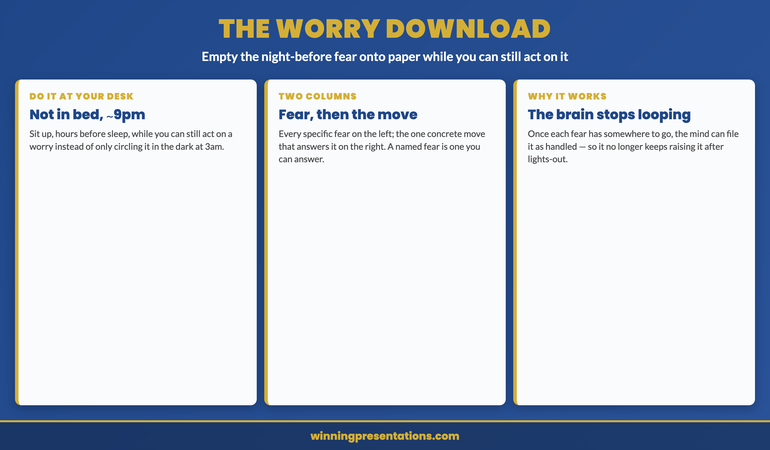
The worry download — done at your desk, not in bed
The worry download is deliberately a desk activity, not a bedtime one, and the timing matters as much as the content. You do it hours before you sleep — around nine in the evening is a good marker — sitting up, at a desk or table, with a pen and a single sheet split into two columns. In the left column you write every specific fear about the presentation, exactly as it occurs to you, in its own words: “they’ll ask why the numbers slipped in Q2,” “the CFO will think the timeline is naive,” “I’ll lose my thread on the third slide.” Not vague dread — the actual, named fears, because a named fear is one you can answer and a vague one is not. In the right column, against each fear, you write the one concrete move that answers it: the two sentences you will say about Q2, the slide you will skip to if challenged on the timeline, the one-line note that gets you back on the third slide. The point is not to eliminate the fear. It is to pair every fear with a response, so the brain can file it as handled rather than keep raising it.
This is why doing it at the desk, upright and early, is the whole trick. At 9pm you can still act on a worry — write the two sentences, find the backup slide, draft the answer. At 3am you can only circle it. The download moves the worrying to the time and place where it can actually be resolved, and in doing so gives the night-time mind permission to stop, because the work is genuinely done and written down where you can see it. A different client, a newly promoted director facing his first executive committee in 2016, tried exactly this the night before. He told me afterwards it was his first proper night’s sleep before a big meeting in years — not because the fear had vanished, he was careful to say, but because it finally had somewhere to go besides the dark. He had not become fearless; he had simply emptied the worry onto paper, paired each item with a move, and left it there, so his mind did not have to keep carrying it to bed. When the harder questions came the next day, several of his answers were ones he had drafted in that right-hand column — the download had quietly doubled as preparation. For anything board-level, pairing it with a deliberate pre-read strategy resolves even more of the worry before the room.
The 3am rule and the 11pm question
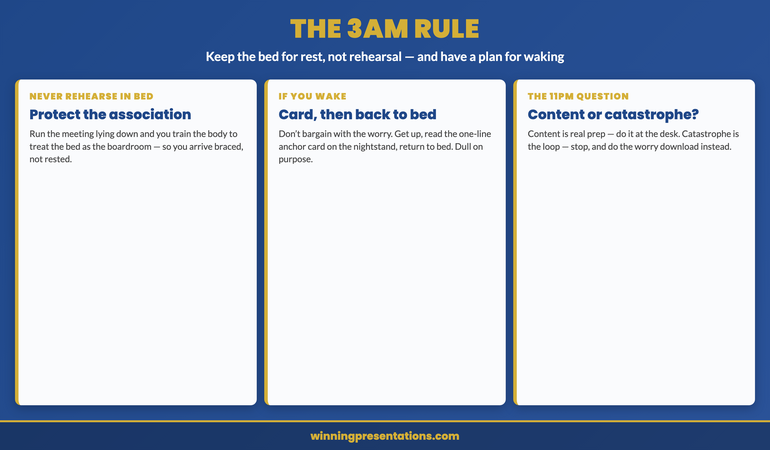
The 3am rule has one absolute clause: you never rehearse the presentation in bed. This sounds small and is not, because the bed is doing quiet work on your nervous system that you cannot afford to undo. Sleep depends on your body associating the bed with rest. Every time you lie there running the meeting, you teach your body that the bed is a place where high-stakes performance happens — you train it to treat the bed as the boardroom. Do that for enough nights before enough presentations, as the operations leader had for years, and the body starts arriving in bed already braced, which is the opposite of what you need. So the rule protects the association: the presentation gets rehearsed at the desk, in daylight or evening, sitting up; the bed gets nothing but rest. Rehearsing horizontally is the habit that turns one bad night into a standing pattern, and the rule exists to break it.
If you do wake at 3am — and sometimes you will — the rule gives you a fixed, boring routine instead of the loop. You do not lie there negotiating with the worry. You get up, you go and read the single anchor card you left on the nightstand, and you go back to bed. The anchor card is one line — the calmest true thing you can tell yourself, something like “the work is done; I will be fine tomorrow; sleep is the last piece of preparation” — and reading it standing up, away from the pillow, is itself part of breaking the bed-as-boardroom link. The routine is deliberately unexciting because excitement is the enemy here; you want the mind to find waking so dull that it gives up and lets you sleep. The diagnostic that governs all of this is what I call the 11pm question. Before you let yourself rehearse anything that late, you ask: am I rehearsing the content, or rehearsing the catastrophe? If it is the content — genuinely useful preparation — then it is legitimate, and the answer is to get up and do it properly at the desk, not half-do it in bed. If it is the catastrophe — the worst version on a loop — then it is not preparation at all, and the answer is to stop and, if you have not already, do the worry download. Most late-night rehearsing, honestly examined, turns out to be catastrophe, which is why the question is worth asking by name.
One payment. Lifetime access. No subscription to forget about.
Conquer Your Fear of Public Speaking is a one-off £39 — instant download, lifetime access, nothing recurring. It is a self-paced system for managing the fear and the physical symptoms of public speaking, including the sleepless nights before, with practical tools to settle the nervous system. Built by someone who spent years early in her own career dreading presentations before learning to manage the fear rather than fight it.
Frequently asked questions
Is it normal to lose sleep before presentations even when I’m experienced?
Yes, and it is more common among experienced presenters than people assume. Losing sleep before something that matters is a sign that you care about the outcome and that your mind has plenty of material to work with — both of which come with experience and competence, not despite them. The well-prepared mind has more to rehearse in the dark, and the person who cares feels the stakes more sharply. So the broken sleep is rarely evidence that you are not cut out for it; far more often it is the night-time face of taking the work seriously. The point of the worry download and the 3am rule is not to make you stop caring, which you should not want, but to keep the caring from costing you the night before.
I’ve tried everything to sleep before a big presentation — why would this be different?
Most sleep advice treats the symptom — warm milk, screens off, breathing apps — without addressing what is actually keeping you awake, which is a mind looping an unresolved worry it has nowhere to put. The worry download is different because it works upstream of bedtime: by pairing every named fear with a concrete move at your desk hours earlier, it lets the brain file the worry as handled rather than keep raising it. The 3am rule then protects the sleep you do get by stopping you training the bed to feel like the boardroom. It is not a relaxation trick on top of the same problem; it removes the reason the mind keeps you up. If general sleep advice has not worked, it is usually because it never gave the worry somewhere to go.
What if I do the worry download and still wake at 3am?
That can happen, and the rule already plans for it — the download reduces the waking, it does not promise to abolish it. If you wake, you do not lie there bargaining with the worry, because lying there is what feeds the loop. You get up, go and read the one-line anchor card you left on the nightstand, and return to bed. The routine is meant to be dull on purpose: you are giving your mind nothing interesting to do, so it settles. One imperfect night before a presentation is survivable far more often than people fear — a single short night rarely undoes the preparation you have done. The aim is to protect the nights overall and to stop the bed becoming a place your body braces in, not to guarantee an unbroken eight hours.
Should I just take something to knock myself out the night before?
That is a question for your doctor, not for me, and nothing here is medical advice. What I can say from the coaching side is that the goal is to arrive settled and clear-headed, and many people find that anything that leaves them foggy in the morning trades one problem for another. The approach in this article works on the cause of the wakefulness rather than overriding it: give the worry somewhere to go at your desk, protect the bed from rehearsal, and run a dull routine if you wake. For many capable people that is enough to change the night before considerably. If sleep problems are persistent or severe and reach well beyond the night before a presentation, that is worth raising with a professional who can look at the whole picture.
The Winning Edge — weekly newsletter
The Winning Edge is a weekly newsletter for professionals who want to present with less dread and more control. One short email a week on the practical moves that make high-stakes presenting feel survivable — including the nights before. Subscribe to The Winning Edge →
For more on settling the fear that drives the sleepless nights, see the wider presentation coaching resources.
About the author
Mary Beth Hazeldine is Owner & Managing Director of Winning Presentations Ltd. With 24 years of corporate banking experience at JPMorgan Chase, PwC, Royal Bank of Scotland, and Commerzbank, she advises executives across financial services, healthcare, technology, and government on structuring presentations for high-stakes funding rounds, board approvals, and strategic decisions.
The next time a big presentation is keeping you awake, do these things instead of lying there running the meeting on a loop: at your desk around 9pm, do the worry download — two columns, every specific fear on the left and the one concrete move that answers it on the right — so the worry has somewhere to go besides the dark; put a single anchor card on the nightstand with one calm true line for any 3am waking; and hold the 3am rule absolutely, never rehearsing the presentation in bed, because the bed has to stay a place for rest, not the boardroom. Protect the night before, and you walk into the room rested rather than wired — which is the version of you the room deserved all along.