Tag: senior leadership

17 Apr 2026
A male operations manager responding confidently to a question from a senior female executive in a high-level skip-level meeting, boardroom setting, composed and direct, editorial photography style

Skip-Level Meeting Q&A: Handling Questions From Senior Leadership

Quick Answer: Skip-level meetings — where your boss’s boss engages directly with you — carry a distinct Q&A dynamic. Senior leaders ask differently from your direct manager: they operate at a higher level of abstraction, they test your strategic thinking rather than your operational knowledge, and they pay close attention to how you handle uncertainty. Preparation requires mapping the questions they are likely to ask, practising responses that demonstrate judgement rather than just facts, and knowing how to redirect operational detail back to the strategic level without appearing evasive.

Tomás had run his division’s operations for three years. His direct manager trusted him completely. When the group CEO announced a series of skip-level conversations with senior managers, Tomás wasn’t particularly concerned. He knew his numbers. He knew his team. He had delivered consistently.

The CEO’s first question was: “If you had to restructure this division to be twenty percent more efficient without reducing output, where would you start?” Tomás answered with an operational plan — headcount distribution, process changes, technology investments. The CEO listened politely, then said: “That’s useful. I was asking where the biggest strategic constraint is.”

Tomás had answered the question he was comfortable with rather than the one that was asked. He had given operational detail in response to a request for strategic judgement. The CEO moved on. Tomás knew, walking out, that the conversation had not gone the way he needed it to.

It was a recoverable situation — Tomás followed up by email with a more strategic framing, and the CEO later described him positively in a talent review. But the preparation gap was clear: he had been ready for the operational meeting he expected, not the strategic conversation that actually happened.

If you have a skip-level meeting coming up

The Executive Q&A Handling System includes a framework for predicting the questions senior leaders ask, structuring your responses at the right level of abstraction, and handling the difficult moments — the stretch questions, the challenges to your assumptions, the questions you didn’t anticipate.

Explore the System →

Why Skip-Level Q&A Is Different From Any Other Meeting

Skip-level meetings — where a senior leader engages directly with someone two or more levels below them — serve a specific organisational function: they give senior leadership an unfiltered view of how the organisation thinks and operates below the layer of direct management. This purpose shapes every question a senior leader asks in these settings.

Your direct manager assesses whether you are executing well on defined objectives. A skip-level senior leader is assessing something different: whether you have the strategic thinking, the judgement under pressure, and the professional credibility to operate at the next level. They are using the conversation to calibrate your potential, not just your current performance.

This changes the preparation requirement significantly. Preparing for your direct manager’s questions means knowing your operational data deeply. Preparing for skip-level questions means being able to step above the operational data and discuss what it means at a strategic level — what the implications are, where the constraints lie, and what you would do if you were making the decisions rather than executing them.

The emotional dynamic is also different. Most executives are more comfortable being challenged by their direct manager — the relationship has context, history, and established trust. A senior leader who challenges an assumption in a skip-level meeting does so without that context. The challenge can feel more exposing, and the temptation to become defensive or to over-explain is higher. Knowing this in advance — and having specific strategies for managing it — is part of effective skip-level preparation.

Executive Q&A Handling System

Predict the Questions, Structure the Answers, Handle the Pressure

The Executive Q&A Handling System — £39, instant access — gives you a systematic approach to predicting the questions senior executives ask, structuring answers at the right level, and managing the high-pressure moments that define how you are perceived in the room. Designed for executives who present to, or are questioned by, decision-makers more senior than their direct line.

  • Question prediction frameworks for skip-level and senior leadership contexts
  • Response structure guides for strategic, operational, and challenge questions
  • Techniques for handling the questions you didn’t predict — without losing credibility
  • Scenario playbooks for investment committee, board, and skip-level meeting Q&A

Get the Q&A Handling System →

Designed for executives who are questioned by senior decision-makers in high-stakes contexts.


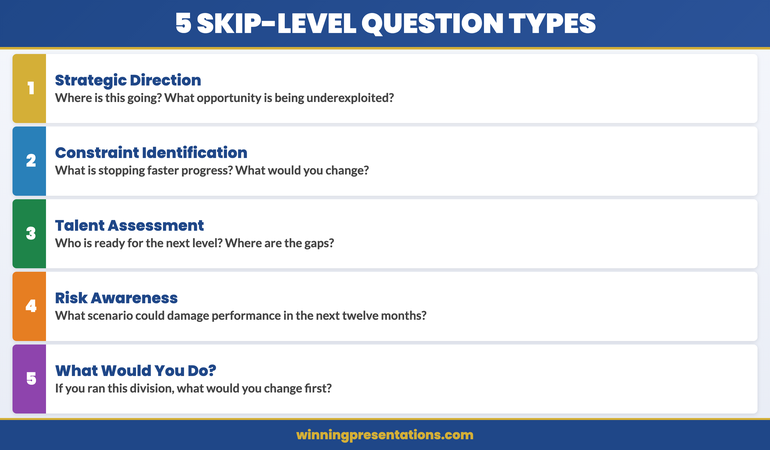
Five Skip-Level Question Types infographic showing: Strategic Direction, Constraint Identification, Talent and Team Assessment, Risk and Challenge, and What Would You Do Differently — the five categories senior leaders use in skip-level meetings

The Five Question Types Senior Leaders Use

Skip-level questions cluster into five recognisable types. Knowing these in advance allows you to prepare answers that operate at the right level — not too operational, not too vague.

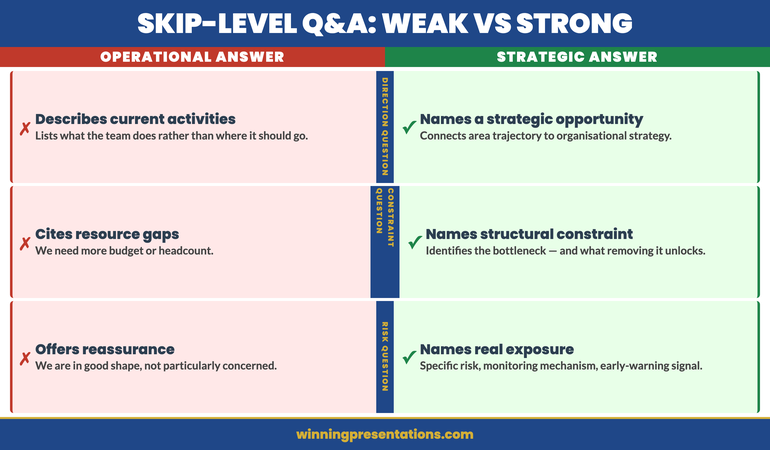
1. Strategic direction questions. “Where do you see this business in three years?” or “What’s the biggest opportunity your team is underexploiting?” These questions invite you to demonstrate that you think above your day-to-day responsibilities. The trap is giving an operational answer — describing what your team does rather than where it should go. The strong response connects your area’s trajectory to the wider organisational strategy and names a specific opportunity or constraint that you believe is underweighted.

2. Constraint identification questions. “What’s stopping you from moving faster?” or “What would you change if you had the authority?” These are diagnostic questions. Senior leaders use them to identify organisational bottlenecks and to assess whether middle management has a clear view of what is holding back performance. The weak response is to describe a resource constraint — “we need more budget or headcount.” The strong response names a structural or strategic constraint — a process, a decision-making dependency, or a talent gap — and articulates what removing it would unlock.

3. Talent and team questions. “Who on your team is ready for the next level?” or “Where are the talent gaps that worry you most?” These questions assess your people judgement and your investment in your team’s development. Have a specific answer — naming individuals where relevant — and demonstrate that you think deliberately about succession and capability rather than managing the team as an undifferentiated group.

4. Risk and challenge questions. “What keeps you up at night?” or “What’s the scenario that could significantly damage performance in the next twelve months?” These questions test your risk awareness and your honesty about vulnerability. Executives who answer with reassurance — “we’re in good shape, I’m not particularly concerned” — miss the point. A thoughtful risk response names a genuine concern, explains the monitoring mechanism in place, and identifies the early-warning signal that would trigger action.

5. The “what would you do” question. “If you were running the division, what’s the first thing you’d change?” This is a test of strategic confidence and intellectual courage. The safest-seeming answer — “that’s not my decision to make” — is the one that signals you are not thinking above your role. The strong response articulates a clear view, grounds it in specific evidence, and frames it as a perspective rather than a criticism of current strategy.

A Preparation Framework That Works at Any Level

Effective skip-level preparation follows a three-layer structure. Each layer prepares you for a different type of question and a different dimension of the conversation.

Layer 1 — Know your brief. What does this senior leader already know about your area? What recent decisions or events have shaped their view of your division? What is their stated agenda for the skip-level series — are they gathering strategic input, conducting a talent assessment, or investigating a specific performance question? Knowing the context of the conversation lets you frame your answers in terms they will find relevant rather than comprehensive.

Layer 2 — Prepare your positions. For each of the five question types above, develop a clear, confident position. This is not a scripted answer — it is a considered point of view. On strategy: where does your area need to go and why? On constraints: what is genuinely holding back performance? On talent: who is ready for more and who needs development? On risk: what is the real exposure? On what you would change: what is your honest view?

Layer 3 — Anticipate the follow-up. Senior leaders who ask a question and get a polished first answer often follow up with something harder — a challenge to an assumption, a request for more specificity, or a question that follows the logic of your answer to an uncomfortable place. For each prepared position, ask yourself: what is the most challenging follow-up question this answer could generate, and what is my response? This is where most skip-level preparation fails: the first answer is prepared, the follow-up is not.

For the underlying approach to Q&A preparation in high-stakes settings, see The Q&A Briefing Document: The Five Sections Every Executive Needs Before a High-Stakes Q&A.

If your skip-level meeting involves formal Q&A — or if you want a systematic approach to predicting and preparing for the questions senior leaders ask — the Executive Q&A Handling System provides the question prediction and response structuring framework in one place.


Weak vs Strong Skip-Level Q&A Responses comparison infographic showing three question types — Strategic Direction, Constraint Identification, and Risk Assessment — with examples of operational answers that miss the mark versus strategic answers that demonstrate senior-level thinking

Handling Questions in the Room

No matter how well you prepare, a skip-level meeting will generate at least one question you didn’t predict. How you handle the unpredicted question is often more revealing than how you handle the prepared ones.

When a question catches you off-guard, the effective response sequence is: pause briefly, clarify if necessary, then answer at the highest level you can before offering to follow up with more specificity. “That’s an important question. My current thinking is [position]. I’d want to check [specific data point] before I give you a more precise answer — can I send that through to you by end of week?” This response demonstrates intellectual honesty, shows that you distinguish between your current thinking and confirmed data, and keeps the conversation moving without bluffing.

When a senior leader challenges an assumption in your answer, don’t immediately capitulate or immediately defend. Both responses look weak — capitulation suggests you weren’t confident in your original position, and over-defence suggests you can’t distinguish between a good challenge and a bad one. Instead, engage with the challenge: “That’s a useful pushback. The reason I landed on [position] is [reasoning]. If [alternative factor the leader raised] is weighted more heavily, I can see how the answer changes.” This demonstrates that you can think in the room, not just recite prepared positions.

When you genuinely don’t know the answer to a question, say so clearly and briefly. “I don’t have that data to hand, but I can get it to you by [specific date]” is a stronger answer than a hedged, half-informed response that a senior leader will see through. The willingness to say “I don’t know” clearly — without excessive apology — is a mark of confidence, not of weakness. See also The Bridging Technique: How to Handle Difficult Questions Without Losing the Room.

The Three Traps That Derail Skip-Level Q&A

Understanding what derails other executives in skip-level meetings is as valuable as knowing what works. Three patterns come up consistently.

Trap 1: Trying to impress rather than inform. Skip-level conversations derail most often when the executive treats it as a performance — an opportunity to demonstrate how impressive they are — rather than as a dialogue. Senior leaders are highly attuned to impression management and discount it quickly. The executive who speaks plainly, admits uncertainty where it exists, and demonstrates genuine thinking is almost always more credible than the one who delivers polished answers that say less than they appear to.

Trap 2: Staying too close to your direct manager’s position. One of the purposes of skip-level meetings is for senior leadership to hear perspectives that may differ from what the management layer above you reports. If you align all your answers with your direct manager’s stated positions, you signal that you are a reliable executor rather than an independent thinker. Have a view. Where it differs from your manager’s, you can acknowledge the difference respectfully: “My manager and I have discussed this — my own read of the situation is slightly different, and I think both perspectives are legitimate.”

Trap 3: Over-managing upward. Some executives use skip-level meetings primarily to manage how they are perceived by the senior leader — steering away from topics where performance has been weak and toward areas of strength. Senior leaders recognise this pattern quickly. A question about a difficult area that gets redirected to a comfortable one signals that the executive is managing the conversation rather than engaging with it. Addressing a difficult topic directly — “I know Q3 performance in my area was below expectation. Here is my assessment of what happened and what we’ve changed” — is far more credible than a smooth deflection. For related techniques, see Regulatory Review Q&A: What Compliance Officers Actually Want to Hear.

After the Meeting: Following Through on What You Said

Skip-level meetings leave two kinds of residue: the impression you created in the room, and the commitments you made during the conversation. Both require active management after the meeting ends.

Within twenty-four hours, send a brief follow-up note to the senior leader’s PA or directly, depending on the level of formality. The note should do two things: thank them for the time and confirm any specific follow-up items you committed to. “Following our conversation this morning, I’ll send through the Q3 variance analysis by Friday and the talent pipeline summary by end of next week.” This demonstrates that you take the conversation seriously, that you are organised, and that commitments made in the room are honoured.

Deliver the follow-up items on time — or earlier. A commitment made to a senior leader that is late, or that requires chasing, signals unreliability at exactly the moment when you want to be creating the opposite impression. If something unexpected delays a follow-up item, communicate proactively rather than waiting to be asked.

After the meeting, brief your direct manager on what was discussed. This is professional protocol — your manager should not hear about the conversation through other channels — and it gives you the opportunity to get their input on whether your answers aligned with the division’s official positions. If you expressed a view that differs from your manager’s, this conversation is important: it surfaces the difference in a direct, constructive way rather than leaving it to emerge through the senior leader’s subsequent communications.

Prepare Systematically, Not Just Thoroughly

The Q&A System That Covers What You Can’t Predict

The Executive Q&A Handling System — £39, instant access — includes question prediction frameworks, response structuring guides, and techniques for handling the challenging moments that no amount of preparation fully eliminates. Designed for executives facing Q&A from senior leadership, investment committees, and boards.

Get the Q&A Handling System →

Frequently Asked Questions

Should I tell my direct manager about a skip-level meeting before it happens?

Yes, always. Attending a skip-level meeting without briefing your direct manager creates an unnecessary trust issue. Most managers understand that skip-level conversations are a normal organisational practice — but they expect to know about them. Before the meeting, let your manager know it is happening, ask if there are any topics you should be aware of, and agree on which areas you have authority to speak to independently. After the meeting, debrief them on what was discussed. This approach keeps the relationship with your manager intact while allowing you to have a genuine, direct conversation with the senior leader.

What if a senior leader asks me about a topic that falls outside my brief?

Acknowledge the boundary clearly and briefly, then offer what you can. “That sits primarily with [function or colleague]. My perspective, from what I observe in working with that team, is [observation].” This response demonstrates self-awareness about your scope without appearing unwilling to engage. Senior leaders often value the cross-functional perspective — your observation, clearly framed as an outside view, can be genuinely useful. The trap is either claiming authority you don’t have or refusing to engage with anything outside your immediate remit.

How should I handle a question where my honest answer reflects badly on the organisation?

Honesty is the correct approach, but framing matters. A response that simply delivers a critical assessment — “morale is poor and I don’t think the restructuring was handled well” — without context or solution-orientation is difficult for a senior leader to do anything with. The more useful framing names the issue, offers your assessment of its cause, and identifies what you believe would address it. This positions you as someone who is engaged with the problem rather than just observing it. Senior leaders generally value candour from executives who can pair it with constructive thinking.

The Winning Edge — Free Weekly Newsletter

Practical frameworks for Q&A handling, executive communication, and presenting to senior leadership. Every Thursday.

Subscribe to The Winning Edge →

About the Author

Mary Beth Hazeldine is Owner & Managing Director of Winning Presentations. With 25 years of corporate banking experience at JPMorgan Chase, PwC, Royal Bank of Scotland, and Commerzbank, she advises executives across financial services, healthcare, technology, and government on structuring presentations for high-stakes funding rounds and approvals.

07 Jan 2026
Presenting to senior management - what nobody warns you about your first executive presentation

Your First Presentation to Senior Management: What Nobody Warns You About

Quick Answer: Presenting to senior management requires a complete mindset shift. Lead with your recommendation (not context), plan for half your allotted time, expect interruptions, and treat questions as engagement rather than attacks. The executives evaluating you care less about your analysis and more about your judgment. Your first senior presentation is an audition—and most people fail it by over-preparing the wrong things.

My first time presenting to senior management lasted four minutes.

I’d prepared for three weeks. Forty-two slides. Every objection anticipated. Every data point verified.

The Managing Director stopped me on slide two: “What do you recommend?”

My recommendation was on slide 38. I stammered through an explanation of why the context mattered first. He checked his watch. The other executives followed his lead.

I learned more about presenting to senior management in those four minutes than in my entire MBA.

Nobody had warned me that senior executives don’t want your journey—they want your destination. Nobody explained that my carefully constructed narrative would be seen as wasting their time.

Here’s what I wish someone had told me before that first presentation.

The Executive Slide System

Your first presentation to senior management deserves slides that match executive expectations. The Executive Slide System gives you the exact templates, frameworks, and structures that senior leaders expect—so you can focus on delivery, not formatting.

Includes: Executive summary templates, board-ready formats, and the one-page structures that get read.

Get the Executive Slide System →

The 5 Rules for Presenting to Senior Management Nobody Teaches

Rule 1: Lead With Your Recommendation

Everything you learned about building to a conclusion is wrong for senior audiences. Executives don’t have patience for narrative arcs. They want to know what you think—immediately.

Open with: “I recommend X because of Y. Here’s the supporting analysis.”

Not: “Let me walk you through the market conditions, competitive landscape, and historical context that led us to consider…”

When presenting to senior management, your first sentence should contain your recommendation. Everything else is supporting material they may or may not request.

Rule 2: Plan for Half Your Time

If you’re scheduled for 30 minutes, prepare 15 minutes of content. Senior meetings run over. Executives arrive late. Questions derail timelines. The presenter who plans for the full slot always runs out of time before reaching their point.

The presenter who plans for half the time looks polished when they finish early—and prepared when interruptions eat the rest.

Rule 3: Expect Interruptions (And Welcome Them)

Junior presenters interpret interruptions as rudeness. They’re not. When a senior executive interrupts, they’re telling you what matters to them. That’s valuable intelligence.

When interrupted, stop talking. Listen. Answer the question. Then ask: “Should I continue with the presentation, or would you prefer to discuss this further?”

Handing control to the room demonstrates confidence, not weakness.

Rule 4: Answer Questions Like an Executive

The question: “What’s the timeline?”
The junior answer: “Well, it depends on several factors. If we get approval by March, and assuming resources are allocated according to plan, and barring any unforeseen…”
The senior answer: “Six months from approval. I can break that down if helpful.”

When presenting to senior management, answer what was asked. Provide the minimum information needed. Stop talking. If they want more detail, they’ll ask.

Rule 5: Your Slides Are Not Your Presentation

Senior executives can read faster than you can speak. If you’re reading your slides, you’re wasting their time. If everything important is on the slides, why are you there?

Your slides should support your points, not contain them. Speak to the room. Glance at slides for reference. Never, ever read them aloud.

Presenting to senior management - 5 rules nobody teaches for executive presentations

What Senior Executives Are Actually Evaluating

Here’s what nobody tells you about presenting to senior management: they’re barely evaluating your content. They’re evaluating you.

Specifically, they’re asking themselves:

Does this person have judgment? Not just data, but the ability to synthesize information into clear recommendations.

Does this person respect my time? The ability to communicate efficiently signals respect—and readiness for senior roles.

Does this person stay composed under pressure? How you handle tough questions reveals how you’ll handle tough situations.

Would I trust this person in front of clients or the board? Every internal presentation is an audition for external ones.

Your analysis could be perfect, but if you fail these tests, the opportunity doesn’t come again.

For the complete framework on giving presentations that command any room, see my full guide: How to Give a Presentation: The Complete Step-by-Step Guide.

FAQ: Presenting to Senior Management

How is presenting to senior management different from regular presentations?

Senior managers process information differently. They don’t want your journey—they want your destination. Lead with recommendations, not context. Expect interruptions. Answer questions directly without over-explaining. And respect their time obsessively—if you’re scheduled for 30 minutes, plan for 15.

What’s the biggest mistake when presenting to senior management for the first time?

Building to your recommendation instead of leading with it. First-time presenters spend 10 minutes on background before reaching their point. By then, senior managers have already formed opinions—usually negative ones about your communication skills. State your recommendation in the first 60 seconds.

How do I handle tough questions when presenting to senior management?

Pause before answering. Answer only what was asked. Stop talking. Don’t interpret questions as attacks—they’re engagement. If you don’t know something, say “I’ll follow up by end of day” and move on. Executives respect honesty far more than fumbled guesses.

📧 Join 2,000+ professionals getting weekly insights on executive presentations. Subscribe to The Winning Edge →

đź“‹ Free Download: Executive Presentation Checklist

Prepare for presenting to senior management with the same checklist I give clients before high-stakes meetings. Covers the signals executives notice in the first 60 seconds.

Get Your Free Checklist →


About the Author

Mary Beth Hazeldine spent 24 years at JPMorgan, PwC, RBS, and Commerzbank. She’s a clinical hypnotherapist and MD of Winning Presentations.

This article was created with AI assistance; all stories and insights are based on 35 years of real client work.

07 Jan 2026
C-suite presentation mistakes - 5 credibility killers that make executives stop listening

C-Suite Presentation Mistakes: 5 Credibility Killers That Make Executives Stop Listening

Quick Answer: The five c-suite presentation mistakes that destroy credibility are: (1) burying your recommendation under context, (2) using hedge words that signal uncertainty, (3) over-explaining before asked, (4) reading slides instead of commanding them, and (5) treating Q&A as an attack rather than an opportunity. Each mistake signals to executives that you’re not ready for senior-level conversations.

She had 14 slides. The CFO gave her 90 seconds.

I watched Sarah—a senior manager at RBS—prepare for weeks. Her analysis was flawless. Her c-suite presentation mistakes, however, were textbook. She opened with methodology. She built to her recommendation. She hedged every conclusion with “I think” and “maybe.”

The CFO interrupted on slide three: “What do you need from me?”

Sarah froze. Her recommendation was on slide 11. She stumbled through an explanation of why the background mattered first.

He was checking email by the time she reached her point.

The budget request was denied. Not because the idea was wrong—but because Sarah made every c-suite presentation mistake that signals “not ready for this room.”

Here are the five credibility killers I see executives make weekly—and how to avoid them.

🏆 FLAGSHIP PROGRAMME

The Executive Buy-In Presentation System

Stop making the mistakes that get you tuned out. This comprehensive system teaches you exactly how to structure, deliver, and close presentations that win C-suite approval—every time.

What transforms: How you open, how you handle pushback, and how you get decisions made in a single meeting.

Eliminate C-Suite Presentation Mistakes →

The 5 C-Suite Presentation Mistakes That Destroy Credibility

Mistake #1: Burying Your Recommendation

The instinct is natural: build context so the recommendation makes sense. But C-suite executives don’t process information like analysts. They don’t need to understand your journey—they need your destination.

When your recommendation appears on slide 11 of 14, you’re asking executives to hold attention through 10 slides of context they didn’t request. Most won’t.

The fix: State your recommendation in the first 30 seconds. “I’m requesting ÂŁ2M for platform migration. Here’s why.” Then provide context only as requested.

Mistake #2: Hedge Word Epidemic

“I think we might want to consider possibly looking at…”

Every hedge word cuts your perceived conviction in half. Senior executives notice immediately. If you’re not confident in your recommendation, why should they be?

The fix: Delete “I think,” “maybe,” “might,” “possibly,” “perhaps,” “kind of.” State positions as positions: “I recommend Option B.”

Mistake #3: Over-Explaining Before Asked

Anticipating objections seems smart. But when you address concerns nobody raised, you create doubts that didn’t exist. You’re teaching the room what to worry about.

Worse, it signals anxiety. Confident presenters trust their recommendations to withstand scrutiny.

The fix: Present your case. Stop. Let questions emerge naturally. Address them when asked—not before.

Mistake #4: Reading Your Slides

The moment you turn to read your slides, you’ve lost the room. Executives can read faster than you can speak. If you’re adding nothing beyond what’s written, you’re wasting their time.

More importantly, reading signals that you don’t know your content well enough to present it naturally.

The fix: Slides are visual aids, not scripts. Know your content cold. Glance at slides for reference, but speak to the room, not the screen.

Mistake #5: Treating Q&A as an Attack

Defensive body language. Rushed answers. Over-justification. These signals tell executives you’re not comfortable with scrutiny—and therefore not ready for senior roles.

Questions aren’t attacks. They’re engagement. An executive asking tough questions is an executive taking you seriously.

The fix: Welcome questions. Pause before answering. Respond to exactly what was asked—then stop. Treat Q&A as the opportunity to demonstrate your thinking, not a test to survive.

C-suite presentation mistakes - 5 credibility killers with fixes for each

Why C-Suite Presentation Mistakes Matter More Than Content

Here’s the uncomfortable truth: executives often don’t remember your content. They remember how you made them feel.

If you projected confidence, clarity, and command, your recommendations carry weight—even if the details blur. If you projected uncertainty, over-preparation, and anxiety, even brilliant analysis gets discounted.

C-suite presentation mistakes signal something beyond the immediate meeting. They signal whether you’re ready for larger roles, bigger decisions, and higher stakes. Every presentation is an audition.

For more on building the communication skills that command executive rooms, see my complete guide: Leadership Communication Skills: Why Executives Talk Too Much (And Persuade Too Little).

FAQ: C-Suite Presentation Mistakes

What’s the most common c-suite presentation mistake?

Over-explaining context before reaching your recommendation. Executives form opinions within 30 seconds. If you spend the first five minutes on background, you’ve lost them before your point arrives. Lead with your recommendation, then provide only the context they request.

How do I recover from a c-suite presentation mistake mid-meeting?

Stop, acknowledge, and reset. Say: “Let me cut to what matters most—” then state your core recommendation in one sentence. Executives respect people who can self-correct. Continuing down a failing path is worse than admitting you need to change direction.

Do c-suite presentation mistakes differ by industry?

The five core mistakes are universal across industries. However, tolerance levels vary. Financial services executives typically have the least patience for lengthy context. Tech executives may tolerate more detail but still expect clear recommendations. Adjust brevity based on your audience’s culture.

📧 Join 2,000+ professionals getting weekly insights on executive communication. Subscribe to The Winning Edge →

đź“‹ Free Download: Executive Presentation Checklist

Avoid these c-suite presentation mistakes before your next high-stakes meeting. This checklist covers the credibility signals that executives notice in the first 60 seconds.

Get Your Free Checklist →


About the Author

Mary Beth Hazeldine spent 24 years at JPMorgan, PwC, RBS, and Commerzbank. She’s a clinical hypnotherapist and MD of Winning Presentations.

This article was created with AI assistance; all stories and insights are based on 35 years of real client work.

07 Jan 2026
Leadership communication skills - executive commanding boardroom with strategic brevity

Leadership Communication Skills: Why Executives Talk Too Much (And Persuade Too Little)

Quick Answer: Leadership communication skills are built on brevity, not volume. Research shows executives lose audience attention after 30 seconds of continuous speaking. The most persuasive leaders use the “headline first” framework: state your recommendation in under 10 words, pause, then provide only the context requested. This reverses the common mistake of building to your point—which loses senior audiences before you reach it.

“I’ve heard enough.”

Four words that ended a ÂŁ4M budget request.

I watched it happen at Commerzbank. A VP—brilliant analyst, 15 years of experience—had requested 30 minutes with the CFO to present a technology investment. He’d prepared 47 slides. He’d rehearsed for hours. His leadership communication skills, he believed, were solid.

Eleven words into his opening, the CFO raised his hand.

“What’s the number and what do you need from me?”

The VP froze. He’d planned to build context for the first 10 minutes. His recommendation was on slide 34. He stumbled through an explanation of why background mattered first.

The CFO checked his phone. Then stood up. “Send me a one-pager. I don’t have time for this.”

The meeting was over. The budget request died.

I’ve replayed this scene hundreds of times across my 24 years at JPMorgan Chase, PwC, RBS, and Commerzbank. The pattern is always identical: technically excellent professionals who confuse thorough communication with effective communication.

They talk more. They persuade less.

True leadership communication skills work in reverse. You start with your point. You stop talking. You let the room come to you.

Here’s how to build the communication skills that actually move senior stakeholders to action.

🏆 FLAGSHIP PROGRAMME

The Executive Buy-In Presentation System

Stop losing senior stakeholders with over-communication. This comprehensive system teaches you the exact frameworks used by leaders who consistently win approval, secure budgets, and accelerate their careers through high-stakes presentations.

What transforms: How you structure recommendations, command executive attention, handle C-suite pushback, and get decisions made in a single meeting.

Develop Leadership Communication That Gets Buy-In →

Why Executives Talk Too Much (The Expertise Trap)

The more you know, the worse you communicate.

This counterintuitive truth explains why so many technically brilliant professionals fail to develop effective leadership communication skills. Psychologists call it the “curse of knowledge”—once you understand something deeply, you lose the ability to imagine not understanding it.

Here’s how it plays out in executive settings:

The expert’s instinct: “I need to share the complexity so they understand my recommendation.”

The executive’s reality: “I don’t need to understand. I need to decide.”

This gap explains the epidemic of over-communication in corporate leadership. Professionals build elaborate context because they needed that context to reach their conclusion. They don’t realize executives operate on different criteria: trust, confidence, and strategic fit—not technical detail.

Research from Harvard Business Review confirms the pattern. Executives report that 70% of the information they receive is unnecessary for decision-making. More damning: they form opinions about recommendations within the first 30 seconds. Everything after is confirmation or dismissal of that initial judgment.

When you talk for 10 minutes before reaching your point, you’re not building a case. You’re triggering impatience, skepticism, and disengagement.

True leadership communication skills require unlearning the instincts that made you an expert in the first place.

The Leadership Communication Skills Framework

Effective leadership communication rests on three principles that reverse how most professionals are trained to present:

Principle 1: Conclusion First

State your recommendation before your reasoning. This isn’t rude—it’s respectful. You’re signaling that you value their time and trust them to ask for context they need.

Instead of: “Let me walk you through the market analysis, competitive landscape, and financial projections that led us to conclude…”

Say: “I recommend we proceed with Option B at ÂŁ2.4M. Here’s why.”

Principle 2: Minimum Viable Context

Provide only the context necessary for a decision—not the context necessary for full understanding. These are different things. Senior executives don’t need to understand the technical nuances; they need to understand the strategic implications.

Ask yourself before each point: “Would they ask for this if I didn’t offer it?” If not, don’t include it.

Principle 3: Pull, Don’t Push

Create space for questions rather than preemptively answering them. When you anticipate every objection, you signal anxiety. When you state your position and pause, you signal confidence.

The executives who master leadership communication skills speak less than anyone in the room. They make their point. They stop. They let the room come to them.

Leadership communication skills framework - conclusion first, minimum context, pull don't push

The Headline-First Method That Commands Rooms

The single most powerful leadership communication skill is also the simplest: lead with your headline.

Here’s the method:

Step 1: Write your core message in 10 words or fewer.
If you can’t, you haven’t clarified your thinking. The discipline of compression forces clarity. “We should invest ÂŁ2.4M in platform migration to reduce costs 23% by Q4.”

Step 2: Deliver the headline. Then stop.
Don’t immediately explain. Don’t justify. Don’t contextualize. Say the headline, then pause for 2-3 seconds. This pause is uncomfortable—and powerful.

Step 3: Let them pull for more.
After your pause, one of two things happens. Either they accept the recommendation (you’re done), or they ask a question (you answer only what’s asked). Both outcomes are efficient.

Step 4: Answer questions, not topics.
When they ask “What’s the risk?”, answer the risk question. Don’t expand into related topics they didn’t ask about. Answer. Stop. Wait.

This method feels unnatural at first because we’re trained to build context before conclusions. But senior executives have already built mental models for most business situations. They don’t need your context—they need your position.

I’ve watched this single technique transform careers. One client went from consistently losing budget requests to a 90% approval rate. Same quality of thinking. Different sequence of delivery.

🏆 FLAGSHIP PROGRAMME

Master the Communication That Gets Executive Buy-In

The headline-first method is just one technique in a complete system. The Executive Buy-In System gives you frameworks for every high-stakes scenario—from budget requests to strategy presentations to crisis communication.

Get the Complete Executive Buy-In System →

Strategic Silence: The Most Underused Leadership Communication Skill

Junior professionals fill silence. Senior leaders use it.

Strategic silence is the secret weapon of executive communication. When you pause after a statement, you accomplish three things simultaneously:

1. You signal confidence. Only people who trust their words can let them hang in the air. Filling silence with qualifiers signals doubt.

2. You create space for processing. Senior executives are processing your recommendation against multiple competing priorities. Silence gives them room to think.

3. You shift power dynamics. The person who speaks next often loses subtle negotiating ground. When you pause after your recommendation, you force others to respond to your position—rather than the reverse.

How to Deploy Strategic Silence

After your headline: Deliver your core recommendation, then pause for 3 full seconds. Count in your head. It will feel eternal. It isn’t.

After answering questions: Answer what was asked, then stop. Don’t fill the silence with additional context. If they want more, they’ll ask.

When challenged: Pause before responding to pushback. This prevents defensive reactions and signals that you’re considering their point seriously.

When you don’t know: “I don’t have that data. I’ll follow up by end of day.” Then silence. Don’t apologize or over-explain.

The executives with the strongest leadership communication skills are often the quietest people in the room. They speak only when it advances the decision—and they let silence do the rest.

Leadership communication skills - strategic silence technique for executive influence

5 Leadership Communication Skills Mistakes That Kill Credibility

After training 5,000+ executives, these are the communication patterns I see destroy credibility most consistently:

Mistake 1: The Throat-Clearing Introduction

“Before I get into the recommendation, let me give you some background on how we got here…”

This signals that you don’t trust your recommendation to stand on its own. It also trains audiences to tune out your openings—because you’ve taught them nothing important happens at the start.

Fix: Delete your first paragraph. Start with your second.

Mistake 2: The Defensive Pre-Answer

“Now, I know some of you might be thinking…” followed by addressing objections nobody raised.

This creates objections that didn’t exist. You’re literally teaching the room what to push back on. Worse, it signals anxiety about your position.

Fix: Let objections emerge naturally. Address them when asked—and only when asked.

Mistake 3: The Expertise Showcase

Demonstrating depth of knowledge when the situation calls for clarity of recommendation.

Executives don’t promote people who know the most. They promote people who make decisions easier. Your expertise should be invisible—manifesting in confident recommendations, not lengthy explanations.

Fix: Ask yourself: “Am I sharing this for them or for me?” Be honest.

Mistake 4: The Hedge Word Epidemic

“I think we might want to consider possibly looking at…”

Every hedge word halves your perceived conviction. Senior leaders notice this immediately. It signals that you’re not confident enough in your analysis to stake a clear position.

Fix: Delete “I think,” “maybe,” “might,” “possibly,” “perhaps,” “sort of,” “kind of.” State positions as positions.

Mistake 5: The Runaway Answer

Someone asks a simple question. You answer it. Then you keep talking—adding context, related points, and caveats until you’ve lost everyone.

This happens because silence after answering feels uncomfortable. But every additional word dilutes your answer and tests patience.

Fix: Answer the question. Stop. Count to three. If they want more, they’ll ask.

Case Study: The CFO Who Lost ÂŁ4M in 11 Words

Let me return to that Commerzbank meeting—because the failure illuminates exactly what leadership communication skills require.

The VP’s first 11 words were: “Thank you for making time. I’d like to walk you through…”

That’s when the CFO stopped him.

Why? Those 11 words signaled everything wrong with the approach:

“Thank you for making time” — Gratitude is fine, but leading with it signals you view this as a favor, not a business necessity. It subtly undermines the importance of what follows.

“I’d like to walk you through” — This announces a journey, not a destination. It tells the CFO that his time will be spent on your process, not his decision.

Now consider an alternative opening:

“I’m requesting ÂŁ4M for platform migration. It reduces operating costs by 23% within 18 months. Net positive ROI by month 14.”

Same meeting. Same request. Completely different frame.

This opening accomplishes everything the original failed to do:

→ States the ask immediately (£4M)
→ Provides the outcome (23% cost reduction)
→ Establishes the timeline (18 months)
→ Preempts the obvious question (when does it pay off?)

The CFO now has everything he needs to engage. He might approve on the spot. He might ask about risks. He might question assumptions. But he’s engaged with the decision—not trapped in a presentation.

Six months later, I coached a different VP on the same request. He opened with the headline. He got approval in 12 minutes.

Same ÂŁ4M. Same CFO. Different leadership communication skills.

Leadership communication skills case study - 11 words that lost ÂŁ4M vs opening that wins approval

🏆 FLAGSHIP PROGRAMME

Get the System That Wins ÂŁ4M Approvals

The difference between rejection and approval often comes down to the first 30 seconds. The Executive Buy-In System teaches you exactly how to open, structure, and close high-stakes requests—so you get decisions made in a single meeting.

Transform Your Executive Communication →

How to Build Leadership Communication Skills

Leadership communication skills develop through deliberate practice, not passive awareness. Here’s the progression that works:

Week 1-2: The Headline Discipline

Before every meeting, email, or presentation, write your core message in 10 words or fewer. Don’t proceed until you can. This single practice forces the clarity that underpins all executive communication.

Week 3-4: The Silence Practice

In every conversation, practice pausing for 2 seconds after making a point. Notice the urge to fill silence. Don’t. Let others respond first. Track how often your pause creates space for others to engage.

Week 5-6: The Audit

Record yourself in a meeting or presentation (with appropriate permissions). Review the recording and count: How many words before your main point? How many hedge words? How much silence after key statements? The numbers will be uncomfortable. That’s the point.

Week 7-8: The Cut

Take your next presentation and cut it by 50%. Not 10%. Not 25%. Half. This forces ruthless prioritization. You’ll discover that most of what you planned to say wasn’t necessary for the decision.

Ongoing: The Feedback Loop

After every high-stakes communication, ask yourself: Did I get the outcome I needed? If not, was it because they didn’t understand—or because I didn’t persuade? The answer is almost always the latter.

📧 Join 2,000+ professionals getting weekly insights on executive communication and leadership presence. Subscribe to The Winning Edge →

FAQ: Leadership Communication Skills

What’s the biggest leadership communication skills mistake?

Over-explaining. Senior leaders assume more context helps. It doesn’t. Every additional word dilutes your core message and signals uncertainty. The executives who command rooms use half the words and twice the conviction.

How do I develop leadership communication skills quickly?

Start with the “headline first” discipline. Before any meeting or presentation, write your core message in 10 words or fewer. If you can’t, you haven’t clarified your thinking. Practice delivering that headline, then stopping. The pause after forces others to engage.

Why do technically brilliant people struggle with leadership communication skills?

Technical expertise creates a curse of knowledge. You understand the complexity, so you feel compelled to share it. But executives don’t need to understand—they need to decide. The shift from “expert who explains” to “leader who recommends” requires deliberately simplifying, not showcasing depth.

How is leadership communication different from regular presentation skills?

Regular presentation skills focus on clarity and engagement. Leadership communication skills focus on decision and action. You’re not informing—you’re influencing. Every word should move the room closer to the outcome you need.

Can introverts develop strong leadership communication skills?

Absolutely. Introversion often produces better leadership communication because introverts naturally speak less and listen more. The key is strategic contribution—speaking only when it advances the decision. Many of the most effective executive communicators I’ve coached are introverts.

How do I communicate with leadership communication skills when I’m not the most senior person in the room?

Lead with your recommendation, not your credentials. Senior executives respect people who respect their time. State your position clearly, provide the minimum context needed, and let them pull for more if they want it. Confidence in delivery matters more than title on the org chart.

đź“‹ Free Download: CFO Questions Cheatsheet

Know exactly what CFOs and senior executives will ask before they ask it. This cheatsheet covers the 10 questions that determine budget approval—so you can prepare the answers that get to yes.

Get Your Free Cheatsheet →

Related Reading

Closing: The Leaders Who Command Rooms Speak Less

That VP at Commerzbank taught me something I’ve never forgotten: expertise doesn’t equal influence. You can be the smartest person in the room and still lose the room—if you can’t communicate at the speed of decision.

Leadership communication skills aren’t about finding more articulate ways to share what you know. They’re about finding more efficient ways to move people to action.

Less context. More conviction.
Fewer words. More weight.
Less explaining. More recommending.

The executives who get things done aren’t the ones who talk the most. They’re the ones who know when to stop talking.

Master that—and every room becomes yours.


About the Author

Mary Beth Hazeldine is a qualified clinical hypnotherapist, NLP practitioner, and Managing Director of Winning Presentations. After 5 years terrified of presenting, she built a 24-year banking career at JPMorgan Chase, PwC, RBS, and Commerzbank. She has treated hundreds of anxiety clients and trained over 5,000 executives.