Quick answer: Senior leaders who decide to work on their presentation skills in June walk into the autumn board season — September and October, when most high-stakes approvals happen — already prepared. The ones who wait until they have a board meeting in the diary are trying to rebuild a skill in the two weeks they can least afford to spend on it. Presentation skill does not improve under deadline pressure. It improves in the quiet quarter, when there is room to practise on presentations that do not matter yet. June is the last clean window before that quarter closes.
JUMP TO:
- Why the timing of the decision matters more than the decision
- The quiet quarter: the only low-stakes practice window you get
- The three-presentation test: do you actually need this now?
- What the work changes, and what it does not
- Why the enrolment window is the part people get wrong
- Frequently asked questions
In September 2017, a divisional managing director booked a block of coaching with me three weeks before he was due to present a restructuring case to his group’s executive committee. He was good — genuinely good — in the room one-to-one. Sharp, warm, fast on his feet. But every time he stood in front of more than four people his delivery flattened into a recital, and he knew it. He had known it for years. He had simply never had a reason urgent enough to do anything about it, and now the reason had arrived with a date attached.
We had three weeks. In three weeks you can fix the structure of one deck and rehearse one opening until it stops sounding like a recital. You cannot change how a person behaves in front of a room. That takes longer, because the behaviour is a habit, and habits are rebuilt through repetition on low-stakes occasions, not installed before a high-stakes one. He presented. It went adequately. The committee approved a watered-down version of the case after asking him to come back with more detail. Afterwards he said the thing I have heard senior leaders say more times than any other: “I wish I’d started this a year ago.”
(This article was created with AI assistance; all stories and insights are based on 35 years of real client work.)
He did not need a year. He needed a quarter — one clean stretch of time with no board meeting in it, where he could practise on presentations that did not matter yet. That stretch existed. It had been sitting in his calendar every summer for a decade. He had never used it for this, because the work never felt urgent in June. It only ever felt urgent in September, by which point the window had closed.
If you already know the autumn board season is coming:
The Executive Buy-In Presentation System is a self-paced programme — 7 modules covering the structure, psychology, and delivery that get senior approval. No deadlines, optional recorded Q&A calls. Start now and you arrive in September with the work already done, not still in progress.
Why the timing of the decision matters more than the decision
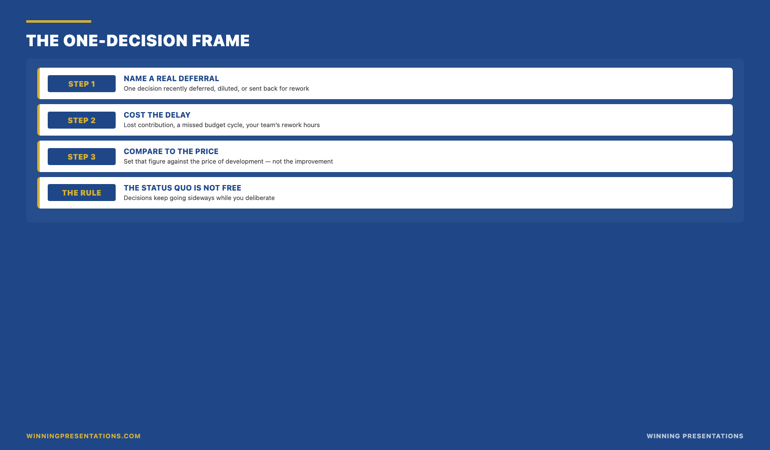
Most senior leaders treat developing their presentation skills as a thing they will get to. It sits on the personal-development list alongside the language they meant to learn and the writing course they bookmarked. It moves up the list only when a specific high-stakes presentation appears in the diary — and by then it is too late to do the work properly, because the work and the deadline are now competing for the same fortnight.
This is the trap. The need announces itself at exactly the moment you have no room to address it. You cannot rebuild a delivery habit in the two weeks before the board meeting that exposed the habit, because those two weeks belong to the deck, the numbers, the pre-reads, and the politics. Whatever spare attention you have goes into the content of the specific presentation, not into the underlying skill. So the skill never improves. You get marginally better at presenting that one deck, then revert.
The leaders who actually improve do the opposite. They decide to work on the skill when nothing is at stake — when there is no board meeting in the diary forcing the issue — precisely because that is the only time the skill can be rebuilt rather than patched. The decision is counterintuitive because it requires acting on a need that does not feel urgent yet. June rarely feels urgent. September always does. The leaders who pull ahead are the ones who act in June anyway.
The quiet quarter: the only low-stakes practice window you get
Here is the framework I give every senior leader who asks when to start. I call it the quiet quarter: the stretch from roughly mid-June to mid-September when, in most organisations, the high-stakes decision calendar goes quiet. Boards meet less over summer. Investment committees thin out. Major approvals cluster in the autumn and again before year-end. The summer is the trough.
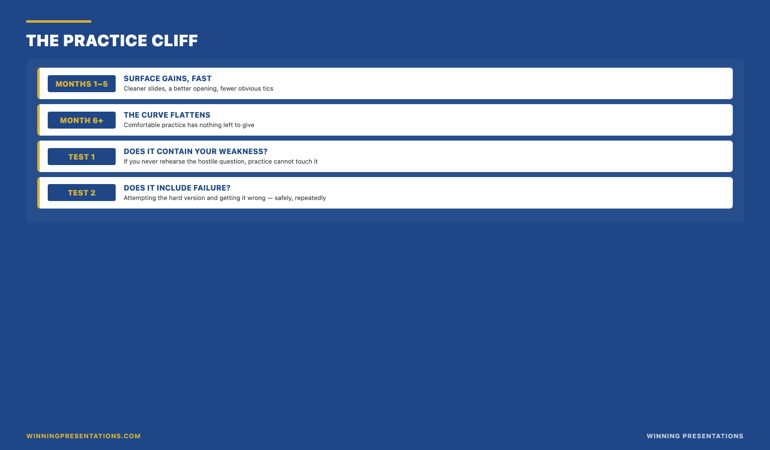
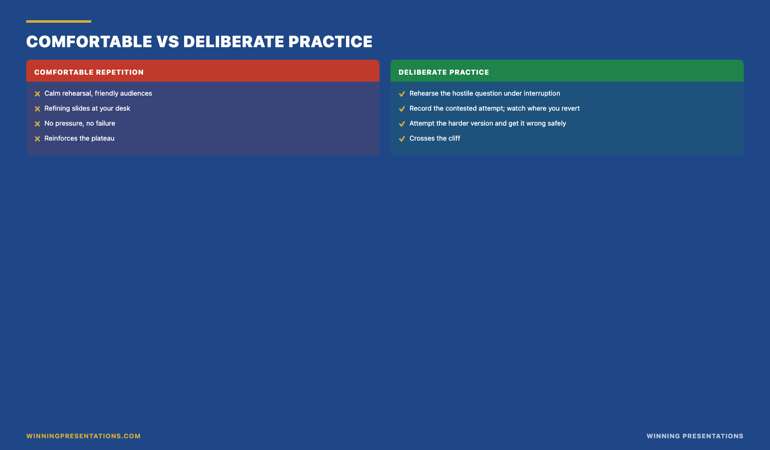
The quiet quarter is the only block of time in the year when a senior leader can practise presenting on occasions where a poor performance costs nothing. Team updates, internal reviews, conference talks, the standing operational meetings that happen regardless of season — these are the reps. They are low-stakes by definition, which is exactly what makes them useful for rebuilding a habit. You cannot rebuild a habit on the occasions that matter, because on those occasions you revert to your default under pressure. You rebuild it on the occasions that do not matter, until the new behaviour becomes the default that shows up when one does.
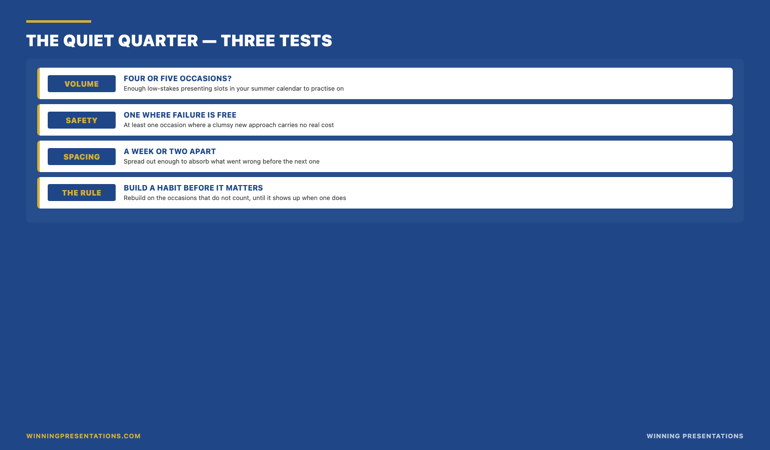
The quiet quarter has three usable properties, and the test of whether you are using it is whether you can answer yes to each. First, volume: are there at least four or five presenting occasions in your summer calendar, however minor? Second, safety: is at least one of them an occasion where a clumsy attempt at a new approach carries no real cost? Third, spacing: are they spread out enough — a week or two apart — that you can absorb what went wrong in one before the next? If you can answer yes to all three, you have a quiet quarter you can use. If you cannot, you do not have a development window this summer, and you should build one by volunteering for a low-stakes speaking slot.
The reason June is the decision point, specifically, is that the quiet quarter is about to open. Decide in June and you have the full trough ahead of you. Decide in August and you have half of it. Decide in September and the trough has closed and you are back to patching one deck before one meeting. The window does not wait for the need to feel urgent.
Use the quiet quarter while it is open.
The Executive Buy-In Presentation System gives you the complete framework for securing senior approval — stakeholder analysis, case construction, and the presentation structures that hold up to board-level scrutiny. It is self-paced across 7 modules, with monthly cohort enrolment and optional recorded Q&A calls, so you work through it on your own calendar over the summer rather than cramming it before a meeting. £499, lifetime access to materials.
- 7 self-paced modules — no deadlines, no mandatory live attendance
- Optional live Q&A / coaching calls, fully recorded so you can watch back anytime
- The structure and psychology that move senior decisions, not generic presentation tips
- New cohort opens every month — enrol whenever the summer suits you
The three-presentation test: do you actually need this now?
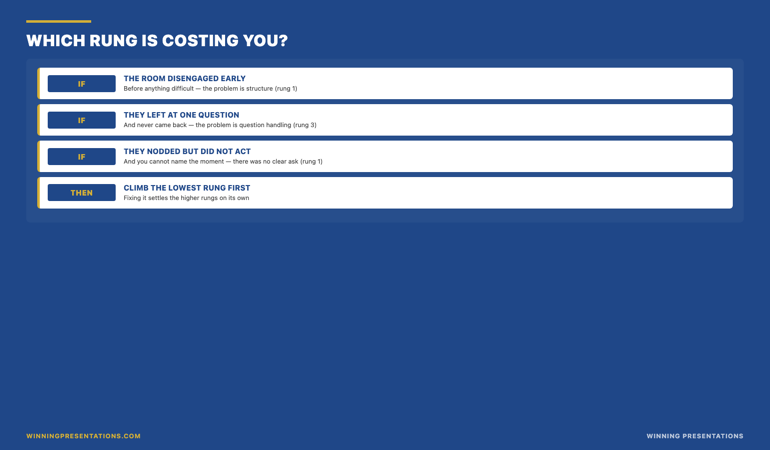
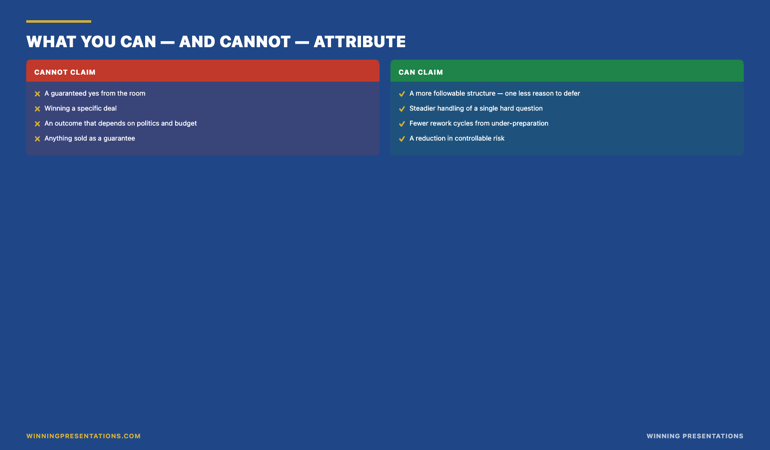
Not every senior leader needs structured development. Some present well already and would waste a summer on it. The way to tell the difference is to look backward, not forward — at your last three high-stakes presentations, not your next one. Pull them up in your memory and ask three specific questions about each.
One: did the decision land the way you wanted, and if it did not, can you point to the moment in the room where it slipped? A leader who presents well can usually name the exact question or slide where a deferral started. A leader who cannot — who only knows that “it didn’t quite land” — is missing the diagnostic awareness that improvement depends on. Two: did you do anything differently across the three, or did you present the same way each time? Identical delivery across three different audiences is the signature of a default you cannot override, which is precisely the thing the quiet quarter is for. Three: did anyone senior give you feedback, and did it surprise you? Feedback that surprised you marks a blind spot; a blind spot is the highest-return thing to work on, because you cannot fix what you cannot see on your own.
Two or three yeses to the uncomfortable version of those questions — decisions that slipped at a moment you cannot locate, identical delivery regardless of room, surprising senior feedback — means the work is worth a quarter of your summer. Zero or one means you are probably fine and should spend the summer on something else. This is a real test, not a sales device: I have told senior leaders they did not need the work, because spending a development window on a skill you already have is its own kind of waste. For more on positioning yourself with the people whose approval you need, see executive stakeholder presentation skills training.
If your high-stakes presentations are increasingly built with AI:
The AI-Enhanced Presentation Mastery course is the structured programme for senior professionals using AI to build executive-grade decks — 8 modules, 83 lessons, self-paced, with 2 optional recorded coaching sessions. It is the sibling programme to the Buy-In System for leaders whose drafting now runs through Copilot and ChatGPT. £499, lifetime access.
What the work changes, and what it does not
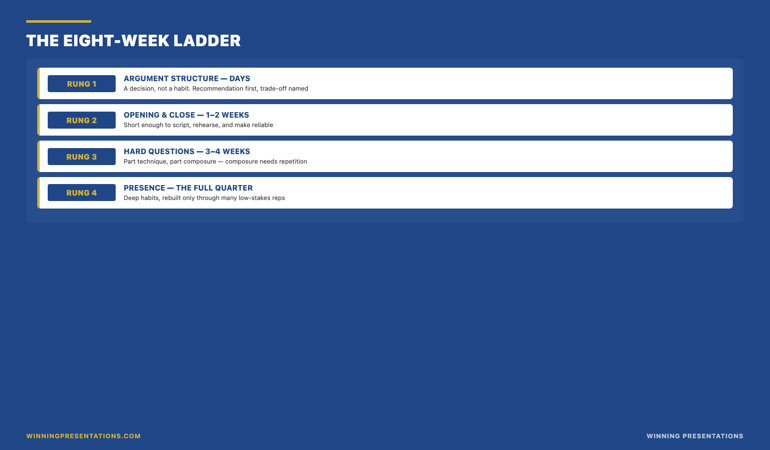
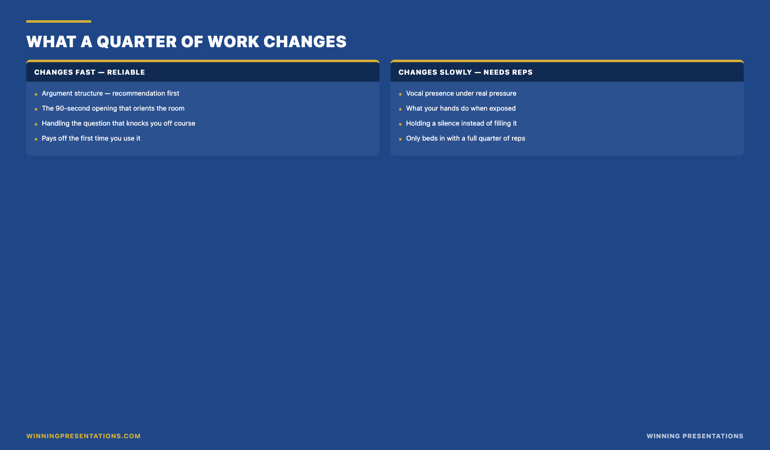
Honesty about scope is what separates useful development from the kind that disappoints. A quarter of structured work, done properly, changes three things reliably and one thing slowly. (The fuller map of which skills move fast and which move slowly is in what a senior leader can change in eight weeks.) The three reliable changes are structural: how you build the argument so the recommendation comes first and the evidence follows; how you open so the room is oriented in the first ninety seconds; and how you handle the questions that previously knocked you off course. These are learnable in a quarter because they are decisions, not reflexes. You can decide to put the recommendation on slide one. You cannot decide to stop your voice flattening under pressure.
The thing that changes slowly is presence — the physical and vocal habits that show up when you are exposed in front of a room. Those shift through repetition across the quiet quarter, not through instruction. This is why the timing matters so much. The structural work pays off the first time you use it; the presence work only pays off if you have given it a quarter of low-stakes reps to bed in. Start in September and you get the structural gains and none of the presence gains. Start in June and you get both. The leader who understands this distinction stops expecting a single course to transform them in a fortnight and starts using the time the way it actually works.
This is also why a self-paced programme suits the quiet quarter better than a fixed-date course. You are not trying to attend a series of live sessions on someone else’s calendar over a summer that includes holidays and cover arrangements. You are trying to work through a structured body of material at the pace your summer allows, then apply each piece to a real low-stakes occasion before moving on. Self-paced, with the live calls recorded so missing one costs nothing, is the format that matches how the development actually happens.
Connected to all of this is the question of what gets approved. The structural work is not cosmetic — it is the difference between a deferred case and a funded one, as anyone who has watched a board defer a sound plan for “more detail” already knows. For the board-specific version of that structural work, see getting board approval through presentation training.
Why the enrolment window is the part people get wrong
The Maven programmes open a new cohort enrolment every month. The word “cohort” here means an enrolment batch — when you join — not a fixed live schedule you have to keep pace with. The course itself is self-paced; you can start the moment you enrol and work through it at whatever speed your summer allows. So the practical question is not “can I keep up with the cohort” but “which month do I want my access to begin.”
This is where June matters in the most concrete way. Enrol with the June cohort and your access begins now, at the start of the quiet quarter, with the full trough of low-stakes practice occasions ahead of you. Wait, and you enrol later with less runway. The decision is small — it is just choosing which month to begin — but the consequence is the difference between a full development quarter and a partial one. The leaders who get the most out of the work are not the ones who study hardest. They are the ones who started at the beginning of their quiet quarter rather than the end.
This month’s cohort enrolment is open.
The Executive Buy-In Presentation System opens a new cohort enrolment every month, and this month’s is open now — begin your access at the start of the summer rather than the end of it. 7 self-paced modules, optional recorded Q&A calls, lifetime access to materials. £499. Pair it later with the wider toolkit in the Complete Presenter bundle (£99) when you want the slides, storytelling, and delivery assets alongside it.
Frequently asked questions
Is it worth starting presentation coaching if I have no big presentation coming up?
That is precisely when it is most worth starting. Presentation skill is rebuilt through repetition on low-stakes occasions, and low-stakes occasions only exist when nothing big is in the diary. If you wait for a major presentation to justify the work, you will be trying to learn the skill and deliver the high-stakes deck in the same fortnight, and the deck will win every time. The leaders who improve most start in the quiet stretch precisely because there is nothing at stake to revert to old habits under.
How is a self-paced course different from one-to-one coaching?
They do different jobs. One-to-one coaching is the highest-touch option for a specific upcoming situation — it is tailored to your exact deck and audience. A self-paced programme gives you the underlying framework and the structural patterns at a lower price point and on your own timeline, which is what the quiet quarter calls for. For most senior leaders the strongest pattern is the structured programme as the foundation over the summer, with selective one-to-one work later for the specific high-stakes occasions where the stakes justify it.
What does “cohort” mean if the course is self-paced?
The cohort is simply the enrolment batch — it marks when your access begins, not a fixed live schedule you have to keep pace with. A new cohort opens every month. There are no deadlines and no mandatory live attendance; the optional Q&A calls are fully recorded, so you can watch them back whenever suits you. Choosing the June cohort just means your access starts at the beginning of the summer, giving you the full quiet quarter to work through the material and apply it.
How much time does it realistically take over a summer?
Most senior leaders work through the core material in a handful of focused sessions spread across several weeks, then spend the rest of the quarter applying one piece at a time to real low-stakes occasions. The applying is where the gains come from, and it does not require carved-out study time — it happens inside presentations you were giving anyway. A reasonable expectation is a few hours of content over the first few weeks, then a summer of deliberate practice on the occasions already in your calendar.
The Winning Edge — weekly newsletter
The Winning Edge is a weekly newsletter for senior professionals who present at the executive level. One short email a week on the structural moves that separate decks committees back from decks they defer. Subscribe to The Winning Edge →
About the author
Mary Beth Hazeldine is Owner & Managing Director of Winning Presentations Ltd. With 24 years of corporate banking experience at JPMorgan Chase, PwC, Royal Bank of Scotland, and Commerzbank, she advises executives across financial services, healthcare, technology, and government on structuring presentations for high-stakes funding rounds, board approvals, and strategic decisions.