

The 48-Hour Window After Every Q&A: Why Most Presentations Win the Room but Lose the Decision
Astrid crushed her steering committee Q&A. Every question answered confidently. The committee chair said, “This looks solid.” Two people nodded. She left the room feeling certain approval was coming.
Three weeks later, the project was still “under review.” No formal objection. No rejection. Just silence.
Astrid had won the Q&A. She had lost the follow-up.
Quick Answer: The Q&A follow-up decision window — the 48 hours after your presentation’s question session — is where most executive approvals are won or lost. Presenting well gets you consideration. Following up strategically gets you a decision. The 3-step framework below covers what to send, when to send it, and how to frame the decision so it moves from “under review” to “approved” before the momentum dies.
Q&A follow-up after your presentation
The 48-hour window begins the moment the Q&A ends. Have you structured your follow-up across the timeline described?
→ Explore the Q&A handling framework and follow-up system → View the Executive Q&A Handling System
What you’ll find in this article:
I learned about the 48-hour window the hard way.
Early in my banking career at Commerzbank, I presented a restructuring recommendation to a regional leadership team. The Q&A lasted 25 minutes — longer than the presentation itself. I answered every question. The managing director said, “Good work, let’s get this moving.”
I walked out, wrote a quick “thank you for your time” email, and waited.
A week passed. Then two. I chased with a gentle follow-up. The response: “We’ve got a few concerns to work through internally.”
Those “concerns” were questions that had surfaced after the Q&A, when the decision-makers were alone and the confidence of my presentation had faded. Without a structured follow-up, the momentum I’d built evaporated. The decision went from “let’s get this moving” to “let’s revisit next quarter.”
What I discovered, across hundreds of presentations since, is that the Q&A session isn’t the end of the conversation. It’s the beginning of a decision window. And that window closes — in most organisations — within 48 hours. What you do in those 48 hours determines whether your presentation becomes an approval or a memory.
Why Q&A Wins Die in the Follow-Up
The psychology is straightforward. During your Q&A, the decision-makers are in your frame. They’re seeing the data you chose, hearing the answers you’ve prepared, and feeling the confidence of a well-structured session. This is peak persuasion.
The moment they leave the room, competing information floods in. The next agenda item. A direct report with a different priority. An email chain about budget constraints. Your carefully constructed frame dissolves within hours.
Worse, the questions they didn’t ask during the Q&A — the ones they were too polite to raise, or the ones that only surface when they’re discussing it with their own teams — now sit unanswered. Without a follow-up strategy, these unasked questions become silent objections.
Most executives don’t reject proposals outright after a good Q&A. They defer them. “Let’s take another look.” “We need to socialise this more broadly.” “Can we revisit this at the next meeting?” Every one of these phrases means the same thing: the momentum has died and nobody wants to be the one to kill it formally.
Strong Q&A preparation — like using a systematic Q&A preparation checklist — gets you through the session. But the follow-up is what closes the deal. And it needs a framework, not an improvised email.
The 48-Hour Decision Window: Why Timing Matters More Than Content
In executive decision-making, timing is a structural advantage. Decisions have momentum, and momentum has a half-life.
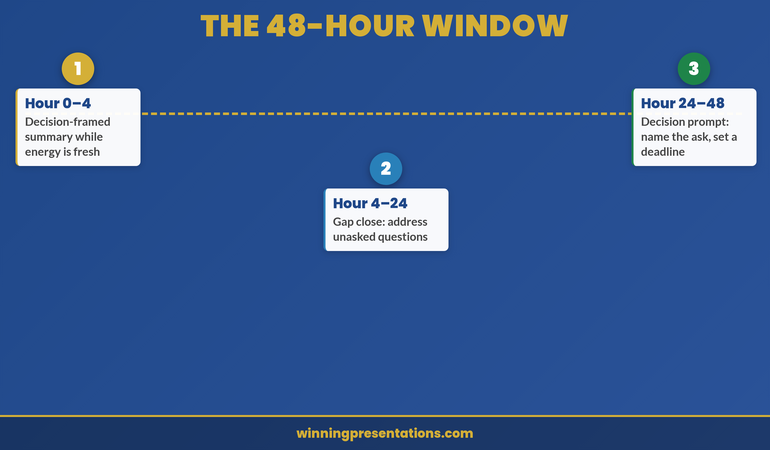
The first 4 hours after a Q&A: the decision-makers still remember your key points, your confidence, and the room’s energy. This is when a follow-up has the most impact.
Hours 4–24: the details begin to fade, but the overall impression remains. A well-structured follow-up during this period anchors the decision in the decision-maker’s mind as “progressing” rather than “pending.”
Hours 24–48: the decision is now competing with everything else on the executive’s agenda. After 48 hours, most decisions migrate from “active” to “someday” — and “someday” decisions rarely happen without external pressure.
This isn’t speculation. It’s the pattern I’ve seen across hundreds of executive decision cycles in banking, consulting, and corporate finance. The presenters who close in one meeting don’t just present better. They follow up faster and more strategically.
Q&A Preparation and Follow-Up Framework
The Executive Q&A Handling System provides a complete framework for Q&A management and the 48-hour decision window:
- Question prediction frameworks for preparation
- Response structures for difficult and ambiguous questions
- Follow-up frameworks for the 48-hour decision window
- Bridge statement techniques for clear communication
Explore the Executive Q&A Handling System →
Based on experience with executive Q&A sessions in banking, consulting, and corporate governance.
Step 1: The Decision-Framed Summary (Within 4 Hours)
Most people send a “thank you for your time” email after a Q&A session. This is a wasted opportunity. The first follow-up email should frame the decision, not express gratitude.
The structure is specific. Lead with the decision statement — not “thanks for the great discussion” but “To confirm, we are requesting approval for [specific ask] by [specific date].” Then list the three strongest points that emerged during the Q&A, phrased as agreed positions, not arguments. Finally, note any action items that were assigned during the session, with owners and deadlines.
This email does three things. It anchors the decision in the recipient’s mind as “active.” It converts the discussion into documented agreement. And it creates a written record that makes deferral harder — it’s much easier to defer a vague conversation than a specific, documented ask.
Send it within 4 hours. Not the next morning. Not after you’ve “had time to reflect.” Within 4 hours, while the room energy is still fresh in everyone’s memory. The technique I describe for pausing before answering creates the same kind of deliberate strategic timing — it’s about controlling the pace, not just the content.
Step 2: The Gap Close (Within 24 Hours)
The gap close addresses the questions that weren’t asked — or were only partially answered — during the Q&A session.
After every Q&A, write down two lists. List one: questions that were asked and answered. List two: questions that should have been asked but weren’t. The second list is more important.
Silent objections — the concerns decision-makers have but don’t voice in the room — are what kill proposals between meetings. If you know the decision-maker’s peers are sceptical about the budget, or the timeline seems aggressive, or the risk assessment didn’t address a specific scenario, proactively addressing these in a follow-up removes them as deferral ammunition.
The gap close email is short. “Following our session yesterday, I wanted to address two points that may be relevant as you discuss next steps.” Then address the unasked questions directly, with concise answers and supporting data if needed.
This demonstrates two things the decision-maker values: you understand their context beyond the presentation room, and you’re not waiting passively for a verdict. A strong question prediction framework helps you identify these silent objections before they become blockers.
Step 3: The Decision Prompt (Within 48 Hours)
The decision prompt is the follow-up most people never send. It explicitly asks for the decision.
Not “just checking in.” Not “wanted to see if you had any further questions.” A direct, respectful request for a decision.
The format: “Based on our discussion on [date] and the follow-up I sent yesterday, I’d like to propose we target a decision by [specific date — ideally within the next week]. If there are outstanding concerns, I’m available to address them in a 15-minute call. Otherwise, I’ll proceed with [specific next step] pending your confirmation.”
This email works because it creates a decision fork. The recipient either approves, raises a specific objection (which you can address), or requests a call (which gives you another opportunity to close). The one thing it prevents is silence — which is where most post-Q&A proposals go to die.
The timing matters. Send it at hour 48 — not earlier, not later. Earlier risks appearing pushy. Later risks losing the momentum entirely. At 48 hours, you’ve given them time to process, you’ve addressed potential gaps, and you’re now making it easy to say yes.
Structured Q&A Follow-Up Over 48 Hours
Complete framework for Q&A management — from preparation through the decision-framed follow-up.
Explore the Executive Q&A Handling System →
Built from experience across banking, consulting, and corporate governance.
The Anatomy of a Decision That Stalls: What Goes Wrong After a Strong Q&A
Understanding why decisions stall helps you prevent it. The pattern is remarkably consistent across organisations and industries.
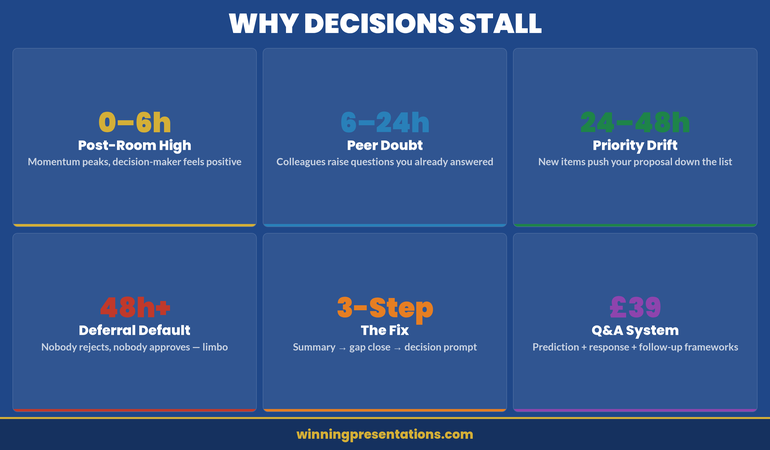
Stage 1: Post-room confidence (hours 0–6). The decision-maker feels positive. Your presentation landed. The Q&A went well. They’re inclined to approve.
Stage 2: Peer consultation (hours 6–24). The decision-maker mentions your proposal to colleagues, direct reports, or their own manager. These people weren’t in the room. They ask questions you’ve already answered — but the decision-maker can’t remember the details. Doubt begins.
Stage 3: Competing priorities (hours 24–48). New urgent items arrive. Your proposal moves from “top of mind” to “when I get to it.” The emotional momentum from your Q&A has fully dissipated.
Stage 4: Deferral default (48+ hours). Without active follow-up, the proposal enters “pending” status. Nobody formally rejects it. Nobody formally approves it. It sits in limbo until an external deadline forces action — or until it’s forgotten entirely.
The 3-step framework interrupts this pattern at stages 1, 2, and 3. The decision-framed summary captures stage 1 momentum. The gap close pre-empts stage 2 peer objections. The decision prompt prevents stage 3 drift.
The Cross-Link: When the Partnership Pitch Needs This Framework
Partnership proposals are particularly vulnerable to the 48-hour window problem because the decision involves multiple stakeholders from multiple organisations. If you’re presenting a partnership, joint venture, or strategic alliance, today’s companion article on the partnership proposal that gets yes in one meeting covers the slide structure — and this follow-up framework is what locks the decision in place after the slides are closed.
Is This Right for You?
✓ This is for you if:
- You’ve had Q&A sessions that felt like wins but never converted into approvals
- Your proposals consistently stall in “under review” status after strong presentations
- You want a structured follow-up framework, not just “send a thank-you email”
✗ This is NOT for you if:
- Your challenge is handling the Q&A itself (questions, hostile audiences, freezing under pressure)
- You’re preparing for a presentation that doesn’t require a decision or approval
- The decision is already made and you need implementation support
Frequently Asked Questions
Won’t sending three follow-up messages in 48 hours seem aggressive?
Not when each message adds value rather than just “checking in.” The decision-framed summary provides documentation. The gap close answers questions they haven’t asked yet. The decision prompt offers a specific path forward. Executives respect efficiency and initiative. What they find annoying is passive “just following up” messages with no substance. Each of these three messages gives them something useful, not just a reminder that you exist.
What if the decision-maker explicitly said “we need more time”?
Respect the timeline they give — but still send the decision-framed summary and the gap close. These aren’t pressure tactics. They’re documentation and proactive objection handling. When they’re ready to decide, your follow-up materials will be the reference documents they use. The only message you delay is the decision prompt — send it when their stated timeline expires, not before.
Does this framework work when the Q&A didn’t go well?
It’s even more important when the Q&A was rocky. A poor Q&A performance is an open wound — if you don’t address it quickly, the decision-makers’ last memory of your proposal is confusion or unconvincing answers. The gap close email is critical here: it lets you provide the clear, composed answers you wish you’d given in the room. Many approvals have been recovered by a strong follow-up after a weak Q&A.
📬 The Winning Edge — Weekly Presentation Intelligence
Join executives who receive one actionable presentation insight every week. Q&A techniques, decision frameworks, and follow-up strategies that convert presentations into approvals.
Read next: Why Visualisation Doesn’t Work for Presentation Anxiety (And What Does, According to Neuroscience)
Your next Q&A session will end. The room will empty. What you do in the next 48 hours determines whether that session becomes an approval or a footnote. Download the Executive Q&A Handling System before your next high-stakes session and own the follow-up.
About the Author
Mary Beth Hazeldine is Owner & Managing Director of Winning Presentations. With 24 years of corporate banking experience at JPMorgan Chase, PwC, Royal Bank of Scotland, and Commerzbank, she advises executives across financial services, healthcare, technology, and government on structuring presentations for high-stakes funding rounds and approvals.