

In this article:
Ines Carvalho had presented hundreds of times at her previous level. As Head of Commercial Strategy she had been calm, clear, occasionally funny. Three months after her promotion to Chief Commercial Officer, she stood in front of the board for the first time — a full agenda item on pricing architecture — and by slide four she felt the imposter wave rise through her chest.
It was a specific moment. She had just finished explaining the margin implications of a tiered pricing model when she noticed the senior non-executive chair frown and glance at the CFO. That was all. A frown. But inside Ines the internal voice started a recursive commentary: he thinks this is basic, they can see you do not belong here, any minute now someone will ask the real question and you will not have the answer. Her next sentence came out in a higher register and slightly too fast.
What saved her was a small intervention she had used once years earlier. She stopped talking, looked at her slide, took one deliberate breath, and said, “Let me slow down on this next point, because it is the most commercially important one.” The chair’s frown, as it turned out, was not about her — he had been puzzled by a figure on the previous slide. The presentation recovered. The board approved the direction.
Ines came through. But on the drive home she knew she could not run her C-suite presenting life on the hope that a panic-interruption technique would save her every time. She needed a way to walk into a board room already anchored in evidence of her own competence, so that a frown from a non-exec could never again become a five-minute internal spiral while her mouth kept moving.
If the step up into a more senior presenting role has brought a sharper edge of anxiety with it, Conquer Speaking Fear is a structured programme for executives who need to steady their nervous system before high-stakes delivery — without pretending the feeling is not there.
Why Promotion Triggers Presentation Imposter Syndrome
Imposter syndrome is often framed as a confidence problem that people should have grown out of by the time they reach senior leadership. In practice, the opposite tends to happen. Many executives who felt entirely steady at their previous level experience a distinct uptick in presentation anxiety in the first year of a more senior role. The title changes faster than the self-image, and the gap between the two expresses itself most clearly in front of a room.
Three structural shifts drive this, and understanding them matters because it separates the feeling from any judgement about your actual capability. First, the peer group changes. You are no longer presenting to the people you used to lunch with; you are presenting to people who chaired your interview panel, or to non-executives whose CVs you quietly read before the meeting. The social signalling you used to rely on — the warm nods, the in-jokes, the familiar rhythm of a team you have worked with for years — disappears overnight.
Second, the stakes rise. A presentation at Head-of-X level that went sideways was embarrassing; a presentation at C-suite level that goes sideways affects strategic decisions, capital allocation, or regulatory standing. Your brain registers that escalation accurately, and it responds with heightened arousal. That heightened arousal is useful in small amounts. In larger amounts, it starts to read the room through a threat-detection filter rather than a collaboration filter. The same people who would look engaged before a promotion start to look sceptical after one, even when nothing about their actual expression has changed.
Third, and most uncomfortably, there is no longer a mentor above you on the slide track. At Head-of level, you could privately rehearse with the director above you. At director level, the EVP. At C-suite, the options narrow dramatically — the CEO is not going to walk you through your own pricing presentation, and you would not ask. The loss of that rehearsal scaffolding is under-recognised. It is a real structural change, not a character flaw. These overlapping dynamics are explored further in our guide on promotion presentation anxiety, which looks at the first-year transition in more detail.
Steady Your Delivery Before the Next Board Meeting
Conquer Speaking Fear is a structured programme for senior professionals whose presentation anxiety has followed them into a more exposed role. It addresses the nervous-system response, the internal commentary, and the delivery distortions that imposter feelings create — so that your preparation can actually reach the room.
£39, instant access. Designed for executives presenting at board and committee level.
Fraud-Detection Anxiety at Board Level
There is a specific flavour of imposter experience that appears for the first time when executives start presenting to boards or board committees. It is not the familiar “I hope I do well” nerves of earlier career stages. It is closer to a low-grade fear of being detected as a fraud — even in people with decades of genuine expertise behind them. This is worth naming because the usual confidence advice (“remember how qualified you are”) does not touch it.
Fraud-detection anxiety has a few recognisable features. It tends to activate around the presence of one specific person in the room — often the non-exec whose expertise overlaps most with your own, or the long-serving chair. It focuses your attention on the questions you cannot answer rather than the material you have prepared. And it creates a distinctive somatic pattern: a tightness in the upper chest, a dryness in the throat, and a narrowing of peripheral vision so that the room starts to feel smaller and more claustrophobic than it actually is.
The brain under this kind of load is running an old pattern-match: “people with more experience than me are going to notice that I do not really know what I am doing.” The fact that you do know what you are doing, that you were promoted precisely because you demonstrated that knowledge, does not land emotionally. The body is treating the room as an audit of your legitimacy, and it is preparing accordingly.
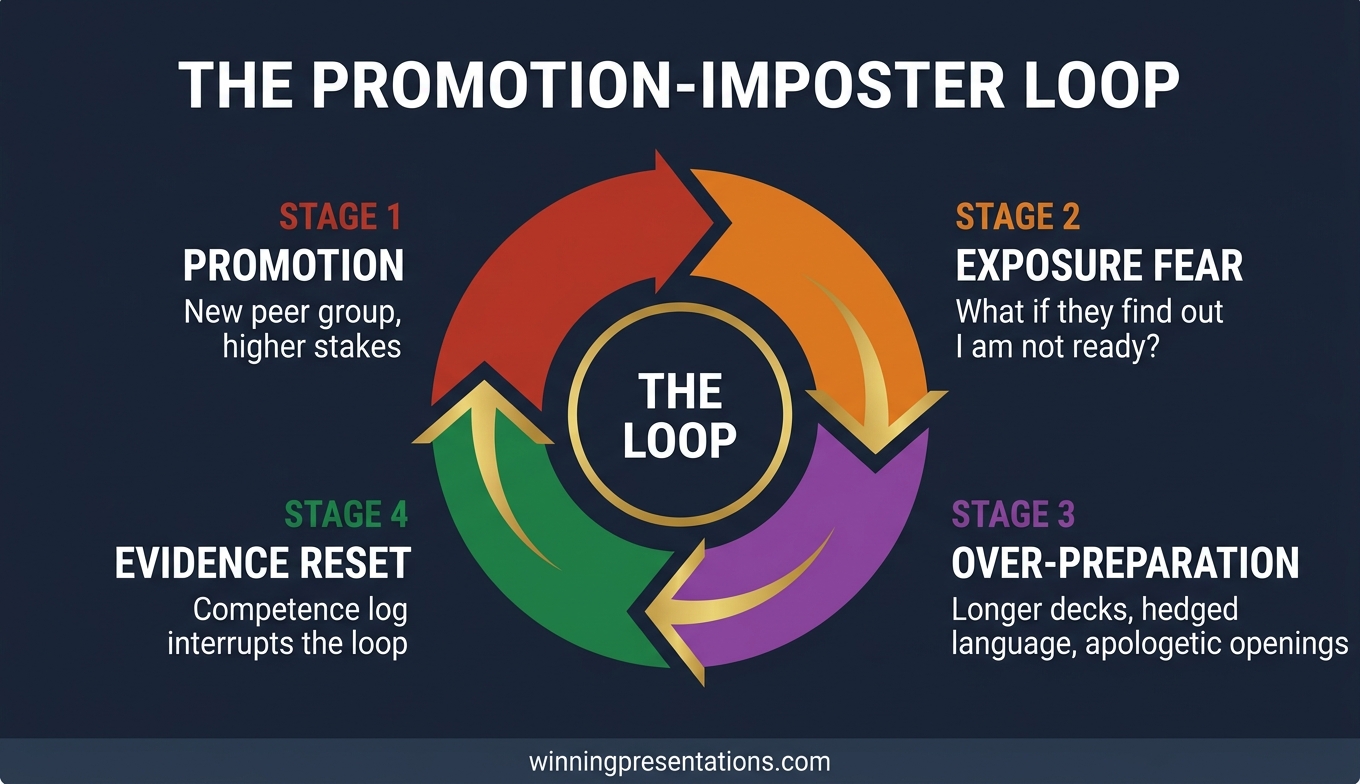
The paradox is that this anxiety is most common in people who are very well prepared. Over-preparation is often a coping response to fraud-detection fear, not an expression of conscientiousness. The pattern is: the more scared I am of being exposed, the more I will try to pre-empt every possible question. And the more pre-emptive detail I load into the deck, the more anxious I become about whether I can hold all of it together under pressure. This overlap between preparation and fear is explored in our companion piece on executive confidence in speaking.
How Imposter Feelings Distort Your Delivery
One of the most painful aspects of post-promotion imposter syndrome is that it produces visible signals in your delivery, which then reinforce the feeling. The internal experience is “I am worried they can see I am not meant to be here.” The external behaviour includes a cluster of small tells that make the room subtly less sure of you than it otherwise would be — which increases the chance of exactly the sceptical look that triggered the spiral in the first place.
Over-preparation. A 60-slide deck for a 20-minute agenda item. Every possible objection pre-answered in a back-up slide. A briefing pack so thick that it telegraphs anxiety rather than mastery. Senior rooms read over-preparation as a lack of editorial judgement, which is the opposite of what the over-prepared presenter wants to signal.
Hedging language. “I think this might suggest that perhaps we could consider…” The sentence arrives with so many softeners that the actual recommendation is invisible. This is almost always an imposter-driven linguistic choice — the presenter is distancing themselves from the claim so that, if challenged, they have an escape route. Boards experience this as evasiveness even when it is really self-protection.
Apologetic openings. “Sorry, this is going to be quite technical,” or “I know this is not my area of core expertise, but…” These openings pre-concede the room before the material has even started. They come from a place of trying to manage expectations downward, but they function as an invitation for the audience to listen less carefully — which then often results in the outcome the presenter was most afraid of.
Speed. The single most common delivery distortion under imposter stress is accelerated pace. The brain wants to get through the exposed moment as quickly as possible, and the mouth cooperates. Pace is the first thing to go and the most reliable outward signal that something internal has shifted. This is particularly noticeable when presenting to former peers, where the contrast between your usual pace and your promoted-role pace is most visible to the room.
Eye-contact collapse. Under imposter load, the eyes start to find the easy faces — the one friendly peer, the people looking at their papers, the back of the room. The person most likely to trigger the fraud-detection fear is precisely the person you stop looking at, which is often the senior figure whose engagement you most need.
Recognising these distortions is not the same as fixing them. You cannot out-will a nervous-system response mid-sentence. But naming them in advance makes them catchable, and catchable is the first step to manageable. If you would like a structured tool for resetting during a presentation when one of these patterns appears, the Conquer Speaking Fear programme includes specific in-the-moment protocols for each of them.
The Competence-Evidence Protocol
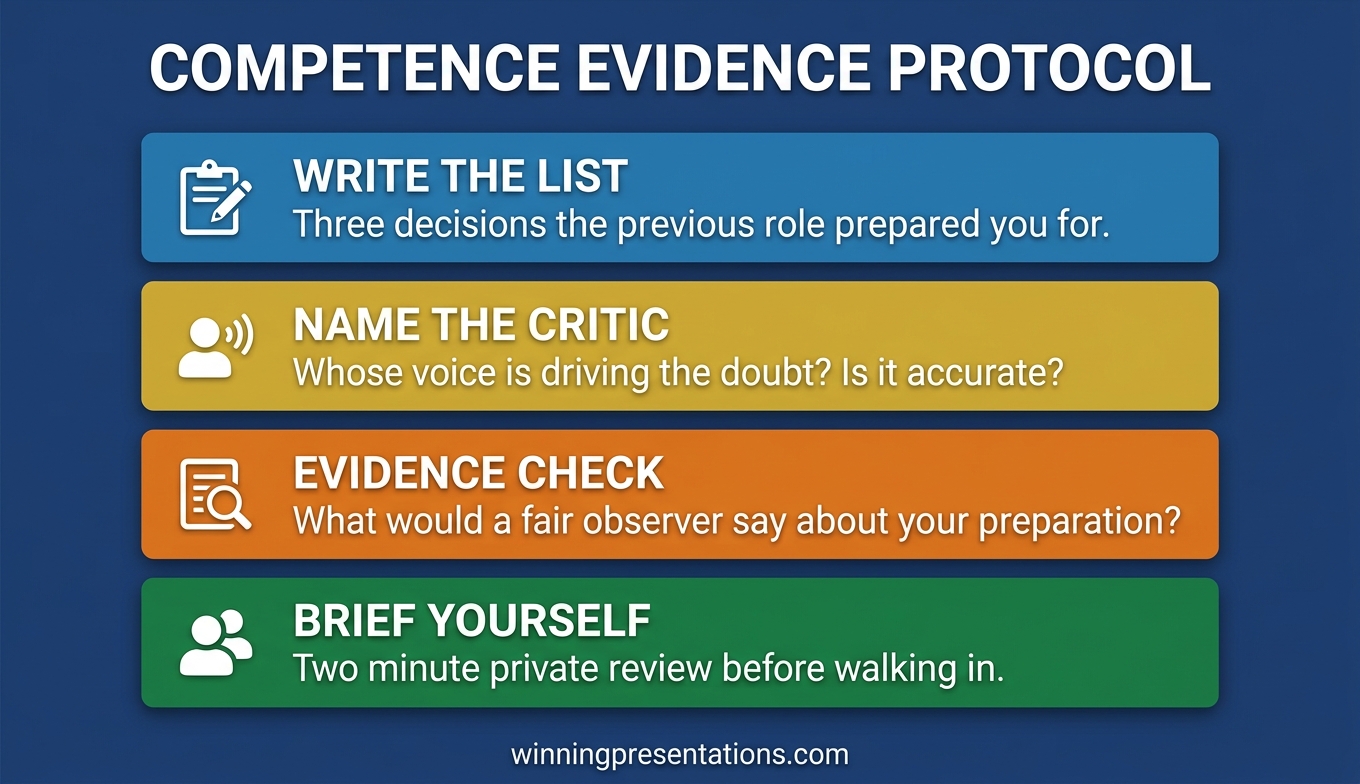
The most durable intervention for post-promotion presentation anxiety is not a breathing technique or a power pose. It is a structured pre-meeting protocol that gives the anxious brain something specific to do with the evidence of your actual competence, rather than leaving it abstract. Generalised affirmations (“you are qualified, you belong here”) do not work well under pressure because the threat-detection system discards them as reassurance. Concrete, reviewable evidence does work, because the brain can anchor to it.
The protocol has four steps, and it takes about forty minutes in total. It is done the afternoon or evening before the presentation, not in the ten minutes beforehand — the work is to enter the room already regulated, not to try to rescue a panicked state at the door.
Step 1: Write out the appointment evidence. In specific, factual language, note the decisions that were made by named people to put you in this role. Who interviewed you. Who signed off. What capability they cited in doing so. The goal is not to flatter yourself; it is to externalise the reality that this promotion was a deliberate, informed decision by people whose judgement you respect. Imposter thinking floats when the appointment feels vague. It steadies when the appointment becomes an event with names and reasoning attached.
Step 2: List three pieces of relevant track record. Not your whole career — three specific pieces of work that map to the subject of the presentation you are about to give. For a pricing architecture presentation: the pricing decision you drove in 2023, the margin recovery you led last year, the model you built that is still in use. The brain needs to see that the topic of the meeting is not a novel exposure — it is a field in which you have demonstrable history.
Step 3: Pre-answer the three hardest questions. Not in slide form — in plain English, written out in full sentences. The act of writing, rather than mental rehearsal, is what embeds the answer. Under pressure, written-out answers retrieve far more reliably than rehearsed ones. This is the single highest-leverage part of the protocol. It also short-circuits the “what if they ask the thing I cannot answer” loop, because you have already gone and found the thing.
Step 4: Define the minimum successful outcome. Write one sentence: “If this meeting goes well enough, what will have happened?” Often the imposter brain treats the meeting as a career-defining exam. Defining a minimum successful outcome shrinks it to a manageable transaction: “The board will have understood the commercial logic of the recommendation and agreed the direction, even if the detail needs a follow-up session.” That is a realistic target. “The board will think I am brilliant” is not.
This protocol does not remove the anxiety. What it does is prevent the anxiety from colonising your preparation and your opening minutes. You arrive with a written anchor. When the familiar wave rises, you have something specific to return to — which is what a nervous system actually needs in a high-stakes room.
A Structured Programme for Senior-Role Presentation Anxiety
Conquer Speaking Fear walks through the nervous-system response, the imposter patterns that follow a promotion, and the in-the-moment protocols for steadying your delivery when the wave rises mid-sentence. Written for executives, not beginners.
£39, instant access.
Reframing Your New Peer Group
One of the quieter drivers of post-promotion imposter anxiety is a subtle misreading of the new room. At earlier career stages, an audience full of more senior people is genuinely auditing you; that is part of how progression works. By the time you reach C-suite, the room’s orientation is different, but the presenter often does not update their internal model to match.
A board committee or executive committee is not primarily there to audit your legitimacy. They are there to make a governance decision or a strategic decision based on material you know more about than they do. Your expertise is the reason you are in the room; they are looking to you for judgement, not for justification. The non-exec who frowns is usually not thinking “does she belong here?” She is thinking “do I understand this figure?” or “how does this affect the risk appetite we set in January?”
This reframe is important because the feeling of being audited produces defensive behaviour, and defensive behaviour produces exactly the outcome the imposter brain most fears. The presenter hedges, over-explains, or apologises, and the room’s attention subtly re-orients from the content to the presenter’s discomfort. By contrast, a presenter who walks in holding the frame “my job is to help you make a good decision” tends to sound clear, specific, and calmly authoritative — because the relationship to the room is cooperative, not performative.
In practical terms, try rewriting your opening line to reflect this reframe. Not “I am going to talk you through the pricing architecture,” which is presenter-centred, but “There is a commercial decision in front of the board today that I want to make as straightforward as possible. The pricing architecture matters because…” The second version positions you as a partner to the committee’s work, not a candidate for their approval.
Building a Steady State for Future Presentations
The first year after a promotion is when imposter-driven presentation anxiety is most acute. By the end of that year, most executives have either built a stable presenting rhythm at the new level — or they have developed chronic avoidance patterns that will shape the rest of their tenure. The difference between the two outcomes is rarely about natural confidence. It is about whether a few specific habits are deliberately put in place.
After every significant presentation, write a three-line debrief. What worked. What did not. What I will do differently next time. Do not rely on memory. Imposter thinking systematically misremembers presentations — it retains the moments of perceived failure and discards the moments of competence. A written debrief corrects for this distortion over time. After twelve presentations, you have a factual record of what actually happens when you present at your new level, which is far more useful than a feeling.
Find one peer-level rehearsal partner. Ideally someone else who has been recently promoted into a similar exposure. You are not asking for coaching; you are asking for thirty minutes of “run your opening past me before the meeting.” This restores a version of the mentor-above rehearsal scaffolding that the promotion removed, just in a horizontal rather than vertical form.
Build a personal file of competence evidence. Save the email where the CEO said the board was impressed. Save the note from the non-exec chair. Save the pricing decision that your model produced. Not for vanity — for review before the next high-stakes meeting. When fraud-detection anxiety rises, concrete evidence has to be retrievable within sixty seconds, or the anxiety will win.
Normalise the feeling. The goal is not to reach a state where board presentations feel easy. Senior presentations should carry a healthy weight — the stakes are real, and a certain level of internal arousal is both appropriate and useful. The goal is to uncouple the arousal from the self-concept. You can feel the wave rise and not take it as evidence that you do not belong. That is a skill, and it is trainable. The same uncoupling principle underpins our framework for emotional regulation during Q&A, which is often the moment when imposter pressure peaks.
Frequently Asked Questions
Why does presentation anxiety get worse after a promotion?
Because three things shift upwards at the same time: the stakes of the presentation, the seniority of the audience, and the absence of a mentor above you to pre-rehearse with. Your internal sense of competence tends to catch up more slowly than your title does, and that gap is where imposter-driven anxiety lives. It is not a sign that you are less capable than before — it is a predictable response to a more exposed role.
Does imposter syndrome eventually go away on its own?
For some people it settles as they accumulate a track record in the new role. For many others it becomes quieter but does not disappear, and it can re-intensify at the next promotion or whenever the stakes rise again. Waiting for it to fade is a high-risk strategy because it can shape avoidance patterns that constrain your career. A deliberate pre-meeting protocol, a written debrief habit, and a peer rehearsal partner tend to produce more reliable steadying than the passage of time alone.
How do I stop apologising at the start of board presentations?
Write your opening line out in full and read it back. If it contains any version of “sorry,” “I know this is,” or “bear with me,” rewrite it. Replace the apology with a framing sentence that positions you as a partner to the committee’s decision rather than a candidate for approval — for example, “There is a commercial decision in front of the committee today, and the purpose of the next ten minutes is to give you what you need to make it well.” Apologetic openings are almost always a learned habit, and they are changeable with a written script.
Should I tell my CEO or chair that I am feeling imposter syndrome?
There is no universal answer, but a measured version of the conversation is often helpful with a trusted chair or sponsor — not framed as a request for reassurance, but as a practical discussion about how your first year in the role is going. A good chair will usually respond with specific feedback on what they have observed, which is more useful than generalised encouragement. Keep it professional and structural. The aim is not to be rescued but to open a feedback channel that the promotion might otherwise have closed.
Join The Winning Edge
Free weekly newsletter for executives navigating high-stakes presenting at senior level. Practical frameworks, nervous-system protocols, and board-room communication strategies — delivered every Thursday.
Read next: Imposter pressure often peaks in the Q&A rather than the prepared remarks. See Emotional Regulation and the Q&A Reset for a practical protocol on steadying yourself between a difficult question and your answer.
Next step: Pick your next board or committee presentation and run the four-step competence-evidence protocol the evening before — written out, not mental. Compare how the opening five minutes feel against your last one. That is the quickest way to test whether a structured approach changes your delivery in the rooms that now matter most.
Mary Beth Hazeldine is the Owner & Managing Director of Winning Presentations. With 25 years of corporate banking experience at JPMorgan Chase, PwC, Royal Bank of Scotland, and Commerzbank, and 16 years training executives, she advises senior leaders across financial services, healthcare, technology, and government on presenting with confidence in newly promoted and board-level roles.