Tag: presenting delays

20 Mar 2026
Executive at whiteboard or conference table with project timeline on screen in background, calm authoritative demeanour, navy and gold accents, professional corporate setting

Project Delay Presentation: The Slide Structure That Keeps Stakeholder Trust When Timelines Slip

Quick Answer: Delays happen to every large project. The difference between those that maintain stakeholder trust and those that lose it comes down to a single structure: a four-slide “delay briefing” that leads with what happened, explains why, shows concrete recovery action, and requests one clear decision. This approach transforms the conversation from “you failed to deliver” into “here’s how we move forward together.”
Already in a project delay situation? Skip ahead to the “The 4-Slide Delay Briefing Structure” section for the exact format you need to present this week. If you’re managing multiple stakeholders, the “Stakeholder Mapping for Delay Conversations” section will help you tailor the message to each audience before you walk in the room.

Why Delays Derail Stakeholder Trust (And How to Prevent It)

Marcus arrived at the steering committee meeting with the regular progress update, ready to bury the bad news on slide 14 of 18. He thought if he framed it right—”We’ve experienced some velocity headwinds on the critical path, but we’re still tracking to rebaseline the milestones”—no one would actually notice the £12 million rail modernisation project was now running six weeks behind.

The executive sponsor noticed immediately. So did the infrastructure minister’s office representative. Within fifteen minutes, Marcus had lost the confidence of the entire governance board. For the next three months, every decision took twice as long. Every status update was scrutinised. Trust, once lost, becomes the most expensive commodity on any project.

Marcus, a Programme Director at a large UK infrastructure firm, was managing a £12 million rail station modernisation project with a baseline deadline of 18 months. At month twelve, the structural survey revealed unexpected foundation work that hadn’t appeared in the preliminary geotechnical study. The project slipped nine weeks. Marcus tried to bury the announcement in a standard progress deck, presenting it on slide 14 of 18 with vague language like “velocity headwinds” and “rebaselining milestones.” The executive sponsor spotted it immediately, then in the next meeting, challenged every decision. Marcus’s credibility plummeted for three months until he shifted to a completely different approach: a dedicated four-slide delay briefing presented at the top of the next steering committee agenda. He led with the specific date the delay was discovered, the exact cause (unexpected foundation requirements), named the recovery action owner, and asked for one decision (approve the revised critical path or commission an external validation). The transparency reset trust entirely. His next project—which also slipped nine weeks—never lost sponsor confidence because the delay was briefed the same way, the first time the governance board heard about it.

The problem is almost never the delay itself. Every large project experiences schedule pressure. Sponsors understand that. What destroys trust is the appearance of hiding, the use of vague language, the inclusion of delay news buried in a thirty-slide deck rather than presented first and directly.

The solution is structural. It is not a better apology. It is not more frequent updates. It is a specific slide structure that does three psychological things at once:

  • It signals respect for your audience’s time. You’re not making them hunt for the news. It’s there, honest and clear, at the top of the agenda.
  • It reframes the conversation from failure to problem-solving. You’re not asking for forgiveness; you’re inviting them to collaborate on next steps.
  • It demonstrates control in the face of uncertainty. You know what happened, why it happened, what you’re doing, and what you need from them. That confidence is contagious.

Large organisations—especially those managing infrastructure, capital projects, or regulated environments—live with delays. What they cannot tolerate is the feeling that the project team is making decisions or hiding information. Transparency, specificity, and a clear path forward are worth more than a miracle recovery plan that no one believes.

The 4-Slide Delay Briefing Structure

The structure is deceptively simple, but the simplicity is the point. When people are stressed—and a project sponsor hearing about a major delay is stressed—they cannot process complexity. They want four things in order:

  1. What is the bad news?
  2. Why did it happen?
  3. What are we doing about it?
  4. What do you need from me?

Each of those gets one slide. No more. The power comes from the restraint.

Side-by-side split comparison infographic showing The Buried Approach (delay hidden on slide 14, vague language, no clear owner, sponsor surprised) versus The Proactive Brief (dedicated slide at top of agenda, specific dates and cause, named owner, sponsors briefed in advance)

Figure 1: The Buried Delay Approach loses sponsor trust within minutes. The Proactive Brief reframes the conversation.

This is not a presentation format you use to convince people the delay isn’t actually a delay. It is a format designed to deliver difficult news in a way that keeps the governance relationship intact. If your organisation uses executive presentation structure frameworks, you already understand that simplicity, specificity, and signal-to-noise ratio matter more than comprehensiveness.

Delay Briefing This Week? Use the Exact Four-Slide Structure

The Executive Slide System £39 includes the complete four-slide delay briefing structure used by project and programme leaders in infrastructure, capital, and technology sectors. If you need to rebuild the conversation fast, start with the sequence, not the slides. It includes:

  • Slide templates for the exact four-slide delay structure (ready to adapt to your project)
  • Worked examples from infrastructure, capital, and tech projects
  • The governance conversation framework—how to brief stakeholders before the formal meeting
  • Recovery plan slide formats designed for high-scrutiny executive review

Price: £39 once. No subscription.

Get the Executive Slide System

Slide 1: What Happened (The Single Honest Statement)

This slide has one job: state the fact. No hedging. No jargon. No minimisation.

Bad examples:

  • “We are experiencing velocity headwinds on the critical path.” (What does that mean?)
  • “The project has encountered some scheduling challenges.” (This could mean anything.)
  • “We’ve had to rebaseline certain milestones.” (Why?)

Good example:

  • “On 14 February, we discovered additional foundation work required for the east wing. The project now runs nine weeks behind the baseline completion date.”

The difference is specificity. Specific date. Specific reason. Specific number of weeks. No interpretation, no softening language, no “however.” Just fact.

This slide should take up maybe 60 per cent of the slide real estate. The text should be in the sans-serif body font, the colour navy (#1F4788) on white. Add a single icon or accent line in gold if you want visual interest, but do not overcomplicate it. People are anxious. They want clarity.

The psychological effect is paradoxical: the more direct and simple this slide is, the more competent and trustworthy the project team appears. Vagueness makes people nervous. Specificity makes them think you have control.

Slide 2: Why It Happened (One Root Cause, Not a List)

This is where most project leaders go wrong. They list five reasons—poor requirements, scope creep, resource constraints, third-party delays, weather—and by the time they finish, the executive has tuned out and lost confidence.

The rule for this slide is absolute: one root cause.

If you cannot distil the delay to one root cause, you do not yet understand the delay well enough to brief it. Go back to your team. Work until you find the single thread that, if pulled, explains everything else.

In Marcus’s case, the root cause was not “poor surveying” or “inadequate budget” or “bad luck.” It was: “The preliminary geotechnical study did not include excavation analysis of the east wing basement.” Everything else flowed from that one fact.

This slide should be roughly the same size as Slide 1. One sentence or two maximum. The root cause in the largest font. Smaller text (if needed) showing what this root cause led to.

Do not use this slide to explain away the delay. Do not list mitigation measures you should have taken but didn’t. Do not apologise. State the cause, and move to the next slide.

Slide 3: What We’re Doing About It (Concrete Action)

Now the conversation shifts forward. This slide answers: “What is the concrete action, and who owns it?”

The slide should include:

  • A single recovery action (not a list of ten ideas). For Marcus, it was: “Commission specialist foundation engineering firm to design and schedule the additional work.”
  • The named owner (not “the team” or “we”). For Marcus: “Sarah Chen, Engineering Lead, responsible.”
  • A deadline (when will this action complete). For Marcus: “Completed design and schedule by 28 March.”
  • The outcome that deadline produces (what the sponsor will have on 28 March). For Marcus: “Revised critical path and cost impact for sponsor decision.”

This slide is not a wish list. It is not “things we hope to do.” It is a commitment. The owner should know they are being named on this slide before they walk in the room.

The psychological shift here is profound. The sponsor went from hearing bad news to hearing that the project team has a plan and someone accountable for it. That is enough to keep most governance boards confident.

Slide 4: What You Need To Decide (The One Question)

The final slide removes the ambiguity about the sponsor’s role. It is not “What do you think we should do?” It is a specific decision gate.

This slide should frame a single, clear decision:

  • “Approve the revised critical path, or request external validation before approval.”
  • “Release the contingency budget, or commission a value engineering review first.”
  • “Proceed with the revised schedule, or escalate to the steering committee.”

The decision should be answerable in the meeting or within a short specified window (e.g., “within 48 hours”).

This slide does something psychologically important: it returns agency to the sponsor. They are not passive recipients of bad news; they are decision-makers. Their role is clear. The path forward is clear. That clarity is worth more than any amount of hope or optimism.

Four-card stacked infographic showing The 4-Slide Delay Briefing Structure: Card 1 "What Happened" (one sentence, specific date, specific weeks), Card 2 "Why It Happened" (single root cause), Card 3 "What We're Doing" (named owner, concrete action, deadline), Card 4 "What You Need To Decide" (one decision gate)

Figure 2: The 4-Slide Delay Briefing—each slide answers one question in order.
Pro tip: Rehearse this four-slide briefing with your executive sponsor or steering committee chair before the formal meeting. The briefing works best when it is not a surprise. If the sponsor already knows the four points, the formal briefing becomes confirmation, not shock. That small gesture—giving them a heads-up—can mean the difference between “the project team hid this from us” and “the project team is being transparent with us.”

Timing, Sequence, and Stakeholder Communication

A four-slide briefing fails if it is presented cold. The real skill is in the pre-briefing communication strategy.

Start the process 48 hours before the formal steering committee or governance meeting. Your approach should be:

  1. Brief the chair or sponsor individually first (1:1 conversation, not email). Share all four slides. Let them ask questions. Answer fully. This is not a surprise—it is a partnership.
  2. Brief any other key governance members (steering committee chair, finance lead, executive sponsor) before the group meeting. Same four slides. Same transparency. By the time the group meets, there are no surprises.
  3. Present the four-slide briefing to the full governance board as the first agenda item. This is not buried in a 30-slide deck. It is the opening conversation.

Stakeholder mapping for the delay conversation means understanding which stakeholders need to hear the news first, in what sequence, and in what format. For a capital project, the executive sponsor is always first. For a product release, the head of product is first. For a regulatory matter, legal and the regulatory lead are first.

The four-slide briefing then becomes the “formal record” that was already discussed, not a shock announcement.

Common Mistakes That Destroy Trust

Mistake 1: Trying to Make the Delay Sound Small

Language like “a modest three-week slip in the east wall construction phase” sounds like you are minimising the problem. Call it what it is: “three weeks.” Let the sponsor decide if it is modest or serious.

Mistake 2: Burying the Announcement in a Larger Deck

If the delay briefing is slides 14–17 of a 30-slide progress deck, the sponsor’s first reaction is not “Okay, let’s work on this together.” It is “Why is this buried? What else are they hiding?” Present the four slides as a standalone briefing or as the first section of a meeting.

Mistake 3: Listing Multiple Root Causes

If you say “The delay was caused by poor surveying, inadequate budget reserves, and unexpected weather,” the sponsor hears “Your project team is disorganised and doesn’t know what actually went wrong.” Find the one thing that, if it hadn’t happened, the project would not be delayed. Everything else is secondary.

Mistake 4: Proposing a Recovery Plan Without a Named Owner

“We will accelerate the east wing work by bringing in additional resources” is vague. “Sarah Chen will bring in two additional foundation teams by 21 March, with completion targeted for 15 May” is a commitment. The named owner is what gives sponsors confidence.

Mistake 5: Leaving the Sponsor’s Role Ambiguous

Do not end with “Any questions?” End with a specific decision gate: “We need you to approve the revised schedule by Friday, or escalate to the steering committee for a broader review.” That clarity is what allows them to move forward instead of worry.

When Sponsor Trust Is at Stake, Structure Is What Protects Your Standing

Sponsors rarely lose confidence because of one delay. They lose confidence when the briefing is vague, evasive, or unprepared. The Executive Slide System gives you the specific slide formats that keep governance relationships intact under pressure — the delay briefing, the recovery plan, and the replan presentation. Each format is structured to demonstrate clarity, ownership, and forward motion, so the conversation stays professional rather than defensive.

Get access to: Delay briefings, replan presentations, budget conversations, governance resets, and crisis communication frameworks.

Get the System for £39

Building the Recovery Narrative Beyond the Four Slides

Once the four-slide briefing has been delivered and the decision made, the project moves into a different communication phase. This is no longer a crisis brief; it is a recovery narrative.

The recovery narrative should include weekly updates (brief, specific), clear milestones with target dates, and a planned “recovery complete” milestone that the sponsor can anticipate. The tone shifts from “here is bad news” to “here is progress toward resolution.”

In many cases, especially in long-term infrastructure projects, the recovery narrative becomes routine status reporting. The key is that the project team has now established a pattern of transparency and specificity. Future announcements—whether positive or negative—will be received with greater credibility because the team has demonstrated they communicate clearly under pressure.

This is where the decision-slide framework for executive conversations becomes invaluable. Every recovery update, every milestone review, and every governance conversation needs the same clarity: here is the situation, here is what we are doing, here is what we need from you.

Adapting the Framework to Your Project Type

The four-slide structure works across all project types because it is psychologically sound, not because it is industry-specific. However, the content adapts slightly depending on what you are managing:

Infrastructure and Capital Projects: Slide 1 focuses on the specific work package delayed and weeks behind. Slide 2 names the physical or contractual cause. Slide 3 names the remediation action and owner. Slide 4 asks for budget or schedule approval.

Technology and Product Launches: Slide 1 names the feature or release delayed and the revised go-live date. Slide 2 focuses on technical or resource constraints (bugs discovered, skills gaps, third-party API delays). Slide 3 names the engineering lead and the specific resolution path. Slide 4 asks for a decision on MVP scope or launch timing.

Regulatory and Compliance Projects: Slide 1 names the deadline or milestone at risk. Slide 2 cites the regulatory or compliance barrier (new interpretation, third-party audit finding, external requirement change). Slide 3 names the compliance lead and the approach to remediation. Slide 4 asks for escalation to legal or regulatory leadership if needed.

The structure is the same. The details change based on your context. The psychological principle—clarity, ownership, and forward motion—is universal.

Is This Approach Right For You?

  • Yes, if: You manage projects with external stakeholders or governance boards who need to approve scope, schedule, or budget changes. You are facing a delay of more than a few days and need to reset the relationship with sponsors.
  • Yes, if: You have experienced a situation where poor communication about a delay led to loss of confidence, and you want a framework to prevent that from happening again.
  • No, if: Your delays are typically resolved without governance approval or sponsor notice. This framework is for situations where the sponsor’s trust and decision-making matter.

Frequently Asked Questions

What if the delay is still being assessed? Do I brief the sponsor before I have all the facts?

Yes. Here is what you say: “We discovered a potential delay on [date]. We do not yet have a full assessment, but here is what we know so far: [specific facts]. We are commissioning [named action] to give us full clarity by [date]. In the interim, here is what the delay could mean: [range]. We will brief you the moment we have the full picture.” This is transparency, not weakness. Sponsors trust teams that know what they don’t know.

Should I present the four-slide briefing in a formal steering committee meeting, or in a 1:1 with the sponsor first?

Do a 1:1 first (48 hours before the formal meeting). Share all four slides. Answer every question. Then brief other key stakeholders individually. Then present to the full group as confirmation, not shock. The four-slide briefing is the same in all contexts, but the audience shape matters for trust.

What if the sponsor asks for more detail or a deeper recovery plan during the four-slide briefing?

Have a follow-up deck ready (separate from the four slides). The four-slide briefing is the governance conversation. The follow-up deck is the detailed plan. Keep them separate. The four-slide briefing should answer the immediate questions (what, why, what now, what do you decide). The follow-up deck goes deeper into risk, cost, resource, and timeline detail. Never mix them or the impact of the four-slide clarity is lost.

🆓 Free resource: Executive Presentation Checklist — a free guide to strengthen your presentation preparation.

For more on structuring high-stakes presentations, read our guide to pipeline review presentations for sales leaders—another scenario where clarity and specificity determine whether sponsors lean forward or pull back.

What’s Inside the Executive Slide System

The Executive Slide System gives you slide structures, templates, and decision frameworks for the executive presentation scenarios you face most often — including delays, budget briefings, governance resets, crisis communications, and stakeholder recoveries. Each template is ready to adapt to your specific project, timeline, and audience.

What you get:

  • Slide templates for 12 executive scenarios (including the complete four-slide delay briefing)
  • Decision-slide frameworks that make briefings clear and actionable
  • Worked examples from real projects (infrastructure, capital, technology, regulatory)
  • Pre-briefing communication strategy guides
  • One-time price: £39

Get the Executive Slide System for £39

About the author: Mary Beth Hazeldine is a former investment banker at RBS with over 20 years’ experience in executive communication, stakeholder management, and crisis briefings across infrastructure, capital, and technology sectors. She is based in Edinburgh and specialises in helping leaders master the presentation skills that determine organisational outcomes. Her work has been featured in financial media and executive leadership publications.

Project delays are inevitable in large organisations. What matters is whether your sponsors believe you are hiding something or collaborating with them to move forward. The four-slide briefing structure gives you a way to do the latter.

24 Feb 2026
Executive reviewing red-status project dashboard with declining metrics before presenting recovery plan to steering committee

The Failing Project Presentation Nobody Teaches You to Give

Quick Answer: When your project is off track, most people present excuses disguised as context. Executives don’t want to know why it failed — they want to know what happens next, what it costs, and what decision you need from them. The failing project presentation that saves careers follows a specific structure: own the status in one sentence, quantify the impact, present a recovery plan with options, and make a specific ask. Six slides. No defensive preamble.

The project was £1.2M over budget, four months behind, and the steering committee wanted answers in fifteen minutes.

My client — a programme director at a financial services firm — had prepared 34 slides. Thirty-four. Timeline comparisons, resource allocation charts, dependency maps, vendor performance scorecards, risk registers, and a RACI matrix that nobody had asked for.

I looked at the deck and said: “You’ve built the defence case. Where’s the recovery case?”

She paused. “What do you mean?”

“You’ve spent 30 slides explaining why this happened. You’ve spent 4 slides on what happens next. The steering committee doesn’t need a forensic investigation — they need to know three things: how bad is it, what’s the plan, and what do you need from us.”

We rebuilt the entire presentation in two hours. Six slides. The first one said: “Project is off track. Here’s the recovery plan and what I need from this committee to execute it.”

She walked into that steering committee and walked out with the resources she’d asked for. Not because the news was good — it wasn’t. Because the structure told the room she was in control of the problem, not drowning in it.

🚨 Project gone red and presenting to leadership this week? Quick check: Does your first slide state the status and the plan — or does it start with context and background? If it’s background, you’re building a defence case. They want a recovery case. → Need the exact off-track project structure? Get the Executive Slide System → £39

Why Most Failing Project Presentations Make Things Worse

Here’s the pattern I’ve seen in every failing project presentation that ends badly: the presenter leads with explanation.

“The vendor deliverables were delayed.” “We lost two key team members in Q2.” “The requirements changed mid-stream.” “The timeline was ambitious from the start.”

Every one of these statements might be true. And every one of them sounds like an excuse.

This isn’t fair. But it’s how executive brains work. When leadership hears explanation before solution, they categorise you as someone who understands the problem but can’t fix it. And once you’re in that category, every subsequent slide — no matter how good — gets filtered through that lens.

The worst version of this is what I call the “archaeology presentation”: a slide-by-slide excavation of everything that went wrong, presented in chronological order, building toward a conclusion the room figured out in slide one. By the time you reach your recovery plan on slide 28, three people have left and the remaining decision-makers have already decided you’re not the person to lead the fix.

Related: If you need to deliver bad news more broadly (not just project updates), see the complete structure for presenting bad news without destroying credibility.

How do you present a project that is behind schedule?

Lead with the status and the plan, not the reasons. State the current position in one sentence (“Project is four months behind and £1.2M over budget”). Then immediately pivot to recovery: what the plan is, what it costs, and what decision you need. The reasons belong in an appendix — available if asked, never volunteered upfront. Executives respect ownership and forward motion. They lose confidence in explanations.

What Executives Actually Need to Hear

I’ve sat in hundreds of steering committees across JPMorgan, PwC, and Commerzbank. When a project goes red, every executive in the room is silently asking four questions — and they need them answered in this order:

1. “How bad is it — in numbers?” Not narrative. Numbers. How much over budget? How many months delayed? What’s the cost of the delay per week or month? If you can’t quantify the impact, you don’t understand it well enough to present it.

2. “Does the project lead know they’re in trouble?” This is the ownership test. If you present the red status without explicitly owning it — if you drift into passive voice (“milestones were missed”) or distribute blame (“dependencies weren’t met”) — you’ve failed this test. The room needs to hear you say: “This project is off track. I own that.”

3. “Is there a credible plan to recover?” Not a vague commitment. A specific plan with options, timelines, resource requirements, and trade-offs. “We’re working on solutions” is the single worst sentence in project management. It tells the room you don’t have a plan yet.

4. “What do you need from us?” Every executive meeting exists to make decisions. If you present a problem without asking for something specific — budget, resources, timeline extension, scope reduction — you’ve wasted their time. And they’ll remember that.

⭐ Turn a Red Status Into a Recovery Plan That Gets Resources

The Executive Slide System includes Scenario 07: “Project Is Off Track” — a step-by-step playbook that tells you exactly which template to open, which AI prompt to run, and which checklist to verify before you walk into the steering committee.

Your off-track project toolkit:

  • Project Status Update template (Card 03) — RAG-status structure with business-impact language
  • Risk Assessment template (Card 09) — pre-emptive objection handling for the questions you’ll get
  • 3 AI prompts per template — Draft → Refine → Executive Polish (stress-test it as a skeptical CEO)
  • The 15-minute version for when the steering committee is tomorrow

Get the Executive Slide System → £39

Built from steering committees at JPMorgan, RBS, PwC, and Commerzbank. Includes 15 scenario playbooks — find your exact situation, follow it like a recipe.

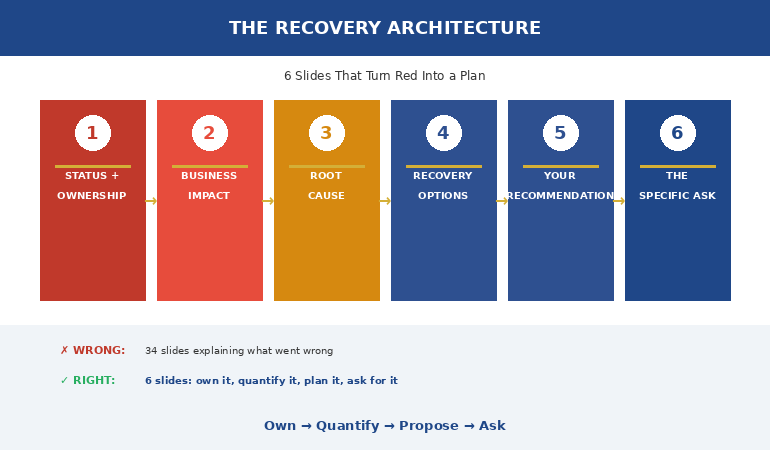
The Recovery Architecture: 6 Slides That Turn Red Into a Plan

After working with dozens of project leads facing this exact situation, I developed what I call the Recovery Architecture. It’s the opposite of the instinctive “explain then propose” approach — and it’s the structure that consistently gets resources instead of blame.

Slide 1: Status + Ownership (one sentence each). “Project Horizon is off track: 4 months delayed, £1.2M over budget. I own this update and the recovery plan that follows.” That’s it. One slide. Two sentences. The room now knows three things: the facts, that you know the facts, and that you have a plan. Most presenters take 10 slides to get here.

Slide 2: Business Impact (quantified). Not project impact — business impact. “Each month of delay costs £180K in manual workarounds and risks missing the Q3 regulatory deadline. Total exposure if unresolved: £2.1M.” Executives think in business outcomes. Translate your project metrics into their language.

Slide 3: Root Cause (one slide, no narrative). Three bullet points maximum. Each bullet: what happened, why, and whether it’s resolved or ongoing. This is the only backward-looking slide in your deck. Keep it surgical.

Slide 4: Recovery Options (not one plan — two or three). This is the slide that separates career-preserving presentations from career-ending ones. Don’t present one plan. Present options with trade-offs. “Option A: Accelerated timeline, £400K additional budget, delivered Q3. Option B: Reduced scope, current budget, delivered Q2 with Phase 2 in Q4. Option C: Pause and reassess, £80K sunk cost, decision in 30 days.” Now the steering committee is choosing between options — not judging your competence.

Slide 5: Your Recommendation. Pick one option and explain why. “I recommend Option A because the regulatory deadline isn’t movable and the cost of non-compliance exceeds the additional budget.” You’ve earned the right to recommend because you’ve shown you understand the full picture. Use the decision slide structure here — recommendation first, reasoning second.

Slide 6: The Specific Ask. “I need this committee to approve £400K additional budget and extend the timeline to Q3. I need that decision today because the vendor contract expires Friday.” Specific. Time-bound. Actionable. This is where steering committees make decisions — if you give them something specific to decide.

The Recovery Architecture six-slide structure for presenting a failing project showing status ownership, business impact, root cause, recovery options, recommendation, and specific ask

How to Own the Status Without Destroying Your Credibility

The ownership moment is the most psychologically difficult part of the failing project presentation. Your instinct screams: if I admit this is my responsibility, they’ll fire me. But the data says the opposite.

In 24 years of banking, I never saw a project lead get fired for owning a problem with a plan. I saw plenty get sidelined for hiding one.

What should you say when a project is failing?

There’s a specific formula that works: Status + Ownership + Pivot. “This project is off track [status]. I’m responsible for this update and the recovery plan [ownership]. Here’s what I’m proposing [pivot].” The pivot is critical — it moves the room’s attention from the problem to the solution in the same breath. Without the pivot, ownership sounds like confession. With it, ownership sounds like leadership.

What you never say: “We” when you mean “I.” “Challenges were encountered.” “The timeline proved ambitious.” Passive voice in a crisis presentation is a credibility killer. It tells the room you’re distancing yourself from the problem — which tells them you can’t be trusted to fix it.

If the physical stress of presenting bad news is a concern — and it is for most people, even experienced presenters — the structural approach helps here too. When you know your first slide establishes ownership and your second quantifies impact, the uncertainty drops. And uncertainty is what drives most presentation anxiety.

The difference between “we’ve noted your concerns” and “approved — proceed with Option A” is slide structure, not content quality. The Executive Slide System gives you the exact Project Status + Risk Assessment templates used in Scenario 07: Project Is Off Track — with matched AI prompts that stress-test your recovery plan before the room does.

Building the Recovery Plan Slide That Gets Resources, Not Blame

The recovery plan slide is where most people make their second big mistake: presenting one plan with absolute confidence.

“Here’s what we’re going to do.”

This feels strong. It’s actually weak. Because if any executive in the room disagrees with any element of your plan, they have only two options: accept it entirely or reject it entirely. Most will defer — “let’s think about this” — which means you leave without a decision.

Options change the dynamic. When you present two or three recovery paths with clear trade-offs, you shift the room from judge to decision-maker. They’re no longer evaluating whether your plan is good enough. They’re choosing which path forward they prefer. That’s a fundamentally different conversation — and it’s one that ends with a decision.

Each option needs four elements: what changes (scope, timeline, resource), what it costs, what the trade-off is, and when it delivers. No narrative. A comparison table works perfectly here — executives can scan three columns in ten seconds and immediately see the trade-offs.

Your recommendation goes on the next slide, not embedded in the options. This separation matters. It shows you’ve considered the alternatives honestly before recommending one — which builds more trust than presenting your preferred option as the only credible path.

⭐ Stop Getting ‘Let’s Revisit This’ When Your Project Needs a Decision Now

The Executive Slide System is built for exactly this moment. Scenario 07 walks you through the off-track project presentation step by step — which template to open, which prompt to run, what to verify before you walk in, and the 15-minute version for when the meeting is tomorrow.

Your off-track project deliverables:

  • Red-status opener slide — status + ownership + decision ask in one sentence
  • Recovery plan options template — next 14 days / next 90 days with costed trade-offs
  • Risk + mitigation slide format that pre-empts the objections you’ll get from the steering committee
  • AI prompt: “Stress-test this recovery plan as a skeptical CEO” — before the room does it for you

Get the Executive Slide System → £39

Built from steering committees where projects went red — at JPMorgan, RBS, PwC, and Commerzbank. Scenario 07 walks you through the recovery presentation step by step.

Your routine project status updates should already be using a decision-first structure — so when the project goes red, the format feels familiar to leadership. The Executive Slide System includes both the routine and the crisis versions of the project status template.

What to Do in the 48 Hours After the Meeting

The presentation isn’t the end — it’s the beginning of the recovery. What you do in the 48 hours after a failing project presentation determines whether the room’s confidence holds or collapses.

Within 2 hours: Send a one-page summary of the decision made, the option approved, the specific next steps with owners and dates. Don’t wait for the minutes. Own the follow-up. This signals that the same person who presented the recovery plan is already executing it.

Within 24 hours: Have individual conversations with the two or three most important stakeholders. Ask: “Was there anything in the presentation that concerned you that you didn’t raise in the meeting?” This catches objections that went unsaid — and demonstrates you’re managing the politics, not just the project.

Within 48 hours: Send the first micro-update. Even if nothing has materially changed, show movement. “Vendor contract extended (confirmed). New resource starts Monday. First milestone under revised plan: March 14.” This establishes the cadence that the recovery plan is real, not just a presentation.

The project leads who survive red-status moments are never the ones with the best excuses. They’re the ones who demonstrate — through structure, ownership, and immediate action — that the project is in competent hands despite the setback.

How do you tell executives a project is off track?

Directly, with numbers, in one sentence. “Project Horizon is four months behind schedule and £1.2M over budget.” Then immediately follow with your recovery plan. The biggest mistake is building up to the bad news with context — executives read the room and know bad news is coming, so every slide of context feels like stalling. Say it, own it, and pivot to the plan. That’s the structure that earns continued trust.

Is This Right For You?

✓ This is for you if:

  • Your project has gone red or amber and you have a steering committee or leadership update coming
  • You’ve been building a “what went wrong” deck and know it’s not landing
  • You need a structure that gets a decision — not a deferral

✗ This is NOT for you if:

  • Your project is on track and you need a routine status update format (see project status update framework)
  • You’re looking for a post-mortem or lessons-learned template (different format)

⭐ Your Steering Committee Isn’t Waiting. Get the Structure That Gets Decisions.

The Executive Slide System was built in the steering committees of global banks and consulting firms — the rooms where red-status projects get decided. Scenario 07 gives you the exact template, prompt card, checklist, and 15-minute emergency version for presenting a project that’s off track.

Inside:

  • 22 executive slide templates including Project Status Update and Risk Assessment
  • 51 AI prompts — including “stress-test this as a skeptical CEO” for your recovery plan
  • 15 scenario playbooks — Scenario 07 (off-track project) + Scenario 04 (presenting bad news) both apply
  • 6 checklists covering structure, decision readiness, and objection handling

Get the Executive Slide System → £39

Instant download. 30-day money-back guarantee. Used by project leads, programme directors, and consultants presenting to steering committees.

Frequently Asked Questions

Should I present the bad news first or build context?

Bad news first. Always. When you build context before delivering the status, every slide feels like stalling — and the room knows it. State the status and your ownership in one sentence on slide one, then move immediately to impact and recovery. Context belongs in an appendix, available if someone asks. In 24 years of steering committees, I never saw an executive thank someone for building up to bad news gradually. They thanked the people who said it clearly and followed it with a plan.

What if the project failure isn’t my fault?

It doesn’t matter. This sounds harsh, but it’s the reality of executive presentations. The room doesn’t care about fault allocation — they care about who’s going to fix it. If you present the causes (even legitimate ones like vendor delays or requirements changes), you signal that you’re focused on attribution rather than recovery. Own the situation, present the plan, and save the root cause analysis for the retrospective. The person who fixes the problem always has more credibility than the person who correctly identifies who caused it.

How do I present a recovery plan when I’m not sure it will work?

Present options with confidence levels. “Option A has an 80% probability of delivering by Q3 if we get the additional budget approved this week. Option B is lower risk but extends the timeline to Q4.” Executives are comfortable with uncertainty — they make decisions under uncertainty every day. What they can’t work with is vagueness. “We’re exploring several approaches” gives them nothing to decide on. Specific options with honest probabilities give them everything they need.

How many slides should a failing project update have?

Six. Status + Ownership (1 slide), Business Impact (1 slide), Root Cause (1 slide), Recovery Options (1 slide), Your Recommendation (1 slide), The Specific Ask (1 slide). Plus an appendix with supporting data available if asked. Anything more than this means you’re explaining instead of leading. If your steering committee typically runs longer, use the six slides as your core and put everything else in the appendix. The decision gets made in six slides or it doesn’t get made at all.

📬 The Winning Edge — Weekly Newsletter

One executive presentation insight per week. Real steering committee scenarios, real structures, no filler. Written for project leads and programme directors who present to people who make decisions.

Subscribe Free →

Related: If the project has already failed and you’re presenting the aftermath, read Presenting After Failure: The 3 Words That Saved a VP’s Career — the recovery structure for when the damage is done and your career depends on what you say next.

Your steering committee isn’t waiting for you to find the perfect words. They’re waiting for a plan. Get the structure that delivers one — before the meeting delivers a verdict.

About the Author

Mary Beth Hazeldine is the Owner & Managing Director of Winning Presentations. With 24 years of corporate banking experience at JPMorgan Chase, PwC, Royal Bank of Scotland, and Commerzbank, she has delivered high-stakes presentations in boardrooms across three continents.

A qualified clinical hypnotherapist and NLP practitioner, Mary Beth combines executive communication expertise with evidence-based techniques for managing presentation anxiety. She has trained thousands of executives and supported presentations for high-stakes funding rounds and approvals.

Read more articles at winningpresentations.com