

In this article:
Ines Moreira, regional head of supply chain for a European consumer group, walked out of her first executive committee presentation on a Tuesday afternoon in March and went straight to her car. She had not started it. She sat in the driver’s seat for twenty minutes and went through the whole thing in her head, sentence by sentence. She had lost the thread at minute fourteen. The CFO had asked a question she had not expected and she had said the words “I’ll come back to you on that” four times in two minutes. She was certain she had damaged her standing with the executive team.
That evening she sent a long, apologetic email to her line manager detailing everything she thought she had got wrong. He replied the next morning with three lines. She had not damaged her standing. She had lost the thread for roughly forty seconds, not fourteen minutes. The CFO’s question had been off-agenda and nobody in the room had expected her to have an answer. The reason she was now certain she had failed was not because she had failed. It was because her body had decided she had and her mind had spent the night building evidence to match.
Ines kept that email. Six months later, before her next executive committee presentation, she re-read it. Reading it did not remove the nerves. But it removed the story she had been carrying — that she was someone who lost the thread — which had been a far heavier thing to walk into the room with than the nerves themselves.
What Ines did in the seventy-two hours after that first presentation determined whether she came back to the committee six months later as herself or as a more cautious, more over-prepared, more apologetic version of herself. The difference is rarely made in the presentation. It is made in the recovery.
If you want a neuroscience-based approach to rebuilding confidence after a difficult presentation, Conquer Your Fear of Public Speaking covers nervous system regulation, cognitive reframing, and the specific protocols for recovering from a presentation setback without over-correcting into permanent caution.
The First Hour: What Not to Do
The first hour after a presentation that went badly is the worst time to analyse what happened. The nervous system has just come down from a threat response. Cortisol is still circulating. The part of the brain that constructs narrative is wide awake and looking for patterns, and the patterns it finds are disproportionately negative because it is still interpreting the environment as dangerous.
If you replay the presentation in detail during this hour, you are not reviewing a performance. You are laying down memory in an elevated state. The memory that forms now is the memory you will carry forward, and it will be more catastrophic than the actual event. Every executive who has ever walked out of a difficult presentation and gone straight to their desk to write a brutal post-mortem knows this feeling. The post-mortem, written in that state, is almost always harsher than the reality warrants.
Three protective moves in the first hour. Walk — physically move for at least twenty minutes, outside if possible. This is not a wellness cliche. It is how the body metabolises the cortisol still in the bloodstream. Eat a proper meal — a real one, not a snack. Low blood sugar amplifies threat-interpretation. Do not email your manager tonight. The email you write in the first hour will not be the email you would write in the morning. Write it if you need to, but save it as a draft and open it at 8 a.m. the next day.
Recover Without Over-Correcting Into Permanent Caution
Conquer Your Fear of Public Speaking is a neuroscience-based programme covering nervous system regulation, cognitive reframing, physical symptom management, and pre-presentation protocols — including recovery strategies for after a presentation that did not go the way you wanted.
£39 — instant access. Designed for executives who need a structured way back after a difficult speaking experience.
Separate What Actually Happened From the Story
Every difficult presentation generates two records. The first is what actually happened — the sequence of words, questions, responses, and reactions in the room. The second is the story you are telling yourself about what happened. The two are never the same, and in the aftermath of a presentation that felt bad, the gap between them becomes the central problem to solve.
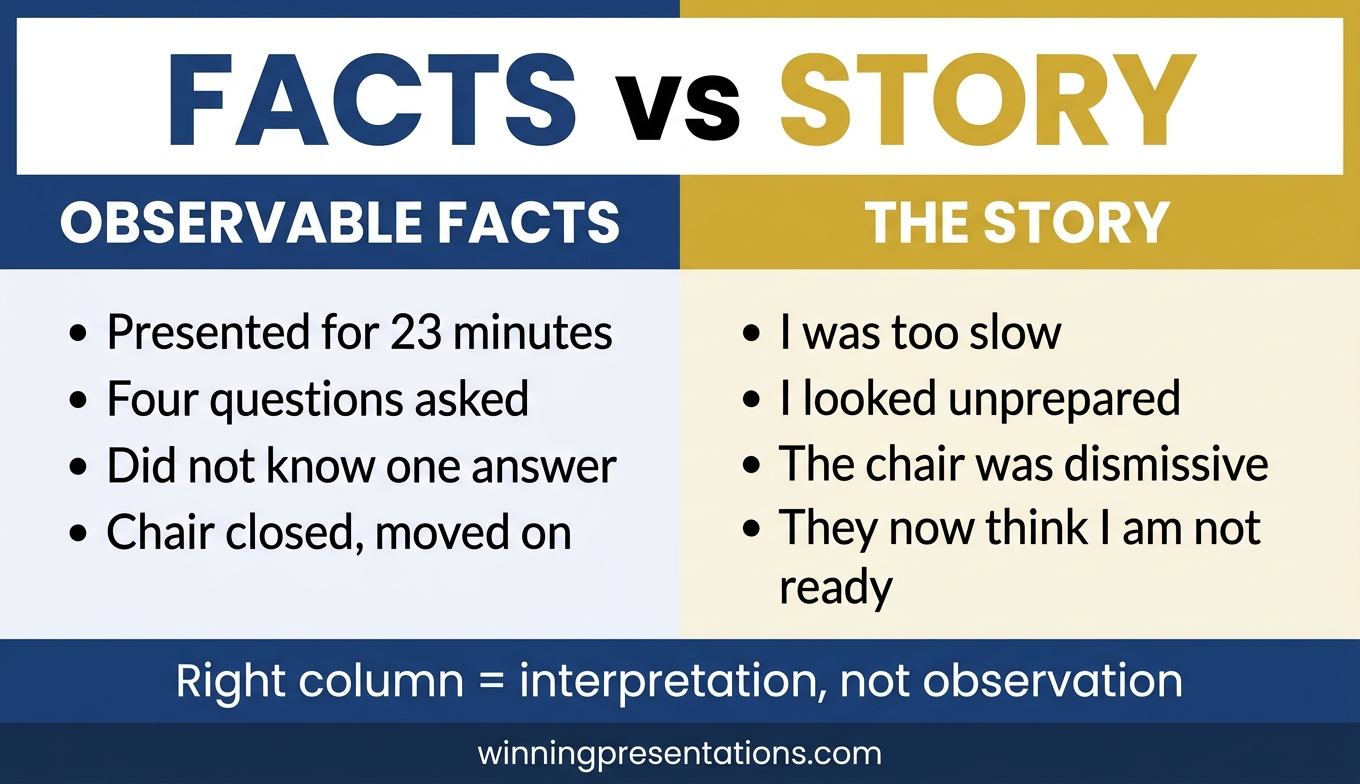
A concrete exercise. Twenty-four hours after the presentation — not sooner — write two lists on the same page. On the left, write only the observable facts. “I was asked to present for twenty minutes. I spoke for twenty-three. There were four questions. I did not know the answer to one of them. Two people nodded during the executive summary. The chair closed with thank you and moved to the next item.” Observable. Describable to someone who was not there. No interpretation.
On the right, write the story you are telling yourself. “I was too slow. The question I could not answer made me look unprepared. The chair’s tone was dismissive. The exec team now thinks I am not ready for this level of exposure.” This is not the truth — it is the interpretation. Naming it as interpretation is the point of the exercise. Both lists on the same page make visible what the mind is adding on top of the facts.
The right column almost always contains future tense and mind-reading — “they now think,” “they will remember,” “they will not trust me.” None of these are observations. They are predictions about what other people are thinking, based on a mind that is still in threat response. Treat them as hypotheses, not facts. The principles in the broader guide to presentation anxiety recovery go deeper into how interpretation loops form and how to break them.
The Three-Day Rule for Post-Presentation Review
Most executives conduct their post-presentation review within twenty-four hours, often the same evening. This is the wrong timing. The review is too emotionally coloured to be accurate, and the conclusions drawn then tend to stick. Wait three days before writing anything approaching a considered analysis.
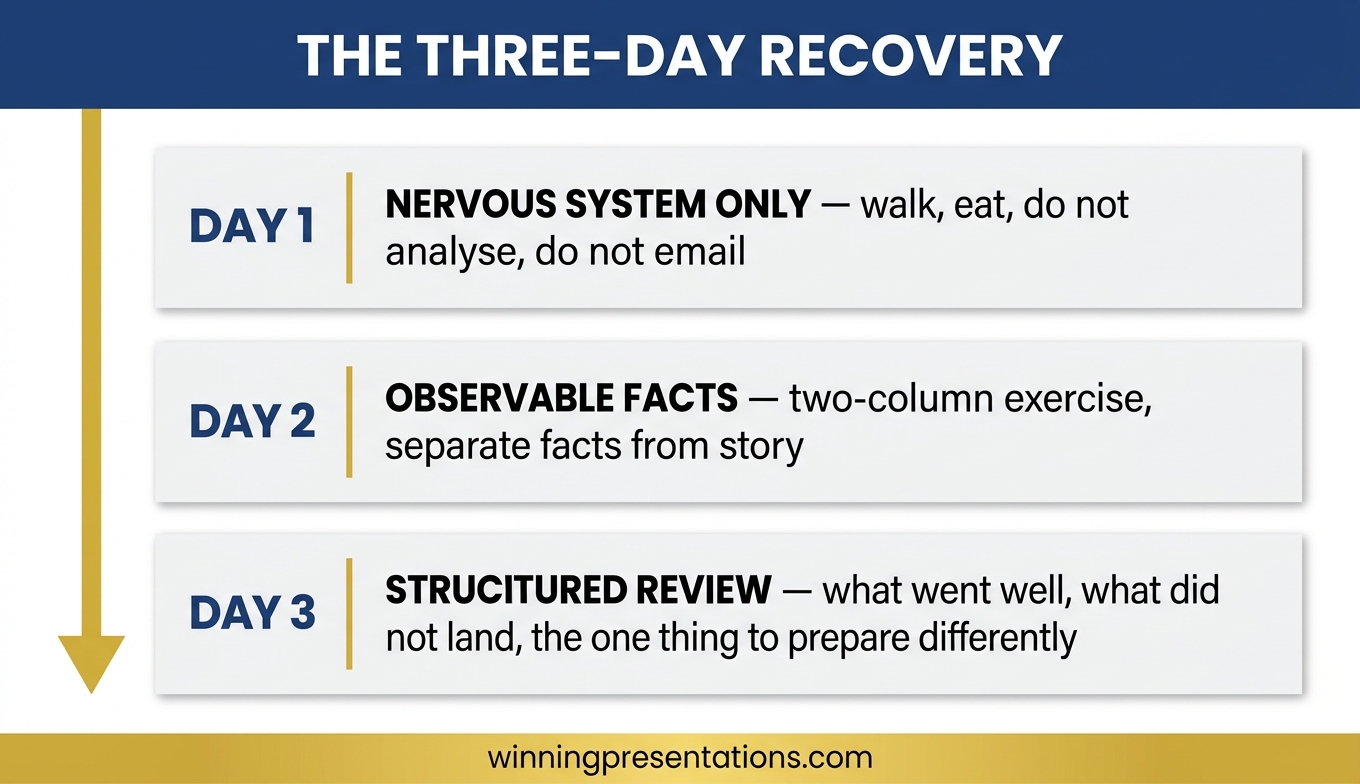
Day one. Nervous system recovery only. No analysis. No replay. If intrusive thoughts come — they will — write them down in one line and move on. The writing-down itself is protective; the mind is less likely to keep rehearsing a thought it knows has been captured.
Day two. Observable facts only. The two-column exercise above. Still no conclusions. Still no “what should I have done differently.” The task today is just to get the facts and the interpretations onto separate sides of the same page.
Day three. The structured review. Three questions, in this order. What were the two or three things that went well — specific, observable, not generous? What were the two or three things that did not land — specific, observable, not catastrophic? What is the one thing I would prepare differently for a comparable situation? Not everything. One thing. A review that produces a list of fifteen learning points produces no learning at all, because nothing gets implemented.
The reason for the three-day gap is not psychological indulgence. It is accuracy. A review written in an elevated state conflates the felt experience with the observable performance. By day three, the physiology has returned to baseline and the review reflects what actually happened rather than how it felt.
Why You Must Talk to Exactly One Person
Talking to nobody is a mistake. Talking to everyone is a bigger one. After a difficult presentation, the instinct is either to go silent — hoping the event fades — or to process it with half a dozen colleagues. Neither works. Silence lets the story solidify unchecked. Multiple conversations produce multiple reinforcements of whichever narrative you have already started telling.
The correct protocol is exactly one person. A trusted colleague who was in the room, or a line manager who has context but was not in the room. Their role is not to reassure you. Their role is to compare their version of what happened to yours, and to notice where the two diverge. The divergence is the diagnostic.
Frame the conversation carefully. “I am trying to work out what actually happened in that presentation, not whether it was good or bad. What did you see from your seat? What landed, what did not?” This framing disarms the reassurance reflex. Most colleagues, asked directly how a presentation went, will offer reassurance. Asked what they observed, they will describe. The description is useful. The reassurance is not.
Do this conversation on day two or three, not day one. Do it once. Do not keep returning to it. The conversation is a calibration check, not a source of ongoing validation.
Recover the Confidence the Experience Is Trying to Take
Conquer Your Fear of Public Speaking covers the neuroscience of presentation recovery: how the nervous system stores a difficult speaking experience, how to keep a setback from becoming a narrative, and structured protocols for the days and weeks that follow.
£39 — instant access.
Preparing for the Next One Without Over-Preparing
The biggest risk after a difficult presentation is over-correction. The presenter who stumbled on one question prepares twelve hours of Q&A answers for the next session. The presenter who lost the thread at minute fourteen scripts every word. The presenter who got a sceptical response from one board member rewrites the deck three times. Each of these is a caution response, and caution looks like preparation but behaves like constriction.
Over-prepared presentations land worse than well-prepared ones. They read as defensive, they sound rehearsed, and the presenter loses the responsiveness that makes live executive presentations feel alive. The audience feels the difference even when they cannot name it.
The discipline is to prepare the next presentation to the same standard you would have prepared it if the last one had gone well. Not more. Not less. If you would normally rehearse twice, rehearse twice. If you would normally prepare three anticipated questions, prepare three — including the one you could not answer last time. Preparing six because of last time is over-correction. Preparing two because you do not want to think about the topic is avoidance. Neither serves the next audience.
The one allowable change. Pick one specific thing from the day-three review and build it into the preparation for the next presentation. One. A single micro-change — “I will pause for three seconds before answering any question I do not immediately know the answer to” — produces the confidence gain that a global rewrite cannot. The brain registers that something has been improved. It does not need ten improvements to register that.
Related principles apply across any public speaking confidence setting — the fewer the deliberate changes, the more sustainable the rebuilding.
If you want a structured path through the recovery weeks, Conquer Your Fear of Public Speaking covers the nervous system regulation protocols and cognitive reframing techniques that underpin sustainable recovery.
The Long-Term Confidence Question
A single difficult presentation is a data point. A series of difficult presentations without recovery is a pattern. The long-term confidence question is whether the pattern is forming and, if it is, whether the cause is within the presentation itself or somewhere upstream.
Sometimes the upstream cause is physical — chronic sleep debt, under-recovery, caffeine stacked on cortisol. A presenter who is running on nothing will find any presentation destabilising, because the nervous system has no reserve. Addressing the physiology is upstream of addressing the presentation.
Sometimes the cause is structural — a role that requires presenting to an audience for which the presenter has not yet built the right mental model. Executive committee presentations are a different cognitive load from functional team updates, and the first few at a new level will feel harder even when preparation is identical. This is development, not failure, and treating it as failure compounds the problem.
And sometimes the cause is narrative — a story the presenter has been carrying for years, possibly from a single formative event early in their career, that now attaches itself to every difficult presentation. The solution is not another rehearsal. It is examining the story.
The practical move is to distinguish between these three causes before deciding what to change. Adding rehearsal to a physiology problem does not help. Adding rehearsal to a narrative problem makes it worse. Adding rehearsal to a developmental curve is appropriate but insufficient. Bouncing back from a setback depends on matching the intervention to the actual cause, not the apparent one.
Frequently Asked Questions
How long does it take to recover confidence after a bad presentation?
Most executives recover the felt confidence within two to four weeks if they follow a structured recovery process. The nervous system settles within seventy-two hours. The narrative takes longer, because the mind continues to rehearse the story in the weeks that follow. A deliberate, one-time structured review followed by the next presentation at comparable stakes usually closes the loop.
Should you apologise to the audience after a presentation you think went badly?
Rarely. Most apologies post-presentation are driven by the presenter’s discomfort rather than any need in the audience. They also amplify the signal that something went wrong — the audience often did not register the issue until the apology arrived. Only apologise if there is a specific, observable error that materially affected the audience’s understanding, and keep the apology factual and brief.
Is avoiding the next presentation ever the right move?
Almost never. Avoidance compounds the issue by making the next presentation bigger, not smaller. The shorter the gap between a difficult presentation and the next opportunity, the less the narrative has time to solidify. If you can present again within three to four weeks at comparable stakes, do.
Does it help to watch a recording of the presentation?
Only after day three, and only once. Before day three, the recording is experienced through the elevated state and tends to confirm the catastrophic story. After day three, one viewing, with a specific question in mind — “where did I lose the thread?” — can be diagnostic. Repeated viewings are rarely useful and often harmful.
Join The Winning Edge
Free weekly newsletter for executives working on speaking confidence, recovery from difficult presentations, and the neuroscience of presenting under pressure — delivered every Thursday.
Not ready for the full programme? Start here instead: download the Public Speaking Cheat Sheets — nine printable guides covering pre-presentation protocols, nervous system regulation, and quick-reference recovery techniques.
Read next: If the thing that destabilised the presentation was a question you could not answer, see Handling a Question You Genuinely Cannot Answer in an Executive Setting for a complementary framework on responding in the moment.
The next step is tactical. If you are inside the first seventy-two hours, protect the physiology. If you are inside the first week, do the two-column exercise once, on paper, not in your head. If the next presentation is within a month, prepare it to your normal standard and build in exactly one micro-change. Recovery is not glamorous and is rarely dramatic — it is the accumulation of small, deliberate moves in a settled state.
Mary Beth Hazeldine is the Owner & Managing Director of Winning Presentations. With 24 years of corporate banking experience at JPMorgan Chase, PwC, Royal Bank of Scotland, and Commerzbank, she advises executives on structuring presentations and managing the psychology of high-stakes speaking — including the recovery period after a presentation that did not go as planned.