Tag: presentation pushback

16 May 2026
Featured image for When Someone Notices You’re Shaking: The 4-Word Sentence That Restores Authority

When Someone Notices You’re Shaking: The 4-Word Sentence That Restores Authority

Quick Answer

When someone in the room comments on the fact that you are shaking, the response that restores authority is not denial, not apology, and not over-explanation. It is four words: “Caffeine, not the room.” Said calmly, with eye contact, with no smile and no shrug. The line acknowledges what was observed, attributes it to a neutral cause, and closes the conversation in one breath. The room moves on. Your authority is intact. And you have not lied — caffeine is genuinely the cause for many senior professionals at midlife, even when the underlying anxiety is also a factor.

Magdalena had been chairing the European executive committee of a logistics group for two years when one of the divisional MDs interrupted her mid-recommendation: “Maggie — your hand is shaking. Are you all right?” The room looked at her. She had a half-second to respond. The recommendation she had been about to make involved a £14M restructuring. The wrong answer — any answer that broke the rhythm or invited a longer conversation about her wellbeing — would have made the next forty minutes about the wrong topic.

What Magdalena said was: “Caffeine, not the room.” She said it without smiling, without shrugging, with steady eye contact. The MD nodded. The room moved on. She finished the recommendation, the committee approved it, and the meeting ran another 35 minutes without anyone returning to the comment. Three weeks later she told me the line had felt like the most powerful thing she had said in a meeting that year, even though it was four words.

The rare moment when a senior colleague comments on a visible anxiety symptom — shaking, sweating, voice tremor — is one of the highest-stakes seconds in executive Q&A. The standard advice in older presentation training programmes is wrong for this moment. Acknowledging it (“yes, I’m a bit nervous”) collapses authority. Denying it (“no, I’m fine”) sounds defensive. Over-explaining it (“I had a difficult morning”) invites further conversation about something that is none of the room’s business. The structurally right response is the one that closes the topic in one breath without lying, without apologising, and without leaving the audience wondering.

If you want a structured library of executive Q&A responses

The four-word response is one specific case of a broader category — wellbeing-adjacent comments mid-meeting. The full system covers the calm-authority responses senior leaders need across the harder Q&A categories: hostile questions, technical curveballs, premature challenges, and the wellbeing-adjacent comments this article addresses.

Explore the Executive Q&A Handling System →

Why comments about visible anxiety happen at senior level

Most senior professionals expect that comments about visible anxiety symptoms are vanishingly rare in executive environments. They mostly are. But the situations in which they do happen follow a pattern, and understanding the pattern reduces both the frequency and the impact.

The first context is when the comment comes from a peer who knows you well. The MD who comments on Magdalena’s shaking is not being hostile — they are signalling concern, often clumsily. In peer-to-peer dynamics at the executive level, the comment is more likely from someone who would describe themselves as on your side. This matters because the response can read as either rebuffing concern (which damages the relationship) or accepting concern (which collapses authority in front of the rest of the room). The line needs to thread both — closing the topic without rejecting the colleague.

The second context is when the comment comes from a more junior person in the room — a board observer, a junior member of the executive team, an investor representative who is new to the dynamic. In this case the comment is sometimes status-testing rather than concern. The response needs to land with slightly more weight, but the four-word format still works because it produces enough closure to disincline a follow-up.

The third context is when the comment comes from a senior person who is hostile. This is rare in well-functioning executive environments and more common in turnaround or distressed-asset situations. The hostile version of the comment is usually disguised as concern but is structurally an attempt to undermine. The four-word response works here too, with one adjustment — the eye contact needs to be slightly more direct and the pause after slightly longer. The same line. Different delivery. Same closing effect.

What unites all three contexts is that the room is watching how you absorb the comment, not the content of the comment itself. The four-word format is calibrated for that observation — short enough to demonstrate composure, neutral enough to not invite follow-up, factual enough to not read as denial.
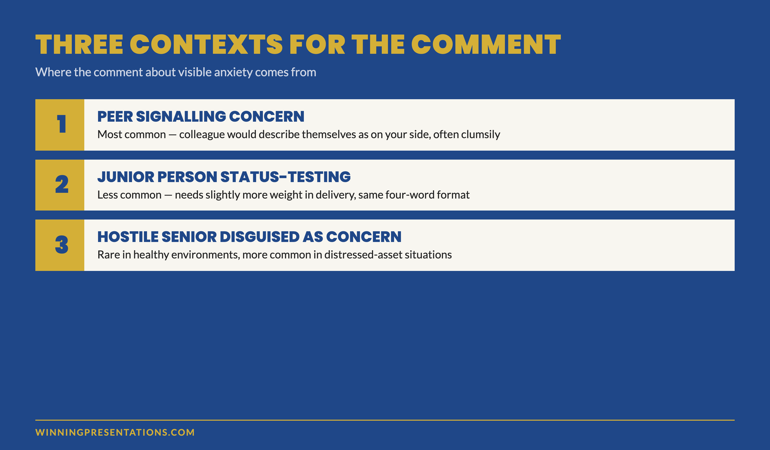
Three contexts in which a colleague might comment on visible anxiety mid-presentation: peer signalling concern, junior person status-testing, hostile colleague disguising challenge as concern — each shown with the appropriate response calibration on a stacked-card layout

The 4-word response — and why it works

“Caffeine, not the room.” The line works at four levels simultaneously, which is why such a short response can do so much.

At the first level, it acknowledges what was observed. The colleague said they noticed shaking. The response confirms there is something to notice — no awkward denial. The room is not left wondering whether the senior leader saw what everyone else saw.

At the second level, it attributes the cause to something neutral and external. Caffeine is not embarrassing. It is not weakness. It is not a confession. It is the kind of thing that everyone in the room has experienced at some point, and the colleague who commented now has a frame that lets them move on without feeling they were rebuffed for caring.

At the third level, it explicitly excludes the most damaging interpretation. “Not the room” means: this is not about you, not about the meeting, not about the stakes, not about the recommendation. The phrase actively closes the door on the interpretation the room would otherwise be running silently.

At the fourth level, the brevity itself communicates composure. A senior leader with the calm to dispatch the comment in four words and return to the recommendation is not someone who is collapsing. The shortness of the response is the demonstration of authority.

The line is not a deflection or a lie. For most senior professionals at midlife, caffeine is genuinely a contributor to visible tremor — the body’s adrenaline response amplifies the slight muscular tremor that caffeine produces, and at 50+ the body’s caffeine clearance is slower than it was at 30, so the morning’s three coffees are more present in the system at the 11am board meeting than they used to be. Naming caffeine names a real contributor. The line is honest.

For senior professionals whose tremor is heavily anxiety-driven, the line still works because it is structurally true that the underlying activation is multifactorial. The body’s cooling channel, the caffeine in the system, the room temperature, the morning’s accumulated load — all of these contribute. Naming one accurate factor in a way that closes the room’s curiosity is the structural work the line is doing. It is not lying about anxiety. It is choosing which true thing to name.

For senior professionals who want to expand the response library beyond the wellbeing-adjacent category — into hostile questions, technical curveballs, and the harder Q&A scenarios — the Executive Q&A Handling System covers the full set of structures that hold authority under different kinds of pressure.

What loses the room — three common responses

The senior professional whose hand is shaking and who hears the comment is often, in the half-second of decision, drawn to one of three responses. All three are tempting because they are emotionally honest. All three damage authority. Knowing why is part of being able to override the impulse and reach for the four-word line instead.

Response 1 — The acknowledgement (“Yes, I’m a bit nervous”)

This response is the one that emotionally intelligent senior leaders are most drawn to. It feels honest, vulnerable, and humanising. In peer one-to-one settings it would be the right call. In a meeting where you are mid-recommendation and the room is watching, it is structurally damaging. The acknowledgement transfers the room’s attention from the recommendation to your emotional state. The next forty minutes will run with that frame. The committee will approve or reject the recommendation partly on whether they think you can manage the emotional load of the implementation. You have unintentionally introduced a different decision criterion.

Vulnerability has its place in executive leadership. The middle of a recommendation in front of an executive committee is not the place. The four-word line lets you save the vulnerability for a different conversation in a different setting.

Response 2 — The denial (“No, I’m fine”)

This response feels like the opposite of acknowledgement, but it has the same effect through a different mechanism. The denial is read by the room as defensive. The colleague who commented now feels rebuffed. The audience starts watching for confirmation of the symptom rather than letting it pass. The denial extends the moment by inviting closer observation, which is the opposite of what closure is supposed to do. The room’s attention stays on whether you are fine, not on the recommendation.

The denial also tends to be visibly false. The hand is still shaking. Saying “I’m fine” with a shaking hand reads as someone trying to control the narrative rather than someone with the calm to dispatch the comment. The audience trusts the body more than the words.

Response 3 — The over-explanation (“I had a difficult morning”)

This response feels like the diplomatic middle ground. It acknowledges that something is going on without confessing to anxiety. The damage here is that it invites a follow-up — colleagues who care will ask what happened, and the room is now committed to a conversation about your morning. The recommendation is still on hold. You are still talking about yourself rather than the £14M restructuring. The frame is still not back where it needs to be.

The over-explanation is also a category of response that, repeated over time, builds a reputation for being someone whose meetings get derailed by personal things. Not in any single instance, but in aggregate. Senior leaders who use this pattern frequently find their authority eroding without being able to identify why.
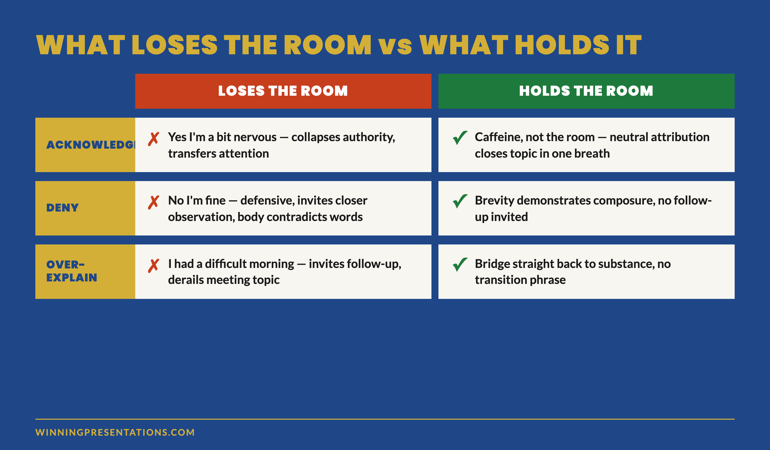
What loses the room versus what holds the room when someone comments on visible anxiety mid-presentation: split comparison showing the three damaging responses on the left — acknowledgement, denial, over-explanation — versus the four-word neutral attribution that closes the topic in one breath on the right

For the full executive Q&A response library

The Executive Q&A Handling System

  • Structured response patterns for the hardest categories of executive Q&A — hostile questions, technical curveballs, premature challenges, wellbeing-adjacent comments
  • Calm-authority frameworks designed for senior professionals who need to hold the room under genuine pressure
  • Decision-safe answers in 45 seconds — the format the boardroom expects, not the over-long answers junior training teaches
  • Built for board, executive committee, and investor presentation contexts

The Executive Q&A Handling System — £39, instant access, lifetime use.

Get the Executive Q&A Handling System →

For senior professionals presenting to boards, committees, and investor panels.

What to do in the next 60 seconds after the line lands

The four-word response closes the topic. The next 60 seconds reinforce the closure. The senior professional who delivers the line and then immediately returns to the recommendation reinforces the message that the comment was not significant. The senior professional who delivers the line and then pauses, smiles awkwardly, looks down, or says anything else — undoes the work the line just did.

The structure for the next 60 seconds is direct: bridge straight back to the substantive content with no transition phrase. Not “as I was saying” — that phrase signals that you registered a disruption. Not “where was I” — that phrase signals you lost your place. Just go to the next sentence of the recommendation as though no comment had been made. The room will follow your lead. The colleague who commented will let it go because you have signalled that you have.

It helps to have rehearsed the recommendation deeply enough that the next sentence is available without conscious effort. This is one specific reason structural preparation matters — the muscle memory of what comes next means the bridge back to substance is automatic, and the room reads the automaticity as composure.

If the colleague who commented is someone you would want to address one-to-one — a peer who has shown concern in good faith — the right time is after the meeting, in private. A short message: “Thanks for noticing — I appreciated it. All fine, just over-caffeinated.” This preserves the relationship without having spent the meeting itself on it.

Frequently asked questions

What if it really is the room and not caffeine?

The line still works because it is structurally true that the body’s response is multifactorial. The activation in your system right now is some combination of caffeine clearance, room temperature, accumulated load, and the meeting context — naming one accurate contributor in a way that closes the room’s attention is not lying. It is choosing which true thing to name. The honest part is that you are not denying anything; you are attributing to a contributor that does not invite further conversation. If caffeine is genuinely not in your system that morning, alternatives include “low blood sugar, not the room,” “morning workout, not the room,” or “cold hands, not the room” — pick the one that is also true for you.

What if my voice is shaking rather than my hand?

The same structural response works with a slight word change. “Cold tea, not the room” lands well for voice tremor because the room can pattern-match the explanation easily — a slightly warm-then-cold drink does affect vocal cords. “Allergies, not the room” works in spring or early autumn. The four-word format is the structure; the specific neutral attribution adapts to which symptom the colleague flagged.

What if the colleague follows up and asks if I’m sure I’m okay?

The follow-up is rare when the line is delivered with composure, but it does happen. The response is a single sentence with a redirect: “Honestly fine, thanks — let me come back to the customer concentration figure on slide nine.” The redirect to a specific later point in the deck signals confidence and gives the room a forward direction. The colleague almost always lets it go because the redirect demonstrates you are clearly tracking the substance of the meeting.

Does this work in virtual meetings as well as in-person?

Yes, with one adjustment. In a virtual meeting, the colleague’s comment usually arrives via chat or as a small spoken interruption between substantive contributions. The response is the same four words spoken with the same composure, but you can also use the chat to send a brief follow-up to the colleague directly: “Thanks — really fine, just morning caffeine. Will catch up after.” The dual-channel response works particularly well in virtual settings because it preserves the relationship while keeping the meeting on track.

Is this advice different for women in male-dominated executive environments?

The structural response is the same; the calibration is sometimes different. Women in heavily male-dominated executive teams sometimes find that even the brief four-word line gets followed by a more persistent follow-up, because the dynamic of the room treats the visible symptom as more remarkable than it would in a woman’s voice or hand. The response to the persistent follow-up is the same single-sentence redirect described above, with the same forward orientation. The structural work — close the topic, return to substance — does not change. The cultural environment may make the closure require slightly more weight in delivery; the words themselves are the same.

The Winning Edge — weekly newsletter for senior presenters

One framework, one micro-story, one slide pattern — every Thursday morning, ten minutes’ read. For senior professionals who want my best material before it appears anywhere else.

Subscribe to The Winning Edge →

Not ready for the full system? Start here: download the free Executive Presentation Checklist — a one-page reference for the structural questions every executive deck must answer before the meeting.

For more on the in-the-moment physical reset that prevents these comments arising in the first place, see the 20-second physical reset for mid-presentation symptoms.

Mary Beth Hazeldine — Owner & Managing Director, Winning Presentations Ltd. After 24 years in corporate banking at JPMorgan Chase, PwC, Royal Bank of Scotland and Commerzbank, she advises senior professionals across financial services, healthcare, and technology on structuring presentations and Q&A responses for high-stakes funding rounds, board approvals, and committee decisions.

05 May 2026
Composed senior female executive holding steady eye contact with a skeptical board chair mid-interruption in a high-stakes boardroom.

Authority Challenged Mid-Presentation: The Neutral Voice Technique

Quick answer: When your authority is challenged mid-presentation, the neutral voice technique is the most effective first move. Drop the pitch of your voice slightly, slow your pace, and answer the substance without matching the challenger’s emotional charge. Neutral voice signals composure, keeps the room’s trust, and buys you the seconds you need to reset. It works because it interrupts the physiological escalation that hostile energy triggers in most presenters.

A senior technology director — I’ll call her Rafaela — was halfway through a board-level recommendation in early 2024 when the non-executive chair interrupted her. “I’m going to stop you there. I don’t think you’ve actually understood what this committee asked for.” The room went still. Two other board members looked down at their papers.

Rafaela felt her chest tighten and her pulse climb. Her first instinct was to defend — to explain what she had understood, correct the chair, demonstrate that the work had been sound. That instinct, she later told me, was the single biggest risk of the whole meeting. If she had followed it, she would have raised her voice, accelerated her speech, and escalated the confrontation. She would have lost the room.

Instead, she did something she had rehearsed for exactly this moment. She paused. She lowered the pitch of her voice by a noticeable amount. She slowed her pace. And she answered the substance of the challenge without matching its energy. Ten minutes later, the chair was nodding along with her recommendation.

That tool — the neutral voice technique — is one of the most effective responses available when your authority is challenged mid-presentation. It is not a scripted line. It is a physiological move that signals composure and gives you back the seconds you need to think clearly.

Want the neuroscience-based system behind staying calm under pressure?

Calm Under Pressure covers the nervous system mechanics behind composure in high-stakes professional moments — including the exact physiological steps that make the neutral voice technique reliable rather than hit-and-miss.

Explore Calm Under Pressure →

What actually happens when your authority is challenged

A challenge mid-presentation does two things simultaneously. At the social level, it puts your credibility into question in front of an audience that was until that moment willing to listen. At the physiological level, it triggers a threat response — the same one that fires when you are physically confronted — in under a second.

The threat response pushes blood flow to the limbs and away from the prefrontal cortex. Heart rate and breathing rate increase. Pitch rises. Speech speeds up. These are not signs of weakness; they are the body preparing to defend, attack, or flee. The problem is that none of these preparations help you handle a challenge from a board chair. What you need is deliberate, slow, clear thought — and the body has just removed the conditions for it.

The second problem is perception. Everyone in the room notices the physiological response. The rising pitch and faster speech read as defensiveness. The room shifts from “listening to a recommendation” to “watching a presenter under pressure”. That shift is difficult to reverse once it has happened.

The neutral voice technique addresses both problems at the same time. Dropping the pitch and slowing the pace forces the body to override the threat response, and it signals to the room that the presenter is not going to let the challenge dominate the moment. Both effects are fast — measurable within the first sentence of the response.

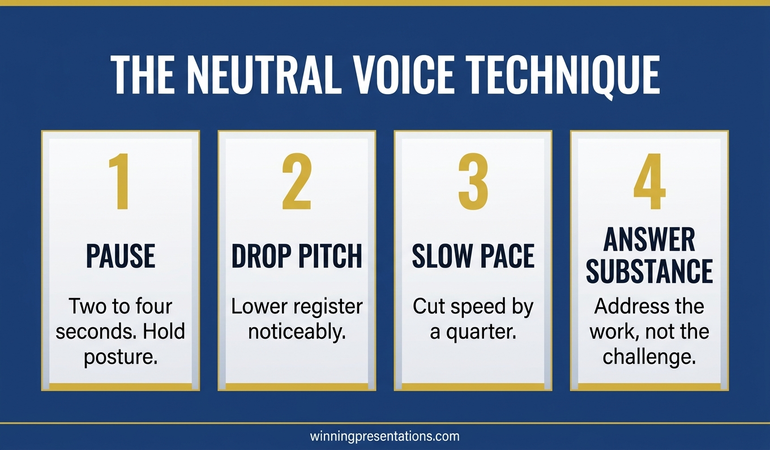
Neutral voice technique 4-stage dashboard infographic showing pause, drop pitch, slow pace, and answer substance as the sequence to hold composure when authority is challenged.

The neutral voice technique, step by step

The technique has four steps. Each one takes under two seconds. Combined, they produce a response that lands as composed even when the challenge was aggressive.

Step one: pause for two to four seconds. Do not rush to answer. The pause is not hesitation — it is deliberate composure. Hold your posture. Keep eye contact with the challenger. The silence interrupts the expected escalation pattern and resets the emotional tempo of the room.

Step two: drop the pitch of your voice. Lower it by a noticeable amount — roughly equivalent to the difference between your normal speaking voice and the voice you use when you are thinking aloud. The drop has to be real; a half-hearted version is audible to the room as an attempt rather than a shift. Practice beforehand so you know what the target pitch feels like.

Step three: slow your pace. Cut your speaking speed by roughly a quarter. Put small deliberate gaps between phrases. Slow pace communicates that you are not rushed and that you are not intimidated into producing a fast defence. The room reads slow, controlled pace as seniority.

Step four: answer the substance, not the challenge. Address what was said about the work, not what was implied about you. If the challenger said “you don’t understand what we asked for”, the response is to articulate what you understood — calmly — and invite correction. “What I understood was X. If that is not what the committee wanted, I would find it useful to hear what the gap is.” This takes the heat out of the exchange by converting it into a question about information.

Closely related to voice control is the broader voice command technique for executive presentations, which covers the mechanical side of pitch, pace, and breath under pressure.

Why neutral voice holds the room

Audiences read tone before content. When a presenter is challenged, the room instinctively watches how the presenter responds before registering what they say. A calm, composed tone communicates that the presenter can be trusted to handle pressure. A defensive or escalated tone communicates the opposite, regardless of how accurate the underlying response is.

Neutral voice works because it sends three signals simultaneously. It signals that the challenge has not destabilised you. It signals that you take the substance seriously enough to respond carefully rather than reflexively. And it signals that you are willing to keep the exchange professional even if the challenger has not.

The third signal is the most important. The challenger has set an emotional tone; if you match it, the conversation continues on their terms. If you do not match it, the mismatch is audible to the whole room. Most audience members will side with the calmer voice, because composure under pressure is what they are implicitly looking for in a senior presenter.

This is why neutral voice holds even when the challenger is senior. A board chair who raises their voice and is met with a calm, lower-pitched response does not look more senior; they look less composed. The dynamic changes not because you have contradicted the chair but because you have declined the emotional register they tried to set.

The neuroscience-based system that makes composure reliable

Calm Under Pressure is the neuroscience-based confidence system for senior professionals who need clear thinking in high-stakes moments. It covers nervous system regulation, in-the-moment recovery, and the specific physiological mechanics behind techniques like neutral voice. Not presentation-specific — applies to any high-stakes professional situation.

  • Nervous system regulation for pre-presentation and in-the-moment use
  • Physiological protocols for pitch, pace, and breath recovery
  • Cognitive reframes for handling the moment of challenge

Designed for senior professionals who need calm, clear thinking under pressure.

Get Calm Under Pressure →

£19.99, instant download. Neuroscience-based system.

The three common responses that make it worse

Understanding what to avoid is as useful as knowing what to do. Three responses to a mid-presentation challenge make things predictably worse.

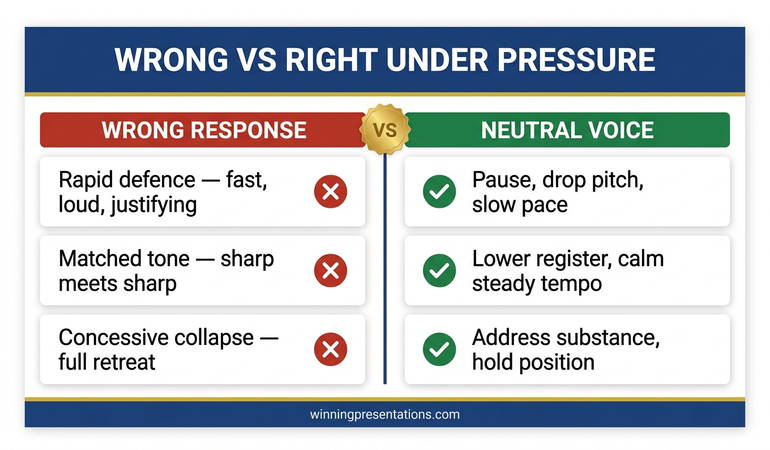
The rapid defence. The most common response is to answer immediately, at speed, with a detailed justification of why the challenger is wrong. The rapid defence reads as insecurity. It also compounds the problem physiologically — the faster you speak, the more the threat response escalates. By the time you finish the first defence, your pitch is up, your pace is up, and the room has already formed a view.

The matched tone. The second pattern is to match the challenger’s tone — if they are sharp, you become sharp; if they are dismissive, you become firm. This is the trap that even experienced presenters fall into, because it feels strong. The problem is that matching tone in a confrontation escalates it; the audience then watches two people trade sharpness while the content disappears. Whoever the audience perceives as escalating first loses authority.

The concessive collapse. The third pattern is the opposite — full concession. “You’re right, I think I may have misunderstood, let me go back and look at it.” This sounds humble but reads as collapse when the underlying work is actually sound. It also teaches the challenger that aggressive framing produces concessions, which makes the next challenge worse. Full concession is appropriate when the challenge is accurate; it is damaging when the challenge is merely confident.

The neutral voice technique is a deliberate middle path. It neither defends nor concedes; it converts the challenge into a substantive conversation about the work. Where there is a genuine gap, the conversation reveals it. Where there is not, the composed response demonstrates that the work holds up.

A related pattern worth managing is the priority order for managing physical symptoms under pressure — voice, breath, and visible tremor all respond to similar protocols.

Wrong versus right infographic contrasting rapid defence, matched tone, and concessive collapse with the neutral voice response, shown in a split comparison format.

Practising it before you need it

Neutral voice is a physiological skill. You cannot install it in the middle of a real challenge. You have to rehearse it in low-stakes situations so that when a real challenge comes, the body knows what to do without conscious thought.

Solo rehearsal. Record yourself reading a short paragraph at your normal speaking voice. Then read the same paragraph with the pitch dropped and the pace slowed. Listen back. Most people are surprised how different the two recordings sound, and how much more authoritative the neutral version is. Do this for five minutes once a week until you can switch between the two on demand.

Structured simulation. Ask a colleague to interrupt your practice presentation with a hostile challenge — ideally one that feels slightly unfair. Rehearse the four-step response. The first few simulations will feel artificial. By the fifth, the body starts to associate challenge with pause-and-drop rather than with defend-and-speed. That association is what you are trying to install.

Morning protocol. On the day of a high-stakes presentation, spend two minutes in a private room practising the neutral voice pitch. Reading a few sentences aloud in the target tone primes the voice for the meeting. This combines well with the broader morning protocol for presentation day, which covers body, voice, and mindset preparation.

Partner post: the “actually…” question and how to handle correction attempts is the specific-case companion to the general neutral voice technique.

For the deeper pattern of presentation anxiety

Conquer Your Fear of Public Speaking (£39) is a neuroscience-based programme for presentation anxiety — the underlying pattern that makes moments of challenge feel harder than they need to. Designed for senior presenters who want to address the root, not just the symptom.

Explore Conquer Speaking Fear → £39

The composure that comes from preparation

The thing about neutral voice is that it does not look like a technique when it works. From the audience, it simply looks like the presenter is unflappable. The challenge came, the response was calm, the substance was addressed, and the presentation moved on. The work the presenter did internally — the pause, the pitch drop, the pace adjustment, the decision to answer substance — is invisible.

That invisibility is the point. Senior presenters are not expected to look as though they are managing themselves under pressure. They are expected to just be composed. The only way to produce that appearance reliably is to have practised the physiological moves beforehand, so that in the moment the body does the work without requiring conscious thought.

Start with the simplest version. Next time you feel your pitch rising during a meeting — not even a challenge, just a moment of mild pressure — drop it deliberately. Slow the next sentence. Notice what happens to your own thinking and to the room. The skill scales from there.

Reliable composure in high-stakes professional moments

The neuroscience-based confidence system for senior professionals who need clear thinking when the pressure arrives. Not presentation-specific — applies to every high-stakes moment.

Get Calm Under Pressure → £19.99

Instant download. Neuroscience-based system.

Frequently asked questions

What if the challenger is senior to me?

Seniority of the challenger does not change the technique. Neutral voice is not a challenge to the hierarchy; it is a response to the emotional register. A senior challenger who raises their voice and is met with calm, substantive reply does not feel contradicted — they feel responded to. The room reads the composure as appropriate respect, not as insubordination.

What if the challenge is partly right?

Acknowledge the correct part, clearly, without collapsing the rest. “You are right that we did not include the Q3 figures; we had a cut-off decision to make and I can explain the reasoning. On the second point, we did include the sensitivity analysis — it is on page seven of the pre-read.” Neutral voice is compatible with concession on the merits. What it is not compatible with is wholesale retreat.

What if my voice cracks or shakes?

Pause for longer, breathe through the nose, and start the sentence at a lower pitch than feels natural. A voice cracks when it is trying to produce sound at a pitch higher than the current breath support can hold. Dropping the pitch below the break point stabilises it. This is the same mechanism behind the broader technique for voice recovery under pressure.

Does this work in virtual meetings?

Yes, and the technique is particularly useful on video calls. Audio compression flattens the emotional register of both challenger and responder, so the pitch drop and pace slowdown stand out more sharply. Maintain eye contact with the camera during the pause, and slightly exaggerate the pace change — video lag can compress perceived timing.

Get The Winning Edge

One email each Thursday. Named techniques from real boardroom work — composure, voice, framing — that senior professionals can try in the next presentation.

Subscribe to The Winning Edge →

Not ready for the full system? Start here instead: download the free Executive Presentation Checklist — the one-page reference senior presenters use to pressure-test a deck before a senior meeting.

Next step: rehearse the neutral voice shift for five minutes this week, so it is available to you the next time pressure arrives.

About the author

Mary Beth Hazeldine is Owner & Managing Director of Winning Presentations Ltd. With 24 years of corporate banking experience at JPMorgan Chase, PwC, Royal Bank of Scotland, and Commerzbank, she advises executives across financial services, healthcare, technology, and government on structuring presentations for high-stakes funding rounds and approvals.

02 May 2026
Male executive responding calmly to a senior objection during Q&A

Executive Q&A Objections: How to Handle “We have Tried That” Pushback

Quick Answer: The strongest response to an executive Q&A objection follows a four-beat structure: acknowledge the pattern the objector is pattern-matching to, name the specific difference in the current situation, offer the evidence, and propose the decision-criterion shift. This handles dismissal without being defensive. It works whether the pushback is fair or unfair.

Rafaela had walked the chief operating officer through forty-two slides explaining why their procurement system needed replacement. The COO listened, asked two clarifying questions, and then said, at slide forty-three: “We looked at this two years ago. It was going to cost twelve million and take eighteen months. Nothing has changed. Why is this different now?”

The room went quiet. Rafaela’s team had spent six weeks on the analysis. What they had not done was prepare for this specific objection. The COO was pattern-matching. He was not asking about the procurement system — he was asking whether this was the same failed initiative in new clothing. Rafaela did what most executives do when hit with that objection. She defended the new analysis. The meeting ended without a decision.

What should have happened is specific. The objection was predictable. The response structure exists. The reason most executives fail to use it is that they do not know objections follow a recognisable pattern. Once you see the pattern, the response becomes repeatable.

If you are walking into an executive Q&A soon

The Executive Q&A Handling System covers the structural responses for dismissal, pattern-matching, and hostile pushback — the Q&A moments that most damage credibility.

Explore the System →

Why executive objections are pattern-matching

Experienced executives rarely ask questions from a position of curiosity. They pattern-match the current proposal to a previous situation that failed, succeeded, or cost the business something. The question sounds specific — about your proposal — but it is usually anchored to that previous situation. Until you name the anchor and demonstrate the difference, no amount of data about the current proposal will move the conversation forward.

This is a cognitive efficiency, not a fault. Senior executives have seen many initiatives. They compress evaluation by recognising categories. The job of your response is not to defend the current proposal on its own terms. It is to unpick the pattern-match and rebuild it around the specific, genuinely different features of the current situation.

Three implications follow. First, generic data will not work — it needs to speak to the specific anchor. Second, the response structure is the same whether the pattern-match is fair or unfair — the objector is not tracking that distinction. Third, if you cannot identify the anchor within the first three sentences of the objection, you are not ready to respond yet.

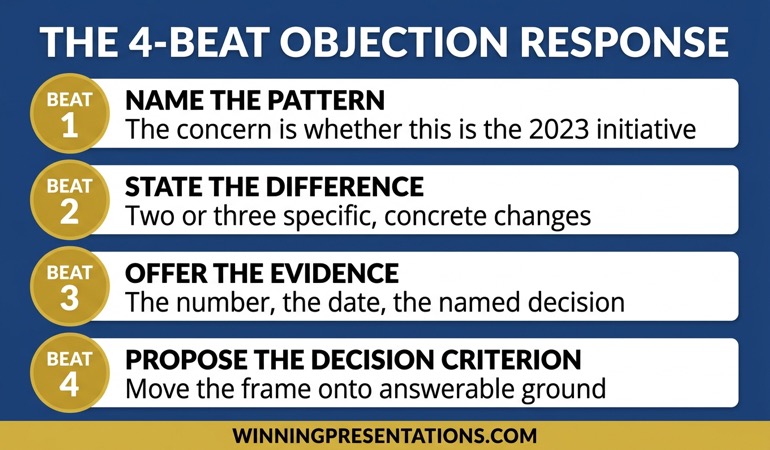
The four-beat response structure

The structure has four components, delivered in order, inside roughly thirty to forty-five seconds of spoken response.

Beat 1: Name the pattern. “The concern you are raising is whether this is the same initiative we declined in 2023.” This beat does three things. It confirms you heard the objection. It shows you understand the underlying pattern, not just the surface question. It moves the conversation from defence to shared diagnosis.

Beat 2: State the specific difference. “Two things have changed materially. The previous proposal was a full platform replacement at the same time. This proposal sequences replacement across three years, with the first tranche covering only the accounts payable module.” Name the difference concretely. Not “much has changed” — specifics. Two or three, not more.

Beat 3: Offer the evidence. “The first-tranche cost is £1.8m — an eighty-five percent reduction from the 2023 proposal, because we are not rebuilding the custom reporting layer that drove most of the previous cost.” Evidence is specific. It is not “we have done more analysis.” It is the number, the date, or the named decision that would not have been possible two years ago.

Beat 4: Propose the decision criterion. “The right question is not whether to replace the system. It is whether the accounts payable module alone justifies the £1.8m commitment. If we can agree that is the frame, the numbers support a clear answer.” This moves the decision onto criteria the executive can engage with directly, rather than leaving them stuck in the anchor.

Stacked cards infographic showing the four-beat executive Q&A objection response structure: name the pattern, state the specific difference, offer the evidence, propose the decision criterion

THE EXECUTIVE Q&A HANDLING SYSTEM — £39

Prepared responses for the objections that make or break executive Q&A

The Executive Q&A Handling System covers objection categories, response templates, and the preparation drill that turns Q&A from the weakest part of a presentation into the part that earns the decision. £39, instant access.

Get the Executive Q&A System →

Designed for executives facing board, investment committee, and senior leadership Q&A.

The “we’ve tried that” objection

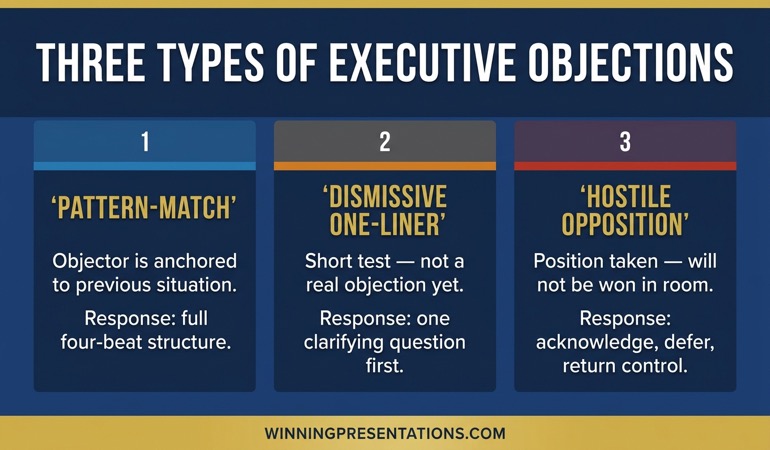
This is the most common executive objection, and the one most frequently mishandled. The four-beat structure applies, but with one adjustment: Beat 1 must explicitly acknowledge the previous attempt with respect.

The wrong response is “that was different” or “circumstances have changed.” Both feel dismissive of the earlier work. Remember: the executive often owned, approved, or was adjacent to the earlier attempt. Dismissing it is dismissing them.

The right response names the earlier attempt with specificity. “You led that review in 2023. The original recommendation was to move forward and it was halted after the scope expanded during procurement.” That line does three things: it shows you know the history, it respects the prior decision, and it sets up the specific difference you are about to introduce.

Once the respect is established, the remaining three beats follow the standard structure. The specific difference must be genuine — if the current situation is not materially different, the objection is correct and you need to revise the proposal, not the response.

The dismissive one-liner

Some objections are short and designed to end the conversation. “That sounds expensive.” “I don’t see it.” “It’s not the right time.” These are not full objections — they are tests. The executive is signalling that they are not yet engaged and wants to see whether you can bring them in.

The correct response is a single clarifying question before you engage the substance. “When you say it sounds expensive, are you comparing it to the status quo cost, or to the budget envelope you had in mind for this initiative?” The question forces the executive to surface the actual concern. Once surfaced, you can apply the four-beat structure to the real objection underneath.

This is harder than it sounds. The instinct when you hear “that sounds expensive” is to launch into the cost justification you have prepared. Resist it. A thirty-second defence of the cost to a dismissive one-liner almost always lands badly, because you are answering a surface question rather than the concern underneath. The clarifying question takes five seconds and saves the conversation.

Related: the honest-answer Q&A framework covers how to respond when the right answer is “I don’t know” without losing credibility.

Genuinely hostile objections

Sometimes the objection is not a pattern-match or a test. It is a genuine, hostile push to derail the proposal. The executive has already decided they do not want this to proceed and is using the Q&A to signal that position to the room.

Three tells: the objection is repeated in slightly different forms even after you address it; the body language of other executives tracks the hostile executive rather than you; the substance of the objection shifts without acknowledging your previous response. If two of the three are present, you are dealing with hostile opposition, not Q&A.

The response is structurally different. Do not try to win the Q&A. Acknowledge the concern explicitly, name what you heard, propose a follow-up conversation to resolve it outside the meeting, and return control to the chair. “I hear the concern about implementation timing. I would like to propose that we take that specific question offline and come back with a joint view by next Tuesday. Chair, can we park it for now and continue?”

This does not resolve the opposition. It prevents the opposition from dominating the remaining meeting time and creates a structured path to resolve it afterwards. Most hostile objections are actually negotiations about something adjacent to the proposal — scope, timing, ownership. They get resolved in one-to-one conversation, not in group Q&A.

Dashboard infographic showing the three types of executive Q&A objections and the response approach for each: pattern-matching, dismissive one-liners, and hostile opposition

For the moments when you genuinely do not have the answer, the cannot-answer response framework covers how to hold credibility without bluffing.

What not to do

Do not repeat the original case. The objection has already signalled that the original case did not land. Repeating it — even with more emphasis — will not change the outcome. The four-beat structure explicitly abandons the original framing and rebuilds the discussion on different terms.

Do not answer with data before engaging the pattern. Data only works once the executive has agreed the current situation is genuinely comparable to whatever they are pattern-matching to. Beat 1 does the reframing. Data fits into Beat 3, not Beat 1.

Do not apologise for the original analysis. “I know this sounds like the 2023 initiative, and I understand why — let me be clear about what’s different” is a stronger opening than “I’m sorry, I should have led with this.” Apology early in a response signals that the objection is justified. Often it isn’t.

Do not say “great question.” Executives hear “great question” as filler. It buys you no thinking time and devalues the specificity of the response that follows. Use silence instead — a two-second pause before Beat 1 is universally read as thoughtful.

For the moments in Q&A when you need to recover emotional control before responding, the emotional regulation Q&A reset covers the physical technique for those moments.

The Executive Q&A Handling System includes a full objection bank with prepared four-beat responses for the twelve most common executive objection patterns.

THE FULL OBJECTION BANK

Prepared responses for twelve recurring executive objection patterns

The Executive Q&A Handling System gives you the prepared four-beat structure for each common objection — “we’ve tried that”, “not the right time”, dismissal, redirection, and more. £39, instant access.

Get the Q&A System →

Frequently Asked Questions

How long should a four-beat response take?

Thirty to forty-five seconds total. Longer responses lose the room. Shorter responses feel incomplete. Practise the sequence in rehearsal with a timer. The goal is not to memorise the specific words, but to internalise the rhythm. Once the rhythm is natural, you can improvise the specifics in the moment.

What if I cannot identify the pattern the executive is matching to?

Ask. “Is there a previous initiative you are comparing this to?” Or: “Help me understand the framing — are you seeing this as similar to another situation?” Asking directly for the pattern is often received well, because it demonstrates that you are trying to engage with their actual concern rather than a surface version of it.

Can I use this structure in written responses, not just live Q&A?

Yes — the structure works equally well in follow-up memos. Each beat becomes a short paragraph. Written responses have the advantage of allowing more specificity in Beats 2 and 3, because the reader can absorb more detail in text than in spoken form. The structure is the same; the density can be higher.

What if the executive interrupts me during the four beats?

Allow the interruption. If the executive interrupts, they are signalling what part of the response they want to focus on. Follow their focus. You can always return to the remaining beats later. Insisting on completing the four beats against an active interrupter reads as rigid and loses you the room.

Practical Q&A and presentation technique, Thursdays

The Winning Edge is a weekly newsletter covering the structural mechanics of high-stakes presentation moments — including Q&A preparation, objection handling, and recovery techniques.

Subscribe to The Winning Edge →

Partner post: If the Q&A objections come from a single cautious decision-maker rather than a group, the risk-averse CEO presentation framework covers the related one-to-one dynamic.

Your next step: Before your next executive Q&A, write down the three most likely objections and draft the four-beat response to each. Most presenters skip this step. The ones who do it walk in with a measurable preparation advantage.

About the Author

Mary Beth Hazeldine is Owner & Managing Director of Winning Presentations Ltd. With 24 years of corporate banking experience at JPMorgan Chase, PwC, Royal Bank of Scotland, and Commerzbank, she advises executives across financial services, healthcare, technology, and government on structuring presentations for high-stakes funding rounds and approvals.

18 Feb 2026
Executive woman standing and gesturing confidently while answering questions from colleagues seated around a boardroom table, demonstrating composed Q&A handling during a high-stakes presentation

5 Executive Q&A Mistakes I See Every Week — With the 15-Second Fixes

The presentation was fine. The five minutes of Q&A afterwards undid all of it.

Quick answer: After 24 years in corporate banking and consulting — and now coaching executives who present for a living — I see the same five Q&A mistakes every single week. Not from junior staff. From directors, VPs, and partners who present beautifully and then lose the room the moment questions start. Each mistake has a specific fix, and every fix follows the same structure: answer in 15 seconds using Headline → Reason → Proof, then stop talking. Below are the five mistakes, the real scenarios where I see them, and the exact rewrites that work.

At Commerzbank, I once watched a managing director lose a syndication deal during Q&A. Not because he didn’t know his numbers — he knew them cold. Because the lead investor asked a straightforward question about covenant flexibility, and instead of giving a 15-second answer, he gave a four-minute masterclass on covenant structures across European credit markets. By the time he finished, the investor had mentally moved on. The deal went to a competitor who answered the same question in two sentences.

I’ve now seen some version of that moment hundreds of times. Different industries, different stakes, same five patterns. The executives who win in Q&A aren’t smarter or better prepared. They’ve learned to answer the question that was asked — in 15 seconds — and then stop.

Mistake #1: The Knowledge Dump

What it looks like: Someone asks a focused question. The presenter answers the question — and then keeps going. They add context. Then caveats. Then the methodology behind the number. Then the alternative they considered. What started as a clear answer becomes a four-minute monologue that buries the actual point under layers of unnecessary detail.

Where I see it: Budget reviews. Quarterly updates. Any situation where the presenter has spent days preparing and unconsciously wants to demonstrate the depth of their preparation. The more homework you’ve done, the more tempting the knowledge dump becomes — which is why it’s disproportionately a problem for the most diligent presenters.

The real scenario: A VP at a technology firm presented a platform migration proposal. The CTO asked: “What’s the downtime risk during cutover?” The VP answered the question correctly in his first sentence (two hours, with a rollback plan). Then he spent three more minutes explaining the technical architecture of the rollback, the testing protocol, the vendor SLA, and two edge cases they’d modelled. The CTO had his answer in the first ten seconds. The next three minutes made him wonder what the VP was overcompensating for.

The 15-second fix:

Headline: “Maximum two hours, with a full rollback plan.”
Reason: “We’ve tested the rollback three times in staging — average recovery is 40 minutes.”
Proof: “The vendor SLA guarantees four-hour resolution, but our internal testing hasn’t exceeded ninety minutes.”
Then stop.

If the CTO wants the technical architecture, the testing protocol, or the edge cases — he’ll ask. And that follow-up question is a buying signal, not a threat. The knowledge dump kills buying signals because it answers questions nobody asked.

Stop Losing the Room After Slide 12

The Executive Q&A Handling System includes the Headline → Reason → Proof response framework, question mapping templates by stakeholder type, and the preparation system that means you walk into Q&A knowing what they’ll ask and exactly how you’ll answer. Built from real boardroom situations where Q&A decided whether budgets got approved and deals got funded.

Get the Executive Q&A Handling System → £39

Instant download. Question mapping + response frameworks + recovery scripts. Built from 24 years in banking and consulting where Q&A decided most major budgets, deals, and approvals.

Mistake #2: The Defensive Deflection

What it looks like: Someone asks a question that implies a weakness in the proposal. Instead of addressing the weakness, the presenter pivots to a strength. “What about the implementation risk?” gets answered with “Well, the ROI projections are very strong.” The question was about risk. The answer was about return. The panel notices.

Where I see it: Investment committees. Client pitches. Promotion panels. Any situation where the presenter feels their competence is being questioned — which activates a defensive instinct to redirect toward what they’re confident about. I’ve written extensively about this dynamic in the context of handling difficult presentation questions.

The real scenario: A programme director presented a change management initiative to the executive committee. A board member asked: “What’s the fallback if adoption rates don’t hit 60% in the first quarter?” The director answered: “Our stakeholder engagement plan is comprehensive — we’ve mapped every business unit and we have champions in each region.” That’s not a fallback plan. That’s a prevention plan. The board member asked what happens if it fails. The director told him why it won’t. Those are different conversations.

The 15-second fix:

Headline: “If adoption is below 60% at the end of Q1, we move to targeted intervention.”
Reason: “That means intensive support for the three lowest-adoption business units rather than broad engagement.”
Proof: “We used this approach on the last programme — pulled two units from 35% to 70% in six weeks.”
Then stop.

The fix answers the question that was asked (what’s the fallback), names it specifically (targeted intervention), and provides evidence it works (last programme). The board member now knows the presenter has thought about failure — which, paradoxically, increases their confidence in the plan succeeding.

PAA: Why do experienced presenters deflect tough questions?
Because the brain processes tough questions as threats before it processes them as requests for information. The amygdala fires before the prefrontal cortex engages, which means the first instinct is defensive — redirect to safe ground. This happens faster and more intensely the higher the stakes and the more senior the audience. The fix isn’t willpower (you can’t override the amygdala with intention). The fix is preparation: if you’ve already written a 15-second answer for the tough questions, your brain retrieves a structure instead of improvising a defence.


Table showing five executive Q&A mistakes — Knowledge Dump, Defensive Deflection, Premature Concession, Good Question Stall, and Unfinished Answer — with what it sounds like and what the room hears for each

Mistake #3: The Premature Concession

What it looks like: Someone challenges the recommendation, and the presenter immediately folds. “Have you considered doing this in two phases instead of three?” gets answered with “Yes, we could definitely do that. We could also look at a four-phase model. We’re flexible on the approach.” The presenter thinks they’re being collaborative. The panel hears: “I’m not committed to my own recommendation.”

Where I see it: Everywhere. This is the most common mistake among presenters who’ve been told to “read the room” and “be flexible.” They’ve overcorrected from rigid to spineless. The result is that the panel doesn’t know what the presenter actually recommends — and a committee that doesn’t know what you recommend will always defer the decision.

The real scenario: A finance director presented a restructuring proposal to the CEO and COO. The COO asked: “Could we achieve the same cost savings with voluntary redundancies only?” The finance director said: “That’s something we could explore. There are definitely scenarios where voluntary approaches work well.” The correct answer was no — the modelling showed voluntary-only achieved 40% of the target savings. But the finance director didn’t want to disagree with the COO directly. The result: the decision was deferred six weeks while they “explored” an option the finance director already knew wouldn’t work.

The 15-second fix:

Headline: “Voluntary-only achieves roughly 40% of the target savings.”
Reason: “The gap is in the operational restructuring, which requires role changes that voluntary programmes can’t address.”
Proof: “We modelled both scenarios — I can share the comparison if that would be helpful.”
Then stop.

This doesn’t dismiss the COO’s suggestion. It respects it by giving a factual answer with evidence. “I can share the comparison” invites further discussion without surrendering the recommendation. The presenter maintains their professional position while remaining genuinely flexible on the method.

📋 The Q&A Handling System includes question mapping templates that help you predict these challenges before the meeting — so you’ve already written the 15-second answer before the question lands.

Get the Executive Q&A Handling System → £39

Walk Into Q&A Knowing What They’ll Ask

The Executive Q&A Handling System gives you the question mapping method (predict 80% of questions before the meeting), the Headline → Reason → Proof response structure, “I don’t know” recovery scripts, and hostile question deflection techniques. Stop improvising. Start preparing the part that actually decides outcomes.

Get the Executive Q&A Handling System → £39

Instant download. Built from real boardroom, investment committee, and client pitch situations across 24 years in banking and consulting.

Mistake #4: The “Good Question” Stall

What it looks like: “That’s a great question.” Pause. Visible thinking. Then an answer that starts slowly and gains momentum — because the presenter was buying time to formulate a response. Everyone in the room knows it. The “good question” opener is the most widely recognised stall tactic in corporate communication, and using it signals exactly one thing: you weren’t prepared for that question.

Where I see it: Panel interviews. Board Q&A. Client discovery sessions. The more senior the audience, the more they notice it — because they’ve all used it themselves, and they know what it means. It’s the executive equivalent of “um.”

The real scenario: A head of strategy presented the annual plan to the investment committee. The chair asked: “What’s the biggest risk you haven’t addressed in this plan?” The head of strategy said: “That’s a really good question. Let me think about that.” Pause. “I think the biggest unaddressed risk is probably market volatility in Q3.” The answer was fine. The delivery — the stall, the visible improvisation, the “probably” — told the room he hadn’t considered unaddressed risks before being asked. For a head of strategy. That’s a credibility problem.

The 15-second fix:

Headline: “The biggest unaddressed risk is regulatory change in the APAC region.”
Reason: “We’ve modelled market volatility — that’s on slide nine. But the regulatory environment in Southeast Asia is moving faster than our planning cycle.”
Proof: “I’ve flagged this with the risk committee and we’re building a scenario analysis for Q2 review.”
Then stop.

No stall. No “good question.” Straight into the headline. The answer is honest (yes, there’s a risk I haven’t fully addressed), specific (regulatory change in APAC), and shows action (flagged with risk committee, scenario analysis in progress). This is what the committee wanted to hear: not perfection, but awareness.

PAA: What should you say instead of “good question” during Q&A?
Nothing. Just answer. If you need a beat to think, use a silent pause — two seconds of silence is less damaging to your credibility than “good question” followed by visible improvisation. If you genuinely need more time, use a bridging phrase that adds value: “The short answer is [headline]. The longer answer involves [one specific factor] — let me walk you through it.” This buys time while already delivering content, rather than advertising that you’re thinking.

Mistake #5: The Unfinished Answer

What it looks like: The presenter gives 80% of an answer and then trails off, ends with “…so yeah,” or gets interrupted before landing the point. The question was answered in substance but not in structure — so the panel isn’t sure whether the answer is complete, whether there’s more coming, or whether the presenter ran out of things to say. The room fills the silence with their own interpretation, which is rarely favourable.

Where I see it: Town halls. All-hands meetings. Any situation with a large audience where the presenter feels the pressure of silence and either rushes the ending or leaves it hanging. It’s also common in executive Q&A sessions where follow-up questions come fast and the presenter abandons their current answer to address the next one.

The real scenario: A regional director presented expansion plans to the group CEO. The CEO asked: “What happens to margin if the exchange rate moves 5% against us?” The director started strong: “A 5% adverse move impacts margin by approximately 1.2 points. We’ve modelled this and the business case remains positive down to a 7% move…” Then someone’s phone buzzed. The director lost focus, said “…so we’ve got some buffer there,” and stopped. “Some buffer” is not a landing. “Remains positive down to 7%” is a landing — but he didn’t get there cleanly.

The 15-second fix:

Headline: “A 5% adverse move impacts margin by 1.2 points.”
Reason: “The business case stays positive down to a 7% move — so we’ve got meaningful buffer.”
Proof: “We’ve stress-tested three scenarios. The breakeven point is an 8.3% move, which hasn’t happened in this corridor in a decade.”
Landing: “The short version: the exchange rate risk is real but manageable.”

The landing matters. It tells the room: “My answer is complete. I’ve finished. You have what you need.” Without it, the panel is left constructing their own conclusion — and under uncertainty, human brains default to the negative interpretation. A clean landing controls the narrative. A trailing answer surrenders it.


The Headline Reason Proof framework for answering executive Q&A questions in 15 seconds showing three steps with timing and example response for each

📋 The Q&A Handling System includes the complete Headline → Reason → Proof framework with practice templates for every question type.

Plus hostile question deflection and “I don’t know” recovery scripts for the questions you can’t predict.

Get the Executive Q&A Handling System → £39

Why All 5 Mistakes Have the Same Root Cause

The knowledge dump, the defensive deflection, the premature concession, the “good question” stall, and the unfinished answer all come from the same place: the presenter is responding to their emotional state, not to the question.

The knowledge dump is driven by the need to prove competence. The deflection is driven by the instinct to avoid vulnerability. The concession is driven by the desire to avoid conflict. The stall is driven by the fear of looking unprepared. The unfinished answer is driven by the anxiety of silence.

All five emotions are normal. All five are present in every high-stakes Q&A. And all five produce answers that are worse than the answer you’d give if you simply followed a structure: Headline → Reason → Proof → Stop.

The structure doesn’t eliminate the emotion. It gives you something to do instead of following the emotion. When your brain wants to dump knowledge, the structure says: “Headline first.” When your brain wants to deflect, the structure says: “Answer the actual question.” When your brain wants to concede, the structure says: “State your position with evidence.” When your brain wants to stall, the structure says: “Skip the preamble.” When your brain wants to trail off, the structure says: “Land it.”

That’s why the best Q&A performers aren’t necessarily the smartest people in the room. They’re the ones who’ve practised a structure until it’s automatic. I’ve seen this dynamic in every high-stakes Q&A that went wrong — the content was there, the structure wasn’t.

If the anxiety component of Q&A is the bigger problem for you — if the emotional state is so strong that even a good structure gets overwhelmed — the cognitive and physiological techniques in breaking the audience judgment anxiety loop work alongside the structural approach here.

One Structure. Every Question. Every Time.

The Executive Q&A Handling System gives you question mapping by stakeholder type, the Headline → Reason → Proof framework with practice templates, “I don’t know” recovery scripts, defensive-to-directive answer rewrites, and hostile question deflection techniques. One system for every Q&A scenario — budget reviews, board presentations, client pitches, and the questions you didn’t see coming.

Get the Executive Q&A Handling System → £39

Instant download. Built from 24 years in banking and consulting where most major decisions were shaped during Q&A, not during the slides.

Frequently Asked Questions

How many questions should I prepare for before a high-stakes presentation?

Map 8-12 questions across four categories: cost/budget, risk/contingency, timeline/feasibility, and credibility/capability. For each one, write a 15-second answer using Headline → Reason → Proof. This covers roughly 80% of what you’ll actually be asked. The remaining 20% will be variations — and because you’ve practised the structure, you’ll handle variations more cleanly even without specific preparation. The goal isn’t to predict every question. It’s to build a response muscle that fires automatically under pressure.

What do you do when someone asks a question you genuinely don’t know the answer to?

Never bluff and never say just “I’ll get back to you.” The recovery structure is: acknowledge what you do know, name the specific thing you’d need to verify, and commit to a concrete deadline. For example: “The two-phase model is feasible — I know the dependency structure supports it. What I’d need to confirm is the risk impact on the migration timeline. I can have that analysis to you by Thursday.” This shows competence, honesty, and reliability — which is exactly what a senior audience evaluates during Q&A.

Is the Headline → Reason → Proof structure too formulaic for senior audiences?

Senior audiences don’t notice the structure — they notice the clarity. A formulaic-feeling answer is one where the presenter robotically recites a prepared script. A structured answer is one where the presenter gives a clear headline, supports it with a specific reason, and closes with evidence. The difference is delivery, not framework. Practise the structure until it becomes natural rather than mechanical. Most executives find that after 5-10 practice rounds, the structure disappears into their communication style and what remains is simply clearer, more confident Q&A performance.

📬 The Winning Edge Newsletter

Weekly strategies for executive presentations, Q&A preparation, and career-critical communication. No fluff.

Subscribe free →

Related: These five mistakes become even more damaging in transition scenarios where there’s no follow-up meeting to correct the record — see the full before/after breakdown in how exit presentation Q&A damages careers. And if the anxiety itself is driving these patterns, the cognitive intervention in breaking the audience judgment thought loop works alongside the structural approach here.

Five mistakes. One root cause. One structure that fixes all of them. Headline → Reason → Proof → Stop. Practise it for your next five presentations and notice what changes. The questions won’t get easier. Your answers will get shorter, clearer, and more credible — which, in executive Q&A, is the same thing as getting better.

📋 Get the question mapping templates + response frameworks + recovery scripts.

Get the Executive Q&A Handling System → £39

About the Author

Mary Beth Hazeldine is the Owner & Managing Director of Winning Presentations. With a 24-year career in banking and consulting at JPMorgan Chase, PwC, Royal Bank of Scotland, and Commerzbank, she spent most of those years in rooms where Q&A decided outcomes — budget approvals, deal mandates, strategic pivots, career-defining moments.

She now helps executives prepare for the part of their presentation that actually determines results.

Book a discovery call | View services

Optional: Get Q&A, slides, confidence, storytelling, and delivery in one package — The Complete Presenter (£99). Save over 50%.