The Political Landscape Map: Who Blocks, Who Enables, Who Decides
Quick answer: Most presentations fail because of politics, not content. Before you build a single slide, you need to map three things: who has the power to say yes, who will quietly block you, and who can champion your recommendation when you’re not in the room. This article gives you the framework to identify all three — and a system for navigating each.
Jump to:
The best deck I ever helped a client build got rejected in seven minutes.
It wasn’t the content. The data was solid. The recommendation was clear. The slides were tight — twelve of them, structured exactly right. My client, a Head of Strategy at a mid-cap bank, had rehearsed until the delivery was calm and confident.
The problem was a person he’d never spoken to. A Group Risk Director sitting three chairs from the decision-maker. She had concerns about implementation timelines that nobody had surfaced before the meeting. When the CFO looked at her for a reaction, she shook her head. Meeting over.
Afterwards, my client said: “I prepared for every question. I just didn’t prepare for every person.”
That sentence changed how I teach presentation strategy. In 24 years of corporate banking at JPMorgan Chase, PwC, Royal Bank of Scotland, and Commerzbank, I watched this pattern repeat hundreds of times: brilliant content, devastating political blindspot. The people who consistently got approvals weren’t the best presenters. They were the ones who mapped the room before they entered it.
That mapping process is what I now call the Political Landscape Map.
Why Politics Kills More Presentations Than Bad Slides
Here’s something most presentation training ignores entirely: the decision about your recommendation is rarely made during your presentation.
It’s made before, in conversations you weren’t part of. In hallway exchanges between stakeholders. In the silent risk calculations happening while you’re still on slide two. In the relationship dynamics between people who have history you know nothing about.
When executives decide, they silently ask three questions: What happens if I say yes and it goes wrong? What happens if I say no and miss out? Can I defend this decision to my peers? Your slides can answer the first two. Only political preparation can answer the third.
The uncomfortable truth is that most professionals prepare exclusively for the content challenge — clearer data, better structure, tighter delivery. But in rooms where decisions involve multiple stakeholders, political dynamics determine outcomes more often than presentation quality.
This doesn’t mean content doesn’t matter. It means content is necessary but not sufficient. You need both the right slides and the right relationships with the people evaluating them.
PAA: Why do good presentations still get rejected?
Good presentations get rejected when the presenter addresses the content but not the politics. If a key stakeholder has concerns that weren’t surfaced before the meeting, or if someone in the room feels bypassed or threatened by the recommendation, no amount of data will overcome that resistance. Mapping the political landscape before you present is as important as building the deck itself.
The System for Getting Decisions — Not Just Delivering Presentations
The Executive Buy-In Presentation System teaches you how decisions actually get made in senior rooms — and how to position yourself on the right side of that decision before you open your mouth. 7 modules covering decision psychology, stakeholder mapping, proof strategy, and pressure response.
Includes: Decision Definition Canvas • Stakeholder Landscape Map template • Proof Selector Matrix • Executive Buy-In Blueprint • Pressure Response Playbook with scripts
Get the Executive Buy-In System → £199
Self-study programme with modules released over 4 weeks + live Q&A calls. Currently £199 — price rises to £499 (self-study) / £850 (live cohort) on March 1st.
The Three Roles in Every Decision Room
Every room where a significant decision gets made contains three types of people. Your job is to identify all of them before you present — not during.
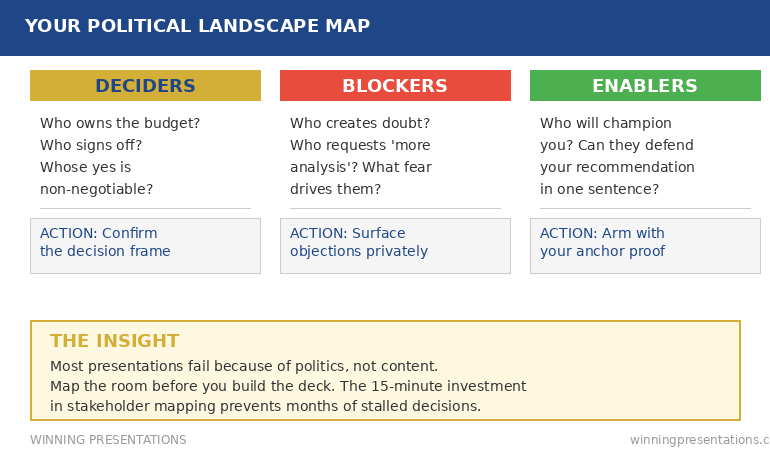
I call this framework the Decider / Blocker / Enabler model — a political landscape map that categorises every stakeholder by their role in the decision, not their title on the org chart. It’s the same approach used in change management and consulting, adapted specifically for high-stakes executive presentations where the politics of the room matter as much as the quality of the slides.
The Decider. This is the person whose “yes” actually matters. In some rooms, it’s obvious — the CEO, the CFO, the Board Chair. In others, it’s not. I once watched a VP present to a room of eight people, addressing his entire pitch to the most senior person present. The actual decision-maker was a Commercial Director two levels below, who controlled the budget line. The VP never made eye contact with her. The proposal died.
The Decider isn’t always the most senior person. They’re the person who owns the budget, the risk, or the political capital required to move forward. Ask yourself: Who actually signs off on this? Whose approval is non-negotiable?
The Blocker. This is the person who can prevent your recommendation from being approved — even if they can’t approve it themselves. Blockers don’t always announce themselves. They ask careful questions. They raise “concerns for consideration.” They request “further analysis.” My client’s Group Risk Director was a classic blocker: she didn’t reject the proposal directly. She simply signalled doubt, and the room followed.
Blockers are motivated by different fears. Some worry about career risk — what if this makes me look bad? Some worry about territorial loss — does this reduce my influence? Some have legitimate technical concerns that haven’t been addressed. The key is understanding which fear is driving the resistance, because each requires a different response.
The Enabler. This is the person who will champion your recommendation when you’re not in the room. Enablers are the most underutilised asset in executive presentations. They’re the colleague who says “I’ve seen the analysis, it’s solid” in the pre-meeting conversation. They’re the board member who turns to the Decider and says “I think this addresses my concern from last quarter.”
You can’t create enablers in the presentation itself. You create them before it — through pre-meeting alignment conversations that give them the information and confidence to support you publicly.
Do this in 60 seconds before your next deck:
Write down the names of everyone in the room. Label each person: D (Decider), B (Blocker), or E (Enabler).
If you can’t label them, you’re not ready to present yet.
Fix it fast: The Executive Buy-In Presentation System (£199 — rises March 1st) includes a ready-to-use Political Landscape Map template + the Decision Definition Canvas so you can do this properly in under 10 minutes.
The Executive Buy-In Presentation System includes the Decision Definition Canvas and the Proof Selector Matrix — tools specifically designed to map stakeholder dynamics and match your approach to each person’s concerns. Learn more about the Executive Buy-In System (£199).
Building Your Political Landscape Map
The map itself takes 15 minutes. The intelligence it reveals can save you months of stalled decisions.
For every significant presentation, before you build a single slide, write down every person who will be in the room (or who influences people in the room). Then answer four questions about each:
1. What is their role in this decision? Decider, Blocker, or Enabler. Some people are genuinely neutral — they’ll follow whoever has the strongest signal. Mark them too. They matter because they’re the audience your Enablers are trying to influence.
2. What is their primary fear? Career risk, financial risk, reputation risk, or timing risk. This isn’t about what they’ll say — it’s about what they’re silently calculating. A CFO who asks “What’s the ROI?” is usually asking “What happens to me if this loses money?” Those are different questions requiring different answers.
3. What is their relationship to your recommendation? Does this increase or decrease their influence? Does it create work for their team? Does it solve a problem they’ve been publicly advocating for — or does it contradict something they’ve championed before? People don’t evaluate recommendations in isolation. They evaluate them through the lens of their own position.
4. What would make them feel safe saying yes? This is the critical question. Not “what evidence would convince them?” but “what would reduce their perceived risk enough to support this?” For some, it’s precedent. For others, it’s a guarantee of reversibility. For others, it’s simply being consulted before the meeting so they don’t feel ambushed.
PAA: How do you identify stakeholder dynamics before a presentation?
Start by listing everyone in the room and categorising them as Decider, Blocker, Enabler, or Neutral. Then identify each person’s primary concern — career risk, financial risk, reputation risk, or timing risk. Finally, have one-on-one conversations before the meeting to surface objections and build support. The goal is to know the room’s dynamics before you enter it.
Decisions Happen Before the Meeting. Your Preparation Should Too.
Module 1 of the Executive Buy-In System includes the Decision Definition Canvas — a diagnostic that maps the decision, the decision-maker, the perceived risk, and the success criteria in under 10 minutes. Module 4 teaches you how to match proof to each stakeholder’s specific fear type.
Get the Executive Buy-In System → £199
Study at your own pace with live Q&A calls for support. 7 modules, 36 lessons, built from real boardroom experience where political preparation consistently separated approved proposals from stalled ones.
Presenting this week? Do this in 15 minutes:
1. List every attendee + two influencers who won’t be in the room but shape opinions.
2. Label each: D (Decider) / B (Blocker) / E (Enabler) / N (Neutral).
3. Write each person’s likely fear: career risk, financial risk, reputation risk, or timing risk.
4. Schedule one 10-minute conversation with the most likely Blocker.
5. Add one slide that directly addresses the Blocker’s concern.
6. Confirm the decision question with the Decider’s office.
How to Work the Map Before You Present
The map is useless if you build it and then present as though you haven’t. Here’s how to act on it.
For Deciders: Confirm the decision frame. Before the meeting, have a brief conversation with the Decider (or their gatekeeper) to confirm what decision they’re actually expecting. “I want to make sure I’m structuring this around the right question — is the decision whether to proceed, or which option to proceed with?” This single question has saved my clients more time than any slide redesign. It also signals competence — you’re thinking about their decision, not your content.
For Blockers: Surface the objection privately. This is the most important step, and the one most people skip. Meet the Blocker before the presentation. Not to persuade them — to listen. “I’m presenting the X recommendation next week. I’d value your perspective before I finalise the approach.” Most Blockers don’t want to destroy your proposal. They want their concern acknowledged. When they feel heard in private, they’re far less likely to ambush you in public.
If you discover a concern you can address, build it into your presentation explicitly: “Sarah in Risk flagged the implementation timeline, and I’ve adjusted the phasing to reflect that.” This does two things: it neutralises the objection and it publicly credits the Blocker, which converts them from opponent to contributor.
For Enablers: Arm them with your anchor proof. Your Enabler can only champion your recommendation if they can articulate why it’s the right call — in one sentence, from memory, to sceptics. Give them that sentence. “The anchor proof is [X]. If anyone pushes back on [concern], the response is [Y].” When your champion can defend your recommendation as confidently as you can, the decision doesn’t depend solely on your performance in the room.
For Neutrals: Make the default easy. Neutral stakeholders will follow the strongest signal. If your Enabler speaks first and confidently, Neutrals tend to follow. Structure your presentation so the ask is clear and the next step is simple. People default to “yes” when saying yes is easier than asking more questions.
If you’re interested in the broader stakeholder mapping process for your executive presentations, I’ve written a detailed tactical guide.
The Executive Buy-In System covers this entire process in depth — from the Decision Definition Canvas (Module 1) through pressure response scripts for when Blockers challenge you in the room (Module 6). See the full Executive Buy-In System syllabus (£199).
What to Do When the Politics Are Against You
Sometimes you map the landscape and the picture isn’t good. The Blocker is powerful. Your Enabler is junior. The Decider is risk-averse. What then?
Don’t present until the ground is prepared. The biggest mistake I see is professionals walking into rooms they haven’t prepared politically because “the meeting is already scheduled.” Postponing a meeting to do proper alignment work is almost always a better outcome than presenting into a hostile or uncertain room. You lose a week. You gain a decision.
Reframe the ask to reduce perceived risk. If the political landscape suggests a full “yes” is unlikely, consider presenting a smaller ask: a pilot, a phased approach, a “proceed to next stage” rather than “approve the full programme.” This isn’t weakness — it’s reading the room accurately and adapting. Executives trust people who propose manageable risks over those who push for everything at once.
Use the Blocker’s language in your framing. If you’ve had a pre-meeting conversation with the Blocker, use their exact words in your presentation. “As [Name] rightly pointed out in our earlier conversation, the implementation timeline needs careful sequencing.” This isn’t manipulation — it’s demonstrating that you’ve listened. It’s remarkably difficult for someone to oppose a recommendation that explicitly incorporates their concern.
PAA: What do you do when executives resist your presentation recommendation?
First, diagnose the type of resistance. Is it a content objection (they need more evidence), a risk concern (they need reassurance), a political dynamic (they have competing interests), or a trust issue (they don’t yet believe you can deliver)? Each requires a different response. The psychology of executive buy-in is about addressing the real concern, not just the stated one.
Stop Presenting Into Rooms You Haven’t Read
The Executive Buy-In Presentation System teaches you how senior people actually decide — and how to structure your approach around their psychology, their politics, and their risk calculations. 7 modules: decision clarity, buy-in structure, credibility, proof strategy, AI execution, pressure response, and your personal executive playbook.
Get the Executive Buy-In System → £199
⏰ Launch pricing ends March 1st. The price rises to £499 (self-study) / £850 (live cohort). Lock in £199 before it changes.
Self-study modules + live Q&A calls. Built from 24 years in corporate banking where political preparation consistently separated approved proposals from stalled ones.
Frequently Asked Questions
How far in advance should I map the political landscape?
For high-stakes presentations (board approvals, budget requests, major client pitches), start mapping at least two weeks before. You need time for one-on-one conversations with Blockers and Enablers. For routine updates, a quick mental map the day before is usually sufficient — but even five minutes of stakeholder thinking prevents most political blindspots.
What if I can’t get access to the Blocker before the meeting?
If direct access isn’t possible, find someone who has it. Ask a mutual colleague: “What’s [Name]’s main concern about this area right now?” Even indirect intelligence is better than walking in blind. If you truly can’t get any information, acknowledge the gap in your presentation: build in a slide that explicitly addresses the most likely objection from that person’s position. Showing you’ve anticipated their concern — even without a conversation — signals respect for their perspective.
Is this approach manipulative?
Stakeholder mapping is standard practice in change management, consulting, and programme leadership. It’s not about manipulating anyone — it’s about understanding what different people need in order to feel confident making a decision. The pre-meeting conversations are about listening, not persuading. The goal is to build a presentation that genuinely addresses everyone’s legitimate concerns, not to circumvent them.
How do I handle a situation where two stakeholders have conflicting interests?
This is more common than most people realise. When stakeholders conflict, your job is to name the tension rather than pretend it doesn’t exist. “I’m aware that this recommendation creates different priorities for Operations and Finance, and I’ve tried to structure a phased approach that addresses both.” Naming the conflict demonstrates political awareness. Ignoring it guarantees that one side will surface it — on their terms, not yours.
📬 The Winning Edge Newsletter
Weekly executive presentation strategies, stakeholder navigation techniques, and career-critical communication insights. No fluff.
🎯 Free: Executive Presentation Checklist
The pre-presentation checklist I give every executive before a high-stakes meeting. Covers structure, messaging, and audience preparation — including a stakeholder mapping section.
Related: If you’ve recently been promoted and you’re presenting to a room where you don’t yet know the political dynamics, read The Presentation You Give After Getting Promoted (Most Get It Wrong) — the listening-led approach is your fastest path to mapping a new political landscape. And if the politics of presenting trigger anxiety, introverted executives often have an advantage in these situations because they observe dynamics rather than performing over them.
The best presentation in the world fails when it’s delivered into a room you haven’t read. Map the Deciders, the Blockers, and the Enablers. Have the conversations before the meeting. Build your slides around their concerns, not just your content.
Start with the Executive Buy-In Presentation System (£199 — launch pricing ends March 1st) — and learn the decision psychology that turns political awareness into consistent approvals.
About the Author
Mary Beth Hazeldine is the Owner & Managing Director of Winning Presentations. With 24 years of corporate banking experience at JPMorgan Chase, PwC, Royal Bank of Scotland, and Commerzbank, she spent over a decade navigating the political dynamics of boardroom decisions before teaching others to do the same.
A qualified clinical hypnotherapist and NLP practitioner, Mary Beth combines executive communication expertise with decision psychology and stakeholder strategy. She has trained thousands of professionals and helps leaders turn political complexity into consistent buy-in.