
Tag: presentation panic

01 Jul 2026
What to Do in the Three Seconds After Your Mind Goes Blank

What to Do in the Three Seconds After Your Mind Goes Blank

Quick answer: When your mind goes blank during a presentation, the thing that turns a half-second gap into a spiral is not the blank itself — it is having no plan for the blank, so the panic of “I’ve lost it” floods in and makes the gap worse. The recovery is a three-move sequence you prepare in advance: stop, anchor, bridge. Stop means you do not fill the gap with filler or apology — you let a brief silence sit, which the room reads as a pause, not a failure. Anchor means you return to a fixed point you wrote before you started: a single sentence that summarises your whole argument, which you can always say even when the next detail has vanished. Bridge means you use a prepared transition to climb back into the structure — “the point underneath all of this is… so let me take the next piece.” The blank stops being catastrophic the moment you have somewhere to go when it happens, and the one-sentence anchor is that somewhere. Prepared, the blank costs you three seconds. Unprepared, it can cost you the room.

In 2017 I worked with a capable senior manager who had presented hundreds of times without incident and then, in an internal town hall in front of a few hundred colleagues, went completely blank mid-sentence. She told me about it afterward in detail because it had frightened her more than anything in her career. She was halfway through a point she knew cold when the next word simply was not there. There was a slide on the screen she suddenly could not connect to anything she had been saying. She heard her own voice stop, felt the heat rise in her face, and the only thought in her head was “everyone can see this.” She filled the gap the way most people do — “sorry, um, where was I, sorry” — which did not help, because the apology announced the blank to a room that might otherwise have read the pause as a beat. The water glass was right there; she reached for it not because she was thirsty but because she needed somewhere to put her hands. It took her the better part of a minute to find her way back, and the minute felt like ten.

What she said next is the thing I want this article to fix. She said: “The worst part was that I had no idea what to do. I just stood there hoping it would come back.” That is the real problem with going blank — not the blank, which happens to nearly everyone who presents often enough, but the absence of any plan for it. An experienced presenter who blanks and has a prepared recovery loses three seconds and the room never registers it. An experienced presenter who blanks with no plan is left hoping, and hoping is not a method; it leaves you stranded in the gap while the panic builds. The difference between the two is not nerve or talent. It is whether you decided in advance what you would do.

(This article was created with AI assistance; all stories and insights are based on 35 years of real client work.)

The recovery I now teach is a three-move sequence, prepared before you ever stand up: stop, anchor, bridge. Stop is refusing to fill the gap with apology or filler, and letting a short silence sit instead. Anchor is returning to a single fixed sentence — the one that summarises your whole argument — which is available to you even when every detail has gone. Bridge is the prepared transition that carries you from the anchor back into your structure. The three moves work because they replace the one thing that makes a blank catastrophic, which is having nowhere to go. Once you have somewhere to go, the blank is just a pause, and a pause is survivable.

If the fear of going blank is the thing that makes every presentation harder than it needs to be:

Conquer Your Fear of Public Speaking is a structured programme for managing the physical symptoms and the underlying fear that make moments like the blank feel catastrophic. It is built for capable professionals whose nerves do not match their competence — people who present well most of the time and want the dread to stop running the show.

See the programme →

Why a blank spirals — the second layer that does the damage

A blank itself is a small, ordinary event. The mind loses the thread of a sentence for a moment; it happens in conversation constantly and nobody notices, because in conversation there is no audience watching and no stakes attached to the gap. What turns the same small event into a spiral in a presentation is a second layer that arrives on top of it: the interpretation. The moment the word does not come, a frightened presenter does not think “I’ve lost my thread for a second.” They think “I’m falling apart and everyone can see.” That catastrophic reading floods the system with exactly the stress response that makes recall harder, so the blank that would have lasted a second extends while you fight it. The blank is the first layer; the panic about the blank is the second; and it is the second layer that does the real damage.

This is why filling the gap with apology makes everything worse. “Sorry, um, I’ve completely lost my train of thought” does two harmful things at once. It announces the blank to a room that, in the first second or two, almost certainly read your pause as deliberate — audiences are far less aware of your internal state than you feel they are. And it feeds the second layer, because saying it out loud confirms the catastrophic interpretation to yourself. The recovery has to break the second layer, not the first, because the first layer is harmless on its own. You do not need a technique to stop your mind ever pausing — that is not achievable. You need a technique that stops the pause from becoming a panic, and that is entirely achievable, because the panic comes from having no plan, and a plan is something you can prepare.

The stop-anchor-bridge recovery

Stop is the hardest of the three moves and the most important, because it goes against the reflex. When the blank hits, every instinct says fill the silence immediately — with “um,” with an apology, with anything. The move is to do the opposite: close your mouth, let the silence sit for a beat, and breathe out once. A two-second silence feels enormous from the inside and reads as a normal thinking pause from the outside. The stop does two things: it denies the panic the oxygen of a spoken apology, and it gives your recall the moment it needs without you talking over it. Most blanks resolve themselves in the silence if you let them, because the thread returns the instant you stop straining for it. Stop is not doing nothing; it is the active choice to wait instead of flail.

If the thread does not return in the silence, you anchor. The anchor is a single sentence you decided on before you started — the one-sentence summary of your entire argument — and the reason it works is that it is always available. The specific next detail can vanish; the overall point of what you are doing almost never does, because it is the thing you understand most deeply. So you say it: “The point underneath all of this is that we have one window to act and it closes in the autumn.” Saying the anchor aloud does three jobs — it gives you something true and confident to say while recall reboots, it reminds the room of your through-line, and it almost always shakes the next detail loose, because stating the big point re-activates the structure beneath it. Then you bridge: a prepared transition that climbs from the anchor back into the deck. “So let me take the next piece of that.” The bridge is deliberately generic precisely so it works from anywhere — you are never searching for the specific transition you lost, only reaching for the all-purpose one you prepared.

Stop letting the fear of the blank run every presentation.

Conquer Your Fear of Public Speaking is a structured programme for the capable professional whose nerves do not match their competence. It works on the physical symptoms that show up in the moment and the underlying fear that makes an ordinary pause feel like a collapse — so a blank becomes a three-second beat rather than the thing you dread for a week beforehand. £39, instant download, lifetime access.
Get the programme — £39 →

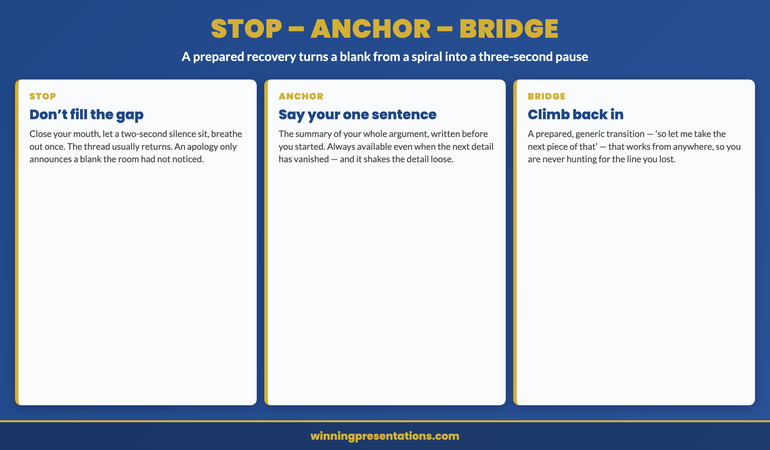
The stop-anchor-bridge recovery infographic. Stop: when the blank hits, do not fill the gap with apology or filler; close your mouth, let a two-second silence sit, breathe out once, and the thread usually returns. Anchor: if it does not, say the one fixed sentence you wrote before you started, the summary of your whole argument, which is always available even when the next detail has gone. Bridge: use a prepared generic transition such as so let me take the next piece of that to climb from the anchor back into your structure. The blank costs three seconds when you have somewhere to go.

The one-sentence anchor you write before you start

The whole recovery depends on the anchor existing before you need it, which means writing it is the single highest-value piece of preparation you can do against the blank. Before any presentation that matters, write one sentence that captures the entire argument — not the topic, but the point. “We have one window to fund the bet and it closes in the autumn” is an anchor. “A presentation about our growth options” is not, because it is a label, not a claim, and a label gives you nothing to say. The test of a good anchor is that you could say it confidently with no slides, no notes, and no warning, at any moment in the presentation, and it would be true and on-point. Write it on a card or at the top of your notes, and know it the way you know your own name, so that when everything else goes it is still there.

I watched the anchor do its job for a senior leader in 2019 who had a board Q&A coming up that she was dreading, specifically because she had blanked once before in front of that board and could not shake the fear of it happening again. We did not try to make her unblankable, which is not a thing. We wrote her one-sentence anchor — the core of her recommendation — and rehearsed the stop-anchor-bridge sequence until it was automatic. In the actual Q&A she did blank, on a hostile question, exactly as she had feared. But this time she stopped, let the silence sit, said her anchor sentence, and bridged into her answer — and the recovery was so clean that a colleague told her afterward it had looked like a deliberate, composed pause for thought. Same presenter, same vulnerability to going blank. The only thing that had changed was that she now had somewhere to go. To take this from the article tomorrow: write the one-sentence anchor for your next presentation, put it on a card, and rehearse saying it cold — so that if the blank comes, you stop, say the anchor, and bridge, instead of standing there hoping.

Reducing how often the blank happens at all

A recovery plan is the priority because it removes the fear, and removing the fear is what matters most — once you know you can recover, the dread that makes presentations harder than they need to be loosens its grip. But there are a few things that reduce how often the blank arrives in the first place, and they are worth doing alongside the recovery rather than instead of it. The most reliable is to present from structure rather than from memorised script. A memorised script is brittle: lose one line and the whole sequence can collapse, because each line is the cue for the next. A clear structure — a small number of points you understand and can speak to in your own words — is robust, because if you lose the exact phrasing you still have the point, and the point regenerates the words. Presenters who blank catastrophically are very often presenters who tried to memorise, and the memorisation is the brittleness.

The second is managing the physical state that makes recall fail, because the blank is partly a stress response and the stress response is partly manageable. A presenter who arrives over-adrenalised — shallow breathing, racing heart — is more likely to blank and slower to recover, because the body is in a state that suppresses recall. The settling techniques that reduce that state before you stand up are the same ones that help in the moment, and they are a large part of what a structured fear-of-speaking programme actually teaches. The deeper point is that the blank, the dread, and the physical symptoms are not three separate problems; they are one system, and working on the fear reduces all three. The same connection between a settled physical state and command of the room runs through the partner article on the opening pause, and through the wider presentation coaching work.

The competence is already there. The programme works on the fear around it.

Conquer Your Fear of Public Speaking is for the professional who presents well most of the time and wants the nerves to stop costing them — the dread beforehand, the symptoms in the moment, the fear of the blank. Instant download, lifetime access, £39. Built by someone who spent years on the wrong side of that fear before learning to manage it.
Get lifetime access — £39 →

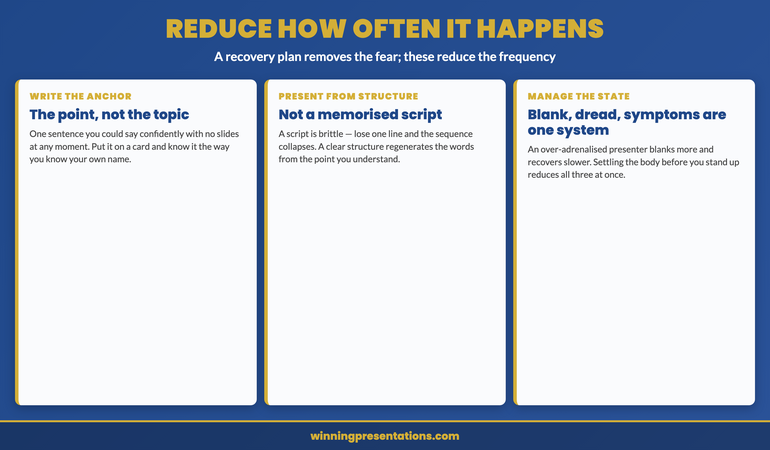
Reducing how often the blank happens infographic. Write the one-sentence anchor: a sentence that captures the entire argument, not the topic but the point, that you could say confidently with no slides at any moment. Present from structure not script, because a memorised script is brittle and losing one line can collapse the sequence, while a clear structure regenerates the words from the point. Manage the physical state, because a presenter who arrives over-adrenalised is more likely to blank and slower to recover; the blank, the dread and the symptoms are one system, and working on the fear reduces all three.

Frequently asked questions

Won’t the audience notice the pause and realise I’ve gone blank?

Far less than you fear. In the first second or two, a silent pause reads to an audience as a deliberate beat for thought — they cannot see inside your head, and they are far less attuned to your internal state than the panic tells you they are. What gives the blank away is not the pause but the apology: “sorry, I’ve lost my place” announces something the room had not noticed. This is exactly why stop comes first in the recovery. If you simply pause, breathe, and then say your anchor, the great majority of the time the room registers nothing more than a composed presenter taking a moment. The blank is visible only when you narrate it, so the discipline is to recover in silence rather than out loud.

I have tried “just breathe” advice before and it did not help in the moment — how is this different?

Because breathing on its own gives you nothing to say, and the terror of the blank is the silence you cannot fill. Stop-anchor-bridge includes the breath but does not stop there: it gives you a specific, prepared sentence to say next — the anchor — and a specific way back into your material — the bridge. That is the difference between a calming instruction and a recovery method. “Just breathe” tells you how to feel; stop-anchor-bridge tells you exactly what to do and say, in order, which is what you actually need when recall has failed and the room is waiting. The breath settles the body; the anchor and the bridge get you moving again. You need all three, and the prepared sentence is the piece most advice leaves out.

Does going blank mean I am not cut out for senior presenting?

No — going blank is one of the most common experiences among capable, experienced presenters, including very senior ones, and it is a poor predictor of presenting ability. It tends to happen precisely because you care about the outcome, which raises the stakes and the stress, which is why it strikes competent people in high-stakes rooms rather than indifferent ones. What separates senior presenters who handle it from those who do not is not immunity to the blank but a prepared recovery and a calmer relationship with the fear. Treat the blank as a normal, survivable event with a known response, and it stops being evidence about your fitness for the role. The presenters who never blank are mostly the ones who present rarely; the ones who present constantly have all learned to recover.

How long does it take to stop dreading the blank?

The dread usually drops sharply the first time you recover cleanly with a plan, because the fear is largely fear of helplessness, and one successful recovery proves to you that you are not helpless. Having the stop-anchor-bridge sequence and a rehearsed anchor often changes how a presentation feels before you have even used them, simply because you walk in knowing you have a response if the blank comes. The deeper, steadier reduction in the underlying fear — the kind that changes your physical state before you stand up — builds over a number of presentations and is what a structured fear-of-speaking programme is designed to accelerate. The immediate relief comes from the plan; the lasting change comes from repeatedly proving the plan works.

The Winning Edge — weekly newsletter

The Winning Edge is a weekly newsletter for professionals who want to present with less dread and more control. One short email a week on the practical moves that make high-stakes presenting feel survivable. Subscribe to The Winning Edge →

For the moves that establish command before the content even begins, see the partner article on the opening pause, and the wider presentation coaching resources.

About the author

Mary Beth Hazeldine is Owner & Managing Director of Winning Presentations Ltd. With 24 years of corporate banking experience at JPMorgan Chase, PwC, Royal Bank of Scotland, and Commerzbank, she advises executives across financial services, healthcare, technology, and government on presenting under pressure, managing presentation nerves, and structuring high-stakes presentations.

The next time your mind goes blank mid-presentation, do three things instead of standing there hoping: stop, and let a two-second silence sit rather than filling it with an apology the room had not yet needed; anchor, by saying the one sentence you wrote beforehand that captures your whole argument; and bridge, with the prepared transition that carries you back into your material. Write that anchor sentence before your next presentation and rehearse saying it cold. The presenter who has somewhere to go when the blank comes loses three seconds and the room never knows. The presenter who has no plan is left hoping — and hoping is the thing that turns an ordinary pause into the moment you dread for a week.

10 Feb 2026
Professional taking a calming breath before high-stakes presentation, moment of composure

The Fight or Flight Hack I Learned From Hypnotherapy (It Works in 90 Seconds)

My heart was pounding so hard I could hear it in my ears.

I was standing outside a boardroom at JPMorgan, about to present a restructuring proposal to twelve senior executives. I’d done this a hundred times. I knew the content cold. But my body didn’t care about my experience. It had decided I was about to be eaten by a predator.

My hands were shaking. My mouth was dry. My brain was screaming at me to run — literally run — out of the building and never come back.

That was the day I realised something had to change. Not my preparation. Not my slides. Not my “mindset.” Something deeper. Something neurological.

I spent the next three years training as a clinical hypnotherapist, specifically to understand why intelligent, experienced professionals lose control of their bodies before presentations — and what actually works to stop it.

Here’s what I learned.

Quick answer: Presentation panic is an amygdala hijack — your brain’s threat detection system firing when there’s no actual threat. You can’t think your way out of it because the amygdala bypasses your rational brain. But you can interrupt it with a 90-second nervous system reset: ground your feet, slow your exhale, activate a physical anchor, and engage your peripheral vision. This shifts you from sympathetic (fight/flight) to parasympathetic (calm/focused) dominance before you enter the room.

For five years, I had a secret. I was a senior banking executive who delivered high-stakes presentations regularly — and I was terrified every single time.

Not nervous. Not “a bit anxious.” Terrified. The kind of fear where your vision narrows, your thoughts scatter, and your body feels like it belongs to someone else.

I tried everything the corporate world suggests: more preparation, more practice, more positive thinking. I visualised success. I told myself I was “excited, not nervous.” I did power poses in the bathroom.

None of it worked. Because none of it addressed the actual problem.

The problem wasn’t psychological. It was physiological. My nervous system was hijacking my body, and no amount of positive thinking could override 200,000 years of human evolution.

When I trained as a hypnotherapist, I finally understood why — and more importantly, what to do about it. (If you want the full story of how I overcame my fear of public speaking, I’ve written about that separately.)

Why Your Body Betrays You (The Neuroscience)

Here’s what’s actually happening when you feel presentation panic:

Your amygdala — the brain’s threat detection centre — has identified a potential danger: you’re about to be evaluated by a group of people. For our ancestors, group rejection meant death. Being cast out of the tribe was a survival threat.

Your amygdala doesn’t know the difference between a boardroom and a savannah. It just knows: evaluation by group = potential rejection = danger.

So it does what it’s designed to do: trigger the sympathetic nervous system. Flood your body with adrenaline and cortisol. Prepare you to fight or run.

This is the amygdala hijack. And here’s the crucial part: it happens before your rational brain gets involved.

The threat signal reaches your amygdala faster than it reaches your prefrontal cortex — the thinking brain. By the time you’re consciously aware of the fear, your body is already in full fight-or-flight mode. (This “low road” threat response was first described by neuroscientist Joseph LeDoux in his research on fear processing.)

This is why you can’t think your way out of it. By the time you’re thinking, the hijack has already happened.

You need to interrupt the nervous system directly.

The 90-Second Nervous System Reset

This technique works because it targets the vagus nerve — the main communication line between your body and your parasympathetic nervous system (the “rest and digest” system that calms you down).

Do this 2-3 minutes before you need to present:

Step 1: Ground (15 seconds)

Stand with both feet flat on the floor, hip-width apart. Press your feet down firmly — feel the floor pushing back up against you.

This isn’t metaphorical “grounding.” It’s neurological. Pressure receptors in your feet send signals to your brain that say “stable, safe, solid ground.” This interrupts the “run away” signal.

Mentally scan from the soles of your feet up through your ankles. Notice the connection to the earth. Your body is supported.

Step 2: Breathe (30 seconds)

Here’s the key most people get wrong: it’s not about breathing deeply. It’s about breathing out slowly.

Your exhale activates the parasympathetic nervous system. Your inhale activates the sympathetic (stress) system. Most anxious breathing is short inhale, short exhale — which keeps you stuck in stress mode.

The 4-7-8 pattern:

  • Inhale through your nose for 4 counts
  • Hold for 7 counts
  • Exhale slowly through your mouth for 8 counts

The extended exhale is what shifts your nervous system. Do this 3-4 times.

⚡ Presenting in the next 24 hours? Do this now (2 minutes):

  • Run the 90-second reset once (Ground → Breathe → Anchor → Peripheral)
  • Write the first sentence you’ll say when you start — just 9 words
  • Fire your anchor the moment you stand up tomorrow

If you want the guided audio version + the full calm protocol for tonight and tomorrow morning:

🎧 Emergency Relief: Guided Audio You Can Use Tonight

Conquer Speaking Fear includes a guided audio walkthrough of the 90-second reset — so you can practise with my voice in your ears instead of trying to remember each step. Use it tonight, use it tomorrow morning, use it 5 minutes before you present.

Get Conquer Speaking Fear → £39

Instant download. 30-day money-back guarantee. Printable protocol card included.

Step 3: Anchor (30 seconds)

This is the technique that changed everything for me. It’s called “anchoring” in NLP, and it gives you a physical switch to access calm on demand.

While you’re in that calm state from the breathing:

  • Press your thumb and middle finger together firmly
  • Hold for 10 seconds
  • Associate this pressure with the feeling of calm

The more you practise this (outside of stressful situations), the stronger the anchor becomes. Eventually, pressing those fingers together triggers the calm state automatically.

I’ve used this anchor in boardrooms, on stages, in TV interviews. It works because you’re not trying to create calm in the moment — you’re accessing calm you’ve already stored.

Step 4: Engage Peripheral Vision (15 seconds)

When we’re anxious, our vision narrows — literally. This is called “tunnel vision” and it’s part of the fight-or-flight response. Your brain focuses on the threat and ignores everything else.

You can reverse this deliberately:

  • Pick a spot on the wall in front of you
  • While keeping your eyes on that spot, expand your awareness to include what’s in your peripheral vision
  • Notice objects on the far left and far right without moving your eyes

This simple technique shifts your brain from “focused threat detection” to “relaxed awareness.” It’s impossible to maintain full fight-or-flight while in peripheral vision mode.

The Conquer Speaking Fear programme includes guided audio for each step of this protocol, plus advanced techniques for building permanent calm anchors.

90-second nervous system reset technique showing 4 steps: Ground, Breathe, Anchor, Engage

Why “Just Breathe” Doesn’t Work Alone

You’ve probably been told to “just breathe” before presentations. And you’ve probably found it doesn’t help much.

Here’s why: breathing alone, without the other elements, often makes anxiety worse.

When you focus intensely on your breathing while anxious, you’re focusing on a body that feels out of control. You notice how fast your heart is beating. You notice how shallow your breath is. You notice how uncomfortable you feel.

This increases anxiety, not decreases it.

The 90-second reset works because it combines multiple interventions:

  • Grounding interrupts the “run” signal
  • Extended exhale activates the parasympathetic system
  • Anchoring accesses pre-stored calm
  • Peripheral vision shifts brain state

Each element alone has some effect. Together, they’re transformative.

Physical Anchors: The Technique Nobody Teaches

Anchoring is the most powerful technique I learned in hypnotherapy training, and it’s almost never taught in corporate presentation skills courses.

The concept is simple: your brain naturally associates physical sensations with emotional states. Think of a song that instantly transports you to a specific memory and feeling. That’s an anchor — the song triggers the emotional state.

You can create these deliberately.

How to Install a Calm Anchor

Step 1: Create a genuine calm state

Do this when you’re actually relaxed — after a bath, during meditation, while listening to calming music. Don’t try to do it when you’re already anxious.

Step 2: Intensify the calm

Once you feel relaxed, focus on the feeling. Notice where you feel it in your body. Make it stronger in your imagination. Give it a colour if that helps.

Step 3: Set the anchor

At the peak of the calm feeling, press your thumb and middle finger together (or any unique physical gesture you can do discreetly). Hold for 10-15 seconds while maintaining the calm feeling.

Step 4: Release and repeat

Release the fingers, break the state (stand up, shake it off), then repeat 3-5 times in the same session.

Step 5: Test and strengthen

Later, in a neutral state, fire the anchor (press the fingers). Notice if you feel a shift toward calm. The more you repeat steps 1-4 over days and weeks, the stronger the anchor becomes.

This isn’t magic. It’s classical conditioning — the same mechanism Pavlov discovered with his dogs. You’re conditioning your nervous system to produce calm on demand.

🎯 Build a Permanent Calm Switch

The anchor installation protocol in Conquer Speaking Fear goes deeper than what I can cover here — including how to “stack” multiple calm memories into one anchor, how to test anchor strength, and how to rebuild an anchor if it weakens over time. This is the skill that transforms occasional relief into permanent confidence.

Get Conquer Speaking Fear → £39

Includes guided audio for anchor installation + stacking technique.

Before, During, and After: A Complete Protocol

The 90-second reset is for immediate pre-presentation use. But if you’re dealing with significant presentation anxiety, you need a complete protocol.

The Night Before

Do NOT review your slides obsessively. This increases anxiety by keeping the presentation front-of-mind.

Instead:

  • Do one final review in the early evening, then stop
  • Spend 10 minutes with your calm anchor (install or strengthen it)
  • Avoid alcohol (it disrupts sleep and increases next-day anxiety)
  • Go to bed at your normal time

The Morning Of

Your nervous system is most suggestible in the first 20 minutes after waking.

  • Don’t check email or news immediately — this triggers stress hormones
  • Do 5 minutes of the breathing protocol while still in bed
  • Visualise yourself calm and in control (not the presentation content — just the feeling of confidence)
  • Move your body — even a 10-minute walk shifts your nervous system state

The full morning protocol in Conquer Speaking Fear includes a specific sequence designed to set your nervous system baseline before high-stakes days.

2-3 Minutes Before

This is when you use the 90-second reset: Ground → Breathe → Anchor → Peripheral Vision.

Do this in a private space if possible — a bathroom, an empty corridor, even a stairwell. You need 90 seconds where no one will interrupt you. (For more techniques to calm your nerves before a presentation, see my dedicated guide.)

During the Presentation

If you feel anxiety rising mid-presentation:

  • Fire your anchor discreetly (press thumb and finger under the table or behind your back)
  • Slow your speaking pace deliberately — anxiety makes us rush
  • Engage peripheral vision while speaking — it’s easier than you think
  • Ground through your feet if you’re standing

Nobody will notice you doing these things. They’re invisible interventions.

After

Your nervous system doesn’t know the “threat” is over just because the presentation ended. You may feel residual anxiety for hours.

  • Don’t immediately debrief or replay what happened
  • Take 5 minutes for physical movement — walk around, stretch
  • Do 3-4 extended exhales to signal safety to your nervous system
  • Later that day, acknowledge what went well (your brain needs positive data to update its threat assessment)

What Changed for Me

That day at JPMorgan, standing outside the boardroom with my heart pounding, I didn’t have these techniques. I went in anxious, stayed anxious throughout, and delivered a presentation that was technically acceptable but emotionally flat.

Now, fifteen years and hundreds of presentations later, I still get the initial spike of adrenaline. That’s normal — it’s your body preparing for a performance. The difference is I know exactly how to channel it.

The 90-second reset isn’t about eliminating all nervousness. It’s about moving from panic (sympathetic dominance) to focused energy (balanced nervous system). The goal isn’t to feel nothing. It’s to feel ready.

You can learn to do this too. Your nervous system isn’t broken — it’s just running outdated threat detection software. You can update it.

🧠 The Complete Nervous System Control System

Everything in Conquer Speaking Fear:

  • The 90-second reset (guided audio + printable card)
  • Anchor installation protocol with memory stacking
  • Night-before and morning-of routines
  • Mid-presentation recovery techniques
  • Post-presentation nervous system reset

Get Conquer Speaking Fear → £39

Instant download. 30-day money-back guarantee. Used by hundreds of executives.

For physical symptoms specifically (shaking hands, racing heart, sweating): Calm Under Pressure (£19.99) provides targeted techniques for the body-level symptoms of presentation anxiety.

Frequently Asked Questions

How long does it take for anchoring to work?

Most people notice some effect after 3-5 installation sessions spread over a week or two. The anchor strengthens with repetition — the more you install it during genuinely calm states, the more reliable it becomes. Some of my clients have anchors they’ve been using for years that fire instantly.

What if I don’t have 90 seconds before the presentation?

If you only have 30 seconds, prioritise the extended exhale (3-4 breaths with long exhale) and fire your anchor. These two elements give you the most nervous system shift in the least time. Even one proper exhale helps.

Can this work for people with severe presentation anxiety?

Yes, but severe anxiety may need additional support. These techniques are the foundation I use with all my clients, including those with diagnosed anxiety disorders. For severe cases, I recommend combining these techniques with professional support from a therapist who understands performance anxiety specifically.

Note: These techniques are performance tools, not medical treatment. If you experience panic attacks, severe anxiety symptoms, or symptoms that significantly impact your daily life, please consult a qualified healthcare professional alongside using performance techniques.

Why does peripheral vision help with anxiety?

Tunnel vision is part of the fight-or-flight response — your brain narrows focus to the perceived threat. By deliberately engaging peripheral vision, you signal to your brain that you’re not in immediate danger (you wouldn’t be scanning the horizon if a predator were attacking). This shifts you out of the high-alert stress state.

📬 The Winning Edge Newsletter

Weekly techniques for presentation confidence and executive communication. Evidence-based strategies from a clinical hypnotherapist who’s been in the boardroom.

Subscribe free →

Related: Once your nervous system is under control, you need a presentation that’s worth delivering. Read The M&A Integration Update That Stops Panic for a framework that keeps 500 people calm when the stakes are high.

Your body’s fear response isn’t your enemy. It’s an ancient protection system that kept your ancestors alive. The problem is it can’t distinguish between a sabre-toothed tiger and a quarterly business review.

You don’t need to eliminate fear. You need to regulate it. Ground your feet. Extend your exhale. Fire your anchor. Engage your peripheral vision.

Ninety seconds. That’s all it takes to shift from panic to ready.

About the Author

Mary Beth Hazeldine is the Owner & Managing Director of Winning Presentations. A qualified clinical hypnotherapist and NLP practitioner, she spent 24 years in corporate banking at JPMorgan Chase, PwC, Royal Bank of Scotland, and Commerzbank before specialising in presentation anxiety.

Mary Beth combines evidence-based nervous system techniques with real-world executive experience. She has trained thousands of professionals in managing presentation fear and high-stakes communication pressure.