Tag: presentation improvement

22 Feb 2026
Professional woman sitting alone at a conference table after a meeting writing notes in a notebook with empty chairs around her and the last presentation slide still visible on screen in golden late afternoon light

The Presentation Debrief Framework Nobody Uses (The 5-Minute Review That Makes Your Next One Better)

Quick answer: Most professionals present, feel relief, and move on — then repeat the same mistakes next time. A structured presentation debrief framework changes that. The 5-Minute Debrief captures what worked, what didn’t, and one specific change for next time. Done within 30 minutes of presenting while memory is fresh, it compounds into measurable improvement over weeks — without courses, coaches, or extra rehearsal time.

⚡ Try this after your next presentation (10 minutes):

Within 30 minutes of finishing, answer four questions on your phone: (1) Where did audience energy shift? (2) What one moment worked best? (3) What one thing would I change? (4) What Q&A question did I handle badly? That’s the entire presentation debrief framework. Do it 10 times and you’ll be measurably better than everyone who skips this step. Full breakdown below.

Get the Structure Right So You Can Focus on Getting Better

The Executive Slide System gives you decision-first slide structures for every executive format — so your debrief focuses on delivery, Q&A, and audience engagement instead of “were my slides in the right order?”

Get the Executive Slide System → £39

Built from 24 years of corporate experience. Used in weekly updates, board presentations, and steering committee meetings.

She Wasn’t the Most Talented Presenter. After 6 Months, She Was the Best.

A director I coached at a financial services firm told me something honest in our first session: “I’m not terrible at presenting. But I’m not getting better. I’ve been presenting for eight years and I’m exactly where I started.”

She presented weekly to her leadership team, monthly to the steering committee, and quarterly to the board. That’s roughly 70 presentations a year. Eight years. Over 500 presentations — and she felt no better than when she started.

I didn’t change her slides. I didn’t teach her breathing techniques. I gave her one thing: a presentation debrief framework to complete within 30 minutes of every presentation.

Four questions. A phone note. Five minutes.

After three months, her leadership team noticed the change. After six months, her managing director described her as “the clearest presenter in the division.” She hadn’t taken a course. She hadn’t hired a coach beyond our initial session. She’d simply started learning from each presentation instead of moving on and forgetting.

After 24 years in corporate environments and 15 years training executives, this is the highest-leverage technique I know — and it’s the one nobody does.

Why Presentations Don’t Improve Without a Debrief

Think about how you treat presentations today. You prepare (sometimes for days), you deliver, you feel relieved, you move on to the next task. By the following morning, the specific details of what went well and what didn’t are already fading.

This means every presentation starts from scratch. You bring the same habits, the same structural patterns, the same nervous tics, the same Q&A weaknesses — because you never captured what to change.

Compare this to any other professional skill. Athletes review game footage. Surgeons debrief after procedures. Pilots complete post-flight checklists. In every high-performance field, the review phase is considered essential. In corporate presenting — a skill that directly impacts promotions, budget approvals, and career trajectory — the review phase simply doesn’t exist.

The result is predictable: professionals who present 70 times a year get 70 repetitions of the same mistakes instead of 70 iterations of improvement. Your executive presentation structure is the foundation — but the debrief is how you refine everything that sits on top of it.

The Presentation Debrief Framework: 4 Questions in 5 Minutes

Complete this within 30 minutes of presenting — in the car, at your desk, on your phone. The window matters: after 30 minutes, the specific details start fading and you’re left with general impressions, which aren’t useful.

Question 1: What was the audience’s energy at the start vs. the end?

Not “how did it go?” (too vague). Specifically: were they engaged at the start? Did energy increase or decrease? When did you notice a shift? This reveals whether your opening is strong and whether you’re losing people in the middle. If energy dropped at slide 4 every time, slide 4 is the problem.

Question 2: What’s the one thing that worked best?

Force yourself to identify one specific moment. Not “it went well” — that’s useless. “The CFO leaned forward when I showed the cost comparison on slide 3” or “The room laughed at the opening story about the vendor delay.” Specific moments you can deliberately repeat.

Question 3: What’s the one thing I’d change?

One thing only. Not a list of five improvements — that’s overwhelming and you won’t act on any of them. “I rushed the Q&A answer about timeline” or “Slide 7 had too much detail and I lost them.” One specific change you can implement next time. The approach to reading the room before you enter it gets better with each debrief because you start noticing patterns in how different audiences respond.

Question 4: What question did I handle badly (or not expect)?

This is the Q&A improvement question. Even if Q&A went well, identify the one question you hesitated on or answered weakly. Write down what you wish you’d said. Over ten debriefs, you’ll build a personal library of strong answers to recurring questions — and common Q&A mistakes stop recurring because you’ve consciously addressed them.
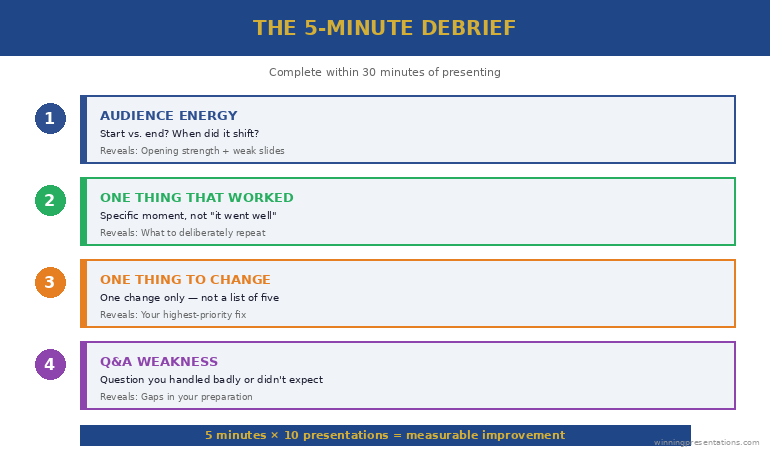
The 5-Minute Debrief showing four questions: audience energy, one thing that worked, one thing to change, and one Q&A improvement

When your slide structure is already right, your debrief focuses on delivery — not on fixing slides. The Executive Slide System solves the structure so you can focus on getting better.

Get the Executive Slide System → £39

Real Debrief Examples — What Useful Entries Look Like

Here are three actual debriefs (anonymised) from executives I’ve worked with. Notice how specific they are — that’s what makes them actionable.

Debrief 1 — Weekly leadership update (5 minutes):

Energy: Started engaged, dropped at slide 2 (capacity data — nobody cared). Picked back up when I flagged the vendor risk. What worked: Opening with the decision I needed. Got an immediate response. What I’d change: Cut the capacity slide entirely. Move the risk flag to slide 1. Q&A: The COO asked about the impact on Project Y. I wasn’t prepared. Answer for next time: “No dependency — different vendor, different timeline. I checked this morning.”

Debrief 2 — Steering committee (30 minutes):

Energy: High throughout — the committee was genuinely engaged. Dropped slightly during the risk section (too many risks listed). What worked: The cost-benefit slide. The CFO said “that’s exactly what I needed to see.” What I’d change: Reduce risks from 5 to 3. The committee can only influence 3 anyway. Q&A: Strong overall. One question about contract flexibility — I gave a confident answer because I’d prepared it. The Question Map worked.

Debrief 3 — Client pitch (45 minutes):

Energy: Polite but flat. The prospect was nodding but not engaging. What worked: The case study slide got the first real question. That’s the slide that created genuine interest. What I’d change: Lead with the case study instead of our company overview. They don’t care about us until they see proof we’ve solved their problem. Q&A: They asked about implementation timeline — I was vague. Need exact dates for next pitch.
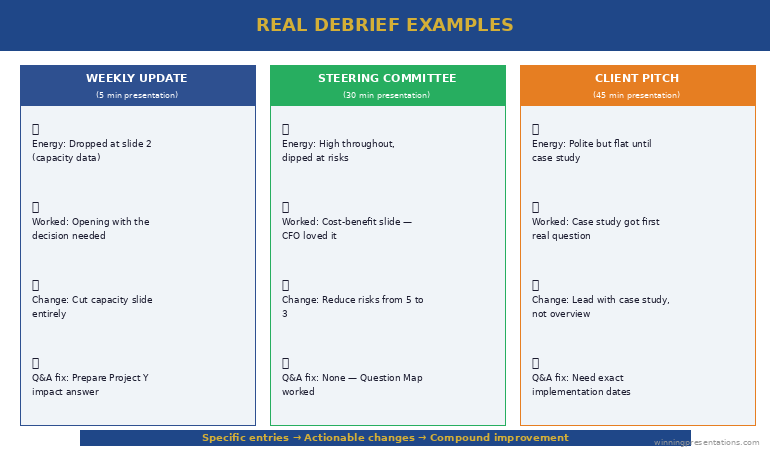
Three real debrief examples showing specific entries for weekly update, steering committee, and client pitch presentations

The Executive Slide System (£39) solves the structural problems so your debriefs focus on delivery, audience engagement, and Q&A — the skills that compound over time.

The Compound Effect: What Changes After 10 Debriefs

The presentation debrief framework doesn’t produce dramatic overnight change. It produces something more valuable: compound improvement.

After debrief 1-3: You start noticing patterns you didn’t see before. “I always rush the ending.” “The room always drops at slide 4.” “I never prepare for the timeline question.” Awareness is the first change.

After debrief 4-7: You start making deliberate changes before each presentation based on previous debriefs. “Last time I rushed the ending — this time I’ll pause before the closing slide.” “Slide 4 always loses them — I’ll cut it.” Your preparation becomes targeted instead of general.

After debrief 8-10: The changes become automatic. You naturally lead with decisions, cut weak slides, and prepare for the questions that used to catch you off guard. Your Q&A answers are stronger because you’ve built a library of prepared responses from previous debrief entries. Other people start noticing the improvement — because it’s visible and consistent.

Ten debriefs. Fifty minutes total. That’s the investment that separates someone who’s “presented for eight years” from someone who’s “improved through 500 presentations.”

The Executive Slide System (£39) eliminates the most common structural problems from the start — so your debriefs capture delivery insights instead of slide-order mistakes.

Common Questions About Presentation Debriefs

How do you review your own presentation?

Within 30 minutes of presenting, answer four specific questions: What was the audience’s energy at the start vs. end? What one thing worked best? What one thing would you change? What Q&A question did you handle badly or not expect? Specificity matters — “it went OK” is useless. “The CFO leaned forward at slide 3 but checked her phone at slide 6” is actionable.

How do you improve at presenting over time?

By capturing learning after each presentation instead of moving on and forgetting. A presentation debrief framework creates compound improvement — patterns emerge after 3-4 reviews, deliberate changes happen after 5-7, and automatic improvement is visible after 8-10. Without a structured review, you get repetition of the same habits rather than iteration toward better ones.

What’s the most common presentation mistake professionals repeat?

Burying the recommendation. In almost every debrief I review with executives, the audience’s energy drops mid-presentation because the presenter is building context instead of leading with the decision. Professionals repeat this mistake because they never capture the pattern. One debrief that notes “energy dropped at slide 4 — too much context before the recommendation” fixes it permanently.

Start Improving From Your Very Next Presentation

The Executive Slide System gives you the structure. The 5-Minute Debrief gives you the improvement loop. Together, every presentation you give is better than the last.

Get the Executive Slide System → £39

Used in weekly updates, board presentations, steering committees, and every executive format that benefits from continuous improvement.

Frequently Asked Questions

Do I really need to debrief every presentation?

Every one that matters. Weekly updates, steering committees, board meetings, client pitches — yes. A casual team huddle — probably not. The compound effect requires consistency, but 5 minutes per presentation is a low barrier. If you present 4 times a week and debrief each one, that’s 20 minutes a week for career-changing improvement.

What if I don’t have time within 30 minutes?

Type four bullet points on your phone while walking back to your desk. It doesn’t need to be a formal document — it needs to be specific and captured before the details fade. A 60-second phone note is infinitely more useful than a detailed review three days later when you’ve forgotten the specifics.

Should I ask my audience for feedback instead?

Self-debrief and audience feedback serve different purposes. Your debrief captures what you noticed in real time — audience energy, moments of connection, Q&A weaknesses. Audience feedback tells you what they valued. Both are useful, but the self-debrief is the one you control and can do consistently. Don’t wait for feedback that may never come — capture your own learning immediately.

Get Weekly Presentation Intelligence

Debrief frameworks, slide structures, and the executive communication strategies that compound over time — delivered every week.

Join the Newsletter

Related: If your debrief reveals Q&A as your biggest weakness, read Nobody Prepares for Q&A. That’s Why Q&A Kills the Presentation. — the Question Map for predicting every question before you present.

Your next step: After your next presentation, take 5 minutes to answer the four debrief questions. Be specific. One worked, one to change, one Q&A fix. Do this ten times and you’ll be measurably better than everyone who skips this step.

Want the slide structures that solve the most common debrief finding — so you can focus on delivery instead of fixing slides?

Get the Executive Slide System → £39

About the Author

Mary Beth Hazeldine is the Owner & Managing Director of Winning Presentations. With 24 years of corporate banking experience at JPMorgan Chase, PwC, Royal Bank of Scotland, and Commerzbank, she specialises in executive-level presentation skills and continuous improvement frameworks for professional communicators.

A qualified clinical hypnotherapist and NLP practitioner, Mary Beth combines executive communication expertise with evidence-based techniques. She has spent 15 years coaching executives to improve through structured debriefs, not just preparation.

Read more articles at winningpresentations.com

04 Feb 2026
Executive looking frustrated after presentation with green checkmark on screen behind him — vague praise instead of actionable feedback

Why ‘Great Presentation’ Is the Worst Feedback You Can Get

“Great presentation, really liked it.” The CFO shook my client’s hand, smiled, and walked out. Three weeks later, the £1.8 million budget request was quietly shelved.

The quick answer: When executives tell you “great presentation,” it almost always means your deck failed to force a decision. Actionable presentation feedback sounds uncomfortable — “slide 3 needs the ROI number,” “cut sections 4 through 7,” “lead with the ask next time.” Vague praise is a polite exit. If you’re consistently hearing “good job” but not getting approvals, the problem isn’t your delivery. It’s your slide structure.

⚡ Presenting tomorrow and need actionable feedback fast?

Before you walk into the room, ask one person — your manager, a peer, a trusted stakeholder — these three slide-specific questions:

  1. “Which slide would you cut first if I had to lose three?”
  2. “Is my recommendation on the first substantive slide, or buried at the end?”
  3. “What’s the one question the CFO will ask that I haven’t answered?”

Those three answers will give you more useful feedback in ten minutes than a dozen “great job” responses after the meeting. If you want the slide structure that forces this kind of feedback automatically, the Executive Slide System (£39) builds decision points into every section.

The Night I Realised Praise Was a Warning Sign

Early in my banking career at JPMorgan Chase, I presented a credit restructuring proposal to a room of seven senior directors. Twelve slides. Thirty-five minutes. When I finished, the most senior director nodded and said, “Really well put together. Thanks for that.”

I walked out feeling brilliant. Told my manager it went well. Two days later, she pulled me aside: “They’ve gone with another approach. Apparently, the deck didn’t address the regulatory risk.”

Nobody in that room told me what was missing. They told me it was “well put together.” That phrase now sets off alarm bells whenever I hear a client use it. Because in 24 years of corporate banking — across JPMorgan, PwC, Royal Bank of Scotland, and Commerzbank — I’ve learned that the executives who give you a compliment and nothing else are the ones who’ve already mentally moved on.

The executives who interrogate your slides? They’re the ones about to approve something.

Vague vs Actionable: What Real Presentation Feedback Sounds Like

After 24 years of coaching executives through high-stakes presentations — from board-level budget approvals to investor pitches — I’ve noticed a pattern that separates the presenters who get promoted from those who plateau. It has nothing to do with charisma or slide design. It’s about the type of feedback they receive — and what they do with it.

Vague feedback sounds warm. “Great presentation.” “Really interesting.” “Good job, thanks.” It feels good in the moment, but it gives you nothing to improve. You walk out not knowing what worked, what didn’t, or what to change for next time.

Comparison chart showing vague presentation feedback versus actionable feedback with specific examples

Actionable presentation feedback sounds different — and often less comfortable. “Slide 3 needs a clearer decision point.” “The finance section is twice as long as it needs to be.” “Your recommendation should be on the first slide, not the last.” These responses tell you exactly what to change. They mean the listener engaged deeply enough with your content to form a specific opinion.

Here’s the uncomfortable truth: if every stakeholder tells you “great job” and nobody challenges a single slide, your deck didn’t provoke enough thought to drive a decision. You entertained the room. You didn’t move it.

What does ‘actionable feedback’ mean for a presentation? Actionable presentation feedback identifies a specific element — a slide, a data point, a structural choice, an argument — and tells you what to change, add, or remove. It’s feedback you can act on before your next presentation without guessing what the person meant.

Your Slides Should Force Decisions — Not Compliments

The Executive Slide System gives you the exact 12-slide structure that makes executive audiences engage, challenge, and approve — instead of politely nodding and moving on. Built from frameworks I’ve used across JPMorgan Chase, PwC, and RBS.

Get the Executive Slide System → £39

Includes 12-slide executive structure, decision slide templates, and the recommendation-first framework refined across 24 years of high-stakes corporate presentations.

Why Executives Default to ‘Great Presentation’ (It’s Not About You)

Before you blame yourself for getting vague praise, understand why it happens. Senior leaders default to “great presentation” for three reasons — and none of them mean your content was actually great.

Reason 1: Your deck didn’t demand a response. Most presentation structures end with a summary slide or a “thank you.” Neither forces a decision. When you don’t build a decision point into your slides, the only polite response is a compliment. Executives aren’t going to volunteer constructive criticism you didn’t ask for.

Reason 2: They’re being politically careful. In senior leadership, vague praise is often code for “I don’t want to commit to a position in this room.” If your presentation doesn’t make it easy for them to say yes or no, they’ll say “great job” because it’s the safest non-answer. I saw this constantly at Commerzbank — the more political the room, the vaguer the feedback.

Reason 3: They’ve already decided — and it’s not in your favour. This is the hardest one to accept. When a senior leader has already made up their mind against your recommendation, “great presentation” is a kindness. It lets them reject your proposal without rejecting you personally. My client with the £1.8 million budget request? The CFO had already allocated those funds elsewhere. The compliment was a consolation prize.

In every case, the problem isn’t the executive. It’s the structure of the presentation itself. A well-structured executive deck makes it nearly impossible for a room to respond with vague praise — because it forces specific questions, specific objections, and specific decisions.

📊 This is exactly why the Executive Slide System builds a decision slide into position 3 — before the supporting evidence — so executives engage with your ask immediately instead of passively consuming your content. Get the Executive Slide System → £39

How do you ask for feedback after an executive presentation? Never ask “how was it?” or “any feedback?” — these invite vague praise. Instead, ask a specific, slide-level question: “Was the risk section on slide 7 strong enough to address your concerns?” or “Would you restructure the recommendation on slide 3?” Specificity invites specificity.

The Feedback Extraction Framework (Stop Hoping — Start Structuring)

After watching hundreds of executives present at board level, I developed a four-step framework that consistently turns vague “nice job” responses into genuinely useful, actionable presentation feedback. The key insight: you have to build feedback extraction into the presentation itself — not bolt it on afterwards.

Four-step feedback extraction framework showing before, during, after, and apply stages for improving executive presentations

Step 1 — Before: Build a feedback scaffolding slide. Add a penultimate slide that asks the room a specific question. Not “any questions?” but “Which of these three options would you recommend, and why?” This forces the room to respond with substance. One of my clients at RBS started using a “decision criteria” slide that listed three options with trade-offs. The room couldn’t leave without picking one — and their feedback immediately became specific, because they had to justify a choice.

Step 2 — During: Watch for the lean-in moment. Every presentation has a moment where the audience shifts posture — they lean forward, pick up a pen, or furrow their brow. That’s the slide that landed. Note which slide triggered it. That’s your strongest content, and everything else should be restructured to match its impact. I teach executives to build their executive summary slide using the same approach that triggered that lean-in.

Step 3 — After: Ask slide-specific questions. Immediately after presenting (or within 24 hours), ask one targeted question: “If you could change one thing about slide 5, what would it be?” Not “how was the presentation?” — that invites “great job.” Make your question so specific that the only possible answer is actionable. If they respond with “it was fine,” that slide didn’t register. Move your attention to the slides that provoked an actual reaction.

Step 4 — Apply: One change per cycle. Don’t overhaul your entire deck based on one round of feedback. Change one thing — the opening, one data visualisation, the recommendation placement — and present again. Measure whether the feedback changes. This creates a compounding improvement loop that, over time, transforms a deck that gets polite nods into one that gets challenged, questioned, and approved.

Stop Getting Compliments. Start Getting Approvals.

The Executive Slide System includes the exact decision slide format, feedback-forcing structure, and recommendation-first framework I’ve refined across hundreds of executive presentations. Your deck shouldn’t generate praise — it should generate action.

Get the Executive Slide System → £39

Built from frameworks refined across JPMorgan Chase, PwC, Royal Bank of Scotland, and Commerzbank — where vague praise meant lost deals.

Why is vague feedback harmful for presentations? Vague feedback creates a dangerous illusion of success. When you’re told “great job” repeatedly, you stop improving. You keep using the same structure, the same slides, the same approach — and you can’t understand why budgets get delayed, projects stall, and decisions don’t happen. Vague praise doesn’t just fail to help you. It actively holds you back by convincing you nothing needs to change.

Why Your Slide Structure Determines Your Feedback Quality

This is the part most presentation advice gets backwards. They tell you to “ask better questions” or “request feedback proactively.” That helps — but it treats the symptom, not the cause.

The cause is your slide structure.

A deck that follows a narrative arc — context, evidence, analysis, recommendation — naturally builds to a decision point. When the last substantive slide presents a clear recommendation with trade-offs, the room has no choice but to respond with specific feedback. They have to say “I agree with option A because…” or “I disagree because slide 7 doesn’t address…” Either response gives you something concrete to work with.

Compare that to a deck that ends with a summary slide restating what you already said. The room has nothing to decide. No recommendation to accept or reject. No trade-offs to weigh. So they default to the only available response: “nice job.”

Every presentation I’ve restructured for clients — whether it was a £4 million budget proposal at JPMorgan or a quarterly business review at PwC — the single biggest change was moving the recommendation to the front and building decision points into every section. The result? Feedback went from “looks good” to “I need you to strengthen the compliance section before I can approve this.” That’s a completely different conversation. That’s a conversation that leads somewhere.

📊 The Executive Slide System builds this recommendation-first, decision-forcing structure into every slide — so your deck naturally generates the kind of actionable feedback that drives approvals. Get the Executive Slide System → £39

Related: If the feedback you’re receiving is “great job” but you feel physically ill before every presentation, the problem might be deeper than slide structure. Read: The Medication Question: What Executives Actually Do Before Big Presentations

Common Questions About Presentation Feedback

How do you give actionable feedback on a presentation? Reference specific slides by number, identify what’s missing rather than what’s wrong, and suggest a concrete change. “Slide 4 needs the ROI calculation” is actionable. “The middle section felt slow” is not. If you’re the one giving feedback, the most useful gift you can offer is a specific slide number paired with a specific recommendation.

What should I do if I only get positive feedback on my presentations? Positive-only feedback is a red flag, not a green light. It usually means your deck didn’t create enough tension to provoke a real response. Try adding a decision slide that forces the room to choose between options. Ask one person before you leave: “If you could only keep three slides from this deck, which three?” Their answer will tell you which slides actually mattered — and which were filler.

How do you improve a presentation when nobody gives you specific feedback? Stop waiting for others to tell you what’s wrong. Instead, audit your own deck using one metric: which slides generated questions or comments, and which generated silence? The silent slides are the ones to cut or restructure first. Build a decision point into every presentation — even a simple “do you agree with this recommendation?” — and the room will be forced to respond with specifics.

The Structure That Turns ‘Great Job’ Into ‘Approved’

I built the Executive Slide System after 24 years of watching presentations succeed and fail at the highest levels of corporate banking. It contains the exact slide order, decision frameworks, and recommendation-first structure that forces executive audiences to engage — not just applaud. If your presentations keep generating compliments but not commitments, your structure is the problem. This fixes it.

Get the Executive Slide System → £39

Includes 12-slide executive structure, decision slide templates, and the recommendation-first framework used in high-stakes approvals and funding rounds.

Frequently Asked Questions

Is ‘great presentation’ always negative feedback?

Not always — but it should trigger scrutiny. If “great presentation” comes with a specific follow-up action (approval, next meeting scheduled, budget allocated), the praise is genuine. If it comes with nothing else — no questions, no next steps, no decision — it’s a polite way of ending the conversation without committing. The tell is what happens in the 48 hours after: silence means it wasn’t great.

How do I get my boss to give me more specific feedback on my presentations?

Ask before you present, not after. Send your boss the deck in advance with one question: “Can you flag the slide that’s weakest before I present to the group?” This gives them permission to be critical in private (where it’s safe) rather than in public (where they’ll default to “looks good”). After the presentation, ask about a specific slide: “Did slide 6 make the case strongly enough?” The more specific your question, the more specific their answer.

What’s the fastest way to tell if my presentation actually worked?

Count the questions. A presentation that generated zero questions either answered everything perfectly (rare) or failed to engage the room (common). A deck that triggered three to five specific, content-level questions — “How did you calculate the ROI?” or “What’s the timeline risk?” — drove genuine engagement. The type of question matters too: questions about your data mean they’re evaluating your proposal. Questions about your background mean they’re evaluating you. One leads to approval. The other leads to “great presentation.”

📬 The Winning Edge Newsletter

Weekly insights on executive presentations, slide structure, and the psychology of getting buy-in — from 24 years inside corporate boardrooms. No fluff. No generic tips. Just the frameworks that actually work.

Subscribe to The Winning Edge → Free

🆓 Free Download: Executive Presentation Checklist

The pre-presentation checklist I give every client before high-stakes meetings. Covers slide structure, decision points, and the three things to verify before you present to senior leadership.

Download the Executive Presentation Checklist → Free

Your Next Step

If you walked out of your last presentation hearing “great job” and nothing else, your structure needs work. Not your delivery. Not your confidence. Your structure. A recommendation-first slide order with built-in decision points makes it nearly impossible for a room to respond with vague praise — because your deck demands a specific response.

Restructure one deck. Present it. Notice the difference: fewer compliments, more questions, better decisions. Get the Executive Slide System → £39

About the Author

Mary Beth Hazeldine is the Owner & Managing Director of Winning Presentations. With 24 years of corporate banking experience at JPMorgan Chase, PwC, Royal Bank of Scotland, and Commerzbank, she has delivered high-stakes presentations in boardrooms across three continents.

A qualified clinical hypnotherapist and NLP practitioner, Mary Beth combines executive communication expertise with evidence-based techniques for managing presentation anxiety. She works with executives preparing for high-stakes funding rounds and approvals across banking, consulting, and corporate leadership.

Book a discovery call | View services

23 Jan 2026
Professional woman having a realization moment about why watching TED Talks didn't improve her presentation skills, showing the breakthrough when passive learning clicks as the problem

Why Watching TED Talks Won’t Improve Your Presentations (I Watched 200+ Before I Figured This Out)

I spent three years watching TED Talks, studying the speakers, taking notes on their techniques. My presentations didn’t improve at all.

Quick answer: Watching TED Talks to improve presentations is like watching cooking shows to become a chef—it feels productive, but passive consumption doesn’t build skills. The problem isn’t the content; it’s the learning mode. Presentation skills require active practice with frameworks, not passive observation of polished performances. The executives who actually improve use structured frameworks they can apply immediately, not inspiration they can’t replicate.

In practice, improving your presentations requires deliberate application of specific frameworks to real presentations you’re building—not watching someone else’s finished product and hoping the magic transfers.

Written by Mary Beth Hazeldine — executive presentation coach, 24 years corporate banking, trained 5,000+ executives. Last updated: January 2026.

🚨 Presenting THIS WEEK? Skip the TED Talks. Do this instead:

  1. Pick ONE framework (problem → solution → action works for 80% of business presentations)
  2. Restructure your current deck using that framework (don’t start from scratch)
  3. Practice the transitions between sections out loud (this is where most people stumble)
  4. Record yourself once on your phone—watch for filler words and pacing only

This 45-minute active session will improve your presentation more than 10 hours of TED Talk watching.

📋 Copy/paste this opening for your next presentation:

“Here’s the decision we need today…” [state the specific ask]

“Here’s the impact if we don’t act…” [make it concrete and urgent]

“Here’s what I’m recommending…” [your solution in one sentence]

This 30-second opening uses the Problem-Solution-Action framework. It works for 80% of business presentations.

📅 Want to systematically improve your presentations over the next 90 days?

The difference between professionals who plateau and those who keep improving is structured practice with feedback. This article explains why passive learning fails—and what to do instead.

After my three years of TED Talk “research,” I finally understood the problem: I was confusing entertainment with education, and inspiration with skill-building.

The executives I now train often come to me after the same realisation. They’ve watched the talks, read the books, attended the webinars. Their presentations haven’t changed.

If you’ve ever wondered why consuming great presentation content hasn’t made you a better presenter, this article explains exactly why—and what actually works instead.

Why Watching TED Talks Doesn’t Transfer to Your Presentations

TED Talks are meticulously crafted performances. The speakers have typically rehearsed for months. They’ve worked with professional coaches. The talks are edited to remove any rough edges. The stage, lighting, and audience are optimised for the speaker’s success.

None of that transfers to your Tuesday afternoon project update.

I see this constantly: executives who can quote Chris Anderson’s TED commandments, who’ve watched Brené Brown’s vulnerability talk six times, who know exactly why Simon Sinek says to “start with why”—but who still struggle to structure a clear 10-minute board update.

The gap isn’t knowledge. It’s application.

A senior product manager named Rachel told me: “I watched Amy Cuddy’s body language talk and tried the power pose before my next presentation. It didn’t help at all. My problem wasn’t confidence—it was that my slides were a mess and I didn’t know how to structure my argument.”

TED Talks give you inspiration. They don’t give you frameworks you can actually use.

The Passive Learning Trap (And Why It Feels Productive)

Here’s the uncomfortable truth about why we default to watching TED Talks when we want to improve presentations: it’s easy, and it feels productive.

Watching a brilliant speaker is enjoyable. You’re learning something. You’re “investing in yourself.” You can do it from your couch after dinner.

Actually restructuring your deck using a new framework? That’s hard. Recording yourself and watching the playback? Uncomfortable. Getting feedback from a colleague? Vulnerable.

So we choose the easy path and wonder why nothing changes.

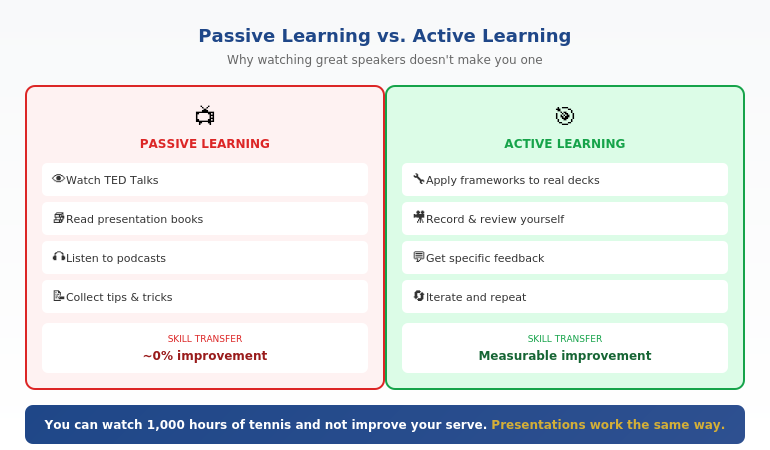
The research on skill acquisition is clear: passive consumption accounts for almost zero skill transfer. You can watch 1,000 hours of tennis and not improve your serve. Presentations work the same way.

A finance director named James spent six months consuming presentation content—books, podcasts, YouTube channels, TED Talks. When I asked him to show me a recent presentation, it had all the same problems as before: buried lead, too many slides, unclear ask.

“I know what good looks like,” he said. “I just can’t seem to do it.”

That’s the passive learning trap in one sentence.

Diagram comparing passive learning like watching TED Talks versus active learning like applying frameworks, showing why only active learning improves presentation skills

📥 Want to start applying frameworks immediately?

Get the 7 Presentation Frameworks Cheat Sheet — the exact structures that handle 90% of business presentations. Free, instant download.

Download Free Framework Cheat Sheet →

Then, when you’re ready for guided practice with feedback, the course below takes you deeper.

⭐ From Watching to Doing: The Structured Path

AI-Enhanced Presentation Mastery is built on the principle that killed my TED Talk habit: frameworks you apply immediately, not inspiration you forget tomorrow.

What makes it different:

  • 4 executive presentation frameworks (apply to your real presentations)
  • Live cohort sessions (active practice, not passive watching)
  • AI-enhanced workflow (70% faster creation, more time for what matters)

See the Full Curriculum →

Next cohort starts soon. Limited to 20 participants for hands-on feedback.

📦 What You Get (Specifically):

  • 4 executive presentation frameworks — board updates, budget requests, project proposals, stakeholder alignment
  • AI-enhanced creation workflow — cut creation time by 70% so you can focus on delivery and refinement
  • Live cohort sessions — practice with feedback, not passive observation
  • Framework application exercises — apply each framework to a real presentation you’re building
  • Spaced learning structure — designed for retention, not just completion

📌 What this course gives you that TED Talks can’t:

  • Frameworks, not performances — structures you can apply to YOUR presentations, not polished shows to admire
  • Active application — you build real presentations during the course, with feedback
  • Accountability — cohort structure means you actually do the work, not just consume content

TED Talks show you what great looks like. This course teaches you how to build it yourself.

What Actually Improves Presentations (The Research)

If watching doesn’t work, what does? The research on skill acquisition points to three elements that actually improve presentations:

1. Deliberate Practice (Not Just Repetition)

Deliberate practice means working on specific weaknesses with immediate feedback. It’s not comfortable. It’s not entertaining. And it’s the only thing that consistently improves performance.

For presentations, this means: identify one specific weakness (unclear structure, filler words, weak openings), focus on that element, get feedback, adjust, repeat.

Watching TED Talks is the opposite of deliberate practice. It’s passive, there’s no feedback, and you’re not working on your specific weaknesses.

2. Frameworks (Not Tips)

Tips are forgettable. “Make eye contact.” “Tell a story.” “Use fewer bullet points.” You’ve heard them all. They don’t stick because they’re not systematic.

Frameworks are memorable and applicable. “Every executive presentation follows: context (30 seconds), problem (1 minute), solution (2 minutes), ask (30 seconds).” That’s a framework you can actually use on Tuesday.

The executives who improve fastest are the ones who master 3-4 frameworks and apply them repeatedly, not the ones who collect 100 tips they never use.

3. Spaced Repetition (Not Binge Learning)

Remember all those TED Talks you watched? How much do you actually remember? Research shows that massed learning (consuming lots of content at once) creates the illusion of learning but poor retention.

Spaced repetition—revisiting concepts over time with increasing intervals—actually builds lasting skills. This is why one-day workshops rarely create lasting change, but structured programmes with spaced practice do.

For more on why traditional approaches fail, see why most presentation training fails.

Ready for frameworks that actually stick? AI-Enhanced Presentation Mastery uses spaced learning and active application—the opposite of TED Talk binge-watching. See the Curriculum →

The Framework Approach: How Top Performers Actually Learn

The executives who consistently deliver strong presentations share a common trait: they’ve internalised a small number of frameworks so deeply that they apply them automatically.

They’re not thinking about “tips” during a presentation. They’re not trying to remember what that TED speaker did. They’re executing a structure they’ve practiced dozens of times.

Here’s what the framework approach looks like in practice:

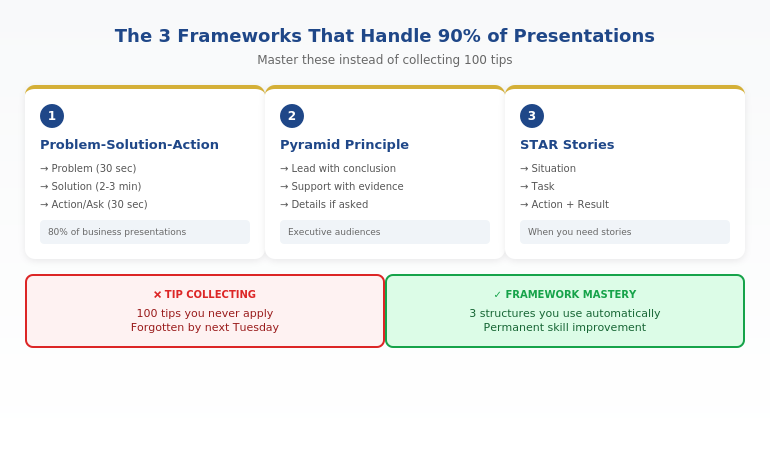
The Problem-Solution-Action Framework

This single framework handles 80% of business presentations:

  1. Problem (30 seconds): What’s the issue we’re addressing? Make it concrete and urgent.
  2. Solution (2-3 minutes): What do you propose? Be specific about the approach.
  3. Action (30 seconds): What do you need from this audience? Make the ask clear.

A product director named Sarah told me this framework transformed her stakeholder updates: “Before, I’d just walk through my slides in order. Now I structure everything around: here’s the problem, here’s what I’m doing about it, here’s what I need from you. My updates went from 20 minutes to 8, and I get decisions faster.”

The Pyramid Principle

Start with your conclusion, then support it with evidence. The opposite of how most people present (building up to the conclusion).

Executives don’t have time for suspense. They want the answer first, then the supporting logic. This framework alone will differentiate you in most corporate environments.

The STAR Framework for Stories

When you do tell stories (and you should), use: Situation, Task, Action, Result. This keeps your stories tight and business-relevant—unlike the rambling anecdotes that make audiences check their phones.

Three frameworks. Applied consistently. That’s worth more than 500 hours of TED Talks.

Related: See what to look for in presentation skills training that actually works.

The three presentation frameworks that handle 90 percent of business presentations: Problem-Solution-Action, Pyramid Principle, and STAR Stories

⭐ If You’ve Tried “Learning Presentations” Before and It Didn’t Stick

That’s not a reflection on you—it’s a reflection on passive learning methods. AI-Enhanced Presentation Mastery is designed for executives who’ve consumed plenty of content but haven’t seen results.

Why it’s different:

  • You apply frameworks to real presentations you’re building (not hypotheticals)
  • Live sessions mean accountability and feedback (not self-paced content you never finish)
  • AI workflow handles the grunt work so you focus on what matters

See the Full Curriculum →

For executives who are done with passive content and ready for structured improvement.

The 90-Day Path From “Watching” to “Doing”

If you’re ready to stop watching and start improving, here’s what a structured 90-day path looks like:

Days 1-30: Foundation

Goal: Master one framework completely.

Pick the Problem-Solution-Action framework. Apply it to your next three presentations. Don’t add complexity—just get this one structure automatic.

Record yourself delivering the opening of each presentation. Watch for: clear problem statement, logical flow to solution, specific ask at the end.

Days 31-60: Expansion

Goal: Add the Pyramid Principle.

Now you have two tools: PSA for the overall structure, Pyramid for how you present information within each section. Lead with conclusions. Support with evidence.

Get feedback from one trusted colleague on one presentation during this phase. Specific feedback on structure, not general “that was good.”

Days 61-90: Integration

Goal: Add storytelling with STAR.

Identify one story you can use in your presentations. Structure it with STAR. Practice it until it’s natural. You now have three frameworks that handle nearly any business presentation.

By day 90, you’ve done more active skill-building than three years of TED Talk watching.

If you’re experiencing a plateau in your presentation skills, see the presentation skills gap most professionals don’t see.

Want a structured path with expert guidance? AI-Enhanced Presentation Mastery compresses years of self-directed learning into a focused cohort experience. Learn More →

Frequently Asked Questions

Are TED Talks completely useless for presentation skills?

Not completely—but they serve a different purpose than skill-building. TED Talks can inspire you, expose you to new ideas, and show you what excellence looks like. What they can’t do is teach you how to structure your own presentations, give you feedback on your delivery, or help you apply frameworks to your specific context. Think of them as entertainment that occasionally inspires, not training that builds skills.

Why does watching great speakers not make me better?

Skill acquisition research shows that passive observation creates almost zero transfer to active performance. You can watch 1,000 hours of tennis and not improve your serve. The same applies to presentations. Improvement requires deliberate practice: working on specific weaknesses, getting feedback, and adjusting. Watching—no matter how attentively—doesn’t include any of those elements.

What’s the fastest way to improve my presentations?

The fastest path to improve presentations is: (1) learn one framework deeply, (2) apply it to your next real presentation, (3) record yourself, (4) get specific feedback, (5) adjust and repeat. Most professionals try to learn too many techniques at once and apply none of them consistently. Mastering one framework and using it repeatedly will improve your presentations faster than consuming hundreds of hours of content.

How many frameworks do I actually need?

For most business professionals, 3-4 frameworks handle 90% of presentations: a general structure framework (Problem-Solution-Action), an information hierarchy framework (Pyramid Principle), a storytelling framework (STAR), and optionally a persuasion framework. Going beyond that adds complexity without proportional benefit. Depth beats breadth.

Should I still watch TED Talks?

If you enjoy them, yes—but recategorize them in your mind. They’re entertainment and inspiration, not training. Watch them when you want to relax, not when you want to improve. And when you do watch, focus on structure rather than delivery. Notice how the speaker organized their argument. That’s more transferable than trying to copy their charisma.

How long does it take to see real improvement?

With deliberate practice using frameworks, most executives see noticeable improvement within 3-4 presentations (roughly 2-4 weeks if you present regularly). Significant improvement—where colleagues start commenting on the difference—typically takes 8-12 weeks of consistent framework application. This is dramatically faster than passive learning, which often produces no improvement at all regardless of time invested.

What if I don’t present very often?

Less frequent presenting actually makes framework-based learning more important, not less. When you only present occasionally, you need reliable structures you can pull out without much warmup. Frameworks give you that. Create practice opportunities: volunteer for presentations, offer to present at team meetings, record yourself practicing. The less naturally you get reps, the more deliberate you need to be about creating them.

Is This Course Right For You?

✓ This is for you if:

  • You’ve consumed presentation content before without seeing results
  • You want frameworks you can apply immediately to real presentations
  • You’re a senior professional who presents to executives/stakeholders
  • You’re willing to do active practice, not just watch content

✗ This is NOT for you if:

  • You want self-paced content you can watch passively
  • You’re looking for inspiration, not skill-building
  • You prefer consuming content to applying it
  • You’re not currently presenting at work

⭐ Three Years of TED Talks Taught Me This: You Need Frameworks, Not Inspiration

After 200+ TED Talks and zero improvement, I finally understood: passive watching doesn’t build skills. AI-Enhanced Presentation Mastery is everything I wish existed when I was stuck in the consumption trap.

What you’ll actually do:

  • Apply 4 executive frameworks to real presentations
  • Practice with live feedback (not passive video)
  • Use AI to handle creation so you focus on delivery

See the Full Curriculum →

Next cohort starting soon. Limited to 20 participants.

📧 The Winning Edge Newsletter

Weekly frameworks for executive presentations—the opposite of passive content consumption. Actionable structures you can apply immediately. For senior professionals who want results, not just inspiration.

Subscribe Free →

Your Next Step

If you’ve been trying to improve presentations by watching TED Talks, consuming podcasts, or reading books, you now understand why it hasn’t worked. The problem isn’t your effort or intelligence—it’s the learning mode.

Passive consumption feels productive but builds no skills. Active application of frameworks—even just one framework, applied consistently—will do more for your presentations than years of watching.

Start with Problem-Solution-Action. Apply it to your next presentation. Record yourself. Get feedback. That’s the path forward.

Or, if you’re ready for structured improvement with expert guidance, see the AI-Enhanced Presentation Mastery curriculum.

If you’re also dealing with high-stakes presentations where failure has real consequences, see how to present after a failure without destroying your credibility—today’s partner article on recovery presentations.

About the Author

Mary Beth Hazeldine is the founder of Winning Presentations and creator of AI-Enhanced Presentation Mastery. The “200+ TED Talks” admission that opened this article is real—and it took her three years to realise watching wasn’t the same as learning.

With 24 years of corporate experience at JPMorgan Chase, PwC, Royal Bank of Scotland, and Commerzbank, plus having trained 5,000+ executives, she now teaches the framework-based approach that actually builds presentation skills.

Book a discovery call | View services

29 Dec 2025
How to improve public speaking skills - the 5 things that actually matter

How to Improve Public Speaking Skills: The 5 Things That Actually Matter

Last updated: December 29, 2025 · 5 minute read

Most advice on how to improve public speaking skills focuses on the wrong things.

“Make better slides.” “Use more hand gestures.” “Work on your vocal variety.”

These aren’t wrong — they’re just not where the leverage is. After 24 years of corporate presenting and 19 years of training professionals at Winning Presentations, I’ve identified the five areas that create 80% of the improvement.

Focus on these first. Everything else is polish.

⚡ Key Takeaways

  • Structure is the foundation — a clear framework makes everything else easier
  • Your opening determines engagement — nail the first 30 seconds
  • Pacing separates amateurs from pros — slow down for key points
  • Presence comes from stillness — stop fidgeting, start commanding
  • Recovery skills build real confidence — know how to handle mistakes

📋 In This Guide

⭐ The Missing Piece Most People Skip

You can master all 5 areas below—but if nerves hijack your delivery, none of it matters. Conquer Your Fear of Public Speaking addresses the root cause that derails most presenters.

Includes:

  • The psychology of why fear shows up (even when you’re prepared)
  • The Calm-First Method to reset your nervous system
  • In-the-moment recovery techniques when things go wrong

Get the Complete System → £39

Based on clinical hypnotherapy practice + 24 years of corporate presenting at JPMorgan, PwC, RBS, and Commerzbank.

The 5 Things That Actually Improve Public Speaking Skills

I’ve watched hundreds of presenters improve over the years. The ones who progress fastest focus obsessively on these five areas — often ignoring everything else until they’ve mastered them.

5 high-leverage areas to improve public speaking skills - structure, opening, pacing, presence, recovery

1. Structure: The Foundation Everything Else Builds On

A clear structure makes every other aspect of presenting easier. When you know exactly where you’re going, you don’t get lost. When you don’t get lost, you don’t panic. When you don’t panic, you look confident.

Research from Harvard Business Review confirms that audiences remember structured presentations far better than unstructured ones.

The quick fix: Use a simple framework for every presentation. Problem → Solution → Proof → Action. Or Situation → Complication → Resolution. Pick one and stick with it until it becomes automatic.

Most of my clients at JPMorgan and PwC used the same three structures for 90% of their presentations. Simplicity beats creativity when you’re still improving public speaking skills.

2. Opening: The First 30 Seconds Determine Everything

Your audience decides within 30 seconds whether to pay attention or check their phones. This isn’t opinion — it’s how human attention works.

What doesn’t work: “Good morning, my name is… and today I’ll be talking about…”

What does work: Opening with a question, a surprising fact, a brief story, or a bold statement. Something that creates curiosity.

I coach clients to script their first 30 seconds word-for-word and rehearse until it’s automatic. This eliminates the “blank mind” problem that derails so many presentations. For 15 specific opening techniques, see my guide on how to start a presentation.

3. Pacing: The Difference Between Amateur and Professional

Nervous speakers rush. They talk fast, skip transitions, and barrel through to the end. This signals anxiety and makes content harder to absorb.

The fix: Deliberately vary your pace.

  • Speed up slightly for background information
  • Slow down dramatically for key points
  • Pause completely before important conclusions

The contrast signals importance. When you slow down, people lean in. When you pause, they anticipate. Master this and you’ll seem more polished than 90% of presenters.

For more on delivery techniques, see my complete guide on how to speak confidently in public.

Of course, pacing falls apart when nerves take over. That’s why managing your physiological state matters just as much as technique. Conquer Your Fear of Public Speaking covers exactly how to stay calm enough to control your delivery.

⭐ Why Technique Fails Under Pressure

You know what to do. But when the moment arrives, your nervous system takes over. Structure disappears. Pacing goes out the window. This isn’t a knowledge problem — it’s a physiology problem.

Conquer Your Fear of Public Speaking teaches you:

  • How to interrupt the fear response before it peaks
  • The 60-second pre-presentation reset
  • Recovery techniques when you lose your place

Master Your Nerves → £39

4. Presence: Stillness Commands Attention

Presence isn’t about charisma or natural talent. It’s about what you don’t do.

Stop swaying. Stop fidgeting. Stop touching your face. Stop pacing randomly.

The technique: Plant your feet. Keep your hands in a neutral “home position” (loosely at your sides or resting on the podium). Move deliberately when you choose to, then return to stillness.

Stillness signals confidence. Movement signals nerves. It’s that simple.

Watch any great speaker and you’ll notice: they’re remarkably still when making key points. The movement comes between points, not during them.

5. Recovery: The Skill Nobody Practices (But Everyone Needs)

Here’s a secret: confident speakers aren’t people who never make mistakes. They’re people who recover smoothly when they do.

Losing your place, stumbling over words, having technology fail — these happen to everyone. The difference is having a plan.

Recovery phrases to memorise:

  • “Let me come back to that point.”
  • “Give me a moment to check my notes.”
  • “Actually, let me rephrase that.”

Practice these until they’re automatic. Then, when something goes wrong, you have an immediate response ready — no panic required.

I’ve frozen in front of 200 people at a conference. Took a breath, said “Give me a moment,” checked my notes, continued. Several people told me afterward they hadn’t noticed. Recovery is a skill, and it’s learnable.

For more on building lasting confidence, see my guide on how to build confidence in public speaking.

The complete recovery system—including what to do when your mind goes completely blank—is covered in Conquer Your Fear of Public Speaking.

Quick Wins vs. Long-Term Development to Improve Public Speaking Skills

If you’re presenting next week, focus on areas 1 and 2: get your structure tight and nail your opening.

For long-term improvement, work on one area per month:

  • Month 1: Structure (use the same framework for every presentation)
  • Month 2: Opening (script and drill your first 30 seconds)
  • Month 3: Pacing (record yourself and watch for rushing)
  • Month 4: Presence (eliminate one fidget habit)
  • Month 5: Recovery (memorise three recovery phrases)

This compounds. After five months, you’ll be unrecognisable from where you started.

For a detailed improvement framework, see my guide on how to get better at public speaking.

Your Next Step to Improve Public Speaking Skills

Pick one area from this list. Just one. Focus on it for the next 2-4 weeks.

That’s how real improvement happens — not by trying to fix everything at once, but by systematic focus on high-leverage skills.

⭐ Ready to Address the Root Cause?

Technique matters. But if anxiety undermines your delivery, all the structure and pacing tips in the world won’t help. Conquer Your Fear of Public Speaking gives you the complete system to present with confidence.

What’s Inside:

  • The Psychology of Speaking Fear (why it happens even when you’re prepared)
  • How Fear Gets Conditioned—and how to break the cycle
  • The Calm-First Method with full theory explained
  • Pre-Speaking Reset + In-the-Moment Recovery strategies

Get Complete Access → £39

FAQs About Improving Public Speaking Skills

What’s the fastest way to improve public speaking skills?

Focus on structure and your opening. A clear framework eliminates most anxiety, and a strong opening buys you audience goodwill. These two areas give you the most improvement in the shortest time — you can meaningfully improve both in a single week.

How long does it take to become a good public speaker?

With focused practice on one area at a time, most people see significant improvement in 3-6 months. The key is consistent practice with real presentations — not endless rehearsal in isolation. Aim for at least one real presentation every two weeks while you’re actively improving.

Can you improve public speaking skills without a coach?

Yes, but it takes longer. A coach provides the feedback loop that accelerates improvement. Without one, record yourself and watch it back — this reveals habits you can’t see while presenting. Finding a skilled presenter willing to give honest feedback is the next best option.

What’s the most common mistake when trying to improve public speaking skills?

Trying to fix everything at once. People read a list of 20 tips and try to implement all of them in their next presentation. This overwhelms working memory and usually makes things worse. Focus on one skill at a time, master it, then move to the next.

📬 Get Weekly Presentation Insights

Join 2,000+ professionals getting practical presentation tips every Tuesday. No fluff—just techniques that work.

Subscribe to The Winning Edge →

📥 Free Download: 7 Presentation Frameworks

Structure your presentations so you always know what comes next. The same frameworks I taught executives at JPMorgan and PwC.

Download Free →


Mary Beth Hazeldine is the Owner & Managing Director of Winning Presentations and a qualified clinical hypnotherapist. She draws on 24 years of corporate experience at JPMorgan Chase, PwC, Royal Bank of Scotland, and Commerzbank. Her clients have collectively raised over £250 million using her presentation techniques.

28 Dec 2025
How to get better at public speaking - what works vs what doesn't after 24 years of presenting

How to Get Better at Public Speaking: What Actually Works

Last updated: December 28, 2025 · 5 minute read

I wasted three years trying to get better at public speaking using advice that doesn’t work.

I read every book. Watched every TED talk about TED talks. Practised in front of mirrors until I felt ridiculous. Visualised success until I could picture standing ovations in my sleep.

Still terrified. Still mediocre.

Then I discovered what actually moves the needle — and it’s not what most articles tell you. After 24 years of corporate presenting and 19 years of training others, I’ve learned that most popular advice on how to get better at public speaking is either wrong or incomplete.

Here’s what actually works.

⚡ Key Takeaways

  • “Practice more” is incomplete advice — deliberate practice on specific skills beats repetition
  • Feedback from the right people matters more than hours of solo practice
  • Recording yourself is uncomfortable but essential — you can’t fix what you can’t see
  • Focus on one skill at a time for 2-4 weeks before moving to the next
  • Real presentations beat rehearsals — there’s no substitute for actual stakes

📥 FREE DOWNLOAD: 7 Presentation Frameworks

Stop winging your structure. These frameworks give you a proven path from opening to close.

Download Free →

What Doesn’t Work to Get Better at Public Speaking

Let me save you some time. These popular techniques either don’t work or work far less than people claim:

❌ “Just practice more”

This is the most common advice and the most misleading. Research on deliberate practice shows that repetition without feedback doesn’t improve performance — it just reinforces existing habits, including bad ones.

I practised my presentations obsessively for years. All I did was get really good at being mediocre in a consistent way.

❌ Picturing the audience in their underwear

I genuinely don’t know who invented this advice, but it’s absurd. Trying to visualise something ridiculous while also delivering complex information just splits your attention and makes everything worse.

❌ Memorising your entire presentation

This backfires spectacularly. Memorised presentations sound robotic, and the moment you lose your place, you’re in freefall with no recovery path.

I memorised a 20-minute presentation for a Commerzbank client pitch. Forgot one line. Couldn’t recover because I’d memorised a script, not understood a structure. Disaster.

❌ Generic “be confident” advice

Confidence is a result, not a technique. Telling someone to “be confident” is like telling someone to “be taller.” For actual confidence-building techniques, see my guide on how to build confidence in public speaking.

What Actually Works to Get Better at Public Speaking

How to get better at public speaking - what works vs what doesn't comparison

✅ Record yourself and actually watch it

This is uncomfortable. Do it anyway.

You think you’re pausing for effect — the video shows you’re racing through without breathing. You think you’re making eye contact — the video shows you’re staring at your slides. You think your “ums” aren’t that bad — the video counts 47 in ten minutes.

I resisted recording myself for years. When I finally did, I discovered I had a habit of looking at the ceiling when thinking. No one had ever told me. I’d been doing it for a decade.

Record your next presentation. Watch it once. Pick ONE thing to fix.

✅ Get feedback from someone who presents well

Not your spouse. Not your friend who “thinks you did great.” Someone who actually presents at a high level and will tell you the truth.

At JPMorgan, I finally asked a senior MD who was known for brilliant client presentations to watch me and give honest feedback. His comment: “You start strong but lose energy in the middle. Your voice drops and you speed up like you want it to be over.”

That single piece of feedback improved my presentations more than three years of solo practice.

💡 Want a Shortcut?

Public Speaking Cheat Sheets distil everything I’ve learned about effective presenting into quick-reference guides you can review before any presentation.

Openings that hook. Structures that flow. Techniques for energy, pacing, and presence.

Get the Cheat Sheets — £14.99 →

✅ Focus on one skill for 2-4 weeks

Don’t try to improve everything at once. Your working memory can’t handle it.

A focused improvement plan:

  • Weeks 1-2: Pausing (count to 2 after key points)
  • Weeks 3-4: Opening strong (see my guide on how to start a presentation)
  • Weeks 5-6: Eliminating filler words
  • Weeks 7-8: Eye contact (one thought per person)

This compounds. After two months, you’ve made four significant improvements. After six months, you’re unrecognisable.

✅ Present more often — with real stakes

There’s no substitute for actual presentations to actual audiences where something actually matters.

Rehearsing alone builds familiarity. Presenting to real humans builds skill. The nervous system activation, the need to read the room, the pressure to recover from mistakes — none of this happens in practice.

Volunteer for presentations. Take the meeting slot no one wants. Every real presentation is a rep that counts.

For more on managing the nerves that come with real stakes, see my complete guide on how to speak confidently in public.

🎓 Want Structured Improvement?

AI-Enhanced Presentation Mastery gives you an 8-module system covering every aspect of presenting — with live coaching sessions where I give you the direct feedback that accelerates improvement.

Stop guessing what to work on. Get a proven curriculum.

Learn More — £249 →

The Fastest Path to Get Better at Public Speaking

If I had to start over, here’s exactly what I’d do:

  1. Week 1: Record my next presentation and identify my biggest weakness
  2. Weeks 2-3: Focus exclusively on fixing that one weakness
  3. Week 4: Get feedback from a strong presenter on my progress
  4. Repeat with the next weakness

This cycle — record, focus, feedback, repeat — is how professionals improve at any skill. Public speaking is no different.

For more specific techniques, see my complete public speaking tips guide.

Your Next Step

Record your next presentation. Watch it once. Identify ONE thing to fix. Work on that for two weeks.

That’s it. That’s how you actually get better at public speaking.

Resources to Improve Your Speaking

📖 FREE: 7 Presentation Frameworks
Structure your presentations so you always know what comes next.
Download Free →

💡 QUICK WIN: Public Speaking Cheat Sheets — £14.99
Quick-reference guides for openings, structure, delivery, and presence.
Get Instant Access →

🎓 COMPLETE SYSTEM: AI-Enhanced Presentation Mastery — £249
8-module course with live coaching sessions. Stop guessing — get direct feedback.
Learn More →

Frequently Asked Questions About Getting Better at Public Speaking

How long does it take to get better at public speaking?

With focused practice on one skill at a time plus regular real presentations, most people see noticeable improvement in 4-6 weeks. Significant transformation typically takes 3-6 months. The key is consistency and feedback — not just hours logged.

Can you get better at public speaking without a coach?

Yes, but it takes longer. A coach provides the feedback loop that accelerates improvement. Without one, you can substitute by recording yourself and finding a skilled presenter willing to give honest feedback. The improvement cycle still works — it’s just slower.

What’s the single most effective way to get better at public speaking?

Recording yourself and watching it back. It’s uncomfortable, but nothing else gives you accurate information about what you actually do (versus what you think you do). Most people are shocked by what they discover — and that shock is the starting point for real improvement.

Is public speaking a natural talent or a learned skill?

It’s overwhelmingly a learned skill. Some people start with advantages — comfortable with attention, naturally expressive — but the techniques that make someone genuinely excellent are all learnable. I was terrible for five years before becoming good enough to train others.


Mary Beth Hazeldine is the Owner & Managing Director of Winning Presentations and a Microsoft Copilot PowerPoint specialist. She draws on 24 years of corporate experience at JPMorgan Chase, PwC, Royal Bank of Scotland, and Commerzbank, plus qualifications as a clinical hypnotherapist. Her clients have collectively raised over £250 million using her presentation techniques.

Get Weekly Presentation Insights

Join 2,000+ professionals getting practical presentation tips every Tuesday.

Subscribe to The Winning Edge →