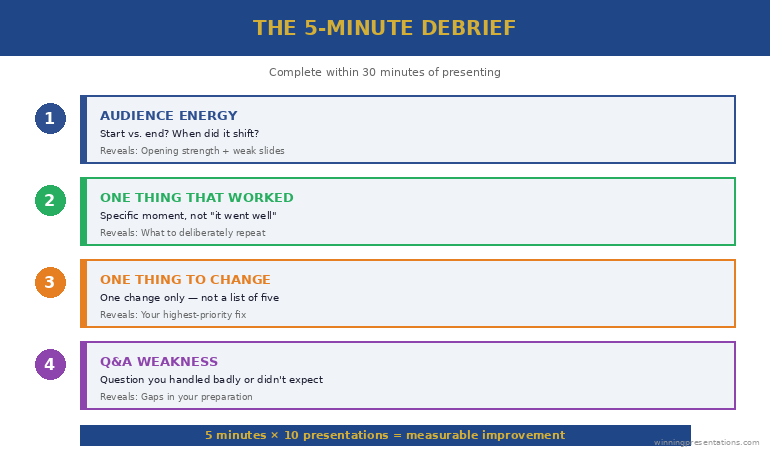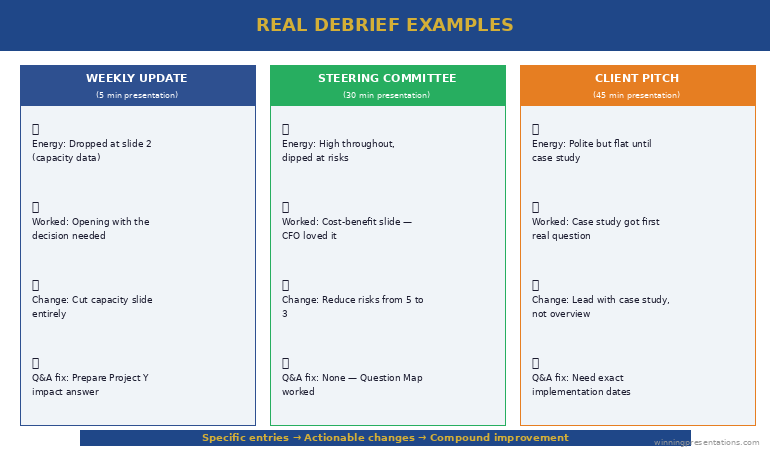
Quick answer: A presentation review protocol is the structured review a senior leader runs the morning after a presentation that landed at roughly 70% — approved but soft, agreed but not advocated, passed but not championed. The protocol exists because the 70% meeting is the one most senior leaders never review at all: a clear win gets celebrated, a clear loss gets dissected, and the 70% meeting gets filed as “fine” and forgotten, which is exactly why the same 30% goes missing in the next meeting. The protocol has four steps run in a fixed order: separate the structural miss from the delivery miss from the room dynamics, reconstruct the three columns of what you said versus what landed versus what you assumed they would take but did not, isolate the single slide that would have moved the meeting from 70% to 85%, and run the recurrence test across your last three presentations to find whether the 30% is an accident or a pattern. The whole protocol takes about forty minutes and is run before the inbox, while the room is still recoverable from memory. The senior leader who runs it after every 70% meeting compounds; the senior leader who files the 70% meeting as “fine” repeats it.
JUMP TO:
In 2016 I worked with a divisional managing director at one of the institutions I had spent part of my own career in, preparing him for a capital-allocation presentation to his executive committee. The deck was strong, his preparation was thorough, and the meeting went well. The committee approved his proposal. He rang me that afternoon pleased, and I was pleased for him, and then he said something almost in passing that I have thought about ever since: “They approved it, but the chair said ‘let’s revisit the phasing at the next committee’, and two of them were nodding along but not really with me.” The proposal had passed. But it had passed at about 70% — approved on paper, soft in the room, with the phasing flagged for a future fight he had thought he had already won. He was ready to file the meeting as a success and move on. I asked him to do something different. I asked him to come back the next morning, before he opened his inbox, and reconstruct exactly which 30% of that room he had not actually persuaded. He was reluctant, because the meeting had technically succeeded and reviewing a success felt like manufacturing a problem. He did it anyway. What he found was that the entire soft 30% lived on a single slide — the phasing slide — that he had built fast because he assumed it was uncontroversial. It was the slide the chair had flagged. The 30% was not spread across the deck. It was concentrated in one place he had not respected.
I have now run some version of this review with around thirty senior leaders after meetings that landed at roughly 70%, and the finding is consistent enough that I now treat it as a rule. The 70% meeting — the approved-but-soft, agreed-but-not-advocated, passed-but-not-championed meeting — is the single most valuable meeting a senior leader can review and the one they almost never do. A clear win gets a celebration and no review. A clear loss gets a painful dissection. The 70% meeting gets filed as “fine”, and the precise 30% that did not land — the slide that went quiet, the assumption that was not shared, the committee member who nodded without buying — survives intact into the next presentation, where it costs the senior leader the same 30% again. The review protocol exists to catch that 30% while it is still recoverable from memory, which is the morning after and not a week later.
(This article was created with AI assistance; all stories and insights are based on 35 years of real client work.)
The protocol I want to describe is not a feelings exercise and it is not a confidence-management ritual. It is a structured, four-step review run in a fixed order, on the deck itself, the morning after the meeting, before the inbox is opened. It produces one concrete output: the single slide to rebuild before the next presentation. The senior leaders who run it after every 70% meeting improve at a noticeably faster rate than the ones who only review their outright failures, because the 70% meetings are far more frequent than the failures and they carry a more precise lesson. A failure tells you something was badly wrong. A 70% meeting tells you exactly which 30% was wrong, if you review it while you can still remember the room.
If the 30% keeps landing on the same kind of slide:
The Executive Slide System ships 26 executive templates built for the slides that most often go soft in committee — phasing, resource trade-offs, risk, and the ask. 93 AI prompts help you populate each from your live numbers, and 16 scenario playbooks cover the executive scenarios where the missing 30% tends to hide. Built for senior presenters who would rather fix the structure than re-learn the same lesson every quarter.
Why the 70% meeting is the one nobody reviews
The 70% meeting is structurally invisible because it does not trigger either of the two emotions that prompt a review. An outright failure triggers the pain that forces a senior leader to ask what went wrong; the pain is the review mechanism. An outright success triggers the relief that lets a senior leader move on without examining anything; nothing about a success demands scrutiny. The 70% meeting sits precisely in the gap between the two. It produces a result good enough to be relieved about and soft enough to leave real value on the table, and the relief wins. The senior leader walks out thinking “that went fine”, and “fine” is the most expensive word in the executive vocabulary because it ends the inquiry exactly where the inquiry would have been most useful.
The cost of not reviewing the 70% meeting is not the single meeting. It is the compounding. The 30% that did not land in this meeting was produced by something specific — a slide built too fast, an assumption left unstated, a committee member whose particular concern was never addressed. Whatever produced it is still in the senior leader’s default method, because nothing in the meeting forced them to look at it. So it reappears. The phasing slide that went soft in June goes soft again in September, because the senior leader never noticed in June that phasing was their structural weak point. Over a year of quarterly presentations, the same untouched 30% costs the senior leader four meetings’ worth of soft approvals, deferred decisions, and revisit-it-later flags, all traceable to one structural habit that a forty-minute review in June would have surfaced.
There is also a calibration cost. A senior leader who only reviews their failures develops a distorted map of their own presenting. They know what a disaster looks like and they know roughly what a triumph looks like, but they have no resolution on the wide middle band where most of their actual meetings live. The 70% review is what builds resolution in that middle band. It teaches the senior leader the difference between an 85% meeting and a 70% meeting, which is a more useful distinction than the difference between a triumph and a disaster, because the 85-versus-70 distinction is the one that determines whether a proposal gets championed or merely tolerated by the people who have to carry it forward after the meeting closes. The discipline of a structured mid-year review applies the same logic at the level of a whole half-year rather than a single meeting.
The four-step presentation review protocol
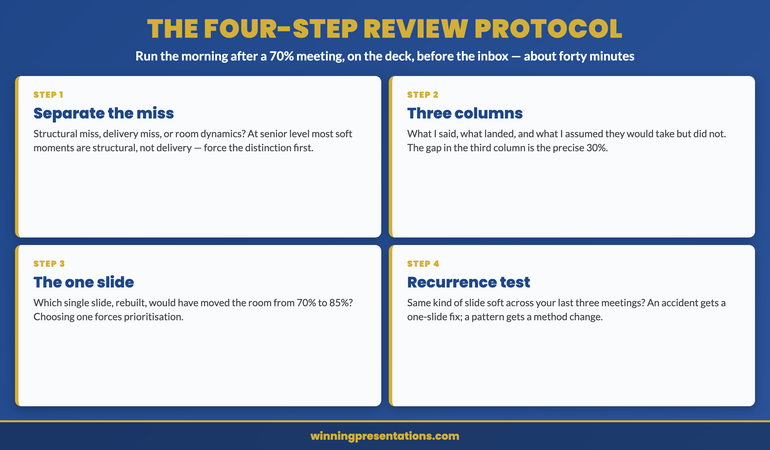
Step one is to separate the structural miss from the delivery miss from the room dynamics. The morning after, open the deck and ask of the soft moments in the meeting: was this a slide that was built wrong, a slide that was delivered wrong, or a slide that was fine but met a room dynamic I did not manage? The three are different problems with different fixes, and the most common error in self-review is to attribute a structural miss to a delivery failure. The senior leader who concludes “I should have presented the phasing more confidently” when the actual problem was that the phasing slide had no rationale on it will work on their delivery and leave the structural hole untouched. Force the distinction first. Most of the soft 30% in a senior-level meeting is structural, not delivery, because at senior level the delivery is usually competent and the structure is where the variance lives.
Step two is the three-column reconstruction. On a single sheet, write three columns: what I said, what landed, and what I assumed they would take but they did not. The first column is straightforward recall. The second column requires honesty about the room’s actual reaction rather than the reaction you wanted. The third column is where the value is, because the gap between what you assumed the room would accept and what they actually questioned is the precise location of the 30%. In the capital-allocation meeting I described at the start, the third column had one entry: “I assumed the phasing was uncontroversial.” That single unexamined assumption was the whole soft 30%. The three-column reconstruction makes assumptions visible, and unexamined assumptions are almost always what produces the soft band, because a senior leader pressure-tests the parts of the deck they are worried about and builds the parts they are confident about fast and unguarded. The room finds the unguarded parts.
Step three is to isolate the single slide that would have moved the meeting from 70% to 85%. This is the protocol’s sharpest instrument and the one that makes it actionable rather than merely reflective. Having reconstructed the three columns, ask: if I could rebuild exactly one slide before re-running this meeting, which one would have moved the room most? Not all the slides — one slide. The discipline of choosing one forces prioritisation and almost always points at the slide where the third column’s assumption lived. The output is concrete: one slide to rebuild, which the senior leader can do that same week while the lesson is fresh, so that the rebuilt slide is ready the next time a similar meeting comes around. Step four, the recurrence test, then determines whether that one slide is an isolated fix or the visible symptom of a pattern worth deeper work.
Rebuild the slide that went soft from a template that holds at committee level.
The Executive Slide System ships the templates for the slides that most often produce the soft 30% — phasing, resource trade-offs, risk-and-mitigation, and the explicit ask — along with 26 executive templates, 93 AI prompts for populating slides from live numbers, 16 scenario playbooks, and 7 checklists. Built for senior presenters who run multiple committee cycles a year. £39, instant download, lifetime access.
- 26 executive slide templates — including the resource trade-off and phasing structures that most often go soft in committee
- 93 AI prompts — populate each slide from your live numbers rather than rebuilding from a blank page
- 16 scenario playbooks — capital allocation, board approval, quarterly review, and the post-meeting revisit scenario
- 7 checklists — including a pre-meeting check on the slides you built fast and unguarded
The one-slide rule: where the missing 30% almost always lives
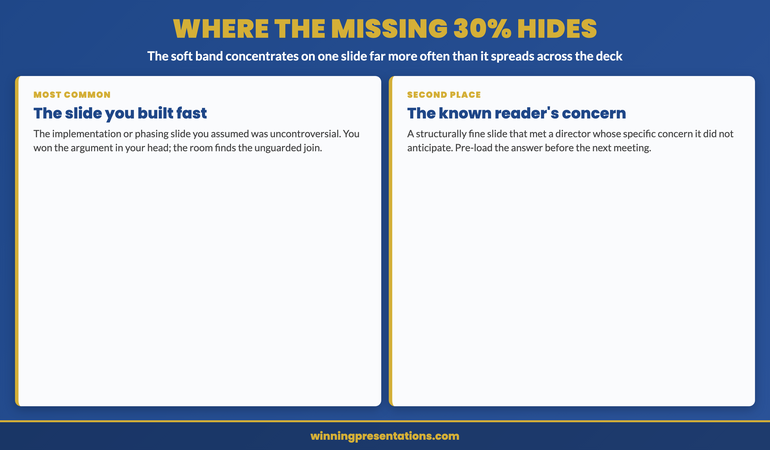
Across the reviews I have run, the missing 30% concentrates on one slide far more often than it spreads across the deck, and the slide it concentrates on is almost always the one the senior leader built fast because they assumed it was uncontroversial. This is not a coincidence. A senior leader allocates their preparation attention to the parts of the deck they are worried about. They war-game the headline recommendation, they pressure-test the numbers they expect to be challenged, they rehearse the answers to the questions they can see coming. What they do not pressure-test is the part they are confident about, and confidence in a senior leader is usually well-founded except in one predictable place: the slide that connects their strong recommendation to its practical implementation. Phasing. Sequencing. Resourcing. The how-and-when slide. That slide is built fast because the senior leader has already won the argument in their own head, and the room — which has not been in their head — finds the unexamined join.
The one-slide rule has a useful corollary for preparation, not just review. If the missing 30% almost always lives on the slide you built fastest, then the highest-leverage move in preparing the next presentation is to find the slide you are least worried about and pressure-test it as if it were the slide you are most worried about. The senior leader who does this pre-empts the most common source of the soft band. In practice this means taking the implementation or phasing slide — the one you were about to leave as a quick summary — and giving it the same rationale, the same anticipated-objection handling, and the same specificity you gave the headline slide. The room rewards the move immediately, because the room was always going to probe the join between recommendation and execution, and the senior leader who has already done that work reads as someone who has thought the whole thing through rather than someone who has fallen in love with their own recommendation.
There is a second place the 30% hides, less common but worth naming: the slide that was structurally fine but met a specific person in the room whose particular concern the slide did not anticipate. This is the room-dynamics category from step one. The finance director who always asks about downside scenarios, the operations head who always asks about delivery capacity, the chair who always asks about optionality — each of these is a known reader with a known concern, and a slide that does not anticipate the known reader’s known concern will go soft when that person speaks, regardless of how well the slide is built in the abstract. The fix here is not to rebuild the slide structurally but to pre-load the answer to the known reader’s known concern into the slide or the talk track. Building a working method for improving at presentations depends on learning your specific room’s specific readers, which is exactly what the recurrence test surfaces over time.
For the deeper framework on turning soft approval into active advocacy:
The Executive Buy-In Presentation System is a self-paced programme with 7 modules covering stakeholder analysis, case construction, and the structures that move a committee from tolerating a proposal to championing it. Senior leaders who keep landing at 70% rather than 85% use the stakeholder-mapping module to identify the known readers whose concerns are producing the soft band. Optional live Q&A calls, fully recorded, watch back anytime. New cohort opens every month. Lifetime access to materials. £499.
The recurrence test: accident or pattern
Step four of the protocol is the recurrence test, and it is what turns a single review into a development tool. Having isolated the one slide that would have moved this meeting, ask: across my last three presentations, was the soft 30% on the same kind of slide? If the answer is no — the phasing slide was soft this time, the risk slide last time, the ask slide the time before — then this meeting’s soft band is an accident, a one-off, and the one-slide fix is sufficient. If the answer is yes — the implementation slide has been the soft one three meetings running — then the senior leader is not looking at an accident. They are looking at a structural weakness in how they handle a whole category of slide, and the fix is no longer one slide but a method change.
I worked with a senior operations leader who ran the recurrence test after a quarterly review that had landed at about 70%. The soft slide was the capacity slide. She assumed it was a one-off until she pulled her two previous quarterly decks and found that the capacity slide had been the soft one all three times. She had a structural blind spot: she built capacity slides as a backward-looking status report — here is what we delivered — when the committee wanted a forward-looking constraint analysis — here is what limits what we can promise. Three meetings of soft capacity slides traced to one method error that no single-meeting review would have surfaced, because in any single meeting the soft capacity slide looked like bad luck. The recurrence test made the pattern visible, and once it was visible the fix was obvious and permanent. She rebuilt her standard capacity slide as a forward-looking constraint analysis, and the soft band on that slide did not recur.
The recurrence test is also what protects the senior leader from over-correcting on a genuine one-off. Not every soft 30% is a pattern, and a senior leader who treats every soft slide as evidence of a deep structural flaw will churn their method constantly and never build the consistency that comes from a stable, well-tested default. The test’s value is precisely that it distinguishes the accident from the pattern, so the senior leader fixes the patterns at the method level and lets the accidents go as accidents. Run over a year, the recurrence test produces a short, accurate list of the two or three slide categories where a given senior leader is genuinely weak — which is a more valuable piece of self-knowledge than any amount of general feedback, because it is specific, behavioural, and directly fixable.
Fix the slide category once. Use the template every cycle after that.
Instant download. Lifetime access to the Executive Slide System — 26 templates, 93 AI prompts, 16 scenario playbooks, 7 checklists. No subscription, no renewal. £39 once, for the senior presenter who would rather rebuild a weak slide category permanently than re-learn the same lesson every quarter.
Frequently asked questions
Is it worth reviewing a meeting that technically succeeded? It feels like manufacturing a problem.
The technically-successful 70% meeting is the most worthwhile meeting to review precisely because the success masks the value left on the table. Reviewing it is not manufacturing a problem; it is recovering the precise 30% that the approval allowed you to ignore. The senior leader who only reviews failures learns slowly, because failures are infrequent and their lessons are coarse. The 70% meetings are frequent and their lessons are precise — they tell you exactly which slide, which assumption, and which known reader produced the soft band. The forty minutes the morning after is the highest-return preparation time available, because it is the only time the room is still recoverable from memory and the lesson is still attached to a specific slide rather than a vague sense that something could have gone better.
How soon after the meeting does the review need to happen?
The next morning, before the inbox, is the working window. The room’s actual reactions — who nodded without buying, which slide went quiet, what the chair flagged for later — decay quickly from memory and are substantially gone within forty-eight hours. A review run a week later reconstructs the meeting the senior leader wishes they had given rather than the one they actually gave, because the inconvenient details have faded and the convenient narrative has consolidated. Run it the next morning while the discomfort of the soft moments is still sharp enough to remember accurately. The protocol takes about forty minutes, which is why running it before the inbox matters: once the day’s demands start, the review gets deferred to a calmer moment that never arrives.
What is the most common mistake senior leaders make in reviewing their own presentations?
Attributing a structural miss to a delivery failure. The senior leader concludes “I should have presented that part more confidently” when the actual problem was that the slide had no rationale on it, and then works on their delivery while the structural hole stays open. At senior level the delivery is usually competent and the variance lives in the structure, so the default assumption should be that a soft moment was structural until proven otherwise. The first step of the protocol — forcing the distinction between structural miss, delivery miss, and room dynamics — exists specifically to interrupt this error. Most soft moments resolve to a slide that was built wrong, not delivered wrong, once the senior leader is honest about which it was.
Does this protocol work for a presentation given to one senior stakeholder rather than a committee?
It works the same way and is, if anything, easier to run because there is only one reader to reconstruct. The three-column reconstruction becomes a single-reader analysis: what I said, what this person took, and what I assumed they would accept but they questioned. The one-slide rule still applies — the soft moment in a one-to-one almost always concentrates on the slide where you assumed agreement and met a question instead. The recurrence test is also sharper with a single recurring stakeholder, because the same person’s pattern becomes visible quickly: if your finance director has gone soft on your downside slide twice running, that is not luck, that is a known reader whose known concern you keep under-serving, and the fix is to pre-load their concern into the slide before the next meeting.
The Winning Edge — weekly newsletter
The Winning Edge is a weekly newsletter for senior professionals who present at the executive level. One short email a week on the structural moves that separate the meeting that gets championed from the meeting that merely gets approved. Subscribe to The Winning Edge →
For the wider library of senior-presenter assets — slide system, storytelling primer, Q&A taxonomy, delivery references — the Complete Presenter bundle (£99) collects them in one place. See the broader catalogue of board-readiness assets at the executive buy-in masterclass.
About the author
Mary Beth Hazeldine is Owner & Managing Director of Winning Presentations Ltd. With 24 years of corporate banking experience at JPMorgan Chase, PwC, Royal Bank of Scotland, and Commerzbank, she advises executives across financial services, healthcare, technology, and government on structuring presentations for high-stakes funding rounds, board approvals, and strategic decisions.
The next time a presentation lands at 70% — approved but soft, passed but flagged for later — do not file it as fine. The next morning, before the inbox, open the deck, run the three-column reconstruction, isolate the one slide that would have moved the room to 85%, and check whether that slide category has been soft three meetings running. The senior leader who reviews the 70% meeting recovers the missing 30% and stops paying for it again. The senior leader who files it as fine carries the same 30% into the next meeting, and the next, and never sees the slide that was costing them the room.