Tag: presentation coaching

25 Jan 2026
Professional evaluating executive presentation coaching options to find a programme worth the investment

Executive Presentation Coaching: What to Look For in 2026

I spent £8,000 on presentation coaching that taught me nothing I could use.

The coach was credentialed. The programme was respected. But after six sessions, I was still freezing in front of the board—because everything I’d learned was theory that collapsed under pressure.

Quick answer: The best executive presentation coaching in 2026 focuses on frameworks you can apply under pressure, not concepts you understand intellectually. It should address both structure (how to build slides that work for executive audiences) and delivery (how to present with authority when stakes are high). Most coaching fails because it teaches presentation theory without accounting for the stress response that hijacks your performance when it matters most.

When you find the right coaching:

  • You stop dreading presentations and start seeing them as career accelerators
  • Your recommendations get approved faster—because executives trust how you communicate
  • The skills compound: each presentation builds on the last instead of starting from scratch

Written by Mary Beth Hazeldine — Owner & Managing Director of Winning Presentations, 24 years in corporate banking (JPMorgan Chase, PwC, RBS, Commerzbank), qualified clinical hypnotherapist, and someone who’s been on both sides of executive presentation coaching—as a client who wasted money, and now as someone who teaches what actually works. Last updated: January 2026.

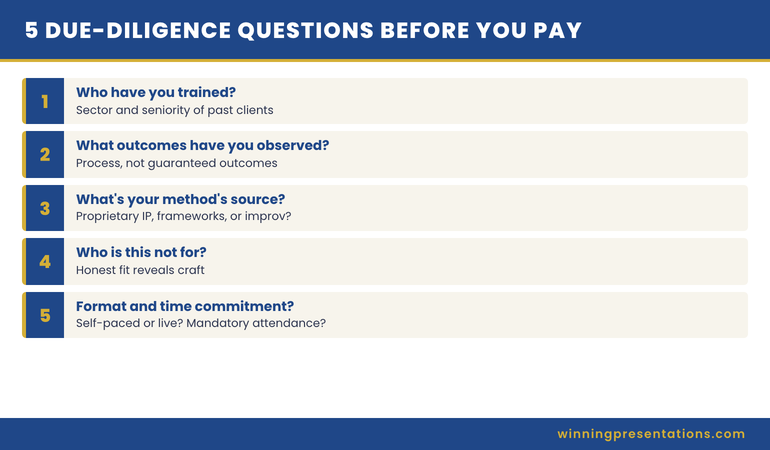
🚨 Evaluating a coaching programme THIS MONTH? Ask these 3 questions:

  1. Can you show me the exact frameworks I’ll use? (If they can’t, it’s theory-based)
  2. How do you address performance under pressure? (If they don’t, skills won’t transfer)
  3. What measurable outcomes have past participants achieved? (Vague answers = vague results)

These questions separate programmes that transform from programmes that teach.

I’ve helped senior professionals transform their executive presentations at global banks, consulting teams, and Fortune 100 companies—environments where one presentation can determine funding, strategy, or careers.

→ Want a programme designed for senior professionals? See the AI-Enhanced Presentation Mastery curriculum — frameworks-first approach for executives who present to decision-makers.

📅 Investing in your presentation skills this quarter?

This guide will help you evaluate any programme—including mine—so you invest in coaching that actually delivers results.

That £8,000 I spent? It taught me what not to look for. Over the next decade—through hundreds of executive presentations and eventually training senior leaders myself—I learned what actually creates transformation versus what just sounds impressive.

The difference isn’t subtle. And in 2026, with AI changing how presentations are created, the gap between effective coaching and outdated approaches has never been wider.

Why Most Executive Presentation Coaching Fails

The presentation coaching industry has a dirty secret: most programmes don’t produce lasting change.

Executives complete the training, feel inspired for a week, then revert to their old patterns the moment they’re under pressure. The coaching “worked” in the safe environment of the training room—but collapsed in the boardroom.

Here’s why:

Problem 1: Theory Without Application

Most coaching teaches concepts: “Lead with your conclusion.” “Use the pyramid principle.” “Make eye contact.”

These aren’t wrong—but they’re incomplete. Understanding a concept intellectually doesn’t mean you can execute it when your nervous system is in fight-or-flight mode.

The insight: Effective executive presentation coaching must bridge the gap between knowing and doing. That requires frameworks specific enough to follow under pressure, plus techniques for managing the stress response that blocks execution.

Problem 2: Generic Approaches

Many programmes teach the same content to everyone: entry-level employees, middle managers, and C-suite executives all get the same “presentation skills” curriculum.

But presenting to a board is fundamentally different from presenting to peers. The expectations, the communication patterns, the decision-making dynamics—all different.

The insight: Executive-level coaching should focus specifically on high-stakes, senior-audience scenarios. Generic “presentation skills” won’t cut it.

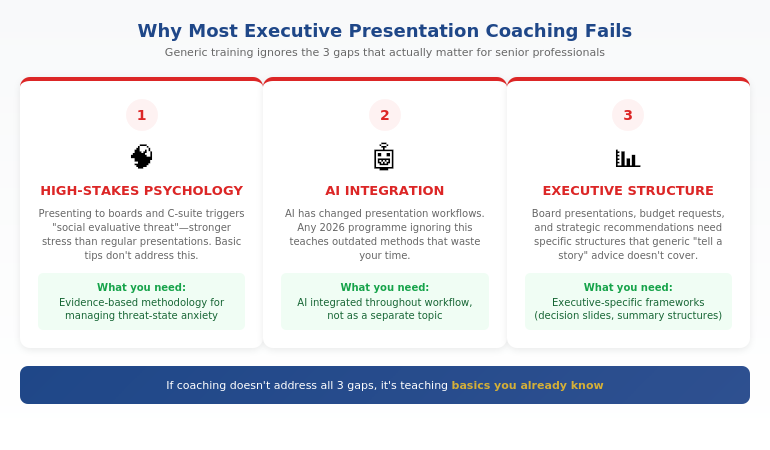
Problem 3: Ignoring the Stress Response

Here’s what most coaches don’t understand: the anxiety that executives feel before high-stakes presentations isn’t a mindset problem. It’s a physiological response.

When your brain perceives threat (and being evaluated by people who control your career IS a threat), it triggers hormonal cascades that impair verbal fluency, working memory, and executive function—the exact cognitive skills you need to present well.

The insight: Any coaching that doesn’t address nervous system regulation will fail when stakes are high. “Just be confident” isn’t a technique—it’s a wish.

📚 Research note: The Trier Social Stress Test (Kirschbaum et al., 1993)—the gold standard for measuring social evaluative threat—consistently shows that being judged by high-status observers produces stronger cortisol spikes than other stressors. Research on anxiety and working memory (Eysenck & Calvo’s Processing Efficiency Theory) explains why intelligent, knowledgeable executives can “blank” during presentations: anxiety consumes cognitive resources needed for verbal retrieval. The expertise is intact, but access is blocked. Effective coaching must account for this biological reality.

For more on why training fails, see the hidden reasons most programmes don’t stick.

Diagram showing why most executive presentation coaching fails: theory without application, generic approaches, and ignoring the stress response

What Actually Works: The 5 Non-Negotiables

After spending too much money on coaching that didn’t work, and then developing programmes that do, I’ve identified five elements that separate effective executive presentation coaching from expensive disappointments.

Non-Negotiable 1: Frameworks, Not Concepts

Effective coaching gives you specific, repeatable structures—not abstract principles.

Concept: “Lead with your conclusion.”
Framework: “Your first slide headline should state your recommendation + key benefit. Example: ‘Approve £500K for Q4 Campaign (2.3x Projected ROI).’ Here’s the template.”

The difference? A framework tells you exactly what to do. A concept requires you to figure it out yourself—which you can’t do under pressure.

What to look for: Can the coach show you the exact templates, structures, or scripts you’ll use? If it’s all principles and no specifics, keep looking.

Non-Negotiable 2: Pressure-Tested Techniques

Skills learned in calm conditions don’t automatically transfer to stressful ones. Effective coaching builds in stress inoculation—practicing under conditions that simulate real pressure.

What to look for: Does the programme include practice with realistic scenarios? Do they address what happens when anxiety spikes mid-presentation? Do they teach recovery techniques for when things go wrong?

Non-Negotiable 3: Executive-Specific Content

Presenting to a board requires different skills than presenting to a team meeting. Effective executive coaching focuses specifically on:

  • Decision-oriented structures (not information dumps)
  • Managing challenging questions from senior stakeholders
  • Building credibility with time-poor, skeptical audiences
  • The specific dynamics of high-stakes approval scenarios

What to look for: Is the content designed for senior audiences, or is it generic “presentation skills” repackaged?

Non-Negotiable 4: Both Structure AND Delivery

Some coaching focuses only on slide design. Others focus only on speaking skills. Neither alone is sufficient.

You need both: the ability to structure content that works for executive audiences AND the ability to deliver it with authority under pressure.

What to look for: Does the programme address both what you present (structure, slides, messaging) and how you present it (delivery, presence, managing nerves)?

Non-Negotiable 5: Modern Integration

In 2026, any executive presentation coaching that ignores AI is incomplete. Not because AI replaces presentation skills—but because AI changes how presentations are created.

The executives who thrive use AI to accelerate the mechanical work (drafts, formatting, research synthesis) while applying human judgment to the strategic work (what to include, how to frame it, what story to tell).

What to look for: Does the programme address how to leverage AI tools effectively? Or is it stuck in a pre-2023 world?

💬 “The framework changed how I structure every board presentation. I used to spend 6+ hours on decks that got questioned. Now I spend 90 minutes and get approval on the first pass.” — Senior Director, Global Consulting Firm

⭐ A Programme Built on These 5 Non-Negotiables

AI-Enhanced Presentation Mastery was designed specifically for senior professionals who present to decision-makers. It’s frameworks-first (not theory), addresses the stress response, and integrates modern AI workflows.

What’s included:

  • Executive presentation frameworks (decision slides, board updates, stakeholder pitches)
  • Techniques for calm authority under pressure
  • AI integration for faster, higher-quality presentation creation

See the Full Curriculum →

Cohort-based programme for senior professionals. Limited seats per session.

The 2026 Coaching Landscape: What’s Changed

The executive presentation coaching market has shifted dramatically. Here’s what’s different now:

Change 1: AI Has Raised the Bar

When anyone can generate a “decent” presentation in minutes using AI, the baseline has changed. Decent isn’t enough anymore.

The executives who stand out are those who can take AI-generated foundations and elevate them with strategic thinking, audience insight, and executive-level polish. Coaching that doesn’t address this reality is already outdated.

Change 2: Remote + Hybrid Has Become Permanent

Many executive presentations now happen on video—or hybrid with some participants in-room and others remote. This changes everything: how you build rapport, how you read the room, how you maintain engagement.

Coaching designed for in-person only is incomplete. Look for programmes that address the specific challenges of presenting through screens.

Change 3: Decision Speed Has Increased

Executives have less patience than ever. The “let me walk you through this” approach that worked a decade ago now loses audiences before you’ve made your point.

Modern coaching should emphasise decision-oriented structures: recommendation first, evidence second, context only when asked.

Change 4: Credentialism Matters Less, Results Matter More

Traditional presentation coaching often leaned on credentials: “trained at [famous institution]” or “certified in [methodology].”

Smart buyers now ask: “What outcomes have your participants achieved?” Credentials don’t guarantee results. Ask for evidence of transformation, not badges.

For more on what separates top performers, see why most presentation training fails senior professionals.

Looking for a programme designed for the 2026 reality? AI-Enhanced Presentation Mastery integrates frameworks, stress management, and modern AI workflows—specifically for senior professionals.

Red Flags: When to Walk Away

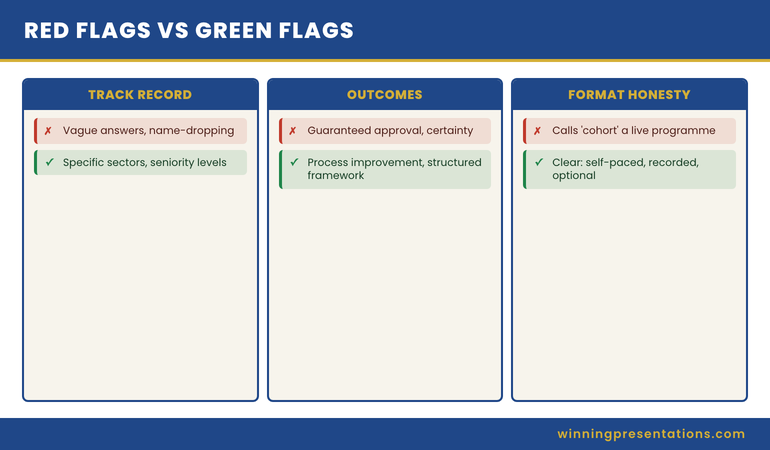
Not all coaching is worth the investment. Here are the warning signs:

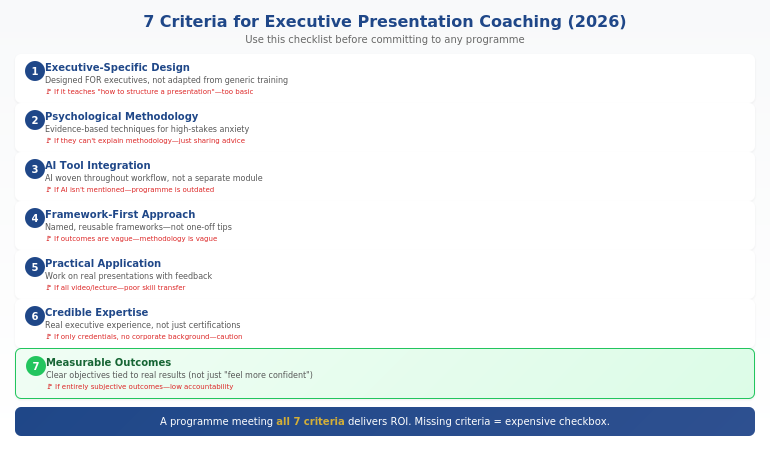
Red Flag 1: “Everyone Needs the Same Training”

If a programme promises to help “everyone from interns to executives,” it’s not executive-focused. Generic content won’t address the specific challenges of high-stakes senior presentations.

Red Flag 2: All Theory, No Templates

If the coach can’t show you specific frameworks, templates, or structures you’ll walk away with, you’re paying for concepts you could read in a book.

Ask: “Can you show me an example of a framework I’ll learn?” If the answer is vague, walk away.

Red Flag 3: No Mention of Pressure or Nerves

If the programme doesn’t address performance anxiety, stress response, or presenting under pressure, it’s incomplete. Skills learned in calm conditions often collapse when stakes are high.

Red Flag 4: Outdated Content

If there’s no mention of AI, remote/hybrid presenting, or modern executive communication patterns, the content may be years out of date.

Ask: “How has this programme evolved in the last two years?”

Red Flag 5: No Evidence of Results

If the coach can’t point to specific outcomes from past participants—faster approvals, promotions, successful pitches—the programme may not deliver transformation.

Ask: “What measurable results have past participants achieved?”

Red flags when evaluating executive presentation coaching: generic content, no templates, ignoring nerves, outdated material, no evidence of results

⭐ A Programme That Passes Every Test

AI-Enhanced Presentation Mastery includes specific frameworks you can review before enrolling, addresses performance under pressure, and is updated for 2026 realities—including AI integration and remote/hybrid presenting.

You’ll get:

  • Frameworks you can see before you enrol (no mystery content)
  • Techniques for managing the stress response
  • Modern AI workflows that save hours per presentation

See the Full Curriculum →

Designed for senior professionals presenting to boards, executives, and key stakeholders.

How to Evaluate Any Programme

Use this framework to assess any executive presentation coaching you’re considering—including mine:

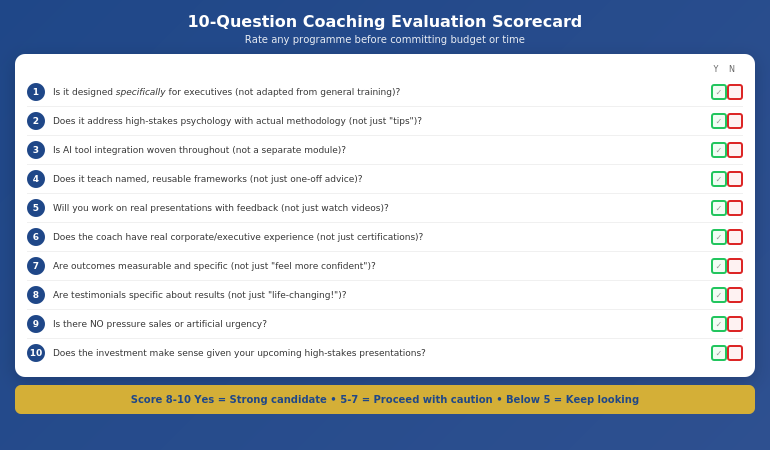
The 10-Question Evaluation

Content Quality:

  1. Is the content designed specifically for executive/senior audiences?
  2. Can they show you the exact frameworks and templates you’ll use?
  3. Does it address both structure (slides/content) AND delivery (presence/nerves)?
  4. Is it updated for 2026 realities (AI, remote/hybrid, decision speed)?

Practical Application:

  1. Does it include practice with realistic high-stakes scenarios?
  2. Do they address what happens when anxiety spikes mid-presentation?
  3. Will you walk away with tools you can use immediately?

Evidence of Results:

  1. Can they point to specific outcomes from past participants?
  2. Do they offer any guarantee or way to assess fit before full commitment?
  3. Does the programme structure support actual skill development (not just information transfer)?

Score it: If a programme doesn’t score at least 7/10, consider alternatives.

10-question coaching evaluation scorecard to rate any executive presentation coaching programme before committing

🎯 Choose Your Next Step Based on Your Timeline

If you present to ExCo/Board in the next 14 days: Focus on immediate fixes—review our decision slide framework and calm presence techniques. Long-term coaching can wait.

If you’re evaluating coaching this month: Use the 10-question scorecard above. Request curriculum details before any call. Compare at least 2-3 options.

If you’re planning Q1 development: Book now for early cohorts—quality programmes fill quickly in January. The AI-Enhanced Presentation Mastery next cohort has limited seats.

🎯 If you’re investing in coaching this quarter, do this TODAY:

  1. List the specific presentation challenges you need to solve (not vague “get better”—specific scenarios)
  2. Identify 2-3 programmes to evaluate using the 10-question framework above
  3. Request to see actual content before committing (frameworks, templates, curriculum)
  4. Ask for outcomes evidence from past participants in similar roles

This takes an hour. It prevents spending thousands on coaching that won’t deliver.

For more on presentation skill development, see what actually gets senior professionals ahead.

Want to evaluate AI-Enhanced Presentation Mastery? See the full curriculum and framework overview — you can review exactly what’s included before making any decision.

Frequently Asked Questions

How much should I expect to invest in executive presentation coaching?

Quality programmes range from a few hundred pounds for self-paced courses to several thousand for intensive 1:1 coaching. The question isn’t the absolute cost—it’s the return. A £500 programme that transforms your executive presentations delivers better ROI than a £5,000 programme that teaches theory you can’t apply.

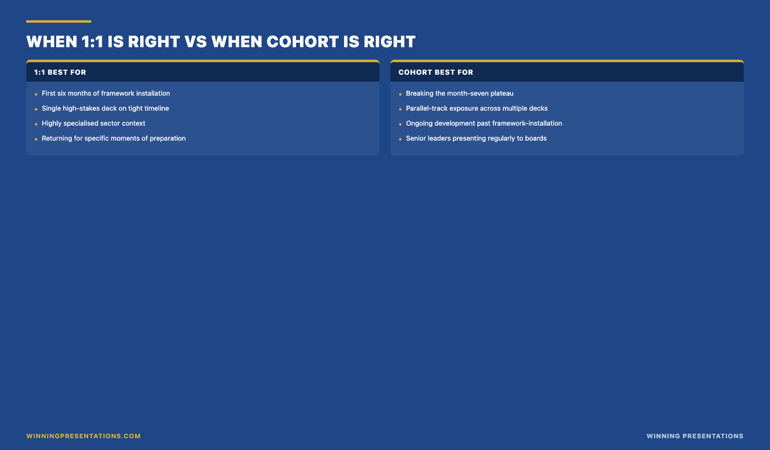
Is 1:1 coaching better than group programmes?

Not necessarily. 1:1 offers personalisation; group programmes offer peer learning and accountability. The best choice depends on your learning style and specific needs. What matters more than format is whether the content meets the 5 non-negotiables.

How quickly should I expect results from coaching?

With framework-based coaching, you should see improvement in your very next presentation. Deep transformation—the kind that makes high-stakes presenting feel natural—typically takes 3-6 months of deliberate application.

Should I look for a coach with experience in my industry?

Industry experience can be helpful but isn’t essential. Executive presentation patterns are remarkably consistent across sectors. What matters more is whether the coach understands high-stakes, senior-audience dynamics—not the specifics of your industry.

Can AI tools replace executive presentation coaching?

AI can help you create slides faster, but it can’t teach you to present with authority under pressure. The mechanical parts of presentation creation are being automated; the human elements—strategic thinking, executive presence, managing the room—remain irreplaceable. The best coaching helps you leverage AI for efficiency while developing the skills AI can’t provide.

What if I’ve tried coaching before and it didn’t work?

The failure was likely in the approach, not in you. Most coaching fails because it’s theory-based, generic, or ignores the stress response. Use the evaluation framework in this article to find a programme that addresses those gaps. Don’t give up on coaching—find better coaching.

Does coaching work for people who are naturally nervous presenters?

Yes—in fact, naturally nervous people often see the biggest transformation. Here’s why: coaching that addresses the stress response (not just “presentation tips”) gives anxious presenters specific techniques to manage their physiology. They’re not trying to “stop being nervous”—they’re learning to present effectively despite the nerves. Many of the most composed executive presenters you see are naturally anxious people who’ve learned to channel that energy rather than display it.

Is This Right For You?

✓ Executive coaching is right for you if:

  • You present to boards, executives, or senior stakeholders
  • Your presentations affect decisions on funding, strategy, or career advancement
  • You want frameworks and techniques, not just theory
  • You’re ready to invest time in deliberate practice

✗ Executive coaching is NOT right for you if:

  • You mainly present to peers or direct reports (lower stakes)
  • You’re looking for quick tips rather than skill development
  • You’re not willing to practice between sessions
  • You expect transformation without applying what you learn

⭐ The £8,000 I Wasted Taught Me What Works

That expensive coaching that failed? It taught me exactly what to avoid—and what to build. AI-Enhanced Presentation Mastery is everything I wish that programme had been: frameworks-first, pressure-tested, and designed specifically for executives who present to decision-makers.

What you’ll get:

  • Executive presentation frameworks (not theory—templates you can use immediately)
  • Techniques for calm authority under pressure
  • Modern AI integration for faster, better presentations

See the Full Curriculum →

Cohort-based programme on Maven. Review the full curriculum before deciding.

📧 Optional: Get weekly executive presentation strategies in The Winning Edge newsletter (free).

Your Next Step

The right executive presentation coaching can transform how you communicate with decision-makers—and by extension, how your career progresses.

But the wrong coaching wastes thousands and leaves you no better than before. The difference is in knowing what to look for.

Use the 10-question evaluation on any programme you’re considering. Demand to see frameworks before you commit. Ask for evidence of results. And don’t settle for theory-based coaching that collapses under pressure.

Your ability to present to executives is one of the highest-leverage skills you can develop. Invest in coaching that actually delivers transformation—not just inspiration.

To review a programme designed around these principles, see the AI-Enhanced Presentation Mastery curriculum.

P.S. If your immediate challenge is structuring slides for executive approval, see how to build decision slides that get “yes” in 60 seconds. If it’s managing nerves when presenting to senior leadership, see how to sound calm and credible under pressure.

About the Author

Mary Beth Hazeldine is the Owner & Managing Director of Winning Presentations and a qualified clinical hypnotherapist. The £8,000 coaching failure that opens this article is real—and the decade that followed taught her what actually creates transformation in executive presentations.

After 24 years in corporate banking at JPMorgan Chase, PwC, Royal Bank of Scotland, and Commerzbank—where presenting to senior leadership was unavoidable—she now teaches the frameworks and techniques that actually work under pressure.

Book a discovery call | View services

20 Dec 2025
Presentation confidence training comparison - why most programs fail and what actually builds lasting confidence

Why Presentation Confidence Training Fails (And What Actually Works)

A hypnotherapist reveals the missing piece in most confidence programmes — and the framework that builds lasting change

I’ve seen many professionals seek structured approaches to presentation confidence training. Workshops. Coaching programmes. Expensive corporate initiatives.

Most of them don’t work. Not because the training is bad — but because it’s incomplete.

After 24 years in banking and training as a clinical hypnotherapist she applies evidence-based clinical techniques to managing presentation anxiety.

Whether you’re looking for public speaking confidence training or a presentation confidence course that actually sticks, this guide will show you what to look for — and what to avoid.

Why Most Presentation Confidence Training Fails

Here’s what typical confidence coaching for presentations looks like:

  • “Believe in yourself”
  • “Project confidence and others will believe it”
  • “Visualise success”
  • “Practice positive affirmations”

None of this is wrong, exactly. But it misses the fundamental problem.

Presentation anxiety isn’t a mindset problem. It’s a nervous system problem.

When you’re about to present, your brain detects a threat (the audience) and triggers fight-or-flight. Your heart races. Your hands shake. Your mind goes blank. No amount of “believing in yourself” overrides that biological response.

In my hypnotherapy practice, I saw this constantly. Clients who had done confidence workshops, read the books, repeated the affirmations — and were still paralysed by anxiety. Because they were trying to think their way out of a physiological state.

That’s why most presentation confidence training doesn’t stick. It treats the symptom (lack of confidence) instead of the cause (nervous system dysregulation).

Related: Presentation Confidence: How to Build It (And Why “Fake It Till You Make It” Doesn’t Work)

The 3 elements of effective presentation confidence training - nervous system, frameworks, and application

What Effective Presentation Confidence Training Includes

After treating anxiety clients in clinical practice and training executives across global financial institutions

Element 1: Nervous System Techniques (Not Just Mindset)

Effective confidence training for speakers includes tools that speak directly to your physiology:

  • Breathing patterns that activate the parasympathetic response
  • Grounding techniques that redirect nervous energy
  • Anchoring methods (from NLP) that access confident states on demand
  • Reframing that changes how your brain interprets arousal

These aren’t “woo-woo” relaxation tips. They’re how your nervous system actually works. When you understand the machinery, you can operate it deliberately.

This is what my hypnotherapy training taught me — and what’s missing from most presentation confidence training programmes.

Related: How to Calm Nerves Before a Presentation: The 5-Minute Reset

Element 2: Structural Frameworks (Not Just “Be Confident”)

Anxiety thrives on uncertainty. When you don’t know what comes next, your brain interprets that as danger.

The solution isn’t more confidence — it’s more structure.

Effective public speaking confidence training gives you:

  • A clear structure for any presentation
  • Opening templates you can rely on
  • Transitions that carry you forward
  • Recovery phrases for when things go wrong

When you have a framework, your nervous system calms down. You’re not wondering “What do I say next?” because the structure answers that question automatically.

I discovered this in my fifth year of banking when I took “Pitching to Win” training. It didn’t make me a confident person — it gave me a framework I could trust. And that framework gave me presentation confidence for 19 more years.

Related: Presentation Structure: 7 Frameworks That Actually Work

Element 3: Practical Application Over Time (Not One-Day Workshops)

Here’s the problem with one-day confidence workshops: you learn techniques on Tuesday and forget them by Friday.

Lasting confidence building for presentations requires:

  • Spaced practice — applying techniques over weeks, not hours
  • Real presentation application — using frameworks on actual work, not hypothetical exercises
  • Feedback loops — knowing what’s working and what needs adjustment
  • Accountability — structure that keeps you implementing

Research on skill acquisition is clear: lasting change requires practice over time, not intensive one-off sessions. That’s why most corporate presentation confidence training doesn’t stick — it violates how learning actually works.

Presentation coming up and nerves already building?

Before you rehearse again, check whether you have a system for the physical response — not just the words. The difference between conventional training and a nervous system approach is significant once you’ve experienced it.

If you’re at the point where more preparation isn’t solving the problem, Conquer Speaking Fear gives you the nervous system framework that addresses the anxiety response underneath the rehearsal.

For a ready-made framework: Explore Conquer Speaking Fear →

Stop Practising More. Build a System Instead.

Most presentation confidence training tells you to rehearse until it feels natural. Conquer Speaking Fear addresses what rehearsal alone cannot — the physiological anxiety response that fires before you open your mouth.

  • Evidence-based nervous system techniques to calm the acute anxiety response
  • Structured preparation frameworks that replace repetitive rehearsal with targeted readiness
  • The in-the-moment recovery system for when nerves hit mid-presentation
  • Designed for professionals who know their material but still feel the anxiety response each time

£39, immediate access.

Get Conquer Speaking Fear → £39

Designed for experienced professionals who need composure under pressure, not just on a good day.

The Results: What Good Presentation Confidence Training Delivers

When all three elements work together, the results are predictable:

Within 3-5 presentations:

  • Noticeably reduced physical anxiety symptoms
  • Ability to recover from mistakes without derailing
  • Consistent structure that eliminates “what do I say next?” panic

Within 15-20 presentations:

  • Automatic confidence that doesn’t require conscious effort
  • Ability to handle high-stakes situations without excessive preparation anxiety
  • Speaking up becomes natural rather than something to dread

My clients have used these techniques to:

  • present in high-stakes boardrooms and funding environments
  • Transition from dreading presentations to volunteering for them
  • Cut preparation time by 75% while improving delivery

These aren’t outliers. They’re the predictable outcome when you address the nervous system, provide frameworks, and allow time for application.

The Psychology Behind Effective Presentation Confidence Training

Here’s what I learned from treating hundreds of anxiety clients:

Confidence isn’t a personality trait. It’s a nervous system state.

Some people appear naturally confident because their nervous system has learned, through repeated positive experiences, that presenting isn’t a threat. Their brain doesn’t trigger fight-or-flight because it’s accumulated enough evidence that they’ll be okay.

Effective presentation confidence training accelerates this process. It gives you:

  1. Tools to manage your physiological state — so you can present even when anxious
  2. Frameworks that create predictability — so your brain has less to fear
  3. Successful experiences — so your nervous system builds evidence that you’re safe

Each successful presentation deposits “evidence” in your brain. Over time, these deposits compound. What once required conscious effort becomes unconscious competence.

This is the science behind confidence building for presentations — and why approaches that skip the nervous system component don’t create lasting change.

Related: Public Speaking Tips: 15 Psychology-Backed Techniques

Who benefits most from presentation confidence training - professionals who've tried before, executives who freeze, anyone who dreads presenting

Who Benefits Most From Presentation Confidence Training

The nervous system + framework + application approach to confidence coaching for presentations works best for:

Professionals who’ve tried confidence training before without lasting results. If workshops didn’t stick, you likely need the nervous system component that was missing — not more mindset work.

Executives who know their material but freeze under pressure. This is the classic sign that physiology, not knowledge, is the bottleneck. You don’t need to know more — you need to manage your nervous system.

Anyone who dreads everyday presenting moments. Team meetings. Speaking up in discussions. Client calls. Public speaking confidence training works for any situation where you need to speak with confidence.

People who want a system, not just tips. If you’re tired of collecting techniques that don’t add up to transformation, you need an integrated presentation confidence course.

Related: How CEOs Actually Present: Executive Presentation Skills

Frequently Asked Questions About Presentation Confidence Training

How is this different from presentation skills training?

Most presentation skills training focuses on delivery techniques — eye contact, gestures, vocal variety. That’s useful, but it doesn’t address the nervous system response that prevents you from using those techniques under pressure. Effective presentation confidence training starts with physiology, then adds frameworks, then develops delivery. In that order.

I’ve done confidence coaching before. Why would this be different?

If previous training focused on mindset (affirmations, visualisation, “believing in yourself”), it missed the physiological component. You can’t think your way out of a fight-or-flight response. The techniques I teach — drawn from clinical hypnotherapy — work at the nervous system level where anxiety actually lives.

What’s included in the course?

The AI-Enhanced Presentation Mastery course includes: 8 self-paced modules (30-45 minutes each), 50+ AI prompts for faster preparation, nervous system techniques from my hypnotherapy practice, structural frameworks for any presentation type, and lifetime access to all materials.

Is there a guarantee?

Yes. Maven offers a full refund until the halfway point of the course. If it’s not working for you, you get your money back — no questions asked.

How long does presentation confidence training take to work?

Most people notice meaningful improvement within 3-5 presentations when applying these techniques consistently. Deep, automatic confidence typically takes 15-20 presentations over several months. The course is structured over 4-6 weeks specifically because lasting change requires spaced practice, not one-day intensity.

Can I build confidence if I rarely present?

Yes, but you’ll need to create opportunities. The course helps you apply techniques to everyday moments — team meetings, speaking up in discussions, client calls — not just formal presentations. Frequency builds confidence faster than intensity.

What if I’m already a decent presenter but want to be great?

The nervous system techniques help at every level. Even experienced presenters have moments of anxiety — high-stakes pitches, hostile audiences, career-defining moments. The frameworks and AI tools also save significant preparation time, which benefits everyone regardless of skill level.


The Confidence That Holds Even When You’re Under Pressure

Conquer Speaking Fear (£39) builds the kind of composure that stays consistent — not dependent on a good night’s sleep, a friendly audience, or a perfect day. Structured techniques, not mindset mantras.

Get Conquer Speaking Fear → £39

Nervous system techniques + Structural frameworks + Spaced learning + Live coaching

£499

Self-paced. Immediate access.


Mary Beth Hazeldine is a qualified clinical hypnotherapist and Owner & Managing Director of Winning Presentations. She spent 25 years in corporate banking at JPMorgan, PwC, Royal Bank of Scotland, and Commerzbank, and applies evidence-based clinical techniques to managing presentation anxiety. She advises executives across financial services, healthcare, technology, and government on structuring presentations and managing presentation anxiety.

The Winning Edge Newsletter

Weekly techniques for executives who present under pressure. Evidence-based, practical, no fluff.

Subscribe Free →

Not ready for the full system? Start here instead: download the free 7 Presentation Frameworks — practical structures for the most common presentation scenarios.

13 Dec 2025
What 24 years in banking taught me about high-stakes presentations

What 24 Years in Banking Taught Me About High-Stakes Presentations

📅 Updated: December 2025

What 25 years in banking taught me about high-stakes presentations

If you want a ready-made framework for executive presentations: Explore The Executive Slide System →

Templates, AI prompts, and scenario playbooks for building board-ready slides.

Quick Answer

Executive presentation training rarely teaches what actually matters. After 25 years $2 JPMorgan, PwC, RBS, and Commerzbank, I learned that high-stakes presentations aren’t won with better slides — they’re won with better preparation, political awareness, and the ability to read a room. The presenters who consistently got approvals weren’t the most polished speakers. They were the ones who’d done the work before they walked in.

🎁 FREE DOWNLOAD

Executive Presentation Checklist

12-point checklist I wish I’d had when I started. One page. Print it before your next big meeting.

Download Free Checklist →

No spam. Unsubscribe anytime.


I still remember my first presentation to JPMorgan’s Executive Committee.

I was 26. I’d spent three weeks building a 45-slide deck. I knew every number, every assumption, every footnote. I’d rehearsed my talking points until I could recite them in my sleep.

Seven minutes in, the Global Head of Operations held up his hand. “What’s the ask?”

I froze. My ask was on slide 38.

“I’ll… I’ll get to that,” I managed.

“I don’t have time for you to get to it. What do you want us to do?”

I fumbled forward, completely thrown off my script. The meeting ended with a polite “send us a one-pager” — which in banking means no.

That moment was the beginning of everything I know about high-stakes presentations.

Lesson 1: The Decision Happens Before the Meeting

Here’s what they don’t teach in executive presentation training: by the time you walk into that room, most decisions are already made.

At a UK hight street bank, I watched a colleague present a flawless recommendation for a £3M technology investment. Perfect slides. Clear ROI. Confident delivery.

The CFO said no in under two minutes.

What my colleague didn’t know: the CFO had already committed that budget to another initiative. The decision was made three weeks earlier in a conversation he wasn’t part of.

The best presenters I worked with at JPMorgan spent more time before the meeting than during it. They’d walk the halls, grab coffee with stakeholders, understand the politics. By the time they presented, they already knew who would support them, who would push back, and what objections they’d face.

The presentation wasn’t where they made their case. It was where they confirmed what they’d already built.

Lesson 2: Executives Buy Confidence, Not Content

In 2008, I was presenting a risk assessment to the bank’s board during the financial crisis. Markets were collapsing. Nobody knew what would happen next.

I had two options: present the uncertainty honestly, or project confidence I didn’t feel.

I chose honesty. I said: “I don’t know what’s going to happen. Nobody does. But here’s what we do know, here’s what we’re watching, and here’s how we’ll respond to each scenario.”

After the meeting, the Chief Risk Officer pulled me aside. “That was the most credible presentation I’ve seen all week. Everyone else is pretending they have answers. You gave us a framework for decisions we can actually make.”

Confidence isn’t about having all the answers. It’s about being clear on what you know, what you don’t know, and what you recommend despite the uncertainty.

Executives don’t expect you to predict the future. They expect you to help them make good decisions with incomplete information. That’s what they do every day.

If you want the slide frameworks distilled from decades of corporate presenting, The Executive Slide System gives you 22 ready-made templates to start from.

Seven lessons from 25 years of banking presentations

Lesson 3: Your Slides Are Not Your Presentation

At PwC, I worked with a partner who was legendary for client presentations. He’d walk in with three slides — sometimes two — and walk out with seven-figure engagements.

I once asked him how he did it.

“The slides are a prop,” he said. “They’re not the show. The show is what happens in the room. The conversation. The questions. The moment you see them lean forward because you’ve said something that matters to them.”

He was right. I’ve seen beautiful 50-slide decks put people to sleep. I’ve seen scribbled whiteboards close deals.

The difference isn’t the slides. It’s the presenter’s ability to:

  • Read the room and adjust in real-time
  • Answer questions they didn’t prepare for
  • Make the audience feel heard, not talked at
  • Create space for the decision to emerge naturally

Related: Executive Presentation Template: 12 Slides That Command the Room

📄
Want the Checklist?

12 things to do before every executive presentation. The prep work that actually matters.

Download Free →

Build Your Next High-Stakes Presentation in Under an Hour

The Executive Slide System gives you 10 board-ready slide templates and 30 AI prompt cards.

Executive Slide System — £39, instant access.

  • 10 executive presentation templates (QBR, board update, budget request, and more)
  • 30 AI prompts to build each slide type in minutes
  • Narrative structure built in — no blank-slide panic

Designed for directors and senior managers who present to boards, leadership teams, and investors.

Lesson 4: The Question You Don’t Expect Will Define You

At a US Investment Bank., I was presenting a £8M operations initiative to the regional CEO. Everything was going perfectly. Slides landing. Heads nodding. I was about to close with my ask.

Then the CEO asked: “What happens to the 47 people in Mumbai whose jobs this eliminates?”

I hadn’t prepared for that question. It wasn’t in my risk assessment. It wasn’t in my stakeholder analysis. I’d been so focused on ROI and efficiency that I’d completely missed the human element.

I stumbled through something about “redeployment opportunities” and “natural attrition.” It was vague and everyone knew it.

The CEO said: “Come back when you’ve thought about the people, not just the numbers.”

That presentation taught me something that’s shaped every executive conversation since: the question you don’t expect reveals what you haven’t thought through. And executives notice.

The best way to prepare for unexpected questions isn’t to anticipate every possible question. It’s to think more broadly about your recommendation in the first place. Who’s affected? What could go wrong? What would make you change your mind?

Related: How to Present to a CFO: The Finance-First Framework

Lesson 5: Vulnerability Builds More Trust Than Perfection

This one took me years to learn.

Early in my career, I thought executive presentations were performances. I needed to appear competent, polished, in control. Any sign of uncertainty was weakness.

Then I watched a Managing Director at RBS do something that changed my perspective.

She was presenting a strategy that had partially failed. Instead of burying the failure in positive spin, she opened with: “I want to tell you what went wrong, what I learned, and what I’d do differently.”

The room leaned in. For the next 20 minutes, she had complete attention. When she finished, the Chief Executive said: “That’s the most useful strategy review I’ve heard this year.”

She got more budget, not less.

Executives are surrounded by people telling them what they want to hear. Honesty — even uncomfortable honesty — is rare and valuable. The presenter who admits what didn’t work, explains why, and shows they’ve learned is more credible than the one with a perfect track record they can’t explain.

Lesson 6: Presence Trumps Content Every Time

At Commerzbank, I sat through hundreds of presentations. I started noticing a pattern.

The presenters who got approvals weren’t always the ones with the best analysis. They were the ones who:

  • Walked in like they belonged there
  • Made eye contact with decision-makers, not their slides
  • Spoke at a pace that commanded attention
  • Paused after making important points
  • Handled pushback without getting defensive

Executive presence is hard to define but easy to recognise. You know it when you see it. And it’s not about being the most charismatic person in the room — some of the most effective presenters I’ve worked with were quiet, understated people who simply projected certainty.

It can be learned. I’ve seen people transform their presence in a matter of months. But it requires deliberate practice, feedback, and usually someone who can show you what you can’t see in yourself.

Lesson 7: AI Won’t Save You

I’ve been using AI tools for presentations since they became available. They’re remarkable for certain things — generating first drafts, formatting consistently, iterating quickly.

But here’s what 24 years taught me that no AI can replicate:

  • Knowing that the CFO and COO don’t speak to each other, so you need separate pre-meetings
  • Sensing that the room has turned and you need to skip ahead
  • Hearing the question behind the question
  • Building relationships that mean your call gets answered

AI makes the mechanical parts of presentations faster. That’s valuable. But the mechanical parts were never the hard part.

The hard part is everything that happens between humans — the trust, the politics, the unspoken dynamics. That’s where presentations are won or lost. And that hasn’t changed in 24 years.

Related: Why AI Won’t Replace Presentation Skills (But Will Amplify Them)

The best presenters spent more time before the meeting than during it

The presentation is the opening act. The Q&A is where trust is built or lost.

The Executive Slide System gives you the frameworks to structure both.

Executive Slide System — £39, instant access.

Designed for executives who present where decisions are made.

What I’d Tell My 26-Year-Old Self

If I could go back to that first JPMorgan Chase presentation, here’s what I’d say:

Stop building slides. Start building relationships. The people in that room are more important than anything on your screen. Know what they care about before you walk in.

Lead with the ask. Respect their time. Tell them what you want, then justify it. Not the other way around.

Prepare for the conversation, not the presentation. Your slides will take 15 minutes. The Q&A will take 45. Prepare accordingly.

Get comfortable being uncomfortable. The moment that terrifies you — the hard question, the pushback, the silence — is where trust is built. Don’t run from it.

Find people who’ll tell you the truth. You can’t see your own blind spots. Get feedback from people who’ll be honest, not kind.

Why I Started Teaching This

After 25 years in banking, I’d collected a lot of lessons. Most of them learned the hard way.

When I moved into training, I discovered that most executive presentation training focused on the wrong things. Slide design. Speaking techniques. Body language tips.

All useful. But none of it addressed what actually determines outcomes: the strategic preparation, the stakeholder management, the ability to read a room and adapt in real-time.

So I built a programme that teaches what I wish I’d known at 26. Not theory — the actual skills and frameworks that worked in real boardrooms with real money on the line.

Reading vs. Doing

What You Get Free Articles AI-Enhanced Mastery (£249)
Awareness of what matters
structured frameworks (AVP, 132, S.E.E.) Mentioned ✓ Deep training
8 structured learning modules ✓ Self-paced
Live coaching sessions ✓ 2 sessions
Templates & prompt packs Examples ✓ Full library
Before/after transformations ✓ Real examples
Outcome Know what to do Actually do it

Frequently Asked Questions

How is executive presentation training different from regular presentation skills?

Regular presentation training focuses on delivery — how to stand, how to speak, how to use slides. Executive presentation training focuses on outcomes — how to get decisions, how to manage stakeholders, how to handle high-stakes situations. The audience, the stakes, and the dynamics are fundamentally different.

Can presentation skills really be taught?

Yes, but not through lectures. The skills that matter — reading a room, handling pushback, projecting confidence — require practice with feedback. That’s why the Maven course includes live coaching sessions, not just video content.

What if I don’t work in banking?

The principles apply across industries. I’ve trained executives in biotech, SaaS, consulting, and manufacturing. The dynamics of high-stakes presentations — managing stakeholders, leading with conclusions, handling tough questions — are universal.

How long does it take to see improvement?

Most people see significant improvement within their first 2-3 presentations after training. The frameworks give you structure immediately. The confidence builds with practice.

📧
The Winning Edge Newsletter

Weekly insights on executive presentations from 16 years of training executives leaders. No fluff. No theory. Just what works.

Subscribe Free →

Related Reading

About the Author

Mary Beth Hazeldine spent 25 years in corporate banking at JPMorgan Chase, PwC, Royal Bank of Scotland, and Commerzbank before moving into executive training. She teaches at Winning Presentations and is launching the AI-Enhanced Presentation Mastery course in January 2026.