If you are searching for presentation opener and closer templates — concrete lines you can adapt for a board update, an internal review, or a senior pitch — the most direct option is the Presentation Openers & Closers Swipe File. It contains 50 opening lines and 30 closing techniques, copy-paste ready, designed for senior professionals working on real presentations rather than generic public-speaking advice. £9.99, instant download.
This page explains what an opener and closer template actually needs to do at executive level, what the swipe file contains, and how to decide whether it fits the kind of room you present in.

Already know the swipe file is what you want? If you would prefer to skip the comparison and view the file directly, see the Presentation Openers & Closers Swipe File on Gumroad — 50 opening lines, 30 closing techniques, copy-paste ready. The remainder of this page is for readers who want context first.
Why Generic Opener and Closer Advice Doesn’t Work in an Executive Room
Search for presentation opening and closing templates and most of what surfaces is written for the conference circuit: tell a story, ask a rhetorical question, quote someone famous, end with a call to action. Structurally fine, but it is not the room a senior professional is actually presenting in. Boards, executive committees, and senior reviews do not want a TED-style hook before they know whether you are about to ask for budget, flag a risk, or report a result. The opening line that earns a keynote audience is the same line that loses a board chair in the first ten seconds.
The closing problem is sharper. Most generic advice ends presentations with a motivational flourish or a vague “any questions?” handoff. Senior audiences expect the opposite: a clean restatement of what you want, what you are not asking for, and what happens next on the calendar. A weak close on a strong deck still ends with the room unsure what was decided. That is a structural failure, not a delivery failure — and it is the one a swipe file of presentation opening lines built for the conference stage cannot fix.
A Copy-Paste Swipe File Built for Senior Rooms
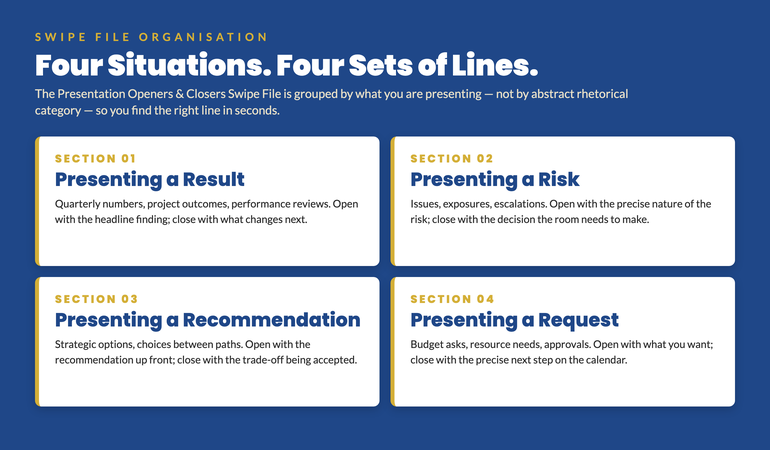
The Presentation Openers & Closers Swipe File is a short, practical reference. It contains 50 opening lines and 30 closing techniques, written for the kinds of presentations senior professionals actually deliver: board updates, executive reviews, budget asks, strategic recommendations, and internal pitches where the audience is small, senior, and short on time. Each line is designed to be adapted, not recited. The lines are framed by situation — presenting a result, presenting a risk, presenting a recommendation — so you pick from the section that matches the room.
The swipe file sits alongside the broader Winning Presentations approach to how to start a presentation and the closing principles in how to end a presentation with executive action. Those articles cover the why; the swipe file gives you the lines. It is a tool, not a course — sized for a senior professional who has half an hour to prepare a real presentation and wants a vetted starting point rather than a blank page.
It is delivered as an instant download. The moment you complete checkout, the file is yours to keep. There is no schedule, no waitlist, and no recurring billing. You can pull it open the night before a board meeting, scan the relevant section, and adapt two or three lines to the deck in front of you.
What the Swipe File Contains
- 50 proven opening lines — written for senior audiences, organised by situation so you find the right line quickly rather than scrolling a generic list
- 30 closing techniques — structures for ending with a clean ask, a clean handoff, or a clean restatement of what you want the room to do next
- Copy-paste ready — each line is designed to be adapted to your deck, not read verbatim, so you keep your voice while borrowing the structure
- Situation-led organisation — sections grouped by what you are actually presenting (a result, a risk, a recommendation, a request) rather than abstract rhetorical categories
- Instant download, no expiry — available the moment you buy, kept for as long as you need it across future presentations
Price: £9.99, single payment, instant download.
Walk Into Your Next Presentation With a Vetted Opening and Closing Already Drafted
The Presentation Openers & Closers Swipe File gives you 50 opening lines and 30 closing techniques, copy-paste ready, organised by the situation you are presenting into — so you can pull the file open the night before and adapt two or three lines to your deck. £9.99, instant download, single payment.
- 50 opening lines written for senior audiences — boards, executive committees, internal reviews
- 30 closing techniques designed to end with a clean ask, not a vague handoff
- Organised by situation — result, risk, recommendation, request — so you find the right line quickly
- Copy-paste ready — adapt to your deck without rebuilding the structure from scratch
- £9.99, single payment, instant download on Gumroad
Get the Openers & Closers Swipe File → £9.99
Designed for senior professionals presenting to boards, executive committees, and internal review meetings
Why the First Thirty Seconds and the Last Sixty Carry the Room
Senior audiences make two quick judgements about a presenter: one in the opening, and one in the close. The opening sets the frame — whether the room thinks you have a clear point or are still arranging your thinking out loud. The close sets the residue — what stays in the room’s head when the next item on the agenda begins. Most presentations have a defensible middle. Far fewer have an opening that earns immediate attention or a close that lands what was actually being asked.
Templates help here in a specific way: they remove the blank-page friction at exactly the point where most presenters lose time. You do not need to invent how to open a budget request from scratch. The structural moves that work for a budget request have been used hundreds of times by senior presenters before you. The same is true for closing a strategic recommendation, a project update, or a risk briefing. The swipe file is a starting point built from those structural moves — you adapt the lines to your situation rather than reinvent the patterns under deadline pressure.
Stop staring at a blank slide the night before a senior presentation.
The Presentation Openers & Closers Swipe File replaces the opening and closing rewrite cycle with a vetted starting point you can adapt in minutes. 50 openers, 30 closers, organised by situation. £9.99, instant download.
Is This the Right Resource for You?
The swipe file is designed for you if:
- You present to senior audiences — boards, executive committees, investment panels, internal senior reviews
- You want vetted opening and closing patterns you can adapt under time pressure
- You prefer concrete lines organised by situation over abstract advice on how to “hook” an audience
- You want a one-off resource, not a course or a subscription
- You work in financial services, technology, healthcare, government, or another setting where senior audiences expect a clean ask and a clean close
The swipe file is probably not the right fit if:
- You are training for the conference or keynote circuit and need stage-craft and audience-warming techniques
- You are preparing a wedding speech, an after-dinner talk, or another non-business presentation
- You want a full slide and storytelling system rather than a focused opening-and-closing reference
If your wider need is structural — the full sequence of a board-level deck, including opening, body, and close together — the related guide on board presentation opening lines for executives compares the swipe-file approach with the broader structural system.
Buy once, keep it on the shelf for every future presentation.
A single £9.99 payment for instant download access. No subscription, no expiry, no recurring billing. Pull the file open before each new senior presentation — the lines travel from one quarterly update to the next without going stale.
Frequently Asked Questions
How are the opener and closer templates organised?
By situation rather than by rhetorical category. Sections are grouped around what you are actually presenting — a result, a risk, a recommendation, a request — so you can scan to the relevant block, choose two or three candidate lines, and adapt them to your deck. The closing techniques are organised the same way, with patterns for ending with a clean ask, a clean handoff, or a clean restatement of next steps.
Can I use the lines verbatim or do I need to adapt them?
Adapt them. The lines are designed as structural starting points, not scripts to recite. The intent is that you keep your own voice and the specifics of your situation while borrowing a structure that has worked in similar senior rooms. Senior audiences are quick to detect a memorised opener, so adaptation is the point.
Is the swipe file relevant outside the UK?
Yes. The opening and closing patterns were drawn from senior briefings in British and international corporate environments, but the structural moves apply across markets. Senior audiences in financial services, technology, healthcare, and government respond to the same fundamentals of a clean opening and a clean close wherever they sit.
What format does the swipe file come in?
It is a downloadable file delivered through Gumroad. Once you complete checkout you have immediate access; there is no app, no portal log-in, and no recurring billing. The file is yours to keep and revisit indefinitely.
How does this compare to a full presentation course?
The swipe file is narrower by design. It addresses the opening and closing only — the two moments where most presentations lose the room — rather than the full deck structure, slide design, or delivery work that a broader course covers. If you need the wider system, the swipe file is a useful entry point and the related courses on this site cover the rest.
The Winning Edge — weekly newsletter for senior professionals
Short, practical essays on executive presentations, openings and closings that earn the room, and the structures that hold up under senior scrutiny. One email a week.
About the Author
Mary Beth Hazeldine is the Owner & Managing Director of Winning Presentations. With 24 years of corporate banking experience at JPMorgan Chase, PwC, Royal Bank of Scotland, and Commerzbank, she advises senior professionals across financial services, healthcare, technology, and government on structuring presentations — including the openings and closings — for boards, executive committees, and investor panels.