Tag: presentation anxiety

30 Jan 2026
Professional man speaking in meeting with uncertain expression and open hand gesture, searching for words mid-sentence

How to Stop Rambling When Nervous: The 3-Sentence Structure

The question was simple: “Can you give us a quick update on the project?”

What came out of my mouth was anything but quick. I talked for four minutes. I repeated myself twice. I went off on a tangent about a supplier issue that nobody asked about. By the time I stopped, the room had glazed over and my manager was checking her phone.

I knew I was rambling. I could hear myself doing it. But I couldn’t stop.

Quick answer: Nervous rambling happens when anxiety hijacks your working memory, making it impossible to organise thoughts in real-time. The fix isn’t “slow down” or “take a breath”—it’s having a structure so simple you can use it even when your brain is flooded with stress hormones. The 3-sentence structure works: Point (what you’re saying), Reason (why it matters), Example or Action (proof or next step). When you know exactly how your answer will be shaped, you stop filling silence with words.

Why We Ramble When Nervous (The Neuroscience)

Before I became a clinical hypnotherapist specialising in presentation anxiety, I spent 24 years in corporate banking. I’ve been the rambler in the room more times than I’d like to admit. And I’ve watched hundreds of intelligent professionals do the same thing—lose control of their words the moment pressure hit.

Here’s what’s actually happening in your brain when you ramble:

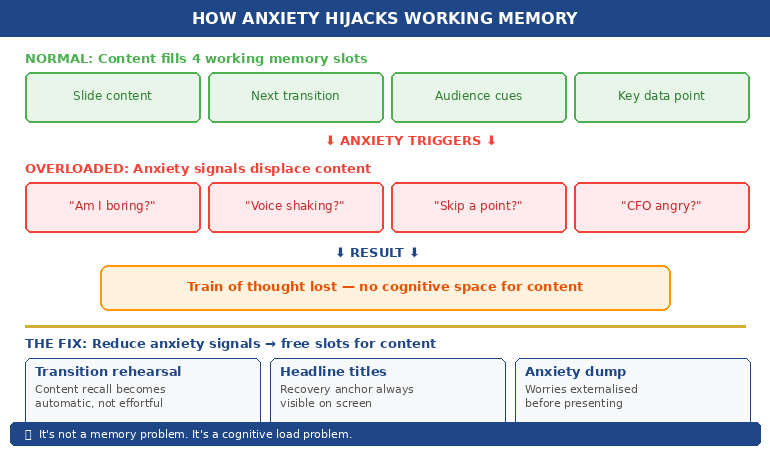
When you feel anxious—someone asks you a question, all eyes turn to you, you’re put on the spot—your amygdala triggers a stress response. Cortisol and adrenaline flood your system. Your heart rate increases. And critically, blood flow shifts away from your prefrontal cortex (where organised thinking happens) toward your limbic system (where survival instincts live).

This is why you can’t “think straight” when nervous. Your brain is literally operating with reduced cognitive capacity. The part of you that organises thoughts, prioritises information, and knows when to stop talking? It’s running on backup power.

So you do what feels safe: you keep talking. Silence feels dangerous when you’re in fight-or-flight mode. Your brain interprets the pause as a threat—they’re judging me, I need to fill this space, I should add more context—and words keep pouring out.

The rambling isn’t a character flaw. It’s a neurological response to perceived threat.

And that’s exactly why “just relax” doesn’t work. You can’t think your way out of a stress response. You need a structure so automatic that it works even when your prefrontal cortex is compromised.

The 3-sentence structure to stop rambling: Point, Reason, Example, then Stop

The 3-Sentence Structure That Stops Rambling

The structure I teach is deliberately simple. It has to be—because you’ll be using it when your brain is running at 60% capacity.

Sentence 1: POINT — State your answer directly. No preamble, no context-setting, no “Well, that’s a great question.” Just the point.

Sentence 2: REASON — Give one reason why this matters or why it’s true. One. Not three. Not five. One.

Sentence 3: EXAMPLE or ACTION — Either give a brief example that illustrates your point, or state the next action. Then stop.

That’s it. Point. Reason. Example. Stop.

Let me show you how this works with the question that started my rambling disaster:

“Can you give us a quick update on the project?”

What I said (rambling): “So, the project is going well, I think we’re making progress, although there have been some challenges with the timeline because the supplier had some issues, which reminded me that we need to talk about the procurement process at some point, but anyway, the team is working hard and we’ve completed most of the first phase, or at least the parts that don’t depend on the supplier, and I think we should be on track for the deadline, assuming nothing else comes up…”

What I should have said (3-sentence structure): “We’re on track for the March deadline. The first phase is 80% complete, with the remaining work dependent on supplier delivery next week. I’ll flag any risks in Friday’s update.”

Same information. Fraction of the words. Zero rambling.

If you’re also struggling with talking too fast when nervous, the 3-sentence structure helps with that too—when you know exactly what you’re going to say, you naturally slow down.

⭐ Stop Rambling. Start Commanding the Room.

Conquer Speaking Fear gives you the complete system for speaking with confidence—including the mental techniques that stop nervous rambling at its source.

What’s included:

  • The neuroscience of why you ramble (and how to interrupt the pattern)
  • Structure templates for answering any question concisely
  • Hypnotherapy-based techniques to reduce anxiety before speaking
  • Practice exercises you can do in 5 minutes before any meeting

Get Conquer Speaking Fear → £39

Created by a clinical hypnotherapist who spent 5 years conquering her own speaking fear

Practice Scenarios: Using the Structure in Real Meetings

The 3-sentence structure only works if you’ve practised it enough that it becomes automatic. Here are five common meeting scenarios with example responses:

Scenario 1: “What do you think about this proposal?”

Point: “I think it’s viable but needs refinement.”
Reason: “The timeline is aggressive given our current resource constraints.”
Example/Action: “I’d suggest we map out dependencies before committing to the April launch.”

Scenario 2: “Can you explain what went wrong?”

Point: “The integration failed because of a data format mismatch.”
Reason: “Our system expected JSON but the vendor sent XML.”
Action: “We’ve implemented validation checks to prevent this going forward.”

Scenario 3: “Where are we on budget?”

Point: “We’re 12% over budget.”
Reason: “The overage is driven by unplanned contractor costs in Q2.”
Action: “I’m presenting options to recover the gap at Thursday’s review.”

Scenario 4: “What’s your recommendation?”

Point: “I recommend we go with Vendor B.”
Reason: “They’re 20% cheaper and have better implementation support.”
Example: “They successfully deployed for three companies in our industry last year.”

Scenario 5: “Can you introduce yourself?”

Point: “I’m Sarah, the project lead for the digital transformation initiative.”
Reason: “I’ve been with the company for six years, most recently leading the CRM migration.”
Action: “I’m here to answer any questions about implementation timelines.”

Notice what’s missing from all of these: filler words, excessive context, tangents, and the word “just.” Each response is complete. Each response is concise. Each response stops.

For more techniques on speaking confidently in meetings, including how to handle interruptions and pushback, see my detailed guide.

What Doesn’t Work (And Why People Keep Suggesting It)

You’ve probably heard all of these. None of them work reliably for nervous rambling:

“Take a deep breath before you speak.”

This can help with physical symptoms, but it doesn’t solve the structural problem. You can take a deep breath and still ramble for three minutes because you don’t know where your answer is going. Breathing helps your body; structure helps your words.

“Just slow down.”

When you’re anxious, your brain interprets pauses as danger. Telling yourself to slow down creates internal conflict—your stress response is pushing you to fill silence while your conscious mind is trying to brake. The result is often choppy, awkward speech that still goes on too long.

“Think before you speak.”

With what cognitive resources? When you’re nervous, your prefrontal cortex is impaired. “Think before you speak” assumes you have full access to your thinking capacity. You don’t. You need a structure simple enough to execute on autopilot.

“Practice more.”

Practice what, exactly? If you practice without a structure, you’re just reinforcing bad habits. Unstructured practice can actually make rambling worse because you’re training your brain that “more words = better prepared.”

The 3-sentence structure works because it gives your impaired brain a simple template to follow. Point. Reason. Example. Stop. Even at 60% cognitive capacity, you can execute three steps.

⭐ Get the Complete Speaking Confidence System

Conquer Speaking Fear combines practical techniques like the 3-sentence structure with deeper work on the anxiety that causes rambling in the first place.

You’ll learn:

  • How to interrupt the anxiety-rambling cycle before it starts
  • The “mental rehearsal” technique used by elite performers
  • How to recover when you catch yourself rambling mid-sentence
  • Building long-term confidence that reduces nervous responses

Get Conquer Speaking Fear → £39

From a clinical hypnotherapist with 24 years in high-pressure corporate environments

Advanced Techniques for Chronic Ramblers

If rambling is a persistent problem—not just occasional nervousness—these advanced techniques can help:

The Physical Anchor

When you finish your third sentence, do something physical: put your pen down, place your hands flat on the table, or shift your weight slightly. This physical action creates a “stop signal” that interrupts the urge to keep talking. Your body tells your brain: we’re done.

The Preview Technique

Before you start speaking, say how many points you’ll make: “Two things on this.” Now you’ve created a public commitment. Your brain knows it needs to stop after two things. This works especially well for longer responses where three sentences isn’t enough.

The Callback Close

End by referencing the question you were asked: “So to answer your question about timeline—March 15th, assuming no supplier delays.” This signals clearly that you’ve completed your answer. It also proves you actually answered what was asked, which ramblers often fail to do.

The Silence Practice

Rambling is often a fear of silence. Practice sitting in silence after you finish speaking. In your next low-stakes meeting, give a short answer and then deliberately wait. Notice that the silence isn’t as uncomfortable as your brain predicted. Nobody judges you for being concise. The more you prove this to yourself, the less you’ll feel compelled to fill space with words.

For related techniques on presentation skills for meetings, including how to handle being put on the spot, see my comprehensive guide.

What causes rambling when speaking?

Rambling is caused by anxiety triggering a stress response that impairs your prefrontal cortex—the part of your brain responsible for organising thoughts and knowing when to stop. When you’re nervous, your brain interprets silence as threatening and pushes you to keep talking. This isn’t a character flaw; it’s a neurological response to perceived pressure. The solution is having a simple structure that works even when your cognitive capacity is reduced.

How do I stop over-explaining at work?

Use the 3-sentence structure: Point (your answer), Reason (why it matters), Example or Action (proof or next step). Then stop. Over-explaining usually happens because you’re uncertain whether you’ve been clear enough, so you keep adding context. The structure gives you confidence that you’ve said enough. If they need more, they’ll ask.

Why do I ramble when I’m put on the spot?

Being put on the spot triggers your fight-or-flight response, which reduces activity in your prefrontal cortex. Without full access to your thinking brain, you can’t organise thoughts in real-time—so you talk while thinking, which produces rambling. The fix is having a structure so simple you can use it on autopilot: Point, Reason, Example, Stop.

⭐ Finally Speak With Confidence and Clarity

Conquer Speaking Fear gives you both the practical structures and the deeper anxiety work to stop rambling for good.

Inside the programme:

  • The 3-sentence structure with practice scenarios
  • Hypnotherapy-based techniques to calm your nervous system
  • How to handle being put on the spot without panicking
  • Building lasting confidence that reduces anxiety over time

Get Conquer Speaking Fear → £39

Instant access. Start using these techniques in your next meeting.

Frequently Asked Questions

What if three sentences isn’t enough to answer the question?

For complex questions, use the Preview Technique: “There are three parts to this.” Then give each part its own Point-Reason-Example structure. You’re not limited to three sentences total—you’re using the structure as a unit. Three parts with three sentences each gives you nine focused sentences, which is plenty for almost any question. The key is that each unit has a clear endpoint.

How do I practice the 3-sentence structure?

Start with low-stakes situations: answering emails out loud, explaining something to a friend, or responding to questions in your head while watching the news. The goal is making the structure automatic before you need it under pressure. Spend one week practising daily for five minutes, and the pattern will start to feel natural.

What if I catch myself rambling mid-sentence?

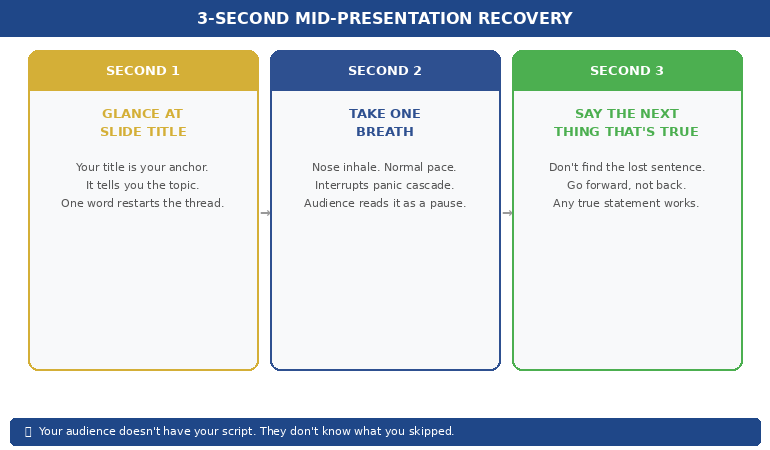
Stop, pause, and say: “Let me summarise.” Then give your Point in one sentence. It’s completely acceptable to course-correct publicly. In fact, people respect it—it shows self-awareness. What they don’t respect is someone who clearly knows they’re rambling but can’t stop.

Is rambling a sign of anxiety disorder?

Occasional rambling when nervous is normal—most people experience it. If rambling is severely impacting your work performance or causing significant distress, it may be worth speaking with a mental health professional. But for most people, rambling is a skill gap, not a disorder. You haven’t learned a structure for speaking concisely under pressure. That’s fixable.

📧 The Winning Edge Newsletter

Weekly techniques for speaking with confidence, managing presentation anxiety, and commanding any room. No fluff—just what works.

Subscribe Free →

📋 Free: Public Speaking Cheat Sheets

Quick-reference guides for managing nerves, structuring answers, and recovering from mistakes—keep them on your phone for any meeting.

Download Free Cheat Sheets →

Your Next Step

The next time someone asks you a question in a meeting, pause for one second. In that second, identify your Point—the single sentence that answers the question. Then give your Reason. Then your Example or Action. Then stop.

Point. Reason. Example. Stop.

It will feel abrupt at first. Your brain will scream at you to add more context. Resist. Let the silence sit. Watch what happens: nothing bad. People nod. They move on. They respect your conciseness.

The rambling that used to derail your credibility? It’s not a fixed part of who you are. It’s a pattern. And patterns can be interrupted.

Three sentences. That’s all you need.

Related: If unclear slide structure is contributing to your rambling during presentations, see why “Overview” is the worst slide title—the fix often starts with clearer thinking before you speak.

26 Jan 2026
Professional woman at podium with microphone looking nervous but determined before presentation

Hands Shaking During Presentations: The 30-Second Nervous System Reset

I dropped the clicker in front of 200 people.

My hands were shaking so badly I couldn’t grip it properly. It clattered onto the floor, rolled under the front row of chairs, and I had to ask someone to retrieve it while the entire room watched. The presentation hadn’t even started yet.

That was fifteen years ago. I was a senior banker at JPMorgan Chase, supposedly confident, supposedly competent. But my hands told a different story. They shook before every important presentation—sometimes visibly, sometimes so badly I couldn’t hold my notes steady.

What changed everything wasn’t “just relax” advice. It was understanding why hands shake in the first place—and learning specific techniques to interrupt the nervous system response that causes tremors.

Quick answer: Hands shake during presentations because your nervous system releases adrenaline, which causes involuntary muscle contractions. You can’t think your way out of shaking—it’s a physiological response. The fix is also physiological: specific techniques that activate your parasympathetic nervous system and interrupt the adrenaline cascade. The 30-second reset in this article works because it addresses the cause, not the symptom.

Written by Mary Beth Hazeldine, Owner & Managing Director of Winning Presentations. Qualified clinical hypnotherapist and NLP practitioner. I spent 5 years with debilitating presentation anxiety before learning to regulate my nervous system. These techniques come from both clinical training and personal experience. Last updated: January 2026.

🚨 Presenting in the NEXT 30 MINUTES? Do this now:

  1. Press your feet firmly into the floor (activates grounding response)
  2. Squeeze your thigh muscles hard for 5 seconds, then release (redirects adrenaline)
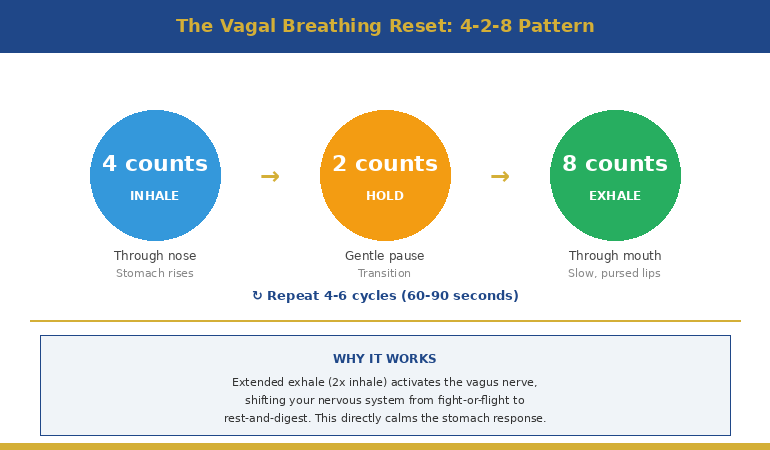
  3. Exhale longer than you inhale (4 counts in, 6 counts out) for 5 breaths

This combination interrupts the adrenaline cascade that causes tremors. It works in under 60 seconds.

Why Your Hands Shake (The Real Reason)

Here’s what nobody tells you about shaking hands: you can’t think your way out of them.

When your brain perceives a threat (and yes, presenting to senior leaders registers as a threat), it triggers the sympathetic nervous system. Adrenaline floods your bloodstream. Your muscles tense. Blood flow redirects to major muscle groups.

The shaking? That’s excess adrenaline with nowhere to go. Your muscles are primed for fight-or-flight, but you’re standing still at a podium. The energy has to release somehow—and it releases as tremors.

Why “Just Relax” Doesn’t Work

Telling yourself to relax when adrenaline is coursing through your system is like telling yourself not to blink. The response is involuntary. It’s happening below conscious control.

That’s why willpower fails. That’s why positive thinking fails. That’s why “just breathe” often makes it worse—because shallow, panicked breathing actually signals MORE danger to your nervous system.

📚 Research note: The physiological tremor response is well-documented in stress research. Studies on the autonomic nervous system (Porges’ Polyvagal Theory) show that physical interventions—not cognitive ones—are required to shift from sympathetic (fight/flight) to parasympathetic (calm) activation. This is why the techniques in this article focus on physical actions, not mental reframes.

The Good News

If the cause is physiological, the solution is also physiological. You don’t need to overcome fear. You need to interrupt the adrenaline response. That’s exactly what the techniques below do.

For more on the nervous system response before presentations, see how to calm nerves before a presentation.

The 30-Second Nervous System Reset

This is the technique that changed everything for me. It works because it activates your parasympathetic nervous system—the “rest and digest” system that counteracts adrenaline.

The Reset (Do This Exactly)

Step 1: Ground (5 seconds)

Press both feet firmly into the floor. Feel the pressure. Notice the contact points—heels, balls of feet, toes. This activates your body’s grounding response and pulls attention away from your hands.

Step 2: Squeeze and Release (10 seconds)

Squeeze your thigh muscles as hard as you can for 5 seconds. Then release completely. This gives the excess adrenaline somewhere to go—large muscle groups can absorb what your hands cannot.

Step 3: Extended Exhale (15 seconds)

Breathe in for 4 counts. Breathe out for 6 counts. Repeat three times. The extended exhale is critical—it directly activates the vagus nerve and signals safety to your nervous system.

Total time: 30 seconds.

You can do this while sitting, while standing at the side of the room, even while someone else is introducing you. Nobody will notice. Your nervous system will.

⭐ Stop the Shaking Before It Starts

Calm Under Pressure contains the complete nervous system regulation toolkit—including the advanced techniques I use with executive coaching clients who experience severe physical symptoms.

What’s included:

  • The full 5-minute pre-presentation protocol
  • Emergency techniques for when symptoms hit mid-presentation
  • Body positioning that naturally reduces tremors
  • The “invisible reset” you can do while presenting

Get Calm Under Pressure → £19.99

Developed from clinical hypnotherapy training and 5 years of personal experience with presentation anxiety.

What to Do BEFORE the Presentation

The best way to stop hands shaking during a presentation is to reduce the adrenaline surge before it happens.

The Night Before

Avoid caffeine after 2pm. Caffeine amplifies the adrenaline response. If you’re already prone to shaking, coffee on presentation day is fuel on fire.

Prepare your body, not just your slides. Lay out what you’ll wear. Know exactly where you need to be and when. Reduce every source of morning stress.

The Morning Of

Physical movement. A 20-minute walk, some stretching, or light exercise burns off baseline adrenaline. Your nervous system starts calmer.

Cold water on wrists. This sounds strange, but cold water on your inner wrists activates the vagus nerve and triggers a calming response. Do it in the bathroom 10 minutes before you present.

30 Minutes Before

Arrive early. Stand in the room. Touch the podium. Handle the clicker. Familiarity reduces threat perception.

Do the 30-second reset (from above) at least twice before you begin.

For a complete breathing protocol, see presentation breathing techniques.

Timeline showing what to do before a presentation to prevent hands from shaking: night before, morning of, and 30 minutes before

What to Do DURING the Presentation

Sometimes the shaking starts mid-presentation. Here’s how to manage it in real time.

The Invisible Reset

You can activate the parasympathetic response without anyone noticing:

  • Press your feet into the floor (grounding)
  • Press your tongue against the roof of your mouth (vagus nerve activation)
  • Slow your exhale (even slightly longer exhales help)

These micro-adjustments work while you’re speaking. Nobody will see them.

Use Your Body Strategically

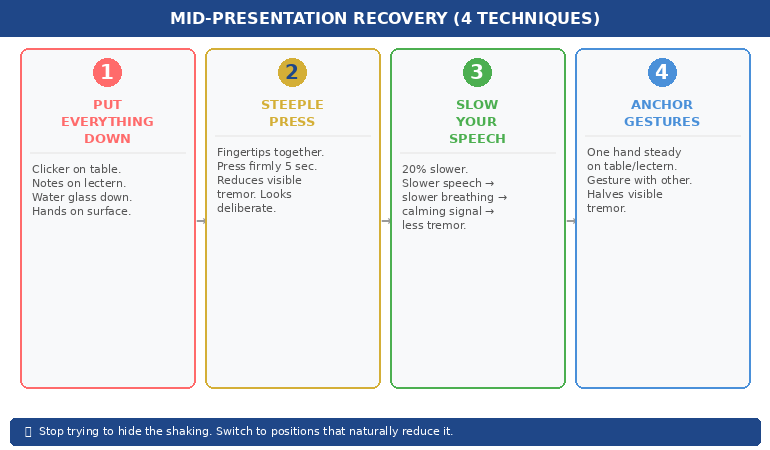
Rest your hands on the podium. The contact point absorbs tremors and gives you stability.

Hold a pen (but don’t click it). The grip gives tremors somewhere to go. Just don’t fidget with it—hold it still.

Use open gestures. Counter-intuitively, moving your hands purposefully makes tremors less visible than trying to hold them still. Gesture broadly when making key points.

If Tremors Are Visible

Don’t apologise. Drawing attention to shaking makes it worse—both for you and your audience’s perception. Most people don’t notice unless you point it out.

Set things down. If you’re holding papers that shake, set them on the podium. If you’re holding a clicker, rest your hand against your thigh between clicks.

→ Want the complete toolkit? Calm Under Pressure (£19.99) includes emergency techniques, body positioning guides, and the “invisible reset” protocol for managing symptoms in real time.

5 Practical Hacks to Hide Tremors

While you work on the underlying nervous system regulation, these practical strategies reduce visible shaking:

1. Don’t Hold Papers

Shaking hands + paper = amplified tremor. The paper acts like a flag, making small tremors look dramatic. Use note cards (stiffer) or put notes on the podium/table.

2. Use a Slide Advancer, Not a Laptop

Reaching for a laptop keyboard makes tremors visible. A wireless clicker keeps your hands by your side or behind the podium between advances.

3. Interlock Your Fingers

When not gesturing, loosely interlace your fingers in front of you. This provides stability and makes tremors virtually invisible.

4. Rest One Hand

Keep one hand in your pocket or resting on a table while gesturing with the other. Fewer visible hands = fewer visible tremors.

5. Arrive Warm

Cold hands shake more. If the room is cold, warm your hands beforehand—rub them together, hold a warm drink, run them under warm water.

5 practical techniques to hide trembling hands during presentations: no papers, use clicker, interlock fingers, rest one hand, stay warm

⭐ I Spent 5 Years With Shaking Hands. You Don’t Have To.

The techniques in this article are a starting point. Calm Under Pressure is the complete system—everything I learned from clinical hypnotherapy training, nervous system research, and 5 years of personal trial and error.

Inside:

  • The full pre-presentation regulation protocol
  • Emergency resets for acute anxiety
  • Long-term techniques to reduce baseline anxiety
  • Audio guides for nervous system regulation

Get Calm Under Pressure → £19.99

Stop managing symptoms. Start regulating your nervous system.

When Shaking Signals Something Deeper

For most people, hands shaking during presentations is a normal stress response that these techniques can manage effectively.

But if you experience:

  • Shaking that happens outside of stressful situations
  • Tremors that interfere with daily activities
  • Symptoms that have suddenly worsened without clear cause

Consider consulting a healthcare professional. Persistent tremors can occasionally indicate other conditions worth ruling out.

For severe anxiety that goes beyond physical symptoms, see what to do about panic attacks before presentations.

→ Ready to stop the shaking for good? Calm Under Pressure (£19.99) gives you the complete nervous system regulation toolkit so you can present without visible anxiety.

Is This Right For You?

✓ This is for you if:

  • Your hands visibly shake before or during presentations
  • You’ve tried “just relax” and it doesn’t work
  • You want techniques that address the cause, not just hide symptoms
  • You’re willing to practise the techniques before your next presentation

✗ This is NOT for you if:

  • Your tremors happen outside of stressful situations (see a doctor)
  • You’re looking for medication recommendations
  • You expect instant results without practising the techniques
  • Your main issue is content/slides, not physical anxiety

⭐ That Dropped Clicker Changed Everything I Knew

After I dropped that clicker in front of 200 people, I spent years learning why shaking happens and how to stop it. The clinical hypnotherapy training, the nervous system research, the personal experimentation—it’s all in Calm Under Pressure. So you don’t have to figure it out yourself.

What you’ll get:

  • The complete 5-minute pre-presentation protocol
  • Emergency techniques for acute symptoms
  • Body positioning that naturally reduces tremors
  • The “invisible reset” for mid-presentation relief
  • Long-term techniques to reduce baseline anxiety

Get Calm Under Pressure → £19.99

From someone who solved her own shaking hands—and now helps executives do the same.

Frequently Asked Questions

What if my hands shake so badly I can’t hold notes or a clicker?

Don’t hold them. Put notes on the podium. Use a wireless clicker that you can grip against your thigh between slides. Or memorise your key points so you don’t need notes at all. The techniques in this article will reduce severity over time, but in the meantime, set yourself up so tremors don’t interfere with your delivery.

Does this work for severe anxiety, not just mild nerves?

Yes—these techniques are based on nervous system regulation, which works regardless of severity. In fact, they’re most effective for severe symptoms because they address the physiological cause rather than trying to override it mentally. That said, if you experience panic attacks or anxiety that significantly impacts daily life, consider working with a mental health professional alongside these self-help techniques.

Should I tell my audience I’m nervous?

Generally, no. Most people don’t notice nervousness unless you point it out. Announcing “sorry, I’m really nervous” makes the audience look for signs of anxiety and reduces their confidence in your content. Better to use the techniques in this article and let your preparation speak for itself.

What if the techniques don’t work?

They need practice. The nervous system doesn’t change overnight. Try the 30-second reset at least 10 times in low-stakes situations (at your desk, before phone calls) before expecting it to work in high-stakes moments. Most people see noticeable improvement within 2-3 weeks of consistent practice.

📧 Optional: Get weekly techniques for confident presenting in The Winning Edge newsletter (free).

Your Next Step

Shaking hands during presentations isn’t a character flaw. It’s a nervous system response—and nervous systems can be trained.

Start with the 30-second reset. Practice it today, at your desk, when no one’s watching. Practice it tomorrow before a low-stakes meeting. Build the muscle memory so it’s automatic when you need it.

For the complete toolkit—including the 5-minute pre-presentation protocol, emergency techniques, and body positioning guides—get Calm Under Pressure (£19.99).

P.S. If your nerves are under control but your slides aren’t landing, see why data presentations often backfire with executives—and what to do instead.

About the Author

Mary Beth Hazeldine is the Owner & Managing Director of Winning Presentations. That dropped clicker that opens this article? That was her—and it started a journey into clinical hypnotherapy, nervous system regulation, and presentation psychology.

Now a qualified clinical hypnotherapist and NLP practitioner, she combines 24 years of corporate banking experience with evidence-based techniques for managing presentation anxiety. The shaking stopped years ago. Now she helps others do the same.

Book a discovery call | View services

24 Jan 2026
Professional woman taking a calming breath as panic subsides before a presentation, showing the moment of regaining control

Panic Attack Before Presentation: What to Do in the Moment

My hands were shaking so badly I couldn’t hold my notes. My heart was pounding so hard I was certain everyone in the corridor could hear it. I had seven minutes until I was supposed to present to the board—and I was hiding in a bathroom stall, convinced I was dying.

Quick answer: A panic attack before presentation is your nervous system’s false alarm—it feels life-threatening but it isn’t. The 90-second protocol that stops it: (1) Cold water on wrists and neck, (2) 4-7-8 breathing (inhale 4, hold 7, exhale 8), (3) Name 5 things you can see out loud. This interrupts the panic cycle and gives your prefrontal cortex time to regain control from your hijacked amygdala.

In practice, panic attacks before presenting are far more common than most professionals admit—and they’re completely manageable once you understand what’s happening in your body and have a reliable protocol to interrupt the cycle.

When you have a protocol that works:

  • Panic becomes manageable instead of terrifying
  • You present anyway—and no one knows what happened
  • The fear of panic itself starts to fade

Written by Mary Beth Hazeldine — executive presentation coach and qualified clinical hypnotherapist. I spent 5 years having panic attacks before presentations until I learned what actually works. I’ve since helped hundreds of executives who thought they’d have to live with this forever. Last updated: January 2026.

🚨 Panic attack happening RIGHT NOW? Do this:

  1. Cold water — Run cold water on your wrists and splash your face/neck (activates dive reflex, slows heart)
  2. 4-7-8 breath — Inhale 4 counts, hold 7 counts, exhale 8 counts. Repeat 3 times.
  3. 5-4-3-2-1 grounding — Name 5 things you see, 4 you touch, 3 you hear, 2 you smell, 1 you taste
  4. Move — Shake your hands, roll your shoulders, walk. Movement discharges adrenaline.

This takes 90 seconds. The panic will peak and pass. You will be able to present.

→ Want this protocol in audio form you can use in the moment? Get Calm Under Pressure →

📅 Presenting in the next 7 days?

The protocol above handles acute panic. But if you want to prevent panic attacks from escalating—or stop them before they fully activate—you need to train your nervous system in advance. That’s what this article teaches.

That board presentation I mentioned? I made it through. Delivered the full 20 minutes. Got the budget approved. No one knew what had happened in that bathroom seven minutes earlier.

I learned something crucial that day: panic attacks feel unsurvivable, but they’re not. And once you have a reliable protocol, you stop fearing the fear itself—which is often worse than the panic.

After 5 years of suffering through this alone—and then training as a clinical hypnotherapist specifically to understand why it happens—I now teach these techniques to executives who thought presentation panic was just something they had to endure. It isn’t.

What’s Actually Happening During a Panic Attack

Understanding what’s happening in your body removes some of the terror. A panic attack before presentation is your nervous system misfiring—your brain has incorrectly flagged “presentation” as “life-threatening danger.”

The Amygdala Hijack

Your amygdala (the brain’s threat detector) triggers fight-or-flight. It doesn’t consult your rational brain first. By the time you think “this is just a presentation,” your body is already flooded with adrenaline and cortisol.

This is why telling yourself to “just relax” doesn’t work. Your rational brain isn’t driving anymore.

The Physical Symptoms (And Why They Happen)

Every panic symptom has a survival purpose that’s now misfiring:

  • Racing heart — Pumping blood to muscles for fighting or fleeing
  • Shallow breathing — Quick oxygen intake for action
  • Sweating — Cooling the body for exertion
  • Trembling — Muscles primed for explosive movement
  • Tunnel vision — Focusing on the “threat”
  • Nausea/stomach drop — Digestion shutting down to redirect energy
  • Feeling of unreality — Dissociation to protect from trauma

None of these will hurt you. They feel terrible, but they’re your body trying to protect you from a threat that doesn’t exist.

The Critical Fact Most People Don’t Know

Panic attacks peak within 10 minutes and pass within 20-30 minutes—even if you do nothing. Your body cannot sustain that level of activation indefinitely. The adrenaline gets metabolised. The cortisol clears.

The 90-second protocol below speeds this process dramatically by directly interrupting the nervous system cascade.

Diagram showing the panic attack cycle and how the 90-second protocol interrupts it at each stage

The 90-Second Protocol (Step-by-Step)

This protocol works because it targets your nervous system directly—not through thoughts, but through physical interventions that trigger automatic calming responses.

Step 1: Cold Water (15 seconds)

Run cold water over your wrists. If possible, splash cold water on your face and the back of your neck.

Why it works: This activates the “mammalian dive reflex”—an automatic response that slows your heart rate. Your body thinks you’re diving into water and immediately begins calming your cardiovascular system. It’s not psychological; it’s physiological.

If you can’t get to water: Press something cold against your wrists or neck—a cold drink can, ice from a water glass, a cold window, your phone screen.

Step 2: 4-7-8 Breathing (45 seconds)

Inhale through your nose for 4 counts. Hold for 7 counts. Exhale through your mouth for 8 counts. Repeat 3 times.

Why it works: The extended exhale activates your parasympathetic nervous system (the “rest and digest” system). You’re manually flipping the switch from fight-or-flight to calm. The hold interrupts the hyperventilation pattern that makes panic worse.

Can’t remember the counts? Just make the exhale longer than the inhale. That’s the key mechanism.

Step 3: 5-4-3-2-1 Grounding (20 seconds)

Name out loud (or silently if you’re not alone):

  • 5 things you can see
  • 4 things you can touch
  • 3 things you can hear
  • 2 things you can smell
  • 1 thing you can taste

Why it works: This engages your prefrontal cortex (rational brain) and pulls attention away from the amygdala (panic brain). You cannot fully panic while actively cataloguing your environment. It anchors you in the present moment rather than the catastrophic future.

Step 4: Move (10 seconds)

Shake your hands vigorously. Roll your shoulders. Walk a few steps. Do wall push-ups if you’re somewhere private.

Why it works: Your body has been flooded with adrenaline meant for physical action. Movement discharges it. This is why animals shake after a threat passes—they’re completing the stress cycle. Humans often skip this step, which is why the chemicals linger.

For more breathing techniques, see the complete guide to presentation breathing.

⭐ Never Face Presentation Panic Unprepared Again

Calm Under Pressure is the complete system for managing physical anxiety symptoms before and during presentations—including the 90-second protocol in audio form you can use in the moment.

What’s inside:

  • The Emergency Protocol audio (what you just learned, guided so you don’t have to remember)
  • The 7-Day Nervous System Reset (reduces baseline anxiety before big presentations)
  • The Pre-Presentation Ritual (prevents panic from fully activating)

Get Calm Under Pressure → £19.99

Created by a clinical hypnotherapist who spent 5 years managing her own presentation panic.

How to Stop Panic Before It Starts

The 90-second protocol handles acute panic. But ideally, you prevent presentation panic from fully activating in the first place.

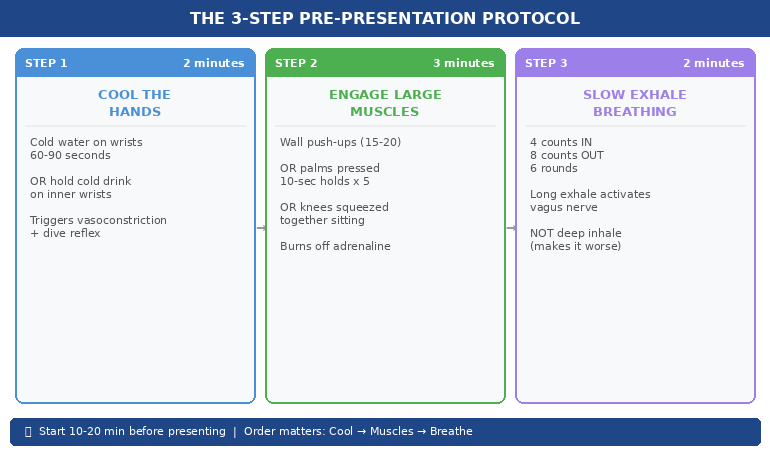
The Pre-Presentation Ritual (30 minutes before)

1. Physiological sigh (5 minutes before leaving for the room)

Double inhale through your nose (one breath, then a second shorter breath on top), then long exhale through mouth. Repeat 3-5 times. Stanford research shows this is the fastest way to reduce real-time stress.

2. Cold exposure (10 minutes before)

Hold something cold, splash cold water on your wrists, or step outside briefly if it’s cold. Pre-activates the calming dive reflex before you need it.

3. Movement (15-20 minutes before)

Take a brisk walk. Climb stairs. Light stretching. Burns off anticipatory adrenaline before it accumulates to panic levels.

4. Arrival ritual (5 minutes before)

Arrive early. Claim your space. Touch the podium or table. Greet one person. This reduces the “entering hostile territory” feeling that triggers panic.

The Morning-Of Protocol

On presentation days:

  • Limit caffeine — It amplifies anxiety symptoms. Half your normal amount, or skip it.
  • Eat protein — Stabilises blood sugar. Blood sugar crashes trigger anxiety responses.
  • Exercise early — Even 20 minutes of movement reduces anxiety for hours afterward.
  • Avoid news/social media — Your nervous system doesn’t need additional activation.

Want the complete pre-presentation ritual with guided audio?

Includes the full 30-minute protocol you can follow the morning of any high-stakes presentation.

Get Calm Under Pressure → £19.99

Long-Term: Training Your Nervous System

If you experience panic attacks regularly before presentations, your nervous system has learned to associate “presentation” with “danger.” The long-term solution is retraining that association.

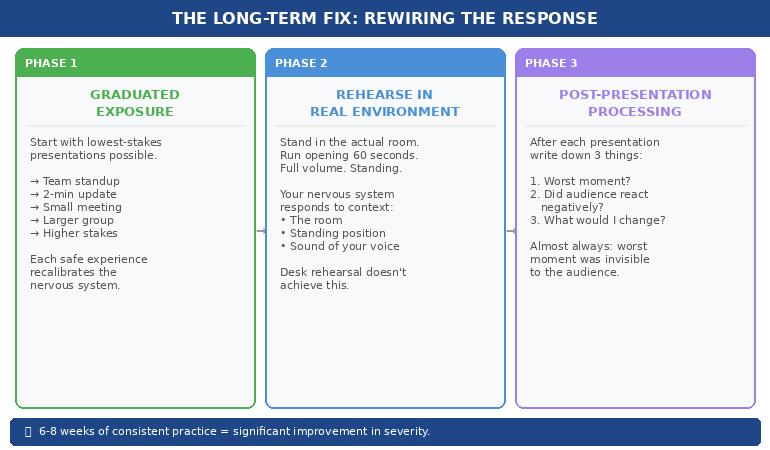
Gradual Exposure

Your nervous system learns safety through repeated exposure without catastrophe:

  • Speak up in small meetings first
  • Volunteer for low-stakes presentations
  • Record yourself presenting and watch it back
  • Present to friends or family

Each time you present and survive, your amygdala gets evidence that presentations aren’t actually life-threatening. The threat association weakens.

Daily Nervous System Training

Daily practice—not just on presentation days—builds your capacity to regulate:

  • Daily breathwork — 5 minutes of 4-7-8 breathing trains your body to access calm states quickly
  • Cold exposure — Cold showers or ice on wrists builds stress tolerance
  • Vagal toning — Humming, singing, gargling stimulate the vagus nerve that controls the calm response

Cognitive Reframing

Physical interventions work faster, but shifting how you think about panic also helps:

  • “This is excitement” — Anxiety and excitement have identical symptoms. Relabelling helps.
  • “My body is preparing me” — Reframe symptoms as preparation for performance, not danger signals.
  • “I’ve survived this before” — You have a 100% survival rate for panic attacks so far.

For more on the psychology of speaking fear, see the hypnotherapist’s guide to lasting change.

The three-level approach to managing presentation panic: emergency protocol, prevention ritual, and long-term nervous system training

⭐ Stop Dreading Every Presentation

The techniques in this article work. But implementing them when you’re already anxious is hard. Calm Under Pressure gives you the complete system with audio guides so you don’t have to think—just press play.

You’ll get:

  • Emergency audio protocol (use during active panic)
  • 7-day nervous system reset program
  • Pre-presentation morning ritual
  • Long-term training guide

Get Calm Under Pressure → £19.99

Used by executives who present in high-stakes boardrooms and client meetings.

When to Seek Professional Help

The techniques here help most people manage presentation panic. But some situations warrant professional support:

Consider seeing a professional if:

  • Panic attacks happen frequently outside of presentations
  • You’re avoiding career opportunities because of fear
  • Anxiety is affecting sleep, relationships, or daily life
  • You’re using alcohol or substances to cope
  • These techniques aren’t helping after consistent 4-week practice

Effective professional approaches for presentation panic:

  • Cognitive Behavioural Therapy (CBT) — Evidence-based treatment for anxiety disorders
  • Clinical Hypnotherapy — Works with subconscious associations driving panic
  • EMDR — Particularly helpful if there’s a traumatic presentation experience in your history
  • Medication — Beta-blockers block physical symptoms; SSRIs address underlying anxiety. Discuss with your doctor.

Seeking help isn’t weakness—it’s strategic. Many successful executives work with professionals to optimise their performance.

For more on building lasting confidence, see the 5-minute reset that actually works.

Ready to take control of presentation panic?

Get the complete toolkit—emergency protocols, prevention rituals, and the training system.

Get Calm Under Pressure → £19.99

Frequently Asked Questions

Can a panic attack actually hurt me?

No. A panic attack before presentation feels dangerous but isn’t. The symptoms are uncomfortable—sometimes terrifying—but they won’t cause heart attacks, fainting (blood pressure rises during panic, making fainting nearly impossible), or permanent harm. Understanding this reduces the fear of panic itself.

What if panic happens DURING my presentation?

Pause. Take a drink of water (buys time, activates swallowing reflex which calms). Take one breath with a long exhale. Continue. Most audiences assume you’re collecting your thoughts. If needed, say “Let me take a moment to make sure I’m explaining this clearly.”

Will people know I’m having a panic attack?

Almost certainly not. Internal symptoms (racing heart, nausea, doom feeling) are invisible. External symptoms (trembling, sweating) are far less obvious than you think. Others are focused on their own concerns, not analysing your physiology.

Should I tell my audience I’m nervous?

Generally, no. It draws attention to something they haven’t noticed and reduces your perceived authority. Exception: if you’re visibly struggling, a brief “Bear with me for a moment” is better than pretending nothing is wrong.

Why do panic attacks seem to come out of nowhere?

They don’t. There’s usually a buildup of anticipatory anxiety that crosses a threshold—hours or days of rumination, sleep disruption, and physical tension accumulating until the system tips. Prevention techniques address this buildup.

Can I take medication for presentation panic?

Beta-blockers (propranolol) are commonly prescribed for performance anxiety—they block physical symptoms without affecting mental clarity. Safe for occasional use, but they don’t address the underlying cause. Discuss with your doctor.

How long until these techniques work?

The 90-second protocol works immediately—relief within minutes. Prevention techniques show results within 1-2 weeks of consistent use. Long-term nervous system retraining takes 4-8 weeks to produce lasting change.

Is This Right For You?

✓ This is for you if:

  • You experience physical panic symptoms before presenting
  • You’ve tried “just relax” and it doesn’t work
  • You want techniques that work with your nervous system
  • You’re willing to practice before the high-stakes moment

✗ This is NOT for you if:

  • Panic attacks happen frequently in daily life (see a professional)
  • You want a magic fix without practice
  • Your main issue is content preparation, not anxiety
  • You’re unwilling to try physical techniques

⭐ I Hid in Bathroom Stalls for 5 Years. Then I Found What Works.

The techniques in Calm Under Pressure are what finally ended my own presentation panic—and what I now teach executives who thought they’d suffer through this forever. You don’t have to.

The complete system:

  • 90-second emergency protocol (audio)
  • Pre-presentation ritual (30-minute preparation)
  • 7-day nervous system reset
  • Long-term training guide

Get Calm Under Pressure → £19.99

From someone who’s been in that bathroom stall—and found her way out.

📧 Optional: Get weekly techniques for presentation confidence in The Winning Edge newsletter (free).

Your Next Step

A panic attack before presentation doesn’t have to derail your career or your confidence. The 90-second protocol works. The prevention rituals work. The long-term training works.

Start with the emergency protocol. Practice it when you’re calm so it’s automatic when you need it. Then build in the prevention rituals. Then commit to the nervous system training.

You can present without panic. I did—after 5 years of hiding in bathroom stalls. Hundreds of my clients have. You will too.

For the complete system with audio guides, get Calm Under Pressure (£19.99).

P.S. If anxiety about your slides is making panic worse, see what your slides actually communicate about you—sometimes fixing the deck reduces the anxiety.

About the Author

Mary Beth Hazeldine is the Owner & Managing Director of Winning Presentations and a qualified clinical hypnotherapist. The bathroom stall story that opened this article is real—she spent 5 years experiencing panic attacks before presentations before training as a hypnotherapist specifically to understand and overcome them.

With 24 years at JPMorgan Chase, PwC, Royal Bank of Scotland, and Commerzbank—environments where one presentation could change funding, strategy, or careers—she’s helped hundreds of executives who thought panic was something they just had to endure.

Book a discovery call | View services

21 Jan 2026
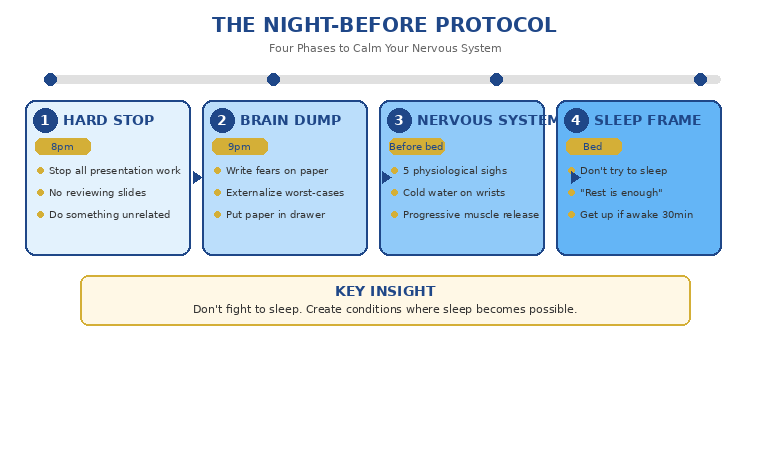
Fear of public speaking at work - the day-before protocol that calms nerves before workplace presentations

Fear of Public Speaking at Work: What to Do the Day Before

Quick answer: If you’re experiencing fear of public speaking at work with a presentation tomorrow, the next 24 hours matter more than you think. What you do today—not what you did last week—determines whether you walk in nervous or confident. The day-before protocol: lock your content by noon, do one physical run-through, prepare for three questions, stop rehearsing by 8pm, and protect your sleep. This sequence has helped executives manage presentation fear for over 15 years.

The goal isn’t to eliminate fear. It’s to arrive prepared enough that fear becomes useful energy instead of paralysing dread.

⚡ Presentation tomorrow? Here’s your day-before protocol:

By noon: Lock your content. No more edits after this.

Afternoon: One full run-through standing up, out loud

Before dinner: Write down 3 questions you might get. Prepare answers.

By 8pm: Stop all rehearsal. Your brain needs processing time.

Evening: Normal routine. Early bed. No alcohol.

If you’re presenting in the next 48 hours, follow this protocol exactly.

The Night Before That Changed Everything

I spent five years terrified of presenting at work. Not just nervous—terrified. The kind of fear that kept me awake the night before, made me nauseous in the morning, and had me rehearsing obsessively until minutes before I had to speak.

The turning point came when I had a board presentation I couldn’t escape. I’d tried everything: more preparation, positive thinking, even beta blockers. Nothing worked.

Then a mentor gave me advice that seemed wrong: “Stop preparing by 8pm. Go to bed early. Trust that you know enough.”

I didn’t believe her. But I was desperate. I followed her protocol exactly.

The next morning, something was different. I wasn’t calm—but I wasn’t paralysed either. The fear was still there, but it felt like energy instead of dread. I delivered that presentation better than any before it.

That day-before protocol became the foundation of everything I now teach about managing fear of public speaking at work.

⭐ Transform Your Presentation Fear Into Confidence

Get the complete system for managing speaking anxiety at work—from the day-before protocol to in-the-moment techniques that actually work.

Inside Conquer Speaking Fear:

  • The day-before protocol (expanded with timing)
  • Morning-of nervous system reset techniques
  • What to do when fear spikes mid-presentation
  • Long-term confidence building exercises

Get Conquer Speaking Fear → £39

Created by a clinical hypnotherapist who personally overcame 5 years of presentation terror. Refined through 15+ years coaching executives in high-stakes workplace presentations.

Why the Day Before Matters More Than You Think

Most people with fear of public speaking at work focus on the wrong timeframe. They think confidence comes from weeks of preparation or years of practice.

It doesn’t. Confidence comes from arriving rested, prepared enough, and not over-rehearsed.

Here’s what actually happens in your brain the day before a presentation:

Your brain is consolidating. Everything you’ve prepared needs time to move from active memory to accessible memory. This happens during sleep and during breaks from rehearsal. When you rehearse until midnight, you’re actually interfering with this process.

Your nervous system is calibrating. The activities you do the day before set your baseline for the next morning. If you spend the evening anxious and rehearsing, you’ll wake up with elevated cortisol. If you spend the evening calm and confident, you’ll wake up closer to that state.

Your fear is looking for evidence. Anxiety makes you hyper-aware of anything that confirms your fear. The day before, your brain is scanning for signs that tomorrow will go badly. What you focus on expands.

This is why the day-before protocol works. It’s not about positive thinking—it’s about giving your brain and nervous system what they need to function well under pressure.

For deeper techniques on calming your nervous system, see the complete guide to calming nerves before a presentation.

The day-before timeline showing what to do 24 hours, evening, and morning before a work presentation

The Day-Before Protocol (Hour by Hour)

Morning (24 hours before):

Do your final content review. Make any last edits to slides or notes. But set a hard deadline: no changes after noon. The urge to keep tweaking is anxiety disguised as productivity. It doesn’t help—it keeps you in “preparation mode” instead of letting you shift to “ready mode.”

If you find yourself wanting to add slides or change your structure, resist. You know enough. More content won’t make you feel more confident—it will make you feel more overwhelmed.

Afternoon (12-18 hours before):

Do one complete run-through. Stand up. Speak out loud. Time yourself if the presentation has a time limit. Don’t stop and restart—go all the way through, mistakes and all.

This isn’t about perfecting your delivery. It’s about proving to your brain that you can get through the whole thing. One complete run-through does more for confidence than ten interrupted rehearsals.

After the run-through, write down three questions you might be asked. For each one, prepare a 30-second answer. Not scripted—just the key points you’d hit. This removes the fear of “what if they ask something I can’t answer.”

Evening (6-12 hours before):

Stop all rehearsal by 8pm. This feels wrong when you’re anxious. Your brain will tell you that more practice equals more safety. It’s lying.

What your brain actually needs is processing time. The material you’ve prepared needs to consolidate. Rehearsing until midnight prevents this and guarantees you’ll feel foggy tomorrow.

Do your normal evening routine. Watch something easy. Talk to someone about anything except the presentation. Go to bed at your usual time or slightly earlier. No alcohol—it disrupts sleep architecture and you’ll wake up groggier.

Want the complete day-before system? Conquer Speaking Fear includes the expanded protocol plus techniques for when anxiety spikes anyway. See what’s included →

The 3 Mistakes That Make Fear Worse

Most advice about fear of public speaking at work focuses on what to do. But avoiding what makes fear worse is equally important.

Mistake 1: Rehearsing until you “feel ready”

You will never feel ready. That’s not how anxiety works. Anxious people don’t rehearse until they feel confident—they rehearse until they’re exhausted and the presentation happens anyway.

The feeling of readiness doesn’t come from more rehearsal. It comes from deciding you’ve prepared enough and trusting that decision. Set a cutoff time and honour it.

Mistake 2: Trying to eliminate the fear

Fear before a work presentation is normal. Trying to make it disappear completely is a losing battle that makes you feel worse when it doesn’t work.

The goal is to be functional with the fear, not fearless. Some of the best presenters I’ve trained still feel nervous before every presentation. They’ve just learned that the fear doesn’t predict failure.

Mistake 3: Running through worst-case scenarios

Your brain thinks this is protective. “If I imagine everything that could go wrong, I’ll be prepared for it.” But what actually happens is you rehearse failure instead of success.

Every time you visualise blanking, stumbling, or being judged, you’re training your brain to expect that outcome. Visualisation works—which is exactly why negative visualisation is so damaging.

If you notice yourself running worst-case scenarios, redirect to “good enough” scenarios instead. Not perfect—just adequate. “I’ll get through it. Some parts will be better than others. I’ll handle the questions.”

The fear spiral versus the preparation spiral showing how the day before determines presentation success

⭐ Break the Fear Spiral Before Your Next Presentation

Learn the techniques that transform presentation dread into manageable nerves—and eventually, into confidence you can rely on.

What you’ll learn:

  • How to stop the mental rehearsal of failure
  • The nervous system reset that works in 60 seconds
  • What to do when fear spikes mid-presentation
  • Building long-term speaking confidence

Get Conquer Speaking Fear → £39

Instant download. Use the techniques before your next presentation.

This pays for itself the first time you present without the paralysing dread.

What to Do the Morning Of

If you’ve followed the day-before protocol, you’ll wake up in better shape than usual. But the morning still matters.

First 30 minutes:

Don’t check your slides immediately. Your brain needs time to wake up before diving into work mode. Do your normal morning routine first.

When you feel yourself starting to worry, notice it without fighting it. “There’s the worry. That’s normal.” Fighting anxiety makes it stronger. Acknowledging it lets it pass.

1-2 hours before:

Do a brief review of your opening and closing. These are the parts that matter most and that people remember. Don’t rehearse the whole thing again—just remind yourself how you’ll start and how you’ll end.

If you have backup slides or notes, make sure they’re accessible. Knowing you have a safety net reduces anxiety even if you never use it.

30 minutes before:

Do the physiological reset: slow exhale (longer than your inhale), relax your shoulders, unclench your jaw. Your body and mind are connected—calming one calms the other.

Arrive early if possible. Being rushed adds stress. Having a few minutes to settle into the space helps your nervous system recognise it as safe.

Right before:

Remember: the fear you’re feeling is the same physiological response as excitement. Your body can’t tell the difference—only your interpretation does. You can reframe “I’m terrified” as “I’m activated and ready.”

For more on building lasting confidence, see the complete guide to presentation confidence.

Struggling with workplace presentations? Conquer Speaking Fear covers the complete system—from long-term confidence building to in-the-moment techniques. Download now →

Related: If you’re presenting to senior leaders or a board, fear often spikes because the stakes feel higher. See board presentation best practices for what actually works in those high-pressure situations.

Common Questions About Fear of Public Speaking at Work

How do I stop being scared of public speaking at work?

You don’t stop being scared—you learn to function with the fear. Fear of public speaking at work is one of the most common workplace anxieties, and trying to eliminate it completely usually backfires. Instead, focus on being prepared enough that fear becomes useful energy rather than paralysing dread. The day-before protocol (lock content by noon, one run-through, stop rehearsing by 8pm, protect sleep) helps more than any amount of positive thinking.

Why do I get so nervous presenting at work?

Workplace presentations trigger fear because they combine public performance with professional consequences. Your brain perceives social evaluation as a threat—and at work, that evaluation can affect your career, income, and standing with colleagues. This fear response is normal and shared by most professionals. The difference between nervous presenters and confident ones isn’t the absence of fear—it’s having techniques to manage it. For lasting change, explore how to overcome fear of public speaking through deeper methods.

What helps with presentation anxiety at work?

Three things help most: adequate preparation (but not over-preparation), a consistent pre-presentation routine, and reframing the fear as activation rather than threat. The day-before protocol is particularly effective because it addresses both the mental and physical aspects of anxiety—stopping rehearsal early lets your brain consolidate learning, while protecting sleep keeps your nervous system regulated.

⭐ Present at Work Without the Paralysing Dread

The complete system for managing speaking fear—from preparation to delivery to long-term confidence building.

Inside Conquer Speaking Fear:

  • The day-before protocol (expanded with timing)
  • Morning-of nervous system techniques
  • What to do when fear spikes mid-presentation
  • Building confidence that lasts
  • Reframing techniques from clinical hypnotherapy

Get Conquer Speaking Fear → £39

Created by a clinical hypnotherapist who overcame 5 years of presentation terror. Instant download.

FAQ

Should I take something to calm my nerves before presenting?

Some people use beta blockers (like propranolol) for physical symptoms—they block the racing heart and shaky hands without affecting mental clarity. If you’re considering this, talk to a doctor. However, medication addresses symptoms, not the underlying fear. The techniques in this article help you need less intervention over time. Avoid alcohol or sedatives—they impair performance even when they reduce anxiety.

What if I can’t sleep the night before?

One night of poor sleep won’t ruin your presentation. The fear of not sleeping is often worse than the actual sleep loss. If you’re lying awake, don’t fight it—get up, do something boring in dim light, and return to bed when drowsy. Avoid screens. Even rest without sleep helps more than anxious tossing. Following the day-before protocol (stopping rehearsal by 8pm, normal evening routine) significantly improves sleep quality.

How do I handle fear that spikes during the presentation?

Pause. Take a sip of water. This buys you 2-3 seconds and looks completely natural. During that pause, take one slow breath and ground yourself by feeling your feet on the floor. The fear spike usually passes in 10-15 seconds if you don’t fight it. Saying “let me think about that for a moment” is always acceptable and gives you time to reset.

Will the fear ever go away completely?

For most people, no—and that’s okay. What changes is your relationship with the fear. Instead of dreading it for weeks, you’ll feel it briefly and move through it. Instead of it controlling your performance, you’ll perform well despite it. Many confident speakers still feel nervous before every presentation—they’ve just learned that the feeling doesn’t predict failure.

📧 The Winning Edge Newsletter

Weekly insights on managing presentation anxiety, building speaking confidence, and communicating effectively at work. Practical techniques from a clinical hypnotherapist with 24 years in corporate banking.

Subscribe Free →

Your Next Step

If you have a presentation at work tomorrow, follow the day-before protocol:

  1. Lock your content by noon—no more edits
  2. Do one complete run-through standing up, out loud
  3. Write down three possible questions and prepare brief answers
  4. Stop all rehearsal by 8pm
  5. Normal evening routine, early bed, no alcohol

The fear won’t disappear. But you’ll arrive tomorrow with a regulated nervous system, consolidated preparation, and enough energy to convert fear into presence.

For the complete system—day-before protocol, morning-of techniques, and long-term confidence building—get Conquer Speaking Fear.

About the Author

Mary Beth Hazeldine is the Owner & Managing Director of Winning Presentations and a former corporate banker with 24 years of experience at JPMorgan Chase, PwC, Royal Bank of Scotland, and Commerzbank. She has trained thousands of executives on high-stakes presentation skills and helped clients secure more than £250 million in funding and budget approvals.

Mary Beth is also a qualified clinical hypnotherapist and NLP practitioner who spent 5 years struggling with presentation terror before developing the techniques she now teaches. The day-before protocol in this article comes from that personal experience—and has been refined through working with executives facing the same fear.

Book a discovery call | View services

20 Jan 2026
High-stakes presentation nerves - what senior leaders actually do to stay calm and present with confidence

High-Stakes Presentation Nerves: What Senior Leaders Actually Do

Quick answer: Senior leaders don’t eliminate high-stakes presentation nerves—they channel them. The executives who seem effortlessly calm have built preparation rituals that transform anxiety into focused energy. The key shift: they interpret racing heart and heightened alertness as “I’m ready” rather than “I’m afraid.” This reframe, combined with specific preparation habits, is what separates composed presenters from visibly nervous ones.

The techniques below come from watching hundreds of senior executives prepare for board meetings, investor pitches, and career-defining moments over 24 years in corporate banking.

⚡ High-stakes presentation in the next 24 hours? Do this now:

Tonight: Run through your opening 3 times out loud. Know your first sentence cold.

Morning of: 10 minutes of movement (walk, stretch). No new content review.

10 minutes before: Find a private space. Six slow breaths (4 counts in, 6 counts out).

Right before: Drink water. Slow your first two sentences deliberately.

The reframe: When you feel your heart racing, say to yourself: “This is my body getting ready to perform.”

The CFO Who Threw Up Before Every Board Meeting

Early in my banking career, I worked with a CFO who presented quarterly results to a FTSE 250 board. In the room, he was composed, authoritative, unshakeable. The board trusted him completely.

What I didn’t know until years later: he vomited before every single board meeting. Every quarter. For seven years.

He wasn’t fearless. He had a system.

The same ritual every time. The same preparation sequence. The same mental reframe that turned physical terror into focused energy.

When I started coaching executives on presentations, I discovered this wasn’t unusual. The most composed presenters aren’t the ones without nerves. They’re the ones who’ve built systems to channel them.

Here’s what those systems actually look like.


⭐ Calm Your Nervous System Before High-Stakes Moments

A hypnotherapist’s toolkit for stopping the physical symptoms of presentation anxiety.

Includes:

  • The 60-second reset that calms racing heart and shaking hands
  • Breathing techniques that work even when you’re already nervous
  • Pre-presentation routine you can do outside the boardroom

Get Calm Under Pressure → £19.99

Created by a clinical hypnotherapist who’s helped hundreds overcome presentation anxiety.

The Myth of the “Naturally Confident” Executive

Here’s what most people believe: some executives are just naturally confident. They were born with a presentation gene. The stakes don’t affect them the way they affect the rest of us.

After 24 years watching senior leaders prepare for high-stakes moments, I can tell you: this is completely wrong.

The executives who look effortlessly calm are often the most anxious beforehand. What they have isn’t an absence of nerves—it’s a system for managing them that’s become automatic.

What nervous professionals do:

  • Try to suppress or eliminate anxiety (impossible)
  • Over-prepare content until the last minute (increases stress)
  • Interpret physical symptoms as evidence they can’t handle it
  • Wing the opening because “I know this material”

What senior leaders do:

  • Accept that nerves are part of high-stakes performance
  • Stop content preparation 24 hours before
  • Interpret physical symptoms as readiness signals
  • Rehearse their opening until it’s automatic

The difference isn’t confidence. It’s preparation architecture.

If you want to overcome the fear of public speaking long-term, you need to build the same systems. But even for a single high-stakes presentation, these habits make a measurable difference.

The Nerves Reframe: Anxiety as Readiness

This is the single most important technique for managing high-stakes presentation nerves.

When you feel anxiety—racing heart, sweaty palms, shallow breathing—your brain is making an interpretation. It’s asking: “What does this physical state mean?”

Most people’s default interpretation: “I’m scared. I’m not ready. This is going to go badly.”

That interpretation makes everything worse. It triggers more stress hormones. It creates a feedback loop of escalating anxiety.

The reframe that senior leaders use:

When you feel those physical symptoms, consciously tell yourself: “This is my body getting ready to perform. These are readiness signals, not danger signals. My system is activating because this matters.”

This isn’t positive thinking. It’s physiologically accurate.

The physical sensations of anxiety and excitement are nearly identical: elevated heart rate, heightened alertness, increased blood flow. The difference is entirely in interpretation. Research shows that people who interpret pre-performance arousal as helpful actually perform better than those who try to calm down.


The Nerves Reframe showing how senior leaders interpret anxiety signals as readiness rather than fear

How to practice the reframe:

Next time you feel presentation nerves, say out loud (or silently): “I’m not scared—I’m ready. My body is activating because this matters. This energy is going to help me perform.”

It feels strange the first few times. After a dozen repetitions, it becomes automatic. Senior executives have done this reframe so many times it’s now their default interpretation.

For the complete protocol including the neurological basis and practice exercises, it’s covered in depth in Conquer Speaking Fear.

Want the complete Nerves Reframe Protocol? Conquer Speaking Fear includes step-by-step techniques for rewiring how your brain interprets anxiety—plus emergency protocols for when panic hits. See what’s included →

What Senior Leaders Actually Do (The Preparation Rituals)

Here’s what I’ve observed from watching hundreds of executives prepare for board meetings, investor presentations, and career-defining moments:

Ritual #1: Content lock 24 hours before

Senior executives stop changing their content a full day before presenting. No more tweaks. No more “one more data point.” The presentation is frozen.

Why this works: last-minute changes increase cognitive load and anxiety. Your brain needs time to consolidate. The executives who seem most natural have stopped thinking about content and started thinking about delivery.

Ritual #2: First sentence memorised word-for-word

Every senior leader I’ve worked with knows their first sentence cold. Not approximately—exactly. They could say it in their sleep.

Why this works: the first 10 seconds are when anxiety peaks. Having an automatic opening eliminates the “what do I say first?” panic. Once you’re past those first words, momentum takes over. Learn more about crafting a powerful executive presentation opening line.

Ritual #3: Physical reset before entering

Before walking into the room, senior leaders find a private space—bathroom, empty office, stairwell—for a 2-minute physical reset. This typically includes: 6 slow breaths, shoulder rolls to release tension, and 30 seconds standing in an expanded posture.

Why this works: physical state drives mental state. You can’t think your way to calm, but you can breathe your way there. For a complete pre-presentation reset routine, see how to calm nerves before a presentation.

Ritual #4: Arrival 15 minutes early

Executives arrive early enough to own the space. They test the technology. They stand where they’ll present. They greet early arrivers casually.

Why this works: arriving rushed puts you in reactive mode. Arriving early puts you in host mode. The psychological shift is significant.


Senior leader preparation timeline showing what executives do 24 hours, 2 hours, and 10 minutes before high-stakes presentations


⭐ High Stakes Trigger Your Nervous System — Here’s the Override

These techniques work at the physiological level, not just “think positive” advice.

Includes:

  • Vagus nerve activation that shifts you out of fight-or-flight
  • The grounding method that stops symptoms mid-presentation
  • Emergency reset when nerves spike unexpectedly

Get Calm Under Pressure → £19.99

Used by executives who present to boards, investors, and leadership teams.

The Day Of: Hour-by-Hour Protocol

Here’s the exact timeline senior leaders follow on presentation day:

Morning (3+ hours before):

  • Normal routine. Don’t disrupt sleep or eating patterns.
  • 10 minutes of physical movement—walk, stretch, light exercise.
  • One run-through of opening and closing only. No full rehearsal.
  • No content changes. The deck is locked.

2 hours before:

  • Review your “one thing”—the single most important message.
  • Visualise the room, the faces, yourself presenting calmly.
  • Light meal or snack. Avoid caffeine if you’re already anxious.

30 minutes before:

  • Arrive at the venue. Test technology. Claim the space.
  • Greet anyone who’s early. Small talk reduces your threat perception.

10 minutes before:

  • Find a private space. Bathroom stall works.
  • 6 slow breaths: 4 counts in, hold 2, 6 counts out.
  • Shoulder rolls. Shake out hands.
  • Say your opening sentence out loud once.
  • Reframe: “I’m not scared—I’m ready.”

1 minute before:

  • Stand tall. Shoulders back. Take up space.
  • Smile briefly—it releases tension.
  • Focus on serving your audience, not on your performance.

This protocol works because it shifts your focus from “how will I perform?” to “how will I serve?” Senior leaders have made this shift so many times it’s automatic. You can build the same pattern.

Want a printable version of this protocol? Conquer Speaking Fear includes the complete day-of timeline plus emergency techniques for unexpected situations. Download now →

Related: Once you’ve managed your nerves, make sure your opening line earns the attention you deserve. Read Executive Presentation Opening Line That Makes Executives Put Down Their Phones.

Common Questions About High-Stakes Presentation Nerves

How do you calm nerves before a high-stakes presentation?

The most effective approach is reframing, not calming. When you feel anxiety symptoms, interpret them as readiness signals rather than fear signals. Tell yourself: “My body is activating because this matters.” Combine this with physical reset techniques—6 slow breaths, shoulder rolls, expanded posture—in the 10 minutes before presenting. Trying to eliminate nerves entirely backfires; channeling them works.

Why do I get so nervous before important presentations?

Your nervous system is doing its job. High-stakes situations trigger a stress response designed to help you perform—increased alertness, faster processing, more energy. The problem isn’t the nerves; it’s interpreting them as “something is wrong.” Senior executives feel the same physical symptoms—they’ve just learned to interpret them as “I’m ready” rather than “I’m afraid.” Build presentation confidence by changing the interpretation, not fighting the sensation.

How do executives stay calm under pressure?

They don’t stay calm—they manage activation. The executives who seem effortlessly composed have built preparation rituals that become automatic: content lock 24 hours before, first sentence memorised, physical reset before entering, early arrival to own the space. They’ve also practiced the anxiety reframe so many times that “I’m ready” is now their default interpretation of nervous symptoms.


⭐ Ready to Eliminate Presentation Fear Permanently?

Go beyond managing symptoms — rewire how your brain responds to high-stakes situations entirely.

Includes:

  • The complete fear-to-confidence transformation system
  • Mental rehearsal techniques that build genuine confidence
  • Cognitive reframing methods from clinical hypnotherapy

Get Conquer Speaking Fear → £39

The complete system for professionals who want to present without fear — not just manage it.

FAQ

What if I’ve tried everything and still get nervous?

You’re not trying to stop being nervous—you’re trying to use the nervousness differently. The reframe technique doesn’t eliminate anxiety; it changes your relationship with it. If deep breathing hasn’t worked, it’s because you were trying to suppress symptoms rather than reinterpret them. The shift from “I need to calm down” to “this activation is helping me” is subtle but transformative.

How far in advance should I start preparing mentally?

Lock your content 24 hours before. Start the mental preparation—visualisation, reframe practice, physical routines—the morning of. Don’t over-prepare the day before; this increases rumination and anxiety. The goal is to arrive at your presentation with fresh energy and automatic habits, not exhausted from mental rehearsal.

Does this work for virtual high-stakes presentations?

Yes—with modifications. For virtual presentations, arrive at your setup 20 minutes early to test technology and settle in. Do your physical reset away from camera, then return with 2 minutes to spare. The reframe technique works identically. Virtual presentations often feel harder because you can’t read the room, so having automatic habits becomes even more important.

What if the nervousness is visible (shaking, sweating)?

Two approaches: manage the symptoms and reframe the visibility. For physical symptoms, the breathing reset helps (it activates your parasympathetic nervous system). But also know this: audiences notice visible nerves far less than you think. And mild nervousness often reads as “this person cares about this topic.” If symptoms are severe, the Calm Under Pressure guide covers specific techniques for physical symptom management.

📧 The Winning Edge Newsletter

Weekly techniques for confident presenting, managing nerves, and executive communication. Practical methods from a clinical hypnotherapist with 24 years in corporate banking—no generic advice, just what actually works under pressure.

Subscribe Free →

Your Next Step

Senior leaders don’t eliminate high-stakes presentation nerves. They build systems that transform anxiety into focused energy.

For your next important presentation: lock your content 24 hours before, memorise your first sentence, do the physical reset 10 minutes before, and practice the reframe—”I’m not scared, I’m ready.”

These aren’t tricks. They’re the exact preparation rituals I’ve observed from executives who present to boards, investors, and senior leadership regularly.

For the complete system—including the Nerves Reframe Protocol, day-of timeline, and emergency techniques—get Conquer Speaking Fear.

📋 Free Resource: Calm Under Pressure Quick Guide

Techniques for managing physical symptoms of presentation anxiety—shaking, sweating, racing heart. Perfect companion to the mindset techniques above.

Download Calm Under Pressure →

About the Author

Mary Beth Hazeldine is the Owner & Managing Director of Winning Presentations and a former corporate banker with 24 years of experience at JPMorgan Chase, PwC, Royal Bank of Scotland, and Commerzbank. She has trained thousands of executives on high-stakes presentation skills and helped clients secure more than £250 million in funding and budget approvals.

Mary Beth is also a qualified clinical hypnotherapist and NLP practitioner, specialising in helping professionals overcome presentation anxiety and speaking fear. After spending five years battling her own terror of presenting at JPMorgan, she developed the neuroscience-based techniques she now teaches to executives worldwide.

Book a discovery call | View services

18 Jan 2026
Presentation anxiety before meetings - the executive reset technique for calming nerves before high-stakes presentations

Presentation Anxiety Before Meetings: The Executive Reset That Actually Works

Presentation anxiety before meetings isn’t a character flaw—it’s your nervous system misfiring a protection response. The executives I’ve trained don’t eliminate anxiety; they reset it. The technique takes 5 minutes: interrupt the pattern, redirect the energy, and anchor to your message. This works whether you’re presenting to the board, leading a steering committee, or delivering a quarterly update to senior leadership.

If you want the complete system for conquering presentation anxiety—not just tips, but the psychological framework that creates lasting change—Conquer Speaking Fear gives you the tools I’ve used with hundreds of executives.

I spent five years terrified of presenting.

Not nervous. Terrified. The kind where you wake at 3am before a big meeting, heart pounding, rehearsing disaster scenarios. The kind where you sit in the car park for ten minutes because your hands won’t stop shaking.

I was a senior banker at JPMorgan Chase. I’d closed multi-million pound deals. But standing up in front of the executive committee? My body acted like I was being chased by a predator.

That’s what drove me to train as a clinical hypnotherapist. Not because I wanted to help other people—at first, I just wanted to fix myself.

What I discovered changed everything: presentation anxiety before meetings isn’t about confidence. It’s about your nervous system. And once you understand that, you can reset it.

Here’s the exact technique I now teach to executives who face the same thing I did.


⭐ Stop the Anxiety Spiral Before Your Next Meeting

A hypnotherapist’s toolkit for calming your nervous system when the dread kicks in.

Includes:

  • The 60-second reset you can do at your desk before walking in
  • Breathing patterns that interrupt the anxiety response
  • Physical grounding techniques that work in real time

Get Calm Under Pressure → £19.99

Created by a clinical hypnotherapist who’s helped hundreds overcome presentation anxiety.

Why Presentation Anxiety Hits Hardest Before Big Meetings

Your brain doesn’t distinguish between physical danger and social threat. When you’re about to present to the board, your amygdala fires the same alarm as if you were about to be attacked.

The result: cortisol floods your system. Your heart races. Your palms sweat. Your mind goes blank or starts racing through worst-case scenarios.

This isn’t weakness. This is evolution.

For most of human history, being rejected by the group meant death. Your brain learned to treat social evaluation as a survival threat. Standing in front of senior leaders—people who control your career, your income, your professional identity—triggers that ancient wiring.

The problem? Most advice tells you to “just relax” or “think positive thoughts.” That’s like telling someone with a racing heart to simply slow it down. The conscious mind doesn’t control the stress response.

What works instead: interrupt the pattern, redirect the energy, anchor to purpose.

This is the foundation of the work I do with executives who need to overcome fear of public speaking at a deeper level than surface-level tips provide.

The 5-Minute Executive Reset

This technique works because it addresses all three channels your nervous system uses: physical, cognitive, and intentional.

Do this 5-30 minutes before any high-stakes meeting. Not the night before (too early). Not as you walk into the room (too late). The sweet spot is the gap between arriving and presenting.

Phase 1: Interrupt (90 seconds)

Break the anxiety loop with a physical pattern interrupt. Options:

  • Cold water on your wrists and the back of your neck
  • 10 slow, deep exhales (exhale longer than inhale)
  • Squeeze your fists tight for 5 seconds, then release completely

Phase 2: Redirect (90 seconds)

Shift from threat-focus to task-focus. Ask yourself:

  • “What’s the ONE thing I need them to understand?”
  • “What decision do I need from this room?”
  • “What’s the best outcome for the people I’m presenting to?”

Phase 3: Anchor (2 minutes)

Connect to your purpose and competence:

  • Recall one specific moment when you presented well (even if small)
  • Remind yourself: “I know this material. I’ve done the work.”
  • Set one micro-intention: “I will speak slowly for the first 30 seconds”

This entire reset takes 5 minutes. It doesn’t eliminate anxiety—it channels it into focus.

Only have 2 minutes? Use the emergency version: splash cold water on your wrists, take three slow exhales, and say “I know this material. My only job is to help them understand one thing.” It covers all three phases in 30 seconds—enough to take the edge off before you walk in.

Want the full reset protocol?

Conquer Speaking Fear includes the complete nervous system reset—plus the deeper psychological work that makes the change permanent.

Get the Complete System — £39 →


The 5-minute executive reset for presentation anxiety showing the three-phase approach

Phase-by-Phase Breakdown: Why Each Step Works

Phase 1: Interrupt — Breaking the Loop

Anxiety feeds on itself. The more you notice your racing heart, the more it races. The more you worry about going blank, the more likely you are to go blank.

A physical pattern interrupt breaks this loop by giving your nervous system something else to process. Cold water works because it triggers the dive reflex—a parasympathetic response that naturally slows your heart rate. Deep exhales work because they activate the vagus nerve, signalling safety to your brain.

The key: make it physical, make it immediate, make it intense enough to notice.

Phase 2: Redirect — From Threat to Task

Anxiety narrows your focus onto threat. You start thinking about what could go wrong, who might judge you, how you might fail.

Redirection expands your focus back to the task. When you ask “What’s the ONE thing I need them to understand?”, you shift from self-focused fear to audience-focused purpose.

This is why well-prepared presenters often feel less anxious: their attention is on the message, not on themselves. If you’re presenting an OKR update to executives, knowing exactly what decision you need makes anxiety harder to sustain.

Phase 3: Anchor — Competence and Purpose

Your brain believes evidence over affirmation. “I’m confident” means nothing if your body doesn’t believe it. “Last month, I explained the Q3 results clearly and the CEO nodded—I can do this” is specific, real, and your nervous system responds to it.

The micro-intention (“I will speak slowly for the first 30 seconds”) gives you one thing to focus on when you start. It’s small enough to achieve, which builds momentum.


⭐ Pre-Meeting Anxiety Is a Body Problem — Not a Mindset Problem

These techniques work at the physiological level, so you’re not fighting your own nervous system.

Includes:

  • Vagus nerve activation that shifts you out of fight-or-flight
  • The calming sequence to use the morning of important meetings
  • Emergency reset when anxiety spikes 5 minutes before you present

Get Calm Under Pressure → £19.99

Used by executives who present to leadership, clients, and boards.

What to Do the Morning of a High-Stakes Meeting

The morning of a big presentation is when anxiety peaks. Here’s the routine I recommend to executives:

The night before:

  • Review your slides once—no more. Over-rehearsing increases anxiety.
  • Write down your opening sentence. Memorise just that.
  • Set your clothes out. Remove decision fatigue.

The morning:

  • Exercise if possible—even a 15-minute walk changes your neurochemistry
  • Eat protein, not sugar. You need stable energy, not a spike and crash.
  • Avoid checking emails about the presentation. New information creates new anxiety.

30 minutes before:

  • Run the 5-minute Executive Reset
  • Review your opening sentence and your closing ask
  • Arrive early enough to test tech and claim your space

This routine isn’t about eliminating nerves. It’s about arriving in a state where you can perform despite them.

For deeper work on building sustainable presentation confidence, the principles here are a starting point—but lasting change requires addressing the underlying patterns.

Ready to address the underlying patterns?

Conquer Speaking Fear goes beyond techniques to rewire how your nervous system responds to high-stakes presentations.

Get Conquer Speaking Fear — £39 →

People Also Ask

Why do I get so anxious before presenting at work?

Your brain interprets evaluation by senior colleagues as a social survival threat. This triggers the same fight-or-flight response as physical danger. It’s not weakness or lack of preparation—it’s your nervous system doing what it evolved to do. The solution isn’t to eliminate the response but to reset and redirect it.

How do I calm down before a big presentation?

Use a physical pattern interrupt (cold water, deep exhales, muscle tension-release), then redirect your focus from self to task by asking “What’s the one thing I need them to understand?” Finally, anchor to a specific moment of past competence. This 5-minute reset works better than generic deep breathing because it addresses all three channels: physical, cognitive, and intentional.

Is presentation anxiety a sign I’m not ready?

No. Many of the most prepared executives experience significant anxiety before high-stakes presentations. Anxiety is about perceived threat, not actual competence. The goal isn’t to feel no anxiety—it’s to perform well despite it. Some research suggests moderate anxiety actually improves performance by increasing focus and energy.

3 Mistakes That Make Presentation Anxiety Worse

Mistake 1: Over-Rehearsing the Night Before

Rehearsing more than twice the evening before a presentation increases anxiety, not confidence. Your brain starts finding new things to worry about. Review once, write down your opening line, then stop. Trust that you know the material.

Mistake 2: Trying to “Feel Confident”

Confidence isn’t a feeling you summon—it’s a result of action. Telling yourself to feel confident when your body is screaming threat creates cognitive dissonance that makes anxiety worse. Instead, focus on one small action: “I will speak slowly for the first sentence.” Action builds confidence; waiting to feel confident prevents action.

Mistake 3: Avoiding the Anxiety

The more you try to suppress or avoid anxiety, the stronger it gets. This is well-documented in psychology research. Instead, acknowledge it: “I notice I’m feeling anxious. That’s my nervous system doing its job. I’m going to do the reset and then present anyway.” Acceptance reduces the secondary anxiety—the anxiety about being anxious.

These mistakes are why quick tips often fail. The deeper approaches to calming nerves address the underlying patterns, not just the symptoms.


⭐ Ready to Stop Dreading Meetings Entirely?

Go beyond managing symptoms — rewire how your brain responds to presentations so the anxiety stops before it starts.

Includes:

  • The complete fear-to-confidence transformation system
  • Mental rehearsal techniques that build genuine calm
  • Cognitive reframing methods from clinical hypnotherapy

Get Conquer Speaking Fear → £39

The complete system for professionals who want to present without dread — not just survive it.

Frequently Asked Questions

How long does it take for the Executive Reset to work?

The reset itself takes 5 minutes and provides immediate relief for most people. However, lasting change—where you stop experiencing severe anticipatory anxiety—typically takes 4-8 weeks of consistent practice. The reset is a tool for the moment; the deeper work in Conquer Speaking Fear addresses the underlying patterns.

What if I have to present in 2 minutes and don’t have time for the full reset?

Use the 30-second emergency version: splash cold water on your wrists, take three slow exhales, and say to yourself “I know this material. My only job is to help them understand one thing.” This covers all three phases in compressed form. It won’t eliminate anxiety, but it will reduce it enough to perform.

Does this work for virtual presentations too?

Yes, and virtual presentations have advantages: you can do the reset without anyone noticing, keep notes visible off-camera, and control your environment. The same technique applies—interrupt, redirect, anchor—just adapted for the virtual context. Many executives find virtual presentations less anxiety-inducing once they learn to use the format strategically.

I’ve tried deep breathing and it doesn’t work for me. Will this be different?

Deep breathing alone often fails because it only addresses one channel (physical) and can actually increase focus on the anxiety. The Executive Reset works differently: it interrupts the anxiety loop, redirects cognitive focus away from threat, and anchors to competence and purpose. If deep breathing hasn’t worked, that’s exactly why this three-phase approach exists.

Get Weekly Confidence-Building Insights

Join executives who receive one actionable technique every week for presenting with confidence and clarity—even under pressure.

Subscribe to The Winning Edge →

Your Next Step

Presentation anxiety before meetings is your nervous system doing what it evolved to do. You can’t eliminate it by willpower, but you can reset it in 5 minutes.

The Executive Reset: Interrupt the loop (physical pattern break), redirect your focus (from self to task), and anchor to competence (specific past success + micro-intention).

Use it before your next high-stakes meeting. Notice what shifts.

And if you’re ready to do the deeper work—to change the pattern itself, not just manage the symptoms—Conquer Speaking Fear gives you the complete system I’ve developed from my own journey and 15+ years of working with executives who face the same thing.

Not ready to buy today? Start with this free resource:

Download the Executive Presentation Checklist—it includes a pre-meeting anxiety check that pairs with the reset technique above.

Download Free Checklist →

15 Jan 2026
Professional woman with hand on chest, eyes closed, showing relief and calm after using presentation breathing techniques

My Heart Was Racing So Fast I Could Hear It. Then I Learned This.

I was hyperventilating in the corridor outside the boardroom.

“Just take deep breaths,” my colleague said. So I did. Big, gulping breaths. My heart raced faster. My hands tingled. I felt dizzy. The “calming” advice was making everything worse.

That was 2003, during my second year at JPMorgan. I had three minutes until I had to present quarterly results to 40 people. And I genuinely thought I might pass out.

What I didn’t know then—what took me five more years of presentation terror and eventually training as a clinical hypnotherapist to understand—is that “deep breathing” is dangerously incomplete advice. It’s not the depth of your breath that calms your nervous system. It’s the ratio.

The technique I’m about to share takes 60 seconds. I’ve been teaching it to executives across financial services, healthcare, technology, and government ever since. It works every single time—because it’s based on how your nervous system actually functions, not on wishful thinking.Last updated:

January 2026 — with the latest Navy SEALs breathing technique..

If you want a structured approach to managing presentation nerves: Explore Conquer Your Fear of Public Speaking →

A neuroscience-based programme for professionals who want to present with genuine confidence.

In This Article

⭐ Stop the Physical Symptoms Before They Start

Calm Under Pressure (£19.99, instant access) gives you the complete nervous system reset toolkit—so you walk into presentations with steady hands, clear voice, and controlled heart rate.

Includes:

  • The 60-Second Reset Protocol (audio + written)
  • Pre-presentation body scan technique
  • Emergency “in the moment” recovery methods
  • Long-term nervous system training exercises

Get Calm Under Pressure → £19.99

Used by executives at JPMorgan, PwC, and RBS. Based on clinical hypnotherapy techniques.

Why “Just Breathe Deeply” Makes Anxiety Worse

Here’s what happens when you’re anxious: your breathing becomes shallow and rapid. Your body floods with adrenaline. Your heart pounds. Every instinct screams take a big breath.

So you do. You gulp air. Big, deep breaths.

And you feel worse.

This isn’t a failure of willpower. It’s physiology. When you take rapid deep breaths—even if they feel “deep”—you’re hyperventilating. You’re flooding your system with oxygen and depleting carbon dioxide. This triggers more anxiety symptoms: tingling hands, dizziness, racing heart, tight chest.

The exact opposite of what you need.

I spent five years making this mistake before every presentation. Standing in corridors, gulping air, wondering why the “calming technique” everyone recommended was making me feel like I was dying.

The breakthrough came when I trained as a clinical hypnotherapist and learned about the vagus nerve—the master switch for your nervous system’s calm response. The vagus nerve isn’t activated by deep breaths. It’s activated by slow exhales.

That’s the key most breathing advice misses entirely.

The 4-7-8 Technique: Exactly How to Do It

This technique was developed by Dr. Andrew Weil, based on ancient pranayama breathing. Navy SEALs use a variation called “box breathing.” I’ve adapted it specifically for presentation scenarios over 15 years of teaching executives.

Here’s the exact protocol:

Step 1: Empty completely. Exhale through your mouth with a whoosh sound. Push every bit of air out. This is important—you need to start from empty.

Step 2: Inhale quietly through your nose for 4 counts. Don’t rush. Count “one-one-thousand, two-one-thousand” in your head.

Step 3: Hold your breath for 7 counts. This feels long at first. That’s normal. Your body is absorbing oxygen properly instead of cycling it too fast.

Step 4: Exhale completely through your mouth for 8 counts. Make the whoosh sound. This extended exhale is where the magic happens—it directly activates your vagus nerve and forces your heart rate down.

Repeat for 3-4 cycles. Total time: less than 90 seconds.

The ratio is 1:1.75:2. The exhale is twice as long as the inhale. This isn’t arbitrary—it’s the ratio that shifts your nervous system from sympathetic (fight-or-flight) to parasympathetic (rest-and-digest).

For more techniques on managing the mental side of pre-presentation nerves, see my guide on what senior leaders actually do for high-stakes presentation nerves.

The 4-7-8 breathing technique diagram showing inhale for 4 counts, hold for 7 counts, exhale for 8 counts

The Science: Why This Ratio Works

Your autonomic nervous system has two modes:

Sympathetic: Fight-or-flight. Heart races, breathing quickens, blood flows to muscles. Useful if you’re running from a predator. Terrible if you’re about to present quarterly results.

Parasympathetic: Rest-and-digest. Heart slows, breathing deepens, mind clears. This is where confident presenting happens.

The vagus nerve is the switch between these modes. And here’s the critical insight: exhaling stimulates the vagus nerve more than inhaling. That’s why the 4-7-8 ratio works—the exhale is twice as long as the inhale, giving your vagus nerve maximum activation.

The 7-count hold serves a different purpose. When anxious, you’re cycling air too fast. The hold forces your body to actually absorb the oxygen you’ve taken in, rather than immediately expelling it and gulping more.

This isn’t meditation. It’s not “mindfulness.” It’s a direct physiological intervention that works whether you believe in it or not.

If you want the complete nervous system reset toolkit—including audio guides you can use in the moment—Calm Under Pressure gives you everything I’ve learned in 25 years of managing presentation anxiety.

When to Use It: A Timing Guide

Timing matters more than most people realise. Here’s exactly when to use the 4-7-8 technique for maximum effect:

The night before (if you’re already anxious): Do 4 cycles before bed. This isn’t about the presentation—it’s about training your nervous system to respond to the technique. The more you practice in calm moments, the faster it works in crisis moments.

Morning of the presentation: Do 4 cycles when you wake up, before the anticipatory anxiety has time to build. Another 4 cycles before you leave for work.

5 minutes before: Find a quiet space. Bathroom, empty office, stairwell, your car. Do 4 complete cycles. This is your primary reset.

2 minutes before: Do 2 cycles while walking to the room. Nobody will notice—you’re just walking and breathing.

Seated at the table, waiting to start: Do 1 subtle cycle as others settle in. (See the subtle version below.)

During Q&A: While someone else asks a question, you have 15-20 seconds. One complete cycle. This is especially useful if you’ve just been asked something difficult and need to compose yourself before answering.

⭐ Master Your Physical Response to Pressure

Breathing is just the start. Calm Under Pressure (£19.99, instant access) covers the complete physical anxiety toolkit: voice control, hand steadiness, posture resets, and the “anchor” technique that stops panic in 10 seconds.

What’s inside:

  • 5 breathing protocols for different scenarios
  • The “grounding” technique for shaky legs
  • Voice warm-up that prevents trembling
  • Emergency reset for mid-presentation panic

Get the Complete Toolkit → £19.99

The Subtle Version for During Presentations

You can’t do full 4-7-8 breathing while you’re actively presenting. But there’s a subtle version that works without anyone noticing.

The “Question Pause” technique:

When someone asks you a question—or when you’re transitioning between slides—pause as if you’re considering your response thoughtfully. During this pause:

  1. Take a slow breath in (2-3 counts, not 4)
  2. Brief hold (1-2 counts)
  3. Slow exhale through your nose (4-5 counts)

Total time: 8-10 seconds. To observers, you look thoughtful and measured. Inside, you’re resetting your nervous system.

This is particularly powerful because most anxious presenters rush to fill silences. The pause actually makes you look more confident while giving you the physiological reset you need.

If your voice tends to shake when presenting, I’ve written a detailed guide on how to stop voice shaking when speaking that pairs well with these breathing techniques.

What If 4-7-8 Feels Too Long?

Some people find the 7-count hold uncomfortable, especially when they’re already anxious. That’s fine—there’s a shorter version that still works.

The 4-4-6 variation:

  • Inhale for 4 counts
  • Hold for 4 counts
  • Exhale for 6 counts

The key principle remains: exhale longer than you inhale. As long as you maintain that ratio, you’ll activate the vagus nerve response.

Start with 4-4-6 if you’re new to breathwork. Once it feels natural, progress to 4-7-8 for stronger effect.

For Video Calls and Virtual Presentations

Virtual presentations have one advantage: nobody can see you from the waist down. Use this.

Before your camera turns on, do your full 4-7-8 cycles. During the call, you can do subtle breathing without anyone noticing—especially when your microphone is muted.

One technique I teach executives: keep your hand resting on your stomach (below camera frame). This lets you feel your breath moving correctly—expanding on inhale, contracting on exhale—while looking completely natural on camera.

For comprehensive virtual presentation strategies, see my guide on how to calm nerves before a presentation.

FAQs

How do you breathe to calm nerves before a presentation?

Use the 4-7-8 technique: inhale quietly through your nose for 4 counts, hold for 7 counts, exhale completely through your mouth for 8 counts. The extended exhale activates your vagus nerve, which directly slows your heart rate and shifts your nervous system from fight-or-flight to calm. Do 3-4 cycles five minutes before presenting for maximum effect.

Why does deep breathing sometimes make presentation anxiety worse?

When anxious, people take rapid deep breaths, which causes hyperventilation—too much oxygen, depleted carbon dioxide. This increases symptoms like tingling, dizziness, and racing heart. The solution isn’t breathing deeply; it’s breathing slowly with an exhale longer than your inhale. That’s why the 4-7-8 ratio works when generic “deep breathing” fails.

What is the 4-7-8 breathing technique?

The 4-7-8 technique involves inhaling for 4 counts, holding for 7 counts, and exhaling for 8 counts. Developed by Dr. Andrew Weil based on yogic breathing, the ratio (1:1.75:2) is specifically designed to activate the parasympathetic nervous system. The extended exhale stimulates the vagus nerve, which controls your body’s calm response.

Can I use breathing techniques during a presentation without anyone noticing?

Yes. Use the “Question Pause” technique: when asked a question, pause as if considering your response, then take a slow breath in (2-3 counts), brief hold (1-2 counts), and slow exhale through your nose (4-5 counts). Total time: 8-10 seconds. To observers, you look thoughtful and measured. This works especially well during Q&A sections.

📧 The Winning Edge Newsletter

Weekly techniques for presenting with confidence. Weekly techniques for executives who present under pressure. Evidence-based, practical, no fluff.

Subscribe Free →

📥 Free Download: 7 Presentation Frameworks

When your structure is solid, anxiety drops. Get the frameworks that give you confidence before you even need breathing exercises.

Download Free Frameworks →

Related: High-Stakes Presentation Nerves: What Senior Leaders Actually Do


Mary Beth Hazeldine spent 25 years in corporate banking at JPMorgan Chase, PwC, Royal Bank of Scotland, and Commerzbank. She’s a qualified clinical hypnotherapist and NLP practitioner, and MD of Winning Presentations. She overcame five years of severe presentation anxiety using the techniques she now teaches.

15 Jan 2026
Should you memorize presentations word-for-word - why it backfires

Should You Memorize Presentations? Why Word-for-Word Is the Worst Strategy

Quick Answer: Don’t memorize presentations word-for-word—it creates a false sense of security that collapses under pressure. When you forget one sentence, you lose the thread entirely. The better approach: memorize your framework and key transitions, then speak naturally from each slide. This gives you flexibility to recover from interruptions while maintaining your core message.


In This Article:

The VP of Strategy at RBS had memorized every word of her board presentation. Three weeks of practice. 47 slides. Perfectly scripted.

Twelve minutes in, a director interrupted with a question. She answered it. Then froze.

She couldn’t find her place in the script. The next 20 minutes were painful—fumbling through slides, apologizing repeatedly, reading directly from the screen. A presentation she knew backwards fell apart because one interruption broke the chain.

I’ve seen this happen dozens of times in my 25 years at JPMorgan, PwC, RBS, and Commerzbank. The executives who memorize word-for-word are actually the most vulnerable when things go off-script. And things always go off-script.

⭐ Want a Structured Framework Instead?

If you want ready-made slide structures that guide your delivery — so you can present confidently from any slide without memorising a script — the Executive Slide System gives you exactly that.

Explore the Executive Slide System →

Stop Memorizing Scripts. Start Using Frameworks.

The Executive Slide System gives you pre-built structures that let you present confidently from any slide—without memorizing a single script. When your slides guide you naturally, you never lose your place.

Get the Executive Slide System → £39

Should you memorize presentations word-for-word - why it backfires

Why Word-for-Word Memorizing Backfires

When you memorize a presentation word-for-word, you’re creating a chain. Each sentence depends on the previous one to trigger the next. This works perfectly in practice—and catastrophically in reality.

Here’s what breaks the chain:

  • A question from the audience
  • A technical glitch that skips slides
  • Running short on time
  • An executive who asks you to “jump to the recommendation”
  • Your own mind blanking on one word

Any of these—and they happen in nearly every business presentation—leaves you stranded. You know the material, but you can’t access it because the retrieval system (your memorized sequence) is broken.

For more on why over-rehearsing creates this vulnerability, see my full guide on presentation rehearsal and the diminishing returns of practice.

The Framework Approach That Actually Works

Instead of memorizing words, memorize structures. Here’s the difference:

Word-for-word memorization: “In Q3, we achieved 127% of our revenue target, driven primarily by expansion in the EMEA region, which contributed 43% of new bookings…”

Framework memorization: “Q3 results → what drove them → EMEA specifics → next steps”

With the framework approach, you know what each section covers and how it connects to the next. The exact words come naturally because you understand the flow, not because you’ve rehearsed a script.

This is why executives who present frequently rarely memorize—they’re too busy to rehearse scripts. Instead, they internalize the story arc and speak from knowledge.

How to memorize a presentation - what to memorize vs what to speak naturally

What You SHOULD Memorize (Only These Four Things)

1. Your opening line. The first 10 seconds set your confidence. Have it locked.

2. Your transitions. Know exactly how you’ll move from section to section. “That’s the problem. Here’s what we’re proposing…” These bridges keep you flowing.

3. Your closing call to action. End strong with a clear ask. Don’t fumble the landing.

4. Your story arc/framework. Know the general framework/story arc of your presentation.

Everything in between? Speak from your slides, your expertise, and your framework. That’s where authentic confidence comes from.

🏆 PREMIUM TRAINING

Master Executive Presentations Without Scripts

The Executive Buy-In System teaches you to present with authority—even when interrupted, challenged, or thrown off-script. Learn the same frameworks I’ve taught to 5,000+ executives at JPMorgan, PwC, and Commerzbank.

Learn More About Executive Buy-In → £199

📧 Join 2,000+ professionals getting weekly presentation insights—frameworks, not scripts. Subscribe to The Winning Edge →

FAQs

Should I memorize my presentation word-for-word?

No. Word-for-word memorization creates vulnerability—one interruption or forgotten word breaks your entire flow. Instead, memorize your framework (the structure and key transitions) and speak naturally from your expertise. This gives you flexibility to handle questions and still deliver your core message.

How do I remember my presentation without memorizing it?

Focus on the story arc, not the script. Know your opening line, your section transitions, and your closing call to action. Let your slides serve as visual prompts for the content in between. Practice talking through your framework rather than reciting words.

What if I forget what to say during a presentation?

With framework-based preparation, forgetting a word doesn’t derail you—you simply continue with the next point in your structure. If you do lose your place, glance at your current slide, take a breath, and state the main point of that slide. Your audience won’t know you skipped anything.

📥 Free Download: 7 Presentation Frameworks

Get the exact structures executives use to present without scripts—including the PREP method mentioned above.

Download Free Frameworks →

Related: Presentation Rehearsal: Why 3 Hours of Practice Makes You Worse


Mary Beth Hazeldine spent 25 years at JPMorgan, PwC, RBS, and Commerzbank. She’s a clinical hypnotherapist and MD of Winning Presentations.

14 Jan 2026
q&a anxiety presentation techniques - how to transform hostile questions into opportunities for credibility

Q&A Anxiety Presentation: The Technique That Turns Hostile Questions Into Opportunities

Quick Answer: Q&A anxiety stems from loss of control, not lack of knowledge. The reframe that changes everything: hostile questions aren’t attacks—they’re opportunities to demonstrate expertise and build credibility. Use the Acknowledge-Bridge-Control technique: validate the concern, find common ground, then guide the conversation where you want it to go.

The question came like a punch to the chest.

“Given that your last two projects ran over budget, why should we trust these numbers?”

I was presenting to the PwC leadership team, and a senior partner had just challenged my credibility in front of everyone. My face flushed. My mind raced to defend, to explain, to justify.

But I’d been training for this moment.

Instead of defending, I paused. Took a breath. And said: “You’re right to ask that. Trust has to be earned. Let me show you exactly what’s different this time.”

The room shifted. What could have been a career-damaging moment became the most credibility-building two minutes of my presentation.

That’s when I learned: hostile questions aren’t threats. They’re opportunities—if you know how to reframe them.

Dreading the Q&A More Than the Presentation Itself?

You are not alone. Most executives say the Q&A is where their confidence collapses — not during the slides. The difference between freezing and flourishing under fire? A structured system for handling any question, including the hostile ones. The Executive Q&A Handling System gives you that system: question prediction frameworks, real-time response techniques, and 51 AI prompts to stress-test your answers before the room does.

Explore the System →

Why Hostile Questions Trigger Panic

When someone challenges you publicly, your brain doesn’t distinguish between professional criticism and physical threat. The amygdala fires. Cortisol floods your system. You’re in fight-or-flight before you’ve processed the actual question.

This is why smart, knowledgeable people freeze under hostile questioning. It’s not about competence—it’s about biology.

The solution isn’t to suppress the response. It’s to reframe the situation before your threat system takes over.

Here’s the reframe that changed everything for me: A hostile question is a gift.

Think about it. The questioner has just told you exactly what concerns them. They’ve revealed their objection, their fear, their agenda. Now you can address it directly instead of guessing what resistance exists in the room.

For a complete guide to managing the Q&A, see our hub article on presentation Q&A techniques.

Reframing hostile questions - from threat to opportunity mindset shift for presentation Q&A

The Acknowledge-Bridge-Control Technique

This three-step technique transforms any hostile question into an opportunity:

Step 1: Acknowledge

Validate the concern genuinely. Not defensively, not dismissively—genuinely.

  • “You’re right to raise that.”
  • “That’s a fair challenge.”
  • “I understand why that’s concerning.”

Acknowledgment disarms hostility. The questioner expected resistance. When you validate instead, the temperature drops immediately.

Step 2: Bridge

Find common ground before presenting your perspective.

  • “We both want this project to succeed…”
  • “Like you, I’m focused on minimising risk…”
  • “The underlying concern—getting this right—is one I share…”

Bridging moves you from opposition to collaboration. You’re no longer adversaries; you’re two people trying to solve the same problem.

Step 3: Control

Now guide the conversation to your key point.

  • “…which is why this approach includes three safeguards we didn’t have before.”
  • “…and here’s specifically what’s different this time.”
  • “…let me show you the data that addresses that directly.”

You’ve validated, connected, and now you’re leading. The hostile question has become your platform.

This technique is part of a broader framework for handling presentation Q&A with confidence.

The Questions Behind the Questions

Most hostile questions aren’t really about what they seem to be about:

  • “Why should we trust these numbers?” = “I’m worried about being burned again.”
  • “This seems overly optimistic.” = “I need reassurance about downside scenarios.”
  • “Have you considered X?” = “I want to feel heard and included.”
  • “This is the third time we’ve discussed this.” = “I’m frustrated with the pace of progress.”

When you address the emotion behind the question—not just the words—you transform the interaction. The questioner feels understood, and understanding builds trust faster than data ever can.

For more strategies on managing challenging interactions, explore our guide to presentation Q&A.

Stop Dreading the Questions

Turn Every Hostile Question Into a Credibility-Building Moment

The Executive Q&A Handling System (£39, instant access): seven field-tested Q&A techniques that signal leadership under pressure, scripts for hostile and loaded questions, the Parking Lot method and four other frameworks for managing derailing questions, and 51 AI prompts to rehearse difficult scenarios before you face them live.

Designed for executives who present to boards, investors, and senior leadership — where the questions matter more than the slides.

Get the Q&A Handling System →

The Winning Edge — Weekly Presentation Insights

Weekly techniques for high-stakes presentations, Q&A preparation, and executive communication from 25 years in corporate boardrooms.

Subscribe Free →

If you present to boards, investors, or senior leadership, the Executive Q&A Handling System gives you a structured approach to preparing for and handling any question — including the ones designed to test you.

Frequently Asked Questions

Why does the Q&A cause more anxiety than the presentation?

During the presentation, you control content, timing, and direction. In Q&A, that control vanishes—questions are unpredictable, and you’re reacting in real-time. Your brain interprets this loss of control as threat, triggering anxiety even when you know your material. More techniques in our full presentation Q&A guide.

How do I stop feeling attacked during hostile questions?

Reframe the question as information-seeking, not attack. Most hostile questions stem from the questioner’s frustration, fear, or agenda—not from your failure. Responding with curiosity instead of defensiveness transforms the dynamic.

What’s the best technique for handling aggressive questions?

The Acknowledge-Bridge-Control technique: Acknowledge the concern genuinely, Bridge to common ground, then Control the direction by offering your perspective. This validates the questioner while keeping you in command of the response.

Prepare for the Unpredictable

Know What They Will Ask Before They Ask It

The Executive Q&A Handling System (£39) includes a question prediction framework that maps the 5 categories of questions your audience will ask — so you walk in with answers ready, not hoping for the best.

Get the Q&A Handling System →

About the Author

Mary Beth Hazeldine is the Owner & Managing Director of Winning Presentations. With 25 years of corporate banking experience at JPMorgan Chase, PwC, Royal Bank of Scotland, and Commerzbank, she has delivered high-stakes presentations in boardrooms across three continents.

A qualified clinical hypnotherapist and NLP practitioner, Mary Beth combines executive communication expertise with evidence-based techniques for managing presentation anxiety. She advises executives across financial services, healthcare, technology, and government on structuring presentations for high-stakes Q&A sessions.

Book a discovery call | View services

14 Jan 2026
presentation q&a techniques - how to handle questions with confidence after your presentation

Presentation Q&A: Why the Questions Terrify You More Than the Presentation


Quick Answer: The Q&A triggers more fear than the presentation because you lose control. You’ve rehearsed your slides; you can’t rehearse unpredictable questions. The solution isn’t predicting every question—it’s building a framework for handling any question. Prepare by category (challenges, gaps, critics), master bridging techniques, and remember: the audience wants you to succeed.

Still Panicking About Q&A?

You’re not alone. Most executives rank Q&A as their biggest presentation fear. The difference between panicked executives and calm ones? A structured system for handling any question. The Executive Q&A Handling System gives you exactly that: a question prediction framework, real-time response techniques, and 51 AI prompts to practise difficult scenarios.

Explore the System →

The Presentation That Nearly Ruined My Career

I delivered the best presentation of my career at Commerzbank in 2008. Twenty-two minutes of polished content, clear data, compelling recommendations. The CFO was nodding. My boss looked pleased.

Then came the Q&A. The first question was fine. The second was manageable. The third came from a director I’d never met: “Your projections assume a 12% market growth rate. What’s your evidence for that, given the current regulatory environment?”

I had evidence. Somewhere. In my backup slides. Which I couldn’t find. While twelve executives watched me fumble through my deck, my credibility evaporating with each passing second.

I eventually found the data. But by then, the damage was done. My carefully constructed presentation had been overshadowed by ninety seconds of visible panic.

That evening, I realised something that changed how I approach every presentation: the Q&A isn’t an afterthought. It’s where credibility is won or lost.

Over the following decade, I became obsessed with Q&A preparation. I interviewed executives who seemed effortlessly confident under questioning. I studied hostage negotiators and crisis communicators. I tested techniques with clients across industries.

What I discovered is that Q&A confidence has almost nothing to do with knowing all the answers. It comes from having a system for handling any question—including the ones you can’t predict.

Stop Rehearsing Every Possible Question

You can’t predict every question. But 95% of difficult questions fall into just 5 categories. Learn which ones matter for your presentation, and you’ll handle any curveball with calm certainty.

The Executive Q&A Handling System (£39) teaches you:

  • The 5-category preparation framework (done in under 30 minutes)
  • Bridging techniques that buy thinking time and signal confidence
  • Hostile question responses that reframe attacks into opportunities
  • 51 AI prompts to stress-test your answers before the room does

Master Your Q&A →

Designed for executives across banking, consulting, and technology. Master your Q&A in one afternoon.

The Psychology of Unpredictability

Why does Q&A trigger more anxiety than the presentation itself? The answer lies in control. During your presentation, you control what information you share, the order, pace, timing, which points to emphasise, when to pause. During Q&A, you control almost nothing. Questions come from anywhere. You’re reacting, not leading. Your carefully rehearsed structure is gone.

This loss of control activates your brain’s threat response. Suddenly you’re not presenting—you’re defending. Your body shifts into fight-or-flight mode, which is exactly the wrong state for clear, confident communication.

The physical symptoms follow: racing heart, shallow breathing, mind going blank. These aren’t signs of incompetence. They’re signs that your nervous system has misidentified a question as a threat.

Understanding this is the first step to managing it. Q&A anxiety isn’t about your knowledge or preparation. It’s about your brain’s response to unpredictability. And that response can be retrained.

How to Prepare When You Can’t Predict

You can’t anticipate every question. But you can prepare for every category of question. Before any presentation, work through five preparation categories:

  1. The Challenges – What are the five most likely challenges to your recommendation?
  2. The Gaps – Where is your data weakest? Identify yours before someone else does.
  3. The Critics – Who in the room is most likely to push back? What do they care about?
  4. The Clarifications – Which parts might be confusing? Prepare simpler explanations.
  5. The “What Ifs” – What scenarios might the audience raise that you haven’t addressed?

This category-based preparation is more valuable than trying to predict specific questions. For more on anticipating objections, see our guide on how to handle difficult questions in a presentation.

Want a structured framework that handles 95% of difficult questions? The Executive Q&A Handling System teaches you category-based preparation, real-time bridging techniques, and hostile question responses—all in one afternoon.

What to Say When You Don’t Know

Here’s a liberating truth: you don’t need to know everything. The most confident executives all share one trait: they’re comfortable saying “I don’t know.” But they say it strategically:

  • The Honest Admission: “I don’t have that specific data with me, but I can get it to you by end of day tomorrow.”
  • The Bridge: “That’s outside my direct area, but what I can tell you is…”
  • The Redirect: “Sarah has been leading that workstream—Sarah, can you speak to that?”
  • The Scope Clarification: “That’s a great question, but it’s probably outside the scope of today’s discussion.”

What you should never do: guess, bluff, or provide data you’re not certain about.

Handling Hostile and Loaded Questions

Not all questions are neutral. Some come with a hidden agenda. Some carry hostility. Difficult question types include:

  • The Loaded Question – reframe the premise before answering
  • The Hostile Question – stay curious, not defensive; treat it as information-seeking
  • The Agenda Question – acknowledge the alternative viewpoint without abandoning your position
  • The Ambush Question – ask for context if unfamiliar; take your time before responding

Key principle: hostile questions are often about emotion, not information. Your job is to address the underlying concern, not just the surface question.

The Difference Between Flustered and Composed

The executives who stay calm under hostile questioning share one thing: they’ve practised specific response techniques until they become automatic. They don’t think—they respond with precision.

Inside the Executive Q&A Handling System (£39, instant access):

  • 7 structured Q&A techniques that signal leadership under pressure
  • Scripts for hostile, loaded, and ambush questions
  • The Parking Lot technique and 4 other methods for handling questions that would derail the discussion
  • 51 AI-powered question prompts for personalised practice

Handle Any Question →

Immediate digital download, ready to use before your next presentation.

7 Techniques That Transform Q&A

These seven techniques have been tested with executives. Each one addresses a specific challenge in Q&A delivery:

  1. Repeat and Reframe – Echo the question back in your own words. This buys thinking time, demonstrates you understood, and shifts the framing to your advantage.
  2. The 30-Second Rule – Keep answers to 30 seconds maximum. Brevity signals confidence; rambling signals uncertainty.
  3. Bridge to Strength – Never leave an answer on a defensive note. Bridge to a point of strength or a supporting fact.
  4. The Parking Lot – For questions that derail the discussion, offer to discuss offline: “That’s important. Let’s park it and I’ll follow up with you.”
  5. Evidence Anchoring – When answering, point to a specific piece of data or research. Vagueness breeds doubt; specificity builds credibility.
  6. The Pause – Pause for 2-3 seconds before answering. It reads as thoughtful, not uncertain. Silence is underused power.
  7. End on Your Terms – Summarise your key point before moving to the next question. Don’t let the questioner have the last word on your topic.

For the specific anxiety that hits during Q&A rather than in planned content, the Q&A anxiety guide addresses the in-the-moment recovery techniques.

Case Study: From Q&A Terror to Q&A Confidence

Priya was a senior manager at a technology company. Brilliant during presentations—her slides were polished, her data was solid, her delivery was engaging. But the moment the first question came, she fell apart. Racing heart, defensive tone, rambling answers.

The problem wasn’t her knowledge. She over-prepared on content and under-prepared on Q&A. We restructured her preparation:

  • Week before: Work through the 5-category objection prep framework. Identify every possible challenge, gap, and critic.
  • Day before: Ask a colleague to challenge her with difficult questions. One hour of real dialogue beats days of solo preparation.
  • Morning of: 10 minutes practising “I don’t know” responses and pause techniques. Physical calibration, not content review.

We also addressed the physical response: before each practice question, she would pause for 2 seconds, take a full breath, then answer. By the time of her next board presentation, this was automatic.

The result: she handled an aggressive line of questioning from the toughest director in the room. No hesitation. No defensiveness. Clear, evidence-anchored answers with strategic pauses. When she finished, the CEO asked her to lead the follow-up strategic initiative.

Frequently Asked Questions

1. Why is the Q&A scarier than the presentation itself?

During a presentation, you control the content, pace, and flow. During Q&A, you lose control. Questions come from anywhere, and you’re reacting instead of leading. This perceived loss of control triggers your threat response—fight-or-flight—which is exactly the wrong neurological state for calm communication.

2. How do I prepare for questions I can’t predict?

You prepare by category instead of by specific question. Work through five categories: the challenges to your recommendation, the gaps in your data, the likely critics in the room, clarifications that might be needed, and “what if” scenarios. This framework captures 95% of difficult questions before they’re asked.

3. What do I do when I don’t know the answer?

You say so—strategically. Use one of four approaches: the honest admission (“I don’t have that data, but I’ll get it by tomorrow”), the bridge (“That’s outside my area, but here’s what I can tell you”), the redirect (“Sarah’s leading that—Sarah, you take this one”), or the scope clarification (“That’s outside today’s scope”). Never guess or bluff.

4. How do I handle hostile questions in a presentation?

Reframe the premise. If someone asks “Doesn’t your plan ignore the regulatory risk?” you might respond: “Actually, our plan was built around regulatory compliance. Here’s why…” Treat hostile questions as information-seeking, not attacks. Stay curious, not defensive.

5. Should I repeat the question before answering?

Yes—but reframe it. Echo the question back in your own words. This demonstrates understanding, buys you thinking time, and shifts the framing slightly in your favour. Example: “So you’re asking whether the timeline accounts for implementation lag—great question.”

6. How long should my Q&A answers be?

Aim for 30 seconds maximum. Longer than that, you’re rambling—which signals uncertainty. Keep it short, evidence-anchored, and end on a point of strength. If they want more detail, they’ll ask.

Get Weekly Insights on Presentation Mastery

Join executives who receive The Winning Edge—weekly strategies for presenting with confidence, handling difficult stakeholders, and leading through communication.

Subscribe to The Winning Edge

Free Resource: CFO Questions Cheatsheet

If you’re presenting to finance leadership, you need this. The CFO Questions Cheatsheet covers the 20 questions CFOs ask most frequently, with research-backed answers and talking points for each. Download free.

Download the Cheatsheet

Q&A Is Where Leaders Are Made

The presentation shows you can prepare. The Q&A shows you can think. It’s the moment where audiences decide whether you’re a functional expert or a leader worth following.

The executives who master Q&A aren’t smarter. They’re not better informed. They’ve simply applied a system—a framework for handling unpredictable questions with calm certainty. They prepare by category, they bridge to strength, they’re comfortable saying “I don’t know,” and they pause before speaking.

That system is learnable. In a few hours of focused preparation, you can transform Q&A from your biggest fear into your greatest strength. You can be the executive in the room who stays composed when others panic. Who clarifies when others fumble. Who builds credibility during questioning instead of just defending.

If Commerzbank taught me anything, it’s this: your presentation is the opening act. Your Q&A is where the audience decides whether you’re worth believing.

Related Resources


About the Author

Mary Beth Hazeldine is the Owner & Managing Director of Winning Presentations. She spent 25 years in banking, including roles at JPMorgan Chase, PwC, RBS, and Commerzbank. A qualified clinical hypnotherapist and NLP practitioner, she advises executives across financial services, healthcare, technology, and government on presenting with confidence and credibility. She specialises in Q&A preparation, stakeholder management, and high-stakes presentation confidence.