

“Let’s take this offline.”
Four words. That’s all it took to kill a £4 million project I’d spent three months preparing.
The logic was solid. The data was compelling. The slides were polished. And yet the steering committee smiled politely, asked reasonable questions, and then… nothing. No decision. No approval. Just “let’s discuss further.”
It took me years — and hundreds more presentations — to understand why. The problem wasn’t my idea. It wasn’t my data. It wasn’t even my delivery. The problem was that I was structuring my message in a way that triggered doubt instead of confidence.
If you’ve ever struggled to get executive buy-in for your presentations — even when your recommendations are sound — you’re probably making the same mistake.
Quick Answer: Executives decide in the first 2-3 minutes of your presentation, then spend the rest looking for reasons to trust or doubt that initial instinct. When you lead with context, build to your recommendation, and back it up with extensive data, you’re accidentally signalling uncertainty. The unspoken question in their mind: “If they need this much explanation, is the recommendation actually solid?” Getting buy-in requires structuring your message to work with executive decision psychology, not against it.
Presenting for a decision this week? Check these first.
- Can you state your recommendation in one sentence? If not, you’re not ready.
- Is it on slide 1? Not slide 10. Not after “context.” Slide 1.
- Do you know the one concern they’ll have? Address it before they raise it.
- What’s the specific decision you need? Not “thoughts” — a decision.
If any answer is unclear, you’re at risk of “let’s discuss further.” For the structured framework, see the Executive Buy-In Presentation System.
In This Article:
Why Good Ideas Get Rejected
I spent 25 years in corporate banking — at JPMorgan Chase, PwC, Royal Bank of Scotland, and Commerzbank. I’ve sat on both sides of the table: the nervous presenter hoping for approval, and the senior stakeholder deciding whether to say yes.
Here’s what I learned from the decision-maker’s chair:
Most presentations that fail aren’t bad. They’re structured wrong.
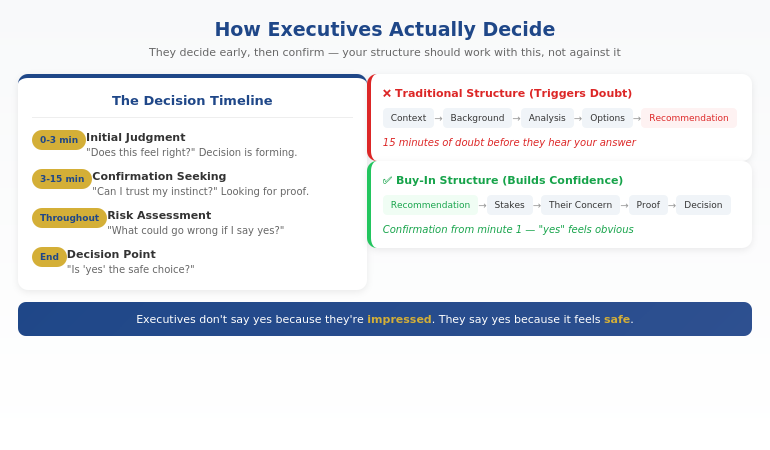
The presenter builds carefully to their recommendation. Context first. Background. Analysis. Options considered. And finally — after 15 or 20 slides — the recommendation.
It feels logical. It feels thorough. It feels like you’re building a case.
But to the executive, it feels like something else entirely: uncertainty.
The unspoken question forming in their mind: “If this recommendation were solid, why would they need all this explanation?”
For more on why traditional structure fails with executives, see our guide to the Pyramid Principle.
How Executives Actually Decide
Research and experience confirm the same thing: senior people decide early.
Within the first 2-3 minutes of your presentation, they’ve formed an initial judgment. The rest of the time, they’re looking for reasons to trust that instinct — or doubt it.
This changes everything about how you should structure your message.
If you lead with context and build to your recommendation, you’re giving them 15 minutes of reasons to doubt before they even hear what you’re proposing.
If you lead with your recommendation and immediately address their likely concern, you’re giving them reasons to trust from the start.
The executive’s internal process:
- Initial judgment (first 2-3 minutes): “Does this feel right?”
- Confirmation seeking (next 10-15 minutes): “Can I trust this instinct?”
- Risk assessment (throughout): “What could go wrong if I say yes?”
- Decision: “Is ‘yes’ the safe choice?”
Your job isn’t to impress them. It’s to make “yes” feel like the obvious, low-risk choice.
How do you get executive buy-in for a project?
Executive buy-in requires structuring your presentation around how senior people actually decide — not how you naturally want to explain. Lead with your recommendation (not context), address their likely concern before they raise it, provide 1-2 proof points that reduce perceived risk, and make the decision you need crystal clear. Executives say yes when “yes” feels safe, not when they’re impressed by your analysis.
⭐ Build the case your stakeholders can’t dismiss
The Executive Buy-In Presentation System is a self-paced framework — 7 modules walking you through the structure, psychology, and delivery that get senior approval. Monthly cohort enrolment, optional recorded Q&A calls. £499, lifetime access to materials.
What’s covered:
- The slide structure that aligns with how executives actually decide
- Stakeholder analysis and concern-mapping before the meeting
- How to choose proof that reassures rather than defends
- Frameworks for handling pushback without getting defensive
Explore the Buy-In System on Maven →
Self-paced with monthly cohort enrolment.
The 4 Things That Trigger Doubt
Through hundreds of presentations — both giving and receiving — I’ve identified four patterns that accidentally signal uncertainty to executives:
1. Too Much Context
When you spend the first 5-10 minutes on background, you’re signalling that the recommendation needs extensive justification. Executives read this as: “They’re not confident enough to lead with the answer.”
2. Too Much Proof
Counter-intuitive, but piling on data often increases doubt instead of reducing it. It feels defensive. The executive wonders: “If this were obviously right, why would they need 15 supporting charts?”
3. Building to the Recommendation
The classic “options analysis” approach — where you present Option A, Option B, Option C, then reveal your recommendation — gives executives 20 minutes of uncertainty before they know what you actually think. By then, doubt has taken root.
4. Over-Explaining Your Credibility
Spending time establishing why you’re qualified to make this recommendation actually undermines your credibility. Senior professionals let their work speak for itself. Over-explaining signals insecurity.
For more on the structural mistakes that kill executive presentations, see our guide to executive presentation structure.
Why do executives say no to good ideas?
Executives rarely reject ideas because the ideas are bad. They reject them because the presentation triggered doubt — too much context, too much defensive proof, building to the recommendation instead of leading with it. When executives feel uncertain, the safe choice is “not yet” or “let’s discuss further.” Good ideas get approved when they’re presented in a way that makes “yes” feel low-risk.
Work at your own pace. Keep the materials forever. Executive Buy-In Presentation System — 7 modules, £499, self-paced with monthly cohort enrolment.
The Buy-In Structure That Works
Once you understand how executives decide, the structure becomes clear:
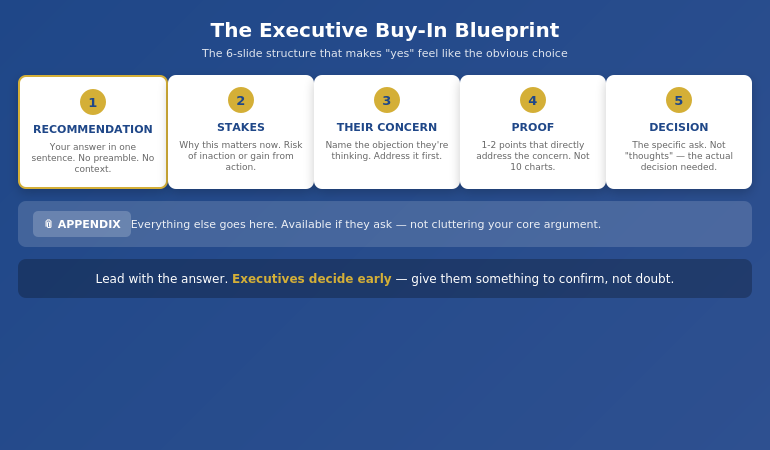
The Executive Buy-In Blueprint:
- Recommendation first (Slide 1). State what you’re proposing in one clear sentence. No preamble. No context. The answer.
- Stakes (Slide 2). Why this matters now. What’s at risk if we don’t act, or what we gain if we do.
- Their likely concern (Slide 3). Name the objection they’re probably already thinking. Address it before they raise it.
- 1-2 proof points (Slides 4-5). Not 10 charts. One or two pieces of evidence that directly address the concern you just named.
- The decision needed (Slide 6). Be specific. Not “your thoughts” — the actual decision. “I’m asking for approval to proceed with a £200K pilot in Q2.”
- Appendix. Everything else goes here. Available if they ask, not cluttering your core argument.
This structure works because it aligns with how executives actually process information. They know your answer immediately, which lets them spend the rest of the time confirming it’s sound — rather than wondering what you’re going to say.
For more on presenting to senior leadership, see our guide on how to present to a board of directors.
How do you present to senior leadership effectively?
Present to senior leadership by leading with your recommendation, not building to it. State your answer on slide 1, address their likely concern on slide 3, provide minimal proof that reduces perceived risk, and make your decision request specific and clear. Senior leaders decide early and spend the rest of the time confirming. Structure your presentation to support that confirmation, not create doubt.
⭐ Stop rewriting your proposal three times only to hear “we’ll think about it”
The Executive Buy-In Presentation System teaches the structure that gets decisions, not delays — 7 self-paced modules with optional recorded Q&A calls. £499, lifetime access.
Explore the Buy-In System on Maven →
Self-paced with monthly cohort enrolment.
Handling Pushback Without Getting Defensive
Even with perfect structure, you’ll face tough questions. Sceptical executives. Unexpected challenges.
How you respond determines whether you win the room or lose it.
Most professionals get defensive under pressure — justifying, over-explaining, or backing down too quickly. All of these destroy credibility.
The Pressure Response Framework:
When you face pushback, there are four types of pressure behind it:
- Clarity pressure: “I don’t understand” → They need you to simplify, not elaborate
- Risk pressure: “What if this fails?” → They need reassurance, not more data
- Control pressure: “Why wasn’t I consulted?” → They need to feel included, not convinced
- Status pressure: Challenging to look tough → They need acknowledgment, not argument
Recognising which type of pressure you’re facing changes how you respond. Most defensive reactions come from treating all pushback the same way.
And sometimes the right answer is: “I don’t know — I’ll find out and come back to you.” Said with calm confidence, this builds credibility. Said defensively, it destroys it.
Is This System Right For You?
The Executive Buy-In Presentation System is designed for professionals who present when decisions matter:
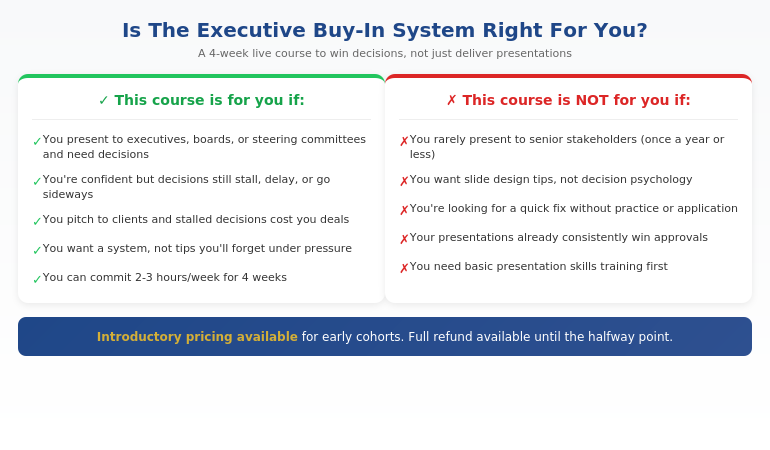
If you recognised yourself in the left column, this system will change how your presentations land — and how often you hear “approved” instead of “let’s discuss further.”
⭐ Built on 25 years in corporate banking
The Executive Buy-In Presentation System is the structured framework developed across 25 years in corporate banking and 16 years coaching senior professionals across financial services, insurance, consulting, and technology. £499, lifetime access to materials.
What you get:
- 7 self-paced modules covering psychology, structure, and delivery
- Frameworks for stakeholder analysis and concern-mapping
- Approaches for handling pushback with calm authority
- Bonus Q&A calls (optional, fully recorded — watch back anytime)
- Lifetime access to all materials
Explore the Buy-In System on Maven →
Self-paced with monthly cohort enrolment — new cohort opens every month.
Frequently Asked Questions
How is this different from presentation skills training?
This course doesn’t teach you how to present — it teaches you how to win decisions. Presentation skills courses focus on delivery, design, and communication. This course focuses on how executives actually decide, and how to structure your message so “yes” feels like the obvious choice. Presentation skills are the vehicle; winning decisions is the destination.
What if I’m already confident but decisions still stall?
This is exactly who the course is for. Confidence isn’t usually the problem — structure is. Many capable, confident presenters unknowingly trigger doubt through too much context, too much proof, or leading with the wrong information. If you’re confident but decisions still stall, get delayed, or don’t go your way, the issue is almost certainly structural, not personal.
How much time does the course require?
The Executive Buy-In Presentation System is self-paced — you set the pace. The video content totals around 4-5 hours, designed to be watched in focused 30-minute sessions between meetings. Most professionals complete the modules alongside their normal work. The frameworks are designed to save preparation time on every presentation thereafter.
Does this work across different industries?
Yes. The system applies across industries because it’s based on how senior people make decisions — not on specific content. Whether you’re in banking, consulting, tech, healthcare, or government, the psychology of executive decision-making is the same. If you present to people more senior than you, this system is relevant.
Get Weekly Executive Communication Insights
Frameworks and techniques for winning decisions — from 25 years in corporate banking.
Your Next Step
The next time you present for a decision, try one thing differently: put your recommendation on slide 1.
Not after context. Not after options. Slide 1.
Then watch how the energy in the room changes. Executives lean in differently when they know what you’re proposing from the start.
That one shift won’t fix everything. But it will show you how much of the problem was structural all along.
P.S. If you’re making a presentation this week, check out the presentation habit that’s quietly killing careers — it’s related to the structural mistake we covered here.
P.P.S. If anxiety is part of your presentation challenge, I wrote about how to speak confidently in meetings — including the nervous system reset that helps even when stakes are high.
About Mary Beth Hazeldine
Owner & Managing Director of Winning Presentations. 25 years in corporate banking at JPMorgan Chase, PwC, RBS, and Commerzbank. Qualified clinical hypnotherapist. I’ve sat on both sides of the table — the nervous presenter and the senior decision-maker — and I teach what actually works to win the room.