

Do You Have a Contingency Blind Spot?
You might need this system if any of these sound familiar:
- You’ve been caught off-guard by “What if your key assumption doesn’t hold?” and had no credible answer
- You’re confident in your recommendation but haven’t fully mapped what breaks if you’re wrong
- Senior audiences ask why you haven’t considered Plan B, and you sense they’re not convinced by “We’ll adapt”
- You’ve presented to boards or senior committees and felt the Q&A was testing something deeper than your numbers
- You’re strong on execution but weaker on contingency frameworks—and you know it matters at senior level
If yes to 2+ of these: You’re not missing execution rigour. You’re missing the contingency thinking that executives expect to see in strategic decisions.
On This Page
- The Board Member’s Question Revealed Everything
- Money Block #1: Know the Contingency Questions Before They’re Asked
- The Five Core Contingency Question Types
- Assumption Failure: “What if you’re wrong?”
- Timing Deviation: “What if it takes longer?”
- Competitive Response: “What if they copy this?”
- Resource Constraint: “What if budget gets cut?”
- Demand Collapse: “What if adoption is slower?”
- Mini CTA #1
- Money Block #2: Stop Getting Caught Without a Plan B
- Mini CTA #2
- Is This Right For You?
- People Also Ask
- Frequently Asked Questions
The Board Member’s Question Revealed Everything
Fadilah had spent two weeks perfecting her recommendation. Market analysis, competitive positioning, three-year financial model, implementation roadmap. It was thorough. It was clear. By the time she reached slide 6, everyone in the room understood the strategic rationale.
Then the longest-serving board member—the one who never asked questions—raised his hand.
“This works if everything unfolds as you’ve written it. But what happens at the first deviation? What’s your Plan B?”
Fadilah paused. She had execution contingencies. But she didn’t have strategic contingencies—she hadn’t mapped what would change her recommendation if key assumptions shifted. So she did what most presenters do: she hedged. “We’d adapt as we go. We’re flexible.”
She saw it in his face. That wasn’t the answer. He wasn’t testing her optimism. He was testing her thinking. And she’d just told him she hadn’t fully thought through what would actually break her recommendation—or what she’d do about it.
That’s when she understood: contingency thinking isn’t a side conversation. It’s the central conversation in senior Q&A.
Know the Contingency Questions Before They’re Asked
The Executive Q&A Handling System (£39, instant download) walks you through how senior executives ask contingency questions, what they’re really testing for, and exactly how to build fallback positions that demonstrate strategic depth rather than optimism.
You’ll learn to predict 80% of the questions before they land—because they follow patterns. And you’ll know how to answer them credibly, without hedging or waffling.
If contingency questions keep catching you flat-footed, the problem isn’t your content — it’s that you haven’t mapped the question patterns.
The Executive Q&A Handling System walks through the five contingency question types senior decision-makers use, how to predict them before the meeting, and how to answer without hedging.
The Five Core Contingency Question Types
Contingency questions in senior Q&A aren’t random challenges. They follow a taxonomy. Once you recognise the pattern, you can prepare systematically instead of hoping you won’t be caught off-guard.
These five types account for roughly 75% of the contingency questioning you’ll encounter in boardrooms and senior Q&A.
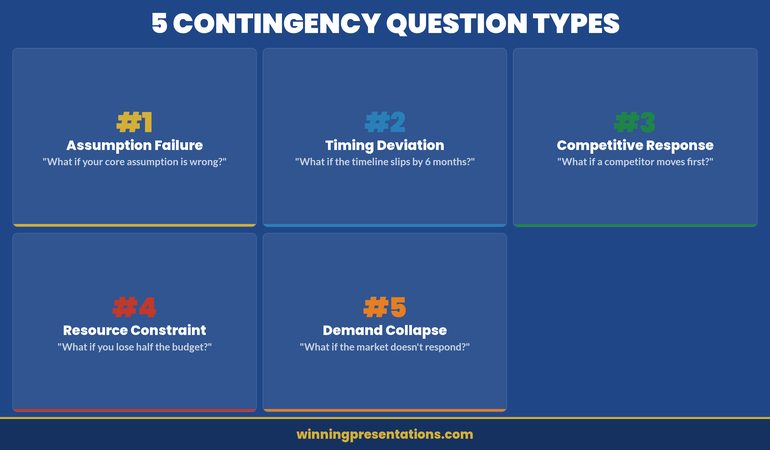
Assumption Failure: “What if you’re wrong?”
This is the most direct contingency question. An executive picks apart one of your core assumptions and asks what happens if it doesn’t hold.
Example: “You’re assuming 60% of the existing customer base will migrate to the new platform. What if that migration rate is only 35%?”
This question is testing whether your entire recommendation collapses if that assumption breaks. The executive isn’t being hostile—they’re doing risk assessment. They want to know if you’ve thought past your base case.
How to answer: Don’t defend the assumption. Instead, show what you’ve modelled if it shifts. “If migration is 35%, we’d expect revenue to lag by 18 months, but we’d still hit break-even in Y3 because the lower initial spend means we’ve held cost discipline.” You’re not predicting the assumption is wrong. You’re demonstrating you’ve mapped the failure path.
Timing Deviation: “What if it takes longer?”
Executives have seen countless projects slip. They want to know whether your contingency planning accounts for the real world—not the project plan.
Example: “You’ve outlined a 12-month rollout. What’s our position if regulatory approval takes an extra quarter?”
The question is straightforward: Can your recommendation survive when timelines stretch? This is particularly acute in regulated industries, where “six weeks” often means “six months”.
How to answer: Show the cost of delay without pretending delay won’t happen. “A quarter-long approval lag reduces Year 1 revenue by approximately 18%, but it doesn’t change the unit economics—it just pushes our break-even to Q2 of Year 2 instead of Q4 of Year 1. We’ve already budgeted for three months of contingency cost.” You’re not predicting everything will go to plan. You’re showing you’ve funded the waiting period.
Competitive Response: “What if they copy this?”
In strategic Q&A, executives ask what happens when competitors respond to your move. This is particularly acute for innovation presentations.
Example: “If we launch this service and it’s successful, what prevents a competitor from replicating it within six months?”
They’re not asking you to guarantee competitive advantage. They’re asking whether your contingency plan accounts for a world where your first-mover advantage erodes faster than you’ve modelled.
How to answer: Show what you’d do if competitive positioning changed. “If competitive response accelerates our timeline to differentiation, we’d shift budget into the proprietary data layer—that’s where the moat is. We can do that within existing spend because we’ve ring-fenced 15% of Year 1 budget as a competitive response reserve.” You’re not claiming you’ll stay unique forever. You’re showing you’ve planned for the commoditisation curve.
Resource Constraint: “What if budget gets cut?”
This is the perennial boardroom question. CFOs and boards always ask: What happens if funding doesn’t materialise as planned?
Example: “This plan depends on the full £2M investment. What if the board only approves £1.5M?”
This isn’t pessimism. This is governance. They want to know whether your recommendation is fragile or robust.
How to answer: Show the phased fallback without reframing the recommendation. “At £1.5M, we’d defer the international expansion to Year 2, but the core UK implementation stays intact. That means we hit our break-even target 12 months later, but the risk profile is actually lower because we’re validating the model before expanding scope. We’d just need to ring-fence the £1.5M for the full year rather than phase it.” You’re not saying the recommendation doesn’t need funding. You’re showing where you can compress without abandoning strategy.
Demand Collapse: “What if adoption is slower than forecast?”
This is the inverse of your growth assumption. Executives ask this because they’ve seen products with brilliant features and zero demand.
Example: “You’re forecasting 2,000 sign-ups in Year 1. What if the market gives you 400?”
They’re testing whether your recommendation survives if you’re optimistic about market pull.
How to answer: Show the contingency without claiming it won’t happen. “At 400 sign-ups, we’d be cash-flow negative through Year 1, but our contingency is the partnership route—we have pre-qualified channels that could accelerate adoption. We’d activate those in Q3 if organic adoption lags. That doesn’t guarantee we hit 2,000, but it gives us a credible path to breakeven without additional capital.” You’re not defending your forecast. You’re showing you have levers to pull if the market doesn’t cooperate.
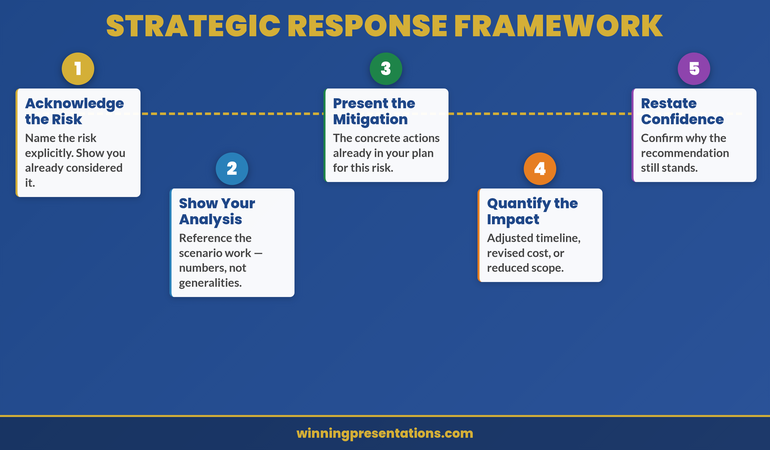
Learning to recognise these five question types gives you a system. You’ll stop feeling blindsided.
Stop Getting Caught Without a Plan B
Every time you walk into a boardroom without a credible fallback position, you’re betting that no one will ask about risk. The Executive Q&A Handling System (£39, instant download) teaches you how to build contingency positions that earn credibility—not defensiveness.
Is This Right For You?
This system is built for senior presenters who:
- Present to boards, executive committees, or C-suite audiences regularly
- Know that Q&A is where credibility is built or lost—and want to control the narrative
- Have been caught by contingency questions and want a framework to prepare systematically
- Understand that “I’ll figure it out” doesn’t work in executive rooms
- Want to walk into Q&A knowing what’s coming and how to respond
Not for you if: You’re presenting to audiences without governance mindsets, or you’re still building foundational presentation skills rather than mastering strategic Q&A.
People Also Ask
How do you answer ‘What’s your Plan B?’ in a presentation?
Your Plan B should never feel like you don’t believe in Plan A. Instead, show the contingency levers you’d pull if key assumptions shift. Focus on what you’d do first to adapt (cost reduction, timeline adjustment, scope compression), not on worst-case fantasy scenarios. The answer demonstrates strategic flexibility, not pessimism.
What are contingency questions in executive Q&A?
Contingency questions are the ones executives ask to test whether your recommendation survives when reality deviates from your plan. They fall into five types: Assumption Failure, Timing Deviation, Competitive Response, Resource Constraint, and Demand Collapse. They’re not objections—they’re risk assessments. Learning to recognise them lets you prepare credible fallback positions instead of being caught off-guard.
Why do boards ask about Plan B?
Boards ask about Plan B because they’re evaluating risk management, not just execution confidence. They want to know whether you’ve thought systemically about what breaks your recommendation and whether you have credible levers to pull. It’s a governance question disguised as a contingency question. The answer tells them whether you’re prepared for the real world or just the project plan.
Frequently Asked Questions
Should I include contingency plans in my presentation slides, or wait for Q&A?
Build your primary recommendation on the slides, but have your contingency thinking fully mapped and ready to articulate in Q&A. You don’t need a “Plan B slide”—that muddies your core message. But you absolutely need credible fallbacks to show when someone asks. This separates presenters who have contingency thinking from those who only have presentations.
How do you prepare for contingency questions you haven’t thought of?
You can’t prepare for questions you haven’t imagined, but you can prepare for the pattern. Once you recognise that most contingency questions fit into one of five types, you can stress-test your recommendation against each one systematically. That covers 75% of what you’ll hear. For the remaining 25%, your answer is structural: acknowledge the question, show the thinking process, and outline how you’d approach that new contingency. That builds credibility even when you’re improvising.
What’s the difference between contingency planning and lack of conviction?
Lack of conviction sounds like “We’re not sure this will work, so we have a backup.” Contingency planning sounds like “This recommendation works on our base case. Here’s what we’d do if Assumption X shifts, because we’ve thought it through.” The first sounds defensive. The second sounds strategic. The difference is in the framing: you’re not hedging your recommendation, you’re demonstrating that you’ve thought past it.
Get the Winning Edge
New frameworks, Q&A patterns, and execution strategies delivered every week.
Related Articles
From This Series
- Technology Evaluation Presentations: The Framework IT Leaders and Finance Directors Use — Article 1 of this release
- The Comparison Trap: Why Watching Great Speakers Creates Anxiety (And What to Do Instead) — Article 2 of this release
About the Author
Mary Beth Hazeldine has spent 25 years coaching executives, watching boardrooms think, and teaching presenters how to handle Q&A with confidence. She’s worked with companies ranging from FTSE firms to scale-ups, helping leaders move from good presentations to boardroom credibility. Her frameworks focus on what actually happens in senior Q&A—not what presentation theory says should happen.