

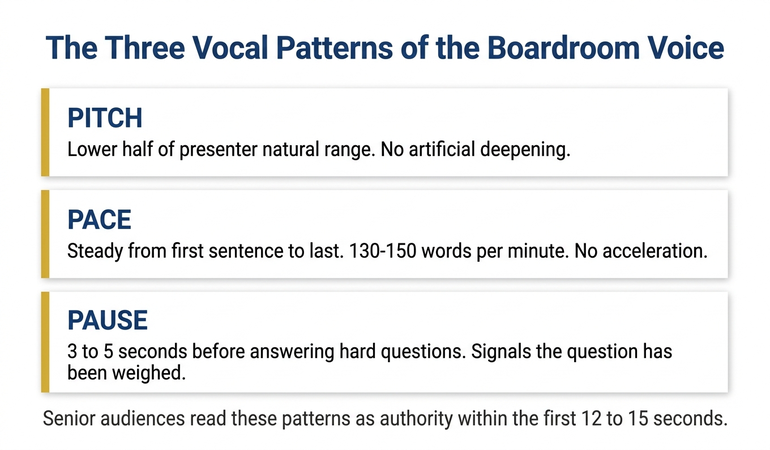
Quick answer: The boardroom voice — the pitch, pace, and pause patterns senior leaders recognise as authority — is structural, not theatrical. Pitch sits in the lower half of the speaker’s natural range. Pace stays steady from the first sentence to the last, with no acceleration when challenged. Pause sits between three and five seconds before answering hard questions. These three patterns combined are what senior committees read as composure, ownership, and substance. Presenters who land the patterns get treated as senior. Presenters who do not get politely deferred, regardless of how strong the underlying analysis is.
JUMP TO:
Henrik had been the technical lead on a major reinsurance modelling project for fourteen months. The work was rigorous, the methodology sound, the conclusions robust. When the time came to present to the executive committee, his director picked him to deliver the case rather than going himself. Henrik had not presented at this level before. He prepared meticulously — three dry runs, a full Q&A list, the deck cut from twenty-two slides to nine. By the morning of the meeting he knew the material cold.
The presentation went almost as planned. The deck landed. Then the chair asked the first question — a sharp one, about a sensitivity assumption. Henrik answered immediately. His voice rose half an octave. He spoke a third faster than he had through the deck itself. The next question came from the CRO. Same pattern — immediate answer, raised pitch, accelerated pace. By question four the chair had stopped looking at Henrik and was directing his questions to the director. The director took over. Henrik watched the rest of the meeting from the cheap seats. The recommendation was approved. He had not been the one carrying it across the line.
The director debriefed Henrik afterwards. The data was right. The analysis was right. The deck was right. What had cost him the room was the voice. The first question had pitched up his voice and accelerated his pace, and from that moment the chair had read him as anxious rather than authoritative. The deck did not save him. The data did not save him. The voice patterns had decided in eight seconds what fourteen months of work could not undo. Six months later, after deliberate work on his vocal mechanics, Henrik presented again. Same kind of room, similar pressure questions. He stayed in the lower half of his range, kept his pace steady, paused before each answer. The chair asked him directly to lead the next phase.
If you want a structured reference for the vocal mechanics senior committees read as authority:
Public Speaking Cheat Sheets cover vocal pacing, pitch, pause, eye contact, and room control on single-page references — designed to review in five minutes before any senior meeting.
Why voice decides what senior committees back
The voice is the channel that carries everything else. The data lives on the slides, but the data is mediated by the voice. The recommendation is in the deck, but the recommendation is heard through the voice. A senior committee makes its initial calibration of the presenter within the first twelve to fifteen seconds of speech. That calibration is largely vocal — pitch, pace, and the rhythm of pause. Visual cues matter, but they are confirmatory rather than primary. The voice is what the committee hears before it has finished reading slide one.
The second reason voice decides is that voice destabilises faster than language under pressure. A presenter can hold their language together — keep saying the right words — while their voice has already given the room a different signal. Pitch rises before the words change. Pace accelerates before vocabulary degrades. The senior audience reads the voice change instantly even though the words remain technically accurate. The presenter does not know it has happened. The committee does. From that moment the rest of the presentation is being heard through a layer of doubt the presenter cannot see.
The third reason is that voice patterns are durable. Once a senior committee has read a presenter as composed, that read sticks for several presentations. Once they have read the presenter as anxious, that read also sticks — and it takes more than one strong delivery to overturn it. This is why early presentations to a senior committee carry weight beyond their content. The presenter is being calibrated. The voice is what they are being calibrated on. For the closely related discipline of how silence functions in this calibration, see the boardroom pause and why four seconds of silence beats any slide.
The pitch pattern — lower-half-of-range steadiness
Pitch is the most under-trained of the three vocal mechanics. Most senior presenters speak at the upper end of their natural range without realising it. The cause is anxiety physiology — under stress, the laryngeal muscles tighten, the vocal folds shorten, and pitch rises. The presenter does not feel it because they are inside their own voice. The audience hears it as elevated, slightly strained, and — at the senior level — slightly junior. A pitch that sits two or three notes higher than the presenter’s relaxed conversational range is read as nervousness even when the words are confident.
The boardroom voice sits in the lower half of the presenter’s natural range. Not artificially deep. Not a forced “broadcaster” tone. Just the lower half of where the presenter’s voice naturally sits when they are at ease — typically two or three notes below where the presenter speaks in formal settings. The exercise to find the lower half is straightforward. Speak a sentence as you would in a relaxed conversation with a peer. Then speak the same sentence as if you are presenting. Most presenters will hear the second version sit one to three notes higher. The training task is to bring the presentation pitch down to within one note of the conversational pitch.
Pitch steadiness is the second part of the pattern. The boardroom voice does not vary pitch much through the presentation. Some variation is fine — a question or a list item can lift the pitch slightly — but the variation lives within a narrow band. The voice that drops a full octave for emphasis or rises for excitement reads as theatrical to senior committees. They are not at a TED Talk. They are at a board meeting. The vocal mode that fits is closer to a documentary narrator than a stage performer. Steady, low, in range, with subtle variation. The presenter is not asked to be flat or robotic. They are asked to stay within a narrower expressive band than is appropriate in many other settings.
Training pitch is mechanical and responds to recording. Record the first three minutes of any high-stakes presentation. Listen back specifically for pitch — does the voice sit in the lower half, or has it crept up? Pitch creep is correctable in three to four weeks of attention. Most presenters discover that what they thought was their natural presentation pitch is actually their stress pitch. The natural pitch is lower and steadier than they remembered. For a related discipline of vocal recovery when pitch destabilises mid-presentation, see voice tremor during presentations and the three-second reset.
Train the vocal patterns senior committees read as authority.
Public Speaking Cheat Sheets are one-page references covering body language, vocal pacing, eye contact, and room control — the delivery mechanics you can review in 5 minutes before any meeting. £14.99, instant access, no subscription.
- One-page references for vocal pacing, pitch, pause, eye contact, and room control
- Designed to review in 5 minutes before any senior meeting
- Covers the vocal mechanics senior audiences read as authority — not generic public-speaking drills
- Instant access on purchase, no subscription, no recurring billing
The pace pattern — steady not slow, never accelerating
Pace is the second of the three vocal mechanics and the most commonly mistaught. The default coaching advice is “speak slowly”. That advice produces a stilted, deliberate cadence that senior committees read as either condescending or performative. The boardroom voice is not slow. It is steady. The natural conversational pace of a senior professional sits between roughly 130 and 150 words per minute. That is the right pace for a senior committee delivery. The discipline is to hold that pace from sentence one to the close — not to slow down, but to stop speeding up.
Acceleration is what damages pace. Most presenters start at a sensible tempo and gradually speed up across the presentation. The cause is usually time pressure — the presenter feels the slot tightening and compresses the remaining material by speaking faster. The senior audience reads the acceleration as loss of control. The presenter has signalled that they are no longer driving the meeting. They are being driven by it. The committee starts to look at the chair to see whether the chair will pull the presentation back to time. The remaining content lands less cleanly because the room is no longer fully attending to it.
The fix for acceleration is structural rather than vocal. The deck must be cut to a length the presenter can deliver at steady pace within the time available, with a five-minute buffer for questions and for the inevitable interruption that pushes the schedule. A presenter who walks into a thirty-minute slot with a deck that requires twenty-eight minutes to deliver at steady pace is signing up to accelerate. A presenter who walks in with a deck that requires eighteen minutes to deliver at steady pace has the room to hold pace through the full delivery and through the early questions. The pace problem is most often a deck-length problem in disguise.
The pause pattern — three to five seconds before hard answers
Pause is the third vocal mechanic and the one that most distinguishes senior presenters from middle-grade ones. The pause that matters is not the pause within the prepared delivery — that pause is structural and easy to plan. The pause that matters is the pause after a hard question. Senior committees ask hard questions. The instinct of most presenters is to answer immediately. The instinct of senior presenters is to pause for three to five seconds before answering. The pause does several things at once.
It signals that the question has been heard rather than blurted past. It creates the room for the presenter to actually choose an answer rather than reaching for whatever comes first. It demonstrates that the presenter is not afraid of silence — and senior committees treat comfort with silence as one of the cleanest cues of seniority. It also slightly slows the room. After a hard question the room is mildly elevated. The three-to-five-second pause settles it back down. By the time the answer comes, the room is in a calmer state to receive it.
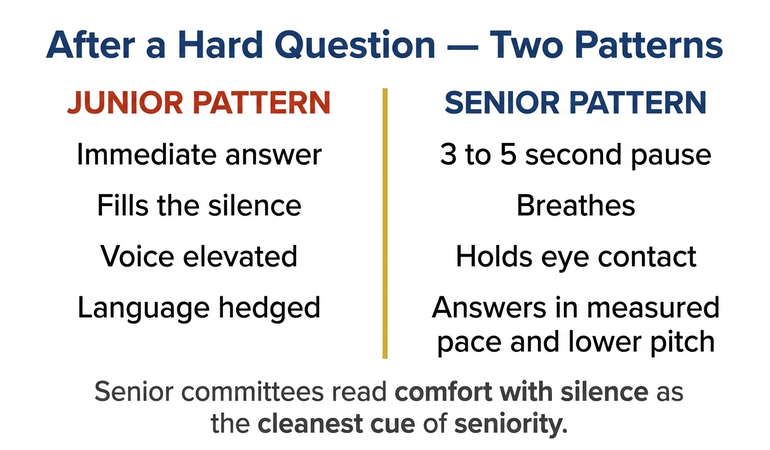
The exercise that builds pause discipline is uncomfortable in practice and high-leverage in effect. In any meeting where a question is asked, count silently to three before answering. Three seconds is longer than it sounds. The first few times the presenter does this, they will feel exposed — as if the silence is screaming. The room will not feel that. The room will feel that the presenter is weighing the question. After two or three weeks of deliberate practice, the three-second count becomes automatic. After two months, it becomes invisible to the presenter and reads as composure to the room. The pause is the single highest-return vocal habit a senior presenter can build.
One important caveat — the pause is not a refuge for unprepared presenters. A three-second pause followed by a confused answer is worse than a hesitant immediate answer. The pause is structural support for an answer the presenter actually has. The preparation that produces strong answers is upstream of the pause. The pause is what holds the presenter steady while they retrieve the answer they have already prepared. For the related discipline of how vocabulary tightens during the pause, see executive vocabulary signals — words that say promotable versus replaceable.
Want the vocal mechanics in a one-page reference you can review before every meeting?
Public Speaking Cheat Sheets cover vocal pacing, pitch, pause, eye contact, and room control on single-page references — designed for the five minutes before you walk into a senior meeting. £14.99, instant access.
How senior presenters train the boardroom voice
The training method that builds the boardroom voice is recording, listening, and one-pattern-at-a-time deliberate practice. Recording captures what the presenter cannot hear in real time. Listening surfaces the gap between how the voice sounds inside the head and how it sounds in the room. One-pattern-at-a-time discipline prevents the common failure mode of trying to fix everything at once and changing nothing. Pitch is usually the right first focus because it is the most measurable. Pace is second. Pause is third because it requires a partner to ask questions.
The training cycle is short — a week per pattern. In the pitch week, the presenter records the first three minutes of every meeting, listens back the same day, and notes whether the pitch sat in the lower half. In the pace week, they record the same and check for tempo drift. In the pause week, they ask a colleague to fire two or three questions at the end of an internal meeting and record the answers. After three weeks, all three patterns will have moved measurably. The patterns become more entrenched with continued practice but the bulk of the change happens in the first four to six weeks.
The companion piece to this article — focused on the broader structural signals senior audiences read as presence beyond just the voice — is executive presence training that works and why posture courses miss the real signals. Together the two articles cover the structural and vocal layers of senior delivery.
Frequently asked questions
Is there a measurable difference between a “boardroom voice” and a normal speaking voice?
The boardroom voice is the speaker’s normal conversational voice plus three structural disciplines — pitch in the lower half of natural range, steady pace at 130 to 150 words per minute, and a three-to-five-second pause before answering hard questions. There is no separate “boardroom register”. A presenter trying to manufacture a register that is not theirs sounds artificial. The work is not to acquire a new voice. The work is to keep the speaker’s natural voice from destabilising under presentation pressure. The patterns are about steadiness, not about transformation.
Does this apply to women presenters in male-dominated boardrooms?
The three patterns apply equally — pitch in the lower half of the speaker’s own natural range, steady pace, three-to-five-second pause. What differs is the pre-existing stereotype the senior audience may bring into the room. Women presenters whose pitch creeps up under stress can be misread more harshly than men with the same pattern. The fix is not to artificially deepen the voice. The fix is to land the lower-half-of-range steadily, with the pace and pause patterns also in place. Once those three patterns are stable, the audience reads the presenter as senior regardless of the room’s defaults. The patterns themselves are the leveller.
Does virtual delivery change any of the patterns?
Pace and pause read more sharply on video than in person. The audience has fewer visual cues to fall back on, so the vocal cues carry more weight. Pitch reads about the same. Pause is more important on video, not less, because in-person settings have other social cues that fill the space (eye contact shift, slight body movement) that video does not. A presenter who pauses for three seconds on video gives the room more presence than the same pause in person. Pace acceleration is the most damaging pattern on video — it accelerates the audience’s perception of the presenter’s anxiety more steeply on video than in person.
How long does it actually take to train the boardroom voice patterns?
The bulk of the change happens in the first six to eight weeks of deliberate practice — one pattern at a time, weekly recording and review. After eight weeks the patterns are largely automatic in calm meetings. They take longer to hold under stress — typically three to six months of repeated exposure to high-pressure rooms. The patterns continue to deepen for years; senior presenters who have worked on this for a decade are recognisably more composed than those who have worked on it for a year. But the visible change in how senior committees treat the presenter happens within the first eight to twelve weeks. That is when the room starts to address questions to the presenter directly rather than through their sponsor.
The Winning Edge — weekly newsletter
The Winning Edge is a weekly newsletter for senior professionals who present at the executive level. One short email a week, focused on the vocal and structural moves that senior committees treat as authority. Subscribe to The Winning Edge →
Not ready for the Public Speaking Cheat Sheets? Start here instead: download the free Executive Presentation Checklist — a one-page reference for the structural moves senior leaders run before every committee deck.
About the author
Mary Beth Hazeldine is Owner & Managing Director of Winning Presentations Ltd. With 24 years of corporate banking experience at JPMorgan Chase, PwC, Royal Bank of Scotland, and Commerzbank, she advises executives across financial services, healthcare, technology, and government on structuring presentations for high-stakes funding rounds, board approvals, and strategic decisions.