
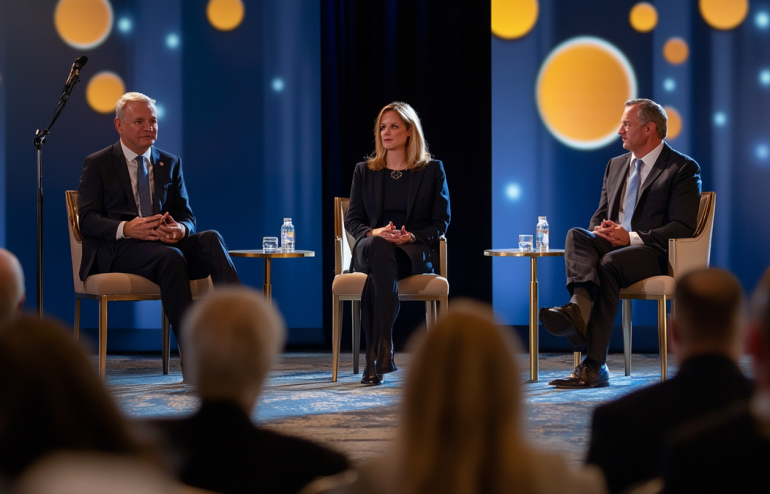
Panel Q&A is a different animal. When you’re one of several presenters, the rules shift. You can’t control where questions go, you can’t always answer first, and you’re exposed to contradictions you didn’t create. Mishandle it, and you look unprepared or evasive—even if your individual answers were solid.
Jump to Section
- The Deferred Answer That Cost Credibility
- Why Panel Q&A Rules Are Different
- When Questions Are Aimed at You (vs. The Group)
- When to Defer, When to Answer, When to Pass
- How to Avoid Contradicting Co-Presenters
- The Pre-Panel Alignment Conversation
- Frequently Asked Questions
The Deferred Answer That Cost Credibility
James was on a fintech panel about regulatory compliance. A moderator asked him directly about cross-border KYC requirements—his area. He glanced at the panellist next to him, hesitated, then said: “I think Marcus might have more recent data on that one.” He didn’t. Marcus gave a half-answer. The moderator asked James again. He deferred again. By the third redirect, the audience saw uncertainty where there had been none before. His credibility didn’t recover. The problem wasn’t his knowledge. It was that he’d abdicated authority over his own expertise to avoid appearing “that guy” who talked too much. Weeks later, the investment firm hosting the panel went with a competitor James had worked with before—because they doubted his confidence.
Panel Q&A isn’t about being polite. It’s about owning your remit without trampling on co-presenters’ authority.
Panel session coming up?
The Executive Q&A Handling System includes frameworks for handling questions in high-pressure shared-stage scenarios.
When Questions Come in Real Time on Stage
The Executive Q&A Handling System contains response architectures that work whether you’re the only voice in the room or one of five. Question prediction frameworks, structured answer templates, and recovery tactics for difficult terrain—all designed for high-pressure settings where you can’t script the answer.
- ✓ Frameworks that work across solo and panel formats
- ✓ Scripts for handling ambiguity and multi-presenter dynamics
- ✓ Recovery tactics when co-presenters contradict you
Designed for board-level and investor relations scenarios
Why Panel Q&A Rules Are Different
In a solo presentation, Q&A is yours. You set the tone, manage the flow, and answer on your terms. You’re the authority. You control the narrative.
In a panel, none of that is true.
Someone else—the moderator—owns the room. Questions can be directed at you, at someone else, or at the group as a whole. You may not speak first. You may not speak at all if you don’t assert yourself. And if a co-panellist says something you disagree with, you have seconds to decide whether to correct them, validate them, or stay silent.
The stakes are higher because the dynamics are more visible. An audience watching a solo presenter evaluate one Q&A doesn’t see a lot. An audience watching three presenters respond to the same question sees everything: hesitation, contradiction, deference, authority. They’re watching you watch your co-panellists. They’re evaluating not just what you say, but when you say it and why.
This is why panel preparation differs from solo Q&A prep. You’re not just preparing answers. You’re preparing behaviour: when to hold back, when to step in, how to validate others without diminishing yourself, and how to signal alignment without sounding scripted.
When Questions Are Aimed at You (vs. The Group)
The moderator will sometimes pose a question directly to you by name. “Sarah, in your experience managing merger integration, how do you handle resistance from legacy systems teams?” That’s yours. Own it.
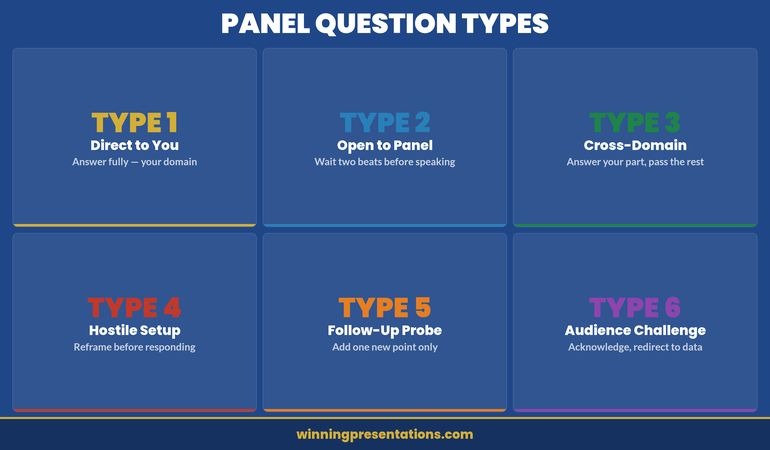
The moderator will also ask the group: “How should organisations approach this?” Now you have a choice.
If the question is direct and named: Answer it. Clearly. Don’t defer to a co-panellist unless you genuinely don’t have relevant experience. If you do, and you defer, you signal doubt. James’s problem wasn’t that he didn’t know—he had the answer. He chose not to own it.
If the question is open to the group: You can answer if you have something distinct to add. You can build on what someone else said. You can stay quiet if the previous answers were comprehensive. There’s no obligation to speak. But if you do speak, you’re competing for the moderator’s attention and the audience’s goodwill. Make it count.
If a question lands on someone else and they stumble: You can bridge in. “That’s a good point about X. I’d add that in my sector, we’ve seen…” This isn’t rescuing them. It’s contributing your angle. It makes you look collaborative and substantive.
If a question lands on someone else and they nail it: Silence is often your best move. If you repeat their answer with minor variations, you look like you’re following rather than leading. If you add something tangential, you sound argumentative. Sometimes, the best use of your airtime is waiting for a question only you can answer.
When to Defer, When to Answer, When to Pass
These three behaviours are not the same. Understanding the difference protects your credibility.
Defer: A co-panellist has more current expertise or direct experience. “That’s really Marcus’s territory—he runs the regulatory function. Marcus, your thoughts?” This is honest and collaborative. It works because you’re not dodging; you’re accurately mapping expertise.
Answer: The question touches your remit. You speak. You don’t wait to see if someone else will take it. If it’s your domain, own it. If you defer when you shouldn’t, you look uncertain.
Pass: You don’t have relevant insight or the question has been thoroughly answered. You stay silent. Silence isn’t weakness. Silence is confidence. The audience doesn’t expect every panellist to answer every question. They expect each panellist to have boundaries and know where they are.
The trap: people confuse “being polite” with deferring. James deferred about KYC requirements—his expertise—because he didn’t want to seem like he was dominating. What he actually signalled was: “I’m not sure enough to stand by this.” That’s worse than speaking too much.
Track your speaking balance before the panel. If you’ve spoken twice and there have been five questions, you’re not over-speaking. If you’ve spoken five times out of five, you’re competing with the moderator. Find the middle ground. But don’t shrink from your expertise to get there.
If you want structured frameworks for knowing exactly when to speak, defer, or stay silent during Q&A, the Executive Q&A Handling System includes decision trees for these exact scenarios.
How to Avoid Contradicting Co-Presenters
A panellist says something you believe is incomplete, outdated, or wrong. You’re on stage. The moderator is looking at you for a response. The audience can sense tension. What do you do?
Validate first. Then add nuance. “Marcus makes a strong point about regulatory timelines. What I’d add, based on recent guidance, is that the approach can vary depending on whether you’re operating in EMEA or APAC. In APAC specifically…” You’re not contradicting. You’re expanding. You’re showing that his point is true in context—and that context matters.
Separate facts from interpretation. If a co-panellist states a fact you know is wrong, correct it gently: “I think the guidance actually changed in Q2 last year—it’s now X rather than Y.” If they’re sharing an opinion or experience that differs from yours, you don’t need to correct them. You can offer your perspective: “In our organisation, we’ve found the opposite to be true.” Two truths can coexist on stage. Two facts cannot.
Watch your tone. If you sound didactic or corrective, the audience hears arrogance. If you sound collaborative or curious, they hear intelligence. “Help me understand—when you say the timeline is always six months, have you seen exceptions when budget constraints shift the priority?” sounds like learning. “That’s not actually how it works” sounds like superiority.
Never make it personal. “Marcus doesn’t understand the post-Brexit landscape” is career-limiting. “The landscape has shifted significantly since the Trade and Cooperation Agreement” is professional and clear.
This is where the pre-panel conversation becomes essential. If you know beforehand that a co-panellist holds a view you disagree with, you can agree on language before you hit the stage. You can decide: do we present unified messaging, or do we surface this debate transparently? (Transparent debate, done well, is often more credible than forced unity.)
The Pre-Panel Alignment Conversation
Every panel should have a 30-minute alignment call before you present. Most don’t. That’s why panels often feel disjointed.
In that call, cover:
1. Likely questions. What will the moderator ask? What will the audience ask? Brainstorm the top seven. Agree on each person’s perspective so you’re not hearing it for the first time on stage.
2. Your domains. “I’ll own questions about implementation. You own strategy. You own the vendor landscape.” Make it explicit. This prevents the situation where two panellists try to answer the same question and sound repetitive or contradictory.
3. Known disagreements. If you know you’ll disagree on something (e.g., pace of adoption, risk tolerance), decide now whether you’ll present it as a debate or align on messaging. If you debate, agree on the language so it sounds intellectual rather than personal. “Some argue we should move fast and absorb the learning curve. Others believe the risk of adoption failure is higher than the upside speed—let me explain why” sounds like substantive disagreement. “I think you’re being too cautious” does not.
4. Messaging priorities. What three things does each panellist need to land? Make sure they don’t overlap. If everyone wants to say “digital transformation requires cultural change,” the message dilutes. If each person owns a different pillar—culture, technology, governance—the message compounds.
5. Speaking style. Will you use data heavily? Anecdotes? Will you interrupt each other or wait for pause points? Will you use humour? None of this needs to be identical, but gross mismatches (one panellist storytelling, another delivering slides worth of statistics) make panels feel off-kilter.
6. Q&A behavior. Agree that if someone is stumbling on an answer, another panellist can bridge in with “I’d add…” rather than leaving awkward silence. Agree that you won’t all speak at once. Agree that if the moderator asks a clarification, you’ll wait a beat before assuming it’s directed at someone else.
This takes 30 minutes. It prevents 30 minutes of on-stage tension.
Also: understand how board-room Q&A differs from other high-stakes settings. Board members ask differently than conference audiences. You’re applying the same frameworks, but the context shifts your priority. Similarly, all-hands Q&A presents unique challenges around what you can and cannot disclose—when you’re one of several leaders on stage, that constraint multiplies.
Multi-Presenter Q&A Breaks Down When You’re Unprepared
The Executive Q&A Handling System teaches you question categories, answer architecture, and micro-recovery tactics. It’s built for moments when you don’t have a script—when a co-panellist says something that changes the Q&A dynamic mid-flow, or when you need to correct someone without damaging rapport.
- ✓ Tactical frameworks for reading the room in real time
- ✓ Language patterns that validate co-presenters whilst establishing your authority
- ✓ Scripts for the moments when conflict between panellists surfaces
Covers shared-stage dynamics and co-panellist alignment
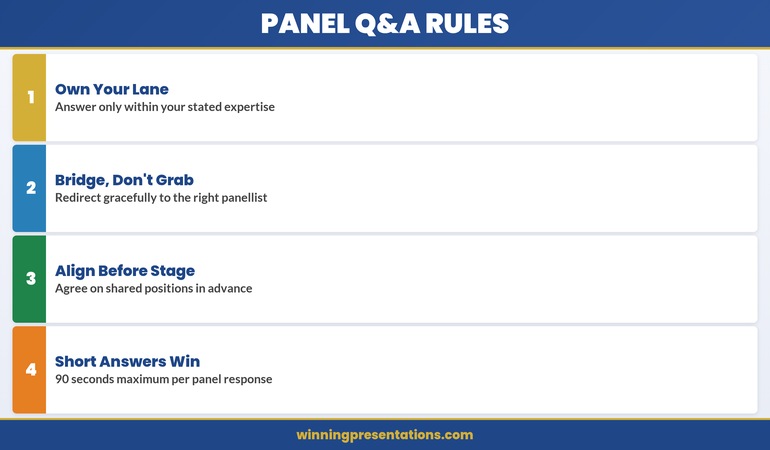
When you encounter a compound question—one that asks multiple things at once—you have a tactical choice in a panel that you don’t have solo. You can answer the first part, then say: “I’ll let Marcus tackle the second part since it touches his remit.” This distributes authority, shows clear domains, and prevents you looking like you’re hoarding airtime. It only works if your domains are clear from the alignment call.
Frequently Asked Questions
What if I disagree strongly with a co-panellist’s answer?
Address it on stage, but frame it as intellectual disagreement, not personal criticism. “I see that differently. Here’s why…” Then explain your rationale with data or experience, not emotion. If it’s a factual error, correct it gently: “The recent guidance actually shifted to X.” If it’s an opinion, you can coexist: “In our organisation, we’ve found the opposite.” The key is keeping it professional. The audience is evaluating your character as much as your expertise.
How do I know when to add to someone else’s answer versus staying quiet?
Speak if: (1) you have something genuinely distinct to add (not a repackaged version of what they said), (2) you have direct experience that illustrates or contradicts their point, or (3) the previous answers were incomplete. Stay quiet if they’ve covered the ground thoroughly and your input is marginal. There’s no rule. Read the room. If the moderator seems satisfied and the audience is nodding, silence is often the right choice.
What if the moderator directs a question at me and I genuinely don’t know the answer?
Say so. “That’s a great question. I don’t have current data on that, but here’s what I do know about the broader context…” Then pivot to what you do know. Audiences respect honesty. They don’t respect bluffing. If a co-panellist has the answer, you can say: “Marcus would be better placed to answer that.” But don’t defer when you can offer value. There’s a middle ground between bluffing and abdicating.
Should we prepare scripted panel answers together?
No. Scripted panels sound robotic and audience-alienating. Instead, prepare the three pillars of your answer: (1) what’s the core insight, (2) what’s the supporting evidence or story, (3) what’s the call to action or implication. Know those. Deliver them conversationally. This gives you consistency without sounding canned.
The Winning Edge
Weekly presentation strategies for executives who present under pressure.
Panel Q&A is learnable. The variables are higher—you’re reading multiple presenters, a moderator, and an audience simultaneously. But the core skills are the same: know your domain, stay on message, listen to what’s being asked (not what you want to answer), and respect co-panellists without diminishing yourself. Do that, and you’ll look composed, credible, and collaborative. That’s how panels build your reputation rather than damage it.
If you’re preparing for an executive panel and want structured Q&A frameworks that account for shared-stage dynamics, the Executive Q&A Handling System provides decision frameworks for both solo and multi-presenter scenarios.
For additional context on different Q&A environments, review how executive presence shapes perception during presentations. Your behaviour on a panel is part of that presence.
About the Author
Mary Beth Hazeldine is Owner & Managing Director of Winning Presentations. With 24 years of corporate banking experience at JPMorgan Chase, PwC, Royal Bank of Scotland, and Commerzbank, she advises executives across financial services, healthcare, technology, and government on structuring presentations for high-stakes funding rounds and approvals.