
Quick Answer: The strongest response to an executive Q&A objection follows a four-beat structure: acknowledge the pattern the objector is pattern-matching to, name the specific difference in the current situation, offer the evidence, and propose the decision-criterion shift. This handles dismissal without being defensive. It works whether the pushback is fair or unfair.
JUMP TO:
Rafaela had walked the chief operating officer through forty-two slides explaining why their procurement system needed replacement. The COO listened, asked two clarifying questions, and then said, at slide forty-three: “We looked at this two years ago. It was going to cost twelve million and take eighteen months. Nothing has changed. Why is this different now?”
The room went quiet. Rafaela’s team had spent six weeks on the analysis. What they had not done was prepare for this specific objection. The COO was pattern-matching. He was not asking about the procurement system — he was asking whether this was the same failed initiative in new clothing. Rafaela did what most executives do when hit with that objection. She defended the new analysis. The meeting ended without a decision.
What should have happened is specific. The objection was predictable. The response structure exists. The reason most executives fail to use it is that they do not know objections follow a recognisable pattern. Once you see the pattern, the response becomes repeatable.
If you are walking into an executive Q&A soon
The Executive Q&A Handling System covers the structural responses for dismissal, pattern-matching, and hostile pushback — the Q&A moments that most damage credibility.
Why executive objections are pattern-matching
Experienced executives rarely ask questions from a position of curiosity. They pattern-match the current proposal to a previous situation that failed, succeeded, or cost the business something. The question sounds specific — about your proposal — but it is usually anchored to that previous situation. Until you name the anchor and demonstrate the difference, no amount of data about the current proposal will move the conversation forward.
This is a cognitive efficiency, not a fault. Senior executives have seen many initiatives. They compress evaluation by recognising categories. The job of your response is not to defend the current proposal on its own terms. It is to unpick the pattern-match and rebuild it around the specific, genuinely different features of the current situation.
Three implications follow. First, generic data will not work — it needs to speak to the specific anchor. Second, the response structure is the same whether the pattern-match is fair or unfair — the objector is not tracking that distinction. Third, if you cannot identify the anchor within the first three sentences of the objection, you are not ready to respond yet.
The four-beat response structure
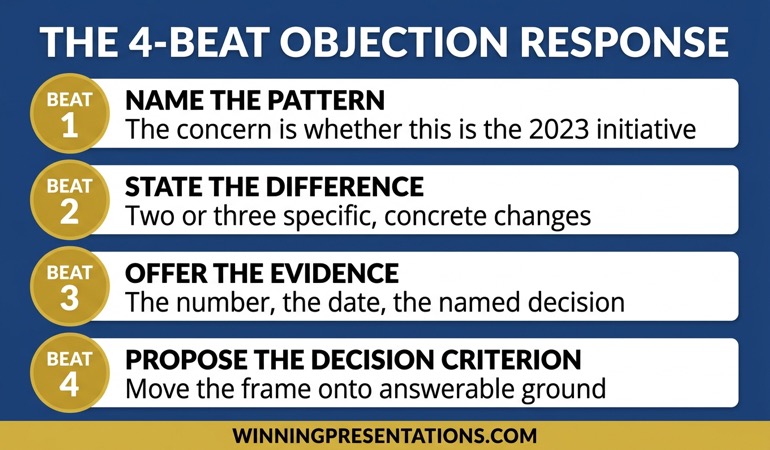
The structure has four components, delivered in order, inside roughly thirty to forty-five seconds of spoken response.
Beat 1: Name the pattern. “The concern you are raising is whether this is the same initiative we declined in 2023.” This beat does three things. It confirms you heard the objection. It shows you understand the underlying pattern, not just the surface question. It moves the conversation from defence to shared diagnosis.
Beat 2: State the specific difference. “Two things have changed materially. The previous proposal was a full platform replacement at the same time. This proposal sequences replacement across three years, with the first tranche covering only the accounts payable module.” Name the difference concretely. Not “much has changed” — specifics. Two or three, not more.
Beat 3: Offer the evidence. “The first-tranche cost is £1.8m — an eighty-five percent reduction from the 2023 proposal, because we are not rebuilding the custom reporting layer that drove most of the previous cost.” Evidence is specific. It is not “we have done more analysis.” It is the number, the date, or the named decision that would not have been possible two years ago.
Beat 4: Propose the decision criterion. “The right question is not whether to replace the system. It is whether the accounts payable module alone justifies the £1.8m commitment. If we can agree that is the frame, the numbers support a clear answer.” This moves the decision onto criteria the executive can engage with directly, rather than leaving them stuck in the anchor.
THE EXECUTIVE Q&A HANDLING SYSTEM — £39
Prepared responses for the objections that make or break executive Q&A
The Executive Q&A Handling System covers objection categories, response templates, and the preparation drill that turns Q&A from the weakest part of a presentation into the part that earns the decision. £39, instant access.
Get the Executive Q&A System →
Designed for executives facing board, investment committee, and senior leadership Q&A.
The “we’ve tried that” objection
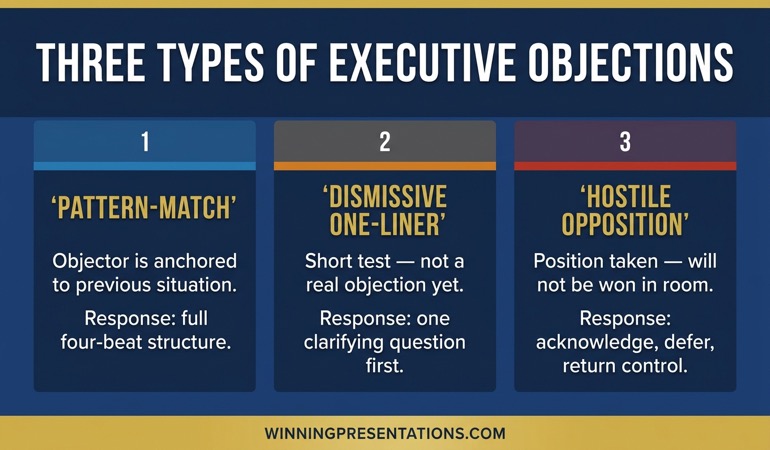
This is the most common executive objection, and the one most frequently mishandled. The four-beat structure applies, but with one adjustment: Beat 1 must explicitly acknowledge the previous attempt with respect.
The wrong response is “that was different” or “circumstances have changed.” Both feel dismissive of the earlier work. Remember: the executive often owned, approved, or was adjacent to the earlier attempt. Dismissing it is dismissing them.
The right response names the earlier attempt with specificity. “You led that review in 2023. The original recommendation was to move forward and it was halted after the scope expanded during procurement.” That line does three things: it shows you know the history, it respects the prior decision, and it sets up the specific difference you are about to introduce.
Once the respect is established, the remaining three beats follow the standard structure. The specific difference must be genuine — if the current situation is not materially different, the objection is correct and you need to revise the proposal, not the response.
The dismissive one-liner
Some objections are short and designed to end the conversation. “That sounds expensive.” “I don’t see it.” “It’s not the right time.” These are not full objections — they are tests. The executive is signalling that they are not yet engaged and wants to see whether you can bring them in.
The correct response is a single clarifying question before you engage the substance. “When you say it sounds expensive, are you comparing it to the status quo cost, or to the budget envelope you had in mind for this initiative?” The question forces the executive to surface the actual concern. Once surfaced, you can apply the four-beat structure to the real objection underneath.
This is harder than it sounds. The instinct when you hear “that sounds expensive” is to launch into the cost justification you have prepared. Resist it. A thirty-second defence of the cost to a dismissive one-liner almost always lands badly, because you are answering a surface question rather than the concern underneath. The clarifying question takes five seconds and saves the conversation.
Related: the honest-answer Q&A framework covers how to respond when the right answer is “I don’t know” without losing credibility.
Genuinely hostile objections
Sometimes the objection is not a pattern-match or a test. It is a genuine, hostile push to derail the proposal. The executive has already decided they do not want this to proceed and is using the Q&A to signal that position to the room.
Three tells: the objection is repeated in slightly different forms even after you address it; the body language of other executives tracks the hostile executive rather than you; the substance of the objection shifts without acknowledging your previous response. If two of the three are present, you are dealing with hostile opposition, not Q&A.
The response is structurally different. Do not try to win the Q&A. Acknowledge the concern explicitly, name what you heard, propose a follow-up conversation to resolve it outside the meeting, and return control to the chair. “I hear the concern about implementation timing. I would like to propose that we take that specific question offline and come back with a joint view by next Tuesday. Chair, can we park it for now and continue?”
This does not resolve the opposition. It prevents the opposition from dominating the remaining meeting time and creates a structured path to resolve it afterwards. Most hostile objections are actually negotiations about something adjacent to the proposal — scope, timing, ownership. They get resolved in one-to-one conversation, not in group Q&A.
For the moments when you genuinely do not have the answer, the cannot-answer response framework covers how to hold credibility without bluffing.
What not to do
Do not repeat the original case. The objection has already signalled that the original case did not land. Repeating it — even with more emphasis — will not change the outcome. The four-beat structure explicitly abandons the original framing and rebuilds the discussion on different terms.
Do not answer with data before engaging the pattern. Data only works once the executive has agreed the current situation is genuinely comparable to whatever they are pattern-matching to. Beat 1 does the reframing. Data fits into Beat 3, not Beat 1.
Do not apologise for the original analysis. “I know this sounds like the 2023 initiative, and I understand why — let me be clear about what’s different” is a stronger opening than “I’m sorry, I should have led with this.” Apology early in a response signals that the objection is justified. Often it isn’t.
Do not say “great question.” Executives hear “great question” as filler. It buys you no thinking time and devalues the specificity of the response that follows. Use silence instead — a two-second pause before Beat 1 is universally read as thoughtful.
For the moments in Q&A when you need to recover emotional control before responding, the emotional regulation Q&A reset covers the physical technique for those moments.
The Executive Q&A Handling System includes a full objection bank with prepared four-beat responses for the twelve most common executive objection patterns.
THE FULL OBJECTION BANK
Prepared responses for twelve recurring executive objection patterns
The Executive Q&A Handling System gives you the prepared four-beat structure for each common objection — “we’ve tried that”, “not the right time”, dismissal, redirection, and more. £39, instant access.
Frequently Asked Questions
How long should a four-beat response take?
Thirty to forty-five seconds total. Longer responses lose the room. Shorter responses feel incomplete. Practise the sequence in rehearsal with a timer. The goal is not to memorise the specific words, but to internalise the rhythm. Once the rhythm is natural, you can improvise the specifics in the moment.
What if I cannot identify the pattern the executive is matching to?
Ask. “Is there a previous initiative you are comparing this to?” Or: “Help me understand the framing — are you seeing this as similar to another situation?” Asking directly for the pattern is often received well, because it demonstrates that you are trying to engage with their actual concern rather than a surface version of it.
Can I use this structure in written responses, not just live Q&A?
Yes — the structure works equally well in follow-up memos. Each beat becomes a short paragraph. Written responses have the advantage of allowing more specificity in Beats 2 and 3, because the reader can absorb more detail in text than in spoken form. The structure is the same; the density can be higher.
What if the executive interrupts me during the four beats?
Allow the interruption. If the executive interrupts, they are signalling what part of the response they want to focus on. Follow their focus. You can always return to the remaining beats later. Insisting on completing the four beats against an active interrupter reads as rigid and loses you the room.
Practical Q&A and presentation technique, Thursdays
The Winning Edge is a weekly newsletter covering the structural mechanics of high-stakes presentation moments — including Q&A preparation, objection handling, and recovery techniques.
Partner post: If the Q&A objections come from a single cautious decision-maker rather than a group, the risk-averse CEO presentation framework covers the related one-to-one dynamic.
Your next step: Before your next executive Q&A, write down the three most likely objections and draft the four-beat response to each. Most presenters skip this step. The ones who do it walk in with a measurable preparation advantage.
About the Author
Mary Beth Hazeldine is Owner & Managing Director of Winning Presentations Ltd. With 24 years of corporate banking experience at JPMorgan Chase, PwC, Royal Bank of Scotland, and Commerzbank, she advises executives across financial services, healthcare, technology, and government on structuring presentations for high-stakes funding rounds and approvals.