

Data questions in presentations are rarely about the data. They are about trust. When a board member challenges your numbers, they are testing whether you understand the assumptions behind them, the limitations within them, and the decisions they should and should not support. Here is how to defend your data under pressure without losing credibility or the room.
Ingrid was presenting the quarterly revenue forecast to the executive committee of a mid-market technology firm. Slide six showed a projected twelve percent growth in recurring revenue, driven by three new enterprise contracts expected to close in the next quarter. The CFO leaned forward. “Ingrid, the pipeline conversion rate you’ve used here is forty-two percent. Our actual conversion rate for the last four quarters has averaged thirty-one percent. Walk me through why you’ve used a different number.” She had used the higher figure because it reflected the conversion rate for enterprise deals specifically, which historically closed at a higher rate than the blended average. But she hadn’t flagged the distinction on the slide or in the supporting notes. She knew the answer—but the ten seconds it took her to locate the rationale in her memory felt, to the room, like hesitation. The CFO’s eyebrows rose. The CEO looked down at his notes. Ingrid recovered well, explaining the enterprise-specific rate and offering to share the supporting data by email. But the damage was subtle and real: for the remainder of the presentation, every number was scrutinised more carefully. She had been credible at slide five. By slide seven, she was being audited. The issue wasn’t the data. It was the gap between her preparation and her presentation of it.
Preparing for a data-heavy presentation with Q&A? The Executive Q&A Handling System includes frameworks and response structures designed for high-scrutiny presentation environments.
Jump to section:
Why Data Challenges Are About Trust, Not Accuracy
When someone challenges a number in your presentation, the instinct is to defend the number. This is almost always the wrong response. The question behind the question is not “Is this number correct?” It is “Do you understand what this number means well enough for me to trust the decision you’re asking me to make?”
Data questions in presentations serve a governance function. The board member or senior executive who challenges your figures is not trying to embarrass you. They are building their own confidence that the data has been properly interrogated before it reaches them. Your job is not to prove the number is right. Your job is to demonstrate that you understand its provenance, its limitations, and its implications for the decision at hand.
This reframing changes your preparation entirely. Instead of preparing to defend every number, prepare to explain the three to five numbers that are most likely to be challenged—the ones with the biggest assumptions, the widest confidence intervals, or the greatest impact on the recommendation. Know the source. Know the methodology. Know the alternative interpretation. And know what your recommendation would be if the number were materially different.
The executive who responds to a data challenge with “The number is correct—it comes from our CRM” is defending accuracy. The executive who responds with “That number reflects our enterprise conversion rate over the last six quarters. If we used the blended rate instead, the forecast would be eight percent rather than twelve. My recommendation wouldn’t change, but the confidence interval would widen” is demonstrating mastery. The first response ends the question. The second response earns trust.
Handle Data Scrutiny With Authority
The Executive Q&A Handling System gives you response frameworks and preparation structures for high-scrutiny presentations—so you defend your numbers with the confidence the room expects.
- ✓ Q&A response frameworks for executive settings
- ✓ Preparation templates for data-heavy presentations
- ✓ Techniques for handling hostile and unexpected questions
Get the Q&A Handling System → £39
Designed for executives who face data scrutiny in high-stakes presentations
Assumption Transparency: The Defence That Prevents the Attack
The most effective defence against data questions is to answer them before they’re asked. Assumption transparency—stating your key assumptions on the slide rather than hiding them in a footnote or an appendix—removes the adversarial dynamic entirely. When you proactively disclose that “this forecast uses enterprise-specific conversion rates (42%) rather than the blended rate (31%),” you’ve eliminated the challenge before the CFO can formulate it.
This approach works because it reverses the power dynamic. When the audience discovers an assumption themselves, it feels like catching you out. When you disclose it proactively, it feels like rigour. The data is identical. The perception is entirely different. Transparency converts a potential weakness into a credibility signal.
The practical implementation is an “Assumptions” callout box on any slide that presents modelled, projected, or estimated data. Keep it brief—three to five key assumptions, each in a single line. Position it at the bottom of the slide in a visually distinct format (grey text, smaller font, clearly labelled). This tells the audience: “I’ve thought about what underpins these numbers, and I’m confident enough to show my working.”
The assumptions you choose to disclose also signal what you consider material. Listing every assumption suggests you’re unsure which ones matter. Listing three tells the audience these are the ones you’ve stress-tested because they have the greatest impact on the recommendation. This selectivity is itself an act of expertise—it shows you can distinguish between assumptions that affect the decision and assumptions that are technically interesting but practically irrelevant.
The Three-Part Response to Any Data Challenge
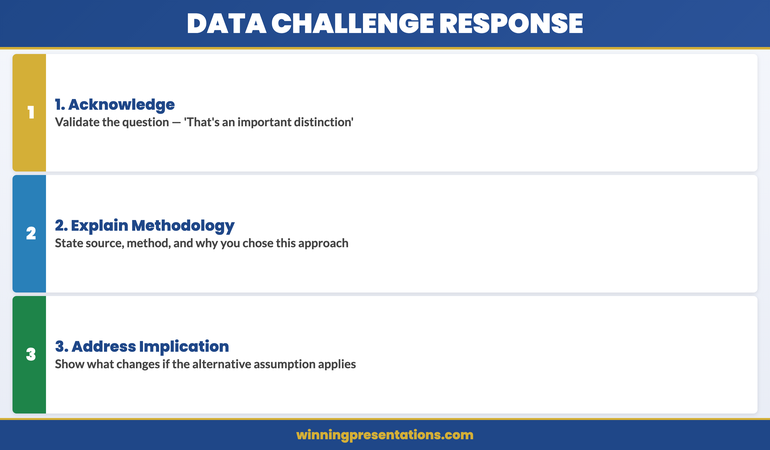
When a data question arrives—and it will, regardless of your preparation—use a three-part response structure that maintains credibility while addressing the challenge directly.
Part 1: Acknowledge the question’s legitimacy. “That’s an important distinction” or “You’re right to question that assumption.” This is not flattery—it is professional respect. It tells the questioner that you understand why the data point matters, which immediately reduces the adversarial temperature. A defensive response—“The data is sound”—escalates. An acknowledging response—“That’s a fair challenge”—de-escalates.
Part 2: Explain the methodology. State the source, the methodology, and the reason you chose this approach over alternatives. Be specific and brief. “We used the enterprise-specific conversion rate because the three pipeline deals are all enterprise contracts. The blended rate includes SME deals, which convert at a lower rate and aren’t represented in this quarter’s pipeline.” This takes fifteen seconds and demonstrates mastery.
Part 3: Address the implication. State what would change if the alternative assumption were used. “If we applied the blended rate, the projection would drop from twelve to eight percent growth. The recommendation to proceed with the hiring plan would still hold, though the timing would shift by one quarter.” This is the element that builds the most trust, because it shows you’ve already considered the alternative the questioner is proposing. You haven’t just defended your number—you’ve demonstrated that the decision is robust regardless. For more on the bridging technique for difficult questions, that guide covers how to redirect challenging questions without appearing evasive.
The three-part structure works because it addresses all three layers of the data challenge simultaneously: the emotional layer (acknowledgement), the technical layer (methodology), and the decision layer (implication). Most presenters only address the technical layer—and that’s why data challenges feel so uncomfortable. When you address all three, the questioner feels heard, informed, and reassured.
Anticipating Data Questions Before They Arrive
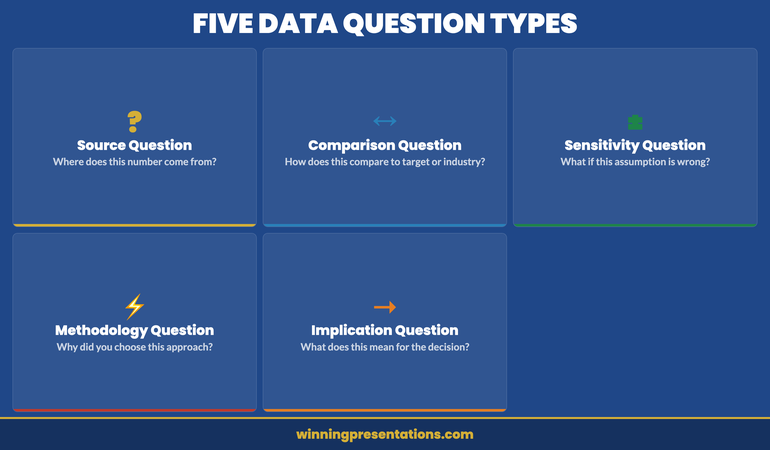
The most predictable data questions follow a pattern. For any presentation containing numerical analysis, audit each slide against five question types that appear in virtually every executive Q&A.
The Source Question: “Where does this number come from?” Prepare a one-sentence answer for every significant data point: the system, the report, the date range, and any manual adjustments. If you had to manipulate the data—filtering outliers, annualising partial data, converting currencies—disclose the methodology proactively or prepare the answer for Q&A.
The Comparison Question: “How does this compare to [last quarter / the industry / the target]?” Prepare context for every headline number. A twelve percent growth figure means nothing without comparison. Twelve percent against a target of fifteen is underperformance. Twelve percent against an industry average of four is outperformance. The questioner wants to calibrate your number against a reference point. Provide it before they ask.
The Sensitivity Question: “What happens if this assumption is wrong?” This is the data question that separates adequate presenters from authoritative ones. Prepare a sensitivity range for your three to five most impactful assumptions. Know what changes—and what doesn’t—when each assumption shifts by a material amount. For techniques on buying time during Q&A, that guide covers legitimate strategies for creating thinking space when unexpected questions arrive.
If you regularly present data-heavy material to senior audiences, the Executive Q&A Handling System provides the preparation frameworks that ensure you’ve anticipated the questions before you enter the room.
Recovering Credibility After a Data Stumble
If you’ve been caught off-guard by a data question—a number you can’t explain, an assumption you didn’t anticipate, a comparison you haven’t prepared—the recovery is more important than the stumble. How you handle the next sixty seconds determines whether the audience writes off the moment or writes off your presentation.
The recovery protocol has three steps. First, resist the urge to guess. An incorrect improvised answer is far more damaging than an honest acknowledgement. “I don’t have that specific breakdown in front of me” is a temporary gap. “I believe the number is roughly…” followed by an incorrect estimate is a credibility collapse.
Second, commit to a specific follow-up. Not “I’ll look into that”—which sounds vague and may never happen—but “I’ll send the detailed breakdown to the committee by end of business today.” The specificity of the commitment signals accountability. The timeline signals urgency. Together, they convert a moment of weakness into a demonstration of professional discipline.
Third, move forward with the presentation. Do not apologise repeatedly, do not circle back to the point, and do not let the stumble colour the rest of your delivery. The audience takes their cue from you. If you treat the moment as a minor administrative gap, they will too. If you treat it as a catastrophe, they will begin scrutinising every subsequent number with renewed suspicion. The stumble matters far less than the signal you send about it. For approaches to handling particularly hostile questions in board meetings, that guide covers the specific dynamics when data challenges carry political intent.
Prepare for Every Data Challenge Before You Enter the Room
Stop dreading Q&A. The Executive Q&A Handling System gives you the frameworks to anticipate, structure, and deliver authoritative responses to data scrutiny—for £39.
Frequently Asked Questions
How do I handle a data question when the questioner has better data than I do?
Acknowledge their data immediately: “That’s a useful data point—thank you. My analysis used [source/timeframe]. If your figures reflect [their likely source], the difference may be [methodology/scope/date range]. I’d like to reconcile the two datasets after this meeting so we’re working from a single source going forward.” This response does three things: it validates their contribution, explains the discrepancy without being defensive, and proposes a constructive resolution. The worst response is to argue that your data is right and theirs is wrong—even if that’s true.
Should I include an appendix with detailed data for Q&A?
Always. An appendix with supporting detail is your safety net for data questions. Structure it as a set of backup slides that mirror your main presentation: for each core slide, prepare one or two appendix slides with the underlying data, the methodology note, the sensitivity analysis, or the comparison benchmarks. When a question arrives, you can say “I have the detailed breakdown—let me pull up the supporting slide.” This signals preparedness and converts Q&A from an interrogation into a collaborative data review.
What if a data challenge reveals a genuine error in my presentation?
Acknowledge it immediately, thank the person who spotted it, and assess the impact on your recommendation in real time. “You’re right—that should be thirty-one percent, not forty-two. Let me quickly assess whether that changes the recommendation.” If the recommendation holds, say so: “The conclusion is the same, but the margin is tighter. I’ll circulate corrected figures after the meeting.” If the error materially changes the recommendation, say that too: “This changes the picture. I’d like to revise the analysis and bring an updated recommendation to next week’s meeting.” Honesty in the moment of error builds more trust than a flawless presentation built on unchallenged assumptions.
The Winning Edge
Weekly insights on Q&A handling, executive presentations, and boardroom communication.
If data scrutiny also triggers anxiety about your credibility as a presenter, our guide to imposter syndrome in presentations covers the psychological patterns that make high performers feel like frauds under pressure.
About the author
Mary Beth Hazeldine, Owner & Managing Director, Winning Presentations. With 24 years of corporate banking experience at JPMorgan Chase, PwC, Royal Bank of Scotland, and Commerzbank, she advises executives across financial services, healthcare, technology, and government on structuring presentations for high-stakes funding rounds and approvals.