
Tag: meeting anxiety

30 Jan 2026
Professional man speaking in meeting with uncertain expression and open hand gesture, searching for words mid-sentence

How to Stop Rambling When Nervous: The 3-Sentence Structure

The question was simple: “Can you give us a quick update on the project?”

What came out of my mouth was anything but quick. I talked for four minutes. I repeated myself twice. I went off on a tangent about a supplier issue that nobody asked about. By the time I stopped, the room had glazed over and my manager was checking her phone.

I knew I was rambling. I could hear myself doing it. But I couldn’t stop.

Quick answer: Nervous rambling happens when anxiety hijacks your working memory, making it impossible to organise thoughts in real-time. The fix isn’t “slow down” or “take a breath”—it’s having a structure so simple you can use it even when your brain is flooded with stress hormones. The 3-sentence structure works: Point (what you’re saying), Reason (why it matters), Example or Action (proof or next step). When you know exactly how your answer will be shaped, you stop filling silence with words.

Why We Ramble When Nervous (The Neuroscience)

Before I became a clinical hypnotherapist specialising in presentation anxiety, I spent 24 years in corporate banking. I’ve been the rambler in the room more times than I’d like to admit. And I’ve watched hundreds of intelligent professionals do the same thing—lose control of their words the moment pressure hit.

Here’s what’s actually happening in your brain when you ramble:

When you feel anxious—someone asks you a question, all eyes turn to you, you’re put on the spot—your amygdala triggers a stress response. Cortisol and adrenaline flood your system. Your heart rate increases. And critically, blood flow shifts away from your prefrontal cortex (where organised thinking happens) toward your limbic system (where survival instincts live).

This is why you can’t “think straight” when nervous. Your brain is literally operating with reduced cognitive capacity. The part of you that organises thoughts, prioritises information, and knows when to stop talking? It’s running on backup power.

So you do what feels safe: you keep talking. Silence feels dangerous when you’re in fight-or-flight mode. Your brain interprets the pause as a threat—they’re judging me, I need to fill this space, I should add more context—and words keep pouring out.

The rambling isn’t a character flaw. It’s a neurological response to perceived threat.

And that’s exactly why “just relax” doesn’t work. You can’t think your way out of a stress response. You need a structure so automatic that it works even when your prefrontal cortex is compromised.
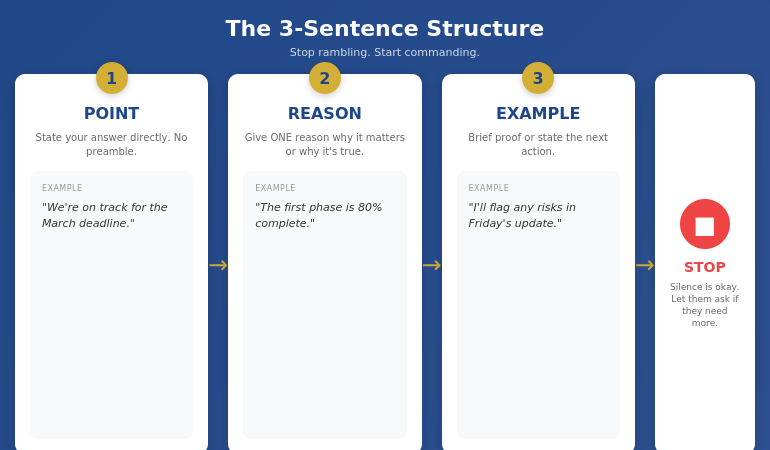
The 3-sentence structure to stop rambling: Point, Reason, Example, then Stop

The 3-Sentence Structure That Stops Rambling

The structure I teach is deliberately simple. It has to be—because you’ll be using it when your brain is running at 60% capacity.

Sentence 1: POINT — State your answer directly. No preamble, no context-setting, no “Well, that’s a great question.” Just the point.

Sentence 2: REASON — Give one reason why this matters or why it’s true. One. Not three. Not five. One.

Sentence 3: EXAMPLE or ACTION — Either give a brief example that illustrates your point, or state the next action. Then stop.

That’s it. Point. Reason. Example. Stop.

Let me show you how this works with the question that started my rambling disaster:

“Can you give us a quick update on the project?”

What I said (rambling): “So, the project is going well, I think we’re making progress, although there have been some challenges with the timeline because the supplier had some issues, which reminded me that we need to talk about the procurement process at some point, but anyway, the team is working hard and we’ve completed most of the first phase, or at least the parts that don’t depend on the supplier, and I think we should be on track for the deadline, assuming nothing else comes up…”

What I should have said (3-sentence structure): “We’re on track for the March deadline. The first phase is 80% complete, with the remaining work dependent on supplier delivery next week. I’ll flag any risks in Friday’s update.”

Same information. Fraction of the words. Zero rambling.

If you’re also struggling with talking too fast when nervous, the 3-sentence structure helps with that too—when you know exactly what you’re going to say, you naturally slow down.

⭐ Stop Rambling. Start Commanding the Room.

Conquer Speaking Fear gives you the complete system for speaking with confidence—including the mental techniques that stop nervous rambling at its source.

What’s included:

  • The neuroscience of why you ramble (and how to interrupt the pattern)
  • Structure templates for answering any question concisely
  • Hypnotherapy-based techniques to reduce anxiety before speaking
  • Practice exercises you can do in 5 minutes before any meeting

Get Conquer Speaking Fear → £39

Created by a clinical hypnotherapist who spent 5 years conquering her own speaking fear

Practice Scenarios: Using the Structure in Real Meetings

The 3-sentence structure only works if you’ve practised it enough that it becomes automatic. Here are five common meeting scenarios with example responses:

Scenario 1: “What do you think about this proposal?”

Point: “I think it’s viable but needs refinement.”
Reason: “The timeline is aggressive given our current resource constraints.”
Example/Action: “I’d suggest we map out dependencies before committing to the April launch.”

Scenario 2: “Can you explain what went wrong?”

Point: “The integration failed because of a data format mismatch.”
Reason: “Our system expected JSON but the vendor sent XML.”
Action: “We’ve implemented validation checks to prevent this going forward.”

Scenario 3: “Where are we on budget?”

Point: “We’re 12% over budget.”
Reason: “The overage is driven by unplanned contractor costs in Q2.”
Action: “I’m presenting options to recover the gap at Thursday’s review.”

Scenario 4: “What’s your recommendation?”

Point: “I recommend we go with Vendor B.”
Reason: “They’re 20% cheaper and have better implementation support.”
Example: “They successfully deployed for three companies in our industry last year.”

Scenario 5: “Can you introduce yourself?”

Point: “I’m Sarah, the project lead for the digital transformation initiative.”
Reason: “I’ve been with the company for six years, most recently leading the CRM migration.”
Action: “I’m here to answer any questions about implementation timelines.”

Notice what’s missing from all of these: filler words, excessive context, tangents, and the word “just.” Each response is complete. Each response is concise. Each response stops.

For more techniques on speaking confidently in meetings, including how to handle interruptions and pushback, see my detailed guide.

What Doesn’t Work (And Why People Keep Suggesting It)

You’ve probably heard all of these. None of them work reliably for nervous rambling:

“Take a deep breath before you speak.”

This can help with physical symptoms, but it doesn’t solve the structural problem. You can take a deep breath and still ramble for three minutes because you don’t know where your answer is going. Breathing helps your body; structure helps your words.

“Just slow down.”

When you’re anxious, your brain interprets pauses as danger. Telling yourself to slow down creates internal conflict—your stress response is pushing you to fill silence while your conscious mind is trying to brake. The result is often choppy, awkward speech that still goes on too long.

“Think before you speak.”

With what cognitive resources? When you’re nervous, your prefrontal cortex is impaired. “Think before you speak” assumes you have full access to your thinking capacity. You don’t. You need a structure simple enough to execute on autopilot.

“Practice more.”

Practice what, exactly? If you practice without a structure, you’re just reinforcing bad habits. Unstructured practice can actually make rambling worse because you’re training your brain that “more words = better prepared.”

The 3-sentence structure works because it gives your impaired brain a simple template to follow. Point. Reason. Example. Stop. Even at 60% cognitive capacity, you can execute three steps.

⭐ Get the Complete Speaking Confidence System

Conquer Speaking Fear combines practical techniques like the 3-sentence structure with deeper work on the anxiety that causes rambling in the first place.

You’ll learn:

  • How to interrupt the anxiety-rambling cycle before it starts
  • The “mental rehearsal” technique used by elite performers
  • How to recover when you catch yourself rambling mid-sentence
  • Building long-term confidence that reduces nervous responses

Get Conquer Speaking Fear → £39

From a clinical hypnotherapist with 24 years in high-pressure corporate environments

Advanced Techniques for Chronic Ramblers

If rambling is a persistent problem—not just occasional nervousness—these advanced techniques can help:

The Physical Anchor

When you finish your third sentence, do something physical: put your pen down, place your hands flat on the table, or shift your weight slightly. This physical action creates a “stop signal” that interrupts the urge to keep talking. Your body tells your brain: we’re done.

The Preview Technique

Before you start speaking, say how many points you’ll make: “Two things on this.” Now you’ve created a public commitment. Your brain knows it needs to stop after two things. This works especially well for longer responses where three sentences isn’t enough.

The Callback Close

End by referencing the question you were asked: “So to answer your question about timeline—March 15th, assuming no supplier delays.” This signals clearly that you’ve completed your answer. It also proves you actually answered what was asked, which ramblers often fail to do.

The Silence Practice

Rambling is often a fear of silence. Practice sitting in silence after you finish speaking. In your next low-stakes meeting, give a short answer and then deliberately wait. Notice that the silence isn’t as uncomfortable as your brain predicted. Nobody judges you for being concise. The more you prove this to yourself, the less you’ll feel compelled to fill space with words.

For related techniques on presentation skills for meetings, including how to handle being put on the spot, see my comprehensive guide.

What causes rambling when speaking?

Rambling is caused by anxiety triggering a stress response that impairs your prefrontal cortex—the part of your brain responsible for organising thoughts and knowing when to stop. When you’re nervous, your brain interprets silence as threatening and pushes you to keep talking. This isn’t a character flaw; it’s a neurological response to perceived pressure. The solution is having a simple structure that works even when your cognitive capacity is reduced.

How do I stop over-explaining at work?

Use the 3-sentence structure: Point (your answer), Reason (why it matters), Example or Action (proof or next step). Then stop. Over-explaining usually happens because you’re uncertain whether you’ve been clear enough, so you keep adding context. The structure gives you confidence that you’ve said enough. If they need more, they’ll ask.

Why do I ramble when I’m put on the spot?

Being put on the spot triggers your fight-or-flight response, which reduces activity in your prefrontal cortex. Without full access to your thinking brain, you can’t organise thoughts in real-time—so you talk while thinking, which produces rambling. The fix is having a structure so simple you can use it on autopilot: Point, Reason, Example, Stop.

⭐ Finally Speak With Confidence and Clarity

Conquer Speaking Fear gives you both the practical structures and the deeper anxiety work to stop rambling for good.

Inside the programme:

  • The 3-sentence structure with practice scenarios
  • Hypnotherapy-based techniques to calm your nervous system
  • How to handle being put on the spot without panicking
  • Building lasting confidence that reduces anxiety over time

Get Conquer Speaking Fear → £39

Instant access. Start using these techniques in your next meeting.

Frequently Asked Questions

What if three sentences isn’t enough to answer the question?

For complex questions, use the Preview Technique: “There are three parts to this.” Then give each part its own Point-Reason-Example structure. You’re not limited to three sentences total—you’re using the structure as a unit. Three parts with three sentences each gives you nine focused sentences, which is plenty for almost any question. The key is that each unit has a clear endpoint.

How do I practice the 3-sentence structure?

Start with low-stakes situations: answering emails out loud, explaining something to a friend, or responding to questions in your head while watching the news. The goal is making the structure automatic before you need it under pressure. Spend one week practising daily for five minutes, and the pattern will start to feel natural.

What if I catch myself rambling mid-sentence?

Stop, pause, and say: “Let me summarise.” Then give your Point in one sentence. It’s completely acceptable to course-correct publicly. In fact, people respect it—it shows self-awareness. What they don’t respect is someone who clearly knows they’re rambling but can’t stop.

Is rambling a sign of anxiety disorder?

Occasional rambling when nervous is normal—most people experience it. If rambling is severely impacting your work performance or causing significant distress, it may be worth speaking with a mental health professional. But for most people, rambling is a skill gap, not a disorder. You haven’t learned a structure for speaking concisely under pressure. That’s fixable.

📧 The Winning Edge Newsletter

Weekly techniques for speaking with confidence, managing presentation anxiety, and commanding any room. No fluff—just what works.

Subscribe Free →

📋 Free: Public Speaking Cheat Sheets

Quick-reference guides for managing nerves, structuring answers, and recovering from mistakes—keep them on your phone for any meeting.

Download Free Cheat Sheets →

Your Next Step

The next time someone asks you a question in a meeting, pause for one second. In that second, identify your Point—the single sentence that answers the question. Then give your Reason. Then your Example or Action. Then stop.

Point. Reason. Example. Stop.

It will feel abrupt at first. Your brain will scream at you to add more context. Resist. Let the silence sit. Watch what happens: nothing bad. People nod. They move on. They respect your conciseness.

The rambling that used to derail your credibility? It’s not a fixed part of who you are. It’s a pattern. And patterns can be interrupted.

Three sentences. That’s all you need.

Related: If unclear slide structure is contributing to your rambling during presentations, see why “Overview” is the worst slide title—the fix often starts with clearer thinking before you speak.

27 Jan 2026
Professional woman in meeting with hand on chest, using self-calming technique, moment of composed confidence

How to Speak Confidently in Meetings (Even When Anxious): The 30-Second Reset That Changes Everything

My mind went completely blank. Twelve people staring. The CEO waiting.

I knew the answer. I’d spent three weeks on that analysis. But when my name was called, my brain emptied like someone had pulled a plug. I mumbled something incoherent, felt my face burn, and spent the rest of the meeting wishing I could disappear.

If you’ve ever struggled to speak confidently in meetings — even when you know your stuff — you’re not dealing with a confidence problem. You’re dealing with a nervous system problem. And that changes everything about how to fix it.

Quick Answer: Speaking confidently in meetings when anxious requires regulating your nervous system BEFORE you speak — not forcing confidence through willpower. The 30-second reset (physiological sigh + grounding + intention) interrupts the threat response and gives your thinking brain back online. Practised before meetings, this technique transforms how you show up.

📅 Got a Meeting Today? Try This 30-Second Reset:

  1. Physiological sigh (10 sec): Two inhales through nose, one long exhale through mouth
  2. Ground yourself (10 sec): Feel feet on floor, hands on table, name 3 things you see
  3. Set one intention (10 sec): “I will make ONE clear point” — not “be perfect”

Do this in the corridor, the bathroom, or even silently at your desk before the meeting starts.

Why You Freeze (It’s Not What You Think)

For five years, I was terrified of speaking up in meetings. As a senior professional in corporate banking — at JPMorgan Chase, PwC, Royal Bank of Scotland — I sat in hundreds of meetings where I knew the answer but couldn’t get the words out.

I tried everything. Power poses. Positive affirmations. “Just be confident.” None of it worked.

Then I trained as a clinical hypnotherapist, and I finally understood what was actually happening.

When you feel anxious in meetings, your brain has detected a threat. Maybe it’s the senior leader who intimidates you. Maybe it’s the fear of saying something wrong. Maybe it’s a memory of a past embarrassment.

Whatever the trigger, your nervous system doesn’t distinguish between “CEO asking a question” and “tiger about to attack.” It launches the same response: blood leaves your brain (hello, mental blank), your throat tightens (goodbye, clear voice), and your heart races (hello, panic).

This is why “just be confident” doesn’t work. You can’t think your way out of a physiological response. You have to calm the nervous system first.

Your Nervous System Is Running the Show

Here’s what’s happening in your body when you freeze in meetings:

Your amygdala (the brain’s alarm system) detects “danger” — which might just be your manager’s raised eyebrow.

Your sympathetic nervous system activates fight-or-flight. Adrenaline floods your system.

Blood flow shifts away from your prefrontal cortex (where clear thinking happens) toward your limbs (for running or fighting).

Your vocal cords tighten. Your mouth goes dry. Your mind goes blank.

None of this is a character flaw. It’s biology. And once you understand that, you can work WITH your nervous system instead of fighting against it.

How do I speak confidently in meetings when nervous?

The key is regulating your nervous system before you need to speak — not forcing confidence through willpower. Use a physiological sigh (two inhales, one long exhale) to activate your parasympathetic nervous system. Ground yourself by feeling your feet on the floor. Set one small intention rather than trying to “be perfect.” This 30-second reset gives your thinking brain back online so confidence can emerge naturally.

Diagram showing the nervous system response in meetings and how the 30-second reset interrupts the freeze response

The 30-Second Reset Explained

This technique comes from my work as a clinical hypnotherapist, combined with the latest neuroscience research. It’s designed to interrupt the threat response and bring your thinking brain back online — fast.

Step 1: The Physiological Sigh (10 seconds)

This is the fastest way to calm your nervous system that science has found. It’s not regular deep breathing — there’s a specific pattern:

  • Inhale through your nose
  • At the top of that breath, take a second small inhale (this reinflates collapsed air sacs in your lungs)
  • Long, slow exhale through your mouth

One cycle is usually enough. Two if you’re very activated. This directly stimulates your vagus nerve and shifts you from sympathetic (fight/flight) to parasympathetic (rest/digest) nervous system dominance.

Step 2: Ground Yourself (10 seconds)

Anxiety lives in the future (“what if I mess up?”). Grounding brings you back to now:

  • Feel your feet on the floor — really notice the pressure
  • Feel your hands on the table or in your lap
  • Silently name three things you can see in the room

This engages your sensory cortex and interrupts the anxious thought loop.

Step 3: Set One Micro-Intention (10 seconds)

Don’t aim for “be confident” or “impress everyone.” That’s too big and triggers more anxiety.

Instead: “I will make ONE clear point.” Or “I will ask ONE good question.” Or even “I will say my name clearly when I introduce myself.”

Small, achievable intentions build momentum. Perfectionism builds paralysis.

⭐ Go Deeper: Rewire Your Response to Speaking Situations

The Conquer Speaking Fear system addresses the ROOT cause of meeting anxiety — not just the symptoms. Built from clinical hypnotherapy principles and 24 years in high-pressure corporate environments.

Includes:

  • The nervous system rewiring protocol
  • Pre-meeting preparation sequence
  • In-the-moment recovery techniques
  • Long-term confidence building framework

Get Conquer Speaking Fear → £39

Created by a qualified clinical hypnotherapist who spent 5 years terrified of speaking in meetings.

What to Do Before the Meeting

The 30-second reset works best when you do it BEFORE the meeting, not when you’re already in fight-or-flight.

The Night Before:

  • Review the agenda. Know what topics might require your input.
  • Prepare 1-2 points you could contribute — not a script, just bullet points.
  • Visualise yourself speaking calmly and being heard. (This isn’t woo-woo — it’s neural pathway priming.)

30 Minutes Before:

  • Do the full 30-second reset — in the bathroom, corridor, or silently at your desk.
  • Arrive early if possible. Sitting in your seat before others arrive reduces the “walking into a room of eyes” trigger.
  • Have water nearby. Dry mouth is real, and small sips help.

As the Meeting Starts:

  • Take one grounding breath as you sit down.
  • Place your feet flat on the floor — this is subtle but powerful grounding.
  • Remind yourself of your micro-intention.

For more on building lasting presentation confidence, see our guide to presentation confidence.

Why do I lose confidence when speaking in meetings?

Meetings often contain triggers that activate your brain’s threat detection system: senior people, potential judgement, past experiences of embarrassment. When your amygdala perceives threat, it launches a physiological response that literally reduces blood flow to your thinking brain. This causes the mental blanks, tight throat, and racing heart. It’s not a confidence problem — it’s a nervous system response that can be interrupted and retrained.

Ready to address the root cause of meeting anxiety?

Get Conquer Speaking Fear → £39

What to Do In the Moment

Sometimes anxiety hits mid-meeting, when you’re called on unexpectedly or the conversation shifts to your area.

The 5-Second Emergency Reset:

  1. Press your feet into the floor (grounds you instantly)
  2. Take one physiological sigh (two inhales, long exhale) — you can do this silently
  3. Buy yourself 3 seconds: “That’s a great question. Let me think about that for a moment.”

Those 3 seconds aren’t stalling — they’re giving your prefrontal cortex time to come back online. Executives do this all the time. It signals thoughtfulness, not weakness.

If Your Mind Goes Completely Blank:

It happens. Even to senior leaders. Here’s what to say:

  • “I had a thought on this — give me a moment to collect it.”
  • “Let me come back to that in a minute — I want to make sure I phrase it clearly.”
  • “I’m going to take a beat on that — it’s an important point.”

None of these sound weak. All of them buy you time to let your nervous system settle and your thinking brain re-engage.

If you’re looking for more specific techniques for calming pre-meeting nerves, see our guide on how to calm nerves before a presentation.

How can I stop sounding nervous in meetings?

The shaky voice, fast talking, and filler words (“um,” “like”) are symptoms of nervous system activation — not bad habits. To stop sounding nervous, you need to calm the activation: use the physiological sigh to settle your system, pause before speaking (silence feels longer to you than to others), and speak more slowly than feels natural. When your nervous system is regulated, your voice naturally steadies and your pace naturally slows.

Before meeting preparation timeline showing night before, 30 minutes before, and as meeting starts actions

⭐ Stop Managing Symptoms — Start Rewiring the Response

Quick fixes help in the moment. But if you want lasting change — the kind where speaking up feels natural instead of terrifying — you need to rewire how your nervous system responds to speaking situations.

The Conquer Speaking Fear system includes:

  • The fear response rewiring protocol
  • Graduated exposure framework
  • Cognitive restructuring techniques
  • Long-term maintenance strategies

Get Conquer Speaking Fear → £39

Built from clinical hypnotherapy principles — not generic confidence tips.

Is This Right For You?

Meeting anxiety affects different people in different ways. Here’s how to know if these techniques — and the deeper work — will help you:

Qualification chart showing who the Conquer Speaking Fear system helps and who needs different support

Recognised yourself in the “yes” column?

Get Conquer Speaking Fear → £39

The underlying issue — your nervous system perceiving speaking situations as threats — is addressable. It takes consistent practice, but the change is real and lasting.

For more on developing meeting-specific skills, see our guide to presentation skills for meetings.

⭐ Transform How You Show Up in Every Meeting

The Conquer Speaking Fear system is the complete methodology I developed after five years of personal struggle and clinical training. It addresses the root cause — not just the symptoms.

Inside:

  • The nervous system rewiring protocol
  • Pre-meeting preparation sequence
  • In-the-moment recovery techniques
  • Long-term confidence building framework

Get Conquer Speaking Fear → £39

Created by a qualified clinical hypnotherapist with 24 years in high-pressure corporate environments.

Frequently Asked Questions

Why do I freeze up in meetings but I’m fine one-on-one?

One-on-one conversations feel safer to your nervous system because there’s less perceived judgement and you can read social cues more easily. Meetings multiply the threat signals: more people watching, higher stakes, less control over timing. Your brain isn’t broken — it’s responding to what it perceives as a higher-threat environment. The techniques in this article help you signal “safety” to your nervous system even in group settings.

Can I use these techniques in virtual meetings too?

Absolutely — and in some ways they’re easier to use virtually. You can do the physiological sigh with your camera off before unmuting. You can ground yourself by pressing your feet into the floor without anyone seeing. The “Gallery view stare” often triggers MORE anxiety than in-person meetings, so the reset is even more important. Just adapt: keep water nearby, and use the chat function to buy thinking time if needed.

What if my boss puts me on the spot unexpectedly?

This is the hardest scenario, but it’s manageable. Use the 5-second emergency reset: feet into floor, one physiological sigh, then buy time with “That’s a great question — let me think about that for a moment.” Those few seconds allow your prefrontal cortex to come back online. If your mind is still blank, it’s completely acceptable to say “I want to give that a proper answer — can I follow up with you after the meeting?” This signals thoroughness, not weakness.

How long before I see improvement?

The 30-second reset can help immediately — you may notice a difference in your very next meeting. However, lasting change (where speaking up feels natural rather than managed) typically takes 4-8 weeks of consistent practice. You’re essentially rewiring neural pathways, and that requires repetition. In my experience, meaningful shifts often appear within 2-3 weeks of daily practice, with significant transformation by week 6-8.

Get Weekly Confidence-Building Strategies

Practical techniques for speaking up at work — from a clinical hypnotherapist who’s been there.

Subscribe to The Winning Edge →

Your Next Step

Speaking confidently in meetings when you’re anxious isn’t about forcing confidence or faking it. It’s about understanding that your nervous system is running a threat response — and learning how to interrupt it.

Try the 30-second reset before your next meeting. Notice what shifts.

And remember: that mental blank, that racing heart, that shaky voice — none of it means you’re not capable. It means your nervous system is doing its job. Now you know how to work with it instead of against it.

P.S. If you’re also struggling with how to structure your presentations once you DO speak up, I wrote about the presentation habit that’s quietly killing careers — it’s the structural mistake most professionals don’t even know they’re making.

P.P.S. If your main issue is physical symptoms (racing heart, shaky hands, tight chest), Calm Under Pressure (£19.99) focuses specifically on rapid relief techniques for the body-based anxiety response.

About Mary Beth Hazeldine
Owner & Managing Director of Winning Presentations. 24 years in corporate banking at JPMorgan Chase, PwC, RBS, and Commerzbank. Qualified clinical hypnotherapist and NLP practitioner. I help professionals overcome speaking anxiety and present with confidence.