

Quick answer: A team performance review presentation becomes a senior leadership concern when individual underperformance has operational consequences the board or executive committee needs to understand. The most effective structure separates context from judgement, uses specific dated evidence rather than impressions, and frames the conversation around forward expectations rather than backward blame — protecting both the individual and the organisation’s credibility.
In This Article
- When a Conversation Becomes a Presentation
- When Team Performance Becomes a Senior Leadership Issue
- The Four Components of an Effective Performance Review Deck
- Delivering Difficult Messages Without Losing Authority
- Managing Defensive Reactions in the Room
- The Post-Presentation Follow-Up That Makes It Stick
- Protecting Yourself Legally and Professionally
- Frequently Asked Questions
Henrik had managed the same regional sales team for four years. He knew his people well — knew their habits, their strengths, their reasons for every missed quarter. When his Head of Sales asked him to present to the executive committee on his team’s performance, Henrik assumed it would be a routine briefing: numbers, trends, actions taken.
What he had not anticipated was the level of specificity the committee would demand. The Managing Director wanted to understand why the same two members of the team had missed target for three consecutive quarters, what actions had been taken, what the timeline for resolution looked like, and what the contingency plan was if performance did not improve. Henrik had taken those actions. He had documented conversations, adjusted targets, provided coaching. What he hadn’t done was structure that information in a way that was legible to an executive audience.
His deck, built as a team-wide performance summary, didn’t answer the questions the committee was actually asking. By the third slide, the MD had stopped referring to the deck and was asking Henrik questions directly. The conversation became reactive rather than structured — and the impression Henrik left was of someone who understood the problem but had not thought through the resolution.
Presenting on team performance at executive level requires a different structure from managing team performance at operational level. The audience is asking different questions, with different authority, and different consequences attached to the answers.
Preparing for a leadership presentation on team performance?
The Executive Slide System includes slide templates and scenario playbooks designed for sensitive operational presentations — including performance conversations that need to hold up under board-level scrutiny.
When a Conversation Becomes a Presentation
Most team performance conversations happen in one-to-ones, performance review meetings, and informal corridor discussions. These are bilateral conversations between a manager and a team member. They require different skills — active listening, empathy calibration, clear boundary-setting — but they don’t typically require a formal presentation structure.
A team performance review becomes a presentation when one of three conditions applies. First, when the performance issue has escalated to the point where senior leadership or the board needs to be informed — either because of operational risk, regulatory exposure, or reputational concern. Second, when an HR or legal process requires a documented record of performance management actions, and a formal presentation constitutes that record. Third, when a restructuring or team change is being proposed and the performance context provides the operational rationale for the structural decision.
In all three cases, the audience is no longer the individual being managed — it is a leadership or governance body that needs to understand the situation, assess the risk, and make a decision. The skills required shift from interpersonal management to executive communication. The structure of your deck needs to match that shift.
When Team Performance Becomes a Senior Leadership Issue
Senior leadership takes an interest in team performance when it ceases to be a management problem and becomes an organisational risk. Understanding the thresholds at which this transition occurs helps you anticipate when a formal presentation will be required — and prepare accordingly rather than reactively.
Revenue or delivery risk. When underperformance in a team threatens a client commitment, a revenue forecast, or a regulatory deadline, it becomes visible at board or executive committee level. The question the board asks is not “what is wrong with this person?” — it is “what is the impact on our commitments and what is the plan to manage it?”
Regulatory or compliance exposure. In regulated industries, individual performance failures can create regulatory risk — particularly if the individual has client-facing, authorised, or sign-off responsibilities. A presentation to the board’s risk or audit committee may be required to demonstrate that the organisation identified the issue, managed it appropriately, and has controls in place to prevent recurrence.
Precedent or culture concern. When a senior or long-serving team member is underperforming and leadership is considering action, the board may be briefed because the decision creates a precedent — particularly in a restructuring context. For guidance on the broader restructuring presentation, see this framework for presenting restructuring decisions while maintaining team trust.
In each scenario, the presentation requirement emerges quickly — often within days of a decision being made to escalate. Having a clear structural template prepared in advance reduces the risk of a poorly composed deck under time pressure.
The Four Components of an Effective Performance Review Deck
The structure below works across the full range of team performance presentation contexts — from board briefings to HR panel reviews to executive committee updates. Each component serves a specific function in the executive’s understanding of the situation.
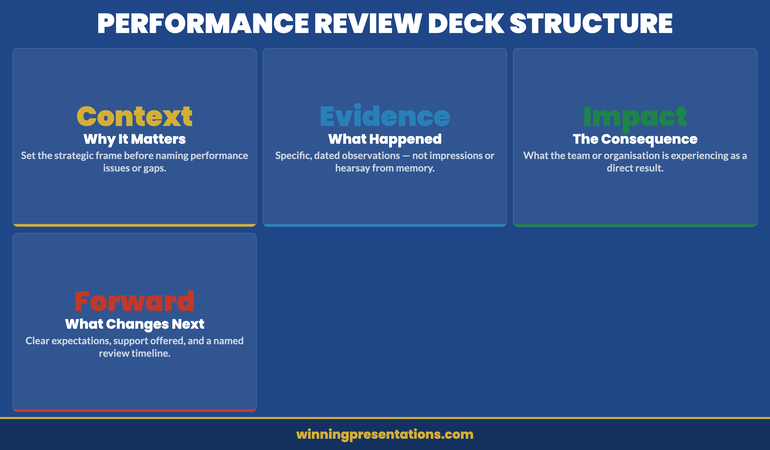
Component one — Context. Before naming the performance issue, establish the strategic frame. What is the team’s role in the organisation? What are their key deliverables? What targets or standards apply? This component ensures that the executive audience has a common reference point before evaluating the performance data. It also signals that your presentation is objective rather than personal — you are presenting against agreed standards, not individual preference.
Component two — Evidence. Present specific, dated observations of the performance concern. The most credible evidence is quantitative — missed targets, delivery failures, client complaints, safety incidents. Where quantitative data is unavailable, use dated written records: meeting notes, email exchanges, formal review documentation. Impressions and recollections carry little weight with an executive audience and invite challenge.
Component three — Impact. Translate the performance data into organisational consequence. What is the team, the client relationship, or the broader organisation experiencing as a result of the underperformance? Impact is the bridge between the individual’s behaviour and the leadership body’s remit. Without a clear impact statement, the board or executive committee has no basis for involvement — the issue remains a line-management matter.
Component four — Forward path. Close with clear expectations for the period ahead, the support being offered, and the review timeline. The forward path demonstrates that you have moved from diagnosis to management — and gives the leadership body something to endorse rather than a problem to resolve for you. A specific timeline with named review points is more credible than a general commitment to improve the situation.
The Executive Slide System
Slide templates and scenario playbooks designed for executive presentations that require precise framing — including sensitive operational and people decisions.
- Slide templates designed for operational review and leadership briefings
- AI prompt cards to structure difficult-topic presentations quickly
- Framework guides for presenting sensitive decisions to executive audiences
- Scenario playbooks for board updates, HR escalations, and risk briefings
Get the Executive Slide System — £39
Designed for executives presenting operational and people decisions to senior leadership.
Delivering Difficult Messages Without Losing Authority
The most common failure mode in team performance presentations is over-softening. The presenter, uncomfortable with the difficult message, introduces so many qualifications and contextual caveats that the core message becomes unclear. An executive audience that cannot determine whether you are describing a serious performance concern or a temporary dip in a capable team member’s output cannot make the decision they need to make.
Be specific about the standard that was missed. “Performance has been below expectations” tells the board very little. “Sales conversion was 32% against a team target of 55% across Q1 and Q2” gives them something concrete to evaluate. Specific evidence is not harsher than vague evidence — it is more honest, and it protects you from the accusation of subjective judgement.
Separate the person from the position. The most professionally robust performance presentations focus on the role’s requirements and the observed gap — not on the individual’s character, motivation, or attitude. “The role requires X. The observed performance on X has been Y for the following documented period” is more defensible and more persuasive than any formulation that attributes the gap to the individual’s personal qualities.
Present the management actions you have taken. An executive audience needs to understand what you, as the presenting leader, have done to address the performance concern before bringing it to their attention. The implicit question behind every escalated performance presentation is: “Has the manager done everything within their authority to resolve this?” If the answer is yes, the escalation is credible. If the answer is not yet, the board will question why the matter has been escalated prematurely.
The Executive Slide System includes scenario playbooks for operational presentations to senior leadership, including frameworks for structuring sensitive people decisions.
Managing Defensive Reactions in the Room
Performance presentations to a leadership or governance body can generate defensive reactions — not always from the individual being discussed, but from other leaders in the room who have their own stake in the situation. A long-serving team member may have advocates at executive level. A performance concern that reflects on the quality of previous leadership decisions may be met with resistance from those who made those decisions. Being prepared for these dynamics is as important as being prepared for the content.
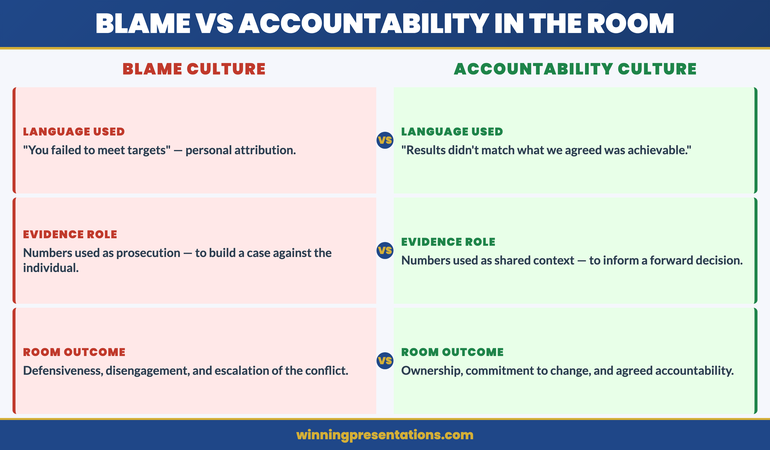
Distinguish between a response that seeks information and one that seeks to discredit. A question like “what support has been offered?” is information-seeking — the executive wants to know whether due process has been followed. A question like “isn’t this a management problem rather than a performance problem?” is often an attempt to redirect accountability. The first deserves a direct, detailed answer. The second deserves a measured response that acknowledges the management dimension while maintaining the performance narrative.
Never make commitments in the room that you haven’t modelled. Under social pressure from a defensive executive, the impulse to concede — to agree that more time should be given, or that the targets should be reviewed — can feel like a way to reduce conflict in the moment. It is rarely a sound operational decision. If you need to consider a proposed change to the performance management plan, commit to modelling the impact and returning within a specific timeframe, rather than agreeing on the spot.
Bring the conversation back to organisational impact. When the room becomes focused on the individual’s personal circumstances or on historical decisions, the most effective re-framing is to return to the organisational impact statement. “I understand the context. The question for this committee is what we do about the fact that [named outcome] is at risk.” This shifts the frame from blame to decision — which is where executive committees are most effective. The principles here align with those in the companion piece on presenting redundancy announcements to affected teams.
The Post-Presentation Follow-Up That Makes It Stick
The performance review presentation creates commitments — from you, from the individual concerned (if present), and from the leadership body. The post-presentation follow-up determines whether those commitments are honoured or allowed to fade. There are three elements to an effective follow-up process.
A written record of decisions made. Within 24 hours of the presentation, send a summary of the decisions taken and actions agreed in the meeting. This serves as a contemporaneous record — which matters both for due process and for accountability. The summary should be factual and outcome-focused, not a narrative account of the discussion.
A direct conversation with the individual. If the individual was not present in the executive presentation, they need to be informed of the leadership body’s assessment and decisions as soon as possible — typically within the same working day. The individual should hear the outcome directly from their manager, not through informal channels. The conversation should align precisely with the written record: the same language, the same commitments, the same timeline.
A structured review checkpoint. The performance improvement plan that follows should have a named review date — typically 30, 60, or 90 days, depending on the severity of the concern. This checkpoint should be diarised at the time of the presentation, with the expectation that you will return to the executive body with a progress update at that point. This creates accountability for both the manager and the individual, and demonstrates to the board that the issue is being actively managed rather than filed.
Protecting Yourself Legally and Professionally
Performance presentations at executive level create a paper trail that may become relevant in subsequent employment proceedings. The way you present the information — and the language you use — has implications that extend beyond the meeting. There are four principles that protect your professional and legal position.
Use documented evidence only. Do not include in your presentation any assertion, characterisation, or concern that does not exist in a contemporaneous written record. The moment an executive presentation introduces information that was never documented at the time it occurred, you create credibility risk — and potentially legal risk if the matter escalates to an employment tribunal.
Involve HR before the presentation. HR should be consulted on both the process and the content of any performance presentation to a leadership body. This is not bureaucratic caution — it is risk management. HR will often identify procedural gaps that, if not addressed before the presentation, create grounds for challenge later.
Be consistent in application. An executive audience will assess whether your performance management approach has been applied consistently across the team. If the individual being discussed has been managed more leniently or more harshly than colleagues in comparable situations, this inconsistency will be visible — and will invite questions about whether the performance concern reflects a genuine standard gap or a management preference. The broader context of leadership credibility in high-stakes presentations is covered in the guide to building credibility in your first board presentation in a new role.
Do not speculate about outcome. In the presentation itself, do not reference possible termination, demotion, or other employment outcomes unless these have been agreed in advance with HR and legal as appropriate disclosures. Speculating about employment consequences in an executive presentation — even informally — can prejudice a subsequent process.
Structure Your Next Leadership Briefing
The Executive Slide System includes framework guides for structuring operational presentations — including sensitive situations that need to hold up under board-level and HR scrutiny.
View the Executive Slide System — £39
Designed for executives preparing operational briefings for senior leadership.
Frequently Asked Questions
Should the individual being reviewed be present in an executive-level performance presentation?
This depends on the nature and purpose of the presentation. If the purpose is to brief a leadership body on an operational risk situation, the individual is typically not present — the presentation is a management briefing, not a performance review meeting. If the presentation is part of a formal HR process and the individual has a right to attend or be represented, HR will advise on the appropriate protocol. As a general principle, decisions about individual presence should be made with HR guidance before the presentation, not during it.
How do I present performance concerns without being accused of bias or discrimination?
The most effective protection against bias accusations is a structure that is entirely evidence-based and explicitly linked to agreed standards. When every assertion in your presentation can be traced to a documented record, a named target, or a published standard, the presentation becomes an analysis of a gap rather than a judgement about a person. Consistency is equally important: ensure that the performance management approach you describe has been applied in the same way to comparable situations across the team.
What should I do if the executive committee disagrees with my assessment?
Listen carefully to the basis of their disagreement. If they have information you do not — about the individual’s context, about commitments made at a higher level, about strategic considerations that affect the assessment — that information is relevant and you should factor it in. If the disagreement is about the interpretation of evidence that you and HR are confident in, present the evidence clearly and request that any decision to deviate from the recommended management approach be made explicit and minuted. You are not required to change your assessment in response to social pressure, but you are required to implement whatever decision the governance body makes within its authority.
The Winning Edge — Weekly Newsletter
Executive presentation strategy, delivered every Thursday. Practical frameworks for high-stakes operational and leadership conversations.
Free resource: Executive Presentation Checklist — a practical pre-meeting audit for high-stakes leadership presentations.
About the Author
Mary Beth Hazeldine is Owner & Managing Director of Winning Presentations. With 24 years of corporate banking experience at JPMorgan Chase, PwC, Royal Bank of Scotland, and Commerzbank, she advises executives across financial services, healthcare, technology, and government on structuring presentations for high-stakes funding rounds and approvals. Connect at winningpresentations.com.


