Tag: headcount request

11 Apr 2026
Senior executive presenting a workforce planning business case to a finance panel — boardroom setting, data-led discussion, confident composed presenter, navy and gold tones

Workforce Planning Presentation: How to Build the Business Case for Headcount and Talent Investment

Quick Answer

A workforce planning presentation wins approval when it frames people investment as a business continuity and performance risk issue, not a staffing preference. Connect each headcount request to a revenue, delivery, or compliance outcome. Boards approve people investment when they can see the cost of the gap, not just the cost of filling it.

Henrik had been waiting for the right moment to bring the workforce planning case to the ExCo for over a year. His organisation was running three critical programmes with teams at 60 per cent of required capacity. Two delivery leads had resigned in eight weeks. Three client contracts had slipped past their committed milestones. He had the data. He had the analysis. He had a clear investment request.

What he did not have was a presentation that made the financial consequence of the talent gap visible to people who were looking at a cost line, not a delivery problem. His first attempt opened with a slide titled “Our People Strategy 2026–2028.” The CFO asked, at the first opportunity, whether the request could wait until the September budget cycle. It was March.

Henrik restructured over one weekend. He replaced the people strategy title with “Revenue and Delivery Risk: Talent Gap Impact Analysis Q1–Q3 2026.” The first content slide showed three specific contracts at risk, with the combined value at risk and the direct cause — under-resourced delivery teams. He was approved within the week.

The data had not changed. The risks had not changed. Only the frame had changed — and the frame made the difference between a deferral and a decision.

Preparing a headcount or people investment case right now?

The Executive Slide System includes slide templates and scenario guides for investment approvals, resource cases, and strategic reviews. It may save you a full deck rebuild.

Explore the System →

Why Workforce Planning Presentations Lose in the Boardroom

People investment cases face a structural disadvantage in executive presentations. Unlike capital expenditure on equipment or technology, headcount investment is perceived as open-ended. Once approved, it establishes a baseline. It grows. It is politically difficult to reverse. These perceptions — whether or not they are accurate in a specific case — shape the scepticism that your presentation must overcome before it reaches the financial analysis.

The second disadvantage is that workforce planning presentations are typically prepared by HR directors or talent leads who are closer to the people complexity than the financial risk. The language of these presentations — capability frameworks, succession pipelines, development investment, engagement scores — is specialist language that does not map directly to the financial and operational language that ExCo and board members use to evaluate investment decisions.

This is not a criticism of HR expertise. It is a diagnosis of a communication gap that recurs across industries and organisation sizes. The fix is not to pretend the people complexity does not exist — it is to translate that complexity into the financial and operational frame your audience uses to make decisions. That translation work is what separates workforce planning presentations that are approved from those that are deferred.

The third failure mode is the absence of urgency. Workforce planning is inherently forward-looking — it deals with risks that will materialise over months or years rather than in the next quarter. Presentations that present this as a planning exercise rather than an immediate risk management decision give executives permission to defer. Your presentation must establish a compelling reason to decide now, or the default answer will always be “not yet.”

Framing Headcount as a Financial Risk, Not a Resource Request

The most effective workforce planning presentations begin not with the headcount number, but with the business risk that the headcount gap is creating. This is a deliberate inversion of the usual approach — most HR-led presentations start with the current state of the workforce and build toward the investment request. Starting with the risk creates a different conversation from the first slide.

The financial risks associated with talent gaps typically fall into four categories. Revenue risk occurs when under-resourced sales, delivery, or client-facing teams cannot execute on committed pipeline or contracted obligations. Delivery risk occurs when project and programme teams cannot meet milestones, creating penalties, reputational damage, or client attrition. Compliance and regulatory risk occurs when specialist functions — legal, risk, finance, data protection — are running below the headcount required to discharge their obligations. Operational resilience risk occurs when single points of dependency create vulnerability to resignation, illness, or unexpected demand.

Map each element of your workforce investment request to one of these risk categories, and quantify the exposure wherever possible. The approach to building a CFO-ready investment case is the same whether the investment is in capital equipment or in people — see the framework in this analysis of getting the CFO on side before the investment presentation. The same pre-meeting alignment principles apply directly to workforce cases.

One technique that consistently strengthens financial framing is the cost-of-vacancy analysis. Rather than presenting the cost of hiring, present the fully loaded cost of the vacancy — the revenue not captured, the work absorbed by over-stretched team members, the quality degradation in delivery, and the increased attrition risk as remaining team members carry unsustainable loads. In most organisations this analysis, when done rigorously, shows that a vacancy costs significantly more than the salary of the role it represents. This reframes the investment from a cost add to a cost reduction.

Four workforce risk categories for executive presentations: revenue risk, delivery risk, compliance risk, and operational resilience

Presenting the Talent Gap Analysis Executives Respond To

A talent gap analysis in an executive presentation is not a comprehensive workforce audit. It is a focused assessment of the specific capability shortfalls that are creating — or will create — the business risks you identified in the previous section. The distinction matters because comprehensive analyses generate questions and debate that divert attention from the investment decision you need.

Structure your gap analysis around three questions. First: what capabilities are required to deliver the business plan in the next twelve to eighteen months? This is a forward-looking question — not what you have, but what you need. Second: what is the gap between current capability and required capability, expressed in specific roles, skills, or capacities? Third: what is the timeline of that gap — which elements are already creating business impact, which will create impact within six months, and which are longer-term strategic considerations?

This three-question structure keeps the gap analysis anchored to the business plan rather than to the workforce in isolation, and it creates a natural urgency gradient — decision-makers can see immediately which elements of the gap require an immediate decision and which can be addressed through a phased approach.

The Executive Slide System includes framework guides for presenting capability and resource analysis in a board-ready format — specifically the challenge of making complex talent data readable at a senior level without losing the analytical rigour that gives the case credibility. If you are building this section of your workforce presentation, those frameworks provide a starting structure that connects capability analysis to business outcome without requiring a page of HR commentary to explain.

Build Your Workforce Investment Case on Slides Executives Approve

The Executive Slide System — £39, instant access — includes slide templates for investment approvals, resource cases, and strategic reviews, with AI prompt cards to structure your financial risk argument and framework guides that organise complex workforce data the way decision-makers read it.

  • Slide templates for executive scenarios including investment approvals
  • AI prompt cards to build financial risk and gap analysis arguments
  • Framework guides for resource and capacity presentations
  • Scenario playbooks for strategic people investment decisions

Get the Executive Slide System →

Designed for executives who present investment cases, resource requests, and strategic proposals to boards and senior leadership teams.

Structuring Your Investment Ask in Tiers

One of the most effective structural choices in a workforce planning presentation is to present the investment request in tiers rather than as a single aggregate number. A single large headcount or salary cost number invites the question “can we do this for less?” — and puts the presenter in a defensive position. A tiered request invites the question “which tier do we approve?” — a more productive conversation that often results in a faster and larger decision.

Tier one should contain the investment required to address immediate, high-impact gaps — the roles or capabilities that are creating current revenue, delivery, or compliance risk. This tier should be sized conservatively and presented with specific risk mitigation as its output. Frame it as the minimum required investment, not the preferred scenario.

Tier two should contain the investment required to fully close the capability gap against the current business plan — to move from risk mitigation to planned capacity. This is your preferred scenario, and it should be linked explicitly to the financial plan: “With tier two approved, we project delivery against the three contracts currently at risk, and we restore the capacity margin required for the Q3 pipeline.”

Tier three, if applicable, should contain the investment required for strategic capability building — roles or capabilities needed for the business plan beyond the current period. This tier is discretionary and should be presented as such. Including it demonstrates that you have thought beyond the immediate requirement, without making the strategic ambition a condition of the immediate approval.

This tiering approach works for the same reason that tiered investment requests work in capital expenditure cases — see the analysis of getting headcount requests approved for the specific framing techniques. It respects the decision-maker’s need to calibrate investment to risk, rather than presenting a take-it-or-leave-it number that creates unnecessary friction.

Handling Common Executive Objections to People Investment

Workforce planning presentations attract a predictable set of objections. Anticipating and structuring responses to these objections before they are raised — either through pre-meeting alignment or through dedicated slides — dramatically improves approval rates.

“Can we develop internally rather than hiring?” This objection reflects a legitimate cost management instinct, but it often underestimates the timeline and capacity constraints of internal development. Your response should acknowledge internal development as part of the long-term strategy while being specific about which elements of the current gap require external hiring: the skills that take twelve to eighteen months to develop internally, the capacity shortfall that cannot be absorbed by development timelines, and the immediate delivery risk that cannot wait for a development programme to complete.

“Can we use contractors or interim resource rather than permanent headcount?” This is sometimes the right answer, and your presentation should address it explicitly rather than waiting for the question. Where the capability gap is temporary or project-specific, interim resource may be the appropriate recommendation. Where the gap is structural — driven by business plan growth, regulatory requirement, or permanent capability shortfall — permanent headcount is the appropriate answer, and you should be prepared to make that case on the basis of total cost of ownership rather than salary line.

“Is this the right time, given the current budget environment?” This is the timing objection — the most common and the hardest to overcome without clear urgency framing. Your response should return to the cost-of-vacancy and delivery risk analysis: the question is not whether the budget environment is challenging, but whether the cost of deferring is greater than the cost of the investment. In most cases where a genuine gap exists, the answer is yes — and your analysis should have made that quantification before this question arises.

Handling objections in executive presentations requires both preparation and a specific structural approach that keeps the conversation on the decision rather than on the objection. The framework in this analysis of managing objections in presentations applies directly to the challenges outlined above.

People also ask: How do I make a workforce planning presentation to the board? A board-level workforce planning presentation should be no more than eight to ten slides and should open with the business risk, not the people strategy. The first two slides should establish what is at risk financially and operationally if the gap is not addressed. The investment request should be tiered. Governance and accountability should be explicit. Avoid HR-specific language — use the financial and operational vocabulary your board uses to evaluate all investment decisions.

People also ask: What data should I include in a workforce planning presentation? Include only the data that is directly relevant to the investment decision. The most effective data points are: the specific roles or capability gaps creating current or near-term business risk, the quantified financial impact of those gaps, the timeline of impact, and the cost comparison between the investment and the ongoing cost of the gap. Avoid presenting comprehensive workforce analytics — they generate questions that dilute the investment conversation.

The Slide Structure That Gets Workforce Investment Approved

The structure below is designed for an ExCo or board-level workforce planning presentation where the primary objective is investment approval. It follows the same logic as any high-stakes investment case: establish the risk, quantify the consequence, define the solution, tier the ask, demonstrate accountability.

Slide 1 — The decision framing: State the investment request and the risk it addresses in one sentence. “We are requesting approval of [headcount/budget] to address a capability gap that is currently placing [three contracts / £X revenue / regulatory compliance in Y] at risk.”

Slide 2 — Current state risk summary: Three to four specific business risks — with financial quantification — created by the current gap. Not a workforce analysis. A business risk analysis.

Slide 3 — Gap analysis: What capability is missing, at what scale, and on what timeline. Anchored to the business plan, not to the workforce structure.

Slide 4 — Tiered investment request: Three tiers — minimum risk mitigation, full gap closure, strategic development — with costs and outputs for each tier clearly stated.

Slide 5 — Cost-of-vacancy analysis: The ongoing cost of the gap per quarter or per year, compared to the investment required to close it. This slide makes the financial case for acting now rather than deferring.

Slide 6 — Governance and accountability: The executive owner, the hiring and onboarding plan, and the four to six milestones by which progress will be measured in the next twelve months.

Slide 7 — The recommendation: The specific tier you are recommending for approval, with a clear statement of the risk it addresses and the outcome it delivers. End with the ask. Companion articles on ESG board presentations and the principles of strategic investment approval apply equally here — both cases require the same risk-first framing discipline.

Seven-slide workforce planning presentation structure from decision framing through investment tiers to governance and recommendation

Structure Your Investment Case the Way Boards Approve It

The Executive Slide System — £39 — includes scenario playbooks and framework guides structured for strategic investment approvals, resource cases, and board-level risk presentations. Get the slide templates that connect your people investment to financial outcomes.

Get the Executive Slide System →

Designed for executives who present investment cases, resource requests, and strategic proposals to boards and senior leadership teams.

Frequently Asked Questions

How long should a workforce planning presentation be?

For an ExCo or board-level investment approval, a workforce planning presentation should be between seven and ten slides, presented in fifteen to twenty-five minutes with time for questions. Longer presentations signal that the business risk has not been distilled clearly — and they increase the likelihood of the conversation drifting into workforce complexity rather than focusing on the investment decision. If you have more detailed analysis, place it in an appendix that can be referenced during questions.

Should I involve the CFO before the formal workforce planning presentation?

Yes — pre-meeting alignment with the CFO is one of the most reliable ways to improve the outcome of a workforce planning presentation. The CFO’s primary concern will be the financial analysis: the cost-of-vacancy calculation, the investment sizing, and the basis for the financial risk estimates. If the CFO has reviewed and is comfortable with the financial analysis before the formal presentation, they become an implicit endorser rather than an objector. A brief thirty-minute meeting before the ExCo session, where you walk the CFO through the financial logic, removes the single most common source of challenge in the room.

What is the best way to present headcount numbers to a cost-conscious executive team?

Present headcount numbers as a ratio of investment to risk mitigation, not as a salary cost in isolation. “We are requesting four additional roles at a total annual cost of £320,000. The current gap in these capabilities is creating a revenue risk of £1.2 million in the next two quarters and a delivery penalty exposure of £180,000.” This framing makes the investment decision legible as a financial calculation rather than a headcount preference. If you present the salary cost alone, cost-management instincts dominate. If you present it as a risk-adjusted investment, the conversation moves to evaluation rather than resistance.

Get weekly presentation strategy in your inbox

Every Thursday, The Winning Edge delivers one actionable insight for executives who present investment cases, strategic proposals, and resource requests to boards and senior leadership teams.

Subscribe to The Winning Edge →

Free resource: Download the Executive Presentation Checklist — a one-page pre-presentation audit for executives preparing high-stakes investment and strategic approval presentations.

About the Author

Mary Beth Hazeldine is Owner & Managing Director of Winning Presentations. With 25 years of corporate banking experience at JPMorgan Chase, PwC, Royal Bank of Scotland, and Commerzbank, she advises executives across financial services, healthcare, technology, and government on structuring presentations for high-stakes investment cases, resource approvals, and board decisions.

08 Apr 2026

Resource Allocation Presentation: Structuring the Case When Budgets Are Contested

Quick Answer

A resource allocation presentation succeeds when it reframes the request from “we need resources” to “here is the cost the organisation is currently bearing by not having them.” Lead with the business impact of the current resourcing gap, quantify where possible, and present headcount or budget as the solution to a named problem — not as a departmental ask. The decision-makers approving your request are evaluating whether the business case justifies the investment, not whether you deserve support.

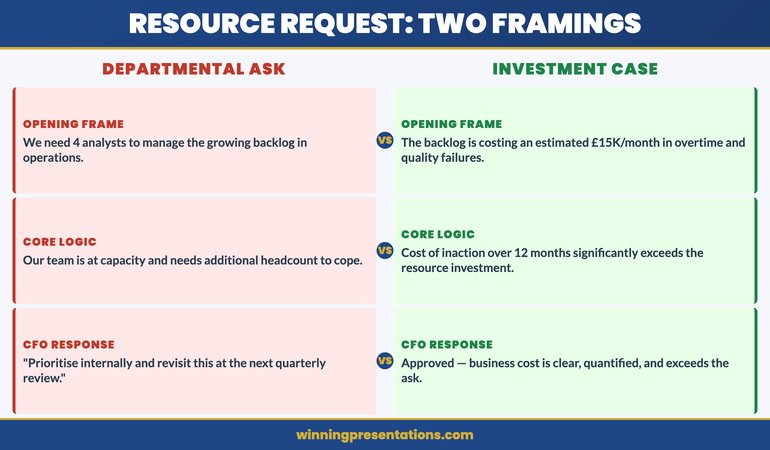
Priya had been waiting six months for approval to hire four additional analysts in her operations team. The backlog was growing. Her existing team were working consistent twelve-hour days. The quality issues were escalating. She had a presentation slot at the quarterly resource review and she was confident the case was obvious.

She opened with: “We need four additional FTEs in operations to manage the current workload and address the backlog that’s been building since Q3.”

The CFO responded: “We’re in a constrained environment. Can you look at prioritising internally and coming back to us with a revised request?” Meeting closed. No decision. Priya left without the headcount.

Three months later, a different team in the same organisation made an almost identical request using a different framing. They opened with the cost of the quality failures, not the size of the headcount gap. They quantified the revenue at risk from the backlog. They got approval the same day.

The two presentations had the same underlying business case. The difference was structural. One asked for resources. The other made the cost of not resourcing impossible to ignore.

Presenting a headcount or budget request this quarter?

Check whether your resource case is framed to get a decision:

  • Does your opening slide describe the business cost of the gap — not the size of the gap?
  • Have you quantified the impact in terms the CFO uses (revenue, cost, risk)?
  • Have you pre-empted the “prioritise internally” objection with a clear slide?

The Executive Slide System includes business case slide frameworks for resource requests, headcount justifications, and budget approvals. Explore the System →

Why Resource Requests Fail at the First Slide

The structural failure in most resource allocation presentations happens before the first supporting slide. It happens in the way the request is framed — and the framing sets the entire tone of the decision-making conversation that follows.

When you open a resource request with “my team needs X headcount” or “we need an additional £Y to deliver this programme,” you have inadvertently positioned yourself as a department competing for a limited pool of organisational resource. The CFO’s mental model shifts to rationing mode: who else is asking, what is the priority order, can this be deferred?

By contrast, when you open with the business impact of the resourcing gap — the revenue at risk, the regulatory exposure, the client attrition rate, the project delay costs — you have positioned the resourcing decision as an organisational investment decision with a clear return. The CFO’s mental model shifts to investment mode: what is the cost of acting, what is the cost of not acting, which is higher?

This is not a rhetorical trick. It is a structural accuracy. In most cases where resource requests are genuinely justified, the business cost of underresourcing is real and quantifiable. The problem is that presenters know this cost intuitively but rarely make it explicit in the presentation. They present the solution (more headcount) without first establishing the problem (the current cost of the gap) in terms that decision-makers recognise.

The fix is to invert the sequence. Present the problem in business cost terms first. Present the solution — the resource request — second. The business case then feels inevitable rather than aspirational.

The Reframe: From “We Need” to “Here Is the Cost”

Two-column comparison showing weak resource request framing versus business-cost reframe approach for executive presentations

The reframe requires identifying, before the presentation, what the organisation is currently paying — in cost, risk, or lost revenue — because the resource gap exists. This is the cost-of-inaction analysis, and it is the most important preparation step in building a resource allocation presentation.

For an operations team with a backlog, the cost-of-inaction might include: delay costs from client contracts with service level agreements, overtime costs already being incurred by existing staff, quality failure costs from rushed delivery, staff turnover risk from sustained overwork, and revenue at risk from clients considering alternative providers.

Not all of these will be fully quantifiable. Some will be directional estimates. That is acceptable — you are not building an actuarial model, you are building a business case. The standard is whether the aggregate cost picture is credible and directionally accurate. Executives making resource decisions are accustomed to working with estimates. They are not accustomed to presenters who have not attempted to quantify the cost at all.

Once you have the cost-of-inaction picture, the structure of your opening changes entirely. Instead of “we need four analysts,” you can open with: “The operations backlog is currently running at eight weeks, which is creating three types of business cost I’d like to walk you through — and I’m proposing a resourcing solution that addresses all three at a total cost significantly below what we’re currently absorbing.”

That opening does not ask for anything. It announces a cost problem and a solution. The ask comes later, after the problem has been established on its own terms.

For the financial slide structures that support this approach, see capital expenditure presentations: building the approval case for board-level investment decisions.

The Business Case Framework That Gets Resource Requests Approved

Stop presenting headcount and budget requests as departmental asks. The Executive Slide System gives you the slide structure to reframe resource allocation as a business investment decision — with the sequence that gets CFO approval.

  • Business case slide templates for headcount requests, budget approvals, and programme investment decisions
  • Cost-of-inaction slide frameworks that quantify the business impact of the current resource gap
  • AI prompt cards to build the five-slide resource case in under 15 minutes
  • Objection-handling slide structures for the “prioritise internally” and “revisit next quarter” responses

Get the Executive Slide System → £39

Designed for operations, finance, and programme leaders presenting resource cases to CFOs, board committees, and senior leadership teams.

The Five-Slide Resource Allocation Framework

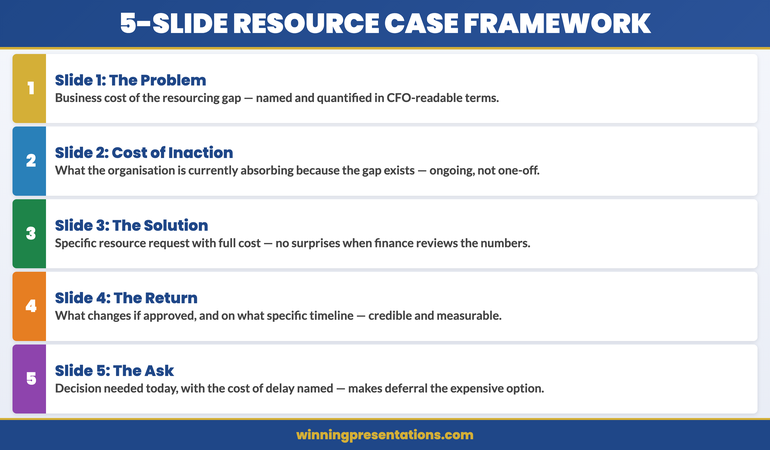
Most resource allocation presentations contain too many slides. The information needed to make a resource decision is focused: what is the problem, what does it cost, what is the proposed solution, what will it cost, and what is the expected return? Five slides cover this sequence. Every additional slide is generally context the decision-makers do not need in order to make the decision.

Slide 1 — The problem framed in business cost terms. A clear statement of the current resourcing gap and its business consequences. Not “we are understaffed” but “current resourcing is producing three identifiable cost outcomes for the business.” Name the outcomes. Quantify where you can.

Slide 2 — The cost-of-inaction analysis. This is often the most important slide in the deck, and the one most presenters skip. Show what the business is currently absorbing because the resourcing gap exists: delayed delivery, quality failures, staff overtime, client risk, regulatory exposure. Present this as an ongoing cost, not a one-off event. “We are currently absorbing an estimated £[X]K per month in [specific cost categories].”

Slide 3 — The proposed resource solution. Now — and only now — introduce the headcount or budget ask. “We are requesting approval for [specific resource] at a total cost of [£X] per annum, beginning [date].” Keep this slide clean and specific. Include the full cost — salary, benefits, onboarding, equipment — so there are no surprises in the financial review.

Slide 4 — The return on the investment. What will change if the request is approved? Be specific about which of the costs identified in slide 2 will be reduced or eliminated, and on what timeline. “Full resolution of the quality issue within 90 days of hire. Backlog reduction to four weeks by end of Q3. Overtime cost eliminated within six weeks.” Specificity here is credibility.

Slide 5 — The ask and the timeline. What do you need from this meeting, and by when? “We need a decision today to begin recruitment in April and have resource in place before Q3 deliverables begin.” Include the consequence of delay: “Each month of delay extends the backlog by approximately [X] weeks and incurs an estimated [£Y] in additional overtime.”

Five slides. Tight, evidence-based, decision-ready. For financial presentation structures supporting this framework, see zero-based budget presentations: building the case from a clean baseline.

How to Quantify the Business Case

The most common objection to the cost-of-inaction approach is: “I can’t quantify the cost precisely enough to put it in front of a CFO.” This objection is worth addressing directly, because it stops many managers from making the attempt.

A CFO reviewing a resource request does not expect a fully audited, actuarially precise cost model. They expect a credible, directionally accurate estimate of what the business is absorbing. The standard is whether the numbers are defensible under reasonable questioning — not whether they are exact.

A workable approach: identify two or three cost categories that are genuinely attributable to the resourcing gap and where you have enough data to produce a directional estimate. For a backlogged operations team: overtime hours worked per month multiplied by blended hourly rate; client SLA penalty clauses at risk; project delay costs from postponed deliverables. You do not need all three. Even one well-evidenced cost category is more persuasive than a verbal claim that “the team is at capacity.”

When presenting estimated figures, be transparent about the methodology: “Based on current overtime hours, we estimate this is costing approximately £15K per month in premium labour costs — and that figure excludes the quality failure costs, which are harder to quantify but have been flagged three times in client reviews this quarter.” Transparency about limitations increases, rather than decreases, credibility with financially sophisticated audiences.

If you’re building the financial case for a resource request this quarter, the Executive Slide System includes slide templates and AI prompt cards specifically designed for cost-of-inaction analysis — the structure that reframes headcount requests as investment decisions for CFO review.

Handling “Prioritise Internally” Objections

Resource allocation presentation objection-handling roadmap: four steps from objection to decision-ready response

“Have you considered whether this could be addressed through internal prioritisation?” is one of the most common responses to resource requests, and one of the most difficult to handle in a presentation setting if you haven’t prepared for it.

The question is not inherently adversarial. It is a legitimate governance question — the CFO’s job is to ensure that resource allocation reflects genuine need rather than departmental preference. The best response addresses it on those exact terms.

The preparation involves completing a credible internal prioritisation analysis before the presentation. What could the team stop doing, reduce in scope, or defer in order to absorb the additional demand? What is the business consequence of each trade-off? Present this analysis proactively — ideally as a dedicated slide in your five-slide framework — rather than waiting to be asked.

A slide that says “We have reviewed internal prioritisation options. Scenario A: defer [specific deliverable] to H2, with [specific business consequence]. Scenario B: reduce [specific workstream] to minimum viable scope, with [specific quality or risk consequence]. Neither scenario resolves the backlog within the Q3 timeline. The most cost-effective resolution remains the resource investment proposed.” This slide pre-empts the objection and demonstrates organisational rigour.

When the objection arises anyway — as it often does — you can respond: “We’ve actually modelled that, and it’s on slide 4. The short version is that the two realistic internal options both carry business costs that exceed the cost of the resource investment over a 12-month horizon. I’d be happy to walk through the detail.” You cannot be sent away to do work you’ve already done.

When to Present and When to Pre-Sell

The formal resource allocation presentation is not where decisions are made. In most organisations, significant resource decisions are made — or at minimum, strongly influenced — in the conversations that happen before the formal meeting. Understanding this changes how you should manage the process.

The most effective resource requesters approach formal presentations as confirmation meetings rather than persuasion meetings. By the time they walk into the room, the CFO or relevant budget holder has already seen the cost-of-inaction analysis in a one-to-one conversation, has had their primary concerns addressed, and has indicated — at minimum — that the case is credible. The formal presentation is where the decision is formalised, not where it is won.

This means the most important step in a resource allocation process often happens two weeks before the presentation: a brief, direct conversation with the decision-maker where you share the headline cost-of-inaction figure and ask whether they want to see the full analysis. “I wanted to give you a heads-up before the resource review — we’ve done some analysis on the backlog cost and I think the number will be higher than expected. Would it be helpful to walk you through it before the formal committee session?” Most CFOs say yes.

This pre-sell approach does not compromise the formal process. It ensures that the formal meeting is productive, focused, and conclusive — rather than an exploratory conversation where the CFO is encountering the case for the first time and needs time to process it before committing to a decision.

Today’s companion article on screen sharing presentations: keeping your audience engaged in virtual approval meetings covers the additional considerations for resource cases presented in remote or hybrid settings.

For revenue-related business cases, see revenue forecast presentations: structuring the financial narrative for senior review.

Stop Leaving Resource Decisions to “We’ll Revisit Next Quarter”

When resource requests are deferred, it’s usually because the business cost wasn’t clear enough to create urgency. The Executive Slide System includes the cost-of-inaction slide framework that makes deferral the more expensive option — and gets the decision at the meeting you’re in.

Get the Executive Slide System → £39

Built from business cases presented to CFOs and board committees across financial services, technology, and professional services.

Frequently Asked Questions

How many slides should a resource allocation presentation have?

Five slides is generally sufficient for a resource request presented to a CFO or senior committee: the problem framed in business cost terms, the cost-of-inaction analysis, the proposed resource solution, the expected return, and the ask with timeline. Additional slides may be appropriate for complex programme investments or multi-phase requests, but the core decision case should be completable in five. Appendices can carry supporting data for questions without adding to the main deck length.

What if I can’t quantify the business cost precisely?

Present a directional estimate with a transparent methodology, and acknowledge the limitations. A credible estimate — “we believe this is costing approximately £X per month, based on overtime hours and delayed delivery costs, though we acknowledge the quality failure component is harder to quantify” — is significantly more persuasive than a purely qualitative claim. CFOs are experienced at making decisions with imperfect data. They are not experienced at approving requests with no financial framing at all.

What’s the best time to submit a resource request?

Align resource requests with your organisation’s planning and budget cycle wherever possible — ideally the quarter before the cycle in which you need the resource in place. Outside of formal cycles, the right time is when the business cost of the gap has become quantifiable and significant. Presenting a resource request in a budget cycle is procedurally easier; presenting it mid-cycle requires a stronger business case. Both are possible — the strength of the cost-of-inaction analysis determines which will succeed.

How do I handle the response “headcount freeze is in place”?

A headcount freeze is a default policy response, not an absolute ceiling on resource decisions. The right response is to present the cost-of-inaction analysis as the reason the freeze should not apply to this request — or to explore whether the resource can be secured through alternative mechanisms: contract, consultancy, temporary cover, or internal reallocation with backfill. Presenting these alternatives proactively signals rigour and significantly increases the likelihood of a favourable decision even within a constrained environment.

The Winning Edge — Weekly Insights for Executive Presenters

Practical frameworks for structuring high-stakes presentations, managing executive audiences, and building decks that get decisions. Delivered every Thursday.

Join The Winning Edge →

Free resource: Executive Presentation Checklist — the pre-presentation checklist for business cases, resource requests, and approval presentations at board and senior leadership level.

About the Author

Mary Beth Hazeldine is the Owner & Managing Director of Winning Presentations. With 24 years of corporate banking experience at JPMorgan Chase, PwC, Royal Bank of Scotland, and Commerzbank, she has delivered high-stakes presentations in boardrooms across three continents.

A qualified clinical hypnotherapist and NLP practitioner, Mary Beth advises executives across financial services, healthcare, technology, and government on structuring presentations for high-stakes funding rounds and approvals.

Book a discovery call | View services

12 Feb 2026
Executive presenting headcount request to leadership team with approval indicators

The Headcount Request That Got Yes When Everyone Said No

“We’re in a hiring freeze. The answer is no.”

That’s what my client heard when she mentioned her headcount request to her CFO in the corridor. The company had just announced a 15% budget reduction. Every department was being told to do more with less. And Sarah needed 12 new engineers to deliver a project the CEO had personally championed.

Two weeks later, she got all 12 approved.

Not because she had special connections. Not because the freeze was lifted. But because her presentation made it impossible to say no — by making the cost of “no” crystal clear.

I’m sharing this now because headcount requests in 2026 face unprecedented scrutiny. AI is reshaping workforce planning, budgets are tight, and executives are asking harder questions about every hire. The old approach — “we need more people because we’re busy” — doesn’t work anymore. What works is a business case so compelling that approval becomes the obvious choice.

Quick answer: Successful headcount requests don’t ask for people — they present a business case for outcomes. The structure that works: lead with the business problem (not the resource gap), quantify the cost of inaction, present headcount as the solution to a problem leadership already cares about, and pre-answer the objections before they’re raised. This approach gets approval even during hiring freezes because it reframes the request from “cost” to “investment with measurable return.”

I’ve helped executives request headcount in every economic condition — boom times when money flowed freely, and downturns when every hire required CEO approval. The pattern is consistent: the requests that get approved aren’t the ones with the best justification. They’re the ones with the best presentation.

Sarah’s situation was typical. She had a genuine need — her team was working 60-hour weeks, attrition was climbing, and the CEO’s pet project was at risk. But her first draft presentation was also typical: a list of reasons why she needed more people, supported by workload data and burnout statistics.

It would have failed. Here’s why — and what we changed.

Why Most Headcount Requests Fail

The fundamental mistake in headcount presentations is starting with the resource gap. “We need 12 more engineers because…” immediately puts leadership in defence mode. They hear “cost” before they hear “value.”

The Psychology of No

When executives hear a headcount request, three mental processes activate simultaneously:

Budget protection: “Where will this money come from? What else won’t get funded?”

Precedent fear: “If I approve this, what other requests will follow?”

Accountability anxiety: “If this hire doesn’t work out, it’s my signature on the approval.”

Your presentation has to address all three — before they become objections.

The “Busy” Trap

The most common headcount justification is also the weakest: “We’re too busy.” Every department is busy. Every manager feels understaffed. “Busy” doesn’t differentiate your request — it makes you sound like everyone else who’s asking.

What executives actually need to hear: not that you’re busy, but that specific business outcomes are at risk without additional resources. That’s a completely different conversation.

🎯 Executive Slide System — Headcount Request Templates Included

Stop building headcount presentations from scratch. The Executive Slide System includes ready-to-use templates for resource requests, budget approvals, and business cases — all structured to get executive buy-in.

  • Business case structure that leads with outcomes
  • ROI calculation frameworks executives trust
  • Objection pre-answer templates
  • Decision slide formats that drive approval

Get the Executive Slide System → £39

Instant download. Used in headcount requests that have secured hundreds of new hires across banking and consulting environments.

The 5-Slide Structure That Gets Yes

Here’s the exact structure Sarah used to get 12 engineers approved during a hiring freeze:

Slide 1: The Business Problem (Not the Resource Gap)

Don’t open with “We need more people.” Open with the business problem that leadership already cares about.

Sarah’s opening: “Project Phoenix — the CEO’s priority initiative — is at risk of missing its Q3 deadline. Current trajectory shows a 67% probability of 8-week delay, which would push launch past the competitor window.”

Notice what’s not mentioned: headcount, engineers, workload, burnout. The first slide is entirely about business impact. Leadership is now thinking about Project Phoenix, not about budget.

Slide 2: The Cost of Inaction

Before you present your solution, make the cost of doing nothing undeniable.

Sarah’s slide: “An 8-week delay costs £2.4M in delayed revenue, puts the Series B timeline at risk, and allows CompetitorX to establish market position. Additionally, current team attrition trajectory suggests we lose 3 senior engineers in the next 90 days — each representing £180K in replacement and ramp-up costs.”

This slide does the heavy lifting. When the cost of inaction is £2.4M+, the cost of 12 engineers looks like a bargain.

Slide 3: The Solution (Now You Can Mention Headcount)

Only after establishing the problem and the cost of inaction do you present headcount as the solution.

Sarah’s framing: “To deliver Phoenix on schedule and protect the £2.4M revenue, we need to add 12 engineers over the next 6 weeks. This represents a £840K annual investment that protects £2.4M in near-term revenue and establishes the team capacity for the 2027 roadmap.”

The headcount request is now positioned as a solution to a problem leadership wants solved — not as a cost to be minimised.

Slide 4: The Risk Mitigation

Address the “what if it doesn’t work” fear before it’s voiced.

Sarah included:

  • Hiring timeline: Specific milestones with contingency plans
  • Ramp-up plan: How new hires become productive (with timeline)
  • Success metrics: How leadership will know the investment is working
  • Exit ramp: What happens if business conditions change

This slide removes the “what if” anxiety that kills approvals.

Slide 5: The Decision

End with a clear, specific ask — not a vague request for “support.”

Sarah’s close: “I’m requesting approval to open 12 engineering requisitions immediately, with a £840K annual budget allocation. This protects £2.4M in Phoenix revenue and positions us for the 2027 roadmap. I need your decision by Friday to maintain the hiring timeline.”

Clear ask. Clear timeline. Clear next step.


5-slide headcount request structure showing business case framework for approval

Want this structure as a ready-to-use template? The Executive Slide System includes the complete headcount request framework — plus decision slides, ROI calculators, and objection pre-answers.

Get the Templates → £39

Making the Numbers Undeniable

The difference between headcount requests that get approved and those that get “let’s revisit next quarter” often comes down to how the numbers are presented.

The ROI Frame

Never present headcount as a cost. Always present it as an investment with measurable return.

Weak: “12 engineers will cost £840K annually.”

Strong: “A £840K investment protects £2.4M in revenue and enables £4.2M in 2027 roadmap delivery. ROI: 7.9x in year one.”

The numbers are the same. The frame is completely different.

The Comparison Anchor

Give leadership a reference point that makes your request seem reasonable.

Sarah’s anchor: “The cost of 12 engineers (£840K) is less than the cost of the 8-week delay (£2.4M), less than the cost of losing 3 senior engineers to attrition (£540K in replacement costs), and less than the consulting alternative (£1.2M for equivalent capacity).”

When you anchor against worse alternatives, your request becomes the sensible middle ground.

The Staged Approach

If your full request feels too large, offer a staged alternative that gets you started.

Sarah’s backup: “If 12 immediate hires isn’t possible, a phased approach of 6 now and 6 in Q2 still protects the Phoenix timeline, though with reduced margin for error.”

This shows flexibility while maintaining the business case. Leadership often approves the full request when they see you’ve thought through alternatives.

📊 Build Business Cases That Get Approved

The Executive Slide System gives you the frameworks for any approval presentation — headcount, budget, project investment, or strategic initiative. Stop guessing what executives want to see.

  • Cost-of-inaction calculation templates
  • ROI presentation frameworks
  • Risk mitigation slide structures
  • Decision slide formats that drive action

Get the Executive Slide System → £39

Instant download. Developed from 24 years of corporate banking presentations where every resource request faced intense scrutiny.

Pre-Answering the Objections

The best headcount presentations answer objections before they’re raised. Here are the five you’ll face — and how to address them in your slides:

Objection 1: “Can’t you do more with AI/automation?”

Pre-answer: Include a slide on what you’ve already automated and why the remaining work requires human judgment. “We’ve automated 40% of routine tasks. The remaining work — architecture decisions, client relationships, complex problem-solving — requires experienced engineers.”

Objection 2: “What about contractors instead of FTEs?”

Pre-answer: Show the total cost comparison including ramp-up time, knowledge retention, and long-term flexibility. Contractors often cost more when you factor in everything.

Objection 3: “Can you reprioritise instead?”

Pre-answer: Show what gets cut if you don’t add headcount — and the business impact of those cuts. Make leadership choose between options, not between “yes” and “no.”

Objection 4: “What if the project gets cancelled?”

Pre-answer: Show how the roles support multiple initiatives, not just one project. “These 12 engineers support Phoenix, but also provide capacity for the 2027 roadmap and reduce our single-point-of-failure risk on critical systems.”

Objection 5: “Why now? Can’t it wait?”

Pre-answer: Show the cost of delay. “Every month we wait adds £300K to the eventual cost (higher salaries in a tighter market, extended project timeline, continued attrition of current team).”

Handling the Tough Q&A

Even with perfect slides, headcount requests face intense questioning. Here’s how to handle the moments that determine approval:

When They Challenge Your Numbers

Don’t get defensive. Show your work.

“The £2.4M delay cost comes from three factors: £1.8M in delayed subscription revenue based on current pipeline, £400K in additional contractor costs to extend the bridge period, and £200K in opportunity cost from the sales team’s reduced confidence in our delivery timeline. I can walk through each calculation.”

When They Ask for Less

Don’t immediately agree. Show the trade-offs.

“I can work with 8 instead of 12, but I want to be transparent about what that means: we move from 95% confidence on the Q3 deadline to about 70%, and we lose the buffer for the inevitable surprises. If 8 is the decision, I’ll make it work — but I want leadership to understand the risk we’re accepting.”

When They Want to Delay the Decision

Make the cost of delay concrete.

“I understand the desire for more time. But every week we delay the hiring process adds roughly 2 weeks to the project timeline, because good candidates don’t stay on the market. If we decide Friday, we can still hit Q3. If we wait until end of month, Q3 becomes unlikely.”

Facing tough Q&A on your headcount request? The Executive Q&A Handling System gives you frameworks for handling challenges, pushback, and curveball questions with confidence.

Get the Q&A System → £39

What Happened to Sarah

Sarah presented to the CFO, COO, and CEO on a Thursday morning. The same CFO who had said “the answer is no” in the corridor.

The presentation took 12 minutes. The Q&A took 20. Most of the questions were about implementation details — a sign that approval was likely.

By Friday afternoon, she had written approval for all 12 positions.

The CFO told her afterwards: “I’ve seen a hundred headcount requests this year. Yours was the only one that made me feel like saying no would cost us money.”

That’s the reframe that changes everything. Not “please give me resources” but “here’s what you lose if you don’t.”

🎯 Get Your Headcount Approved

The Executive Slide System includes everything you need to build a headcount presentation that gets yes:

  • Business case templates: Lead with outcomes, not resource gaps
  • Cost-of-inaction frameworks: Make “no” more expensive than “yes”
  • ROI calculators: Present investment, not cost
  • Objection pre-answers: Address concerns before they’re raised
  • Decision slides: Clear asks that drive approval

Get the Executive Slide System → £39

Instant download. The same frameworks used in headcount requests that have secured hundreds of new hires — even during hiring freezes.

📬 PS: Weekly strategies for executive presentations and getting buy-in. Subscribe to The Winning Edge — practical techniques from 24 years in corporate boardrooms.

Frequently Asked Questions

What if my company has a strict hiring freeze with no exceptions?

Even “no exceptions” freezes have exceptions — they just require CEO-level approval and an exceptional business case. Use the cost-of-inaction framework to show that the freeze is costing more than the hire. If the numbers are compelling enough, freezes get unfrozen. If they’re not, at least you’ve positioned yourself for first approval when the freeze lifts.

How do I request headcount when I can’t quantify the revenue impact?

Focus on risk and cost avoidance instead of revenue. “Without this hire, we have single-point-of-failure risk on a critical system” or “Current overtime costs are £X per month and climbing” or “Attrition risk in the current team represents £Y in replacement costs.” Not everything ties to revenue, but everything ties to something leadership cares about.

Should I ask for more than I need, expecting to be negotiated down?

No. Ask for exactly what you need with clear justification. Padding your request damages credibility and invites the “let’s cut this by 30%” response. If you need 12, ask for 12 and show why 12 is the right number. You can offer a phased alternative, but don’t inflate the initial ask.

How long should a headcount presentation be?

Five to seven slides maximum for the core presentation. You can have backup slides for detailed questions, but the main narrative should be completable in 10-15 minutes. Executives make headcount decisions quickly when the business case is clear — long presentations signal unclear thinking.

Related: If past presentation failures are affecting your confidence in high-stakes requests like headcount approvals, read Presentation PTSD Is Real: Signs You’re Still Carrying an Old Failure for techniques to break the pattern.

Sarah’s CFO was right about one thing: during a hiring freeze, the default answer is no.

But defaults can be overridden — when the cost of “no” is higher than the cost of “yes.”

Your headcount request isn’t about getting resources. It’s about presenting a business case so compelling that approval becomes the obvious choice.

Lead with the problem. Quantify the cost of inaction. Position headcount as the solution. Pre-answer the objections. Ask for a clear decision.

That’s how you get yes when everyone else is hearing no.

About the Author

Mary Beth Hazeldine is the Owner & Managing Director of Winning Presentations. With 24 years in corporate banking at JPMorgan Chase, PwC, Royal Bank of Scotland, and Commerzbank, she has supported hundreds of resource requests, budget approvals, and headcount presentations in high-scrutiny environments.

A certified hypnotherapist and NLP practitioner, Mary Beth combines executive communication expertise with an understanding of the psychology behind approval decisions. She helps professionals build business cases that get yes — even when the default answer is no.

Book a discovery call | View services