

Quick Answer
A cross-cultural presentation requires adapting your communication style — not your content — to the decision-making norms of the audience in the room. What reads as confident directness in London can read as aggressive in Tokyo. What feels like thorough preparation in Frankfurt can feel like over-engineering in New York. The content stays the same. The framing, structure, and delivery shift to match how your audience processes information and makes decisions.
In this article
Astrid had presented the same strategic recommendation to three different regional boards in the space of two weeks.
In Stockholm, she led with the data, presented two options with a clear recommendation, asked for questions, and had approval within twenty minutes. In Singapore, she followed the same structure. Forty minutes later, the board thanked her for the presentation and said they would discuss it internally. Two weeks passed before she received a response — a set of questions she had already answered on slide four. In São Paulo, the board interrupted her before the second slide, asked about the commercial implications, challenged the competitive assumptions, and approved the recommendation on the spot — but with a modification she hadn’t anticipated.
Same proposal. Same slides. Same presenter. Three completely different outcomes. The content wasn’t the variable. The audience’s decision-making culture was. And Astrid’s presentation hadn’t adapted to any of them.
Presenting to an international executive audience soon?
The Executive Slide System gives you adaptable templates and frameworks that work across different audience cultures — so you can structure your content once and adjust the delivery for any room.
Why Presentation Style Matters More Than Language
Most advice about cross-cultural presentations focuses on language: speak slowly, avoid idioms, use simple vocabulary. This is useful but insufficient. The deeper challenge is not whether the audience understands your words — it is whether your presentation structure matches how they expect to receive and process information.
In high-context cultures — Japan, South Korea, parts of the Middle East — what you don’t say often matters as much as what you do. A direct recommendation delivered early in the presentation can feel presumptuous, as though you have decided before consulting the room. In these settings, the expected structure is context first, analysis second, recommendation last — and the recommendation may be framed as a suggestion rather than a conclusion.
In low-context cultures — the US, UK, Netherlands, Australia — the opposite applies. A presentation that spends fifteen minutes building context before reaching the recommendation will lose the room. These audiences want the conclusion first, then the evidence to evaluate it. Anything else feels like deliberate delay.
German-speaking audiences occupy a different position entirely: they want depth. A presentation that moves quickly from recommendation to action without comprehensive supporting analysis feels superficial. They are not impatient for the conclusion — they are evaluating whether the analysis is rigorous enough to support the conclusion.
None of these preferences are wrong. They are simply different norms for how decisions get made. A strong cross-cultural presenter recognises which norm applies and adapts their structure accordingly. A weak one delivers the same presentation everywhere and wonders why it works in some rooms and fails in others.
The Three Decision-Making Norms That Change Everything
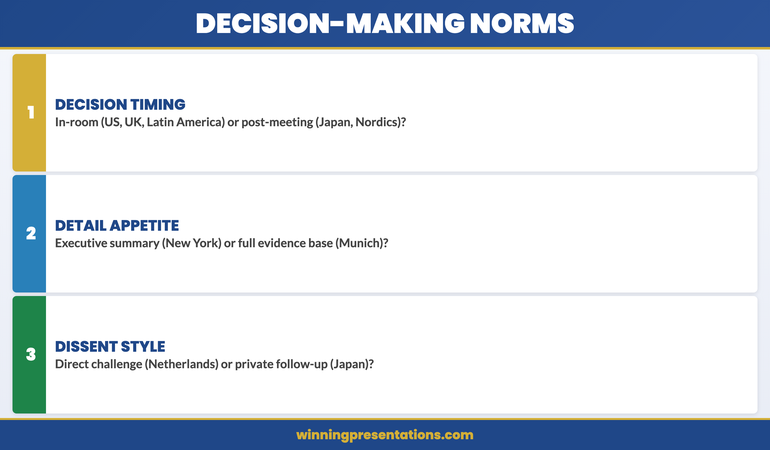
Rather than memorising cultural generalisations by country, focus on three structural variables that drive how your audience will respond to your presentation. Assess these before you build your deck.
1. Decision timing: in-room or post-meeting?
Some audiences expect to make decisions during the presentation. The US, UK, and much of Latin America fall into this category — if the case is strong, the decision should happen now. Other audiences — Japan, South Korea, and many Nordic organisations — prefer to deliberate after the presentation. The decision happens in a conversation you are not part of. If you structure your presentation to force an in-room decision with an audience that prefers post-meeting deliberation, you will get silence, not agreement. Build in a clear “next steps” slide that acknowledges the deliberation process without pushing for immediate commitment.
2. Detail appetite: executive summary or full evidence?
A board in New York may want three slides and a recommendation. A board in Munich may want thirty slides and a detailed appendix. Neither is wrong. The signal you need to read is how much analytical depth the audience requires before they feel comfortable making a decision. When in doubt, build a short core presentation with a comprehensive appendix. This lets you flex: present the summary to an action-oriented audience and pull up appendix slides for a detail-oriented one. The executive presentation structure that works globally is one designed to be modular, not fixed.
3. Dissent style: direct challenge or private question?
How an audience signals disagreement varies dramatically across cultures. In the Netherlands and Israel, disagreement is voiced openly and directly — it is not personal, it is the process. In Japan and many Southeast Asian cultures, disagreement is expressed indirectly: through questions, through silence, or through a follow-up conversation after the meeting. In parts of the Middle East, disagreement may come through a senior figure who speaks last, after everyone else has indicated support. If you misread the dissent style, you may think you have agreement when you actually have unresolved concerns — or you may interpret a direct challenge as hostility when it is simply how the conversation works.
One Deck, Any Audience — Built for Global Presenters
Presenting across cultures means building modular, adaptable decks — not starting from scratch for every region. The Executive Slide System — £39, instant access — gives you the templates designed for exactly this flexibility:
- Modular slide templates that flex from executive summary to full evidence
- AI prompt cards to adapt your messaging for different audience contexts
- Framework guides for structuring presentations around decision-making norms
- Executive summary formats that work for action-oriented and deliberation cultures
Get the Executive Slide System →
Designed for executives presenting strategic recommendations to global stakeholders.
Structural Adaptations for Different Audience Cultures
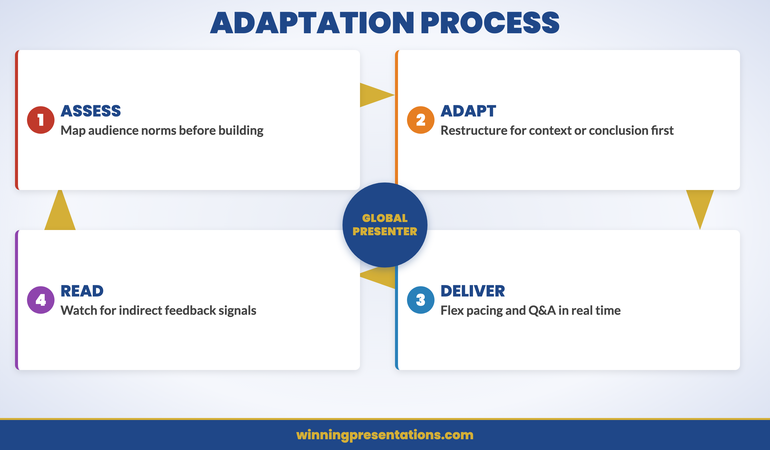
Once you understand which decision-making norms apply to your audience, the structural changes are straightforward. Here are the four most common adaptations.
Lead with context or lead with conclusion
For audiences that prefer deliberation (East Asia, Nordics, many Middle Eastern settings), start with the background, the analysis, and the options — then present your recommendation at the end. This respects the audience’s expectation that they should form their own view before hearing yours. For audiences that prefer action (US, UK, Latin America), invert the structure entirely: recommendation first, then the supporting evidence. These audiences find a context-first structure frustrating because they cannot evaluate the evidence without knowing what it is evidence for.
Adjust the level of explicit direction
Some cultures expect the presenter to tell the room what to do. “I recommend we proceed with Option B and sign off this week” is appropriate for a US or UK board. For a Japanese board, the equivalent might be: “Based on the analysis, Option B appears to address the criteria we discussed. We would welcome your guidance on the appropriate next steps.” The content is the same. The framing shifts from directive to facilitative. Getting this wrong does not just feel odd — it can actively undermine your credibility with the audience.
Build in deliberation space
For audiences that decide after the meeting, your presentation needs to work without you in the room. This means: clear written labels on every slide, no reliance on verbal commentary that won’t be available later, a summary slide that restates the recommendation and the key evidence, and printed or emailed materials that the group can review independently. Think of it as building a presentation that is also a document. For these audiences, the quality of your leave-behind material matters as much as the quality of your delivery.
Manage Q&A expectations explicitly
In some cultures, questions during the presentation are expected and welcomed. In others, questions are saved for the end — or asked through intermediaries after the meeting. If you are presenting to a mixed audience, make the Q&A format explicit at the start: “I’ll pause after each section for questions, or you’re welcome to raise them at the end — whichever is most useful for you.” This removes ambiguity and lets different cultural preferences coexist without awkwardness. The techniques for managing hybrid meeting facilitation apply here too — mixed formats require explicit ground rules.
If you need adaptable templates that flex across these structures, the Executive Slide System includes modular frameworks designed for executives presenting to diverse stakeholder groups across regions.
Presenting to a Mixed-Culture Audience
The most challenging cross-cultural presentation is not one delivered to a single unfamiliar culture. It is one delivered to a room containing multiple cultures simultaneously — a global steering committee, a cross-regional board, or a multinational client team.
In these settings, you cannot optimise for one culture without potentially alienating another. A direct, conclusion-first approach may engage the London and New York attendees while causing the Tokyo attendees to disengage. A context-first approach may lose the Americans before you reach the recommendation.
The practical solution is a layered structure that accommodates both preferences:
Layer 1: Executive summary on slide one
Open with a single slide that states the recommendation, the key evidence, and the ask. This satisfies the action-oriented attendees immediately. It also gives the deliberation-oriented attendees a frame for what follows — they now know where the presentation is going, which makes the supporting analysis easier to process.
Layer 2: Full supporting analysis
Walk through the evidence, the alternatives considered, and the risk assessment. This satisfies the detail-oriented attendees and gives the deliberation-oriented attendees the information they need to form their own view. For the action-oriented attendees who are already persuaded, these slides serve as validation rather than persuasion.
Layer 3: Clear next steps with flexible commitment
End with next steps that offer both immediate action and a deliberation path. “If the group is comfortable proceeding today, the next step is X. If you would prefer to review the materials and reconvene next week, I can have the supporting documentation to you by end of day.” This respects both norms without making either group feel pressured or sidelined.
Maintaining energy in virtual presentations is particularly important in cross-cultural settings, where audience engagement cues may be less visible — especially when cultural norms suppress visible reactions.
Handling Q&A Across Cultural Expectations
Q&A dynamics change significantly across cultures, and misreading them can undo the work your presentation did.
When no one asks questions
In some cultures, an absence of questions does not mean agreement — it means the audience is processing, or that questions will come through private channels later. If you are presenting to a group that does not ask questions during the meeting, do not interpret the silence as assent. Instead, close with: “I expect there will be questions as you review the materials. I will follow up with each of you individually to address anything that needs further discussion.” This gives the audience a culturally appropriate channel for their concerns.
When questions come as challenges
In cultures with direct dissent norms (Netherlands, Israel, parts of Scandinavia), questions may feel like attacks — “Why didn’t you consider Option C?” or “These numbers don’t hold up under X scenario.” This is not aggression. It is rigorous evaluation, and it is a signal of engagement, not rejection. Respond with the same directness: acknowledge the point, address it with evidence, and move on. Becoming defensive in these settings signals that you haven’t thought through your position.
When questions are asked indirectly
In some East Asian and Middle Eastern settings, a question like “Have you also considered the implications for the regional team?” may actually mean “I disagree with the recommendation as it applies to our region.” Listen for the implicit concern behind the explicit question. Responding to the literal question without addressing the underlying concern will leave the issue unresolved — and it may surface as a block to the decision later.
See also how today’s related articles tackle adjacent challenges: structuring a budget overrun presentation for executive committees, understanding the career cost of avoiding presentations, and building structured boardroom presentation skills.
Build Decks That Work in Any Room
The Executive Slide System — £39, instant access — includes modular templates and AI prompt cards that adapt to different audience expectations. Stop rebuilding your deck for every region.
Get the Executive Slide System →
Designed for executives presenting strategic recommendations to global stakeholders.
Frequently Asked Questions
How do you adapt a presentation for an audience you haven’t met before?
Research the decision-making norms rather than the cultural stereotypes. Ask three questions: Does this audience typically decide in the room or after? Do they prefer high-level summaries or detailed evidence? Is dissent expressed openly or privately? You can often get answers from a local colleague or the person who arranged the meeting. Build a modular deck that lets you flex between a short executive summary and a full evidence walkthrough, and read the room’s energy in the first five minutes to adjust in real time.
What is the biggest mistake in cross-cultural presentations?
Assuming that silence means agreement. In many cultures, silence during a presentation is a sign of respect, processing, or deference to seniority — not consensus. The second biggest mistake is interpreting direct questions as hostility. In cultures with strong direct-dissent norms, challenging your analysis is a compliment — it means the audience is taking your proposal seriously enough to stress-test it.
Should you change your slide content for different cultures?
Rarely. The substance — the data, the analysis, the recommendation — should remain consistent. What changes is the structure and the framing. The order in which you present information, the level of explicit direction you give, the way you handle Q&A, and the amount of supporting detail you include in the main body versus the appendix. Think of cross-cultural adaptation as adjusting the delivery envelope, not rewriting the letter inside it.
The Winning Edge — Weekly Presentation Intelligence
Every Thursday, I share one framework, one real-world example, and one practical technique drawn from 24 years of presenting in boardrooms across three continents. Join The Winning Edge newsletter →
Not ready for the full system? Start here instead: download the free Executive Presentation Checklist — a one-page reference covering the structure, opening, and key elements every executive presentation needs before it goes to an international audience.
About the Author
Mary Beth Hazeldine is the Owner & Managing Director of Winning Presentations. With 24 years of corporate banking experience at JPMorgan Chase, PwC, Royal Bank of Scotland, and Commerzbank, she advises executives across financial services, healthcare, technology, and government on structuring presentations for high-stakes funding rounds and approvals.