
Tag: funding presentations

12 Mar 2026
Investor Q&A follow-up questions that kill funding — second-order question map for founders preparing for investor conversations

Investor Q&A: The Follow-Up Questions That Kill Funding (And How to Prepare for Them)

Most investor presentations don’t collapse on the first question. They collapse on the second one.

The founder answers the opening question confidently — “what’s your customer acquisition cost?” — with a specific number and a clear explanation. Then the investor asks: “And how does that break down by channel?” Pause. Then: “What’s the trend over the last four quarters?” Another pause. Then: “What’s driving the increase in Q3?” By the fourth question, the founder is visibly reaching for data they don’t have immediately available. By the fifth, the room has reached a conclusion about how well the business is understood.

The first answer wasn’t wrong. The follow-ups revealed the boundaries of preparation. That’s where investor Q&A funding conversations are actually decided — not on whether you can answer the initial question, but on how far into the second order your preparation extends.

Quick answer: Investor Q&A follow-up questions follow predictable patterns. Every first-order question about metrics, strategy, or competitive positioning has three or four second-order follow-ups that experienced investors use to test the depth of understanding behind the initial answer. Preparing for the follow-ups — not just the opening questions — is what separates funded founders and executives from those who present well but leave investors uncertain. The preparation method is systematic: map each expected question, then generate the three most likely follow-ups for each, and prepare answers to all of them.

📋 Preparing for an investor Q&A this week? The Executive Q&A Handling System (£39) includes the investor Q&A framework with the second-order question map, preparation templates, and exact language for handling the questions most people aren’t ready for.

I spent 24 years in corporate banking at JPMorgan Chase, PwC, Royal Bank of Scotland, and Commerzbank. I have been in rooms where capital decisions were made — and in rooms where they weren’t, despite a strong headline pitch. The difference between those outcomes was rarely the first question and almost always what happened in the third and fourth.

Experienced investors are not trying to catch you out with follow-up questions. They’re trying to assess something specific: how deeply you understand your own business, and whether the answers you gave to the opening questions were genuinely grounded or were polished responses built for presentation rather than for interrogation.

The preparation framework that works isn’t “know your numbers.” Every funded founder knows their headline numbers. It’s “know the story behind every number, the story behind that story, and where the story breaks down.” That’s three levels deep. Most preparation stops at the first.
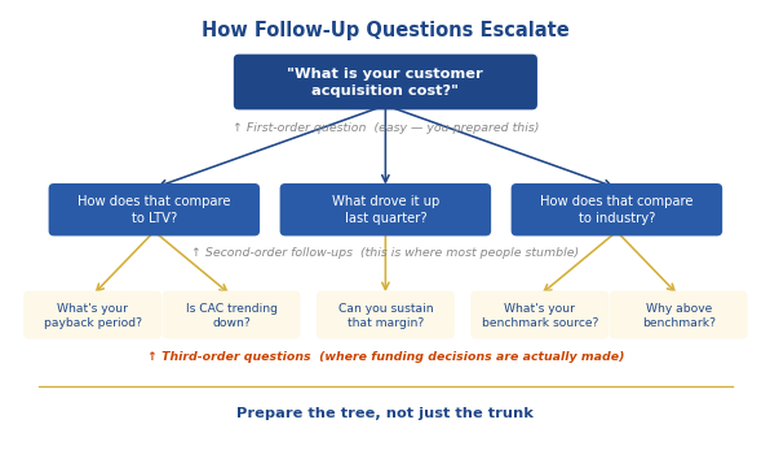

Investor Q&A follow-up question map showing first-order questions and three levels of second-order follow-ups across metrics, strategy, competitive, and risk categories

Why Follow-Up Questions Are Where Funding Is Decided

An investor who asks a follow-up question is not being difficult. They’re doing exactly what their role requires: assessing whether the person in front of them has the depth of understanding to manage the capital they’re being asked to commit.

The follow-up question serves a diagnostic function. If the first answer was memorised or prepared for the pitch, the follow-up will surface that. If the first answer was grounded in genuine understanding, the follow-up is easy — because the same understanding that produced the first answer produces the second one naturally, without additional preparation.

This is why investor Q&A preparation that only covers anticipated first-order questions consistently fails. Founders spend hours preparing answers to “what’s your CAC?” and “who are your main competitors?” and “what’s your burn rate?” — and are then derailed by “how does CAC vary by segment?” or “what’s your win rate against that competitor specifically?” or “at current burn, what’s your runway if the next round takes six months longer than expected?”

The follow-up isn’t harder to answer than the original question. It’s harder only if the answer to the original question was a prepared surface response rather than an expression of genuine understanding. The diagnostic function of the follow-up is precise: it distinguishes one from the other.

Today’s sister article on the investor relations presentation format covers how to structure the deck itself to prevent questions before they’re asked. This article covers the Q&A that follows — and specifically the follow-ups that most preparation misses.

📋 The Investor Q&A Framework That Prepares You Three Questions Deep

The Executive Q&A Handling System includes the investor Q&A preparation framework — the second-order question map, the preparation templates, and the exact language for handling follow-ups on metrics, strategy, competition, and risk:

  • The investor follow-up question map for each major Q&A category — what experienced investors ask second, third, and fourth
  • Preparation template: map your first-order answers and generate second-order questions systematically before the meeting
  • Language for handling questions where the honest answer isn’t the one you planned — without losing credibility
  • The bridging technique for redirecting follow-ups that are moving into territory you want to control
  • How to answer “I don’t know” in a way that builds rather than erodes investor confidence

Get the Executive Q&A Handling System → £39

Built from 24 years in corporate banking and executive Q&A preparation at JPMorgan Chase, PwC, and RBS — including preparing executives for investor presentations and funding rounds.

The Follow-Up Map: Metrics Questions

Every metric question an investor asks has a predictable set of follow-ups. Here are the most common, across the metrics categories that matter most in investor conversations.

Customer acquisition cost (CAC). First order: “What’s your CAC?” The follow-ups investors actually use: “How does that break down by channel?” “What’s the trend over the last four quarters?” “What’s driving the change?” “How does that compare to your LTV at different customer segments?” Preparation means knowing the channel breakdown, the trend, the driver, and the LTV-to-CAC ratio by segment — not just the headline CAC number.

Revenue growth. First order: “What’s your revenue growth rate?” Follow-ups: “New versus expansion revenue?” “Churn rate?” “Net revenue retention?” “What’s the growth rate of your top 10 accounts?” Most founders prepare the growth rate headline. Experienced investors are trying to understand whether that growth is healthy or fragile — new customer acquisition masking significant churn, or a stable expanding base. The follow-ups diagnose which.

Burn rate and runway. First order: “What’s your current burn?” Follow-ups: “How does that compare to six months ago?” “What are the main drivers of burn?” “What happens to burn if you hit your growth targets?” “What levers do you have if you need to extend runway?” Prepare the drivers, the sensitivity, and the optionality. Investors are stress-testing your understanding of the cash dynamics, not just the headline number.

Preparing for an investor meeting? The Executive Q&A Handling System (£39) includes the full investor follow-up question map across metrics, strategy, competitive, and risk categories.

The Follow-Up Map: Strategy Questions

Go-to-market strategy. First order: “What’s your GTM strategy?” Follow-ups: “What’s working best right now and why?” “What have you tried that hasn’t worked?” “What does the unit economics look like at scale?” “How does your GTM need to change when you move upmarket?” Most prepared answers describe the intended strategy. Investors want to know whether you’ve run it, what you’ve learned from running it, and whether your unit economics work beyond the current stage.

Pricing strategy. First order: “How did you arrive at that pricing?” Follow-ups: “Have you tested higher price points?” “Where do you lose deals on price?” “What’s the average contract value trend?” “How does your pricing compare to your top competitor in a head-to-head?” The follow-up questions are probing your pricing confidence — whether it’s based on customer research and competitive intelligence, or on a number that felt reasonable when you set it.

Expansion strategy. First order: “What’s your expansion plan?” Follow-ups: “What are the three biggest risks to the expansion timeline?” “What milestones do you need to hit before you can expand?” “Who else has expanded into that market and what happened to them?” “What does the team composition need to look like to execute?” Investors are looking for realistic planning versus aspirational planning. The follow-ups test whether you’ve worked the plan backwards from the risks.

The Follow-Up Map: Competitive Questions

Competitive positioning. First order: “Who are your main competitors?” The follow-ups: “What do customers choose them over you for?” “What’s your win rate against [specific competitor]?” “What would need to change for a customer to switch back to them?” “What are they doing now that concerns you?” Most competitive answers describe why you’re better. Investors want to understand whether you have accurate intelligence on your competitors’ strengths — not just their weaknesses.

Defensibility. First order: “What’s your competitive moat?” Follow-ups: “How long would it take a well-resourced competitor to replicate your key advantage?” “What assumptions is your moat argument dependent on?” “What happened to the last company that had this advantage?” The defensibility follow-up is almost always about identifying which assumptions the moat depends on. Prepare your moat argument and then prepare the honest answer to “what would need to be true for this advantage to erode?”
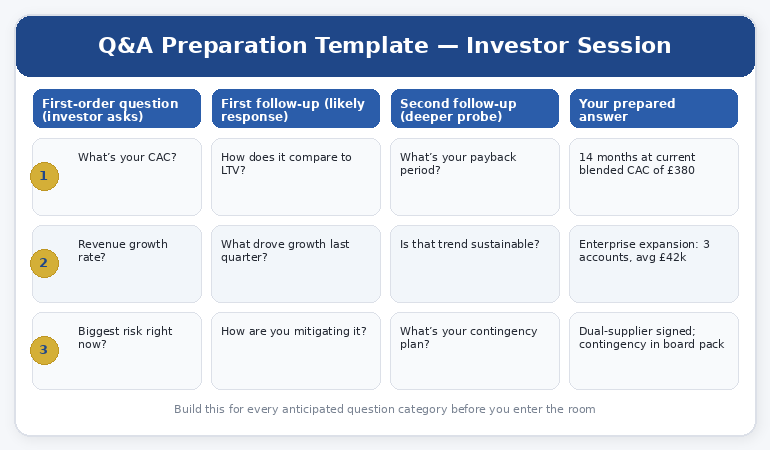

Investor Q&A preparation template showing how to map first-order questions to three levels of follow-up questions across competitive, risk, and metrics categories

⚠️ Stop Being Derailed by the Questions You Didn’t Prepare For

Most investor Q&A preparation covers the opening questions. The Executive Q&A Handling System (£39) includes the follow-up question maps that prepare you three levels deep — so you know exactly how to answer what comes after the first answer.

Get the Executive Q&A Handling System → £39

Used by executives and founders preparing for investor presentations, board meetings, and high-stakes funding conversations.

The Follow-Up Map: Risk Questions

Key person risk. First order: “What happens if you leave?” Follow-ups: “Who on your team could step up?” “What’s been documented so far?” “What would a succession plan look like?” “What would make you leave?” The key person question is expected. The follow-ups are probing whether you’ve actually thought about business continuity or whether “we’re building the team” is a placeholder answer.

Regulatory and legal risk. First order: “What are your main regulatory risks?” Follow-ups: “Have you had any regulatory interaction to date?” “What’s your current legal spend and what’s it for?” “What happens to your business model if [specific regulation] changes?” Prepare the honest answer to the regulatory question, then prepare the follow-up on what you’ve done about it, not just what the risk is.

Technology or execution risk. First order: “What’s the biggest technical risk to delivery?” Follow-ups: “What’s the fallback if that risk materialises?” “Have you had any incidents so far and how did you handle them?” “What does your testing and validation process look like?” Investors are testing whether you have realistic risk management or optimistic risk assessment. The follow-ups are designed to find out.

The CFO presentation framework uses the same principle: financial decision-makers always have prepared follow-ups for every first-order answer, and the presenter who knows what those follow-ups are enters the conversation at a significant advantage.

The Preparation System That Covers Second-Order Questions

The preparation method is straightforward once you understand what it’s for. It has four steps.

Step 1: List every question you expect. Not the questions you hope to get — every question that could reasonably arise across metrics, strategy, competitive positioning, team, and risk. This is your first-order question bank. Most founders have this. Most stop here.

Step 2: For each first-order question, generate three follow-ups. Ask yourself: if I give my planned answer to this question, what’s the next question an experienced investor would logically ask? Then ask it again: and if I answer that, what’s the next one? Three levels. Some questions will only have one or two logical follow-ups. Others will have five. The discipline of generating three forces you to think past your prepared surface answer.

Step 3: Prepare honest answers to the difficult follow-ups. Some of the follow-ups will surface genuine gaps — numbers you don’t know, assumptions you haven’t tested, risks you haven’t fully modelled. This is the most valuable part of the exercise: discovering your preparation gaps before the investor does. Where you have gaps, fill them. Where they can’t be filled before the meeting, prepare an honest, credible answer to “I don’t have that to hand, but here’s what I do know.”

Step 4: Run the preparation with a colleague who hasn’t seen it. The preparation that stays in your head isn’t tested. Having someone else ask you the first-order questions — then follow up unprompted — reveals whether your preparation is actually solid or whether it still has surface areas that look prepared but break down three questions in. The executive presentation structure that works in investor contexts is built to handle Q&A, not just delivery — and practising the Q&A is as important as rehearsing the deck.

Also published today: The Investor Relations Update Format That Prevents Awkward Questions — how to structure the deck itself so that many Q&A questions never need to be asked.

Common Questions About Investor Q&A Preparation

How many investor questions should I prepare for?
Prepare for every question you can anticipate, but the preparation that matters is the second-order follow-ups — not just additional questions. A bank of 40 first-order questions with no follow-up preparation is less valuable than 15 first-order questions, each with three follow-ups you’ve genuinely worked through. Quality of preparation depth matters more than quantity of questions covered.

What should I do when an investor asks a question I genuinely don’t know the answer to?
The honest answer is nearly always more effective than a deflection. The specific phrasing matters: “I don’t have that number with me, but I can tell you that [related thing you do know] — I’ll get you the exact figure after this meeting.” That response demonstrates honesty, demonstrates that related knowledge is solid, and demonstrates that you’ll follow through. What damages credibility is the visible search for an answer that isn’t there, or an answer that clearly isn’t what was asked.

How do investors use follow-up questions differently from opening questions?
Opening questions often probe what you know. Follow-up questions probe how you know it and how deeply. “What’s your CAC?” tests whether you have the number. “What’s driving the increase in Q3?” tests whether you understand why the number is what it is. Investors are assessing both layers simultaneously — but the follow-up is where the second layer is actually examined.

Is This Right For You?

✅ This is for you if:

  • You’re preparing for an investor presentation, board meeting, or funding conversation where Q&A is a significant part of the session
  • You’ve been caught out by follow-up questions in previous investor meetings and want to close those preparation gaps
  • You want a systematic method for preparing Q&A, not just a list of questions to memorise

❌ This is NOT for you if:

  • You’re preparing for an internal Q&A with colleagues rather than external investor scrutiny (the stakes and preparation depth differ)
  • You’re looking for guidance on the deck structure itself rather than the Q&A — that’s covered in the IR update format article published today

🏛️ The Q&A System Built From 24 Years of Watching What Investors Actually Test

The Executive Q&A Handling System is built on a simple premise: the questions that kill funding are not the ones you’ve prepared for. They’re the follow-ups that expose whether the prepared answers were grounded or polished:

  • The investor follow-up question map across metrics, strategy, competitive, and risk categories
  • The four-step preparation system for generating and answering second-order questions before the meeting
  • Language for handling difficult follow-ups — including the honest “I don’t know” that builds credibility rather than eroding it
  • The bridging technique for redirecting follow-ups into the territory you’ve prepared without appearing to deflect
  • Q&A preparation templates for the eight most common investor meeting formats

Get the Executive Q&A Handling System → £39

Built from 24 years in corporate banking at JPMorgan Chase, PwC, Royal Bank of Scotland, and Commerzbank — including preparing executives for investor Q&A, board scrutiny, and high-stakes funding conversations.

Frequently Asked Questions

How do follow-up questions in investor Q&A differ from those in a board presentation?

Board Q&A follow-ups are typically aimed at governance, accountability, and strategic direction — boards are testing whether management understands the decision they’re being asked to approve. Investor follow-ups are more specifically financial and risk-focused — investors are assessing whether the business model and management team warrant the capital commitment. The preparation principles are similar (prepare three levels deep, know the story behind every number), but the territory of the follow-ups is different. The investor Q&A preparation described in this article is specific to investor and fundraising contexts; for board Q&A preparation, the approach is adapted but the underlying method is the same.

What if an investor keeps following up with increasingly detailed questions I can’t fully answer?

The most effective response is to draw a clear line honestly: “That level of detail is in the data room rather than in my head — I’d rather give you accurate numbers than approximate ones. Can I get that to you by end of week?” This response is more credible than an attempted answer that turns out to be imprecise. Experienced investors understand that not every figure is memorised; what they’re assessing is whether the response to uncertainty is honest and organised, or defensive and evasive. The former is reassuring. The latter is not.

How long before a funding meeting should I start Q&A preparation?

The second-order question preparation is most effective when done at least five days before the meeting — not because the content changes, but because the follow-up mapping exercise surfaces preparation gaps that take time to close. If you identify a gap the day before the meeting, you may not be able to fill it; if you identify it a week out, you can get the number, build the analysis, or at least form a credible bridging response. The preparation itself takes three to four hours for a thorough investor meeting. The rehearsal — having a colleague ask first-order questions and follow up unprompted — needs a separate two-hour session.

Should I prepare differently for angel investors versus institutional VCs?

The depth of preparation required is broadly similar, but the territory of follow-up questions differs. Angel investors often focus heavily on founder background, motivation, and resilience — the follow-ups to “what’s your exit strategy?” or “why are you the right person to build this?” tend to be character and commitment-based. Institutional VCs are more likely to pursue financial model follow-ups, comparable transactions, and market sizing logic in detail. Preparing for both audiences requires the same systematic mapping approach, but with different follow-up question banks for each.

The Winning Edge — weekly insight on Q&A handling, executive presentations, and investor communication. Subscribe free →

Want everything in one place? The Complete Presenter Bundle (£99) includes the Executive Q&A Handling System, the Executive Slide System, Conquer Speaking Fear, and four additional products.

About the Author

Mary Beth Hazeldine is the Owner & Managing Director of Winning Presentations. With 24 years of corporate banking experience at JPMorgan Chase, PwC, Royal Bank of Scotland, and Commerzbank, she has delivered high-stakes presentations in boardrooms across three continents.

A qualified clinical hypnotherapist and NLP practitioner, Mary Beth combines executive communication expertise with evidence-based techniques for managing presentation anxiety. She has trained thousands of executives and supported high-stakes funding rounds and approvals.

Book a discovery call | View services

08 Jan 2026
Funding presentation tips - the only slide that actually matters for raising capital

Funding Presentation Tips: The Only Slide That Actually Matters (And Why Most Founders Get It Wrong)

Quick Answer: The most important funding presentation tips are this: your ask slide determines everything. Place it on slide 2 or 3, state your amount and milestone clearly, and never apologize for what you need. Investors decide in the first 90 seconds whether to lean in or tune out—and a buried or weak ask slide tells them you’re not ready for their capital.

She had the best product in the room. She walked out without a term sheet.

I was advising at a pitch competition in London when a healthtech founder delivered what should have been a winning presentation. Her technology was proven. Her traction was impressive. Her team had three successful exits between them.

But she buried her ask on slide 19 of 22. And when she finally revealed it, she said: “We’re, um, looking to potentially raise around £2M, if that works for everyone?”

The judges—all active investors—physically leaned back. One checked his phone.

Afterward, I shared some funding presentation tips with her. The most important: your ask slide isn’t just another slide. It’s the slide that frames everything else.

Get it wrong, and nothing else matters.

The Executive Slide System

Stop losing investors to weak ask slides. The Executive Slide System includes the exact templates that have helped founders raise over £250M—including the ask slide format that gets term sheets signed.

Includes: Pitch deck templates, ask slide frameworks, and one-page structures investors expect.

Get the Executive Slide System →

Why the Ask Slide Determines Everything

Here’s what most funding presentation tips miss: investors don’t evaluate your deck linearly. They’re not sitting there thinking, “Interesting market… nice traction… good team… oh, what do they want?”

They’re thinking: “What’s the bet? How much? Is this worth my next 45 minutes?”

When you delay the ask, you force investors to sit through your entire presentation while a question loops in their brain: “Where is this going?” That cognitive distraction means they’re not absorbing your content. They’re guessing at your punchline.

A fintech founder I coached had a brilliant product but kept his ask until slide 18. We moved it to slide 2. Same deck, same content, different sequence.

His next pitch: “The partner told me it was the clearest funding presentation he’d seen all quarter. We got a term sheet in 48 hours.”

The ask slide doesn’t just tell investors what you want. It tells them what kind of founder you are.

The 3 Elements of an Ask Slide That Works

Your ask slide needs exactly three things. No more, no less.

1. The Amount (Stated as Fact, Not Request)

Weak: “We’re hoping to raise somewhere between £2-4M…”
Strong: “We’re raising £3M.”

Ranges signal uncertainty. “Hoping” signals desperation. State your number like it’s already decided—because in your mind, it should be.

2. The Milestone (What Changes)

Weak: “…for growth and expansion.”
Strong: “…to reach profitability by Q4 2026.”

Investors aren’t buying your company. They’re buying your next milestone. Be specific about what their capital achieves. “Growth” means nothing. “Profitability by Q4” means everything.

3. The Valuation (If Appropriate)

Weak: “We’re flexible on valuation and open to discussion…”
Strong: “At £12M pre-money.”

Early-stage founders sometimes omit valuation—that’s fine if you’re pre-seed. But if you have a number, state it. Hesitation here signals you don’t know your worth.

Funding presentation tips - the 3 elements of an ask slide that gets term sheets

Where to Place Your Ask Slide

The best funding presentation tips all agree: slide 2 or 3, and again at the close.

Why twice? Because investors process information differently at different points. Your opening ask frames the evaluation. Your closing ask prompts action.

A biotech founder I worked with raised £4.2M after we restructured her deck. Her ask appeared on slide 2 (“We’re raising £4.2M to complete Phase 2 trials”) and slide 11 (“Here’s how to participate in this round”).

Same information. Different framing. The first tells them what you need. The second tells them what to do.

The Biggest Ask Slide Mistake (And How to Fix It)

The healthtech founder who lost the pitch competition made a common error: she apologized for her ask.

“We’re, um, looking to potentially raise around £2M, if that works for everyone?”

That single sentence contained five credibility killers:

  • “Um” — hesitation signals uncertainty
  • “Looking to potentially” — hedging your own request
  • “Around” — you don’t know your number
  • “If that works” — asking permission to ask
  • Question mark — framing a statement as a question

Three months later, she pitched again. Same product. Same traction. New ask slide: “We’re raising £2.5M to reach 50,000 users by Q3. Here’s why that’s the bet worth making.”

She closed her round in six weeks.

For more on structuring presentations that close deals, see my complete guide: Client Presentations That Close (Not Just Impress).

FAQ: Funding Presentation Tips

What’s the most important slide in a funding presentation?

Your ask slide—and it should appear on slide 2 or 3, not buried at the end. Investors want to know immediately: How much? For what milestone? At what valuation? When you delay the ask, investors spend the entire presentation wondering where it’s going instead of evaluating your opportunity.

How do I structure the ask slide in a funding presentation?

Three elements only: the amount you’re raising, what milestone it achieves, and your target valuation (if appropriate for stage). Example: “Raising £3M to reach profitability by Q4 2026 at £12M pre-money.” No clutter. No apologies. State it like a fact, not a request.

Should I justify my valuation on the ask slide?

No. State the valuation confidently, then let your traction and team slides do the justifying. Over-explaining your valuation on the ask slide signals uncertainty. Investors will challenge it regardless—save the defense for Q&A when they actually ask.

📧 Join 2,000+ professionals getting weekly insights on presentations that close deals. Subscribe to The Winning Edge →

📋 Free Download: Investor Pitch Deck Checklist

Use these funding presentation tips with the same pre-pitch checklist I give founders before investor meetings. Includes the ask slide formula that gets term sheets signed.

Get Your Free Checklist →


About the Author

Mary Beth Hazeldine spent 24 years at JPMorgan, PwC, RBS, and Commerzbank. She’s a clinical hypnotherapist and MD of Winning Presentations.

08 Jan 2026
Investor presentation mistakes - why more slides fails and what actually gets funded

Investor Presentation Mistakes: Why More Slides Fails (And What Actually Gets Funded)

Quick Answer: The most expensive investor presentation mistakes are burying your unique insight under market education. Investors know the problem exists—they need to know why YOU have the solution. Lead with your unfair advantage in the first 60 seconds, limit slides to 10-12, and structure every slide around decisions, not information. The founders who raise do less explaining and more compelling.

47 slides. 23 investor meetings. Zero term sheets.

That was Dr. Sarah Chen’s track record when she walked into my office. Her biotech science was breakthrough-level—a novel approach to drug delivery that three major pharma companies had already expressed interest in licensing. Her market was massive. Her team included two former heads of R&D from FTSE 100 companies.

But her investor presentation mistakes were killing her funding round.

I watched her pitch. By slide 8, she was still explaining the problem—a problem every biotech investor already understood. Her solution appeared on slide 19. Her competitive advantage was buried on slide 31. Her ask—the actual funding request—didn’t appear until slide 43.

No investor made it that far. They’d checked out by slide 10.

“But they need to understand the science,” she protested.

“They need to understand why YOU win,” I replied. “The science is why they took the meeting. Your job isn’t to educate them—it’s to convince them you’re the bet worth making.”

We rebuilt her deck in a single afternoon. 12 slides. Her unique insight on slide 1. Her ask on slide 2. Her solution on slide 3. The science condensed into one visual on slide 5.

Three weeks later: £4.2M raised at her target valuation.

Same science. Same market. Same founder. The only difference? We eliminated the investor presentation mistakes that were making investors tune out before her brilliance could land.

Here’s everything I’ve learned about what kills funding rounds—and what closes them.

The Executive Slide System

Stop losing investors to slide structure mistakes. The Executive Slide System includes investor-ready templates, the exact frameworks VCs expect, and the slide sequences that get term sheets signed.

Includes: Pitch deck templates, executive summary formats, and one-page structures that get read.

Get the Executive Slide System →

Why More Slides Fails (The Data Nobody Shares)

In my 24 years at JPMorgan Chase, PwC, RBS, and Commerzbank, I reviewed thousands of pitch decks. The pattern became undeniable: deck length inversely correlated with funding success.

Here’s what the data showed:

Decks over 30 slides: 12% conversion to next meeting
Decks 20-30 slides: 23% conversion
Decks 15-20 slides: 34% conversion
Decks 10-15 slides: 47% conversion

The reason isn’t that investors are lazy. It’s that deck length signals something about the founder.

When you need 47 slides to explain your business, investors hear: “This founder can’t prioritize. They don’t know what matters. They’ll bloat the team, the budget, and the timeline the same way they bloated this deck.”

Conversely, a tight 12-slide deck signals: “This founder knows exactly what matters. They respect my time. They’ll run a lean operation.”

Every slide beyond 12 is an argument against yourself.

The 5 Investor Presentation Mistakes That Kill Funding Rounds

After helping founders raise over £250M in aggregate funding, these are the mistakes I see destroy promising deals week after week.

Mistake #1: Leading With the Problem (Not Your Insight)

A SaaS founder came to me after 14 failed pitches. His first 7 slides were market education: industry size, growth trends, competitive landscape, customer pain points.

“They need to understand the opportunity,” he told me.

“They already understand the opportunity,” I said. “That’s why they took the meeting. What they don’t understand is why YOU win.”

His unique insight—a proprietary algorithm that reduced customer acquisition costs by 60%—was buried on slide 12. We moved it to slide 1.

His next three pitches: two term sheets.

First-time founders spend 5-10 slides educating investors about the market problem. This is backwards. VCs already know the problems in their investment thesis. They’ve heard the market education pitch hundreds of times. What they haven’t heard is YOUR unique angle.

The fix: Open with your insight, not the problem. “We’ve discovered that X, which means Y, and we’re the only team positioned to capture Z.”

Investor presentation mistakes - 5 errors that kill funding rounds with fixes

Mistake #2: Too Many Slides (Complexity Signals Confusion)

I once worked with a fintech founder who had 67 slides. Sixty-seven.

“I want to be thorough,” she explained. “I don’t want them to have unanswered questions.”

I asked her: “In 24 years of banking, how many 67-slide presentations got funded in the room?”

She couldn’t name one. Neither could I.

Investors pattern-match constantly. They’re not just evaluating your business—they’re evaluating YOU as an operator. Bloated decks pattern-match to founders who will bloat teams, budgets, and timelines. Lean decks signal lean thinking.

We cut her deck to 11 slides. She raised her seed round in four weeks.

The fix: 10-12 slides maximum. Every slide earns its place by advancing the decision to invest. Information that doesn’t advance the decision gets cut—no matter how interesting.

Mistake #3: Burying the Ask

A hardware startup founder pitched me his deck before a Series A meeting. His ask—£8M at £32M valuation—appeared on slide 41.

“Why so late?” I asked.

“I want them to understand the value before I tell them the price.”

Here’s what happens in investor brains when they don’t know the ask: they spend the entire presentation wondering, “Where is this going? What does he want? How much?” That cognitive distraction means they’re not absorbing your content. They’re guessing at your punchline instead of evaluating your opportunity.

We moved his ask to slide 3. He opened the meeting by saying, “We’re raising £8M to hit profitability by Q4. Here’s why that’s a good bet.”

The investors relaxed. They knew what they were evaluating. They could focus on whether to say yes—not on guessing what the question was.

The fix: Slide 2 or 3: “We’re raising £X for Y milestone at Z valuation.” Then prove why that’s a good bet.

Structure Your Pitch Like the Decks That Get Funded

The Executive Slide System gives you the exact templates used by founders who’ve raised millions. Stop guessing what investors want to see—use the frameworks that work.

Get the Executive Slide System →

Mistake #4: Presenting Financials Like an Accountant

A client—former Big Four consultant—showed me his financial slide. It had 47 line items, three scenarios, and footnotes in 8-point font.

“This is how we did it at Deloitte,” he said.

“Deloitte wasn’t asking for money,” I replied. “They were justifying their fees. You’re selling a dream. Different game.”

Investors don’t invest in spreadsheets. They invest in stories about spreadsheets. Your financial slide should tell a trajectory story: where you are, where you’re going, and what changes at each funding milestone.

Dense financial tables make investors’ eyes glaze. They signal that you’re an analyst, not a visionary. If they want the details, they’ll ask in due diligence—after they’re already interested.

We replaced his 47-line spreadsheet with a single chart showing three numbers: current revenue, target at Series A milestone, and projected exit. One visual. One story. He closed his round in six weeks.

The fix: One chart. Three numbers maximum. Tell the trajectory story: “We’re at £X, targeting £Y by milestone, £Z at exit.”

Mistake #5: Forgetting You’re Selling Yourself

Two co-founders pitched me the same week with nearly identical businesses—both marketplace apps for professional services. Same market size. Similar traction. Comparable technology.

Founder A put his team slide at position 11, after financials. It listed job titles and years of experience: “CEO, 12 years in tech. CTO, 15 years engineering. CFO, 8 years finance.”

Founder B put his team slide at position 3. It opened with: “Our CTO built the matching algorithm at [major acquired startup]. Our head of growth scaled [competitor] from 0 to 2M users. I sold my last company to [Fortune 500] for £40M.”

Founder B raised in three weeks. Founder A is still looking.

Investors bet on jockeys, not horses. Early-stage investing is almost entirely about the team—because the product will change, the market will shift, but the founders’ ability to navigate those changes is what determines success.

The fix: Team slide in the first five. Lead with relevant wins, not job titles. “Our CTO built the platform that X acquired for £Y” beats “CTO, 15 years experience.”

Investor presentation mistakes - the 11-slide structure that raises capital

The Investor Presentation Structure That Raises Capital

After helping founders raise over £250M, here’s the sequence that consistently converts investor meetings into term sheets:

Slide 1: One-sentence company description + the big insight
Slide 2: The ask (amount, use of funds, target valuation)
Slide 3: Team (why you’re the ones to win)
Slide 4: Market opportunity (size + timing)
Slide 5: Solution (what you’ve built)
Slide 6: Traction (proof it works)
Slide 7: Business model (how you make money)
Slide 8: Competition (your unfair advantage)
Slide 9: Go-to-market (how you’ll win)
Slide 10: Financials (trajectory, not tables)
Slide 11: The ask again (close with action)

Notice what’s different from most pitch decks:

The ask appears twice. Opening and closing. No ambiguity about what you need.

The team appears early. Position 3, not position 11. Because that’s what investors care about most at early stage.

Financials are near the end. They’re proof points, not the climax. The story closes on action, not spreadsheets.

Problem slide is gone. Your insight on slide 1 implies the problem. No need to belabor it.

Slide-by-Slide Breakdown: What Goes Where

Let me walk through each slide with specific guidance on what works—and what kills deals.

Slide 1: The Insight

One sentence describing what you do. One sentence describing your unique insight—the thing you’ve figured out that others haven’t.

Bad: “We’re building a platform for enterprise workflow automation.”
Good: “We’ve discovered that 60% of enterprise workflow failures happen at handoff points—and we’ve built the first system that eliminates them.”

Slide 2: The Ask

Amount. Use of funds. Timeline to next milestone. Target valuation (if appropriate for the stage).

Bad: “We’re exploring funding options and flexible on terms.”
Good: “We’re raising £3M to reach profitability by Q4 2026. Here’s why that’s a compelling bet.”

Slide 3: The Team

Relevant wins only. No job histories. Answer: why is THIS team the one that wins?

Bad: Photos with job titles and years of experience.
Good: “3 successful exits between us. Built and sold to [Name]. Scaled [Company] from 0 to £40M ARR.”

Slides 4-9: The Story

Each slide should make ONE point. That point should advance the decision to invest. If it doesn’t advance the decision, cut it.

Slide 10: Financials

One chart. Trajectory story. Where you are, where you’re going, what the funding enables.

Slide 11: The Close

Restate the ask. Clear next steps. Make it easy to say yes.

Delivery Mistakes That Lose the Room

Structure is only half the battle. I’ve seen perfect decks fail because of delivery. Here are the three delivery mistakes that kill investor presentations:

Reading Your Slides

A founder last month had a beautiful deck. But he turned his back to the investors and read every bullet point verbatim. The investors—who could read faster than he could speak—checked out by slide 4.

Your slides are visual aids, not scripts. If you’re adding nothing beyond what’s written, you’re wasting their time.

Defensive Body Language

Crossed arms. Backing away from tough questions. Rushed answers. These signals tell investors you’re not comfortable with scrutiny—and therefore not ready for the pressure of running a funded company.

One founder I coached had brilliant answers but delivered them while backing toward the door. We spent an hour just on physical presence. She closed her round two weeks later.

Filling Silence

After making a key point, most founders immediately keep talking—adding qualifiers, caveats, and context that dilutes their message. The best presenters make their point and stop. They let silence do the work.

For more on delivery that commands the room, see my guide on presentation body language and voice techniques that project confidence.

Investor presentation mistakes - delivery errors that lose the room
Dimensions: 770×450

Q&A Strategy: Turning Tough Questions Into Term Sheets

Most founders fear Q&A. The best founders see it as their biggest opportunity.

Here’s why: During your presentation, investors are passive. During Q&A, they’re engaged. Questions mean they’re taking you seriously enough to probe. No questions is actually the worst outcome—it means they’ve already decided no.

The Question Behind the Question

When an investor asks “What’s your customer acquisition cost?”, they’re not just asking for a number. They’re asking: “Do you understand your unit economics? Can you scale profitably? Are you sophisticated enough to track this?”

Answer the surface question first. Then address the underlying concern: “Our CAC is £45, which gives us a 3.2x LTV ratio. We’ve improved that 40% quarter-over-quarter by focusing on referral loops.”

The Pause Technique

Before answering any tough question, pause for two seconds. This does three things: it shows you’re thinking (not reacting), it prevents defensive responses, and it signals confidence (only nervous people rush).

One founder I coached was asked: “Your competitor just raised £50M. Why won’t they crush you?”

Her instinct was to immediately defend. Instead, she paused. Smiled. Then said: “They raised £50M to solve a problem we’ve already solved. Their money is their disadvantage—they’ll spend it on sales before their product is ready. We’ll be profitable before they figure out their positioning.”

She got the term sheet that week.

When You Don’t Know

“I don’t have that data, but I’ll follow up by end of day.”

That’s it. Don’t guess. Don’t fumble. Don’t over-explain. Investors respect honesty far more than fumbled attempts to sound knowledgeable.

For more on handling difficult questions, see my guide on the executive’s playbook for Q&A.

Case Study: From 47 Slides to £4.2M

Let me return to Dr. Sarah Chen—because her transformation illustrates everything about fixing investor presentation mistakes.

The Before:

  • 47 slides
  • Problem explanation: slides 1-8
  • Science deep-dive: slides 9-18
  • Solution: slides 19-25
  • Team: slide 38
  • Ask: slide 43
  • Result: 23 meetings, zero term sheets

The After:

  • 12 slides
  • Insight + ask: slides 1-2
  • Team: slide 3
  • Science (one visual): slide 5
  • Traction + close: slides 10-11
  • Result: 4 meetings, 2 term sheets, £4.2M raised

The science didn’t change. The market didn’t change. Sarah didn’t become a different person. We just eliminated the investor presentation mistakes that were obscuring her brilliance.

Six months later, she sent me a message. She’d just finished her first board presentation—12 slides, recommendation on slide 2, ask clearly stated.

“The board chair said it was the clearest update he’d received in 20 years of investing,” she wrote. “He asked if I could teach their other portfolio founders.”

The skills that fix investor presentation mistakes don’t just raise capital. They establish you as a leader worth backing again and again.

📧 Join 2,000+ professionals getting weekly insights on presentations that close deals. Subscribe to The Winning Edge →

FAQ: Investor Presentation Mistakes

What’s the most common investor presentation mistake?

Leading with the problem instead of the opportunity. Investors see hundreds of pitches. They know the problems exist. What they need in the first 60 seconds is your unique insight—why YOU have the solution others missed. Start with your unfair advantage, not a market education.

How many slides should an investor presentation have?

10-12 slides maximum for a first meeting. Every slide beyond 12 dilutes your message and signals you can’t prioritize. The biotech that raised £4.2M did it with 12 slides after failing with 47. Investors don’t want comprehensive—they want compelling.

Should I memorize my investor presentation?

Memorize your opening 60 seconds and your ask. Everything else should be conversational. Investors spot rehearsed scripts immediately—and it signals you can’t think on your feet. Know your content cold, but deliver it like a conversation, not a performance.

When should I reveal my funding ask in an investor presentation?

Slide 2 or 3, and again at the close. Investors want to know immediately: How much? For what? At what terms? When you bury the ask, investors spend the entire presentation wondering “where is this going” instead of evaluating your opportunity.

What makes investors stop paying attention during a pitch?

Three things kill attention fastest: too much market education before your insight, dense financial tables instead of trajectory stories, and reading slides instead of commanding them. Investors can read faster than you can speak—add value beyond what’s written.

How important is the team slide in an investor presentation?

Critical—and it should come early (first five slides), not last. Investors bet on jockeys, not horses. Lead with relevant wins, not job titles. “Our CTO built the platform that X acquired for £Y” beats “CTO, 15 years experience.”

📋 Free Download: Investor Pitch Deck Checklist

Avoid these investor presentation mistakes with the same pre-pitch checklist I give founders before VC meetings. Covers structure, timing, and the signals investors notice immediately.

Get Your Free Checklist →

Related Reading

The Investors Who Fund You Remember How You Made Them Feel

Dr. Chen taught me something I’ve never forgotten: investor presentation mistakes aren’t about missing information. They’re about missing connection.

Her 47-slide deck contained everything an investor could want to know. But it didn’t make them feel anything. It didn’t create confidence. It didn’t signal leadership.

Her 12-slide deck contained a fraction of the information—but it made investors lean forward. It made them want to believe. It made them see her as a leader worth betting on.

The founders who raise don’t have better businesses than the founders who don’t. They have better stories. Better structure. Better presence.

Fix the investor presentation mistakes, and you don’t just raise capital. You establish yourself as someone worth funding again and again.

Same founder. Same science. Different slides.

That’s the £4M difference.


About the Author

Mary Beth Hazeldine is a qualified clinical hypnotherapist, NLP practitioner, and Managing Director of Winning Presentations. After 5 years terrified of presenting, she built a 24-year banking career at JPMorgan Chase, PwC, RBS, and Commerzbank. She has treated hundreds of anxiety clients and trained over 5,000 executives.