

A fishing question is not asked because the questioner wants information. It is asked because the questioner wants a commitment — on record, in a room full of witnesses — before you are in a position to give one responsibly. Recognising a fishing question when it arrives, and responding in a way that is honest without being pinned down, is one of the most practically valuable Q&A skills an executive can develop.
Rafaela had been presenting the preliminary findings of a regulatory review to a committee that included two members with strongly opposing positions on the outcome. The presentation was going well — the data was solid, the structure was clear, and the room seemed engaged. Then one of the committee members, a senior partner who had been quiet throughout, leaned forward and asked: “So based on what you’ve found, would you say this falls within acceptable parameters or not?” Rafaela knew the question immediately for what it was. The analysis was not yet complete. She had flagged that explicitly in the introduction. But the question was framing the preliminary data as if it were a conclusion, and asking her to confirm a verdict that would effectively end the debate before the final report was delivered. A simple yes or no would have been wrong — not because she was hiding anything, but because the analysis genuinely did not support a definitive conclusion yet. What she needed was a response that was truthful, specific, and firm without being dismissive of the question. What she gave instead was a hedged non-answer that left the room uncertain about whether she was evading or genuinely uncertain. The committee member pressed again. She felt the moment slip. This guide covers what she should have done instead.
Facing high-stakes Q&A sessions where the questions are designed to corner you? The Executive Q&A Handling System gives you a structured system for predicting and responding to the questions that executives find hardest to handle. Explore the System →
Jump to section:
- What Fishing Questions Are — and How to Recognise Them
- Why Fishing Questions Work: The Psychology of Public Commitment
- The Response Framework: Honest, Specific, and Not Pinned Down
- Common Forms of the Fishing Question and How Each Works
- When the Questioner Presses After Your First Response
- Frequently Asked Questions
What Fishing Questions Are — and How to Recognise Them
A fishing question has a specific structural signature: it frames a binary or forced choice and presents it as a neutral request for your assessment. “Would you say this is a risk or not?” “Is this on track or not?” “Do you think this is acceptable?” The framing appears reasonable — it sounds like the questioner is simply asking for your professional opinion. What it is actually doing is asking you to adopt a position publicly, in conditions that are designed to make the position hard to walk back.
The recognition signals are consistent. First, the question arrives before the relevant analysis is complete or before you are in a position to answer definitively. Second, it offers a binary or forced choice that does not reflect the genuine complexity of the situation. Third, it is asked in front of an audience — because a commitment made privately carries far less weight than one made in a room. Fourth, the questioner already has a preferred answer, and the question is structured to produce it.
Not every blunt or direct question is a fishing question. “What do you think will happen to margin in Q3?” is a direct question that deserves a direct answer. A fishing question is characterised by the mismatch between the certainty implied by its framing and the certainty that your evidence actually supports. When someone asks you to confirm a conclusion that your analysis does not yet justify, that is a fishing question — regardless of how reasonable it sounds.
The distinction matters because the response to a genuine direct question and the response to a fishing question are different. Responding to a genuine question with the caution appropriate for a fishing question signals evasiveness. Responding to a fishing question with the directness appropriate for a genuine question hands the questioner exactly what they were angling for.
Prepare for the Questions Designed to Corner You
The Executive Q&A Handling System gives you a structured approach to predicting, preparing for, and responding to the most challenging executive Q&A scenarios — including the fishing questions, stress tests, and loaded questions that catch executives off guard.
- ✓ System for predicting and preparing for difficult Q&A questions
- ✓ Response frameworks for high-stakes executive questioning
- ✓ Scenario playbooks for board, investor, and committee Q&A
Get the Q&A Handling System → £39
Designed for executives managing high-stakes Q&A sessions
Why Fishing Questions Work: The Psychology of Public Commitment
Fishing questions exploit a well-documented psychological dynamic: public commitments are sticky. Once you have stated a position in front of a group, you are motivated — consciously and unconsciously — to maintain consistency with that position. This is not a weakness. It is a social and professional norm that makes functioning organisations possible. But it can be leveraged against you by a questioner who understands its power.
The dynamic operates in two directions. If you answer “yes, this is within acceptable parameters,” and the final analysis reveals it is not, you are now on record as having misjudged the situation. If you answer “no, it is not acceptable,” you may have committed to a position that the full data does not support, foreclosing options that the complete analysis might have kept open. The questioner wins either way — they have created a record that serves their position, and they have done it using your words.
The social pressure of the room amplifies this dynamic. When a question is asked in front of an audience, silence feels evasive, qualification sounds weak, and refusal to engage appears defensive. The questioner has created conditions in which the most comfortable response — giving a direct answer — is also the most dangerous one. This is why fishing questions are effective: not because they are logically compelling, but because they make the responsible answer psychologically difficult to deliver.
Understanding this mechanism is the first step toward managing it. When you recognise that the discomfort you feel is a function of the question’s design rather than a signal that you should comply with its framing, you can respond from a position of clarity rather than pressure. For a wider framework on recognising questions that are designed to set you up before they are even fully asked, our guide to recognising loaded questions in presentations covers the full taxonomy of adversarial question types.
The Response Framework: Honest, Specific, and Not Pinned Down
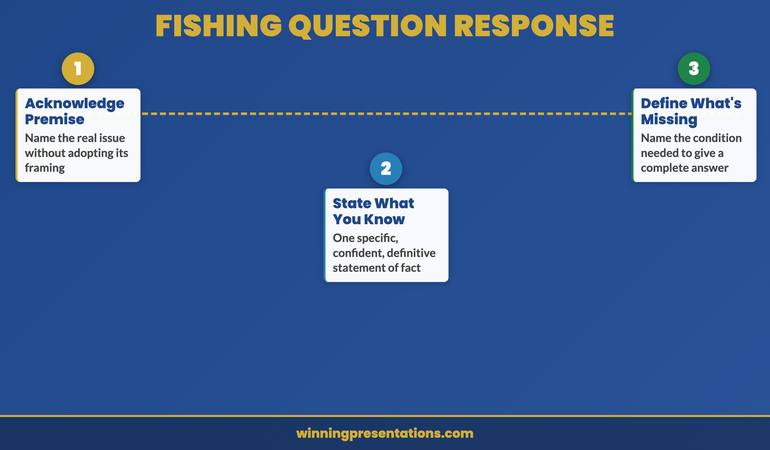
The effective response to a fishing question has three components, delivered in sequence. The first is an acknowledgement of the question’s premise — not agreement with its framing, but recognition that a real issue is being pointed at. “That is a central question, and it is one I want to answer accurately.” This buys a moment and signals engagement rather than evasion.
The second component is a statement of what you can say definitively, based on what you know. Not a hedge, not a qualification — a specific statement of fact. “What I can tell you with confidence is that the data we have reviewed to date shows X.” This demonstrates that you are not avoiding the question, you are giving the questioner the most accurate information available. Specificity is credibility. A vague non-answer and a precisely framed limitation are received very differently by a room.
The third component is a statement of what would be required to answer the full question. “A definitive assessment of whether this falls within acceptable parameters requires the completion of the analysis in section four, which we expect to have by the end of this month.” This is not a delay tactic. It is a statement of epistemic honesty — you are telling the room what you do not yet know and what would change that. This framing converts apparent evasion into professional rigour.
Together, these three components produce a response that is honest, specific, and firm without handing the questioner the commitment they were seeking. The key is the absence of hedging language in the second component. “What I can tell you with confidence is…” is a strong statement. “I think, based on what we have seen so far, it might suggest…” is a weak one that signals uncertainty and invites the questioner to push harder.
The Executive Q&A Handling System provides the full response architecture for fishing questions and other adversarial Q&A patterns, with scenario playbooks for the contexts where these question types most frequently appear.
Common Forms of the Fishing Question and How Each Works
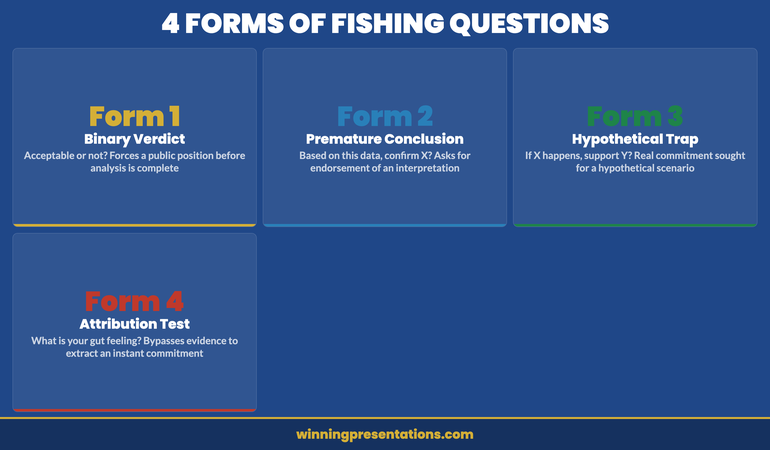
Fishing questions appear in several recurring forms, each with a slightly different mechanism. Recognising the form helps you identify the intent faster, which gives you more time to compose the response before the pressure of the room builds.
The binary verdict request. “Is this acceptable or not?” “Is this on track or not?” This is the most direct form. It offers two options and implies that a refusal to choose one is itself a choice — specifically, a suspicious one. The effective response names the binary as a false choice: “The right answer to that question is more nuanced than a yes or no, and I want to give you the accurate one.”
The premature conclusion invitation. “So based on what you’ve shown us, would you say this confirms X?” This form presents a tentative interpretation as if it flows naturally from your data, and invites you to confirm it. The problem is that the interpretation may go further than your data supports. The response: “The data is consistent with X as one interpretation, but it is also consistent with Y — the full analysis will allow us to distinguish between them.”
The hypothetical commitment trap. “If the final figures come in below target, would you support restructuring?” This asks you to commit to a future action based on a hypothetical — which is doubly problematic, because the hypothetical may not materialise, but the commitment is real and immediate. The response: “I would want to see the complete picture before making a recommendation on restructuring. What I can say is that if figures come in below target, we will need a structured response, and I am prepared to be part of developing that.”
The attribution test. “You’re the expert here — what’s your gut feeling?” This flatters you into bypassing analytical rigour and substituting intuition for evidence. The answer your gut provides is then on the record, divorced from any analytical caveat. The response: “My professional assessment is that we need the full analysis before I can be confident in a recommendation — and a gut feeling in a situation this consequential is not a substitute for that.”
When the Questioner Presses After Your First Response
A skilled fishing questioner will press after your first response. They know that most people will hold their ground once but will concede under repeated pressure — particularly in a public setting where silence is uncomfortable and the questioner appears persistent. The second press is often the moment that matters most.
When a questioner presses, resist the instinct to soften your position or offer additional qualification. Softening signals that your first response was not fully confident, and invites a third attempt. Instead, hold your original framing and restate the key point more briefly: “As I said, I cannot give you a definitive answer on this until the analysis is complete. I understand that is frustrating, and I will make sure you have the full picture as soon as it is available.” Brevity signals confidence. A longer explanation of why you cannot answer suggests you feel you need to justify the position, which creates the impression that it is negotiable.
If the questioner continues to press, naming the dynamic is a legitimate tool — used carefully, and without accusation. “I notice we are coming back to this question, and I want to be transparent about why I am holding the same position: the analysis is not yet at the stage where I can responsibly give you the answer you are looking for. That is not evasion — it is professional accuracy.” This shifts the frame from “the presenter is being difficult” to “the presenter is being rigorous,” and it does so in a way that the room can follow.
For guidance on the structured short-answer approach that works in high-pressure Q&A, our guide to the short answer framework for executive Q&A covers the technique of answering completely and confidently in fewer words — which is the single most effective defence against a questioner who uses repetition as pressure. And for the critical period after a difficult Q&A session, our guide to Q&A follow-up in the 48-hour decision window covers how to manage the aftermath when commitments were sought but not given.
Walk Into Every Q&A Session With a System
The Executive Q&A Handling System gives you the structured approach to predict, prepare for, and respond to every difficult question type — including fishing questions, stress tests, and loaded questions. £39.
Frequently Asked Questions
Is it ever appropriate to answer a fishing question directly?
Yes — when your analysis is complete and your evidence supports a definitive answer. A fishing question is only problematic when it asks you to commit to a position that your evidence does not yet justify. If you have the full data and the answer is clear, give it directly and with confidence. The distinction is not about the form of the question — it is about the relationship between the question’s framing and the state of your analysis. When the evidence supports the answer, there is no reason to withhold it.
How do I avoid appearing evasive when I decline to give a direct answer?
The key is specificity. Evasion sounds vague: “It is complicated, there are a lot of factors…” Professional accuracy sounds precise: “What I can confirm is X. What I cannot yet confirm is Y, because we do not have the Z data.” Specificity about what you know and what you do not know reads as rigour, not evasion. Vagueness reads as evasion regardless of your intent. Always name the specific thing you cannot yet confirm and the specific condition that would allow you to confirm it.
Can I prepare for fishing questions before a presentation?
Yes — and this is one of the highest-value forms of Q&A preparation. Before any high-stakes presentation, identify the two or three questions where someone who disagreed with your preliminary findings or wanted to force a premature conclusion would most likely press you. For each one, prepare your three-component response in advance: what you can confirm, what you cannot, and what would change that. Practising this structure before the session means that when the fishing question arrives, you are not improvising under pressure — you are delivering a prepared response that sounds thoughtful and confident because it is.
The Winning Edge
Weekly insights on executive presentations, Q&A strategy, and boardroom communication.
If the morning of a Q&A-heavy presentation is a source of anxiety for you, our guide to the morning presentation protocol covers the two-hour routine that builds readiness and manages the physiological stress response before you walk into the room.
About the author
Mary Beth Hazeldine, Owner & Managing Director, Winning Presentations. With 24 years of corporate banking experience at JPMorgan Chase, PwC, Royal Bank of Scotland, and Commerzbank, she advises executives across financial services, healthcare, technology, and government on structuring presentations for high-stakes funding rounds and approvals.