

Your first board presentation sets the tone for your executive tenure. Boards expect clarity, confidence and strategic thinking—not perfection. Structure your introduction around your mandate, demonstrate you understand board dynamics, and anchor every point to business value. Get this right, and you’ve gained crucial credibility; stumble, and you’ll spend months rebuilding trust.
In this article:
The story of Chiara’s board debut
Chiara had been promoted to Chief Commercial Officer after eight years as Regional Director. She knew her market. She knew the numbers. She’d thrived in her previous role. But stepping into the boardroom for her first presentation, she made a decision that nearly cost her the role: she presented as if the board were her team.
She dived into operational detail. She answered technical questions with granular process explanations. She treated challenge questions as attacks. By minute fifteen, she’d lost the chair’s attention. By minute twenty-five, a non-executive director had visibly withdrawn. The CFO was checking his notes, clearly unimpressed.
Three weeks later, Chiara received feedback: “Solid operator, but we’re not sure you grasp the strategic horizon.” She’d made six critical errors in that single thirty-minute presentation. Once she understood what boards actually needed—clarity over detail, business impact over process, and confidence over perfection—her next presentation landed. This article details exactly what she learned, and what you need to know before your board debut.
Your first board presentation matters.
The Executive Slide System includes board-ready frameworks and positioning templates designed to help new executives make a strong impression. Explore the System →
What Boards Actually Expect
Board members are not your team. They are not your peers. They are a specific audience with distinct expectations, and your first presentation reveals whether you understand that distinction.
Boards expect three things above all else:
Clarity first. Board members consume information rapidly and demand precision. They have limited time and multiple competing priorities. Your message must be distilled to its essence. If you cannot explain your mandate, your strategy or your risk profile in three sentences, you are not ready for the board.
Business value anchored to reality. Board members will ask themselves: “What does this executive’s success mean for shareholder value, risk mitigation or strategic position?” Every statement you make must connect to one of these. General statements, feel-good language and process updates bore them. They want to understand impact.
Confidence without arrogance. Boards respect executives who own their decisions and acknowledge complexity. They distrust those who claim certainty where none exists, or who become defensive under scrutiny. Your first presentation is a trust-building exercise. Boards are assessing whether you can be trusted with significant decision-making authority.
Beneath these sit a fourth, often-unstated expectation: that you understand board culture. You’ve entered a different ecosystem. The dynamics are different. The conversation speed is different. The tolerance for uncertainty is different. New executives who fail often fail because they treat the board like an extended management team, rather than recognising they are now operating in a distinct governance context.
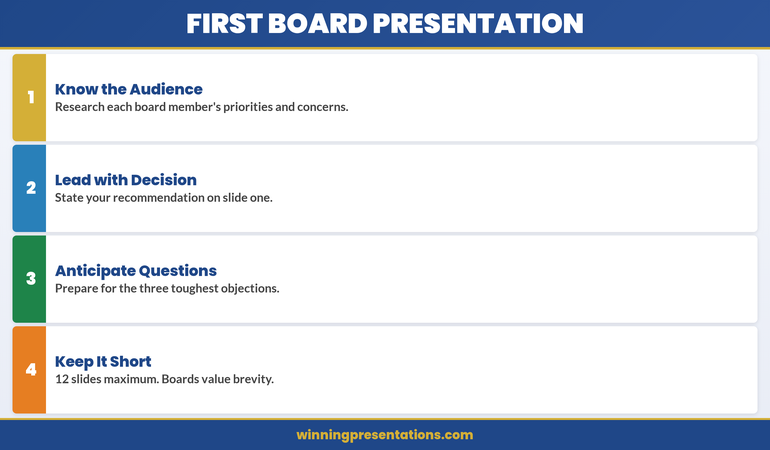
How to Structure Your Introduction
Your introduction is not a biography. It is a 90-second positioning statement that establishes your credibility, your mandate and your early priorities. Structure it in four layers:
Layer 1: The mandate (20 seconds). Start by explicitly stating what the board has asked you to do. “I’ve been appointed to transform our customer acquisition cost structure whilst maintaining market share growth.” This immediately anchors you to a business outcome. It demonstrates you understand your accountability. Board members will recognise whether your mandate is clear—and whether you recognise it.
Layer 2: Your relevant experience (30 seconds). Boards care about pattern-matching. They want to know: has this executive succeeded in similar situations? Compress your career into the two or three experiences that directly support your ability to deliver your mandate. “In my previous role at [Company], I led a similar turnaround across three regions, reducing acquisition costs by 28% whilst growing net revenue by 14%.” Short. Specific. Measurable.
Layer 3: Your early observations (25 seconds). This is your credibility builder. After your first weeks, what have you noticed? What’s the landscape? “I’ve observed that our current acquisition strategy is contact-heavy but conversion-weak. Our data infrastructure is solid, but we’re not leveraging it strategically.” You’re signalling that you’ve done your homework and that you’re thinking strategically.
Layer 4: Your immediate priorities (15 seconds). Close with two to three concrete priorities for the next quarter. “My focus is threefold: map the current customer journey end-to-end, benchmark our position against three direct competitors, and propose a revised acquisition strategy by Q2.” Concrete. Time-bounded. Stakeholder-aware.
This structure takes 90 seconds. It establishes you as someone who understands their mandate, has relevant experience, has done their research, and is thinking strategically about outcomes. It is the opposite of self-focused introduction; it is board-focused positioning.
The Executive Slide System
Stop improvising. Start commanding.
- Board-ready opening templates for new executives
- Section structures that boards recognise
- AI prompts to translate your strategy into board-level language
- Positioning frameworks for major executive scenarios
- Visual hierarchy guidelines that command board attention
Designed for new executives presenting to boards
Already know your mandate? Use our slide templates to structure your presentation in 2 hours →
Six Rookie Mistakes to Avoid
The following mistakes appear consistently in first presentations from executives who would otherwise succeed. Avoid them:
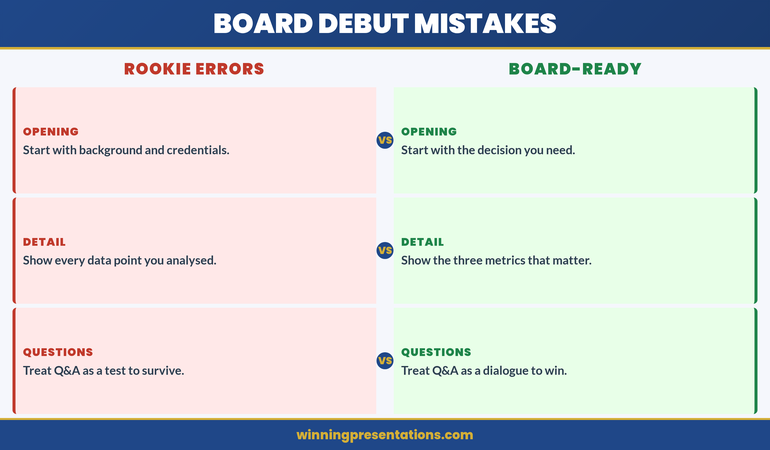
Mistake 1: Presenting to impress rather than to inform. You’re nervous. You want to prove your worth. So you load your slides with detail, demonstrate deep expertise, and answer every conceivable question. Boards interpret this as either insecurity or misaligned priorities. They don’t need to know you’re smart. They need to know you can deliver outcomes. Focus your presentation ruthlessly on what matters to governance and strategy.
Mistake 2: Defending your predecessor’s decisions. This is almost always a trap. New executives often feel obligated to explain why previous strategies were sound. Don’t. You’re the new steward. Your job is to move forward, not to defend the past. If you’re changing strategy, say so clearly. If you’re continuing certain approaches, say so strategically. Never spend board time defending what’s already been decided.
Mistake 3: Overstating certainty about the future. Boards are sophisticated. They know business is uncertain. They respect executives who acknowledge what they don’t know and explain how they’ll navigate uncertainty. New executives often overcompensate by claiming confidence they don’t yet have. “I’m confident we’ll achieve 20% growth” lands worse than “Our baseline scenario models 15% growth; I’m working to identify levers that could take us to 18-20%, and I’ll report back in eight weeks.”
Mistake 4: Using too much jargon. You’ve just entered a new context with new terminology. But board members speak multiple internal languages across your organisation. Don’t deploy specialist jargon to prove you belong. Use plain, precise language. If a term is essential, define it once and move on.
Mistake 5: Reading your slides. This signals either that you don’t know your material or that you don’t respect the board’s time. Know your slides. Speak to them. Make eye contact. Let the slides support your narrative, not replace it.
Mistake 6: Treating questions as attacks. Board members ask sharp questions. That’s their role. They’re not attacking you; they’re doing governance. When challenged, pause. Acknowledge the question. Answer directly. If you don’t know, say so and commit to follow-up. Never become defensive or dismissive. This is where new executives often lose credibility most rapidly.
Need a faster route to board credibility?
The Executive Slide System includes board presentation templates, positioning frameworks and quality-control checklists designed for first presentations. £39. Instant access. →
Demonstrating Strategic Capability in Your First Board Presentation
Boards promote executives who think strategically. Your first presentation is an opportunity to demonstrate that you understand not just your remit, but the broader strategic context in which it sits.
Strategic thinking at board level means connecting three dots: your area of responsibility, the organisation’s overall strategy, and the risks or opportunities that sit at their intersection. Most new executives present only the first dot—their own domain. Strategic executives present all three.
Domain focus: Here’s what I own and what I’m delivering.
Strategic anchor: Here’s how my outcomes connect to our overall strategic direction.
Risk/opportunity insight: Here’s what I’m seeing that the board should know.
Example: “As Chief Commercial Officer, I’m accountable for customer acquisition efficiency and retention. This directly supports our strategy of profitable growth over market-share-grab. In my first month, I’ve identified a material opportunity: our sales team is still working to sales-qualified-lead stage, but our product team has shifted to freemium acquisition. This misalignment is costing us £400K monthly in wasted pipeline. I’m recommending we realign sales motion to freemium conversion within Q2, which should recover £300K annually whilst improving overall customer quality.”
Notice what this communicates: deep operational knowledge (you know the sales process), strategic alignment (you’re connecting to the overall strategy), problem-finding capability (you’ve identified something the board should care about), and decisiveness (you have a recommendation, not a question). This is what strategic executives sound like.
Stepping into your first board-level role?
The Executive Presentation Starter Kit gives you the templates, checklists and prompts to prepare like someone who’s been in the room before.
Reading and Navigating Board Dynamics
Boards have culture, alliances, tensions and unwritten rules. Your first presentation happens in the context of existing dynamics. Understanding these dynamics is part of your job.
Before your presentation: Ask your board secretary who speaks most often, who challenges most directly, who has seniority concerns, who tends to be supportive. Ask your chair or chief executive what landmines exist, what sensitivities matter, and which board members care most about your area. This isn’t manipulation; it’s preparation. Politicians do this before major speeches. Executives should too.
During your presentation: Watch the room. Who is engaged? Who has checked out? When do you lose someone—is it when you get technical, or when you speak about change? Board members often communicate more through body language than words. If the chair is nodding, you’re on track. If a non-executive director is shaking their head subtly, you may have missed a concern.
When fielding questions: Answer the person who asked. Make eye contact. Don’t deflect to the chair. If someone asks a challenging question, resist the urge to over-answer. Say what you know. Acknowledge what you don’t. Commit to follow-up if necessary. Never correct a board member or signal they’ve misunderstood. Instead: “That’s a great point. Here’s how I’m thinking about it…” Then offer your perspective, not a correction.
After your presentation: Don’t disappear. Remain present. Engage in informal conversations if the chair allows it. Board members often ask the sharpest questions in side conversations after formal presentations. These are not attacks; these are opportunities for relationship-building.
Board dynamics take months to fully understand. Your first presentation is not the time to navigate them expertly. But it is the time to signal that you’re aware they exist and that you respect the context you’ve entered.
The 48-Hour Preparation Checklist
You cannot control everything about your first board presentation. But you can control your preparation. This 48-hour checklist covers the essentials:
Timing (48 hours before):
- Confirm the exact time, location and format (in-person, hybrid, virtual).
- Identify the board members attending, their backgrounds and their typical questions.
- Ask your chair or CEO what outcome they’re looking for from your presentation.
- Verify technical setup if presenting virtually (camera, audio, screen sharing).
Content (36 hours before):
- Finalise your slides. No changes after this point.
- Review for jargon. Strip out anything that needs explanation. If you must use a term, define it once.
- Check every number. Every. Single. One. Boards remember inaccuracy.
- Ensure every slide has a clear headline. One idea per slide. No slides that exist just to look impressive.
Practice (24 hours before):
- Deliver your full presentation out loud. Alone first, then to a trusted colleague who will ask board-level questions.
- Time yourself. You must deliver in the allotted time, with buffer for questions.
- Prepare opening remarks. Know your first 90 seconds cold. This sets the tone for everything that follows.
- Prepare for the most likely three questions. Have answers ready. Not memorised scripts—ready thinking.
Logistics (12 hours before):
- Test all technology if presenting virtually. Do a full run-through of screen sharing, audio and video.
- Choose what to wear. Something professional that reflects your role and the board’s culture. Nothing distracting.
- Get sleep. Do not work on your presentation the night before. Your brain needs rest more than your slides need tweaking.
Final hour:
- Arrive early (in-person) or log in 10 minutes early (virtual).
- Greet board members as they arrive. Small talk counts. It signals confidence.
- Take a breath. You’ve prepared. You know your material. You belong in this room.
Frequently Asked Questions
What should I do if a board member challenges me aggressively?
Breathe. Remember that sharp challenge is part of board culture—it’s not personal. Listen fully to the question. Pause before answering (silence is better than filler). Answer directly. If you don’t know, say so and commit to follow-up. Never match their tone or become defensive. Executives who can stay composed under challenge gain respect. This is your opportunity to demonstrate that quality.
How much detail should I include in my first presentation?
Include enough detail to answer the question “How will you deliver that outcome?” but no more. Boards don’t need to understand your process; they need to understand your thinking. If a board member wants detail, they will ask. If you’re unsure, err toward less. You can always elaborate. You cannot unsay what you’ve said.
Should I reference my predecessor in my first presentation?
Minimally. Acknowledge continuity where it matters (“We’ll build on the strong customer base [predecessor] established”), but focus on your mandate and your thinking. Don’t spend time defending their decisions or criticising their approach. You’re the new steward. Make that clear through your focus and energy, not through explicit comparison.
Stay ahead of presentation challenges.
Each week, The Winning Edge delivers executive presentation strategies, framework examples and case studies from executives like you. Join 2,000+ subscribers →
Prefer a checklist? Download the Executive Presentation Checklist (free). Grab it here →
Related reading: How to Present a Major Capital Expenditure to Your Board
Also explore: Presenting a Lateral Move to Stakeholders • Building Executive Presence in Your Presentation • Restructuring Communications that Maintain Team Trust
Your first board presentation matters. It establishes your credibility, signals your understanding of governance, and shapes how board members will interpret your future contributions. Go in prepared. Go in clear. Go in strategic.
If you’d like a faster route to board-ready presentations, the Executive Slide System includes templates, positioning frameworks and quality-control checklists. Hundreds of executives have used it to move from uncertain to commanding. £39. Instant access.
Mary Beth Hazeldine is Owner & Managing Director of Winning Presentations. With 24 years of corporate banking experience at JPMorgan Chase, PwC, Royal Bank of Scotland, and Commerzbank, she advises executives across financial services, healthcare, technology, and government on structuring presentations for high-stakes funding rounds and approvals.