
Tag: executive questions

13 May 2026

“Is This Your Own Work?” — How to Answer When the Slide is Templated

Quick answer: When an executive asks “is this your own work?” about a templated slide, the question is almost never about provenance. It is about whether you can defend the slide’s substance. The decision-safe answer separates form from content: “The layout is from a senior template library I use. The analysis and the recommendation are mine — happy to walk through how I reached them.” Calm, honest, and immediately redirected to the substance. The executive moves on; you have lost no ground.

Markus is a finance director who, after a strong first half of a board presentation, ran into a question he had not prepared for. A non-executive director, peering over reading glasses at a slide showing a competitor benchmarking matrix, said: “This is a very polished slide. Is this your own work?”

Markus felt the room shift. He had used a template, lightly customised, and the question had landed exactly on the slide where he had done the least personal design work. He fumbled. “Well, I, the template was, the underlying data is mine, but the format — yes, well, partly, I — sorry, can I —” The chair stepped in to move the meeting along. Markus recovered later, but for the next ten minutes the room’s confidence in his preparation had visibly dropped. The substance of the slide was excellent. The question that derailed him was about its provenance.

This question is increasingly common as senior presenters move toward template-driven workflows. It feels disproportionately threatening because it implicates not just the slide but your competence as the presenter. The good news: a calm, well-structured response neutralises it in under twenty seconds and often shifts your standing in the room slightly upward, not downward. Knowing the response in advance is the difference.

If executive questions destabilise you mid-presentation

The Executive Q&A Handling System gives you the structured response patterns for the questions senior audiences actually ask — including the meta-questions about provenance, methodology, and authority. Tough questions, calm authority, decision-safe answers in 45 seconds.

Explore the Executive Q&A System →

What the question actually means in the room

The first thing to understand is that “is this your own work?” almost never means what it literally says. Senior executives do not actually care whether you laid out the slide yourself in PowerPoint. They have all used templates, McKinsey decks, BCG frameworks, and consultant-prepared exhibits across decades of careers. The question is a probe.

What it is probing depends on the questioner, but it is usually one of three things. First: can you defend the slide’s content under follow-up scrutiny? The question is a low-cost preamble to a harder question that may or may not arrive. Second: do you understand the slide deeply enough to be the right person presenting it? Some senior executives use the question to test whether the presenter is the author of the analysis or merely the messenger of someone else’s work. Third, occasionally: is this slide built on solid methodology? When the slide contains a chart or matrix, the question can be a request for methodology disclosure dressed as a question about ownership.

What it almost never is: a literal question about whether you used a template. A senior executive asking that question literally would not be a senior executive for long. So when you hear the question, your first job is not to answer the literal version. It is to identify which underlying probe the question is doing — and answer that.

Three readings of the question — and which one to answer

Reading one: “Can you defend the substance?” This is the most common reading, and the safest default if you are uncertain. The questioner is testing whether you can speak fluently about the analysis, the assumptions, the data sources, and the implications. The right response separates form from content — acknowledging the template framing briefly, then redirecting to the substance you can defend.

Reading two: “Are you the author or the messenger?” This is a more probing version of the question and it sometimes arrives when a junior team member presents work that has obvious signs of senior-team involvement (very polished slides, language that sounds borrowed, charts that look professionally produced). The right response acknowledges contributions explicitly and confidently — there is nothing wrong with collaborative work, and the executive knows it. The wrong response is to over-claim authorship, which usually crumbles under follow-up.

Reading three: “What is the methodology?” When the slide is a chart, matrix, or comparison, the question is sometimes a methodology probe in disguise. The right response addresses the methodology briefly, even if the questioner did not explicitly ask for it — because addressing it pre-emptively often closes the door on the harder follow-up that was about to arrive.

You will rarely know with certainty which reading is in play. The decision-safe response answers all three at once.
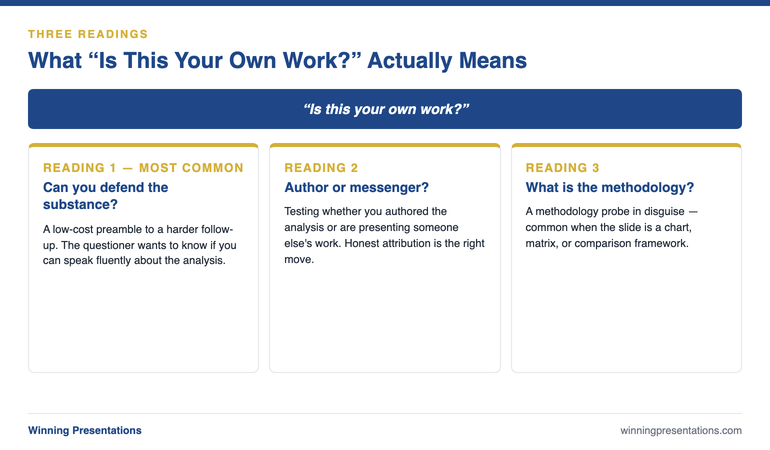
The Three Readings of 'Is This Your Own Work?': a triangular infographic showing the three underlying probes — Can You Defend the Substance? (most common), Are You Author or Messenger?, and What Is the Methodology? — each labelled with the typical questioner intent and the response posture that addresses it. Designed for live-room recall.

The three answers that quietly damage you

Wrong answer one: defensive overclaim. “Yes, absolutely, I designed every slide myself.” Two problems. First, if any follow-up reveals otherwise — a colleague mentions in passing that they helped, the design has a tell, the questioner already knows you used a template — you have lost credibility on something far more important than the original question. Second, defensiveness signals that you treat the question as a threat. Senior executives notice when minor questions trigger disproportionate defensive responses; it adjusts their estimate of your composure.

Wrong answer two: dismissive deflection. “I am not sure what you mean — can we move on?” or any variant that refuses to engage. This reads as evasive, regardless of the questioner’s actual intent, and it tends to encourage the questioner to ask harder follow-up questions to see what you are avoiding. Deflection in a senior room never closes a door; it almost always opens a worse one.

Wrong answer three: the rambling concession. Markus’s stumbled answer falls in this category — too much information delivered too uncertainly. The questioner asked a binary-feeling question and received a paragraph of qualifying caveats. Senior audiences interpret this as either a confidence problem or a trying-to-hide-something problem. Neither is what you want to communicate.

The decision-safe response, broken down

The decision-safe response has three components delivered in roughly twenty seconds.

Component one: brief acknowledgement of form. “The layout is from a senior template library I use.” Twelve words. Honest. Closes the literal question.

Component two: explicit ownership of substance. “The analysis and the recommendation on this slide are mine.” Twelve words. Asserts authorship of the part the executive actually cares about.

Component three: redirection to the substance. “Happy to walk through how I reached the conclusion.” Or, if you sense the methodology reading: “Happy to walk through the data sources and the methodology.” Eight to twelve words. Invites the harder question rather than waiting for it, on your own terms.

Total: roughly thirty seconds, calm, confident, complete. The executive almost always says “no, that is fine, please continue” — because the question has been answered well and there is nothing left to probe. Occasionally the executive accepts the invitation: “Yes, walk us through it.” That is the version of the conversation you want, because you are now in territory you control.

The components are flexible. You can soften them, swap order, or use different words. The structure is what matters: form + substance + invitation. Practise the structure once; the words come naturally in the room.

Stop being destabilised by senior questions

The Executive Q&A Handling System teaches the structured response patterns for the questions senior audiences actually ask — provenance, methodology, scope, alternatives, downside. Calm authority, decision-safe answers, in 45 seconds. Designed for board, audit committee, and investment committee scrutiny.

  • The structured response patterns for the most common executive question types
  • The pause-pace-redirect technique that gives you composure under pressure
  • Scenario playbooks for hostile questions, methodology probes, and challenge follow-ups
  • £39, instant download, lifetime access

Get the Executive Q&A System — £39 →

Designed for senior professionals presenting to boards, executive committees, and investment panels.

Handling harder follow-up questions

Sometimes the question is the start of a longer probe. Three follow-ups arrive often enough that they are worth pre-empting.

Follow-up one: “Then who else was involved?” Honest, direct, brief. “I built the analysis with [name], who runs the modelling team. The recommendation is mine.” Naming collaborators is not a weakness; pretending you worked alone is. Senior audiences trust presenters who attribute clearly. The presenter who says “the team built this together and I am presenting it” is not diminished — they are understood to be a senior leader who knows how senior work gets done.

Follow-up two: “Walk me through the methodology.” If you have the answer prepared, deliver it crisply: data sources, time frame, key assumptions, sensitivity analysis. If you do not, do not invent. “The methodology is documented in the appendix slide on page 14, and I can walk you through it now if helpful — or in the back-pocket Q&A after this section.” Offering an option respects the chair’s time and gives the questioner agency.

Follow-up three: “How confident are you in the conclusion?” The hardest of the three because it asks you to disclose your own uncertainty publicly. The right answer is honest and calibrated, not falsely confident. “I am highly confident in the directional conclusion. The magnitude has more uncertainty — the sensitivity range we tested is plus or minus 18%, and the implications hold across that range. Below that range, the recommendation would change.” Calibrated confidence is the senior register. Either overclaiming or hedging weakens you.
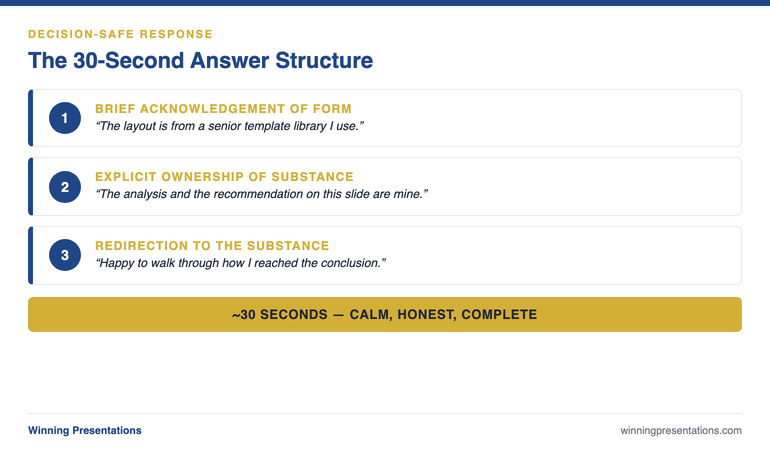
The Decision-Safe Response Structure: a three-step infographic showing Component 1 (Brief Acknowledgement of Form), Component 2 (Explicit Ownership of Substance), and Component 3 (Redirection to the Substance) — with example phrasing under each step and a 30-second total time stamp at the bottom. Editorial style, navy and gold.

How to prevent the question from arriving in the first place

The question arrives most often on slides where the design polish exceeds the apparent depth of the presenter’s engagement with the content. Three preventive practices reduce the frequency dramatically.

Practice one: rewrite every word on every slide. If the language on the slide is plainly yours — your phrasing, your sentence structure, your turn of mind — the slide does not feel templated to the audience even when it is. The question rarely fires when the voice on the slide is unmistakeably the voice of the person speaking.

Practice two: deliver the slide with specific, concrete commentary. Generic walk-throughs (“as you can see, this shows our progress on the strategic priorities”) signal a presenter standing outside the slide. Specific commentary (“the shift you see between Q2 and Q3 in the third row is what we have been calling the cost-mix effect — about £3.2 million of it is just the relabelling we agreed last meeting; the rest is genuine”) signals a presenter standing inside it. Specificity is the strongest signal of authorship.

Practice three: name the methodology before you are asked. Pre-emptively saying “the methodology behind this matrix is documented in the appendix; I am happy to walk through it now if useful, or after this section” closes the methodology door before it can become an interrogation. Some senior questioners only ask about provenance because they want to ask about methodology and they are using the lighter question as a runway. Removing the runway often removes the harder question.

The combination — your voice on the slide, your specific commentary aloud, and methodology pre-empted — makes the “is this your own work?” question vanishingly rare. When it does arrive, the decision-safe response handles it. Both layers together mean the question stops being a destabiliser.

For the closely-related psychological dimension — the gap between deck polish and felt ownership before the meeting starts — see the partner article on template anxiety and confidence recovery.

If you want a complete library of structured response patterns for the questions executives actually ask, the Executive Q&A Handling System (£39) covers methodology probes, hostile challenges, scope tests, alternatives challenges, and the meta-questions like provenance — with the response structures that hold under pressure.

The full Q&A response library

The Executive Q&A Handling System covers the response patterns for hostile, methodology, scope, alternatives, and meta-questions — every major question type senior audiences ask. £39, instant download.

Get the Q&A Handling System →

Built for senior professionals across financial services, technology, and consulting.

FAQ

What if the executive presses harder after my decision-safe response?

That is good news, not bad. Pressing harder means the executive is engaged. The decision-safe response invites engagement on terms you control — methodology, analysis, recommendation — so harder follow-ups land in territory you have prepared for. The presenter who fears the follow-up is usually the presenter who has not prepared the substance underneath the slide. The presenter who welcomes it is the one whose preparation runs deeper than the slide’s surface.

Should I disclose the template source by name?

Usually no — and never under direct cross-examination. “A senior template library I use” is the right level of detail. Naming the specific source invites a tangent (“oh, I have heard of those, are they any good?”) that distracts from your substance. Keep the response moving toward the analysis, where your authority lives.

Does this work the same way for hostile questioners?

Yes, with a small adjustment. Hostile questioners sometimes use the provenance question as a setup for a harder challenge. The structured response holds — form, substance, redirection — but expect the follow-up to come quickly. The pause-pace-redirect technique (a brief pause before answering, measured pace through the answer, deliberate redirection at the end) does much of the work to keep you composed under hostility.

What if I genuinely cannot defend the slide because someone else built it?

Then say so, calmly. “This slide was built by [name] in the modelling team — I can give you the high-level interpretation, and [name] is on the line if you want to go deeper into the methodology.” Honest attribution under pressure is a senior move. Pretending to authorship you do not have is the move that ends careers when it is discovered.

Get The Winning Edge — weekly

One sharp, story-led idea every Thursday on executive presentation craft, the live psychology of the room, and the small decisions that change how senior audiences receive you. Read by senior professionals across financial services, technology, and consulting.

Subscribe to The Winning Edge →

Not ready for the full system? Start here instead: download the free Executive Presentation Checklist — a one-page reference covering the structural moves that hold any executive deck together, before any question arrives.

Practise the response once. Out loud, in front of a wall, with the three components in order. The next time the question arrives in a senior room, you will be ready — and the executive who asked it will move on to the next agenda item, with the room’s confidence in you slightly higher than it was a minute ago.


About the author. Mary Beth Hazeldine is Owner & Managing Director of Winning Presentations Ltd, founded 1990. With 24 years of corporate banking experience at JPMorgan Chase, PwC, Royal Bank of Scotland, and Commerzbank, she advises executives across financial services, healthcare, technology, and government on structuring presentations for high-stakes funding rounds and approvals.

28 Feb 2026
Executive preparing for presentation Q&A at desk with laptop and data tablet in corporate office

Most Executives Don’t Prep for Q&A. Here’s the AI Workflow That Changes That in 10 Minutes.

She’d spent 14 hours on the deck. Every slide was polished. The data was bulletproof. The recommendation was clear. Then the CFO asked one question — “What happens to the margin if we delay by a quarter?” — and she froze. Not because she didn’t know the answer. Because she’d never thought about it. Fourteen hours on slides. Zero minutes on Q&A preparation.

Quick Answer: Most executives prepare extensively for their presentation and not at all for the Q&A that follows it. Yet Q&A is where decisions actually get made or killed. AI changes this equation dramatically: in 10 minutes, you can feed your presentation to ChatGPT or Claude, ask it to role-play as your toughest stakeholder, and generate 15-20 likely challenge questions with concise answers. The executives who do this have a structural advantage over everyone else in the room — because almost nobody does.

🚨 Presenting this week? Quick check: Can you name the three hardest questions your audience might ask? Can you answer each in under 15 seconds? If not, you’ve found your preparation gap — and AI can close it in 10 minutes.

📌 If you’d rather see the structured frameworks than build them from scratch:

The AI prompts and answer structures in this article pair directly with the Executive Q&A Handling System — designed for senior professionals facing high-stakes boardroom, investor, and panel Q&A.

In 25 years of corporate banking — at JPMorgan, PwC, RBS, and Commerzbank — I never once saw a presentation succeed or fail because of the slides. The slides got people to the table. The Q&A determined whether they left with a yes or a “let’s revisit.”

But here’s what I also noticed: even the most senior executives spent almost all their preparation time on the deck and almost none on the questions that would follow it. It wasn’t laziness. It was that Q&A prep felt impossible — how do you prepare for questions you can’t predict?

That changed when AI became genuinely useful. I started asking clients to feed their presentations to ChatGPT or Claude before presenting, with a simple instruction: “You are a sceptical CFO reviewing this proposal. What are your top 10 concerns?” The quality of the questions was startling. Not perfect — but 70-80% overlap with what actually got asked.

Now I recommend this to every executive I work with. It takes 10 minutes. It costs nothing. And it gives you the one advantage that almost nobody in the room has: you’ve already rehearsed the hard questions.

The Q&A Preparation Gap: Why Smart Executives Get Caught Off Guard

How do executives prepare for tough questions? The honest answer, from two decades of watching them: most don’t. They prepare the presentation. They rehearse the delivery. They might anticipate one or two obvious questions. But systematic Q&A preparation — the kind where you map every likely question, draft concise answers, and stress-test for follow-ups — almost never happens.

There’s a structural reason for this. Slide preparation feels productive. You can see the deck taking shape. You can measure progress. Q&A preparation feels abstract and unbounded — there are infinite possible questions, so where do you even start?

This is exactly where AI changes the equation. AI can’t predict every question. But it can do something humans struggle with: it can systematically assume different perspectives and generate questions from each one. A sceptical CFO asks different questions than a supportive COO. A technical architect challenges different assumptions than a commercial director. AI can role-play all of them in minutes.

The result isn’t perfect prediction. It’s coverage. Instead of walking in having thought about 2-3 obvious questions, you walk in having considered 15-20 questions across multiple stakeholder perspectives. That’s the difference between hoping you won’t be caught off guard and knowing you’re prepared for most of what’s coming.

If you’re new to predicting questions systematically, the Question Map method gives you the manual framework. What this article adds is the AI acceleration layer that makes it practical even when you’re short on time.

The 10-Minute AI Q&A Preparation Workflow

This workflow works with ChatGPT, Claude, Copilot, or any capable AI assistant. The principle is the same across tools — you’re using AI as a sceptical audience simulator.

Step 1: Feed it your context (2 minutes). You don’t need to upload your entire deck. Give the AI a brief: “I’m presenting a proposal to [audience] requesting [decision]. The key points are [3-4 bullet points]. The budget is [amount]. The timeline is [duration].” The more specific you are about the audience and the ask, the better the questions will be.

Step 2: Assign a stakeholder role (1 minute). This is the step most people skip, and it’s the one that transforms the output. Don’t just ask “What questions might they ask?” Instead: “You are a sceptical CFO who has seen three similar proposals fail. What are your top concerns about this proposal?” The role-play instruction generates questions that sound like the people in your actual room.

Step 3: Generate questions by role (3 minutes). Run the prompt for 2-3 different stakeholder types. The CFO asks about cost and ROI. The COO asks about implementation and resources. The CTO asks about technical feasibility. Each role generates 5-7 unique questions, giving you 15-20 total.

Step 4: Draft 15-second answers (3 minutes). For each question, ask the AI to help you draft a concise answer using your actual data. “Draft a 2-sentence answer to this CFO question using these facts: [your data].” The 15-second constraint is critical — long answers in Q&A signal uncertainty. Short, structured answers signal confidence.

Step 5: Stress-test with follow-ups (1 minute). Pick the 3 hardest questions and ask the AI: “If I gave this answer, what would the follow-up question be?” This catches the second-level challenges that most people are completely unprepared for.

The AI Q&A preparation workflow showing five steps: feed AI your deck, assign stakeholder roles, generate challenge questions, draft 15-second answers, and stress-test with follow-ups

Walk Into Q&A Having Already Rehearsed the Hard Questions

AI generates the questions. The Executive Q&A Handling System gives you the frameworks for answering them — so every response sounds confident, concise, and credible:

  • The structured response frameworks that turn any question into a 15-second confident answer — including the PREP, Bridge, and Redirect techniques
  • Stakeholder-specific question banks — the actual questions CFOs, COOs, and board members ask, mapped by scenario
  • The follow-up question defence — how to handle “but what about…” without losing composure
  • Recovery scripts for the questions you genuinely didn’t anticipate

Get the Executive Q&A Handling System → £39

Built from thousands of executive Q&A sessions across global banking and consulting — including the questions that derail proposals and the answers that save them.

The Role-Play Prompts That Generate Real Questions (Not Generic Ones)

The quality of AI-generated questions depends entirely on how you prompt. “What questions might be asked about this proposal?” gives you generic questions. Role-play prompting gives you questions that sound like they’re coming from the actual person who’ll be in the room.

Here are the prompt structures that consistently produce the most realistic questions:

The Sceptical Finance Prompt: “You are the CFO of a £500M company. You’ve seen proposals like this before and most have underdelivered on ROI. You are friendly but rigorous. Review this proposal and give me your top 7 concerns, phrased as questions you would ask in the meeting.”

The Political Challenger Prompt: “You are a senior VP whose own project competes for the same budget as this proposal. You need to look supportive in public but you want this proposal deferred. What questions would you ask that sound reasonable but are designed to create doubt?”

The Technically Sceptical Prompt: “You are the CTO. You’ve been burned by projects with unrealistic technical timelines. You want to support innovation but you won’t approve anything that your team can’t actually deliver. What are your concerns?”

Can ChatGPT help with presentation questions? Absolutely — and it’s most useful when you give it a specific persona rather than asking for generic questions. The persona instruction forces the AI to generate questions from a particular perspective, which is far more realistic than a neutral “what might they ask?” approach.

The political challenger prompt is the one most executives never think to use — but it generates the most dangerous questions. The ones that sound supportive on the surface but are designed to stall your proposal. If you understand why executives ask questions they already know the answer to, you’ll recognise these patterns immediately.

AI generates the questions, but you need frameworks for answering them under pressure. The Executive Q&A Handling System gives you the response structures that work when you’re standing in front of the room and need to sound confident in 15 seconds.

Drafting 15-Second Answers: The Structure That Sounds Confident

Here’s a pattern I’ve observed across thousands of executive Q&A sessions: the length of your answer is inversely correlated with how confident you sound. Short, structured answers signal “I’ve thought about this.” Long, wandering answers signal “I’m figuring this out as I speak.”

The 15-second answer structure is: Position → Evidence → Implication.

Position: A one-sentence direct answer. “Yes, the margin impact is approximately 3% in Q1, recovering to baseline by Q3.”

Evidence: One supporting fact. “That’s based on the ramp-up cost curve we modelled using last year’s implementation data.”

Implication: One sentence connecting back to the decision. “The 12-month ROI is still 2.4x, which is above our threshold.”

That’s a complete answer in three sentences. Under 15 seconds. The questioner feels heard, the room feels informed, and you sound like someone who has done the work.

Where AI helps: after generating your list of likely questions, ask the AI to draft a Position-Evidence-Implication answer for each one using your actual data. Then review and adjust for accuracy. You’re not reading these answers verbatim in the meeting — you’re rehearsing the structure so it comes naturally when you’re under pressure.

For more on what happens when Q&A goes wrong and how to recover, see the 4-part executive system for handling difficult questions.

The Stress-Test: Follow-Up Questions That Break Weak Answers

The first question rarely kills a proposal. It’s the follow-up that does. The CFO asks about margin impact — you answer well. Then she asks: “And what happens to that margin if adoption is 30% below your projection?” That’s where unprepared presenters crumble.

AI is exceptionally good at generating follow-up questions because you can give it your answer and ask: “What would a sceptical questioner say next?”

Here’s the stress-test workflow:

Pick your 3-5 hardest questions from the role-play exercise. These are the ones where your answer feels weakest or where the data is softest.

Give the AI your draft answer and ask: “I gave this answer to a sceptical CFO. What is her next question?” The AI will typically probe the weakest assumption in your answer.

Prepare a second-level answer for each follow-up. If you can survive two rounds of questioning on your hardest topics, you can survive the actual Q&A. Most challenges don’t go deeper than two levels.

How do you use AI to prepare for presentation Q&A? Use it as a role-playing partner. Feed it your presentation context, assign it stakeholder roles, generate questions, draft structured answers, then stress-test the weakest ones with follow-up prompts. The entire process takes 10-15 minutes and covers more ground than hours of solo preparation.

The AI generates the questions and helps draft answers. The Executive Q&A Handling System gives you the proven frameworks for when you’re in the room and need to respond with confidence — including recovery techniques for the questions AI didn’t predict.

Stop Dreading the Questions More Than the Presentation

The presentation is the easy part — you control the content. Q&A is where proposals live or die. The Executive Q&A Handling System gives you control of Q&A too:

  • Structured response frameworks — PREP, Bridge, and Redirect techniques that make any answer sound confident and concise
  • The follow-up defence system — how to handle persistent questioning without losing composure or credibility
  • Stakeholder question banks — the actual patterns CFOs, board members, and sceptical executives use when they challenge proposals
  • Recovery scripts for genuinely unexpected questions — so you never freeze, even when caught off guard

Get the Executive Q&A Handling System → £39

Created by a presentation specialist who has coached senior professionals through the Q&A moments that decide careers and budgets.

Why Q&A Prep Is the Fastest Competitive Advantage in Any Room

Think about the last meeting where someone got asked a hard question and answered it immediately, calmly, with specific data. How did that person look? Prepared. Credible. In command of the material. Now think about the last time someone stumbled — paused too long, gave a vague answer, or said “I’ll get back to you on that.” How did that land?

The difference between those two outcomes is almost never intelligence or expertise. It’s preparation. And what makes Q&A prep such a powerful advantage is that hardly anyone does it. Your colleagues are spending hours perfecting slides that everyone will forget. You’re spending 10 minutes preparing for the questions that will determine the outcome.

In banking, I watched this dynamic play out hundreds of times. Two equally qualified directors presenting to the same committee. One had anticipated the CFO’s margin question. One hadn’t. The one who had prepared didn’t just answer the question — she revealed that she’d modelled three scenarios. That single moment of preparation changed the committee’s confidence in her entire proposal.

AI makes this preparation accessible to everyone. You don’t need a coach or a colleague willing to role-play as a hostile questioner. You need 10 minutes and a prompt. The question is whether you’ll use those 10 minutes — because most of your competitors won’t.

Is the Executive Q&A Handling System Right for You?

This is for you if:

  • You prepare thoroughly for presentations but rarely prepare for Q&A — and you know it’s a gap
  • You’ve been caught off guard by a question that derailed your proposal or killed your confidence
  • You present to senior executives, board members, or finance leaders who ask challenging questions
  • You want structured frameworks for answering ANY question confidently, not just the ones AI predicts

This is NOT for you if:

  • You’re looking for AI prompt templates (this article covers that — the product covers the answering frameworks)
  • You never face Q&A in your presentations
  • You already have a systematic Q&A preparation process you’re happy with

From 25 Years of Executive Q&A at JPMorgan, PwC, RBS, and Commerzbank. Now a System You Can Use Before Every Presentation.

I’ve watched Q&A sessions save proposals and destroy them. The Executive Q&A Handling System is built from the patterns that separate the executives who command the room from the ones who lose it:

  • Every response framework, stakeholder question bank, and recovery technique — refined from senior-level presentations across financial services, consulting, and technology
  • The answer structures that consistently sound confident under pressure
  • Works alongside the AI preparation workflow in this article — AI predicts the questions, the system gives you the frameworks for answering them

Get the Executive Q&A Handling System → £39

Instant download. Prepare for your next Q&A today.

Frequently Asked Questions

Which AI tool is best for Q&A preparation?

ChatGPT (GPT-4), Claude, and Copilot all work well for this. The key isn’t the tool — it’s the prompting technique. Role-play prompts with specific stakeholder personas produce significantly better questions than generic “what might they ask?” prompts. Use whichever AI tool you’re most comfortable with and focus on the quality of your instructions.

What if the AI generates questions nobody actually asks?

Expect about 70-80% relevance from well-prompted AI. The remaining 20-30% might be unlikely questions, but they’re rarely useless — they often reveal assumptions in your proposal you hadn’t examined. The point isn’t perfect prediction. It’s coverage. Even if 5 of your 20 generated questions never get asked, you’ve still prepared for 15 more questions than you would have otherwise.

How do I prepare for truly unexpected questions?

You can’t predict every question, but you can prepare a universal response structure. The Position-Evidence-Implication framework works for ANY question, even unexpected ones. If you’ve practised structured responses to 15 predicted questions, the muscle memory carries over to the unpredicted ones. You won’t have the perfect answer, but you’ll have the right structure — and that’s what sounds confident.

Does this work for technical Q&A or only executive-level questions?

The AI role-play approach works for any audience type. For technical Q&A, assign the AI a technical role: “You are a senior architect who has implemented three similar systems and two of them failed. What are your concerns about this technical approach?” The principle is identical — persona-based prompting generates more realistic questions than generic prompting, regardless of the domain.

The Winning Edge Newsletter

Weekly strategies for executive presentations that get decisions, approvals, and buy-in. Practical, tested techniques for senior professionals.

Subscribe free →

Optional free resource: CFO Questions Cheatsheet — the 10 questions finance leaders always ask, with structured response templates.

Also today: If your company is going through a restructure and you’re preparing to present your team’s case, read the reorg presentation structure that protects your department — then use the AI Q&A workflow above to prepare for leadership’s follow-up questions.

Your next presentation has a Q&A at the end. Your colleagues won’t prepare for it. You can — in 10 minutes. Use the AI workflow above to predict the questions, then use the frameworks to answer them with confidence.

→ Get the Executive Q&A Handling System (£39) and walk into your next Q&A fully prepared.

About the Author

Mary Beth Hazeldine is the Owner & Managing Director of Winning Presentations. With 25 years of corporate banking experience at JPMorgan Chase, PwC, Royal Bank of Scotland, and Commerzbank, she has delivered high-stakes presentations in boardrooms across three continents.

A qualified clinical hypnotherapist and NLP practitioner, Mary Beth combines executive communication expertise with evidence-based techniques for managing presentation anxiety. She has coached senior professionals and supported presentations for high-stakes funding rounds and approvals.

Book a discovery call | View services

25 Feb 2026
Executive pausing with raised finger during boardroom Q&A, composing a structured response to a question he wasn't expecting, presentation screen visible behind him

When You Don’t Know the Answer: The 3 Responses That Save You in Executive Q&A

Quick Answer: When you don’t know the answer in a presentation, the worst response is a rambling attempt to fill the silence. The best response is one of three scripts: the Honest Redirect (“I don’t have that number — I’ll confirm by end of day”), the Bridge (“That’s an important question — here’s what the data does show”), or the Scope Shift (“That falls outside what we analysed, but here’s what’s relevant to today’s decision”). Each takes under 15 seconds and preserves your credibility completely.

If you’ve ever hit the “don’t know the answer” presentation moment in executive Q&A, these three scripts solve it fast.

⏰ Presenting in the Next 24 Hours?

☐ Memorise the 3 response scripts below — pick one as your default

☐ Pre-write one follow-up sentence you can paste after the meeting (“Following up from today — [data point] is…”)

☐ Write “I will send by ___” on your notes so you never miss a commitment made in Q&A

At JPMorgan, I was presenting a risk assessment to the credit committee — twelve senior people, two managing directors, one question that changed how I handle Q&A forever.

“What’s the correlation between the counterparty’s default probability and the sector exposure in our current portfolio?”

I didn’t know. I had the counterparty analysis. I had the sector exposure data. But I hadn’t calculated the correlation between the two. It wasn’t in my model.

My mind went blank. Twelve faces waiting. The silence felt like it lasted a minute — it was probably four seconds.

What I wanted to say: “I don’t know.” What I almost said: a rambling attempt to sound knowledgeable that would have made everything worse.

What I actually said: “I don’t have that specific correlation calculated. I’ll run it and have it to you by end of day. What I can tell you is the sector exposure is concentrated in three counterparties representing 68% of the book — which is the more immediate risk.”

The managing director nodded. “That’s the number I actually need. Send me the correlation when you have it.”

I’d admitted I didn’t know — and answered the question they actually cared about. My credibility went up, not down.

Why Going Blank in Q&A Destroys More Credibility Than a Wrong Answer

Here’s the counterintuitive truth about Q&A: a wrong answer delivered confidently is recoverable. Going blank is not.

When you give a wrong answer, you can correct it later — “I misspoke on the margin figure; it’s 23%, not 28%.” The room accepts this. You’re human. You corrected it. Trust maintained.

When you go blank — the visible freeze, the “um,” the rambling non-answer that everyone in the room recognises as a stall — something different happens. The room doesn’t just question your knowledge of that specific topic. They question your competence. “If they didn’t know this, what else don’t they know?”

This is why the stakes of not knowing the answer in a presentation feel so disproportionate. It’s not about one question. It’s about the credibility cascade — the room’s trust in everything you’ve already said starts to erode.

But here’s the thing: it’s not the not-knowing that causes the damage. It’s the response to not knowing. The right response actually builds credibility. The wrong response destroys it.

What should you say when you don’t know the answer in a presentation?

Use one of three scripts depending on the situation: the Honest Redirect (admit + commit + bridge), the Bridge (acknowledge + pivot to what you do know), or the Scope Shift (reframe the question within your presentation’s scope). Each takes under 15 seconds, each preserves credibility, and each gives the room a substantive response instead of silence. The key is having the script ready before Q&A begins — so you’re choosing a response, not searching for one.

The 3 Responses That Preserve Credibility

In 25 years of presenting in banking — and 16+ years training executives since — I’ve found that every “don’t know” moment falls into one of three categories. Each has a specific response that works. The scripts are short, specific, and designed to be memorised before you walk into the room.

For handling difficult questions in presentation Q&A, the 4-part response system (Headline → Reason → Proof → Close) works. But “don’t know” moments are a specific subset — and they need specific scripts.

Response 1: The Honest Redirect

When to use it: You genuinely don’t have the data, but you can get it.

The script: “I don’t have [specific data point] in front of me. I’ll [specific action] and have it to you by [specific time]. What I can tell you is [the related data point that IS relevant to their decision].”

Why it works: Three things happen in this response. First, you demonstrate honesty (which builds trust). Second, you commit to a specific follow-up (which demonstrates reliability). Third, you bridge to something you DO know that’s relevant (which demonstrates competence). The room gets honesty, a commitment, and a useful answer — all in under 15 seconds.

Example: “I don’t have the year-on-year comparison for Q3 specifically. I’ll pull it from the dashboard and send it to you by 3pm. What I can tell you is the Q3 absolute figure was £2.1M, which is above the threshold we set in the business case.”

Critical rule: The follow-up must happen. If you say “by end of day,” it arrives by end of day. If you say “by 3pm,” it arrives by 3pm. One missed follow-up after an “I don’t know” moment erases the credibility you preserved in the room.

⭐ Walk Into Q&A With Response Scripts Ready — Not Just Slides

The Executive Q&A Handling System gives you the complete framework for handling every type of question — including the ones you can’t answer. Pre-built response scripts, bridging phrases, and the Headline → Reason → Proof → Close structure that keeps you in control for 20-45 seconds per answer.

Your Q&A toolkit:

  • “I Don’t Know” response frameworks — three scripts for three situations, ready to memorise
  • Bridging phrases — exact language for pivoting from unknown to known
  • Question forecasting framework — predict 80% of questions before you walk in
  • 7 question type handlers — ROI, Risk, Trade-off, Timing, Capability, Evidence, Political

Get the Executive Q&A Handling System → £39

Built from 25 years of high-stakes executive Q&A. £39, instant access.

Response 2: The Bridge

When to use it: You don’t have the specific answer they asked for, but you have related information that addresses their underlying concern.

The script: “That’s an important question. The specific [metric/data/detail] isn’t in this analysis, but what the data does show is [the related finding that addresses the concern behind their question].”

Why it works: Most questions aren’t about the literal data point. They’re about the concern the data point represents. When the CFO asks “What’s the ROI timeline?” they’re really asking “Is this a safe investment?” If you don’t have the exact ROI timeline but you have the payback period, the cost savings, or the comparable benchmark — that answers the real question.

Example: “The specific ROI timeline isn’t calculated in this model. What the data does show is a payback period of 14 months at current volumes, which compares to an 18-month average for similar implementations in the sector.”

When NOT to use it: Don’t bridge when the specific data point is clearly what they need and nothing else will do. If the CFO asks “What’s the exact spend to date?” and you don’t know, that’s an Honest Redirect, not a Bridge. Bridging away from a number they genuinely need reads as evasion.

Response 3: The Scope Shift

When to use it: The question falls outside the scope of your presentation — they’re asking about something you weren’t tasked with analysing.

The script: “That falls outside the scope of this analysis — we focused specifically on [your scope]. But the relevant finding for today’s decision is [the data point that connects their question to the decision at hand].”

Why it works: It sets a boundary without sounding defensive, and it redirects to the decision the room is there to make. Not every question needs an answer — some need a scope clarification.

Example: “The competitive analysis falls outside this review — we focused on internal process efficiency. But the relevant finding is that the current process costs £380K more than our internal benchmark, regardless of what competitors are doing.”

When NOT to use it: If the question IS relevant to the decision and you simply didn’t include it. In that case, use the Honest Redirect. Scope Shifting a legitimate question reads as deflection.


Don’t want to write the recovery scripts from scratch?

The Executive Q&A Handling System includes all three response scripts — Honest Redirect, Bridge, Scope Shift — plus the bridging phrases that connect them. £39, instant download — lifetime access.

Get the Q&A Handling System →

The 4 Responses That Make It Worse

“Great question.” This is a stall tactic that every executive recognises. The moment you say “great question,” the room knows you’re buying time. It adds nothing and signals that you’re struggling.

The ramble. Talking without direction in the hope that something relevant emerges. This is the most common response to not knowing — and the most damaging. Every second of unfocused talking erodes the structured credibility your presentation built.

“I think…” followed by a guess. If you’re guessing, the room is guessing too — about whether everything else in your presentation was also a guess. A confident “I don’t have that number” is worth ten uncertain “I think it’s roughly…”

The deflection. “That’s really more of a question for the finance team.” Unless it genuinely is outside your scope, redirecting to another team reads as finger-pointing. If you presented the data, you own the Q&A on that data.

For a comprehensive view of the common Q&A mistakes that destroy deals, see the full breakdown of executive Q&A errors.

Three response scripts for when you don't know the answer in a presentation showing Honest Redirect, Bridge, and Scope Shift with exact language

⭐ Stop Dreading the Question You Can’t Answer

The Executive Q&A Handling System was built for the 4-second moment when your mind goes blank and twelve faces are waiting. Pre-loaded response scripts, bridging language, and the Forecast → Build → Control → Protect framework that handles every question type.

Your “I don’t know” recovery toolkit:

  • Three “don’t know” response scripts — Honest Redirect, Bridge, and Scope Shift with exact language
  • Bridging phrase library — pivoting from unknown to known without sounding evasive
  • Executive response structure — Headline → Reason → Proof → Close for every answer type
  • Decision capture sheet — tracking commitments you make during Q&A so follow-ups happen

Get the Executive Q&A Handling System → £39

Built from 25 years of high-stakes executive Q&A. £39, instant access — no subscription.

How to Reduce “Don’t Know” Moments by 80%

The three response scripts handle the moment. But the best strategy is reducing how often that moment happens.

Most “don’t know” moments are predictable — because most executive questions fall into predictable patterns. In my experience, 80% of Q&A questions fall into four categories: challenge questions (questioning your data or assumptions), clarification questions (wanting more detail), scope creep questions (asking about things beyond your presentation), and political questions (testing your alignment with someone in the room).

Before any presentation, take 20 minutes and map the four question types against each major section of your deck. For each section, ask: “What would a sceptic challenge? What would need clarification? What adjacent topic might someone raise? What political angle could this trigger?”

Write two-sentence answers for the top five predicted questions. The ones you can’t answer in two sentences — those are your “don’t know” candidates. Now you can prepare for them specifically: either get the data, or pre-load the appropriate response script (Honest Redirect, Bridge, or Scope Shift).

Is This Right For You?

✓ This is for you if:

  • You’ve experienced the “blank mind” moment in Q&A and want it never to happen again
  • You want specific language to use when you don’t know the answer — not just “be honest”
  • You present to senior leadership and the stakes of fumbling a question are career-level

✗ This is NOT for you if:

  • Your presentations don’t include Q&A (rare in executive settings, but possible)
  • You’re looking for slide templates rather than Q&A frameworks (see the Executive Slide System)

🎓 25 Years of Boardroom Q&A. One System.

The Executive Q&A Handling System is built from 25 years of corporate banking and 16 years coaching senior professionals across financial services, healthcare, technology, and government. Every framework — the three response scripts, the bridging phrases, the prediction techniques — comes from real boardroom situations where the wrong answer (or no answer) cost the deal.

Designed for senior professionals who present to boards, investment committees, and executive sponsors where every answer carries weight.

Get the Executive Q&A Handling System → £39

Instant download — lifetime access to every framework and template.

Frequently Asked Questions

Is it ever okay to say “I don’t know” in a presentation?

Yes — but never as a standalone answer. “I don’t know” followed by silence is a credibility killer. “I don’t have that specific figure — I’ll confirm by 3pm, and here’s what the data does show” is a credibility builder. The admission of not knowing isn’t the problem. The absence of a follow-up, a bridge, or a next step IS the problem. Executives respect honesty. They don’t respect uncertainty that offers nothing in return.

What if the question is deliberately hostile?

Hostile questions and “don’t know” moments require different responses. If someone is testing you or trying to expose a weakness publicly, the Bridge response works best — acknowledge the question, then pivot to the strongest data point you have. For hostile questions specifically, the Executive Q&A Handling System includes a full section on managing politically motivated questions. For a broader overview, see the guide to handling difficult questions in presentations.

How do I follow up after admitting I don’t know?

Same day, without exception. If you committed to “by end of day,” it arrives before close of business. The follow-up should be brief: “Following up from today’s presentation — the Q3 year-on-year comparison is 12.4%, in line with the trend I described. Let me know if you need any additional detail.” Short, specific, and it demonstrates that you were listening, that you committed, and that you delivered. This single follow-up repairs any credibility gap from the moment itself.

What if I genuinely have no related information to bridge to?

Use the Honest Redirect without the bridge. “I don’t have that data. I’ll get it to you by [specific time].” Then move to the next question. A clean, confident admission with a specific follow-up commitment is always better than a forced bridge to something irrelevant. The room can tell when you’re bridging to unrelated data, and it looks worse than a simple “I’ll get back to you.”

📬 The Winning Edge — Weekly Newsletter

One executive presentation insight per week. Real Q&A scenarios, real response scripts, no filler. Written for professionals who present to people who ask hard questions.

Subscribe Free →

Read next: Q&A is only half the battle. If the slides themselves need work, read The Sandwich Feedback Trap: Why It Fails When You Critique Up (And the Mirror Structure That Works).

Read next: If AI is helping you build slides but the structure isn’t landing, read AI Can Write Your Slides. It Can’t Structure Your Argument.

Your next Q&A is coming. The question you can’t answer is coming too. Get the response scripts that turn “I don’t know” from a career risk into a credibility moment.

About the Author

Mary Beth Hazeldine is the Owner & Managing Director of Winning Presentations. With 25 years of corporate banking experience at JPMorgan Chase, PwC, Royal Bank of Scotland, and Commerzbank, she has delivered high-stakes presentations in boardrooms across three continents.

A qualified clinical hypnotherapist and NLP practitioner, Mary Beth combines executive communication expertise with evidence-based techniques for managing presentation anxiety. She advises executives across financial services, healthcare, technology, and government on high-stakes Q&A and presentation structure.

Read more articles at winningpresentations.com

20 Feb 2026
Why Executives Ask Questions They Already Know the Answer To (And What They're Really Testing)

Why Executives Ask Questions They Already Know the Answer To (And What They’re Really Testing)

Quick answer: When executives ask questions during your presentation, they usually aren’t looking for information — they’re running a trust test. They want to know whether you understand the real issue, whether you’ve thought beyond your slides, and whether you stay composed under pressure. Once you learn to decode what’s actually being tested, handling executive questions becomes a completely different skill.

The Question That Wasn’t Really a Question

The CFO already knew the answer. I could see it on his face.

We were in a quarterly review at Royal Bank of Scotland. I’d just presented the client retention numbers — solid figures, well-structured slide. Then the CFO leaned forward and asked: “What’s driving the 3% attrition in the Northern portfolio?”

I knew the answer. He knew I knew the answer. He already had the regional breakdown on his desk — I’d seen it there when I walked in.

But I panicked. I started over-explaining. I gave him the complete history of the Northern portfolio, the market conditions, the competitive dynamics. By the time I finished, two minutes had passed and the room had glazed over.

A colleague presented after me. The CFO asked her a similar question. She said: “Two factors. The repricing in March caught three mid-tier clients off guard, and our response time on renewals was too slow. We’ve already addressed both — I can share the specifics if useful.”

Twelve seconds. She was done. The CFO nodded and moved on.

That’s when I understood something that took me years to fully appreciate across 24 years in corporate banking: executive questions during presentations are almost never about getting information. They’re about testing whether you understand the information well enough to be trusted with what comes next.

Once I learned to decode what executives are actually testing — rather than just answering what they’re literally asking — handling questions in board presentations and senior leadership meetings became the strongest part of my presentations, not the most feared.

Stop Guessing What Executives Actually Want to Hear

The Executive Q&A Handling System gives you frameworks for decoding questions, structuring 15-second answers, and recovering when you don’t know — without losing credibility.

Get the Q&A Handling System → £39

Built from 24 years of boardroom experience across banking and consulting environments.

Why Executive Questions Are Never Really About the Question

Here’s what most presenters get wrong: they hear a question and immediately try to answer it. They treat executive Q&A like an exam — as if the goal is to prove they know the material.

But executives rarely ask questions to learn basic facts. They have analysts, reports, and dashboards for that. They ask questions to evaluate you. Specifically, they’re evaluating three things: your depth of understanding, your judgement, and your composure. This is why getting executive buy-in depends as much on how you handle questions as on what’s in your slides.

I saw this dynamic play out hundreds of times across my banking career. A managing director at JPMorgan once told me something I never forgot: “I already know 80% of what’s in your presentation before you start. The questions are how I figure out the 20% that matters — and whether you know which 20% that is.”

That single insight changes everything about how you prepare for executive Q&A. You stop memorising facts and start thinking about what the questioner is actually evaluating.

The Trust-Test Framework showing three types of executive questions: Knowledge Test, Alignment Test, and Pressure Test with what each is really evaluating

The Trust-Test Framework: 3 Types of Executive Questions

Every question an executive asks during your presentation falls into one of three categories. Once you can identify which type you’re facing, the correct response becomes obvious.

Type 1: The Knowledge Test. This is the question from my CFO story. They already know the answer — they’re testing whether you do. The trap is over-explaining. When you give a two-minute answer to something that requires ten seconds, you signal insecurity. You’re telling the room: “I’m not confident enough to be brief.”

❌ Wrong response to a Knowledge Test: “Well, there are several factors at play here. If you look at the Northern portfolio historically, we’ve seen a trend since Q3 of last year where the mid-tier segment has been under pressure from competitor repricing, and additionally our internal response times on renewal processing have been impacted by the system migration…”

✅ Right response: “Two factors: competitive repricing in March and slow renewal response times. Both addressed — happy to go into specifics.”

The right response does three things: it proves you know the answer, it shows you can prioritise, and it hands control back to the executive. If they want more detail, they’ll ask. If they don’t, you’ve just demonstrated exactly the kind of judgement they were testing for.

Type 2: The Alignment Test. This is the question that sounds like a challenge but is actually a check on whether you’ve thought about the issue from their perspective. At PwC, I watched a partner ask a senior consultant: “How does this recommendation affect the timeline for the regulatory submission?” The consultant’s recommendation was sound. But the partner wasn’t questioning the recommendation — he was checking whether the consultant had considered the one thing keeping him up at night.

❌ Wrong response to an Alignment Test: “The timeline shouldn’t be affected. Our analysis shows that the current approach is the most efficient option based on the data.”

✅ Right response: “It adds approximately two weeks to the regulatory timeline. I’ve mapped out how to absorb that within the existing buffer — slide 8 has the detail if you’d like to see it.”

The Q&A Handling System teaches you to decode what’s really being asked — and respond in 15 seconds or less, every time.

Get the Q&A Handling System → £39

The wrong response defends your work. The right response acknowledges the executive’s concern, shows you’ve already thought about it, and offers proof. That’s the difference between someone who presents information and someone who demonstrates judgement.

Type 3: The Pressure Test. This is the question designed to see how you react when challenged. It might sound aggressive: “Why should we believe this forecast when the last one was 15% off?” It might sound sceptical: “Isn’t this just what we tried in 2023?” At Commerzbank, I watched a board member deliberately challenge a strong proposal just to see if the presenter would fold or hold.

❌ Wrong response to a Pressure Test: “Well, the circumstances were different then, and I think if you look at the methodology we’ve used this time, you’ll see that we’ve improved our approach significantly, and the margin of error is much lower now…”

✅ Right response: “Fair challenge. The 2023 forecast used a single-scenario model. This one stress-tests three scenarios — worst case still delivers 8% above breakeven. The methodology comparison is on slide 14 if that’s useful.”

Notice what the right response does: it doesn’t get defensive, it doesn’t apologise, and it doesn’t over-explain. It acknowledges the challenge (“Fair challenge”), gives the key differentiator in one sentence, provides proof, and offers more detail only if the executive wants it.

The Wrong vs. Right Pattern That Applies to Every Executive Question

Across all three trust-test types, the pattern is the same. Here’s the formula that works in every executive-level presentation:

❌ Wrong pattern: Hear question → feel threatened → start explaining → add context → add more context → hope the executive stops you → realise you’ve been talking for 90 seconds → trail off weakly.

✅ Right pattern: Hear question → identify the trust test → give the headline answer (one sentence) → offer proof or a slide reference → hand control back.

The entire right pattern takes 10-15 seconds. That’s not a guess — I’ve timed hundreds of executive Q&A sessions across my career. The answers that build the most trust are almost always under 20 seconds. The answers that destroy trust are almost always over 60 seconds.

Here’s one more wrong/right comparison that captures the principle perfectly:

❌ What most people do when a board member asks “What’s the risk here?”: They list every risk they can think of, show they’ve done thorough analysis, and end up making the proposal sound dangerous. Two minutes later, the room is more worried than when the question was asked.

✅ What experienced presenters do: “The primary risk is execution timing — specifically the Q3 integration window. We’ve built in a two-week buffer and a fallback option. The risk register is in the appendix.” Fifteen seconds. The board member nods. The proposal still has momentum.

Wrong versus right response pattern showing the long rambling answer compared to the Trust-Test response of headline answer plus proof plus control handback

Turn Q&A Into the Strongest Part of Your Presentation

The Executive Q&A Handling System includes frameworks for predicting questions, structuring 15-second answers, and handling “I don’t know” moments — all built for boardroom-level conversations.

Get the Q&A Handling System → £39

Built from 24 years in banking and consulting environments. Used in board meetings, steering committees, and investor presentations.

What to Say When You Genuinely Don’t Know the Answer

Not every question is a trust test you can decode and pass. Sometimes you genuinely don’t know the answer. And this is where most presenters make the worst mistake of all: they bluff.

I watched a VP at Commerzbank try to answer a technical question about derivatives exposure that he clearly didn’t have the numbers for. He improvised for about 45 seconds. The CFO let him finish, then said: “That’s not what I asked.” The room went silent. His credibility for the rest of the meeting was gone.

The correct response when you don’t know is the simplest one — and the one that actually builds trust:

❌ Wrong: “That’s a great question. I believe the figure is somewhere around… let me think… I want to say it’s approximately 12%, but I’d need to verify that. The general trend has been…”

✅ Right: “I don’t have that specific figure to hand. I’ll confirm it by end of day and send it through. What I can tell you now is that the overall trend supports the recommendation — the exact number won’t change the direction.”

That response does four things: it’s honest, it commits to a specific follow-up action, it gives the executive something useful right now, and it reframes the gap as non-critical to the decision. Executives respect all four of those things far more than a guess.

If you struggle with the pressure of these high-stakes moments — where your career credibility is on the line — you’re not alone. Many of the executives I work with find that having a reliable presentation structure for career-defining conversations reduces the anxiety of Q&A significantly.

Knowing what to say — and what NOT to say — when you don’t have the answer is one of the most valuable executive communication skills. The Q&A Handling System covers exactly this.

Get the Q&A Handling System → £39

Common Questions About Handling Executive Questions in Presentations

Why do executives ask questions they already know the answer to?

Executives use questions as trust tests — not information requests. They’re evaluating whether you understand the material deeply enough to be brief, whether you’ve considered their priorities, and whether you stay composed under challenge. The question itself is rarely the point. Your response reveals your judgement, your preparation, and your confidence — all of which influence whether the executive trusts you with bigger responsibilities and decisions.

How do you handle tough questions from senior leadership in a presentation?

Identify which type of trust test you’re facing: a Knowledge Test (they know the answer — be brief), an Alignment Test (they want to know you’ve considered their concern — acknowledge and show you’ve planned for it), or a Pressure Test (they’re challenging to see your composure — acknowledge the challenge, give one differentiator, offer proof). In all three cases, keep your answer under 20 seconds and hand control back to the questioner.

What do board members want to hear during presentation Q&A?

Board members want brevity, honesty, and evidence of judgement. They want to hear that you understand the core issue (not just the surface question), that you’ve considered the risks and trade-offs, and that you can distinguish between what matters and what doesn’t. The fastest way to build trust in board Q&A is to answer in one sentence, offer a proof point, and let the board member decide if they want more detail.

The Q&A Is Where Decisions Actually Get Made

Your slides set up the case. The Q&A is where the executive decides whether to trust it. The Executive Q&A Handling System gives you the frameworks to pass every trust test — whether you know the answer or not.

Get the Q&A Handling System → £39

Built from 24 years in banking and consulting. Used in board meetings, steering committees, and investor presentations.

Optional: The Q&A Handling System is also available as part of The Complete Presenter (£99) — seven products covering slides, storytelling, confidence, and delivery.

Frequently Asked Questions

What if the executive question is genuinely hostile — not a trust test?

Genuine hostility is rarer than people think, but it happens. The response is the same: acknowledge, answer briefly, and don’t get defensive. “I hear your concern. Here’s what the data shows…” works in hostile environments because it refuses to escalate. The executive either accepts your response or pushes further — but either way, the room sees you as composed. That composure is itself a trust signal, and it often matters more than the content of your answer.

Can I prepare for trust-test questions in advance?

Yes — and you should. Before any executive presentation, identify the three questions the most senior person in the room is most likely to ask. For each one, prepare a headline answer (one sentence), a proof point, and a slide reference. This takes ten minutes and eliminates 80% of Q&A anxiety. The remaining 20% is unpredictable, but the framework still applies: identify the trust test, give the headline, offer proof, hand back control.

Does this work in virtual presentations where you can’t read body language?

The Trust-Test Framework works regardless of format because it’s about the structure of your answer, not the visual cues you’re reading. In virtual settings, the framework actually matters more because you have fewer signals to work with. The 15-second answer discipline is especially critical on video calls where attention spans are shorter and rambling is more noticeable. One practical adjustment: pause for a beat before answering. On video, this reads as thoughtful rather than slow.

What if my boss is in the room and the executive’s question reveals something my boss didn’t want raised?

This is one of the most politically sensitive Q&A scenarios — and one of the most common. The framework still applies: answer honestly but briefly, and don’t volunteer additional context that expands the issue. “That’s something we’ve identified and are addressing — I can share the plan after this meeting” buys you time without lying, deflecting, or putting your boss in a difficult position. The key is to never throw anyone under the bus and never make up an answer to cover for a gap. Executives can spot both instantly.

📬 Get Weekly Presentation Intelligence

Q&A frameworks, executive communication strategies, and the techniques that work in real boardrooms — delivered every week. No fluff. No spam.

Join the Newsletter

Related: If you’re preparing to present to the person who controls your pay, the Q&A portion is often where the real conversation happens. Read Presenting to the Person Who Will Decide Your Bonus — the 6-slide structure that reframes the entire conversation.

Your next step: Before your next executive presentation, identify the three most likely questions from the most senior person in the room. For each one, write a headline answer in one sentence. That’s it. That ten-minute exercise will change how you experience Q&A — permanently.

Want the complete framework for handling any executive question — including the ones you can’t predict?

Get the Q&A Handling System → £39

About the Author

Mary Beth Hazeldine is the Owner & Managing Director of Winning Presentations. With 24 years of corporate banking experience at JPMorgan Chase, PwC, Royal Bank of Scotland, and Commerzbank, she specialises in executive-level presentation skills and Q&A preparation.

A qualified clinical hypnotherapist and NLP practitioner, Mary Beth combines executive communication expertise with evidence-based techniques for managing presentation anxiety. She has spent 15 years training executives and supporting high-stakes board presentations, steering committee updates, and decision meetings.

Book a discovery call | View services