Tag: executive question handling

23 Jun 2026
The Eight Question Patterns Senior Executives Drill Before Every Board Q&A

The Eight Question Patterns Senior Executives Drill Before Every Board Q&A

Quick answer: The senior executives who handle board Q&A best are not the ones who are quickest on their feet. They are the ones who have rehearsed eight specific question patterns so often that none of those patterns surprises them in the room. Q&A handling is not a personality trait. It is a drillable taxonomy — eight predictable shapes that almost every difficult question fits into — and the training that actually moves the needle is the work of recognising the pattern in the first three seconds and responding from a prepared frame rather than improvising from cold. The improvisation problem is not solved with more confidence. It is solved with fewer surprises.

In November 2008, a senior risk director at one of the banks where I worked walked into a committee room to present a proposed change to the credit-approval framework. The paper had been pre-read. The chair, a man with a long memory and a longer reputation, opened the discussion by saying nothing for nearly a minute — and then asked one question that did not appear anywhere in the deck. The director paused, blinked twice, and gave an answer that was technically correct and politically catastrophic. The proposal was deferred for ninety days. Afterwards, in the corridor, she said the thing senior people say when Q&A goes badly: “I did not see that one coming.”

She was wrong about that, although she did not know it yet. The question that ambushed her was not a new question. It was the third of eight question patterns that committee chairs use on every paper they want to slow down. I had heard a version of it in eleven previous meetings. The reason it surprised her was not that the question was novel — it was that she had no taxonomy in her head to slot it into in the moment, so it arrived as a single weather event rather than as the third instance of a recurring kind of weather. The training that fixes this is not training in being quicker. It is training in seeing the pattern.

(This article was created with AI assistance; all stories and insights are based on 35 years of real client work.)

Two years later, I watched the same director chair a committee herself. A junior presenter walked in with a sound paper and got hit with what was structurally the same question. She handled it in eleven seconds. Not because she had become quicker, but because she had spent the intervening period drilling the eight patterns until each one had a prepared opening line and a known direction of travel. The lesson she had absorbed was the only one that matters in executive Q&A training: you cannot rehearse the answer; you can rehearse the pattern.

If a board meeting is on the horizon and Q&A is the part that worries you:

The Executive Q&A Handling System gives you the taxonomy, the prepared openings, and the drill protocol used by senior presenters who walk into committee rooms without dread. Calm authority, decision-safe answers in 45 seconds.

See the Q&A Handling System →

Why “think on your feet” is the wrong frame for executive Q&A

The conventional advice on handling tough questions tells you to stay calm, pause, and think clearly under pressure. None of that is wrong. All of it misses the underlying mechanic. The senior leaders who handle Q&A well are not thinking harder in the room than the ones who handle it badly. They are thinking less. They have offloaded the recognition work to a pattern library they rehearsed beforehand, which is why their answers come out in eleven seconds rather than forty, and why their delivery looks composed rather than improvised. Composure is what is left over when the cognitive work is already done.

“Think on your feet” is also a misleading description of what is actually happening. A director responding to a hard question is not generating an answer from scratch. She is recognising the question type, retrieving a prepared opening line for that type, and adjusting the substance to the specific facts in front of her. The first two steps were done before she walked in. Only the third happens live. This is why training that focuses on improvisation technique — speak more confidently, pause more deliberately, fill less space — has limited ceiling. It works on the third step while leaving the first two unchanged, which is why most leaders plateau on it after a few months.

The training that does not plateau is the training that builds the pattern library. Once the library exists, every subsequent hard question feels more familiar than the last, because each instance reinforces the same eight-slot schema. The director in the corridor in 2008 had no schema. The director chairing the meeting in 2010 had one. The work in between was not personality. It was pattern recognition done deliberately, by drilling.

The eight patterns: the taxonomy that covers almost every hard question

Across roughly two decades of watching senior people get asked hard questions in committees and boards, the same eight shapes recur. They are not the only question types, but they account for the overwhelming majority of the questions that cause damage. Each pattern has a recognisable opening signature and a typical underlying motive, and each one calls for a different response stance. Learning to recognise them is the first half of the work. Learning to respond from a prepared frame is the second.

The eight patterns are: the verification question (where does that number come from); the assumption question (what happens if that holds less than you think); the scope challenge (why this option and not the obvious alternative); the motive probe (whose interest is being served here); the risk question (what is the worst case you have not put on the page); the stakeholder question (how will [a specific party not in the room] react); the timing challenge (why now, rather than next quarter); and the authority question (who else has signed off on this). Almost every difficult question a senior committee asks fits into one of those eight, and a substantial minority are obviously hybrids of two of them. A director who can name the pattern as the question lands has already done two-thirds of the response work.
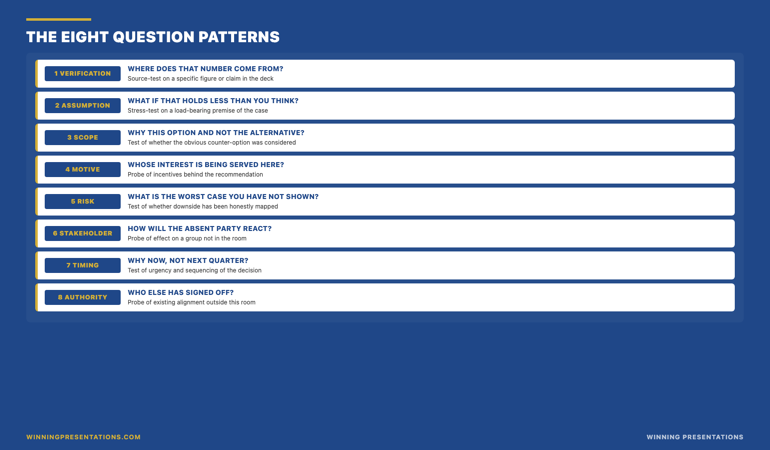
The eight question patterns infographic: verification (where does that number come from), assumption (what if that holds less than you think), scope (why this option not the alternative), motive (whose interest is being served), risk (what is the worst case you have not shown), stakeholder (how will an absent party react), timing (why now not next quarter), authority (who else has signed off) — the taxonomy senior executives drill until none of the patterns surprises them in the room.

The taxonomy is useful because it reduces the apparent unpredictability of Q&A to a manageable surface. The first time a senior leader sees the eight categorised, the response is usually a quiet “is that really it?” and the answer is yes, broadly. The questions feel infinite in the moment because each one is dressed in different language and arrives from a different chair. The patterns underneath are not infinite. They are eight. The work of executive Q&A training is to make the underlying shape visible the moment the question lands, so the response begins from a known starting position rather than from a frantic scan for one.

The drill: how the patterns are actually rehearsed

The drill is not what most people imagine when they think of Q&A practice. Most senior leaders, when they prepare for a board meeting, ask a colleague to fire questions at them in a rehearsal room and try to answer each one well. That is the wrong unit of practice. It treats every question as a one-off and trains nothing except a vague increase in fluency, which fades by the time the actual meeting comes around. The drill that builds a pattern library does something different.

In the drill, the practitioner is asked a question and her first task is not to answer it — it is to name the pattern aloud before responding. “That is a verification question.” “That is an assumption challenge dressed as a scope question.” She names the pattern, pauses for one beat, and then delivers a prepared opening line for that pattern type before adjusting to the specifics. The naming is what builds the recognition reflex. After enough repetitions — perhaps forty across the eight patterns, spread over two or three sessions — the naming becomes silent, but the underlying classification is still happening. By that point the leader is no longer thinking on her feet. She is recognising and retrieving, which is much faster and much steadier under pressure.

The drill also rehearses the response stance for each pattern, which is the second piece of prepared work. A verification question is answered with the source, not the defence. An assumption challenge is answered with acknowledgement first and stress-testing second. A motive probe is answered with transparency, not deflection. Each pattern has a default response stance that works in most cases, and learning the eight stances is what gives the prepared opening lines their substance. The leader who has drilled this walks into the committee with the equivalent of a chess opening repertoire — eight known starts, each one selected by the colour of the question on the other side of the table.

Build the pattern library before the next board meeting.

The Executive Q&A Handling System walks you through the eight patterns, the prepared opening line for each, and the drill protocol that turns recognition into reflex. It is the system used by senior leaders who walk into committee rooms with calm authority — not because they are quicker, but because none of the eight patterns surprises them any more. Lifetime access, including the worksheet, the drill scripts, and the response-stance map for each pattern. £39.

  • The eight-pattern taxonomy with the recognisable opening signature for each
  • Prepared opening lines and response stances per pattern
  • The drill protocol — name the pattern aloud, then respond
  • The 45-second response structure for decision-safe answers

Get the Q&A Handling System — £39 →

The three-second move: classify first, then answer

The single technique that separates trained senior presenters from untrained ones in the moment is what I have come to call the three-second classify. The instant a question lands, the trained leader spends roughly three seconds doing one piece of internal work before opening her mouth: she classifies the question into one of the eight patterns. That work looks, from the outside, like a composed pause — the kind senior people get praised for. It is not a composed pause. It is a categorisation step. The composure is a by-product.

The three-second classify works because it interrupts the default response, which is to start answering from whatever cue word the question landed with. The default response is what leads to the technically-correct, politically-catastrophic answer the director gave in 2008. She heard a verification cue, started answering the verification, and missed that the question was actually an assumption challenge wearing a verification jacket. Had she classified first, she would have spotted the deeper question and responded to that one. Three seconds is enough time to make the distinction visible. Less than three is too fast to engage the schema; more than five looks evasive.

The way you practise the three-second classify is by drilling it explicitly, slowly at first, with the naming spoken aloud. After enough repetitions the naming goes internal, but the gap stays. The gap is the visible part — the deliberate breath that committee chairs read as composure. The internal work is the classification, and it is what turns “thinking on your feet” into something that is actually trainable rather than an inborn trait. For more on the structural decisions that make this preparation possible, see getting board approval through presentation training; for the wider stakeholder positioning work the drill complements, see executive stakeholder presentation skills training.
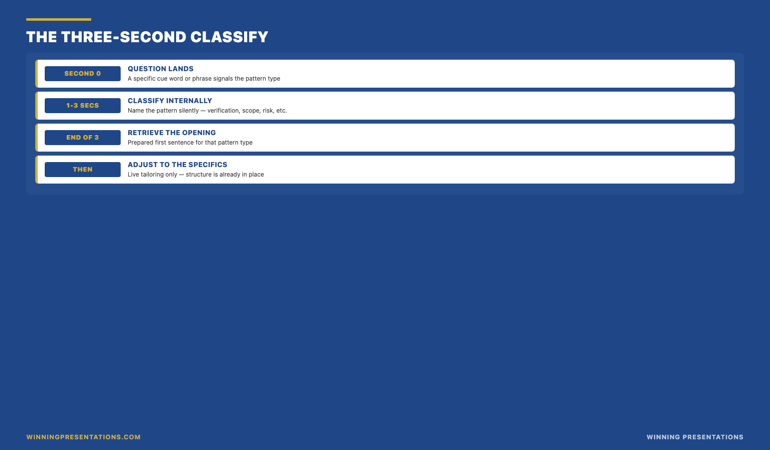
The three-second classify infographic showing the response chain: question lands, three-second classify (name the pattern internally), retrieve the prepared opening line for that pattern, adjust to the specifics — with the rule that the visible composed pause is a by-product of the internal classification step, not a separate composure technique, and the warning that less than three seconds skips the schema while more than five reads as evasive.

One last thing about the three-second classify. It is the only Q&A technique I know that gets better with stress, rather than worse. Most response techniques degrade under pressure — pauses shorten, voices tighten, prepared phrases come out garbled. The classify is different because it engages a recognition system that is faster than the conscious-response system. Under stress, the trained leader notices the pattern more quickly than she does in calm rehearsal, because her attention is sharper. The composed-looking answer that follows is the visible end of an invisible piece of work that, by the time the meeting matters, has become almost automatic.

The director who drilled the eight patterns stopped being surprised in the room.

She was not faster on her feet two years on — she had simply made the questions less surprising. The Executive Q&A Handling System gives you the taxonomy, the prepared openings, and the drill protocol that produces that change. It is the difference between hoping you can handle the next hard question and knowing which of the eight shapes it will be. £39, lifetime access, the same system used by senior presenters who walk in unrattled.

Drill the eight patterns — £39 →

Frequently asked questions

Is Q&A handling training worth it for someone who already presents reasonably well?

Yes, and the leaders who already present reasonably well are usually the ones who get the most from this kind of training. They have the structural work in place — the deck is sound, the opening is composed, the recommendation is clear — which means Q&A is the part of the meeting where most of their downside now lives. A single deferred decision because of a fumbled answer can cost a quarter. The taxonomy and the drill are designed to retire that risk, not to retrain a presenter from scratch. If your decks are getting deferred at the Q&A rather than at the recommendation, this is the layer to invest in.

What is the most common mistake senior presenters make in board Q&A?

Answering the question they heard, not the question that was asked. The two are different more often than people realise, because committee chairs frequently dress one pattern as another — an assumption challenge phrased as a verification question, a motive probe wearing the clothes of a stakeholder query. The leader who has not drilled the patterns hears the surface and answers it; the leader who has drilled them spots the underlying shape and responds to that. The cost of answering the surface question is that the room reads the answer as evasive even when it was technically correct, which is exactly how the director in 2008 ended up with a ninety-day deferral on a sound paper.

How long does it take to drill the eight patterns?

The honest answer is two or three focused sessions to learn the taxonomy and the response stances, followed by perhaps forty practice repetitions distributed across two or three weeks to make the recognition reflexive. The early reps are slow because the naming is conscious; the later ones are fast because the classification has gone internal. Most senior leaders who work through the system properly notice a meaningful change in how Q&A feels by the third or fourth real-world meeting after they finish the drill, not before. The pattern library only earns its keep once it has been pressure-tested in the room, which is why the timeline is weeks rather than days.

Does this work the same way for technical specialists presenting outside their domain?

Largely yes. The eight patterns are content-agnostic — a verification question looks like a verification question whether the subject is credit risk, regulatory change, or software delivery. Where technical specialists need a small adjustment is in the response stance for the verification pattern itself, because they tend to over-answer it with sources and methodology when the room only wants the bottom line. The drill includes a specific calibration for that, but the broader taxonomy holds. Outside your domain or inside it, the eight shapes still account for almost every hard question you will face.

The Winning Edge — weekly newsletter

The Winning Edge is a weekly newsletter for senior professionals who present at the executive level. One short email a week on the structural moves that separate decks committees back from decks they defer. Subscribe to The Winning Edge →

For the wider library of presentation assets that pair with the Q&A taxonomy — the slide system, the storytelling primer, and the delivery references — the Complete Presenter bundle (£99) collects them in one place.

About the author

Mary Beth Hazeldine is Owner & Managing Director of Winning Presentations Ltd. With 24 years of corporate banking experience at JPMorgan Chase, PwC, Royal Bank of Scotland, and Commerzbank, she advises executives across financial services, healthcare, technology, and government on structuring presentations for high-stakes funding rounds, board approvals, and strategic decisions.

The next time a question lands in a board Q&A, do three things instead: classify the pattern in three seconds; speak the prepared opening for that pattern, not the cue word you heard; and adjust to the specifics only after the first sentence is out. The leader who drills those three steps stops being surprised in the room. The leader who tries to think faster instead does not.

23 Jun 2026
The Three-Second Pause Senior Executives Take Before Every Hard Answer

The Three-Second Pause Senior Executives Take Before Every Hard Answer

Quick answer: The pause that senior executives take before answering a hard board question — the deliberate three-second gap that committee chairs read as composure — is not composure. It is a categorisation step. In those three seconds, the trained leader is classifying the question into a known pattern and retrieving the prepared opening for that pattern; the composed delivery that follows is the visible end of an invisible piece of work. This is why the three-second pause is the single habit that changes Q&A performance more than any other: it is not a confidence trick, it is the moment a schema gets engaged. Two seconds is too short to classify; five seconds reads as evasive; three is the engineered sweet spot.

In March 2014, I watched a chief operating officer take a question from her group chairman about a proposed restructuring of a portfolio she had presented on for forty minutes. The chairman, a man known for blunt openings, asked the question with no preamble and then waited. She paused for what I timed afterwards as just over three seconds, looking neither at him nor at her notes, just steady. Then she opened her answer with a single sentence that named the underlying concern in the question more cleanly than the question itself had named it. The chairman nodded once and said “go on.” The proposal was approved that afternoon with one amendment, both of which she had prepared for. The pause was the moment the outcome got decided.

After the meeting she told me, almost in passing, that the pause was something she had learned to do deliberately about four years earlier. Before that, she said, she had been a fast answerer — the kind of executive who responds the moment the question stops, because she thought that was what authority looked like. The fast answers had been costing her. Not because they were wrong, but because they answered the surface of the question rather than the underlying one, and senior committees can tell the difference. The deliberate pause, drilled over a stretch of months, had changed the texture of every Q&A she had been in since. It was the single most useful habit she had built as a senior presenter, and she put it ahead of everything else — ahead of structure, ahead of delivery, ahead of slide design.

(This article was created with AI assistance; all stories and insights are based on 35 years of real client work.)

Two years before her story, in 2012, I had watched a different senior leader fail the same kind of moment. A senior partner I worked alongside in professional services answered a chairman’s question in under a second — immediately, fluently, and correctly. He answered the question that had been asked. The committee deferred his proposal anyway, because the question that had been asked was a decoy for the question that mattered, and his fast answer had revealed that he had not noticed. The pause is not an aesthetic preference. It is the gap in which the leader catches the difference between the surface question and the real one. Without it, you answer fast and lose. With it, you answer steadily and the room can tell that you saw what they meant.

If you handle Q&A well on easy questions and worse on hard ones:

The Executive Q&A Handling System pairs the pre-answer pause with the eight-pattern taxonomy that gives it something to do — so the three seconds are spent classifying, not panicking. The system used by senior presenters who walk into boards with calm authority. £39, lifetime access.

See the Q&A Handling System →

What the pause actually is — and what it is not

The pre-answer pause is widely described in presentation advice as a composure technique. The framing goes that pausing makes you look calm, controls the room, signals authority. All of that is true as far as it goes, but it misses the underlying point. The pause is not the thing. The pause is the time in which the thing happens. The thing is classification — the act of slotting the question into a known category before responding to it. Without the classification, the pause is just a silent gap that conveys nothing useful and quickly starts to feel awkward. With the classification, the pause is the most productive three seconds in the entire meeting.

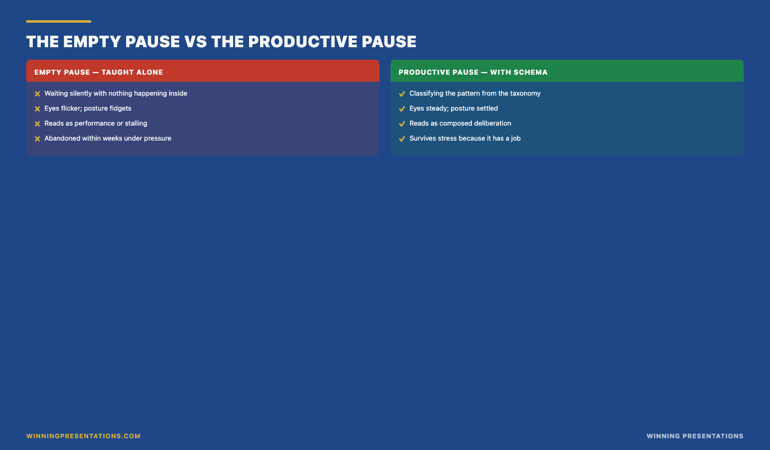
This is also why pause technique taught in isolation does not generalise. Plenty of senior leaders have been told to pause before answering, have tried it for a few weeks, and have abandoned it because nothing changed. Nothing changed because the pause was empty — they were waiting, not classifying. The composed-looking pause that the chief operating officer took in 2014 was full. Three seconds of work happened inside it, and the answer that came out the other side was shaped by that work. The pause without the work is a piece of stagecraft. The pause with the work is the foundation of executive Q&A.

The clearest way to understand the difference is to watch what happens at the end of the pause. A leader who has been classifying opens her answer with a sentence that engages the real question — sometimes one that subtly reframes it. A leader who has only been waiting opens with a phrase that begins to answer the surface, and the committee reads the difference inside half a sentence. The pause does not produce the better answer. The classification inside the pause does. If you have nothing to do during the three seconds, you do not need them.

Why three seconds, and not two or five

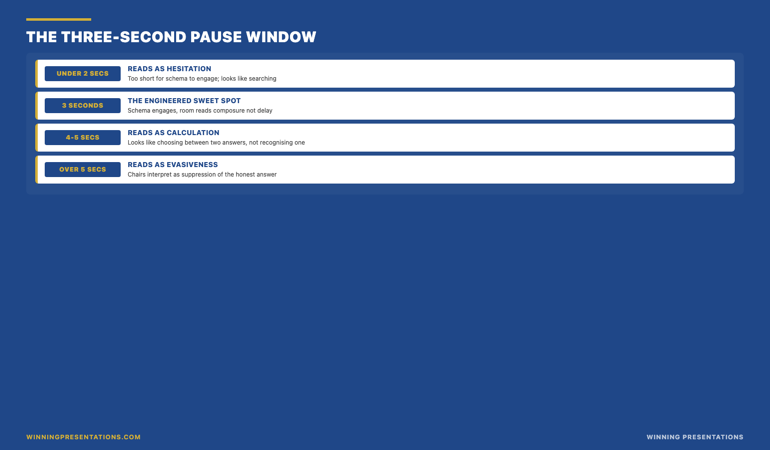
The duration is not arbitrary, and the senior leaders who handle Q&A best have usually converged on roughly the same window through trial. Two seconds is too short. It is not long enough to engage a recognition schema in any reliable way, and from the outside it reads as a hesitation rather than a deliberation — a brief flicker that suggests the leader is searching rather than thinking. The classification step needs slightly more time than the listener’s instinct for a fast response allows, which is why the engineered pause has to be deliberately longer than what feels natural.

Five seconds is too long. At around the four-second mark, a committee starts to read the pause differently. It stops looking like composure and starts looking like calculation — the impression that the leader is choosing between two answers rather than recognising one. By five seconds, the pause has crossed into evasiveness territory, and chairs interpret it as a sign that the honest answer is being suppressed in favour of a curated one. The window between four and five seconds is where the pause stops working in your favour and starts working against you, regardless of what is happening inside your head.

Three seconds is the engineered sweet spot. It is long enough for the schema to engage and short enough that the room reads it as deliberate consideration rather than evasion. It is also long enough to break the autopilot response — the default of starting to answer from the first cue word the question landed on — which is the failure mode that lets surface questions get answered and underlying questions get missed. Three seconds, drilled deliberately, becomes the rhythm of the trained executive’s Q&A: question, three-beat pause, classify, retrieve, deliver. After several months of practice, the rhythm becomes automatic and the leader stops counting. The pause is just where the work goes.

The three-second pause window infographic: two seconds — too short, reads as hesitation, schema does not engage; three seconds — engineered sweet spot, reads as composure, classification step completes; four to five seconds — reads as calculation; beyond five — reads as evasiveness, chairs interpret as suppressed honest answer — with the rule that the pause is not composure, it is the time in which the classification step happens.

This is also why instructions like “pause longer” or “wait until you can hear silence” miss the calibration. The right duration is not about the silence; it is about the cognitive step that needs to happen inside it. Three seconds is the floor at which classification is reliable, and the ceiling at which it still reads as deliberate. Pushing past that, in pursuit of being even more composed, is a common mistake among leaders who have been told that authority looks like silence. Authority looks like a pause with something happening inside it. Past four seconds, even with the right thing happening inside, the outside view starts to slip.

The mechanic: what happens inside the pause

I call the work that goes inside the three-second pause the classify-then-answer sequence, and it has three internal steps that, with practice, collapse into something that feels like a single move. The first step is the named classification — this is a verification question, this is a motive probe, this is an assumption challenge wearing a scope jacket. The naming happens fast once the eight-pattern taxonomy has been drilled (the patterns that make this possible are the subject of Q&A handling training for executives); without the taxonomy, the classification has nothing to land on and the pause stays empty.

The second step is the retrieval of the prepared opening line for the classified pattern. Trained leaders carry a small repertoire of opening lines — one per pattern — that they have rehearsed enough to deliver under pressure. The opening line is rarely the whole answer; it is the first sentence, the one that signals to the committee that the underlying shape of the question has been recognised. The third step is the live adjustment to the specifics of this particular question, which only takes a moment because the opening has already framed the response. By the time the leader’s mouth opens at the end of the three seconds, the structure of the next thirty seconds is already in place.

The reason this matters at the level of board outcomes is that it eliminates the failure mode that costs decisions most often: answering the wrong question fluently. When the classification happens first, the response can engage the question that was actually asked rather than the surface one. When the classification is skipped, the response engages whatever cue word the question landed on, which is often a decoy. The chief operating officer in 2014 caught the underlying concern because she had three seconds in which to spot it. The senior partner in 2012 missed it because he started answering at second one. The board read both pauses for what they revealed about the work happening inside.

The pause without the taxonomy is empty silence. With it, it is the most productive three seconds in the meeting.

The Executive Q&A Handling System gives you the eight-pattern taxonomy that the pause classifies into, the prepared opening lines that the retrieval step pulls from, and the drill protocol that turns the three-step sequence into something automatic. Without the taxonomy the pause has nothing to do; with it, the pause is the foundation of every well-handled board answer you will give. £39, lifetime access, the same system used by senior presenters who walk in unrattled.

  • The eight-pattern taxonomy — what the pause classifies into
  • The prepared opening line for each pattern
  • The drill protocol — classify aloud, retrieve, then respond
  • The 45-second response structure for decision-safe answers

Get the Q&A Handling System — £39 →

How to build the pause without making it look performative

The performance risk is real. A pause that has been added on top of an existing Q&A style usually looks grafted on, and senior committees notice grafted-on technique within two questions. The way around the performance trap is not to focus on the pause itself but on the work inside it. If the classification step has become automatic through drill, the pause emerges as a natural by-product, and the leader is not “doing the pause” — she is just classifying, which happens to take three seconds. Nothing about that needs to look like technique because the technique is invisible.

The practical drill that builds the pause without the performance risk has three stages. Stage one is taxonomy fluency: the leader practises naming the eight patterns aloud against sample questions until each name lands in well under a second. This is desk work, not rehearsal-room work, and takes a handful of sessions. Stage two is paired drill: the leader sits across from a colleague who fires questions and the leader’s first task is to name the pattern aloud before answering — “verification” or “motive probe” or “assumption challenge” — and then deliver the opening line for that pattern. The naming is awkward at first and becomes invisible over time. Stage three is silent drill: the naming goes internal, the pause emerges naturally at around three seconds, and the leader is now ready to use it in a real meeting without anything looking practised.

The pause survives stage three because it is no longer being performed. It is the time required for an internal step that has become automatic but not instantaneous. This is why grafting the pause on without building the schema underneath rarely works — the leader either skips the pause under pressure or holds it awkwardly without anything happening inside. For more on the structural decisions that build the prepared frame the pause draws from, see getting board approval through presentation training.

The classify-then-answer sequence infographic: question lands; three-second pause window opens; step one — name the pattern internally from the eight-pattern taxonomy; step two — retrieve the prepared opening line for that pattern; step three — adjust to the specifics of this question; deliver the answer — with the rule that the pause is the time these three steps need, not a separate composure technique.

The pause is not a stand-alone technique. It is a symptom of a trained Q&A schema doing its job. Try to learn the symptom without the underlying schema and you get the empty version — awkward, performative, and quickly abandoned. Build the schema first, and the pause shows up on its own.

If your Q&A is fine on easy questions and goes sideways on the hard ones, the pause is the layer to invest in.

Fast answers on hard questions are how good papers get deferred. The Executive Q&A Handling System — the eight-pattern taxonomy, the prepared openings, the drill protocol — gives the pause something to do, so the three seconds turn into the most productive interval in your meeting. The leaders who handle hard questions calmly are not faster on their feet; they are using a schema that costs three seconds to engage and saves entire quarters of deferred decisions. £39, lifetime access, no live calls, no deadlines.

Drill the pause that earns its three seconds — £39 →

Frequently asked questions

Does the three-second pause not just look slow?

Only if there is nothing happening inside it. Three seconds of empty silence reads as slow because the room senses no work being done; three seconds of visible deliberation reads as composed because the room senses thought. The difference is what the leader’s eyes and posture convey, and that in turn is shaped by whether there is actually a cognitive step underway. Trained leaders look settled during the three seconds because their attention is engaged with the classification, not with the discomfort of the silence. Untrained ones often look fidgety during the same interval because the silence has nothing to do.

How is this different from the standard advice to “think before you speak”?

Standard advice tells you to think; it does not tell you what to think about, in what order, or for how long. The three-second pre-answer pause is engineered. It is specifically classifying the question into a known pattern, then retrieving a prepared opening for that pattern, and then adjusting to the specifics. Each of those three steps is trainable and each one is observable in the resulting answer. “Think before you speak” produces the empty pause; the classify-then-answer sequence produces the productive one. The structural difference is the schema underneath.

What is the most common mistake senior presenters make on the pause itself?

Closing it with a filler word. The leader has held the pause well, the classification has happened, the opening line is ready — and then she opens with “so” or “right” or “well” or “that’s a good question”, which dissolves the entire three seconds of work she just did. The composure of the pause and the substance of the opening line have to land together; the filler breaks the seal. The fix is to drill the transition from pause to first word so that the opening line is what comes out, not a verbal warm-up. Most leaders only notice this is happening to them when they watch a recording.

How long does it take to make the pause feel natural?

Most senior leaders who drill the pattern taxonomy and pause sequence in parallel notice a meaningful change after three to four real-world meetings — not in calm rehearsal, but in actual committee or board settings where the stakes are real. The drill itself takes a couple of weeks of distributed practice. The full embedding, where the pause shows up automatically under pressure rather than having to be remembered, takes a few months. The leaders who try to install the pause alone, without the underlying classification work, usually report no lasting change — the empty pause does not survive the pressure of a real room.

The Winning Edge — weekly newsletter

The Winning Edge is a weekly newsletter for senior professionals who present at the executive level. One short email a week on the structural moves that separate decks committees back from decks they defer. Subscribe to The Winning Edge →

For the wider library of presentation assets that pair with the Q&A taxonomy — the slide system, the storytelling primer, and the delivery references — the Complete Presenter bundle (£99) collects them in one place.

About the author

Mary Beth Hazeldine is Owner & Managing Director of Winning Presentations Ltd. With 24 years of corporate banking experience at JPMorgan Chase, PwC, Royal Bank of Scotland, and Commerzbank, she advises executives across financial services, healthcare, technology, and government on structuring presentations for high-stakes funding rounds, board approvals, and strategic decisions.

Walk into your next Q&A with two specific pieces of equipment: an eight-pattern taxonomy already drilled, and the discipline to spend three seconds classifying before you open your mouth. The leader who carries both leaves the room with the calm answer. The leader who walks in carrying only confidence answers the surface question fast, and goes home with a deferral.