

The Objection Map: How to Find Resistance Before It Finds You
Three words killed a £4M proposal before the presenter finished slide two.
“We’ve tried that.”
The room shifted. Arms folded. The CFO glanced at her phone. And the presenter — a senior director who’d spent two weeks perfecting those slides — had no response prepared. He stumbled through a vague “this is different because…” and never recovered.
I was in the room. I was his coach. And the worst part? I knew that objection was coming. We’d talked about it in our prep session. But we hadn’t built a specific response into the presentation itself, because he thought his data was strong enough to pre-empt it.
It wasn’t.
Quick answer: An Objection Map is a structured pre-presentation exercise that identifies every likely point of resistance, traces it to the stakeholder most likely to raise it, and builds your response directly into your slides — before you ever enter the room. Most executive presentations fail not because the idea is weak, but because predictable objections went unaddressed. The Objection Map eliminates that failure mode.
⏰ Presenting tomorrow? Do this in 60 seconds:
1. Write down your top 3 likely objections — the ones that make you uncomfortable.
2. For each one, identify which slide should address it — and move that slide earlier.
3. Prepare one sentence per objection that acknowledges the concern and bridges to your evidence.
That’s your minimum viable resistance map. For the complete framework, keep reading.
In this article:
I learned about objection mapping the hard way — during my years at Commerzbank, when I was presenting restructuring proposals to committees that existed to say no.
The first time I presented to a credit committee, I prepared 40 slides of analysis. Bulletproof data. Waterfall charts. Scenario models. I was convinced the numbers would speak for themselves.
They didn’t. The head of risk asked one question about regulatory exposure, and I froze. Not because I didn’t know the answer — I did — but because I hadn’t anticipated needing to deliver it under pressure, in that room, to that face.
After that, I started building what I now call an Objection Map before every significant presentation. In 24 years across JPMorgan Chase, PwC, Royal Bank of Scotland, and Commerzbank, I’ve refined it into a repeatable system. It’s one of the core frameworks inside the Executive Buy-In Presentation System, and it’s the skill that changed my career from “good presenter” to “the person who gets approvals.”
Why Objections Kill Presentations (Even Good Ones)
Here’s what most professionals misunderstand about executive objections: they’re rarely about the quality of your idea.
They’re about risk. Executives don’t sit in presentation rooms asking “Is this a good idea?” They ask “What goes wrong if I say yes?” Every objection is a risk signal, and when you fail to address it, you’re not just leaving a gap in your argument — you’re confirming the risk is real.
I’ve coached executives through hundreds of high-stakes presentations, and the pattern is always the same. The presenter assumes the strength of the proposal will overcome doubt. The audience, meanwhile, is mentally stress-testing every claim. The gap between those two mindsets is where proposals die.
Research from the Harvard Business Review confirms this: stakeholder buy-in depends more on addressing concerns than on presenting benefits. Benefits create interest. Addressed objections create confidence. And confidence is what gets decisions made.
The most dangerous objections aren’t the ones that get voiced. They’re the ones that stay silent — the concerns that make an executive say “Let me think about it” and then never follow up. An Objection Map forces those silent concerns to the surface before you present, so you can address them proactively rather than reactively.
How do you handle unexpected objections in an executive presentation?
Acknowledge the objection immediately — don’t dismiss it or deflect. Reframe it as a valid concern (“That’s exactly the question I’d ask too”), then bridge to your strongest evidence. If you genuinely don’t have the answer, say so and commit to a specific follow-up timeframe. Executives respect honesty far more than improvised answers.
What an Objection Map Actually Is
An Objection Map is a four-column document you create before any significant presentation. It looks simple. It is simple. That’s why it works — because busy professionals actually use it.
The four columns:
Column 1 — The Objection. Write the exact words someone might use. Not a sanitised version. Not what you hope they’ll say. The blunt, uncomfortable version. “We’ve tried that.” “The timing is wrong.” “This won’t scale.”
Column 2 — The Source. Which specific person in the room is most likely to raise this? Name them. If you don’t know who’ll be in the room, find out. Presenting to strangers is gambling.
Column 3 — The Root Cause. Why does this person have this concern? It’s rarely about the words. “We don’t have budget” usually means “I don’t trust this will work.” “The timing is wrong” usually means “I have a competing priority you’re threatening.”
Column 4 — The Pre-Emptive Response. How will you address this concern inside your presentation — before it’s raised? This is the critical difference between an Objection Map and simple preparation. You’re not preparing answers for Q&A. You’re restructuring your narrative to remove the objection entirely.
When I work with clients on high-stakes presentations — proposals involving significant budgets, restructuring plans, or board-level approvals — the resistance map typically surfaces between five and twelve concerns. Of those, two or three will be presentation-killers: objections that, if left unaddressed, will prevent a decision regardless of how strong everything else is.

Stop guessing what the room is thinking.
The Executive Buy-In Presentation System teaches you the complete Objection Map framework, plus stakeholder analysis, champion recruitment, and the slide structures that turn resistance into approval. Self-study modules with live Q&A calls — study at your own pace.
Join the Executive Buy-In System →
Training started 2 Feb — join anytime. New modules released weekly. All calls recorded.
How to Build Your Objection Map in 30 Minutes
You don’t need hours. You need thirty focused minutes and a willingness to be honest about the weak points in your proposal.
Step 1: List every reason someone could say no (10 minutes). Sit with a blank page and write down every objection you can imagine — including the ones you don’t want to think about. Budget. Timing. Priority. Capability. Past failures. Political concerns. If a colleague has ever pushed back on a similar idea, write that down. If your manager has flagged a risk, write that down. Aim for at least eight.
Step 2: Assign each objection to a person (5 minutes). Who in the room is most likely to raise each concern? If you can’t name the person, you don’t know your audience well enough. This is where the psychology of executive buy-in becomes practical. Every objection has a human source, and understanding their motivation is half the battle.
Step 3: Dig to the root cause (10 minutes). For each objection, ask “Why would this specific person care about this specific concern?” The surface objection is almost never the real one. “We’ve tried that” means “I was involved in the last attempt and it made me look bad.” “The data doesn’t support it” means “I don’t trust the methodology.” Finding the root cause tells you which evidence will actually change their mind.
Step 4: Write your pre-emptive responses (5 minutes). For each concern, draft a single sentence — or a single slide — that addresses the root cause directly. Not a defensive rebuttal. A confident acknowledgment that demonstrates you’ve thought about this from their perspective.
How do you anticipate objections before a presentation?
Start by listing every decision-maker who’ll be in the room and their known priorities. Then ask yourself: “If I were them, what would worry me about saying yes to this?” Test your list against a trusted colleague — ideally someone who’ll challenge you. The objections that make you uncomfortable are usually the ones that matter most.
Embedding Responses Into Your Slides
Here’s where most people get the Objection Map wrong. They build the map, identify the concerns, prepare their responses — and then save everything for Q&A.
That’s backwards.
If you know the CFO is worried about implementation cost, don’t wait for her to ask. Put your implementation cost slide before she has to. If the operations director will question timeline feasibility, show your phased delivery plan in the first third of the presentation, not the last.
The principle is straightforward: address objections before they form.
When an executive hears their concern addressed proactively — without having to raise it — two things happen. First, they feel understood. Someone has actually thought about this from their perspective. Second, they can’t use the objection as a blocker, because you’ve already removed the obstacle.
I call this “pre-emptive framing,” and it’s the difference between presentations that get “we need to think about it” and presentations that get “let’s move forward.”
In practice, this means restructuring your slide order around your pre-emptive objections worksheet. The slides that address the top three concerns should appear in the first half of your presentation. Supporting evidence comes second. The “nice to know” detail goes in an appendix — or gets cut entirely.
A client of mine presented a restructuring plan to a hostile board last year. Her resistance map identified “job losses” as the number-one unspoken concern. Instead of burying the headcount impact on slide 18, she addressed it on slide 3 — with specific redeployment plans, timeline, and support packages. The board approved the restructuring in a single meeting. The previous presenter, with a stronger plan but no objection preparation, had been sent away twice.
What the full pre-emptive framing system covers:
✓ The four-column resistance map (what you’ve started learning here)
✓ Stakeholder analysis — understanding who decides, who influences, and who blocks
✓ Champion recruitment — getting someone fighting for your proposal before you present
✓ Slide restructuring — embedding responses into your narrative so objections never surface
✓ The follow-through framework — turning “maybe” into a signed approval
The 7 Executive Objections That Appear in Every Room
After 24 years of corporate banking and coaching executives through high-stakes presentations, I’ve found that most objections are variations of seven core concerns. Once you recognise the pattern, you stop being surprised.
1. “We’ve tried that.” Root cause: fear of repeating a past failure. Your response must show what’s different this time — different approach, different conditions, different data.
2. “We don’t have budget.” Root cause: this proposal isn’t a high enough priority to fight for funding. Your response must reframe the cost of inaction, not the cost of action.
3. “The timing isn’t right.” Root cause: a competing priority the speaker hasn’t surfaced. Your response must acknowledge the competing demand and show how your proposal fits alongside it — not instead of it.
4. “Show me the data.” Root cause: the executive doesn’t trust the reasoning, so they’re demanding proof. Your response must address the trust gap, not just pile on more numbers.
5. “Who else supports this?” Root cause: the executive doesn’t want to be the first person to take the risk. This is why building a coalition before you present is essential.
6. “Let me think about it.” Root cause: unspoken concern they’re not willing to raise publicly. Your resistance map should have already identified what this concern might be — and addressed it in the presentation.
7. “Great presentation.” Root cause: polite rejection. When executives genuinely plan to act, they ask implementation questions. Compliments without follow-up questions are a warning sign. If you’re getting praise without decisions, your presentation is entertaining but not persuasive.
What are the most common objections in business presentations?
The seven most frequent objections revolve around past failures (“we’ve tried that”), budget constraints, timing concerns, requests for more data, lack of visible support from others, stalling (“let me think about it”), and polite rejection disguised as praise (“great presentation”). Preparing specific responses for each increases your approval rate significantly.
Ready to stop hearing “Let me think about it”? The Executive Buy-In Presentation System gives you scripts, templates, and the stakeholder strategy that turns resistance into approval.
What to Do When an Objection Lands Anyway
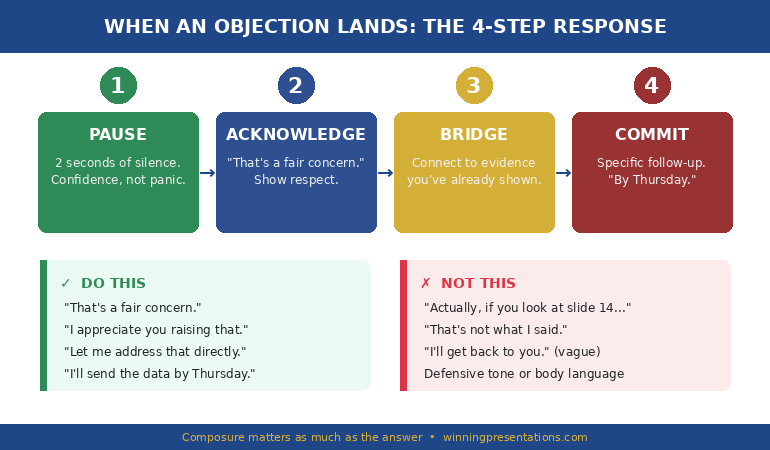
Even the best pre-emptive objections worksheet won’t catch everything. Someone will raise a concern you didn’t anticipate. Here’s the framework I teach for handling it in the moment:
Pause. Don’t respond immediately. Two seconds of silence communicates confidence. Rushing communicates panic.
Acknowledge. “That’s a fair concern” or “I appreciate you raising that.” This isn’t weakness — it’s emotional intelligence. The rest of the room is watching how you handle pushback, and your composure matters as much as your answer.
Bridge. Connect their concern to something you’ve already addressed. “That connects directly to the risk mitigation on slide 7 — would it help if I walked through that again?” This shows your presentation already accounts for their thinking.
Commit. If you don’t have the answer, say so. “I want to give you an accurate response on that. I’ll send the analysis by Thursday.” Executives respect specificity. “I’ll get back to you” is vague and forgettable. “I’ll send the analysis by Thursday” is a commitment they’ll remember.
The biggest mistake I see? Defensiveness. The moment you say “Actually, if you look at slide 14…” with an edge in your voice, you’ve turned a conversation into a confrontation. And nobody approves proposals from someone they’re arguing with.
If presentation anxiety makes handling objections harder — if the fear of being challenged is what keeps you up the night before — that’s a different problem with a different solution. Understanding what executives actually do before big presentations might help you separate the anxiety from the strategy.
Your next presentation doesn’t have to be a guessing game.
The Executive Buy-In Presentation System covers the full approval cycle: Objection Mapping, stakeholder analysis, champion recruitment, pre-emptive framing, and the follow-through that closes decisions. Self-study modules released weekly, with live Q&A calls (all recorded) so you learn on your schedule.
Join the Executive Buy-In System →
Training started 2 Feb — join anytime and access everything released so far. New modules every week. All Q&A calls recorded for on-demand viewing.
Frequently Asked Questions
How far in advance should I create an Objection Map?
At least three to five days before a significant presentation. You need time to research stakeholder concerns, test your responses with a trusted colleague, and restructure your slides based on what you find. Last-minute objection mapping catches the obvious concerns but misses the subtle political ones that actually derail approvals.
What if I don’t know who will be in the room?
Find out. Ask your sponsor, your manager, or the meeting organiser. If you genuinely can’t get an attendee list, prepare responses for the seven standard executive objections listed above. They cover most boardroom scenarios. But presenting without knowing your audience is a risk that’s entirely avoidable.
Does this work for virtual presentations too?
Yes — and it’s arguably more important. In virtual settings, you can’t read body language as easily, so objections are more likely to stay silent. An Objection Map ensures you address the most common concerns proactively, reducing the chance of a quiet “no” after the call ends.
How is this different from just preparing for Q&A?
Q&A preparation means having answers ready for when someone asks. Objection Mapping means restructuring your presentation so the question never needs to be asked. The first is reactive. The second is strategic. Executives who never have to voice their concern are far more likely to approve your proposal.
📬 The Winning Edge Newsletter
Weekly strategies for executive presentations, stakeholder buy-in, and speaking with confidence. No fluff — just what works.
📋 Free: Executive Presentation Checklist
The pre-presentation checklist I use with every client — covers structure, stakeholder prep, slide order, and objection readiness.
Read next:
📊 Why “Great Presentation” Is the Worst Feedback You Can Get — what to do when you’re getting compliments but no decisions.
💊 Beta Blockers for Public Speaking: What Executives Actually Do Before Big Presentations — managing the physical symptoms that make handling objections harder.
Objections aren’t the enemy. Unpreparedness is.
Every objection in an executive presentation is predictable if you know your audience, understand their priorities, and have the humility to admit where your proposal is vulnerable. The resistance map gives you thirty minutes of structured preparation that eliminates the single biggest reason executive presentations fail: not the idea, but the resistance that nobody addressed.
Your next step: pick your most important upcoming presentation. Spend thirty minutes building your Objection Map using the four-column framework. Then restructure your slides to address the top three concerns before anyone has to raise them. If you want the full system — including stakeholder analysis, champion recruitment, and the follow-through framework that turns “maybe” into “yes” — the Executive Buy-In Presentation System is open now. Training is in progress, new modules release every week, and all live Q&A calls are recorded — so you can join anytime and study at your own pace.
About the Author
Mary Beth Hazeldine is the Owner & Managing Director of Winning Presentations. With 24 years of corporate banking experience at JPMorgan Chase, PwC, Royal Bank of Scotland, and Commerzbank, she has delivered high-stakes presentations in boardrooms across three continents.
A qualified clinical hypnotherapist and NLP practitioner, Mary Beth combines executive communication expertise with evidence-based techniques for managing presentation anxiety. She works with senior leaders preparing for board presentations, investor pitches, and high-stakes approvals — helping them structure slides, handle objections, and present with confidence.