Tag: executive presentation skills

31 Dec 2025
Presentation skills goals for 2026 - what senior professionals need to improve

Presentation Skills Goals for 2026: What Senior Professionals Actually Need to Improve

Last updated: December 31, 2025 · 9 minute read

Most presentation skills goals fail before February.

Not because professionals lack discipline. Not because they’re too busy. But because they’re setting the wrong goals entirely.

“Present more confidently” isn’t a goal — it’s a wish. “Get better at slides” isn’t measurable. “Stop being nervous” isn’t achievable through willpower alone.

After 24 years in corporate banking and training over 5,000 executives at Winning Presentations, I’ve watched hundreds of professionals set presentation skills goals every January. The ones who actually improve share something specific: they treat presentation skills like a system, not an event.

Senior professionals who improve fastest invest in a working executive presentation toolkit rather than hoping a single course or book will fix the structural issues.

Here’s what actually works for setting presentation skills goals in 2026 — and why most advice gets it completely wrong.

⚡ Key Takeaways

  • Most presentation skills goals fail because they lack feedback loops, structure, and measurement
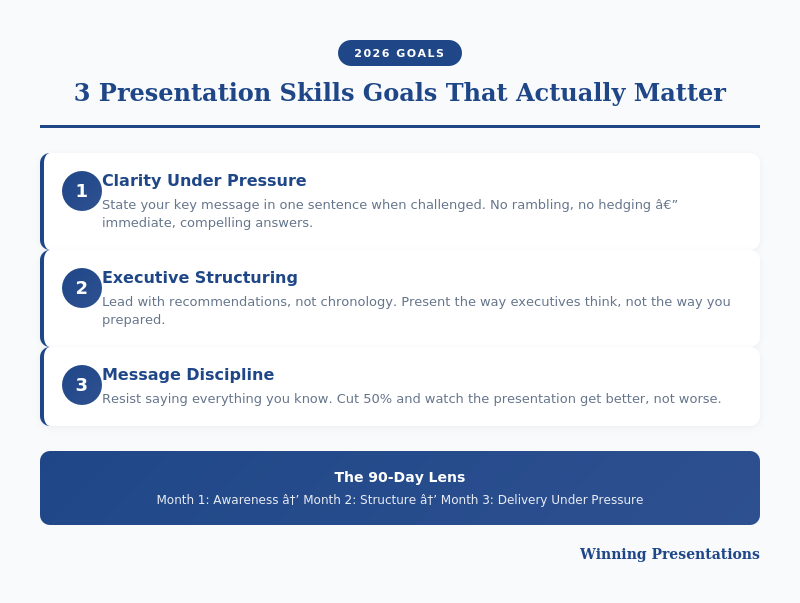
  • The 3 goals that matter: Clarity under pressure, executive structuring, and message discipline
  • 90-day improvement lens — Month 1: Awareness, Month 2: Structure, Month 3: Delivery under pressure
  • Systems beat motivation — deliberate practice compounds; random repetition doesn’t
  • Senior professionals think differently — they focus on skill systems, not presentation events

📥 FREE DOWNLOAD: Executive Presentation Checklist

The pre-presentation routine I use before every high-stakes talk.

Download Free →

Why Most Presentation Skills Goals Fail

Every January, millions of professionals make some version of the same resolution: “This year, I’ll get better at presenting.”

By March, nothing has changed.

The problem isn’t motivation. Research on professional development consistently shows that intention alone doesn’t drive skill improvement. What does? Systems.

Here’s why most presentation skills goals fail:

No Feedback Loop

You present. It goes “okay.” You present again. It goes “okay.” Without specific, structured feedback, you’re just reinforcing existing habits — good and bad.

Most professionals never get real feedback on their presentations. Colleagues say “that was great” because they’re being polite. Your manager focuses on content, not delivery. You have no idea what’s actually working or failing.

No Structure

“Get better at presenting” isn’t a goal — it’s a direction. Better how? Better at what specifically? Better measured by whom?

Vague presentation skills goals produce vague results. Without structure, you’ll drift toward whatever feels comfortable rather than what actually needs improvement.

No Measurement

How do you know if you’ve improved? Most professionals can’t answer this question. They rely on feelings: “I think I’m better.” “That one went well.”

Feelings aren’t measurement. Without clear metrics — even simple ones — you can’t track progress or identify what’s working.

No Pressure Simulation

Practising presentations alone in your office isn’t the same as presenting to a sceptical board. The skills that matter most — composure under pressure, handling tough questions, reading the room — only develop under realistic conditions.

This is why many professionals “know” what to do but can’t execute when it matters. They’ve practised the easy part and avoided the hard part.

For more on building genuine confidence, see my guide on how to speak confidently in public.

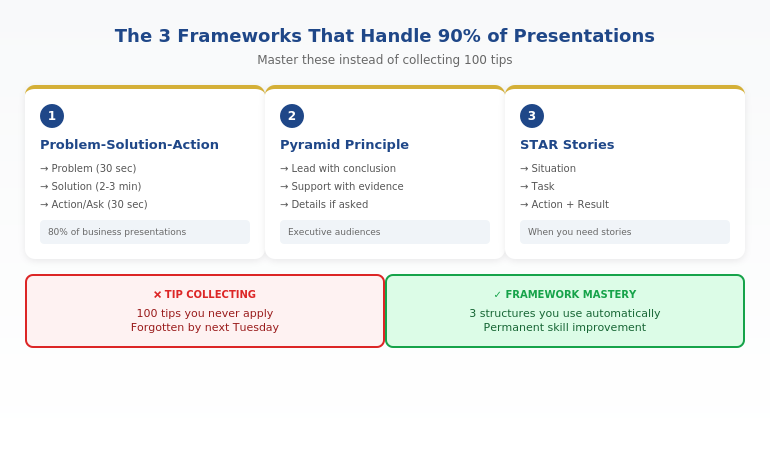
The 3 Presentation Skills Goals That Actually Matter

3 presentation skills goals that actually matter for professionals

After training thousands of executives, I’ve identified the three presentation skills goals that actually differentiate senior professionals from everyone else.

These aren’t “soft skills.” They’re specific, measurable capabilities that directly impact whether you get the outcome you want from a presentation.

Goal 1: Clarity Under Pressure

Can you articulate your key message in one sentence when someone interrupts you mid-presentation and asks “what’s the bottom line?”

Most professionals can’t. They’ve prepared 20 slides but haven’t distilled their core message. When pressure hits — an unexpected question, a time cut, a sceptical executive — they ramble, hedge, or lose the thread entirely.

What this looks like in practice:

  • You can state your recommendation in under 15 seconds
  • You can explain your “why” without slides
  • You stay coherent when challenged or interrupted
  • Your answer to “so what?” is immediate and compelling

How to develop it: Practise the “elevator pitch” for every presentation. Before you open PowerPoint, write your one-sentence message. Then test yourself: can you deliver it under pressure?

Goal 2: Executive Structuring

Do you structure presentations the way senior leaders think — or the way you think?

Most professionals present chronologically: “Here’s what I did, here’s what I found, here’s what I recommend.” Executives want the opposite: “Here’s my recommendation, here’s why, here’s what I need from you.”

What this looks like in practice:

  • You lead with the decision or recommendation
  • You provide supporting evidence, not comprehensive data
  • You anticipate the three questions they’ll ask
  • You can present the same content in 5 minutes or 30 minutes

How to develop it: Study how your most effective executives present. Notice the structure. Then apply it to your own content — starting with the “so what” instead of building toward it.

For detailed frameworks, see my guide on executive presentations.

Goal 3: Message Discipline

Can you resist the urge to say everything you know?

The curse of expertise is wanting to share all of it. But senior leaders don’t want comprehensive — they want relevant. They don’t want thorough — they want clear.

What this looks like in practice:

  • You cut 50% of your slides and the presentation gets better
  • You answer questions directly without over-explaining
  • You let silence exist instead of filling it with caveats
  • Your backup slides contain more content than your main deck

How to develop it: After preparing any presentation, force yourself to cut it by half. Not by rushing — by prioritising. What’s essential? What’s “nice to have”? Kill the nice-to-haves.

💡 Ready to Structure Like a Senior Leader?

The Executive Slide System includes 7 frameworks for structuring presentations the way executives think — recommendation-first, evidence-based, action-oriented.

Stop building toward your point. Start with it.

Get the Executive Slide System — £39 →

The 90-Day Improvement Lens for Presentation Skills Goals

Annual presentation skills goals are too distant. They let you procrastinate. “I have all year” becomes “I’ll start next month” becomes “maybe next year.”

Think in 90-day cycles instead. Three months is long enough to create real change, short enough to maintain urgency.

Month 1: Awareness

Before you can improve, you need to know what needs improving. Most professionals have blind spots — habits they don’t notice, weaknesses they’ve never identified.

Actions for Month 1:

  • Record yourself presenting (video, not just audio)
  • Ask 3 colleagues for specific, honest feedback
  • Identify your top 3 weaknesses — the specific things hurting your impact
  • Watch executives you admire — what do they do differently?

This month isn’t about changing anything. It’s about seeing clearly.

Month 2: Structure

Now that you know what to work on, build the systems that will drive improvement.

Actions for Month 2:

  • Create a pre-presentation routine you use every time
  • Develop 2-3 frameworks you apply to every presentation
  • Build a feedback system — how will you get input after each presentation?
  • Schedule deliberate practice, not just presentations

Structure turns intentions into habits. Without it, you’ll default to old patterns under pressure.

Month 3: Delivery Under Pressure

This is where most professionals skip. They practice alone, in comfortable settings, without stakes.

Actions for Month 3:

  • Present to colleagues who will challenge you — not support you
  • Practice with time constraints (you have 5 minutes, not 20)
  • Rehearse handling interruptions and tough questions
  • If possible, get coaching or join a structured programme

Skills that collapse under pressure weren’t really skills — they were comfort-zone performances.

For advanced techniques on handling pressure, see my guide on advanced presentation skills.

🎓 Want Structured Development?

If 2026 is the year you want to master presentation skills properly, structured development matters more than random practice.

Framework-based programmes with psychology techniques and expert feedback create lasting change — not just temporary motivation. If you’d like to discuss what structured development might look like for you, get in touch →

How Senior Professionals Think About Presentation Skills Goals

There’s a mental shift that separates professionals who continuously improve from those who plateau.

Skills vs Events

Plateau thinking: “I have a big presentation next month. I need to prepare for it.”

Growth thinking: “Presenting is a skill I’m developing. Each presentation is a data point.”

When you treat presentations as isolated events, you prepare, perform, and forget. When you treat presenting as an ongoing skill development, each presentation becomes an opportunity to test, learn, and refine.

Systems vs Motivation

Plateau thinking: “I need to feel confident before I can present well.”

Growth thinking: “I need systems that work even when I don’t feel confident.”

Motivation is unreliable. Systems are consistent. The executives who present brilliantly under pressure don’t rely on feeling good — they rely on preparation routines, structural frameworks, and recovery techniques that work regardless of how they feel.

Deliberate Practice vs Repetition

Plateau thinking: “The more I present, the better I’ll get.”

Growth thinking: “Purposeful practice on specific weaknesses improves skill. Random repetition just reinforces habits.”

Twenty years of presenting doesn’t automatically make you good. It makes you experienced. If you’ve been reinforcing bad habits for twenty years, you’re just an experienced bad presenter.

Deliberate practice means identifying specific weaknesses, designing exercises to address them, getting feedback, and adjusting. It’s uncomfortable. That’s why it works.

Making 2026 the Year You Actually Improve Your Presentation Skills Goals

Here’s the honest truth: most people reading this won’t do anything different in 2026.

Not because they lack ability or desire. But because they’ll set vague goals, rely on motivation, and treat presentation skills as an afterthought when they’re not actively presenting.

The professionals who actually improve will:

  • Set specific, measurable presentation skills goals (not wishes)
  • Build systems that don’t depend on motivation
  • Create accountability through feedback loops or structured programmes
  • Practice under realistic pressure, not comfortable conditions
  • Treat presenting as a skill to develop, not an event to survive

If that sounds like work, it is. Skill development always is. But the compound returns are substantial — in promotions, influence, credibility, and career opportunities.

The question isn’t whether presentation skills matter for your career in 2026. They obviously do.

The question is whether you’ll treat them like the strategic asset they are — or continue hoping that “more practice” will somehow produce different results.

Your Next Step

📖 FREE: Executive Presentation Checklist
The pre-presentation routine I use before every high-stakes talk.
Download Free →

💡 QUICK WIN: Executive Slide System — £39
7 frameworks for structuring presentations the way senior leaders think.
Get Instant Access →

🎓 COMPLETE SYSTEM: Structured Development
If you’re ready for comprehensive training with expert guidance, let’s discuss what that looks like for you →

FAQs: Presentation Skills Goals

What are the most important presentation skills goals to set for 2026?

The three presentation skills goals that matter most are: clarity under pressure (being able to state your key message when challenged), executive structuring (leading with recommendations instead of building toward them), and message discipline (resisting the urge to say everything you know). These directly impact whether you achieve your presentation outcomes.

How long does it take to improve presentation skills?

With deliberate practice and structured feedback, most professionals see meaningful improvement within 90 days. The key is focusing on specific weaknesses rather than general “practice.” Random repetition reinforces habits; deliberate practice changes them. Think in 90-day improvement cycles rather than annual goals.

Why do most presentation skills goals fail?

Most presentation skills goals fail because they lack four things: feedback loops (you don’t know what’s working or failing), structure (vague goals produce vague results), measurement (feelings aren’t data), and pressure simulation (practicing alone doesn’t prepare you for real stakes). Systems address all four.

How can I measure improvement in my presentation skills?

Measure presentation skills improvement through specific outcomes: Did you get the decision you wanted? Did stakeholders engage or disengage? How many clarifying questions did you get (fewer often means clearer communication)? Did you stay within your time limit? Recording yourself and comparing over time also provides objective measurement.

What’s the difference between deliberate practice and just presenting more?

Presenting more reinforces existing habits — good and bad. Deliberate practice involves identifying specific weaknesses, designing exercises to address them, getting feedback, and adjusting your approach. Twenty years of presentations doesn’t automatically make you skilled; it makes you experienced. The distinction determines whether you improve or plateau.


Mary Beth Hazeldine is the Owner & Managing Director of Winning Presentations. She spent 24 years in corporate banking at JPMorgan Chase, PwC, Royal Bank of Scotland, and Commerzbank, and has trained over 5,000 executives to present with impact. Her clients have raised over £250 million using her frameworks.

Get Weekly Presentation Insights

Join 2,000+ professionals getting practical presentation tips every Tuesday.

Subscribe to The Winning Edge →

13 Dec 2025
What 24 years in banking taught me about high-stakes presentations

What 24 Years in Banking Taught Me About High-Stakes Presentations

📅 Updated: December 2025

What 25 years in banking taught me about high-stakes presentations

If you want a ready-made framework for executive presentations: Explore The Executive Slide System →

Templates, AI prompts, and scenario playbooks for building board-ready slides.

Quick Answer

Executive presentation training rarely teaches what actually matters. After 25 years $2 JPMorgan, PwC, RBS, and Commerzbank, I learned that high-stakes presentations aren’t won with better slides — they’re won with better preparation, political awareness, and the ability to read a room. The presenters who consistently got approvals weren’t the most polished speakers. They were the ones who’d done the work before they walked in.

🎁 FREE DOWNLOAD

Executive Presentation Checklist

12-point checklist I wish I’d had when I started. One page. Print it before your next big meeting.

Download Free Checklist →

No spam. Unsubscribe anytime.


I still remember my first presentation to JPMorgan’s Executive Committee.

I was 26. I’d spent three weeks building a 45-slide deck. I knew every number, every assumption, every footnote. I’d rehearsed my talking points until I could recite them in my sleep.

Seven minutes in, the Global Head of Operations held up his hand. “What’s the ask?”

I froze. My ask was on slide 38.

“I’ll… I’ll get to that,” I managed.

“I don’t have time for you to get to it. What do you want us to do?”

I fumbled forward, completely thrown off my script. The meeting ended with a polite “send us a one-pager” — which in banking means no.

That moment was the beginning of everything I know about high-stakes presentations.

Lesson 1: The Decision Happens Before the Meeting

Here’s what they don’t teach in executive presentation training: by the time you walk into that room, most decisions are already made.

At a UK hight street bank, I watched a colleague present a flawless recommendation for a £3M technology investment. Perfect slides. Clear ROI. Confident delivery.

The CFO said no in under two minutes.

What my colleague didn’t know: the CFO had already committed that budget to another initiative. The decision was made three weeks earlier in a conversation he wasn’t part of.

The best presenters I worked with at JPMorgan spent more time before the meeting than during it. They’d walk the halls, grab coffee with stakeholders, understand the politics. By the time they presented, they already knew who would support them, who would push back, and what objections they’d face.

The presentation wasn’t where they made their case. It was where they confirmed what they’d already built.

Lesson 2: Executives Buy Confidence, Not Content

In 2008, I was presenting a risk assessment to the bank’s board during the financial crisis. Markets were collapsing. Nobody knew what would happen next.

I had two options: present the uncertainty honestly, or project confidence I didn’t feel.

I chose honesty. I said: “I don’t know what’s going to happen. Nobody does. But here’s what we do know, here’s what we’re watching, and here’s how we’ll respond to each scenario.”

After the meeting, the Chief Risk Officer pulled me aside. “That was the most credible presentation I’ve seen all week. Everyone else is pretending they have answers. You gave us a framework for decisions we can actually make.”

Confidence isn’t about having all the answers. It’s about being clear on what you know, what you don’t know, and what you recommend despite the uncertainty.

Executives don’t expect you to predict the future. They expect you to help them make good decisions with incomplete information. That’s what they do every day.

If you want the slide frameworks distilled from decades of corporate presenting, The Executive Slide System gives you 22 ready-made templates to start from.

Seven lessons from 25 years of banking presentations

Lesson 3: Your Slides Are Not Your Presentation

At PwC, I worked with a partner who was legendary for client presentations. He’d walk in with three slides — sometimes two — and walk out with seven-figure engagements.

I once asked him how he did it.

“The slides are a prop,” he said. “They’re not the show. The show is what happens in the room. The conversation. The questions. The moment you see them lean forward because you’ve said something that matters to them.”

He was right. I’ve seen beautiful 50-slide decks put people to sleep. I’ve seen scribbled whiteboards close deals.

The difference isn’t the slides. It’s the presenter’s ability to:

  • Read the room and adjust in real-time
  • Answer questions they didn’t prepare for
  • Make the audience feel heard, not talked at
  • Create space for the decision to emerge naturally

Related: Executive Presentation Template: 12 Slides That Command the Room

📄
Want the Checklist?

12 things to do before every executive presentation. The prep work that actually matters.

Download Free →

Build Your Next High-Stakes Presentation in Under an Hour

The Executive Slide System gives you 10 board-ready slide templates and 30 AI prompt cards.

Executive Slide System — £39, instant access.

  • 10 executive presentation templates (QBR, board update, budget request, and more)
  • 30 AI prompts to build each slide type in minutes
  • Narrative structure built in — no blank-slide panic

Designed for directors and senior managers who present to boards, leadership teams, and investors.

Lesson 4: The Question You Don’t Expect Will Define You

At a US Investment Bank., I was presenting a £8M operations initiative to the regional CEO. Everything was going perfectly. Slides landing. Heads nodding. I was about to close with my ask.

Then the CEO asked: “What happens to the 47 people in Mumbai whose jobs this eliminates?”

I hadn’t prepared for that question. It wasn’t in my risk assessment. It wasn’t in my stakeholder analysis. I’d been so focused on ROI and efficiency that I’d completely missed the human element.

I stumbled through something about “redeployment opportunities” and “natural attrition.” It was vague and everyone knew it.

The CEO said: “Come back when you’ve thought about the people, not just the numbers.”

That presentation taught me something that’s shaped every executive conversation since: the question you don’t expect reveals what you haven’t thought through. And executives notice.

The best way to prepare for unexpected questions isn’t to anticipate every possible question. It’s to think more broadly about your recommendation in the first place. Who’s affected? What could go wrong? What would make you change your mind?

Related: How to Present to a CFO: The Finance-First Framework

Lesson 5: Vulnerability Builds More Trust Than Perfection

This one took me years to learn.

Early in my career, I thought executive presentations were performances. I needed to appear competent, polished, in control. Any sign of uncertainty was weakness.

Then I watched a Managing Director at RBS do something that changed my perspective.

She was presenting a strategy that had partially failed. Instead of burying the failure in positive spin, she opened with: “I want to tell you what went wrong, what I learned, and what I’d do differently.”

The room leaned in. For the next 20 minutes, she had complete attention. When she finished, the Chief Executive said: “That’s the most useful strategy review I’ve heard this year.”

She got more budget, not less.

Executives are surrounded by people telling them what they want to hear. Honesty — even uncomfortable honesty — is rare and valuable. The presenter who admits what didn’t work, explains why, and shows they’ve learned is more credible than the one with a perfect track record they can’t explain.

Lesson 6: Presence Trumps Content Every Time

At Commerzbank, I sat through hundreds of presentations. I started noticing a pattern.

The presenters who got approvals weren’t always the ones with the best analysis. They were the ones who:

  • Walked in like they belonged there
  • Made eye contact with decision-makers, not their slides
  • Spoke at a pace that commanded attention
  • Paused after making important points
  • Handled pushback without getting defensive

Executive presence is hard to define but easy to recognise. You know it when you see it. And it’s not about being the most charismatic person in the room — some of the most effective presenters I’ve worked with were quiet, understated people who simply projected certainty.

It can be learned. I’ve seen people transform their presence in a matter of months. But it requires deliberate practice, feedback, and usually someone who can show you what you can’t see in yourself.

Lesson 7: AI Won’t Save You

I’ve been using AI tools for presentations since they became available. They’re remarkable for certain things — generating first drafts, formatting consistently, iterating quickly.

But here’s what 24 years taught me that no AI can replicate:

  • Knowing that the CFO and COO don’t speak to each other, so you need separate pre-meetings
  • Sensing that the room has turned and you need to skip ahead
  • Hearing the question behind the question
  • Building relationships that mean your call gets answered

AI makes the mechanical parts of presentations faster. That’s valuable. But the mechanical parts were never the hard part.

The hard part is everything that happens between humans — the trust, the politics, the unspoken dynamics. That’s where presentations are won or lost. And that hasn’t changed in 24 years.

Related: Why AI Won’t Replace Presentation Skills (But Will Amplify Them)

The best presenters spent more time before the meeting than during it

The presentation is the opening act. The Q&A is where trust is built or lost.

The Executive Slide System gives you the frameworks to structure both.

Executive Slide System — £39, instant access.

Designed for executives who present where decisions are made.

What I’d Tell My 26-Year-Old Self

If I could go back to that first JPMorgan Chase presentation, here’s what I’d say:

Stop building slides. Start building relationships. The people in that room are more important than anything on your screen. Know what they care about before you walk in.

Lead with the ask. Respect their time. Tell them what you want, then justify it. Not the other way around.

Prepare for the conversation, not the presentation. Your slides will take 15 minutes. The Q&A will take 45. Prepare accordingly.

Get comfortable being uncomfortable. The moment that terrifies you — the hard question, the pushback, the silence — is where trust is built. Don’t run from it.

Find people who’ll tell you the truth. You can’t see your own blind spots. Get feedback from people who’ll be honest, not kind.

Why I Started Teaching This

After 25 years in banking, I’d collected a lot of lessons. Most of them learned the hard way.

When I moved into training, I discovered that most executive presentation training focused on the wrong things. Slide design. Speaking techniques. Body language tips.

All useful. But none of it addressed what actually determines outcomes: the strategic preparation, the stakeholder management, the ability to read a room and adapt in real-time.

So I built a programme that teaches what I wish I’d known at 26. Not theory — the actual skills and frameworks that worked in real boardrooms with real money on the line.

Reading vs. Doing

What You Get Free Articles AI-Enhanced Mastery (£249)
Awareness of what matters
structured frameworks (AVP, 132, S.E.E.) Mentioned ✓ Deep training
8 structured learning modules ✓ Self-paced
Live coaching sessions ✓ 2 sessions
Templates & prompt packs Examples ✓ Full library
Before/after transformations ✓ Real examples
Outcome Know what to do Actually do it

Frequently Asked Questions

How is executive presentation training different from regular presentation skills?

Regular presentation training focuses on delivery — how to stand, how to speak, how to use slides. Executive presentation training focuses on outcomes — how to get decisions, how to manage stakeholders, how to handle high-stakes situations. The audience, the stakes, and the dynamics are fundamentally different.

Can presentation skills really be taught?

Yes, but not through lectures. The skills that matter — reading a room, handling pushback, projecting confidence — require practice with feedback. That’s why the Maven course includes live coaching sessions, not just video content.

What if I don’t work in banking?

The principles apply across industries. I’ve trained executives in biotech, SaaS, consulting, and manufacturing. The dynamics of high-stakes presentations — managing stakeholders, leading with conclusions, handling tough questions — are universal.

How long does it take to see improvement?

Most people see significant improvement within their first 2-3 presentations after training. The frameworks give you structure immediately. The confidence builds with practice.

📧
The Winning Edge Newsletter

Weekly insights on executive presentations from 16 years of training executives leaders. No fluff. No theory. Just what works.

Subscribe Free →

Related Reading

About the Author

Mary Beth Hazeldine spent 25 years in corporate banking at JPMorgan Chase, PwC, Royal Bank of Scotland, and Commerzbank before moving into executive training. She teaches at Winning Presentations and is launching the AI-Enhanced Presentation Mastery course in January 2026.


01 Dec 2025
10 executive presentation templates - QBR, budget request, board meeting, investor pitch, strategic recommendation slides

Why Presentation Templates Aren’t Enough (What Actually Gets You Promoted)

Executive presentation skills are what separate people who get promoted from people who stay stuck — and you can’t learn them from a template.

I’ve sold thousands of presentation templates. They’re useful. They give you structure, save you time, and ensure you don’t miss critical elements. But I’ve watched people with perfect templates still fail in the room — because templates solve the “what” problem while executive presentation skills solve the “how” problem.

After 24 years in corporate banking at JPMorgan Chase, PwC, Royal Bank of Scotland, and Commerzbank — and helping clients raise over £250 million in funding — I’ve seen exactly what distinguishes executives who command the room from those who merely survive it. Here’s why developing real executive presentation skills might be the highest-ROI investment in your career.

10 executive presentation templates - QBR, budget request, board meeting, investor pitch, strategic recommendation slides

Templates provide structure — but executive presentation skills determine whether you succeed in the room

What Executive Presentation Skills Actually Include

When I talk about executive presentation skills, I’m not talking about generic public speaking. I’m talking about specific capabilities that matter in high-stakes business contexts:

Reading the room in real-time. Executive presentation skills include knowing when the CFO has already decided and you need to pivot. Sensing when the board is confused versus skeptical. Adjusting your pace, depth, and emphasis based on what’s actually happening — not what you planned.

Handling pushback without getting defensive. Executives will challenge your recommendations. Executive presentation skills include responding to tough questions with confidence, acknowledging valid concerns without caving, and defending your position without becoming adversarial.

Presenting with authority. The same content delivered with hesitation lands completely differently than content delivered with conviction. Executive presentation skills include vocal presence, confident body language, and the ability to own the room without arrogance.

Knowing what to cut in the moment. You prepared 15 minutes of content but the CEO just said “I have 5 minutes.” Executive presentation skills mean you can instantly restructure, hit the essential points, and still land your ask.

Building trust through how you communicate. Leadership is evaluating whether you’re ready for bigger responsibilities. Every presentation is an audition. Executive presentation skills signal “this person can handle senior stakeholders” in ways that content alone cannot.

Why Templates Can’t Teach Executive Presentation Skills

Templates are static. Executive presentation skills are dynamic.

A template tells you to put your recommendation on slide 1. It can’t tell you how to deliver that recommendation when the CEO looks skeptical, the CFO is checking email, and someone just asked a question that suggests they didn’t read the pre-read.

A template gives you a risk assessment structure. It can’t help you respond when a board member says “I don’t buy your mitigation plan” and everyone turns to watch how you handle it.

I’ve seen brilliant analysts with perfect slides get passed over for promotion because their executive presentation skills didn’t match their analytical skills. And I’ve seen people with mediocre slides advance because they commanded attention and handled pressure with grace.

One biotech founder I worked with had a technically perfect investor deck. She’d been pitching for three months with zero second meetings. The problem wasn’t her slides — it was her executive presentation skills. She presented like a scientist, building to conclusions, when investors needed the headline first. After we developed her executive presentation skills, she closed an £8M Series B within four months.

The difference isn’t the deck. It’s the skill.

This is why I created the AI-Enhanced Executive Presentation Mastery course.

It’s an 8-module programme that teaches the executive presentation skills that actually matter — not generic public speaking, but the specific capabilities that get you approved, promoted, and trusted with bigger responsibilities. Learn more about the course →

The Executive Presentation Skills Gap in Most Training

Here’s what most professionals don’t realise: executive presentation skills are rarely taught explicitly.

MBA programmes teach case analysis, not how to present to a hostile board. Corporate training covers “presentation skills” generically — how to structure slides, use visuals, maybe some tips on body language. But the specific executive presentation skills needed to succeed in senior contexts? You’re expected to figure those out through trial and error.

This is expensive learning. Every failed presentation, every deferred decision, every promotion that went to someone else — these are the costs of developing executive presentation skills through experience alone.

An investment banker I coached had been passed over for Director twice. The feedback was always vague: “not quite ready” or “needs more executive presence.” After focused work on his executive presentation skills — specifically handling pressure, stating recommendations with conviction, and managing his pace — he was promoted within eight months. Same person, same technical skills. Different executive presentation skills.

Executive Presentation Skills That Get You Promoted

Based on observing hundreds of executives across my career, here are the executive presentation skills that most strongly correlate with advancement:

1. The ability to synthesise complexity into clarity.

Leadership doesn’t have time for nuance. Executive presentation skills include distilling complex situations into clear recommendations without oversimplifying.

2. Comfort with conflict.

Disagreement is normal at senior levels. Executive presentation skills include engaging productively when people push back, finding common ground without abandoning your position.

3. Executive presence under pressure.

When things go wrong — technical failures, hostile questions, time cuts — how do you respond? Executive presentation skills include maintaining composure and authority even when your plan falls apart.

4. Strategic framing.

Presenting the same facts in different contexts requires different framing. Executive presentation skills include knowing how to position your message for a CFO versus a CEO versus a board.

5. Asking for what you need.

Many professionals present information but fail to make clear asks. Executive presentation skills include confidently requesting decisions, resources, and support — and handling “no” gracefully.

The Career ROI of Executive Presentation Skills

Consider the value at stake when you develop executive presentation skills:

A single successful board presentation could approve a £2M budget that makes your project possible. A strong investor pitch could raise funding that transforms your company. A compelling QBR could lead to the promotion conversation you’ve been waiting for.

Clients have used the executive presentation skills from my training to:

  • Raise over £250 million in combined funding
  • Get £10M board approvals in single meetings
  • Secure promotions after being passed over multiple times
  • Transform from “not ready” to “executive material”

The gap between “good enough” and “excellent” executive presentation skills might be worth hundreds of thousands of pounds over a career. A few hundred pounds invested in developing those skills is rounding error compared to what’s at stake.

FAQs About Executive Presentation Skills

Can executive presentation skills really be taught, or are they innate?

Executive presentation skills are absolutely learnable. Some people have natural advantages, but the specific skills — handling pressure, reading rooms, delivering with authority — develop through deliberate practice and feedback. I’ve watched hundreds of professionals transform their executive presentation skills through structured training.

How long does it take to improve executive presentation skills?

You can see meaningful improvement in executive presentation skills within weeks if you’re practicing deliberately with feedback. The full transformation typically happens over 2-3 months of consistent application. My course is designed to accelerate this timeline significantly.

What’s the difference between general presentation skills and executive presentation skills?

General presentation skills focus on clarity, structure, and basic delivery. Executive presentation skills add layers specific to senior contexts: handling high-pressure questions, reading sophisticated audiences, projecting authority, making confident asks, and adapting in real-time to stakeholder reactions.

Are templates useless if I need executive presentation skills?

No — templates and executive presentation skills work together. Templates ensure your structure is sound and you don’t miss critical elements. Executive presentation skills determine how effectively you deliver that content and handle what happens in the room. You need both, but skills are what differentiate good from great.

Executive presentation skills training - templates plus skills development

Develop Executive Presentation Skills That Get You Promoted

AI-Enhanced Executive Presentation Mastery is an 8-module course that teaches the executive presentation skills templates can’t — reading rooms, handling pushback, presenting with authority, and building executive presence.

Includes 2 live coaching sessions where you’ll practice with real feedback. Clients have used these executive presentation skills to raise over £250 million in funding.

ENROL NOW → £249

8 self-paced modules • 2 live sessions • Templates included • Launches January 2025


Just need templates? The Executive Slide System (£39) includes 10 PowerPoint templates and 30 AI prompts — great if you already have strong executive presentation skills and just need structure.

Related: How to Create Executive Presentations That Get Approved in 2025