Quick answer: Presentation skills learned on a course often fail to transfer to the actual stage because of cognitive load. The room demands attention to a dozen variables simultaneously — content, audience, pace, Q&A, time, slides, equipment — and any new skill that has not yet been over-rehearsed gets dropped first. The fix is not more practice in calm conditions. The fix is rehearsal that deliberately raises the pressure floor so the skill survives the first real-room encounter.
Jump to:
Olufemi finished a presentation programme in October. He had spent eight weeks practising specific structural moves — pyramid-led openings, the forty-five-second answer, the one-chart-per-slide discipline. In the safe environment of the course, the moves felt natural. He was relaxed. He had time to think. The patterns embedded.
In November he stood up at a board meeting to present a strategic proposal. Within thirty seconds he had abandoned the pyramid, started with a context paragraph, and was on his second slide before he had named the recommendation. He noticed in the moment. He could not pull it back. By the time the chair invited questions, he had used three of the eight skills he had practised and dropped the other five entirely. He left the meeting frustrated, certain he had wasted the previous eight weeks.
He had not. The skills were there. They simply had not transferred yet, because the rehearsal conditions during the course were too unlike the actual conditions of a board room. The transfer gap is one of the most underestimated features of senior presentation development. Most senior professionals interpret it as personal failure. It is structural. And it is fixable, if the structural cause is addressed directly.
If your training has not yet transferred to your meetings
The Executive Buy-In Presentation System uses scenario-based modules and structured pressure rehearsal — the configuration that closes the transfer gap. 7 self-paced modules, optional live Q&A calls (fully recorded). £499, lifetime access.
What fails to transfer and why
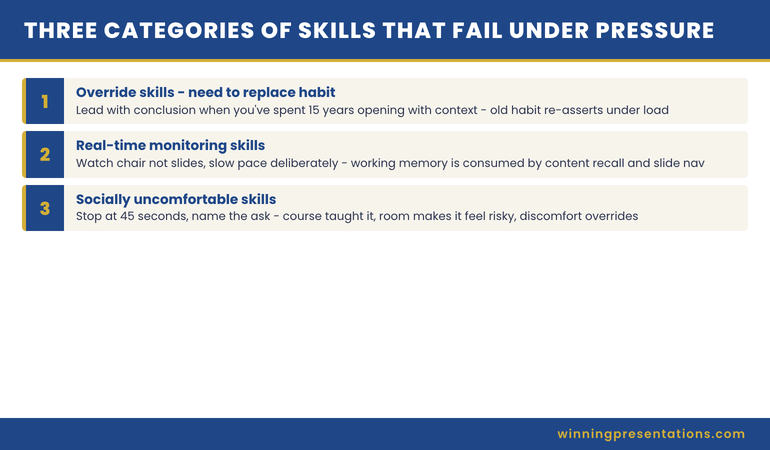
Three categories of skill fail to transfer most reliably. The first category is anything that requires the presenter to override an old habit. If the presenter has spent fifteen years opening presentations with context, learning to open with the conclusion is an override skill. Override skills require more cognitive effort than fresh ones. Under pressure, the override fails first and the old habit re-asserts itself.
The second category is anything that requires real-time monitoring. Watching the chair instead of the slides, slowing the pace deliberately, pausing for forty-five seconds in Q&A — these are skills that demand the presenter notice their own behaviour and adjust it. Under pressure, the part of attention that was supposed to monitor the behaviour is consumed by content recall, slide navigation, and audience reading. The monitoring fails. The behaviour reverts.
The third category is anything socially uncomfortable. Naming the ask explicitly. Stopping at forty-five seconds when the room seems to want more. Acknowledging a difficult question rather than deflecting it. These skills feel exposed. The course taught them as the right move. The room makes them feel risky. Under pressure, the discomfort overrides the training.
There is a pattern in all three categories. The skill is fragile precisely because it is new. Old habits are robust because they have been rehearsed thousands of times in real conditions. New skills, even when correctly practised on a course, have only been rehearsed dozens of times — and almost always in low-pressure conditions. The asymmetry is what produces the transfer gap. The question is not whether the new skill is better. It is whether the new skill is robust enough to survive a context the old skill has dominated for years.
The cognitive load problem
Cognitive load is the technical term for the volume of variables the presenter is tracking simultaneously. In a calm rehearsal environment, the load is low. The presenter has time to think about each move, anticipate the next one, and recover from a stumble. In a senior room, the load is high. Content recall, audience reading, slide navigation, time tracking, Q&A anticipation, and political dynamics are all happening at once. The presenter’s working memory is fully occupied by survival.
Under high load, the brain protects automatic skills first. Anything automatic — old habits, well-rehearsed phrases, familiar slide structures — runs without using working memory. Anything new — recently learned skills, override patterns, real-time monitoring — requires working memory and gets dropped when the budget is exhausted. This is not a weakness. It is the design of the human attention system. Senior professionals are not failing when their training does not show up on stage. Their working memory is being used elsewhere.
The implication is direct. The new skill must become automatic before it will survive the senior room. Automaticity requires roughly an order of magnitude more rehearsal than competence — a skill that feels solid after twelve practice runs typically needs forty to a hundred practice runs to be automatic. Most courses provide twelve. The transfer gap is the gap between competence and automaticity.
There is a related issue, which is that not all rehearsal contributes equally to automaticity. Rehearsal in low-pressure conditions builds automaticity in low-pressure conditions. It does not always transfer. Rehearsal under simulated pressure — in front of a small audience, with time pressure, with disruptive questions, with imperfect equipment — builds the kind of automaticity that survives the real room. The quality of rehearsal matters at least as much as the quantity.
For senior professionals whose training has not yet transferred to meetings
A scenario-based programme designed to close the transfer gap
The Executive Buy-In Presentation System is a self-paced framework for senior professionals who need to secure approval from boards, executive sponsors, and reluctant stakeholders. 7 modules built around realistic stakeholder scenarios — not abstract principles. Optional live Q&A calls are fully recorded so you can watch back at your own pace. The scenario design is what supports transfer to real meetings, because the rehearsal conditions match the application conditions.
- 7 self-paced modules covering stakeholder analysis, case construction, and presentation structures that hold up under board scrutiny
- Scenario-based content — modules built around realistic stakeholder situations, not abstract theory
- Optional live Q&A calls — fully recorded, watch back any time
- No deadlines, no mandatory attendance, lifetime access to materials
£499 · Self-paced · Lifetime access · Next cohort enrolment opens monthly
Pressure rehearsal: the fix
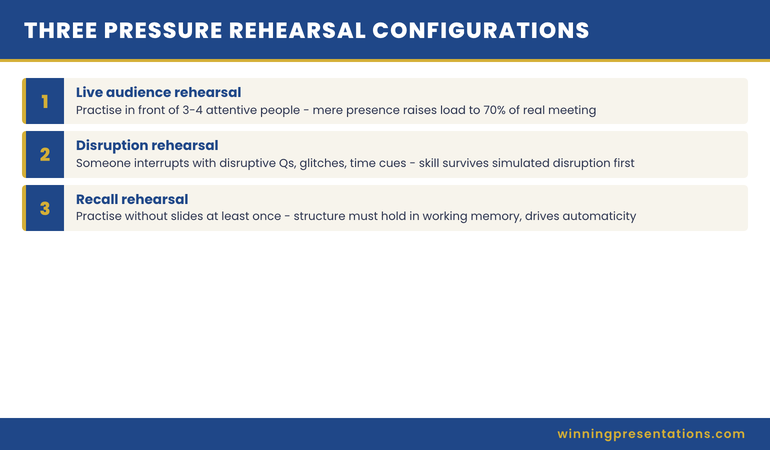
Pressure rehearsal is the deliberate introduction of stress conditions into the practice environment so that the new skill is forced to operate under the cognitive load it will eventually face. Three specific configurations work reliably for senior presenters.
Live audience rehearsal. Practise the new skill in front of three to four people who are paying attention. The mere presence of an attentive audience raises the cognitive load to roughly seventy per cent of a real meeting — far above any solo rehearsal. The audience does not need to be senior. It needs to be present and watching. The eye contact alone consumes working memory in ways no mirror or recording can simulate.
Disruption rehearsal. Have someone interrupt the rehearsal with disruptive questions, technical glitches, or time-pressure cues. The disruptions force the presenter to recover and continue without abandoning the new skill. After ten or twelve disruption-rehearsal sessions, the new skill becomes robust enough to survive most real-room disruptions, because it has already survived simulated ones.
Recall rehearsal. Practise without the slides for at least one rehearsal cycle. The presenter must hold the structure entirely in working memory. This is harder than the real meeting (where slides provide an external anchor) and forces the new structural skill — pyramid, three-part response, ask-evidence-conclusion — into automaticity. By the time the slides are back, the structure runs without consuming attention.
A senior presenter who runs three pressure rehearsal sessions for each new skill, before the skill is needed in a real meeting, transfers reliably. A senior presenter who relies on calm-conditions rehearsal alone transfers in roughly one cycle out of three. The differential is large. It is also entirely under the presenter’s control. The course does not need to provide pressure rehearsal — but the presenter does need to add it before the first real-stakes deployment.
Three skills to protect first
Most senior presenters who finish a course try to deploy ten new skills in their first meeting back. The transfer gap punishes that ambition. The right strategy is to protect three skills aggressively for the first three meetings and let the rest revert temporarily.
Skill one: lead with the conclusion. This is the highest-value structural change a senior presenter can protect. If only one new behaviour survives the first meeting, this is it. The room will recalibrate quickly to a conclusion-first opening, and the rest of the deck can revert without losing the credibility gain.
Skill two: stop at forty-five seconds in Q&A. This is the highest-value delivery change. The discipline of stopping is harder to internalise than any other Q&A skill, because the silence after a forty-five-second answer feels longer than it is. Protect this one through the first three Q&A sessions and the rest of the discipline arrives quickly.
Skill three: name the ask. This is the highest-value closing move. Most senior presentations end vaguely, and the room is left uncertain about what was being requested. Protecting this single skill — explicitly stating the decision, endorsement, or input being sought — produces a disproportionate change in the room’s read of the presenter.
After the first three meetings, with these three skills established, the next layer can be added — slowing pace, watching the chair instead of the slides, formal acknowledgement of difficult questions before answering. Each layer needs the same protection treatment for the first two or three deployments. Trying to add all layers at once is the reliable way to fail the transfer test.
What to do if it has happened to you already
Senior professionals who have already had a transfer failure — finished a course, presented a real meeting, watched the skills evaporate — usually conclude the training was wasted. It was not. The skills are still there. They have not yet transferred. Three steps recover the investment.
First, name what dropped. Sit down within twenty-four hours of the meeting and write the list of skills you intended to use that did not show up. The act of naming is the first step in re-engaging them. Skills that were intentionally rehearsed but did not transfer are not lost. They are dormant. Naming them restores access.
Second, plan a pressure rehearsal sequence before the next real meeting. Three sessions across two weeks, in the configurations described above. The investment is roughly four to six hours. The transfer rate after three pressure rehearsal sessions tends to climb dramatically — most senior presenters report moving from one-in-three transfer to most skills surviving the next encounter.
Third, narrow the deployment ambition for the next meeting. Pick the three skills above (or three different ones, if those do not match the meeting type). Aim for those three to survive. Let the rest revert temporarily. By the third or fourth meeting, the additional layers can come in. By the sixth or seventh, the bulk of the course’s content is in active use. The transfer is just slower than the impatience of the first meeting suggests. See the related discussion of presentation confidence under pressure for the temperament dimension that runs alongside this.
Frequently asked questions
Why did my training feel solid in the course but disappear in the real meeting?
Because the cognitive load in the course was much lower than the cognitive load in the meeting. New skills run on working memory until they automate. Working memory in the senior room is consumed by content recall, audience reading, and Q&A anticipation. New skills get displaced. The fix is more rehearsal under simulated pressure, not more rehearsal in calm conditions.
How long until skills become automatic enough to survive?
Roughly forty to a hundred deliberate practice runs per skill, with at least three of those under pressure conditions. Most senior presenters reach this within two to three real-meeting cycles plus three to five pressure rehearsal sessions per cycle. The full transfer typically takes four to six months from the end of the course.
Can I practise alone, or does pressure rehearsal need other people?
Pressure rehearsal needs other people for at least the live-audience element. The cognitive load of being watched is the active ingredient. Recording yourself and watching back helps with self-correction but does not produce the load that drives automaticity. Even three colleagues sitting in for forty minutes, twice, makes the difference.
If I cannot find rehearsal partners, what is the best alternative?
A structured cohort programme provides rehearsal partners by default — other senior professionals working through the same material, available for practice exchanges. Many senior buyers cite this as the practical reason cohort programmes outperform self-study, beyond the completion-rate effect. Pressure rehearsal partners are part of what is being purchased.
Maven cohort enrolment — closing this week
The scenario-based programme designed to close the transfer gap
The Executive Buy-In Presentation System is a self-paced programme built around realistic stakeholder scenarios — the configuration that supports skill transfer to real meetings. 7 modules, monthly cohort enrolment, optional live Q&A calls (fully recorded). The current cohort closes this week — enrolment then re-opens with the next monthly cohort.
- 7 self-paced modules — work through at your own pace, no deadlines
- Optional live Q&A calls — fully recorded, watch back any time
- Monthly cohort enrolment — enrol any time, start with the next cohort
- Lifetime access to all course materials
£499 · Self-paced · Lifetime access · Next cohort enrolment opens monthly
Companion product for in-the-moment recovery
Conquer Your Fear of Public Speaking — for the physical symptoms that derail transfer
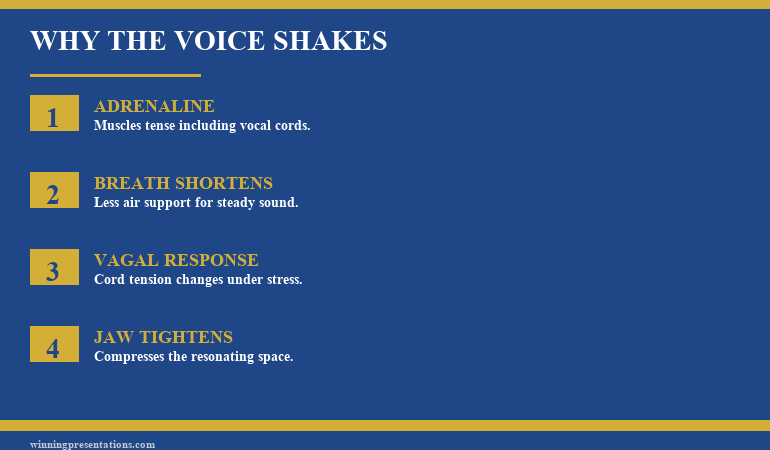
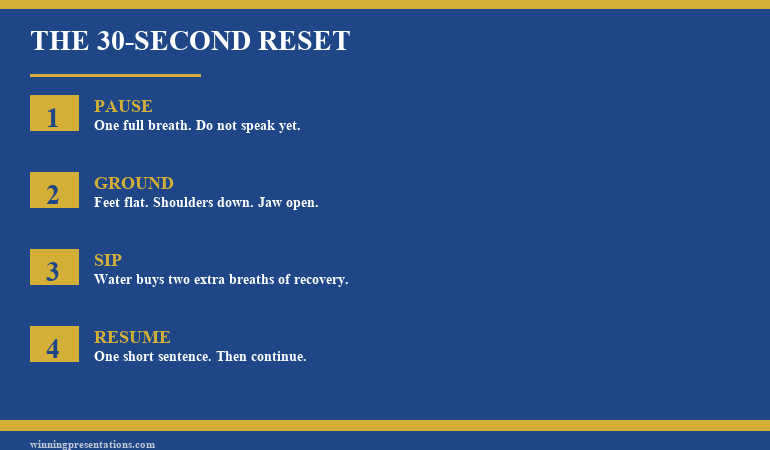
When transfer failure happens, the physical response — racing heart, shaking voice, sweating — often makes recovery harder. Conquer Your Fear of Public Speaking is the £39 toolkit for managing those symptoms in the room. £39 — explore the toolkit →
The Winning Edge — weekly
One short note each Thursday on board-level presentation patterns, structural shortcuts, and the behaviours senior presenters use under scrutiny. Written for professionals who do not have time for newsletters that read like newsletters.
Want a starting point first? The free Executive Presentation Checklist covers the structural fundamentals senior presenters protect first when training is at risk of not transferring.
For a wider view of how senior presenters develop across cycles, see the related piece on board-ready presentation templates — the structural anchor that supports transfer.
Next step: Identify the three new skills you most want to bring into your next senior meeting. Plan three pressure rehearsal sessions in the two weeks before the meeting. Aim for those three skills to survive the first encounter. Let the rest revert temporarily and add them back across the next two cycles.
Mary Beth Hazeldine is the Owner & Managing Director of Winning Presentations. With 25 years of corporate banking experience at JPMorgan Chase, PwC, Royal Bank of Scotland, and Commerzbank, she advises senior professionals across financial services, healthcare, technology, and government on structuring presentations for high-stakes board meetings, investment committees, and executive sessions. She speaks German and works extensively with the German-speaking financial markets.