Tag: Difficult Questions Presentation

21 Apr 2026
Project leader standing at whiteboard facilitating a team retrospective discussion with colleagues seated around a table, calm professional atmosphere, editorial photography style

Team Retrospective Q&A: Honest Answers Without Creating Blame

Quick Answer

Team retrospective Q&A fails when the leader answers defensively or when honesty produces blame rather than insight. The technique that works is separating the system from the individual: acknowledge what happened factually, name the contributing conditions rather than the responsible person, and close each answer with a forward-looking action. Retrospective sessions where leaders model this approach consistently generate more useful information than those where people protect themselves from scrutiny.

Hendrika had run the project for seven months. The delivery had been late by three weeks and two milestones had been missed. The retrospective was scheduled for the Tuesday after go-live, and she had spent the weekend preparing her slides and anticipating the questions.

What she had not prepared for was the question that opened the session. A senior stakeholder looked at the timeline summary and asked, simply: “What happened to the testing phase?”

Hendrika knew exactly what had happened. A resource decision made six weeks into the project had reduced the QA team by two people, a decision she had flagged in writing and been overruled on. But the person who had overruled her was in the room. So was the person who had been leading the under-resourced QA team. Giving the factually accurate answer meant pointing at someone. Giving a vague answer meant accepting responsibility for something that was not entirely hers. Both felt wrong, and she felt the seconds stretching as she tried to find a third path.

The retrospective Q&A is one of the most technically demanding Q&A formats in professional life. It requires honesty without blame, accountability without defensiveness, and forward focus without dismissing what went wrong. These are not natural combinations. They require deliberate technique.

Handling difficult Q&A across all executive formats?

The Executive Q&A Handling System gives you the frameworks to predict, prepare for, and respond to executive questions with confidence — including structured techniques for high-pressure Q&A in team and stakeholder settings.

Find Out More →

Why Retrospective Q&A So Often Produces the Wrong Information

The purpose of a retrospective is to extract accurate information about what happened and why, so the team can learn from it. The structure of a retrospective Q&A almost always works against this purpose.

The problem is that retrospective Q&A takes place in a room where people are simultaneously the witnesses, the subjects, and the interpreters of events. The person answering a question about what went wrong with the testing phase was also involved in the testing phase. The person asking about the missed milestone may have contributed to it. The asymmetry of information is high and the emotional stakes are real, which means the social dynamics of the room frequently override the stated purpose of learning.

Two failure modes dominate. The first is defensive answering: leaders give technically accurate but contextually incomplete answers that protect their decisions from scrutiny without overtly denying the facts. This produces a version of events that is difficult to argue with and impossible to learn from. The second is blame-seeking: questions are framed in ways that pursue accountability for specific individuals rather than understanding of systemic conditions, which causes those individuals to become defensive and the information they hold to become inaccessible.

Both failure modes are rational responses to the incentives in the room. Nobody wants to be publicly identified as the person whose decision caused the delay. Nobody wants to be seen as the person protecting others from accountability. The retrospective format creates a pressure that makes honest information sharing feel risky, and people respond to risk by managing their exposure rather than serving the stated purpose of the session.

The leader’s job in a retrospective Q&A is to change those incentives through the quality of their own answers. When the most senior person in the room models honest, non-defensive, system-focused answers, it signals that the session is genuinely safe to participate in. When they do not, it signals that self-protection is the correct strategy, and the session produces politics rather than learning.

The Blame vs System Distinction: How to Frame Every Answer

The most useful tool in retrospective Q&A is the distinction between individual blame and systemic explanation. These are not mutually exclusive, but they require different framing, and choosing the right frame for each question determines whether the answer generates insight or defensiveness.

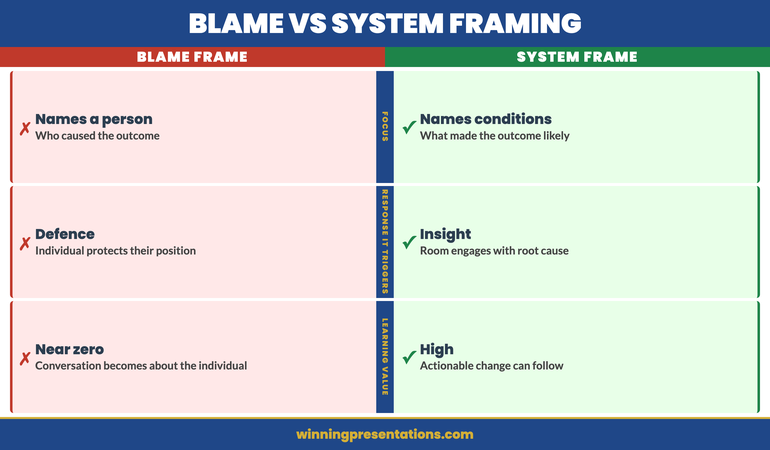
A blame frame identifies a person as the cause of an outcome: “The testing phase overran because the QA lead underestimated the scope.” This may be factually accurate. It is almost always unhelpful, because it produces one response: the QA lead defending their estimation, and the rest of the room waiting to see whether they succeed or fail. The conversation becomes about the individual rather than the conditions in which the estimation was made.

A system frame identifies the conditions that produced the outcome: “The testing phase overran because the scope estimate was made before two significant late-stage requirements were added, and the resource model wasn’t adjusted when those requirements came in.” This is more accurate as a causal account, it is more actionable as a learning point, and it does not require anyone in the room to publicly accept personal responsibility for a failure they may reasonably dispute.

Applying this frame requires that you actually know the systemic conditions — which is why retrospective preparation matters. Before the Q&A, map the key failure points in the project and identify for each one: what were the conditions that made this outcome likely? What decision points existed where a different choice could have changed the result? Who had the information and authority to make those different choices? This analysis gives you system-framed answers for the questions you are most likely to receive, prepared in advance rather than constructed under pressure in the room.

Blame vs system framing in retrospective Q&A: blame frame names a person and produces defensiveness; system frame names conditions and produces actionable insight — four-step approach shown

Handling Direct Criticism of Your Own Decisions

The most uncomfortable moments in retrospective Q&A are those where the question is clearly about a decision you made. The temptation is either to explain at length why the decision was correct given the information available at the time, or to accept responsibility in language so broad that it becomes meaningless. Neither approach serves the session.

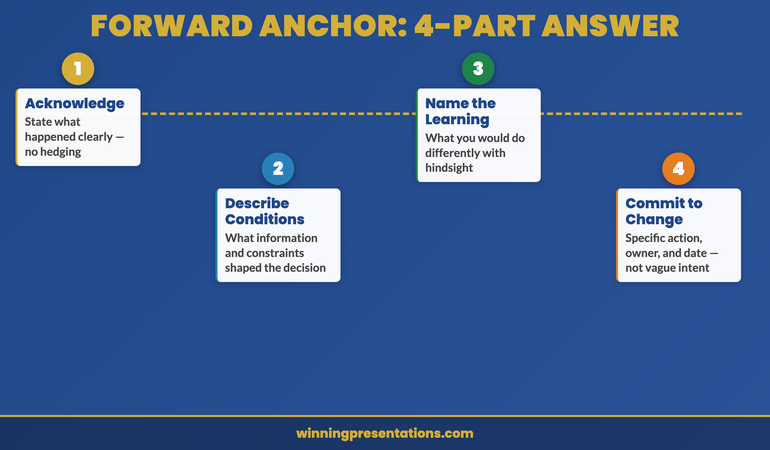
The formula that works is: acknowledge the decision clearly, describe the information and constraints you were working with at the time, name what you would do differently now that the outcome is known, and connect to a specific forward action. This structure does three things simultaneously: it demonstrates accountability without defensiveness, it provides the room with useful information about the decision-making conditions, and it moves the conversation toward what can actually be changed.

An example of this in practice: “The decision to reduce the QA resource in week six was mine. At that point I was prioritising against a budget constraint and I accepted a risk that turned out to be larger than I assessed. If I were making that decision again with what I know now, I would have pushed harder on the timeline rather than on the resource budget. Going forward, the change I’m committing to is a formal risk review whenever resource changes are made after the planning stage.”

Notice what this answer does not do: it does not blame the budget constraint, it does not suggest the outcome was unforeseeable, and it does not imply that anyone else was responsible. It is completely honest about the decision and its consequences. It is also completely constructive in its orientation. Most rooms will respond to this kind of answer with respect rather than further interrogation, because it gives them everything the question was seeking.

For situations where the criticism is directed at a decision that involved others — particularly in a skip-level meeting Q&A context where senior leaders are asking about team decisions — the same formula applies, but with additional care to avoid inadvertently naming individuals whose decisions contributed to the outcome.

The Executive Q&A Handling System

Retrospective Q&A is one of the most demanding formats in executive life. The Executive Q&A Handling System — £39, instant access — gives you the frameworks to predict the questions before they are asked, structure answers that are honest without being exposed, and handle the full range of difficult Q&A scenarios executives face.

  • Frameworks for predicting and preparing for executive questions
  • Structured response techniques for hostile and critical questions
  • System for handling Q&A with confidence across all meeting types
  • Scenario guides for high-pressure retrospective and review sessions

Get the Q&A Handling System →

Walk into Q&A knowing 80% of the questions before they are asked.

Protecting Individual Team Members During Q&A

One of the leader’s primary responsibilities in a retrospective Q&A is ensuring that individual team members are not exposed to public blame in a format where they cannot defend themselves without appearing defensive. This is not about shielding people from accountability. It is about ensuring that accountability happens in the right context, with the right information, and with appropriate due process — not in a group session where the questioner controls the framing and the subject has seconds to respond.

The most common threat to individual team members comes from questions that are phrased to invite a named response: “Who was responsible for the testing plan?” or “Which team signed off the scope change?” These questions are not necessarily malicious. They may be genuine attempts to understand accountability. But in a group retrospective, they create a situation where the honest answer names a specific person in front of their peers and leadership, with no opportunity for context or nuance.

The correct response is to redirect to the systemic level: “The testing plan was a shared responsibility between project management and the QA function — the more useful question is why the plan wasn’t updated when the scope changed in week nine, and that’s what I’d like to address.” This acknowledges the question, redirects to the more useful version of it, and removes the individual from the firing line without appearing evasive.

If an individual genuinely does need to be held accountable for a specific decision or outcome, that conversation happens privately and after the retrospective — not in the session itself. A retrospective Q&A is not a disciplinary process. Treating it as one produces a session where no one who has anything at risk will speak honestly, which defeats the entire purpose of the exercise.

The Forward Anchor: Closing Answers That Move Rather Than Revisit

Every answer in a retrospective Q&A should end with a forward anchor: a specific, concrete statement about what will be done differently based on what is now understood. This is the element most leaders omit, and its absence is what makes retrospective sessions feel circular.

A forward anchor is not a vague commitment to improvement. “We will be more careful about resource decisions in future” is not a forward anchor. It is a statement of intention with no mechanism behind it. A forward anchor identifies the specific change: what will be done, by whom, and by when. “From the next project kick-off, resource changes after week four require a formal impact assessment signed off by the project sponsor before they can be implemented” is a forward anchor. It is concrete, attributable, and auditable.

Including a forward anchor in each answer changes the experience of the retrospective session for everyone in the room. When the leader consistently closes answers by committing to specific changes, the session stops feeling like an autopsy and starts feeling like a useful exercise. Team members who were sceptical about the value of the retrospective become more engaged when they see that the answers they are contributing to are being translated into concrete changes. Stakeholders who came to the session looking for accountability find it — in the form of commitments rather than blame.

The discipline required is that the forward anchors must be real commitments, not placeholders. If you close four answers with forward anchors and none of them are implemented before the next retrospective, the session becomes evidence that retrospectives are a performative exercise rather than a genuine learning mechanism. Treat each forward anchor as a public commitment and manage it accordingly.

Forward anchor technique for retrospective Q&A: four-part answer structure — acknowledge, describe conditions, name the learning, commit to specific change with owner and date

Questions That Need Deferring and How to Do It Honestly

Not every question in a retrospective Q&A can or should be answered fully in the group session. Some questions involve information that is sensitive, incomplete, or that touches on matters requiring individual conversations rather than group disclosure. Deferring these questions is appropriate; how you defer them determines whether the questioner accepts the deferral or pushes harder.

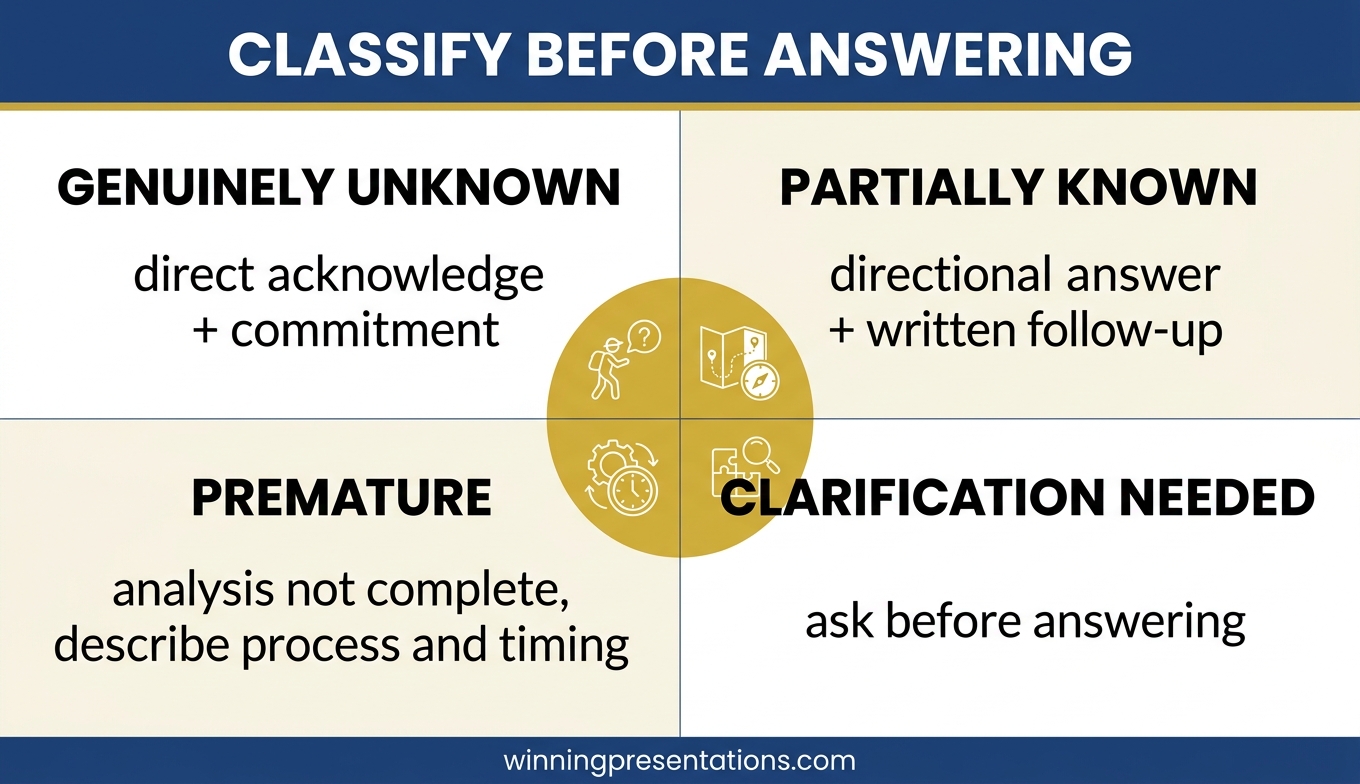
There are three situations where deferral is legitimate. The first is where the answer involves individual performance matters that should not be discussed in a group setting — any question that requires naming a specific person’s failure or shortcoming falls into this category. The second is where the answer requires information you do not yet have: if the post-mortem analysis is still in progress and the question is asking for a conclusion that has not yet been reached, saying so is more useful than offering a provisional answer that may need to be corrected later. The third is where the answer is politically sensitive in a way that the full group context cannot handle safely — a question that implicates a decision made at a level above the session, for example, or one that touches on a matter that is subject to ongoing investigation or process.

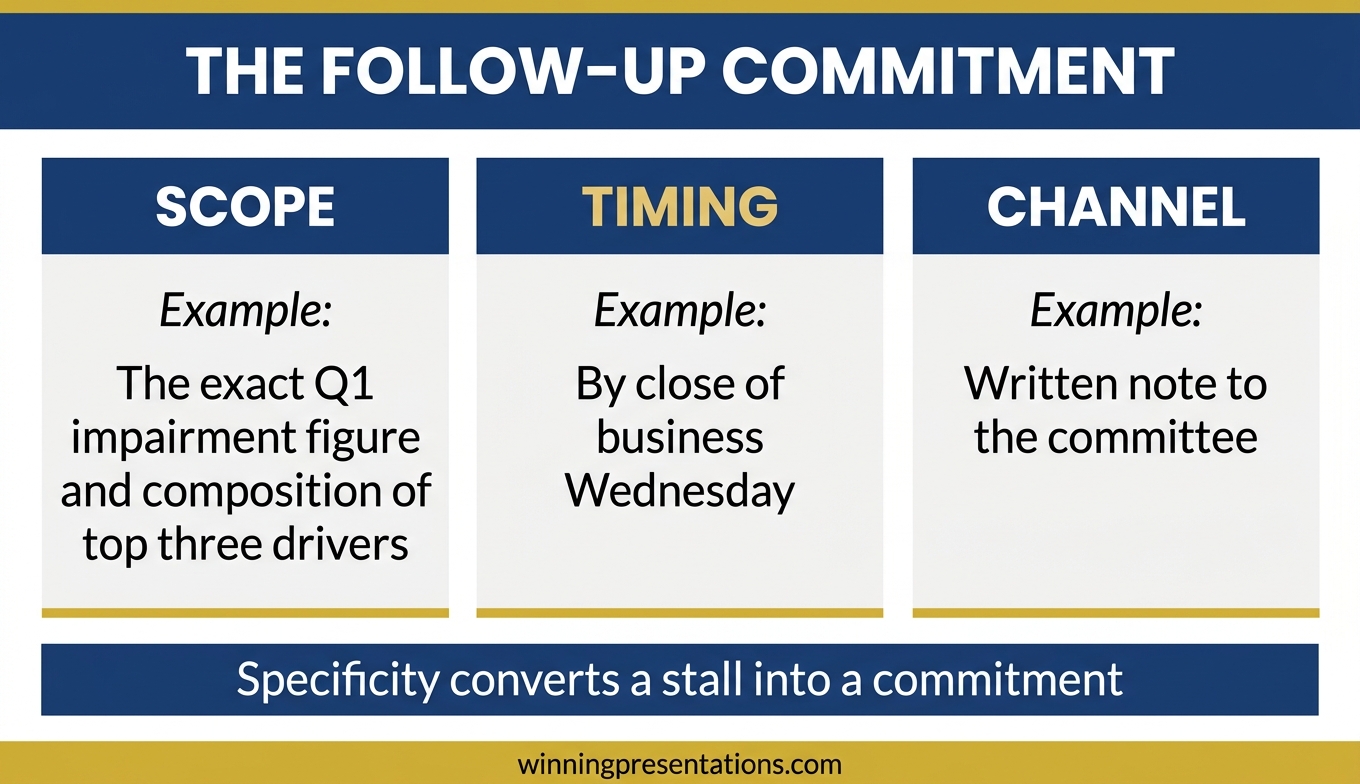
Deferring well requires two elements: a clear statement of why the question is being deferred and a specific commitment to when and how it will be answered. “That’s a question I want to answer properly, and I don’t have all the information I need right now. I will have a complete answer by Friday and I will send it to everyone in this room directly” is a legitimate deferral. “That’s something we can look at separately” is not — it is a deflection that the questioner will correctly identify as evasive.

The same principle of honest deferral applies in other high-pressure Q&A settings. When a question in an all-hands session catches you unprepared, a clear deferral with a specific follow-up commitment is more credible than an improvised answer that turns out to be inaccurate.

For executives who want a complete system for managing difficult questions across all formats, the Executive Q&A Handling System provides structured frameworks for prediction, preparation, and response across the full range of executive Q&A scenarios.

Frequently Asked Questions

How do you handle a question in a retrospective that you know is politically motivated?

Treat it as though it were a genuine question and answer it at face value. Responding to the political motivation rather than the stated question escalates the tension and signals that you are also operating politically rather than professionally. The questioner who is trying to create a moment will find it harder to do so if you give a clear, honest, system-framed answer that removes the emotional charge from the exchange. If the question is genuinely unanswerable at face value — if it is so loaded that any answer confirms the implied accusation — name the assumption in the question before answering: “I want to address the assumption in that question before I answer it directly.”

What is the right approach when a team member answers a retrospective question in a way that is factually inaccurate?

Do not correct them publicly in the session unless the inaccuracy is material to the learning the session is trying to produce. A minor factual error about a date or a sequence is best noted and corrected in the written summary after the session. A significant inaccuracy that would lead the group to a wrong conclusion about what happened needs to be addressed, but the technique matters: “I want to add some context to that” is a more effective opening than “Actually, that’s not correct.” The former invites dialogue; the latter invites defence.

Should the leader present before Q&A, or open directly to questions?

A brief structured presentation before Q&A almost always produces better questions and more useful answers. When the group has a shared factual baseline — the timeline, the key decision points, the actual outcomes against the plan — their questions are more specific and more productive. Opening directly to questions in a retrospective without a shared baseline produces questions that are partly answering themselves and partly seeking the basic information that a five-minute presentation would have provided. The presentation does not need to be long. A ten-minute structured summary of what happened is sufficient to anchor the Q&A that follows.

The Winning Edge — A Newsletter for Executives Who Present

Every Thursday: one practical technique for structuring, presenting, or defending a high-stakes proposal. Designed for executives who need to communicate with authority, not just confidence.

Subscribe to The Winning Edge →

The Executive Q&A Handling System

The complete system for predicting and handling executive Q&A — across retrospectives, board sessions, stakeholder reviews, and all-hands meetings. Walk into Q&A knowing 80% of the questions before they are asked. £39, instant access.

Get the Q&A Handling System →

Designed for executives who need to handle difficult questions with confidence.

For the physical and vocal delivery elements of a difficult presentation session, see the companion piece on microphone technique for executive presentations — the mechanics of how you sound in a large room matter as much as what you say.

About the Author

Mary Beth Hazeldine is the Owner and Managing Director of Winning Presentations. With 25 years of corporate banking experience at JPMorgan Chase, PwC, Royal Bank of Scotland, and Commerzbank, she advises executives across financial services, healthcare, technology, and government on structuring presentations for high-stakes funding rounds and approvals.

06 Apr 2026
An executive presenting with calm authority at a boardroom table while a committee member leans forward with a pointed question, editorial photography style

Fishing Questions in Presentations: How to Respond Without Being Pinned Down

A fishing question is not asked because the questioner wants information. It is asked because the questioner wants a commitment — on record, in a room full of witnesses — before you are in a position to give one responsibly. Recognising a fishing question when it arrives, and responding in a way that is honest without being pinned down, is one of the most practically valuable Q&A skills an executive can develop.

Rafaela had been presenting the preliminary findings of a regulatory review to a committee that included two members with strongly opposing positions on the outcome. The presentation was going well — the data was solid, the structure was clear, and the room seemed engaged. Then one of the committee members, a senior partner who had been quiet throughout, leaned forward and asked: “So based on what you’ve found, would you say this falls within acceptable parameters or not?” Rafaela knew the question immediately for what it was. The analysis was not yet complete. She had flagged that explicitly in the introduction. But the question was framing the preliminary data as if it were a conclusion, and asking her to confirm a verdict that would effectively end the debate before the final report was delivered. A simple yes or no would have been wrong — not because she was hiding anything, but because the analysis genuinely did not support a definitive conclusion yet. What she needed was a response that was truthful, specific, and firm without being dismissive of the question. What she gave instead was a hedged non-answer that left the room uncertain about whether she was evading or genuinely uncertain. The committee member pressed again. She felt the moment slip. This guide covers what she should have done instead.

Facing high-stakes Q&A sessions where the questions are designed to corner you? The Executive Q&A Handling System gives you a structured system for predicting and responding to the questions that executives find hardest to handle. Explore the System →

What Fishing Questions Are — and How to Recognise Them

A fishing question has a specific structural signature: it frames a binary or forced choice and presents it as a neutral request for your assessment. “Would you say this is a risk or not?” “Is this on track or not?” “Do you think this is acceptable?” The framing appears reasonable — it sounds like the questioner is simply asking for your professional opinion. What it is actually doing is asking you to adopt a position publicly, in conditions that are designed to make the position hard to walk back.

The recognition signals are consistent. First, the question arrives before the relevant analysis is complete or before you are in a position to answer definitively. Second, it offers a binary or forced choice that does not reflect the genuine complexity of the situation. Third, it is asked in front of an audience — because a commitment made privately carries far less weight than one made in a room. Fourth, the questioner already has a preferred answer, and the question is structured to produce it.

Not every blunt or direct question is a fishing question. “What do you think will happen to margin in Q3?” is a direct question that deserves a direct answer. A fishing question is characterised by the mismatch between the certainty implied by its framing and the certainty that your evidence actually supports. When someone asks you to confirm a conclusion that your analysis does not yet justify, that is a fishing question — regardless of how reasonable it sounds.

The distinction matters because the response to a genuine direct question and the response to a fishing question are different. Responding to a genuine question with the caution appropriate for a fishing question signals evasiveness. Responding to a fishing question with the directness appropriate for a genuine question hands the questioner exactly what they were angling for.

Prepare for the Questions Designed to Corner You

The Executive Q&A Handling System gives you a structured approach to predicting, preparing for, and responding to the most challenging executive Q&A scenarios — including the fishing questions, stress tests, and loaded questions that catch executives off guard.

  • ✓ System for predicting and preparing for difficult Q&A questions
  • ✓ Response frameworks for high-stakes executive questioning
  • ✓ Scenario playbooks for board, investor, and committee Q&A

Get the Q&A Handling System → £39

Designed for executives managing high-stakes Q&A sessions

Why Fishing Questions Work: The Psychology of Public Commitment

Fishing questions exploit a well-documented psychological dynamic: public commitments are sticky. Once you have stated a position in front of a group, you are motivated — consciously and unconsciously — to maintain consistency with that position. This is not a weakness. It is a social and professional norm that makes functioning organisations possible. But it can be leveraged against you by a questioner who understands its power.

The dynamic operates in two directions. If you answer “yes, this is within acceptable parameters,” and the final analysis reveals it is not, you are now on record as having misjudged the situation. If you answer “no, it is not acceptable,” you may have committed to a position that the full data does not support, foreclosing options that the complete analysis might have kept open. The questioner wins either way — they have created a record that serves their position, and they have done it using your words.

The social pressure of the room amplifies this dynamic. When a question is asked in front of an audience, silence feels evasive, qualification sounds weak, and refusal to engage appears defensive. The questioner has created conditions in which the most comfortable response — giving a direct answer — is also the most dangerous one. This is why fishing questions are effective: not because they are logically compelling, but because they make the responsible answer psychologically difficult to deliver.

Understanding this mechanism is the first step toward managing it. When you recognise that the discomfort you feel is a function of the question’s design rather than a signal that you should comply with its framing, you can respond from a position of clarity rather than pressure. For a wider framework on recognising questions that are designed to set you up before they are even fully asked, our guide to recognising loaded questions in presentations covers the full taxonomy of adversarial question types.

The Response Framework: Honest, Specific, and Not Pinned Down

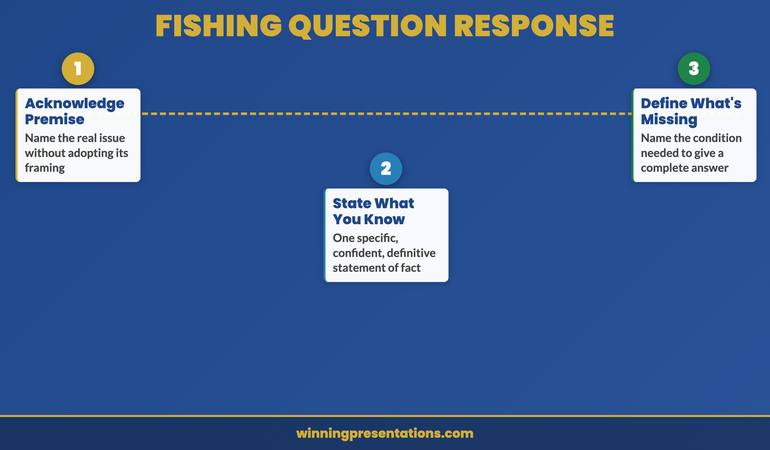
The effective response to a fishing question has three components, delivered in sequence. The first is an acknowledgement of the question’s premise — not agreement with its framing, but recognition that a real issue is being pointed at. “That is a central question, and it is one I want to answer accurately.” This buys a moment and signals engagement rather than evasion.

The second component is a statement of what you can say definitively, based on what you know. Not a hedge, not a qualification — a specific statement of fact. “What I can tell you with confidence is that the data we have reviewed to date shows X.” This demonstrates that you are not avoiding the question, you are giving the questioner the most accurate information available. Specificity is credibility. A vague non-answer and a precisely framed limitation are received very differently by a room.

The third component is a statement of what would be required to answer the full question. “A definitive assessment of whether this falls within acceptable parameters requires the completion of the analysis in section four, which we expect to have by the end of this month.” This is not a delay tactic. It is a statement of epistemic honesty — you are telling the room what you do not yet know and what would change that. This framing converts apparent evasion into professional rigour.

Together, these three components produce a response that is honest, specific, and firm without handing the questioner the commitment they were seeking. The key is the absence of hedging language in the second component. “What I can tell you with confidence is…” is a strong statement. “I think, based on what we have seen so far, it might suggest…” is a weak one that signals uncertainty and invites the questioner to push harder.

The Executive Q&A Handling System provides the full response architecture for fishing questions and other adversarial Q&A patterns, with scenario playbooks for the contexts where these question types most frequently appear.

Fishing question response framework infographic: three steps — acknowledge the premise, state what you know definitively, and specify what is needed for a complete answer

Common Forms of the Fishing Question and How Each Works

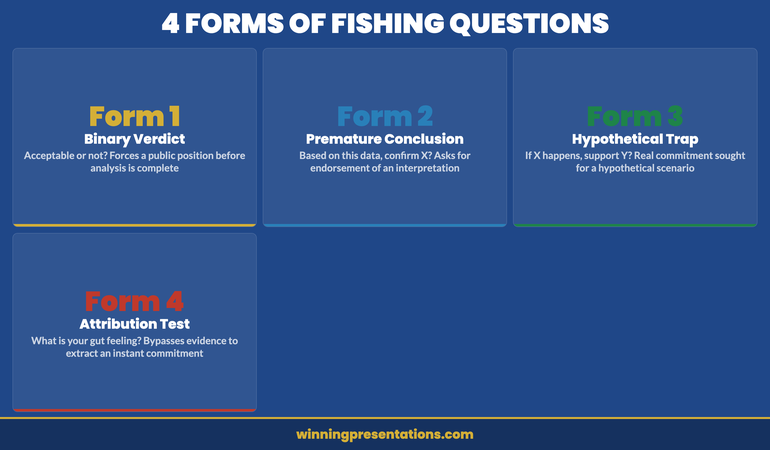
Fishing questions appear in several recurring forms, each with a slightly different mechanism. Recognising the form helps you identify the intent faster, which gives you more time to compose the response before the pressure of the room builds.

The binary verdict request. “Is this acceptable or not?” “Is this on track or not?” This is the most direct form. It offers two options and implies that a refusal to choose one is itself a choice — specifically, a suspicious one. The effective response names the binary as a false choice: “The right answer to that question is more nuanced than a yes or no, and I want to give you the accurate one.”

The premature conclusion invitation. “So based on what you’ve shown us, would you say this confirms X?” This form presents a tentative interpretation as if it flows naturally from your data, and invites you to confirm it. The problem is that the interpretation may go further than your data supports. The response: “The data is consistent with X as one interpretation, but it is also consistent with Y — the full analysis will allow us to distinguish between them.”

The hypothetical commitment trap. “If the final figures come in below target, would you support restructuring?” This asks you to commit to a future action based on a hypothetical — which is doubly problematic, because the hypothetical may not materialise, but the commitment is real and immediate. The response: “I would want to see the complete picture before making a recommendation on restructuring. What I can say is that if figures come in below target, we will need a structured response, and I am prepared to be part of developing that.”

The attribution test. “You’re the expert here — what’s your gut feeling?” This flatters you into bypassing analytical rigour and substituting intuition for evidence. The answer your gut provides is then on the record, divorced from any analytical caveat. The response: “My professional assessment is that we need the full analysis before I can be confident in a recommendation — and a gut feeling in a situation this consequential is not a substitute for that.”

Four common forms of fishing questions in executive presentations: binary verdict, premature conclusion, hypothetical commitment, and attribution test — with response approaches for each

When the Questioner Presses After Your First Response

A skilled fishing questioner will press after your first response. They know that most people will hold their ground once but will concede under repeated pressure — particularly in a public setting where silence is uncomfortable and the questioner appears persistent. The second press is often the moment that matters most.

When a questioner presses, resist the instinct to soften your position or offer additional qualification. Softening signals that your first response was not fully confident, and invites a third attempt. Instead, hold your original framing and restate the key point more briefly: “As I said, I cannot give you a definitive answer on this until the analysis is complete. I understand that is frustrating, and I will make sure you have the full picture as soon as it is available.” Brevity signals confidence. A longer explanation of why you cannot answer suggests you feel you need to justify the position, which creates the impression that it is negotiable.

If the questioner continues to press, naming the dynamic is a legitimate tool — used carefully, and without accusation. “I notice we are coming back to this question, and I want to be transparent about why I am holding the same position: the analysis is not yet at the stage where I can responsibly give you the answer you are looking for. That is not evasion — it is professional accuracy.” This shifts the frame from “the presenter is being difficult” to “the presenter is being rigorous,” and it does so in a way that the room can follow.

For guidance on the structured short-answer approach that works in high-pressure Q&A, our guide to the short answer framework for executive Q&A covers the technique of answering completely and confidently in fewer words — which is the single most effective defence against a questioner who uses repetition as pressure. And for the critical period after a difficult Q&A session, our guide to Q&A follow-up in the 48-hour decision window covers how to manage the aftermath when commitments were sought but not given.

Walk Into Every Q&A Session With a System

The Executive Q&A Handling System gives you the structured approach to predict, prepare for, and respond to every difficult question type — including fishing questions, stress tests, and loaded questions. £39.

Get the System Now → £39

Frequently Asked Questions

Is it ever appropriate to answer a fishing question directly?

Yes — when your analysis is complete and your evidence supports a definitive answer. A fishing question is only problematic when it asks you to commit to a position that your evidence does not yet justify. If you have the full data and the answer is clear, give it directly and with confidence. The distinction is not about the form of the question — it is about the relationship between the question’s framing and the state of your analysis. When the evidence supports the answer, there is no reason to withhold it.

How do I avoid appearing evasive when I decline to give a direct answer?

The key is specificity. Evasion sounds vague: “It is complicated, there are a lot of factors…” Professional accuracy sounds precise: “What I can confirm is X. What I cannot yet confirm is Y, because we do not have the Z data.” Specificity about what you know and what you do not know reads as rigour, not evasion. Vagueness reads as evasion regardless of your intent. Always name the specific thing you cannot yet confirm and the specific condition that would allow you to confirm it.

Can I prepare for fishing questions before a presentation?

Yes — and this is one of the highest-value forms of Q&A preparation. Before any high-stakes presentation, identify the two or three questions where someone who disagreed with your preliminary findings or wanted to force a premature conclusion would most likely press you. For each one, prepare your three-component response in advance: what you can confirm, what you cannot, and what would change that. Practising this structure before the session means that when the fishing question arrives, you are not improvising under pressure — you are delivering a prepared response that sounds thoughtful and confident because it is.

The Winning Edge

Weekly insights on executive presentations, Q&A strategy, and boardroom communication.

Subscribe Free

If the morning of a Q&A-heavy presentation is a source of anxiety for you, our guide to the morning presentation protocol covers the two-hour routine that builds readiness and manages the physiological stress response before you walk into the room.

About the author

Mary Beth Hazeldine, Owner & Managing Director, Winning Presentations. With 24 years of corporate banking experience at JPMorgan Chase, PwC, Royal Bank of Scotland, and Commerzbank, she advises executives across financial services, healthcare, technology, and government on structuring presentations for high-stakes funding rounds and approvals.